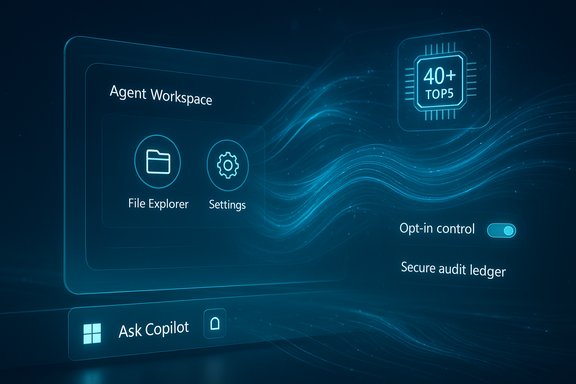
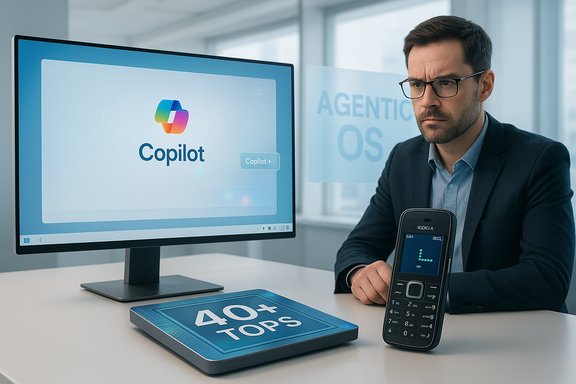
Microsoft’s brief public claim that “Windows is evolving into an agentic OS” immediately became a headline — and not in the way Microsoft intended — as a torrent of user backlash, bitter forum threads, and skeptical coverage forced the company to acknowledge usability and trust problems while defending an AI-first roadmap.
Microsoft’s leadership used the run‑up to Microsoft Ignite to frame Windows as an operating system that will natively host agents: persistent AI processes that remember context, coordinate across apps and devices, and in some cases take limited actions on users’ behalf. The phrase “agentic OS” is shorthand for that shift — an OS that does more than run programs; it orchestrates multi‑step tasks with autonomy. Concretely, Microsoft has signaled a multi‑layer effort that includes:
Microsoft’s next moves — concrete settings, visible audit logs, clear opt‑outs, and independent benchmarking — will determine whether agentic Windows becomes a welcomed productivity layer or a cautionary tale of initiative without consent. The technology is feasible; acceptance will depend on governance, not slogans.
Source: TechRadar Microsoft boasts about agentic Windows features, but users frown
 Background / Overview
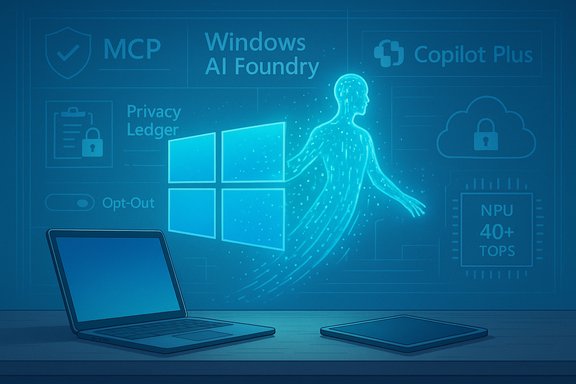
Microsoft’s leadership used the run‑up to Microsoft Ignite to frame Windows as an operating system that will natively host agents: persistent AI processes that remember context, coordinate across apps and devices, and in some cases take limited actions on users’ behalf. The phrase “agentic OS” is shorthand for that shift — an OS that does more than run programs; it orchestrates multi‑step tasks with autonomy. Concretely, Microsoft has signaled a multi‑layer effort that includes:- On‑device runtimes and tools (Windows AI Foundry) for running smaller models locally.
- Platform plumbing to let models and agents access apps and services in a controlled way (Model Context Protocol, or MCP).
- A hardware tier (Copilot+ PCs) that targets NPUs capable of high TOPS throughput to enable richer offline agentic experiences.
What happened: the announcement and the reaction
The post that set it off
On November 10, Pavan Davuluri, President of Windows & Devices, posted a short message saying, in effect, that Windows was “evolving into an agentic OS” and pointing attendees to Ignite demos. The message was concise and promotional, intended for partners and customers. Instead, it landed in public timelines where the single word agentic triggered alarms about autonomy, initiative, and control.The public response
Replies flooded in from power users, developers, privacy advocates, and everyday customers. Themes repeated across X, Reddit, enthusiast forums and coverage:- Fear of initiative: users worried an agentic OS could act without clear, auditable consent.
- Upsell and cloud pressure: critics saw agentic features as another surface for nudging OneDrive, Microsoft 365 and Copilot subscriptions.
- Reliability fatigue: many said Microsoft should fix longstanding polish and stability issues before layering autonomous AI on top.
- Hardware stratification: the Copilot+ NPU guidance (40+ TOPS) suggested a two‑tier Windows where premium AI is gated behind new hardware.
The technical reality: what Microsoft is actually building
Core components and the engineering case
The agentic vision relies on a coherent set of technologies that Microsoft and others have been assembling:- Model Context Protocol (MCP): an open protocol (led by Anthropic) to allow models to call tools and access data in standardized ways. Microsoft has built native MCP hooks into Windows and tooling like Copilot Studio; MCP is the "bridge" that lets agents safely call app functions.
- Windows AI Foundry / Foundry Local: runtime layers to deploy and run smaller models on‑device or orchestrate hybrid local/cloud inference. These aim to reduce latency and keep sensitive inference on the machine when possible.
- Copilot+ hardware tier: Microsoft’s Copilot+ marketing and partner guidance points to devices with NPUs able to deliver tens of trillions of operations per second (often cited as 40+ TOPS) to support richer on‑device models. That creates a performance envelope for premium, private agentic experiences.
Why MCP and local runtimes matter
MCP is central because it standardizes how agents discover and call “tools” — which in Windows means anything from a file picker to a CRM API. If implemented with careful permissioning and registries, MCP can allow useful cross‑app automation while constraining what agents may access. Microsoft’s documentation and demos highlight MCP as the secure on‑ramp for agentic integration.Why the backlash is more than a buzzword fight
The reaction wasn’t merely technophobia. It bundled long‑standing, concrete grievances into a single public outcry.- Loss of control and consent anxiety. Agentic agents need context — files, windows, calendars — to help effectively. Users asked how that context will be collected, stored, and audited. Historical controversies around features that snapshot activity (e.g., earlier “Recall”-style experiments) left raw nerves exposed.
- Polish vs. fancy features. A steady stream of UI regressions, inconsistent dialogs and buggy preview features created a credibility gap. Small polish issues (the “smaller taskbar icons” example) became symbols for a perceived deprioritization of fundamentals. Users told Microsoft to “fix the basics” before shipping initiative‑taking agents.
- Monetization optics. The decision to auto‑install Microsoft 365 Copilot as an app on machines with Office installed — rolled out by Microsoft in Fall 2025 with tenant opt‑outs and an EEA carve‑out — convinced many that agentic features will be another upsell channel. The automatic installation and enabled‑by‑default posture inflamed the debate.
- Developer and enterprise alarm. Influential developers and IT pros worried the OS would become opinionated and less hospitable to low‑level control. Some suggested macOS or Linux for dev workflows if Windows keeps moving toward tightly coupled agent frameworks. Microsoft publicly tried to reassure that it “cares deeply about developers,” but critics wanted concrete fixes.
Where the proposal can help — real upside for some users
Despite the noise, agentic capabilities can deliver measurable value when executed with restraint:- Reduced context switching. For complex, multi‑step tasks — collating meeting materials, triaging a large inbox, or orchestrating a research folder from scattered documents — an auditable agent that can perform allowed actions could save significant time.
- Privacy‑sensitive local inference. On‑device NPUs and Foundry Local runtimes can keep sensitive prompts and reasoning on user hardware, reducing cloud exposure. For regulated enterprises that need low latency and data residency, local agentic inference is attractive.
- Standardized enterprise governance. An OS‑level permission and policy framework for agents — if done right — could actually simplify compliance. Centralized auditing, revocation, and role‑based agent policies could make automation both powerful and controllable.
- Accessibility and productivity wins. Screen‑aware Copilot Vision and voice assistants could materially improve accessibility and create new productivity shortcuts for users with disabilities or those juggling many information streams.
Real risks and trade‑offs Microsoft must solve
No technology is purely beneficial; agentic Windows raises layered risks that demand engineering and policy countermeasures.1) Privacy and telemetry
Agents need context. Every time an agent indexes your filesystem or references recent window contents, a telemetry question is raised: what is recorded, where is it stored, who can access it, and for how long? The design of durable, human‑readable audit logs, revocable permissions, and on‑device defaults is non‑negotiable. Customers will not accept opaque memory or opaque opt‑ins.2) Hardware‑driven fragmentation and two‑tier Windows
Gating the best agentic experiences behind Copilot+ NPUs (the commonly cited 40+ TOPS floor) creates a hardware‑differentiated platform. That’s not just a marketing problem — it’s an operational one for ISVs and IT buyers who now must account for multiple capability tiers when developing and deploying solutions. Independent NPU benchmarks will be essential; vendor TOPS claims alone are insufficient.3) Security and new attack surfaces
MCP and agentic tool chains make coordination easier — and they introduce complex tool‑permission scenarios that could be exploited (prompt injection, malicious tool registration, privilege escalation). A secure, auditable MCP registry, sandboxed tool hosts, and default deny semantics will be necessary to keep attackers from turning agents into silent exfiltration paths. Research already demonstrates attack scenarios against agent protocols; Microsoft and the ecosystem must harden these layers early.4) UX regressions and the credibility gap
Even brilliant agentic capabilities will not win public trust if basic quality and predictability suffer. The optics of auto‑installing Copilot in existing Office installs only widened the credibility gap: users feared heavier AI would be foisted on them without accessible, durable opt‑outs. Microsoft’s acknowledgement that it “has work to do” on reliability is the right tone — the follow‑through must be measurable and visible.5) Monetization and platform economics
Agents as upsell vectors risk converting convenience into nuisance. If agent actions can surface paid content or preferential partners without clear consent, users will rightly distrust the agentic layer. That risk must be mitigated through transparent commercial policies and strict separation of paid placement from system agent recommendations.What Microsoft should do next — a pragmatic roadmap
If the company wants acceptance rather than acquiescence, it needs to pair ambition with governance, transparency, and defaults that respect control.- Ship an explicit Pro/Expert toggle in OOBE and Settings that flips on advanced, agentic defaults while leaving conservative, predictable defaults for mainstream users. Making the choice explicit reduces surprise.
- Publish a privacy ledger inside Settings → Privacy & security: readable, tamper‑resistant logs of what agents have accessed, why, and how to revoke. This must be more than a checkbox; it must be a usable audit trail.
- Keep a clear local‑account path in OOBE for users who do not want cloud entanglement, documented and preserved across updates. Forced Microsoft Account flows have become a flashpoint.
- Commit to independent NPU benchmarking for Copilot+ workloads so enterprises and reviewers can validate vendor TOPS claims under real workloads. Treat TOPS as a guideline, not marketing.
- Build rollback semantics and snapshotting for feature updates so users can revert risky changes easily and reliably. This is basic damage control for an OS that will host autonomous agents.
- Open agentic features to third‑party audit and standard compliance checks; invite independent researchers to validate security and privacy claims. Transparency reduces suspicion.
What users and administrators can do today
While waiting for platform‑level reforms, there are practical mitigations:- Administrators can opt out of the automatic Microsoft 365 Copilot app installation tenant‑wide via the Microsoft 365 Apps admin center; devices in the European Economic Area are exempt from the auto‑install.
- Use Group Policy, registry locks, and AppLocker to limit in‑OS promotions and block unwanted agentic components on managed machines. Test policies across OS versions carefully.
- Audit telemetry settings and use the Diagnostic Data Viewer to inspect what is being collected. Harden telemetry without breaking critical security signals.
- For individual users, uninstall or disable the Copilot desktop app if it’s installed and you don’t want it; note that enterprise re‑provisioning or automatic reinstalls can behave differently.
- Stage updates and use Windows Update for Business or similar tools to validate builds before wide deployment; pause feature updates if you need time to test agentic features.
What is verified — and what remains uncertain
There are several claims that are demonstrably verifiable:- Microsoft publicly used the phrase “agentic OS” and Davuluri’s post drew large negative reply volumes; Davuluri later limited replies and acknowledged the feedback.
- Microsoft is building MCP support and Windows AI Foundry primitives and has published developer materials indicating private previews and partner programs.
- The Copilot+ hardware guidance (40+ TOPS) and the marketing around Copilot+ PCs is real and has been reported across industry outlets; the Copilot+ narrative has been a strategic push for Microsoft and partners.
- Microsoft announced an automatic Copilot desktop app install for Windows devices that have Microsoft 365 desktop apps, with administrative opt‑outs and EEA exclusion, rolled out Fall 2025. That rollout and the admin opt‑out path are documented in admin guidance and widely reported.
- Assertions that Microsoft will disable every workaround to prevent data harvesting are speculative. While the company is closing some OOBE workarounds and tightening provisioning, a blanket claim that all user controls will be removed is not verifiable from public documentation and should be flagged as conjecture. Treat forecasts about heavy‑handed technical lock‑ins as possible but not proven.
- Predictions of mass developer migration from Windows to macOS/Linux are plausible as rhetoric but difficult to quantify; public frustration is real, but platform‑level migration is slow and uneven. These are signals to watch, not certainties.
Bottom line — balancing ambition and stewardship
Microsoft is not inventing a fantasy: the technical building blocks for an agentic OS — MCP, on‑device runtimes, NPU acceleration and cross‑app APIs — are real, documented, and demonstrable. The company’s engineering trajectory could deliver meaningful productivity and accessibility gains when implemented with strong privacy defaults, auditable permissions and reliable baseline behaviour. But the reaction to a single, tightly worded post revealed a critical truth: how you introduce autonomy matters at least as much as what you build. An agentic OS that arrives with opaque defaults, unexpected installs, or weak rollback controls will pay a steep trust tax among power users, IT administrators and developers. The sensible path for Microsoft is clear: pair technical innovation with durable, discoverable controls, independent verification and staged rollouts that respect both privacy and choice. Do that, and agentic Windows can be helpful; ignore it, and the company risks deepening an avoidable rift with the community that made Windows ubiquitous in the first place.Microsoft’s next moves — concrete settings, visible audit logs, clear opt‑outs, and independent benchmarking — will determine whether agentic Windows becomes a welcomed productivity layer or a cautionary tale of initiative without consent. The technology is feasible; acceptance will depend on governance, not slogans.
Source: TechRadar Microsoft boasts about agentic Windows features, but users frown