

Signal President Meredith Whittaker warned in a Bloomberg interview from Davos in January 2026 that chatbots such as ChatGPT and Claude should not be treated as friends, conscious beings, or private confidants, especially as AI assistants seek wider access to users’ digital lives. Her point was not that every use of generative AI is foolish, or that formatting a document with a model is a moral failure. It was that the industry is selling intimacy first and architecture second. For Windows users and administrators, that order should feel familiar — and dangerous.
Whittaker’s most quotable line — “These are not your friends” — landed because it cut against the emotional marketing now wrapped around AI assistants. The leading products are no longer pitched merely as search boxes with better autocomplete. They are companions, coaches, tutors, therapists-adjacent sounding boards, writing partners, meeting deputies, and soon, if vendors get their way, semi-autonomous agents with permission to act.
That distinction matters. A chatbot that answers a prompt is already a privacy calculation; an agent that buys gifts, reads calendars, watches browser activity, drafts messages, and moves between apps is a different class of system. The first asks users to disclose information. The second asks users to delegate access.
That is why Whittaker’s criticism is sharper than the usual “AI hallucinates” complaint. Accuracy is not the center of the argument. The center is power: who gets to see what, who gets to act on whose behalf, and how much of the user’s private world must be flattened into machine-readable context before the assistant becomes useful.
The consumer pitch says AI is becoming more helpful because it is becoming more personal. Whittaker’s counterargument is that “personal” is doing a suspicious amount of work. The more an assistant knows, the more it can predict; the more it can predict, the more it can intervene; and the more it can intervene, the harder it becomes to describe it as just another app.
For Copilot to do that job convincingly, it would need more than a product catalog and a payment button. It would need access to relationships, preferences, schedules, addresses, browsing history, payment credentials, and communications. It might need to infer that a sibling wants one gift, that a child should not see another, that a delivery should avoid a certain date, and that a purchase should be coordinated through a private conversation.
Whittaker’s objection is that this kind of cross-application privilege can become a “backdoor” even if no government agency, criminal gang, or rogue employee ever breaks encryption. Signal’s promise is that messages are protected in transit and not readable by the service. But if an AI layer on the device can read, summarize, or act on those messages after they are decrypted for the user, the practical boundary shifts.
That is the uncomfortable part for Windows users. The PC has always been a platform where privileged software can see a great deal. Security teams already worry about endpoint agents, browser extensions, clipboard managers, remote monitoring tools, and over-permissioned productivity suites. AI agents do not abolish those concerns; they combine them under a friendlier brand.
Agentic AI changes the question from “What did the user submit?” to “What can the assistant reach?” That is a far more consequential inquiry. A prompt is an event; a permission is a standing relationship.
On Windows, that distinction should be easy to grasp. A user can copy a paragraph into an online tool once and regret it later. But an installed assistant with durable access to files, meetings, browser state, email, contacts, screen contents, and app activity creates a continuous data surface. Even if the vendor promises restraint, administrators must still account for bugs, policy drift, legal demands, compromised accounts, malicious plugins, and the oldest problem in computing: users clicking “Allow” because the software will not otherwise do the thing it promised.
The industry’s preferred answer is consent. The user will grant access. The assistant will disclose what it needs. The platform will provide controls. That sounds reasonable until one remembers how consent works in real interfaces: fragmented dialogs, vague descriptions, dark-pattern nudges, business pressure, and a user who only wants to finish a task before lunch.
That is precisely why the “AI friend” metaphor deserves more scrutiny than it gets. It lowers defenses. A command line demands explicitness; a friend invites confession. An enterprise search tool asks for a query; a companion asks how you are feeling.
The vendors know this. The race to make assistants more conversational, persistent, and emotionally legible is not an ornamental design trend. It is a way to increase engagement and context. The assistant that remembers your preferences is stickier than the one that does not. The one that sounds supportive receives more personal information. The one that can act across services becomes harder to leave.
For Microsoft, OpenAI, Anthropic, Google, Meta, and Apple, the prize is not merely model intelligence. It is placement in the user’s daily loop. The company that mediates your messages, meetings, purchases, searches, files, and decisions sits close to the operating-system layer of life, whether or not the software is technically part of the OS.
Secure messaging has spent years defending against classic backdoor demands: weaken encryption, scan content, preserve exceptional access, or make private conversations legible to authorities in the name of safety. AI agents introduce a subtler route around the same wall. If the assistant is invited inside the user’s device and granted access to decrypted content, the encryption layer remains mathematically intact while the privacy outcome weakens.
This is not a reason to abandon endpoint security or give up on encryption. It is the opposite. It is a reminder that privacy is a chain of systems, not a single lock. End-to-end encryption protects one link. Device integrity, permission design, app isolation, cloud retention, identity security, and user interface honesty protect the rest.
For sysadmins, that is the operational lesson. A company can have encrypted messaging, strong identity controls, endpoint detection, data loss prevention, and still lose control if a broadly permissioned AI assistant is allowed to summarize private chats, index regulated documents, or act through a user’s authenticated sessions. The assistant becomes a high-trust automation layer sitting atop every other high-trust system.
There is a difference between using a model to transform material you already control and using it to originate the frame through which you understand a problem. Formatting a document is a constrained task. Asking a chatbot what to think about a colleague, a medical worry, a legal dispute, a child’s behavior, or a political event invites the system into judgment.
Whittaker’s phrase about models “averaging what’s already out there” gets at a deeper anxiety. Generative AI can feel like an answer engine, but it is also a consensus simulator trained on vast residues of human expression. That can be useful. It can also narrow thought by making the statistically fluent response arrive before the user has done the uncomfortable work of forming an idea.
For WindowsForum readers, this is not an argument against automation. It is an argument for task boundaries. Let the machine rename files, summarize release notes, translate boilerplate, draft a PowerShell snippet you then audit, or reformat a table. Be more cautious when it asks to become your confidant, your memory, your taste, or your delegate.
None of those technologies were invented to cause trouble. Macros automated work. Browser plugins made the web richer. Remote tools helped support desks support users. The problem was that capability accumulated faster than containment.
AI assistants are following a similar pattern, except the sales pitch is broader and the permission set could be more intimate. A macro runs in a document. A browser extension sees a browsing session. A full-featured agent aspires to perceive and operate across the whole user environment. That is not a feature increment; it is a trust escalation.
Microsoft’s position in this debate is especially complicated because Windows is both a consumer platform and an enterprise substrate. Copilot can be a helpful productivity layer in Microsoft 365, a coding aid in GitHub, a search and summarization tool in Edge, and a system-level presence in Windows. Each role has different risk, different controls, and different expectations. The brand may be unified, but the threat model is not.
A CIO does not need to decide whether chatbots have souls. The practical questions are plainer. What data can the assistant access? Where is that data processed? Is it retained? Can it be used for training? What logs exist? Can administrators restrict connectors? Are prompts and outputs discoverable? Does the assistant respect information barriers, retention labels, conditional access, and least-privilege design? What happens when an employee leaves?
The agent model makes these questions harder because the assistant’s value often depends on joining data that used to remain separate. A calendar entry by itself may be harmless. A message thread by itself may be protected. A browser session by itself may be routine. Combine them with payment authority, contact access, and model-driven inference, and the system begins to assemble a behavioral map of the user.
That map is valuable. It is valuable to the user, which is why the product exists. It is valuable to the vendor, which is why the platform war is so intense. It is valuable to attackers, litigants, governments, marketers, and anyone else who benefits from context. Enterprise security cannot treat it as exhaust.
Once data is visible to the user, it is visible somewhere in memory, somewhere in an interface, somewhere in the local environment. A sufficiently privileged assistant may not need Signal to cooperate. It may only need the user, the operating system, or an accessibility-like permission to let it observe and act.
That is why Whittaker’s backdoor language is provocative but not careless. She is not necessarily claiming that Microsoft, OpenAI, Anthropic, or any other vendor is secretly building a law-enforcement bypass into Signal. She is warning that a generalized agent with pervasive access can create a functional equivalent of one. The door may be opened by product design rather than statute.
This is where platform vendors will insist on guardrails. They will point to permission prompts, local processing, enterprise controls, privacy dashboards, and model safety policies. Some of those controls will matter. But the strategic direction remains clear: assistants become more useful as they become more embedded, and they become more embedded by seeing more.
That approach will not scale to agentic AI. Ordinary users cannot meaningfully evaluate a system that spans model providers, cloud services, plugins, operating-system APIs, app connectors, and enterprise identity. Even administrators will struggle if vendors make capabilities opaque or bundle them into broad licensing defaults.
The better model is structural restraint. Sensitive apps should be able to deny agent access in ways users cannot casually override. Operating systems should expose narrow, revocable permissions rather than “read everything and act everywhere” grants. Enterprise consoles should make AI connectors visible and governable. Vendors should separate local inference, cloud processing, memory, and action privileges instead of treating them as one magic assistant.
Most importantly, AI systems should not be allowed to launder surveillance through charm. A friendly voice and a rounded avatar do not reduce the need for boundaries. If anything, they increase it.
A model that produces a bad answer can harm a user. An agent that sends the wrong message, buys the wrong product, leaks the wrong file, or summarizes the wrong private conversation can harm a user in a more direct and traceable way. The risk is not only informational. It is transactional.
Existing privacy laws may cover parts of this, especially where personal data processing, consent, retention, and profiling are involved. But the agent architecture strains older categories. Is a model-generated memory a user record, an inference, a productivity feature, or a behavioral profile? Is an assistant acting as the user, the vendor, the employer, or some hybrid of all three? When an enterprise agent crosses from email to CRM to messaging to browser automation, which policy governs the combined action?
These are not edge cases. They are the product roadmap.
That is why Windows, Office, Edge, Teams, and the browser itself are so strategically important. They are already trusted surfaces, or at least tolerated ones. A new AI startup must persuade users to install, authenticate, and connect. Microsoft can place AI where work already happens. Google can place it beside search, Gmail, Android, and Chrome. Apple can place it inside the device relationship. OpenAI and Anthropic can try to become cross-platform layers of their own.
The privacy consequences depend on which model wins. A cloud-first assistant centralizes context in vendor infrastructure. A device-first assistant may reduce some exposure but still creates local access concerns. An enterprise-managed assistant can be governed, but also normalizes workplace surveillance if deployed carelessly. A consumer companion may feel harmless until it becomes the user’s diary, coach, memory, and broker.
Whittaker is effectively telling users not to confuse emotional fluency with loyalty. A chatbot can simulate concern without having interests aligned with yours. An assistant can be useful without being your advocate. A platform can promise privacy while still designing toward maximum context capture.
For Windows users, that means being skeptical of convenience that requires blanket access. It means treating AI memory as a data store, not a personality trait. It means checking whether the assistant is operating inside a governed business tenant or a consumer account. It means understanding that “personalization” and “surveillance” can describe the same technical mechanism from different points of view.
For administrators, the policy direction should be clear. AI assistants belong in the same governance conversation as endpoint management, identity, DLP, browser security, SaaS permissions, and records retention. They should not be waved through as productivity toys because the interface is conversational.
For vendors, the challenge is harder. If they want trust, they will need to make less access feel like a virtue rather than a limitation. That runs against the grain of the agent race, where the most impressive demos tend to be the ones that cross the most boundaries.
 The Chatbot Was Always the Soft Launch for the Agent
Whittaker’s most quotable line — “These are not your friends” — landed because it cut against the emotional marketing now wrapped around AI assistants. The leading products are no longer pitched merely as search boxes with better autocomplete. They are companions, coaches, tutors, therapists-adjacent sounding boards, writing partners, meeting deputies, and soon, if vendors get their way, semi-autonomous agents with permission to act.That distinction matters. A chatbot that answers a prompt is already a privacy calculation; an agent that buys gifts, reads calendars, watches browser activity, drafts messages, and moves between apps is a different class of system. The first asks users to disclose information. The second asks users to delegate access.
That is why Whittaker’s criticism is sharper than the usual “AI hallucinates” complaint. Accuracy is not the center of the argument. The center is power: who gets to see what, who gets to act on whose behalf, and how much of the user’s private world must be flattened into machine-readable context before the assistant becomes useful.
The consumer pitch says AI is becoming more helpful because it is becoming more personal. Whittaker’s counterargument is that “personal” is doing a suspicious amount of work. The more an assistant knows, the more it can predict; the more it can predict, the more it can intervene; and the more it can intervene, the harder it becomes to describe it as just another app.
Microsoft’s Copilot Dream Runs Straight Into Signal’s Threat Model
The flashpoint in Whittaker’s remarks was a scenario attributed to Microsoft AI CEO Mustafa Suleyman: Copilot handling a user’s holiday shopping by monitoring enough context to know what to buy, when to buy it, and whom to contact. That sounds like the natural endpoint of the assistant metaphor. It also sounds, from the perspective of a secure messaging service, like an architectural nightmare.For Copilot to do that job convincingly, it would need more than a product catalog and a payment button. It would need access to relationships, preferences, schedules, addresses, browsing history, payment credentials, and communications. It might need to infer that a sibling wants one gift, that a child should not see another, that a delivery should avoid a certain date, and that a purchase should be coordinated through a private conversation.
Whittaker’s objection is that this kind of cross-application privilege can become a “backdoor” even if no government agency, criminal gang, or rogue employee ever breaks encryption. Signal’s promise is that messages are protected in transit and not readable by the service. But if an AI layer on the device can read, summarize, or act on those messages after they are decrypted for the user, the practical boundary shifts.
That is the uncomfortable part for Windows users. The PC has always been a platform where privileged software can see a great deal. Security teams already worry about endpoint agents, browser extensions, clipboard managers, remote monitoring tools, and over-permissioned productivity suites. AI agents do not abolish those concerns; they combine them under a friendlier brand.
The Privacy Problem Is Not the Prompt, It Is the Permission
Most public discussion of chatbot privacy still focuses on what users type into the box. Do not paste secrets. Do not upload confidential documents. Do not ask a model to analyze sensitive code unless the contract allows it. These are useful rules, but they belong to the first stage of the AI era.Agentic AI changes the question from “What did the user submit?” to “What can the assistant reach?” That is a far more consequential inquiry. A prompt is an event; a permission is a standing relationship.
On Windows, that distinction should be easy to grasp. A user can copy a paragraph into an online tool once and regret it later. But an installed assistant with durable access to files, meetings, browser state, email, contacts, screen contents, and app activity creates a continuous data surface. Even if the vendor promises restraint, administrators must still account for bugs, policy drift, legal demands, compromised accounts, malicious plugins, and the oldest problem in computing: users clicking “Allow” because the software will not otherwise do the thing it promised.
The industry’s preferred answer is consent. The user will grant access. The assistant will disclose what it needs. The platform will provide controls. That sounds reasonable until one remembers how consent works in real interfaces: fragmented dialogs, vague descriptions, dark-pattern nudges, business pressure, and a user who only wants to finish a task before lunch.
The Friend Metaphor Is a Product Strategy
Whittaker’s refusal to treat chatbots as companions is not just philosophical fastidiousness. It is a rejection of a business strategy that makes disclosure feel natural. People tell friends things they would not put in a database. They confide in trusted counterparts, reveal context, and tolerate memory because memory is part of intimacy.That is precisely why the “AI friend” metaphor deserves more scrutiny than it gets. It lowers defenses. A command line demands explicitness; a friend invites confession. An enterprise search tool asks for a query; a companion asks how you are feeling.
The vendors know this. The race to make assistants more conversational, persistent, and emotionally legible is not an ornamental design trend. It is a way to increase engagement and context. The assistant that remembers your preferences is stickier than the one that does not. The one that sounds supportive receives more personal information. The one that can act across services becomes harder to leave.
For Microsoft, OpenAI, Anthropic, Google, Meta, and Apple, the prize is not merely model intelligence. It is placement in the user’s daily loop. The company that mediates your messages, meetings, purchases, searches, files, and decisions sits close to the operating-system layer of life, whether or not the software is technically part of the OS.
Signal Is Defending More Than Signal
It would be easy to dismiss Whittaker’s argument as institutional self-interest. Signal exists to protect private communication, so of course its president is wary of systems that want access to private communication. But that critique misses the broader point: Signal’s threat model is a preview of everyone else’s.Secure messaging has spent years defending against classic backdoor demands: weaken encryption, scan content, preserve exceptional access, or make private conversations legible to authorities in the name of safety. AI agents introduce a subtler route around the same wall. If the assistant is invited inside the user’s device and granted access to decrypted content, the encryption layer remains mathematically intact while the privacy outcome weakens.
This is not a reason to abandon endpoint security or give up on encryption. It is the opposite. It is a reminder that privacy is a chain of systems, not a single lock. End-to-end encryption protects one link. Device integrity, permission design, app isolation, cloud retention, identity security, and user interface honesty protect the rest.
For sysadmins, that is the operational lesson. A company can have encrypted messaging, strong identity controls, endpoint detection, data loss prevention, and still lose control if a broadly permissioned AI assistant is allowed to summarize private chats, index regulated documents, or act through a user’s authenticated sessions. The assistant becomes a high-trust automation layer sitting atop every other high-trust system.
“I Only Use It to Format Documents” Is a Serious Boundary
Whittaker said she uses AI for limited tasks such as formatting documents, but not for thinking, writing, or asking substantive questions. That line may sound austere, especially to users who have found real productivity gains in brainstorming, drafting, coding, and research assistance. But the boundary she draws is analytically useful even for people who do not share it.There is a difference between using a model to transform material you already control and using it to originate the frame through which you understand a problem. Formatting a document is a constrained task. Asking a chatbot what to think about a colleague, a medical worry, a legal dispute, a child’s behavior, or a political event invites the system into judgment.
Whittaker’s phrase about models “averaging what’s already out there” gets at a deeper anxiety. Generative AI can feel like an answer engine, but it is also a consensus simulator trained on vast residues of human expression. That can be useful. It can also narrow thought by making the statistically fluent response arrive before the user has done the uncomfortable work of forming an idea.
For WindowsForum readers, this is not an argument against automation. It is an argument for task boundaries. Let the machine rename files, summarize release notes, translate boilerplate, draft a PowerShell snippet you then audit, or reformat a table. Be more cautious when it asks to become your confidant, your memory, your taste, or your delegate.
Windows Has Seen This Movie Before
The Windows ecosystem is particularly well positioned to understand why convenience keeps winning until it breaks something. The history of the PC is a history of useful integrations that later became security liabilities: macros, browser plugins, shell extensions, unsigned drivers, remote administration tools, bundled updaters, and enterprise agents with sweeping privileges.None of those technologies were invented to cause trouble. Macros automated work. Browser plugins made the web richer. Remote tools helped support desks support users. The problem was that capability accumulated faster than containment.
AI assistants are following a similar pattern, except the sales pitch is broader and the permission set could be more intimate. A macro runs in a document. A browser extension sees a browsing session. A full-featured agent aspires to perceive and operate across the whole user environment. That is not a feature increment; it is a trust escalation.
Microsoft’s position in this debate is especially complicated because Windows is both a consumer platform and an enterprise substrate. Copilot can be a helpful productivity layer in Microsoft 365, a coding aid in GitHub, a search and summarization tool in Edge, and a system-level presence in Windows. Each role has different risk, different controls, and different expectations. The brand may be unified, but the threat model is not.
The Enterprise Version of Helpful Is Auditable
Consumer AI is sold through delight. Enterprise AI has to survive audit. That difference should shape how organizations respond to the agent boom.A CIO does not need to decide whether chatbots have souls. The practical questions are plainer. What data can the assistant access? Where is that data processed? Is it retained? Can it be used for training? What logs exist? Can administrators restrict connectors? Are prompts and outputs discoverable? Does the assistant respect information barriers, retention labels, conditional access, and least-privilege design? What happens when an employee leaves?
The agent model makes these questions harder because the assistant’s value often depends on joining data that used to remain separate. A calendar entry by itself may be harmless. A message thread by itself may be protected. A browser session by itself may be routine. Combine them with payment authority, contact access, and model-driven inference, and the system begins to assemble a behavioral map of the user.
That map is valuable. It is valuable to the user, which is why the product exists. It is valuable to the vendor, which is why the platform war is so intense. It is valuable to attackers, litigants, governments, marketers, and anyone else who benefits from context. Enterprise security cannot treat it as exhaust.
The Backdoor Debate Is Moving From Servers to Screens
For years, encryption fights centered on service providers and governments. Could a company decrypt messages? Could it be compelled to? Should lawful access exist? Could scanning happen before encryption? Those battles are not over, but AI agents push the privacy fight closer to the screen.Once data is visible to the user, it is visible somewhere in memory, somewhere in an interface, somewhere in the local environment. A sufficiently privileged assistant may not need Signal to cooperate. It may only need the user, the operating system, or an accessibility-like permission to let it observe and act.
That is why Whittaker’s backdoor language is provocative but not careless. She is not necessarily claiming that Microsoft, OpenAI, Anthropic, or any other vendor is secretly building a law-enforcement bypass into Signal. She is warning that a generalized agent with pervasive access can create a functional equivalent of one. The door may be opened by product design rather than statute.
This is where platform vendors will insist on guardrails. They will point to permission prompts, local processing, enterprise controls, privacy dashboards, and model safety policies. Some of those controls will matter. But the strategic direction remains clear: assistants become more useful as they become more embedded, and they become more embedded by seeing more.
The User Cannot Be the Only Security Boundary
The tech industry has a bad habit of converting design failures into user responsibilities. Read the permissions. Check the settings. Understand the privacy policy. Know when the assistant is hallucinating. Remember which data class is allowed in which tool. Do not anthropomorphize the chatbot, unless the marketing department does it first.That approach will not scale to agentic AI. Ordinary users cannot meaningfully evaluate a system that spans model providers, cloud services, plugins, operating-system APIs, app connectors, and enterprise identity. Even administrators will struggle if vendors make capabilities opaque or bundle them into broad licensing defaults.
The better model is structural restraint. Sensitive apps should be able to deny agent access in ways users cannot casually override. Operating systems should expose narrow, revocable permissions rather than “read everything and act everywhere” grants. Enterprise consoles should make AI connectors visible and governable. Vendors should separate local inference, cloud processing, memory, and action privileges instead of treating them as one magic assistant.
Most importantly, AI systems should not be allowed to launder surveillance through charm. A friendly voice and a rounded avatar do not reduce the need for boundaries. If anything, they increase it.
Regulators Will Chase the Wrong Layer First
Regulators are already circling AI, but much of the public policy debate still focuses on model safety, copyright, bias, competition, and misinformation. Those are legitimate issues. Yet the assistant layer may prove more immediately consequential for privacy because it sits at the point where personal data becomes operational power.A model that produces a bad answer can harm a user. An agent that sends the wrong message, buys the wrong product, leaks the wrong file, or summarizes the wrong private conversation can harm a user in a more direct and traceable way. The risk is not only informational. It is transactional.
Existing privacy laws may cover parts of this, especially where personal data processing, consent, retention, and profiling are involved. But the agent architecture strains older categories. Is a model-generated memory a user record, an inference, a productivity feature, or a behavioral profile? Is an assistant acting as the user, the vendor, the employer, or some hybrid of all three? When an enterprise agent crosses from email to CRM to messaging to browser automation, which policy governs the combined action?
These are not edge cases. They are the product roadmap.
The AI Race Is Really a Race for Default Trust
The reason Whittaker’s remarks matter beyond Signal is that the AI market is not merely competing on model benchmarks. It is competing for default trust. The winning assistant is the one users leave on, talk to casually, allow to remember, and eventually permit to act.That is why Windows, Office, Edge, Teams, and the browser itself are so strategically important. They are already trusted surfaces, or at least tolerated ones. A new AI startup must persuade users to install, authenticate, and connect. Microsoft can place AI where work already happens. Google can place it beside search, Gmail, Android, and Chrome. Apple can place it inside the device relationship. OpenAI and Anthropic can try to become cross-platform layers of their own.
The privacy consequences depend on which model wins. A cloud-first assistant centralizes context in vendor infrastructure. A device-first assistant may reduce some exposure but still creates local access concerns. An enterprise-managed assistant can be governed, but also normalizes workplace surveillance if deployed carelessly. A consumer companion may feel harmless until it becomes the user’s diary, coach, memory, and broker.
Whittaker is effectively telling users not to confuse emotional fluency with loyalty. A chatbot can simulate concern without having interests aligned with yours. An assistant can be useful without being your advocate. A platform can promise privacy while still designing toward maximum context capture.
The Sensible Path Is Narrower Than the Sales Pitch
There is a productive future for AI assistance, but it is narrower than the one currently being marketed. It looks less like an omniscient friend and more like a set of constrained tools with clearly separated permissions. It helps when summoned, explains what it can see, forgets by default, and asks for narrow authority when action is required.For Windows users, that means being skeptical of convenience that requires blanket access. It means treating AI memory as a data store, not a personality trait. It means checking whether the assistant is operating inside a governed business tenant or a consumer account. It means understanding that “personalization” and “surveillance” can describe the same technical mechanism from different points of view.
For administrators, the policy direction should be clear. AI assistants belong in the same governance conversation as endpoint management, identity, DLP, browser security, SaaS permissions, and records retention. They should not be waved through as productivity toys because the interface is conversational.
For vendors, the challenge is harder. If they want trust, they will need to make less access feel like a virtue rather than a limitation. That runs against the grain of the agent race, where the most impressive demos tend to be the ones that cross the most boundaries.
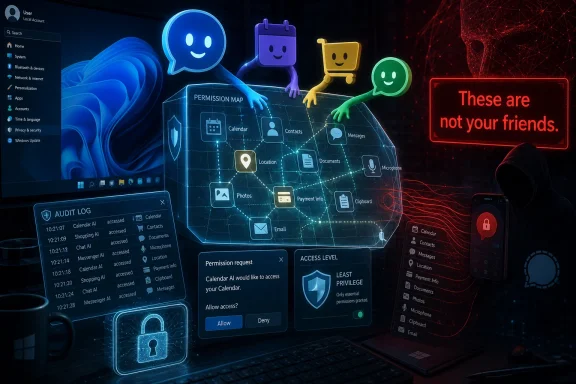
The Line Between Assistant and Eavesdropper Is a Permission Screen
Whittaker’s warning becomes practical when it is translated from principle into user and admin behavior. The point is not to panic over every chatbot window, but to recognize when a tool has crossed from answering into observing and from observing into acting.- Users should treat AI chatbots as software systems, not confidants, companions, therapists, or friends.
- Formatting, summarizing, and transforming low-risk material is a different privacy decision from asking a model to reason over sensitive personal or business context.
- AI agents that shop, message, schedule, browse, or transact require access that can undermine the practical value of encrypted and compartmentalized apps.
- Windows and Microsoft 365 administrators should evaluate Copilot-style features through permissions, logging, retention, connector access, and least-privilege policy rather than through productivity claims alone.
- The most important AI privacy question is shifting from what users type into prompts to what assistants are allowed to see, remember, and do.
- A trustworthy assistant should be constrained, auditable, revocable, and useful without demanding the keys to every room in the user’s digital house.
References
- Primary source: ibtimes.sg
Published: 2026-06-21T11:46:10.647080
Signal President Meredith Whittaker Warns ChatGPT and Claude '...
Signal President Meredith Whittaker warns that ChatGPT and Claude are "not your friends," raising concerns over privacy, surveillance and AI agents' access to personal data.www.ibtimes.sg - Independent coverage: yellow.com
Published: 2026-06-21T04:50:10.639686
Signal Chief Says AI Assistants Want The Keys To Your Private Life | Yellow.com
Signal president Meredith Whittaker warns that AI assistants need deep access to messages, payments, and calendars to function — creating serious privacy risks and potential backdoors. She rejects the idea of AI chatbots as friends or confidants. Read the full analysis.yellow.com - Related coverage: bloomberg.com
- Related coverage: techcrunch.com
Signal's Meredith Whittaker: AI is fundamentally 'a surveillance technology' | TechCrunch
Why is it that so many companies that rely on monetizing the data of their users seem to be extremely hot on AI? If you ask Signal president Meredithtechcrunch.com - Related coverage: windowscentral.com
Microsoft's AI CEO says Copilot will age with a fixed persona | Windows Central
Mustafa Suleyman envisions a future Copilot, complete with a permanent identity, its own room, and the ability to age.www.windowscentral.com - Related coverage: cyberinsider.com
Signal president warns AI agents are making encryption irrelevant
Signal president Meredith Whittaker said AI agents embedded within operating systems are eroding the practical security guarantees of E2EE.cyberinsider.com
- Related coverage: theguardian.com
Signal’s Meredith Whittaker: ‘These are the people who could actually pause AI if they wanted to’ | AI (artificial intelligence) | The Guardian
The president of the not-for-profit messaging app on how she believes existential warnings about AI allow big tech to entrench their power, and why the online safety bill may be unworkablewww.theguardian.com
