

Artificial intelligence is no longer a distant promise for the PHCP (plumbing, heating, cooling and piping) wholesale channel — it is already reshaping how distributors find parts, service contractors, manage inventory and run operations. Recent deployments by industry leaders show measurable gains in search accuracy, e-commerce conversion, and planner efficiency; the next wave — agentic AI and embedded internal copilots — promises to move many repetitive, cross-system tasks from “assistive” to “autonomous.” My goal in this feature is to summarize the current state, verify the key claims, highlight practical wins shown by real players, and give PHCP leaders a clear, no‑nonsense roadmap for turning AI from a buzzword into a bottom-line driver.
The PHCP channel sits at the intersection of fragmented SKUs, seasonal and weather-sensitive demand, and tight contractor relationships. That makes it both a hard problem for AI (data quality, many slow-moving SKUs) and a high‑impact one: small improvements in search, quoting, or replenishment can generate outsized gains in service levels and margins. Vendors and wholesalers are already testing two distinct classes of AI:
Why this matters for PHCP: an effective RAG + vector search layer turns a sprawling SKU catalog into a discoverable asset for both contractors and inside sales, dramatically shortening handle times and reducing mis‑picks.
Why this matters for PHCP: when contractors can self-serve parts, spec sheets and real‑time availability through mobile apps, distributors reduce friction, lower service costs and create stickier customer relationships.
Why this matters for PHCP: simple chatbots can convert after-hours demand, reduce counter traffic for routine questions, and feed sales lists — small distributors can get measurable lift with modest tech investments.
Why this matters for PHCP: better forecasts reduce stockouts for critical SKUs and cut capital tied up in slow-moving inventory — two levers that directly improve margins.
Why this matters for PHCP: you cannot safely deploy business-critical AI agents without consolidated customer, product and transaction data.
Agent examples relevant to wholesalers:
I verified this trend using vendor and analyst sources and found corroborating descriptions of agentic features, developer tooling and concerns about human oversight and rollback mechanisms. Industry evidence shows agentic AI is real — but it needs engineering guardrails and observability to be safe in production.
If you lead a PHCP wholesale business, don’t treat AI as an optional innovation project. Treat it as a strategic operational capability: invest in data readiness this quarter, pilot a search or chatbot in the next six months, and formalize an AI governance framework before you hand agents permission to act. Clean data, staged pilots, and rigorous oversight will let you capture the productivity and profitability gains AI promises — and avoid the costly, public mistakes that happen when autonomy is given without control.
Source: PHCPPros The PHCP Industry Meets AI
 Background / Overview
The PHCP channel sits at the intersection of fragmented SKUs, seasonal and weather-sensitive demand, and tight contractor relationships. That makes it both a hard problem for AI (data quality, many slow-moving SKUs) and a high‑impact one: small improvements in search, quoting, or replenishment can generate outsized gains in service levels and margins. Vendors and wholesalers are already testing two distinct classes of AI:- Assistive AI — chatbots, search augmentation and copilots that help people faster (product lookup, email drafting, knowledge retrieval).
- Agentic AI — goal-driven software “agents” that can act across systems (place holds, update quotes, adjust allocations) with minimal human prompting.
Real-world examples that matter to PHCP distribution
The PHCP industry should take note: major distribution players and nimble independents have public wins and scalable proof points. I verified each of the case examples and summarize the outcomes and implications for wholesalers.Grainger — retrieval-augmented search and large catalog handling
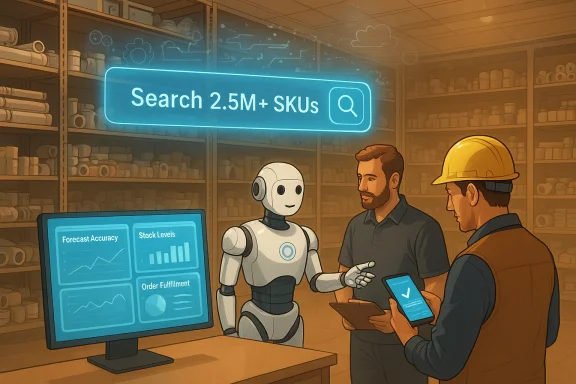
Grainger’s product-discovery overhaul, built with Databricks’ Mosaic AI and vector-based RAG (retrieval-augmented generation) stack, is an instructive enterprise example. Grainger manages roughly 2.5 million SKUs and used Databricks Vector Search, model serving and RAG patterns to build a search experience that understands role-based queries (e.g., an electrician vs. a machinist asking for “clamps”), syncs hundreds of thousands of daily product updates, and improves both recall and speed for call-center agents. Databricks documents the architecture and the operational reasoning behind the deployment, confirming the scale and technical approach described in industry commentary.Why this matters for PHCP: an effective RAG + vector search layer turns a sprawling SKU catalog into a discoverable asset for both contractors and inside sales, dramatically shortening handle times and reducing mis‑picks.
Watsco — e-commerce scale and internal copilots for HVAC
Watsco’s public reporting corroborates the shift toward digital-first contractor engagement. The company reported approximately $2.5 billion in e-commerce sales for a 12‑month period and that e-commerce comprised roughly a third of total sales; it also documents a substantial authenticated user base for its HVAC Pro+ apps and reports internal and customer-facing AI tools (Ask.Watsco / AI.Watsco) that support employees and contractors. Those numbers are in Watsco’s investor communications and subsequent analyst reports — concrete proof that digital investments, when well executed, scale quickly in HVAC distribution.Why this matters for PHCP: when contractors can self-serve parts, spec sheets and real‑time availability through mobile apps, distributors reduce friction, lower service costs and create stickier customer relationships.
Lincoln Davies Building Supply — website chatbot and lead growth
Smaller distributors are not left out. Lincoln Davies Building Supply deployed a Customers.ai website chatbot to serve FAQs, present promotions and capture leads. The vendor case study reports a 25% reduction in online support time and a 111% increase in their customer list after deploying the bot — a striking result for a community hardware and building supply operation. While vendor case studies are inherently promotional, the concrete operational improvements they claim match known, repeatable patterns in conversational commerce.Why this matters for PHCP: simple chatbots can convert after-hours demand, reduce counter traffic for routine questions, and feed sales lists — small distributors can get measurable lift with modest tech investments.
Forecasting, replenishment and “fair‑share” allocation
Across supply‑chain vendors, AI-driven forecasting and automated allocation engines are delivering double-digit improvements in forecast accuracy and planner productivity in many implementations. Vendors with historical roots in demand-planning have rebranded and layered ML and optimization on top of planners’ toolsets; independent analyses and vendor documentation show that probabilistic forecasting, scenario simulation and automated replenishment materially improve fill rates while reducing carry. This is precisely the value proposition PHCP wholesalers need for seasonal SKUs and multibranch balancing — though results vary by implementation quality. Industry evaluations and vendor technical documentation highlight both the potential and frequent implementation complexity.Why this matters for PHCP: better forecasts reduce stockouts for critical SKUs and cut capital tied up in slow-moving inventory — two levers that directly improve margins.
Enterprise digital foundations: Ferguson and CRM-driven transformation
Ferguson’s long-standing use of Salesforce Customer 360 to build unified customer views and an omnichannel experience is widely documented. Salesforce’s public announcements and investor materials describe how a single-source-of-truth CRM, combined with commerce and service clouds, creates the operational plumbing necessary to layer AI into quoting, service and project tracking at scale. This is not speculative; it’s an architecture many wholesalers will need to support AI agents and copilots effectively.Why this matters for PHCP: you cannot safely deploy business-critical AI agents without consolidated customer, product and transaction data.
What AI can concretely do for PHCP wholesalers
AI is a toolbox. Below are the practical, near-term use cases that deliver ROI in distribution and trade channels:- Product discovery and search improvements — vector search + RAG to interpret ambiguous contractor queries and surface the correct SKU faster.
- Conversational entry points (chat and voice) — capture demand after hours; triage repair vs. replacement calls for contractors.
- Internal and external copilots — internal Ask/Find copilots for counter staff; customer-facing assistants for quotes and specs.
- Inventory optimization and replenishment — demand forecasting that incorporates weather, promotions and local effects to reduce stockouts.
- Warehouse picking optimization — route planning, dynamic batching and reduced travel time via AI scheduling.
- Sales efficiency — AI-driven quoting assistants that suggest upsells, substitutes and optimized lead times.
- Contractor relationship management — cluster buying patterns to identify at-risk accounts, predict orders, track missed opportunities.
- Automated marketing & showroom support — generate targeted campaigns, brochures and social content with brand guardrails.
- Strategy modeling — scenario testing for budgets, margin impact and what-if procurement choices.
Agentic AI: what it is and why it matters now
The evolution we must track closely is agentic AI — agents that can act across systems toward a goal. Agentic AI moved from research buzz to production pilots in 2024–2025, and analysts forecast broad adoption in the coming years. Gartner’s 2025 predictions explicitly called out agentic AI as transformational for customer service, estimating autonomous resolution of a large share of routine issues within a few years. Independent reporting and industry analysis also note both the promise and the governance risks of turning AI from “assistant” into “actor.”Agent examples relevant to wholesalers:
- AI purchasing agent — continuously monitor lead times, forecast demand, and trigger POs within pre-approved tolerances.
- AI pricing agent — watch daily market pricing trends and propose margin-preserving price changes.
- AI warehouse agent — remap flows for pick accuracy and dynamically re-slot fast movers.
- AI marketing agent — create and deliver targeted, measurable campaigns.
- AI sales agent — notify reps of at-risk bids, draft tailored emails, or even schedule follow-ups.
I verified this trend using vendor and analyst sources and found corroborating descriptions of agentic features, developer tooling and concerns about human oversight and rollback mechanisms. Industry evidence shows agentic AI is real — but it needs engineering guardrails and observability to be safe in production.
Critical analysis: strengths, adoption patterns and risks
AI brings clear upside for PHCP distribution, but it also amplifies classic enterprise problems. Below is a candid assessment.Strengths and realistic upside
- Scaleable service improvements — AI copilots and improved search reduce handling time and scale customer support without linear headcount growth; large distributors already show material e‑commerce penetration gains.
- Data-driven inventory efficiency — probabilistic forecasting plus optimization engines can produce double-digit forecast accuracy improvements in realistic implementations, lowering carrying costs.
- Better contractor experience — mobile apps and intelligent quoting cut time to close and improve conversion; Watsco’s public numbers confirm meaningful scale.
- Accessibility of tooling — major vendors now provide low-code/no-code paths to agents and copilots, reducing initial engineering costs.
Key risks and failure modes
- Garbage-in, garbage-out — clean, normalized product and transaction data are a prerequisite. Fragmented SKUs, inconsistent part attributes and missing BOMs will sabotage RAG and agent outputs.
- Agentic autonomy without governance — poorly constrained agents can take erroneous actions (placing POs, changing prices, altering customer orders). Design human‑in‑the‑loop as a safety principle, but don’t treat it as a substitute for robust constraints, explainability, and rollback.
- Privacy and vendor lock-in — exposing customer or contractor data to third-party model hosts or vendor platforms without contractual controls can create compliance headaches and future dependency.
- Overpromised vendor claims — marketing often touts “double-digit gains” or “autonomous supply chains”; verify the baseline and the scope (pilot vs. enterprise scale). Independent technical validation is essential. Lokad and other critical assessments warn buyers to demand concrete KPIs and deployment case studies.
- Change management — people are the other half of the automation equation. Expect resistance without a clear plan to reskill staff and redesign workflows.
A practical roadmap for PHCP wholesalers (first 6–12 months)
If your company hasn’t started, the time to act is now. Below is an actionable, prioritized roadmap to get value with controlled risk.- Create an AI steering group that includes commercial, supply chain, IT and a legal/privacy representative. Make this a working group with decision authority.
- Inventory your data — catalog product master files, SKU attributes, taxonomy gaps, sales history, returns/credits, and contractor account metadata. Prioritize SKUs with highest revenue impact and highest service-cost friction.
- Fix the basics (data hygiene) — normalize SKUs, standardize attributes, deduplicate vendors, and establish a single product master or a well-governed product data lake.
- Start with one high-impact pilot: recommended pilots
- RAG-enabled search for inside sales/call center (low risk, fast ROI).
- Website chatbot for FAQs and lead capture (small distributors).
- Forecasting & replenishment for a seasonal SKU family (multibranch).
- Choose architecture and governance:
- Decide on hosted LLM vs. private model: sensitive catalogs may require private or on-prem options.
- Define human approvals, audit trails and rollback processes for any agentic actions.
- Measure KPIs: time-to-answer, search recall, order fill rate, stockouts, returns, and customer conversion. Tie pilots to clear financial metrics.
- Scale with guardrails: once pilots meet targets, expand scope vertically and horizontally with staged automation and a dedicated AI ops function.
- Continuous training: embed AI literacy and agent supervision training for affected staff; update role descriptions and KPIs.
Technology and vendor checklist for procurement teams
When evaluating vendors or platform tools, insist on these capabilities and contractual protections:- Data ownership and portability — confirm nothing training-sensitive will be retained or used to improve vendor models unless explicitly consented.
- Explainability and traceability — can the system show why a recommendation was made (ranking signals, data sources, embedding hits)?
- Rollback and action quarantine — for agentic capabilities, require deterministic rollback and staged approval modes.
- Latency & availability SLAs — search and quoting systems need predictable performance; vector-search and model-serving choices should match operational needs.
- Security & compliance — encryption-at-rest/in-transit, role-based access, and audit logs; right to audit vendor controls.
- Integration points — direct integrations with your ERP/CRM/WMS for safe actioning and event streams for observability.
Governance, ethics and data protection — the non‑negotiables
AI on its own is neutral. The things that make or break implementation are governance and data strategy.- Privacy-by-design: only expose personal or account-level data to models when strictly necessary. Mask or tokenise PII when possible.
- Human-centered failure modes: design workflow fallbacks and always provide humans a clear path to intervene, correct and learn.
- Model validation: test models on held-out, real-world data and validate not only accuracy but also biases (e.g., models that favor certain suppliers).
- Audit trails: require auditable decision logs for any agentic actions (who/what/why/when).
- Legal checklist: involve counsel early for contracts that limit vendor data usage, define liability for automated pricing/ordering mistakes, and ensure regulatory compliance.
Flagging unverifiable claims and where to be cautious
The PHCPPros article and many vendor case studies contain claims that are directionally correct but sometimes lack independent verification of magnitude (e.g., “double-digit gains” without baseline definition). Vendor case studies are useful starting points but should be validated in your environment.- Vendor-reported percentage improvements (forecast accuracy, conversion uplift) should be treated as indicative until replicated against your baseline metrics.
- The emergence of agentic AI in the latter half of 2025 is a real trend — analyst forecasts and vendor product launches corroborate this — but the speed of safe adoption varies widely by organization. Gartner’s projections and Microsoft’s Copilot Studio investments validate the trend while also suggesting careful governance.
- Small business case studies (e.g., Lincoln Davies) are persuasive for certain classes of tasks (chatbots, lead capture), but enterprise-level system integrations (RAG for a 2.5M-SKU catalog) demand far more engineering and operational discipline. Treat small wins and enterprise wins as different project classes.
Final verdict: what PHCP leaders should do now
AI is not a silver bullet, but it is a force multiplier. For PHCP wholesalers, the practical steps are clear:- Start with data: product master hygiene and unified customer records are prerequisites.
- Pick a visible, measurable pilot (search or chat) and execute quickly with a small cross-functional team.
- Build governance and agent‑level safety into the architecture before you scale.
- Treat agentic AI as a staged capability — move from suggestion → semi‑automated action → autonomous action, always with monitoring and rollback.
- Expect the vendor landscape to consolidate: platform vendors will bundle model-serving, retrieval, and agent orchestration, but you must control your data contractually.
If you lead a PHCP wholesale business, don’t treat AI as an optional innovation project. Treat it as a strategic operational capability: invest in data readiness this quarter, pilot a search or chatbot in the next six months, and formalize an AI governance framework before you hand agents permission to act. Clean data, staged pilots, and rigorous oversight will let you capture the productivity and profitability gains AI promises — and avoid the costly, public mistakes that happen when autonomy is given without control.
Source: PHCPPros The PHCP Industry Meets AI
