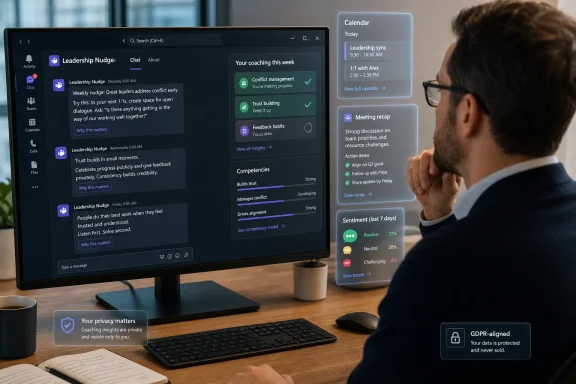
Blended Leading has published a white paper called “AI Mentorship for Leaders” describing AI-generated leadership nudges delivered inside Microsoft Teams, positioning the product as in-workflow micro-mentoring for managers who already spend much of their day in Microsoft’s collaboration hub. The announcement is not just another vendor attaching “AI” to an HR pitch. It is a useful signal of where workplace AI is heading: away from standalone dashboards and toward quiet, persistent interventions embedded in the systems where work already happens. For WindowsForum readers, the story is less about one leadership-development vendor and more about Teams becoming the front door for another category of algorithmic workplace guidance.
The most important detail in Blended Leading’s announcement is not the word “AI.” It is “inside Microsoft Teams.”
That distinction matters because enterprise software adoption is usually won or lost at the point of friction. A learning management system can be carefully procured, beautifully branded, and almost completely ignored if the manager has to remember to visit it between meetings, tickets, escalations, budget reviews, and the daily flood of chat. Teams, by contrast, is already open.
Microsoft has spent years turning Teams from a chat-and-meeting client into an application surface. Bots, tabs, cards, message extensions, activity feed notifications, and now agentic patterns all push toward the same architectural idea: work should come to the user, not the other way around. Blended Leading is riding that current rather than trying to create a separate destination.
That is why leadership-development vendors are now treating Teams the way earlier generations treated email. It is not merely a communications channel. It is the place where prompts can appear at the moment when behavior might actually change.
That sounds modest, but modesty is the strategy. Traditional leadership training has long suffered from a timing problem: people learn frameworks in artificial settings and then return to workplaces where the moment for applying them has already passed. The nudge model tries to collapse that gap.
A manager who receives a prompt about feedback delivery ahead of a one-on-one is more likely to use it than a manager asked to remember a slide from a workshop six months earlier. The promise is not that AI becomes a great leadership coach. The promise is that AI becomes a timely one.
This is the same logic behind much of the current enterprise AI wave. The value is not always in replacing the expert; it is in shrinking the distance between intent and action. In that sense, Blended Leading’s product is less a training platform than a behavioral interface.
Generic advice is easy to dismiss. “Build trust with your team” is corporate wallpaper. A prompt that connects trust-building to a manager’s actual feedback profile, working style, and company competency model is more likely to land.
But personalization changes the administrative stakes. Once a system is drawing from 360-degree feedback, survey responses, psychometric data, and HR context, it is no longer just a productivity assistant. It is processing information that can shape reputations, career trajectories, and organizational judgments.
Blended Leading’s announcement stresses EU hosting, GDPR compliance, ISO/IEC 27001 certification, and organizational control of data. Those are important claims, particularly for European customers and multinationals with strict data-handling requirements. Still, IT and HR leaders should treat them as the start of due diligence, not the end of it.
The operational questions are familiar but unavoidable. Who can see the underlying data? Are nudges retained? Can managers contest or correct profile assumptions? Are outputs used only for development, or can they become performance evidence? These are not edge cases; they are the governance center of the product.
That division is sensible from a product-design perspective. It separates the ingestion of structured and semi-structured development inputs from the interpretation of qualitative feedback and the generation of human-readable guidance. It also gives buyers a useful way to ask sharper questions.
The Extraction AI Agent raises questions about data minimization and mapping. If a company feeds the system competency models, surveys, development plans, psychometrics, and HR metadata, administrators need to know which fields are required and which are merely convenient. The difference matters under any serious privacy regime.
The Sentiment AI Model is potentially the most delicate component. Sentiment analysis can be useful for finding patterns in open-text feedback, but it can also flatten context, misread sarcasm, and encode cultural assumptions. In leadership development, the cost of a bad interpretation is not just a wrong label; it may be advice that nudges a manager toward the wrong self-image.
The Generation AI Agent is the most visible layer, but not necessarily the most dangerous one. A clumsy prompt can be ignored. A hidden misclassification can quietly steer weeks or months of guidance.
But integration is never free. A Teams app or bot becomes part of the tenant’s operational environment. It may require consent flows, app permissions, policy assignments, lifecycle management, and security review. If nudges arrive through activity notifications or chat messages, administrators also need to think about user fatigue and notification hygiene.
This is where many AI workplace pilots stumble. The demo looks clean because the prompt appears in the perfect context. The deployment is messier because real tenants already contain security alerts, compliance reminders, approval workflows, bot messages, Viva updates, Planner tasks, Copilot surfaces, and human colleagues all competing for attention.
A leadership nudge that arrives as one more interruptive card may become noise. A leadership nudge that is timed, relevant, sparse, and clearly tied to development goals may become useful. The difference is not AI magic; it is product discipline and tenant governance.
Managers do not lack content. They lack attention, timing, confidence, and follow-through. Most organizations already own libraries of leadership materials, coaching frameworks, LMS modules, competency models, and performance templates. The problem is that these assets often sit apart from the moments where managers make consequential choices.
That is why the nudge model has commercial force. It does not ask the organization to throw away existing material. It promises to activate it.
The “learn more” link into an LMS is a telling design choice. Blended Leading is not trying to replace the full learning stack, at least not in this positioning. It is trying to become the last-mile delivery system for behavior change.
There is a risk that vendors and buyers use the warmth of human language to soften what is actually a recommendation system. That does not make the system bad. It does mean organizations should be precise about what they are buying.
If the tool is a micro-learning prompt engine, call it that. If it is a coaching assistant, define the boundaries. If it influences development planning, disclose how. If it draws on psychometric and feedback data, explain what the user can and cannot control.
The best version of this category will be transparent about its limits. The worst version will hide behind human metaphors while quietly shaping managerial behavior at scale.
AI nudging offers an appealing compromise. It lets companies extend some form of individualized guidance to a wider population of people managers. The advice can be customized enough to feel relevant, while the delivery cost remains closer to software than coaching.
That is the upside Blended Leading is selling. Companies can reinforce a common leadership model while tailoring the experience to each leader. HR can track adoption and engagement. Managers can receive guidance without booking another session or opening another portal.
But scale can also make bad assumptions travel faster. If an organization’s leadership model is vague, politically loaded, or poorly aligned with actual work, AI will not fix it. It will simply distribute that model more efficiently.
Admins will want to know how the application is installed, what permissions it requests, how data moves between the customer environment and Blended Leading’s service, and whether the tool integrates with Microsoft Entra ID groups, Teams app policies, and existing compliance boundaries. Security teams will ask about encryption, retention, auditability, subprocessors, and incident response. Legal teams will ask whether psychometric and feedback data are processed in ways that create employment-law exposure.
None of that means the product should be avoided. It means the buying committee cannot be limited to HR and a business sponsor. If the tool is embedded in Teams and processes leadership data, IT is not a support function after the fact; IT is part of the product’s risk model from day one.
This is especially true because AI features tend to arrive with a halo of inevitability. A vendor demo can make adoption feel like a simple toggle. In practice, the toggle may sit on top of identity, privacy, records, works council, accessibility, localization, and user-trust decisions.
Blended Leading’s product fits that environment neatly. It does not require the customer to imagine a new work pattern from scratch. It piggybacks on a collaboration habit already established by Teams and on an AI narrative already amplified by Microsoft.
That does not make it derivative. It makes it pragmatic. The enterprise AI winners may not be the companies with the flashiest models, but the ones that pick a narrow behavioral problem and deliver assistance where the user already is.
Leadership development is a particularly plausible test case because the work is recurring, ambiguous, and human. Managers constantly make small decisions that shape team culture. If AI can help at all, it will probably help through repeated, context-sensitive prompts rather than grand once-a-quarter interventions.
This is where product restraint becomes a competitive advantage. A weekly commitment may be more credible than a daily prompt. A nudge tied to a known development goal may be more useful than a generic motivational card. A prompt that asks for one concrete action may outperform a long explanation dressed up as personalization.
The second failure mode is performativity. If leaders know the system tracks engagement, they may click, acknowledge, and move on without changing behavior. HR dashboards can then create a comforting illusion of development activity.
The third failure mode is overreach. A tool designed to help managers reflect could drift into automated evaluation, especially if organizations start correlating nudge engagement with performance data, survey scores, or promotion decisions. That boundary needs to be explicit before deployment, not negotiated after a controversy.
If a company can deliver personalized prompts to thousands of managers through Teams, then classroom-only leadership programs will look increasingly stale. Vendors will need to prove that their content can survive contact with daily work. Coaches may find themselves designing interventions that AI systems distribute and reinforce.
That shift could be healthy. Leadership development has too often been measured by attendance, satisfaction scores, and polished frameworks. In-workflow nudges push the conversation toward behavior, repetition, and application.
The risk is that organizations mistake prompting for development. A nudge can remind a manager to prepare better feedback. It cannot guarantee that the feedback is fair, well-received, or culturally competent. The human system around the tool still matters.
This is especially important for psychometric data. Many employees tolerate assessments when they believe the purpose is development. They become far less comfortable when assessment-derived insights appear to feed automated workplace interventions without clear boundaries.
Blended Leading’s emphasis on organizational DNA, leadership models, and personalized micro-mentoring will appeal to HR leaders looking for alignment. But employees and managers may hear a different message: the company is encoding its preferred leadership behavior into an AI system that will now coach me in real time.
That is not necessarily bad. Organizations have always socialized leaders into preferred behaviors. The difference is that software makes the process more persistent, measurable, and scalable. With that power comes a higher obligation to explain the system plainly.
The CHRO wants better leadership behavior at scale. The CIO wants fewer unmanaged apps and clearer data boundaries. The CISO wants assurance that sensitive feedback and psychometric information are protected. The general counsel wants to avoid turning developmental data into discoverable evidence of inconsistent employment decisions.
A successful deployment would need all of those groups aligned. That does not mean months of bureaucratic drag. It means asking the right questions before the pilot expands.
The tempting path is to start with a friendly cohort and declare victory when engagement is high. The more durable path is to define data use, retention, consent, transparency, escalation, and measurement before the first manager receives a prompt. AI pilots have a habit of becoming infrastructure faster than governance can catch up.
That is both promising and uncomfortable. Leadership is built out of repeated behaviors, and repeated behaviors are exactly where software can exert influence. If the guidance is relevant, transparent, and bounded, it could make development more continuous and less elitist. If it is opaque, noisy, or tied too closely to performance surveillance, it could erode trust.
Near-term buyers should keep the evaluation grounded in concrete operational questions:
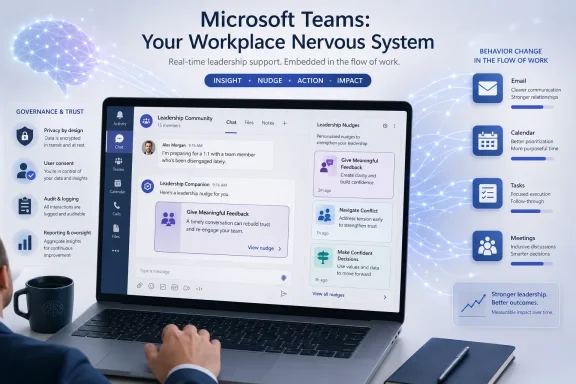
 Microsoft Teams Becomes the New Corporate Nervous System
The most important detail in Blended Leading’s announcement is not the word “AI.” It is “inside Microsoft Teams.”That distinction matters because enterprise software adoption is usually won or lost at the point of friction. A learning management system can be carefully procured, beautifully branded, and almost completely ignored if the manager has to remember to visit it between meetings, tickets, escalations, budget reviews, and the daily flood of chat. Teams, by contrast, is already open.
Microsoft has spent years turning Teams from a chat-and-meeting client into an application surface. Bots, tabs, cards, message extensions, activity feed notifications, and now agentic patterns all push toward the same architectural idea: work should come to the user, not the other way around. Blended Leading is riding that current rather than trying to create a separate destination.
That is why leadership-development vendors are now treating Teams the way earlier generations treated email. It is not merely a communications channel. It is the place where prompts can appear at the moment when behavior might actually change.
The Nudge Is the Product
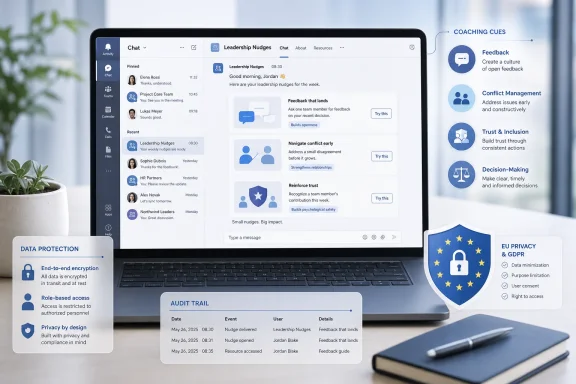
Blended Leading’s white paper describes short, personalized prompts tied to leadership competencies such as conflict management, trust-building, decision-making, and feedback delivery. A typical nudge includes an insight, practical action steps, a connection to the leader’s working style, and a small weekly commitment. The product also offers a “learn more” path into a company’s existing learning management system.That sounds modest, but modesty is the strategy. Traditional leadership training has long suffered from a timing problem: people learn frameworks in artificial settings and then return to workplaces where the moment for applying them has already passed. The nudge model tries to collapse that gap.
A manager who receives a prompt about feedback delivery ahead of a one-on-one is more likely to use it than a manager asked to remember a slide from a workshop six months earlier. The promise is not that AI becomes a great leadership coach. The promise is that AI becomes a timely one.
This is the same logic behind much of the current enterprise AI wave. The value is not always in replacing the expert; it is in shrinking the distance between intent and action. In that sense, Blended Leading’s product is less a training platform than a behavioral interface.
Personalization Makes the Pitch Stronger and the Governance Harder
The company says its nudges are personalized using individual development data, psychometric information, and the organization’s own leadership model. That is exactly what makes the product interesting. It is also exactly what makes it sensitive.Generic advice is easy to dismiss. “Build trust with your team” is corporate wallpaper. A prompt that connects trust-building to a manager’s actual feedback profile, working style, and company competency model is more likely to land.
But personalization changes the administrative stakes. Once a system is drawing from 360-degree feedback, survey responses, psychometric data, and HR context, it is no longer just a productivity assistant. It is processing information that can shape reputations, career trajectories, and organizational judgments.
Blended Leading’s announcement stresses EU hosting, GDPR compliance, ISO/IEC 27001 certification, and organizational control of data. Those are important claims, particularly for European customers and multinationals with strict data-handling requirements. Still, IT and HR leaders should treat them as the start of due diligence, not the end of it.
The operational questions are familiar but unavoidable. Who can see the underlying data? Are nudges retained? Can managers contest or correct profile assumptions? Are outputs used only for development, or can they become performance evidence? These are not edge cases; they are the governance center of the product.
The Three-Agent Architecture Is a Map of the Risk
Blended Leading outlines a three-part AI architecture. An Extraction AI Agent processes individual development data. A Sentiment AI Model analyzes open-text feedback. A Generation AI Agent creates short nudges based on the leader’s profile and the organization’s expectations.That division is sensible from a product-design perspective. It separates the ingestion of structured and semi-structured development inputs from the interpretation of qualitative feedback and the generation of human-readable guidance. It also gives buyers a useful way to ask sharper questions.
The Extraction AI Agent raises questions about data minimization and mapping. If a company feeds the system competency models, surveys, development plans, psychometrics, and HR metadata, administrators need to know which fields are required and which are merely convenient. The difference matters under any serious privacy regime.
The Sentiment AI Model is potentially the most delicate component. Sentiment analysis can be useful for finding patterns in open-text feedback, but it can also flatten context, misread sarcasm, and encode cultural assumptions. In leadership development, the cost of a bad interpretation is not just a wrong label; it may be advice that nudges a manager toward the wrong self-image.
The Generation AI Agent is the most visible layer, but not necessarily the most dangerous one. A clumsy prompt can be ignored. A hidden misclassification can quietly steer weeks or months of guidance.
Teams Integration Is a Feature and a Dependency
For Windows and Microsoft 365 administrators, the Teams angle is both attractive and cautionary. Delivering nudges through Teams reduces training overhead, because users do not need to learn another interface. It also centralizes the experience in a tool already governed by Microsoft 365 policies, identity controls, and app-management practices.But integration is never free. A Teams app or bot becomes part of the tenant’s operational environment. It may require consent flows, app permissions, policy assignments, lifecycle management, and security review. If nudges arrive through activity notifications or chat messages, administrators also need to think about user fatigue and notification hygiene.
This is where many AI workplace pilots stumble. The demo looks clean because the prompt appears in the perfect context. The deployment is messier because real tenants already contain security alerts, compliance reminders, approval workflows, bot messages, Viva updates, Planner tasks, Copilot surfaces, and human colleagues all competing for attention.
A leadership nudge that arrives as one more interruptive card may become noise. A leadership nudge that is timed, relevant, sparse, and clearly tied to development goals may become useful. The difference is not AI magic; it is product discipline and tenant governance.
The Real Competition Is Not Another Vendor
Blended Leading is competing in the leadership-development market, but its harder competition is managerial attention. Every enterprise vendor now wants to be in the flow of work. The phrase is so overused that it risks becoming meaningless, yet the underlying battle is real.Managers do not lack content. They lack attention, timing, confidence, and follow-through. Most organizations already own libraries of leadership materials, coaching frameworks, LMS modules, competency models, and performance templates. The problem is that these assets often sit apart from the moments where managers make consequential choices.
That is why the nudge model has commercial force. It does not ask the organization to throw away existing material. It promises to activate it.
The “learn more” link into an LMS is a telling design choice. Blended Leading is not trying to replace the full learning stack, at least not in this positioning. It is trying to become the last-mile delivery system for behavior change.
AI Mentorship Is a Loaded Phrase
Calling the product “AI mentorship” is clever, but it deserves scrutiny. Mentorship implies relationship, judgment, accountability, and trust built over time. A generated nudge can support those things, but it does not automatically possess them.There is a risk that vendors and buyers use the warmth of human language to soften what is actually a recommendation system. That does not make the system bad. It does mean organizations should be precise about what they are buying.
If the tool is a micro-learning prompt engine, call it that. If it is a coaching assistant, define the boundaries. If it influences development planning, disclose how. If it draws on psychometric and feedback data, explain what the user can and cannot control.
The best version of this category will be transparent about its limits. The worst version will hide behind human metaphors while quietly shaping managerial behavior at scale.
HR Wants Scale, Managers Want Specificity
Leadership development has always had a scale problem. Executive coaching can be powerful, but it is expensive and usually reserved for senior leaders or high-potential employees. Workshops scale better, but they often become episodic rituals with weak transfer into daily work.AI nudging offers an appealing compromise. It lets companies extend some form of individualized guidance to a wider population of people managers. The advice can be customized enough to feel relevant, while the delivery cost remains closer to software than coaching.
That is the upside Blended Leading is selling. Companies can reinforce a common leadership model while tailoring the experience to each leader. HR can track adoption and engagement. Managers can receive guidance without booking another session or opening another portal.
But scale can also make bad assumptions travel faster. If an organization’s leadership model is vague, politically loaded, or poorly aligned with actual work, AI will not fix it. It will simply distribute that model more efficiently.
The WindowsForum Angle Is Administration, Not Inspiration
For a general business audience, this announcement is a story about leadership modernization. For WindowsForum’s readership, it is also a story about tenant-level responsibility. Anything that lives inside Teams quickly becomes an IT concern, even if the budget owner is HR.Admins will want to know how the application is installed, what permissions it requests, how data moves between the customer environment and Blended Leading’s service, and whether the tool integrates with Microsoft Entra ID groups, Teams app policies, and existing compliance boundaries. Security teams will ask about encryption, retention, auditability, subprocessors, and incident response. Legal teams will ask whether psychometric and feedback data are processed in ways that create employment-law exposure.
None of that means the product should be avoided. It means the buying committee cannot be limited to HR and a business sponsor. If the tool is embedded in Teams and processes leadership data, IT is not a support function after the fact; IT is part of the product’s risk model from day one.
This is especially true because AI features tend to arrive with a halo of inevitability. A vendor demo can make adoption feel like a simple toggle. In practice, the toggle may sit on top of identity, privacy, records, works council, accessibility, localization, and user-trust decisions.
The Timing Is No Accident
The announcement lands in a market where Microsoft and its ecosystem partners are pushing hard to make AI feel native to work rather than adjacent to it. Copilot changed expectations for Microsoft 365 customers. Once users are told that AI can summarize meetings, draft messages, analyze documents, and act through agents, it becomes natural for third-party vendors to ask: why not leadership advice too?Blended Leading’s product fits that environment neatly. It does not require the customer to imagine a new work pattern from scratch. It piggybacks on a collaboration habit already established by Teams and on an AI narrative already amplified by Microsoft.
That does not make it derivative. It makes it pragmatic. The enterprise AI winners may not be the companies with the flashiest models, but the ones that pick a narrow behavioral problem and deliver assistance where the user already is.
Leadership development is a particularly plausible test case because the work is recurring, ambiguous, and human. Managers constantly make small decisions that shape team culture. If AI can help at all, it will probably help through repeated, context-sensitive prompts rather than grand once-a-quarter interventions.
The Danger Is Turning Leadership Into Notification Management
The most obvious failure mode is fatigue. Microsoft Teams is already a dense work surface, and many users experience it less as a calm productivity hub than as a machine for distributing interruption. Adding AI mentorship to that stream could help managers act with more intention, or it could become yet another badge to clear.This is where product restraint becomes a competitive advantage. A weekly commitment may be more credible than a daily prompt. A nudge tied to a known development goal may be more useful than a generic motivational card. A prompt that asks for one concrete action may outperform a long explanation dressed up as personalization.
The second failure mode is performativity. If leaders know the system tracks engagement, they may click, acknowledge, and move on without changing behavior. HR dashboards can then create a comforting illusion of development activity.
The third failure mode is overreach. A tool designed to help managers reflect could drift into automated evaluation, especially if organizations start correlating nudge engagement with performance data, survey scores, or promotion decisions. That boundary needs to be explicit before deployment, not negotiated after a controversy.
The Human Coach Is Not Dead, But the Coaching Market Is Changing
AI nudges are unlikely to replace high-quality human coaching for senior leaders, complex conflict, executive transitions, or sensitive performance issues. Those situations require judgment, confidentiality, and a level of contextual understanding that current AI systems cannot reliably provide. But they may change what organizations expect from the broader coaching and leadership-development market.If a company can deliver personalized prompts to thousands of managers through Teams, then classroom-only leadership programs will look increasingly stale. Vendors will need to prove that their content can survive contact with daily work. Coaches may find themselves designing interventions that AI systems distribute and reinforce.
That shift could be healthy. Leadership development has too often been measured by attendance, satisfaction scores, and polished frameworks. In-workflow nudges push the conversation toward behavior, repetition, and application.
The risk is that organizations mistake prompting for development. A nudge can remind a manager to prepare better feedback. It cannot guarantee that the feedback is fair, well-received, or culturally competent. The human system around the tool still matters.
Trust Will Decide Whether the Nudge Feels Helpful or Creepy
The difference between a helpful prompt and a creepy one is often disclosure. If a manager understands why a nudge appeared, what data shaped it, and how engagement is used, the experience can feel like support. If the prompt arrives mysteriously, referencing personal traits or feedback themes without explanation, it can feel like surveillance wearing a friendly mask.This is especially important for psychometric data. Many employees tolerate assessments when they believe the purpose is development. They become far less comfortable when assessment-derived insights appear to feed automated workplace interventions without clear boundaries.
Blended Leading’s emphasis on organizational DNA, leadership models, and personalized micro-mentoring will appeal to HR leaders looking for alignment. But employees and managers may hear a different message: the company is encoding its preferred leadership behavior into an AI system that will now coach me in real time.
That is not necessarily bad. Organizations have always socialized leaders into preferred behaviors. The difference is that software makes the process more persistent, measurable, and scalable. With that power comes a higher obligation to explain the system plainly.
The CIO and CHRO Now Share the Same Problem
The most interesting enterprise AI deployments increasingly sit between departments. Blended Leading’s Teams-based nudges are an HR product, an IT integration, a security review, a data-governance exercise, and a change-management project at the same time. That is the modern AI pattern.The CHRO wants better leadership behavior at scale. The CIO wants fewer unmanaged apps and clearer data boundaries. The CISO wants assurance that sensitive feedback and psychometric information are protected. The general counsel wants to avoid turning developmental data into discoverable evidence of inconsistent employment decisions.
A successful deployment would need all of those groups aligned. That does not mean months of bureaucratic drag. It means asking the right questions before the pilot expands.
The tempting path is to start with a friendly cohort and declare victory when engagement is high. The more durable path is to define data use, retention, consent, transparency, escalation, and measurement before the first manager receives a prompt. AI pilots have a habit of becoming infrastructure faster than governance can catch up.
The Small Prompt Carries a Big Organizational Bet
Blended Leading’s announcement is a small item in the larger AI news cycle, but it captures a larger transition. Enterprise AI is moving from spectacular demos to embedded interventions. The next wave will not always look like a chatbot window. Sometimes it will look like a short Teams message telling a manager how to handle tomorrow’s difficult conversation.That is both promising and uncomfortable. Leadership is built out of repeated behaviors, and repeated behaviors are exactly where software can exert influence. If the guidance is relevant, transparent, and bounded, it could make development more continuous and less elitist. If it is opaque, noisy, or tied too closely to performance surveillance, it could erode trust.
Near-term buyers should keep the evaluation grounded in concrete operational questions:
- The product’s value depends on whether nudges arrive at moments when managers can realistically act on them.
- The sensitivity of the data makes privacy, retention, and access controls central buying criteria rather than legal afterthoughts.
- Teams integration lowers adoption friction, but it also brings the tool into the tenant-governance world of app permissions, notifications, and security review.
- Personalization is only as good as the organization’s leadership model and the quality of the feedback data used to generate guidance.
- The healthiest deployments will separate developmental support from performance enforcement in language, policy, and system design.
References
- Primary source: The AI Journal
Published: Mon, 15 Jun 2026 07:55:41 GMT
Blended Leading Introduces In-Workflow AI Nudges for Leaders Inside Microsoft Teams | The AI Journal
The new white paper explains how personalized micro-mentoring can support leaders without adding another platform to their workload.aijourn.com - Related coverage: blendedleading.com
AI Nudges - Blended Leading
AI Nudges: Personalized Prompts for Everyday Leadership Deliver short, personalized recommendations that help leaders build better habits directly in Microsoft Teams. Request a Demo What AI Nudges Are AI Nudges are personalized micro-prompts that guide leaders toward better decisions and...blendedleading.com - Related coverage: openpr.de
Blended Leading stellt KI-gestützte In-Workflow-Nudges für Führungskräfte in Microsoft Teams vor
Presseveröffentlichung von Blended Leading ✅ Blended Leading stellt KI-gestützte In-Workflow-Nudges für Führungskräfte in Microsoft Teams vor veröffentlicht auf open PRwww.openpr.de - Official source: enablement.microsoft.com
Leading in the era of AI – Microsoft Adoption
Practical guidance for leaders of all types to get the most fromthe adoption of AI capabilities in your business.enablement.microsoft.com - Related coverage: techradar.com
'Every business leader knows the world is changing, but far fewer have a clear picture of what to do about it': Microsoft flags the changing world of AI at work, and why "Frontier Firms" are leading the way | TechRadar
Microsoft digs deep into how businesses are using AIwww.techradar.com - Official source: adoption.microsoft.com
2189585598
Indian Male Industrial Engineer And Hispanic Female Supervisor Using Laptop And Talking At An Electronics Factory. Man Using Soldering Jet Printer, Explaining Process Behind Production Of Motherboardsadoption.microsoft.com
- Related coverage: assets-c4akfrf5b4d3f4b7.z01.azurefd.net
- Related coverage: fingertip.org