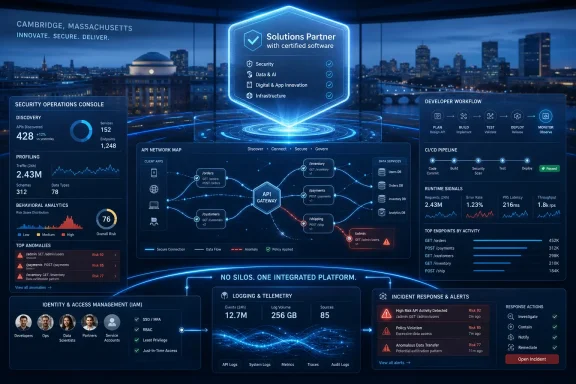
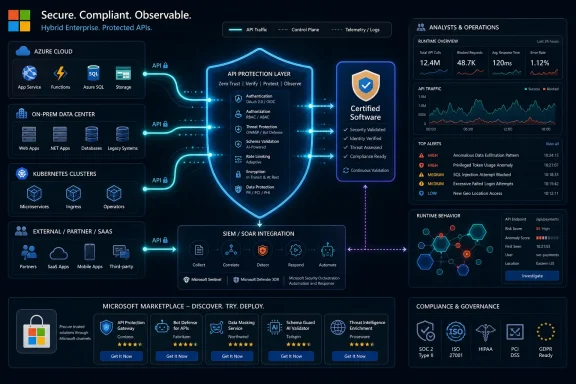
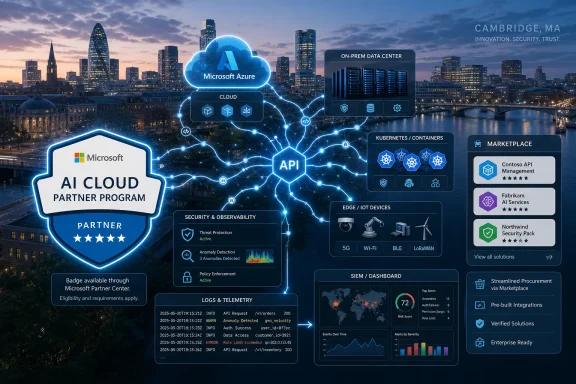
Akamai announced on June 10, 2026, from Cambridge, Massachusetts, that Akamai API Security has earned Microsoft’s Solutions Partner with certified software designation for Security within the Microsoft AI Cloud Partner Program, recognizing interoperability with Microsoft Cloud environments including Azure. The announcement is narrow in the formal sense and larger in the strategic one. Microsoft is not endorsing Akamai’s product as a magic shield, and Akamai is not suddenly becoming an Azure-native Microsoft security service. But the designation lands at a moment when API security has moved from specialist concern to board-level exposure, and it tells us something important about how the Microsoft cloud ecosystem is being stitched together: through marketplaces, partner badges, and interoperability claims that enterprises are increasingly expected to treat as buying signals.
The first thing to strip away is the marketing fog. Microsoft’s “Solutions Partner with certified software” designation is a partner-program credential, not a blanket guarantee that a product will stop breaches, eliminate misconfigurations, or behave perfectly in every tenant. The small print matters here: certified software status is tied to interoperability with Microsoft products and is based, in part, on information supplied by the solution owner.
That caveat does not make the designation meaningless. In enterprise procurement, especially around Azure, badges are part of the language buyers use to reduce ambiguity. A product that has cleared Microsoft’s partner-program requirements can move through vendor review, marketplace procurement, and cloud architecture discussions with less friction than one arriving as an unsupported outsider.
That is the real story behind Akamai’s announcement. The company is not merely saying that its API security product exists in the Azure orbit. It is saying that the product has been packaged, positioned, and reviewed in a way that Microsoft’s cloud customers can understand within Microsoft’s own partner taxonomy.
For WindowsForum readers, the practical distinction is important. This is not a Windows update, not a Defender feature, and not an Azure security control being added to every subscription. It is a third-party security platform gaining a Microsoft ecosystem credential, and that makes it relevant to the administrators and architects who increasingly build hybrid estates out of Microsoft services and non-Microsoft security layers.
That is why Akamai’s press release leans so heavily on visibility. The company frames APIs as the foundation of digital interaction, and that is not just vendor flourish. In cloud-native estates, the API is frequently the real perimeter. Users may authenticate through Microsoft Entra ID, workloads may run in Azure, and traffic may pass through gateways and WAFs, but the exposed business logic still lives in API calls.
Attackers know this. Credential stuffing, token abuse, enumeration, scraping, shadow endpoints, excessive data exposure, and business-logic attacks often do not look like classic malware. They look like legitimate requests used in illegitimate ways. That makes API security difficult for teams that are still mentally organized around endpoints, firewalls, and patch levels.
Akamai’s pitch is that API Security can discover, classify, monitor, and protect APIs across environments, including those touching Azure workloads. The Microsoft designation does not prove that Akamai will solve every one of those problems in a customer’s estate. It does, however, place Akamai’s product in a Microsoft-compatible procurement lane at exactly the time when many enterprises are discovering that Azure-native security alone may not account for every API they actually expose.
This is where Akamai’s history matters. Akamai built its reputation on distributed edge infrastructure, performance, content delivery, DDoS mitigation, and web security. Its security portfolio has increasingly pushed into application and API protection, not as an afterthought but as part of a broader argument: that the edge, the cloud, and the application layer are now inseparable.
Microsoft, meanwhile, has every incentive to make Azure the marketplace where customers discover, buy, and attach third-party capabilities. The Microsoft Cloud is no longer just a set of infrastructure services. It is also a commercial channel, an identity fabric, a compliance environment, and a partner ecosystem.
That dynamic creates a useful tension. Customers want tools that work with Azure without being trapped inside Azure. Microsoft wants partners that enrich its cloud without undermining its platform story. Akamai wants to reassure buyers that its API security layer can sit across the messiness of real enterprise architecture while still fitting into Microsoft’s approved partner framework.
AI systems consume APIs, expose APIs, generate code that calls APIs, and accelerate the pace at which organizations create new integration surfaces. Agentic workflows make the problem sharper. If software agents are allowed to take actions across systems, APIs become the rails on which those actions travel.
That means API inventory and behavioral monitoring are no longer just defensive hygiene. They are preconditions for safely deploying automation. An organization that does not know which APIs exist, what data they expose, which identities can call them, and what normal use looks like is not well positioned to let AI agents operate at speed.
This is also where Microsoft’s ecosystem relevance becomes obvious. Copilot, Azure AI services, Entra, Fabric, Dynamics, Power Platform, and custom Azure workloads are all pulling enterprises toward more automation and more integration. The security problem is not that AI creates APIs from nothing. It is that AI increases the value and velocity of the API layer already holding the business together.
That is not legal boilerplate to ignore. It is the boundary between ecosystem validation and operational assurance. A Microsoft designation may help a buyer identify software that has met certain program criteria, but it does not replace architecture review, proof-of-concept testing, data governance analysis, or incident-response planning.
Security teams should therefore treat the badge as a starting point, not a finish line. The real evaluation still involves hard questions. Which APIs can the product actually discover? How does it integrate with existing gateways and traffic paths? What telemetry does it need? How are false positives handled? Can it detect abuse of authenticated APIs, or only obvious attack signatures? How well does it map to Azure logging, SIEM workflows, and identity context?
Those questions matter because API security failures are rarely caused by the total absence of tools. They are caused by blind spots between teams: developers who publish endpoints faster than security can review them, platform teams that assume gateways are enough, business units that maintain partner integrations outside central visibility, and SOCs that see events without understanding application behavior.
At the same time, Microsoft cannot provide every best-of-breed security control for every customer architecture, especially where cross-cloud and edge-heavy environments are involved. The partner ecosystem exists because customers need more than Microsoft can or should build itself. The certified software designation is one mechanism for making that ecosystem legible.
Akamai’s gain is therefore not merely reputational. It potentially lowers friction for Azure Marketplace discovery, procurement, and internal justification. In large enterprises, that can matter as much as a feature comparison. If a security team can acquire a tool through existing Microsoft marketplace processes, apply cloud-committed spend where applicable, and point to a Microsoft partner designation, the internal sales cycle changes.
That does not mean Akamai gets an automatic win. Microsoft customers already have many overlapping tools, from Azure API Management and Application Gateway to Defender products, Sentinel analytics, third-party WAFs, bot protection platforms, and API posture-management vendors. The burden on Akamai is to prove that its product adds visibility and protection that customers cannot easily assemble from what they already own.
That is where many deployments falter. A platform can discover shadow APIs, but someone has to decide whether they are legitimate. A tool can flag anomalous behavior, but the SOC needs application context to know whether a spike is fraud, a partner integration, or a product launch. A dashboard can show risk posture, but risk does not move until teams change code, rotate secrets, restrict scopes, or retire endpoints.
The Microsoft designation does not remove that operational burden. It may make integration more straightforward, and it may reassure stakeholders that Akamai’s product has been reviewed against Microsoft’s partner-program criteria. But the day-two work remains the same: connect the telemetry, define ownership, establish response paths, and measure whether the number of unknown APIs is actually shrinking.
For Azure-centric organizations, the strongest use case is likely not “replace Microsoft security.” It is “extend visibility where Azure-native controls stop being enough.” That could mean APIs exposed through Akamai’s edge, APIs spanning clouds, APIs used by partners, or APIs whose abuse patterns require behavioral analysis beyond standard gateway policies.
That shift favors vendors that can prove compatibility, publish transactable offers, and align with cloud-provider partner programs. It also favors cloud providers, which become not only infrastructure suppliers but distribution hubs for security and operations software. Microsoft’s partner designations are part of that transformation.
There are benefits. Procurement can be faster. Customers can compare solutions within a familiar ecosystem. Partners can package integrations more cleanly. Security teams can push for tools that are easier to justify to finance and architecture boards.
There are also risks. Badges can be overread. Marketplace presence can be mistaken for deep architectural fit. Buyers can assume that “works with Microsoft Cloud” means “works with our environment,” even when their environment includes years of exceptions, acquisitions, legacy integrations, and undocumented services.
Akamai’s announcement is a useful reminder that cloud security decisions increasingly happen in that gray zone between technical merit and ecosystem convenience. The right answer is not cynicism. It is discipline.
The harder question is whether the designation helps customers make better security decisions. It can, if they use it correctly. It can also become just another logo on a slide if procurement treats it as a substitute for engineering validation.
The best reading is pragmatic. Microsoft’s designation helps identify Akamai API Security as a solution that has met a defined ecosystem bar. Akamai’s broader value proposition still has to be tested against the customer’s real traffic, real APIs, real developers, and real incident workflows.
 Microsoft’s Badge Is Not an Endorsement, but It Is a Signal
The first thing to strip away is the marketing fog. Microsoft’s “Solutions Partner with certified software” designation is a partner-program credential, not a blanket guarantee that a product will stop breaches, eliminate misconfigurations, or behave perfectly in every tenant. The small print matters here: certified software status is tied to interoperability with Microsoft products and is based, in part, on information supplied by the solution owner.That caveat does not make the designation meaningless. In enterprise procurement, especially around Azure, badges are part of the language buyers use to reduce ambiguity. A product that has cleared Microsoft’s partner-program requirements can move through vendor review, marketplace procurement, and cloud architecture discussions with less friction than one arriving as an unsupported outsider.
That is the real story behind Akamai’s announcement. The company is not merely saying that its API security product exists in the Azure orbit. It is saying that the product has been packaged, positioned, and reviewed in a way that Microsoft’s cloud customers can understand within Microsoft’s own partner taxonomy.
For WindowsForum readers, the practical distinction is important. This is not a Windows update, not a Defender feature, and not an Azure security control being added to every subscription. It is a third-party security platform gaining a Microsoft ecosystem credential, and that makes it relevant to the administrators and architects who increasingly build hybrid estates out of Microsoft services and non-Microsoft security layers.
API Security Has Become the Cloud’s Uncomfortable Blind Spot
A decade ago, API security sounded like a developer concern. Today it is a business continuity concern. Modern applications do not merely expose a few documented endpoints for mobile apps or partners; they are often webs of internal APIs, public APIs, third-party integrations, legacy services, and automation hooks that change faster than traditional security inventories can track.That is why Akamai’s press release leans so heavily on visibility. The company frames APIs as the foundation of digital interaction, and that is not just vendor flourish. In cloud-native estates, the API is frequently the real perimeter. Users may authenticate through Microsoft Entra ID, workloads may run in Azure, and traffic may pass through gateways and WAFs, but the exposed business logic still lives in API calls.
Attackers know this. Credential stuffing, token abuse, enumeration, scraping, shadow endpoints, excessive data exposure, and business-logic attacks often do not look like classic malware. They look like legitimate requests used in illegitimate ways. That makes API security difficult for teams that are still mentally organized around endpoints, firewalls, and patch levels.
Akamai’s pitch is that API Security can discover, classify, monitor, and protect APIs across environments, including those touching Azure workloads. The Microsoft designation does not prove that Akamai will solve every one of those problems in a customer’s estate. It does, however, place Akamai’s product in a Microsoft-compatible procurement lane at exactly the time when many enterprises are discovering that Azure-native security alone may not account for every API they actually expose.
Azure Is the Center of Gravity, Not the Whole Universe
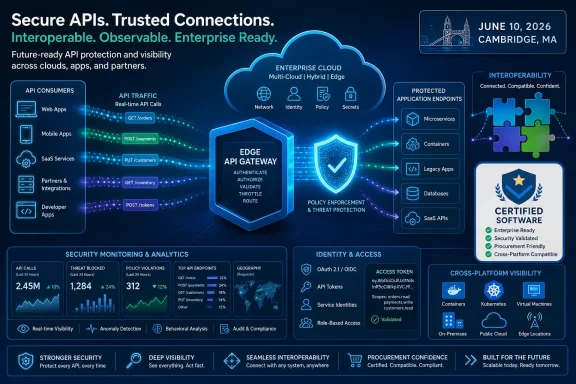
The most interesting phrase in the announcement is “cross-platform visibility.” That is the phrase enterprise security teams should linger over, because few large organizations run purely inside one cloud or one security stack. Even Microsoft-heavy shops tend to have SaaS platforms, legacy data centers, partner portals, CDN edges, Kubernetes environments, and a long tail of integrations that do not fit neatly into a single Azure diagram.This is where Akamai’s history matters. Akamai built its reputation on distributed edge infrastructure, performance, content delivery, DDoS mitigation, and web security. Its security portfolio has increasingly pushed into application and API protection, not as an afterthought but as part of a broader argument: that the edge, the cloud, and the application layer are now inseparable.
Microsoft, meanwhile, has every incentive to make Azure the marketplace where customers discover, buy, and attach third-party capabilities. The Microsoft Cloud is no longer just a set of infrastructure services. It is also a commercial channel, an identity fabric, a compliance environment, and a partner ecosystem.
That dynamic creates a useful tension. Customers want tools that work with Azure without being trapped inside Azure. Microsoft wants partners that enrich its cloud without undermining its platform story. Akamai wants to reassure buyers that its API security layer can sit across the messiness of real enterprise architecture while still fitting into Microsoft’s approved partner framework.
The AI Angle Is Not Decoration
Akamai’s announcement invokes AI adoption, and that is easy to dismiss as obligatory 2026 seasoning. Every vendor now feels compelled to mention AI, whether the connection is central or cosmetic. In this case, though, the connection is more substantial than the buzzword suggests.AI systems consume APIs, expose APIs, generate code that calls APIs, and accelerate the pace at which organizations create new integration surfaces. Agentic workflows make the problem sharper. If software agents are allowed to take actions across systems, APIs become the rails on which those actions travel.
That means API inventory and behavioral monitoring are no longer just defensive hygiene. They are preconditions for safely deploying automation. An organization that does not know which APIs exist, what data they expose, which identities can call them, and what normal use looks like is not well positioned to let AI agents operate at speed.
This is also where Microsoft’s ecosystem relevance becomes obvious. Copilot, Azure AI services, Entra, Fabric, Dynamics, Power Platform, and custom Azure workloads are all pulling enterprises toward more automation and more integration. The security problem is not that AI creates APIs from nothing. It is that AI increases the value and velocity of the API layer already holding the business together.
The Fine Print Should Keep Buyers Sober
The announcement includes Microsoft’s standard disclaimers, and those disclaimers deserve more attention than they usually receive. Microsoft explicitly avoids framing the designation as an endorsement, warranty, guarantee, or proof of effectiveness. It also makes clear that decisions about partner selection and implementation rest with the customer.That is not legal boilerplate to ignore. It is the boundary between ecosystem validation and operational assurance. A Microsoft designation may help a buyer identify software that has met certain program criteria, but it does not replace architecture review, proof-of-concept testing, data governance analysis, or incident-response planning.
Security teams should therefore treat the badge as a starting point, not a finish line. The real evaluation still involves hard questions. Which APIs can the product actually discover? How does it integrate with existing gateways and traffic paths? What telemetry does it need? How are false positives handled? Can it detect abuse of authenticated APIs, or only obvious attack signatures? How well does it map to Azure logging, SIEM workflows, and identity context?
Those questions matter because API security failures are rarely caused by the total absence of tools. They are caused by blind spots between teams: developers who publish endpoints faster than security can review them, platform teams that assume gateways are enough, business units that maintain partner integrations outside central visibility, and SOCs that see events without understanding application behavior.
Akamai Is Buying Its Way Into the Azure Conversation Without Becoming Microsoft
There is a broader market story here. Akamai is competing in a security world where Microsoft has become both partner and gravitational force. Microsoft Defender, Sentinel, Entra, Purview, Intune, and Azure-native controls occupy more of the enterprise security budget than ever. For a third-party vendor, ignoring that ecosystem is commercially dangerous.At the same time, Microsoft cannot provide every best-of-breed security control for every customer architecture, especially where cross-cloud and edge-heavy environments are involved. The partner ecosystem exists because customers need more than Microsoft can or should build itself. The certified software designation is one mechanism for making that ecosystem legible.
Akamai’s gain is therefore not merely reputational. It potentially lowers friction for Azure Marketplace discovery, procurement, and internal justification. In large enterprises, that can matter as much as a feature comparison. If a security team can acquire a tool through existing Microsoft marketplace processes, apply cloud-committed spend where applicable, and point to a Microsoft partner designation, the internal sales cycle changes.
That does not mean Akamai gets an automatic win. Microsoft customers already have many overlapping tools, from Azure API Management and Application Gateway to Defender products, Sentinel analytics, third-party WAFs, bot protection platforms, and API posture-management vendors. The burden on Akamai is to prove that its product adds visibility and protection that customers cannot easily assemble from what they already own.
The Admin’s Problem Is Still Operational, Not Semantic
For sysadmins and security engineers, the label “API Security” can conceal the real work. Tools do not secure APIs by existing. They secure APIs when traffic is routed correctly, assets are inventoried, ownership is established, policies are tuned, alerts are triaged, and developers are pulled into the loop before exposures become incidents.That is where many deployments falter. A platform can discover shadow APIs, but someone has to decide whether they are legitimate. A tool can flag anomalous behavior, but the SOC needs application context to know whether a spike is fraud, a partner integration, or a product launch. A dashboard can show risk posture, but risk does not move until teams change code, rotate secrets, restrict scopes, or retire endpoints.
The Microsoft designation does not remove that operational burden. It may make integration more straightforward, and it may reassure stakeholders that Akamai’s product has been reviewed against Microsoft’s partner-program criteria. But the day-two work remains the same: connect the telemetry, define ownership, establish response paths, and measure whether the number of unknown APIs is actually shrinking.
For Azure-centric organizations, the strongest use case is likely not “replace Microsoft security.” It is “extend visibility where Azure-native controls stop being enough.” That could mean APIs exposed through Akamai’s edge, APIs spanning clouds, APIs used by partners, or APIs whose abuse patterns require behavioral analysis beyond standard gateway policies.
Marketplace Security Is Becoming the New Enterprise Default
The rise of marketplace-attached security products is changing how enterprises buy infrastructure protection. In the old model, a vendor relationship often started with a separate sales motion, a standalone contract, and a bespoke integration plan. In the newer model, cloud marketplaces are becoming the front door.That shift favors vendors that can prove compatibility, publish transactable offers, and align with cloud-provider partner programs. It also favors cloud providers, which become not only infrastructure suppliers but distribution hubs for security and operations software. Microsoft’s partner designations are part of that transformation.
There are benefits. Procurement can be faster. Customers can compare solutions within a familiar ecosystem. Partners can package integrations more cleanly. Security teams can push for tools that are easier to justify to finance and architecture boards.
There are also risks. Badges can be overread. Marketplace presence can be mistaken for deep architectural fit. Buyers can assume that “works with Microsoft Cloud” means “works with our environment,” even when their environment includes years of exceptions, acquisitions, legacy integrations, and undocumented services.
Akamai’s announcement is a useful reminder that cloud security decisions increasingly happen in that gray zone between technical merit and ecosystem convenience. The right answer is not cynicism. It is discipline.
The Real Test Comes After the Badge
The concrete news is straightforward, but its importance will be measured later. Akamai API Security has gained a Microsoft partner-program designation for Security. The designation recognizes interoperability with Microsoft Cloud requirements. The product is positioned for organizations using Azure and other environments where API visibility and protection are increasingly difficult to maintain.The harder question is whether the designation helps customers make better security decisions. It can, if they use it correctly. It can also become just another logo on a slide if procurement treats it as a substitute for engineering validation.
The best reading is pragmatic. Microsoft’s designation helps identify Akamai API Security as a solution that has met a defined ecosystem bar. Akamai’s broader value proposition still has to be tested against the customer’s real traffic, real APIs, real developers, and real incident workflows.
Akamai’s Microsoft Win Leaves Buyers With a Shorter Excuse List
This announcement does not change the API security fundamentals, but it does remove one common objection for Microsoft-heavy shops: whether Akamai can credibly sit in the Azure conversation. That makes the next set of decisions more practical and less theoretical.- Akamai API Security has earned Microsoft’s Solutions Partner with certified software designation for Security within the Microsoft AI Cloud Partner Program.
- The designation speaks to Microsoft Cloud interoperability and program requirements, not to a Microsoft guarantee that the product will be effective in every deployment.
- The announcement matters most for enterprises using Azure alongside edge, hybrid, multi-cloud, or partner-facing API architectures.
- AI adoption raises the stakes because automated systems tend to increase API usage, API dependency, and the consequences of poor API visibility.
- Security teams should treat the designation as a procurement and integration signal, while still requiring proof-of-concept testing, telemetry review, and operational ownership.
- The practical value will depend on whether Akamai helps customers find unknown APIs, detect abusive behavior, and close the gap between application teams and security operations.
References
- Primary source: The Manila Times
Published: Wed, 10 Jun 2026 10:40:57 GMT
Akamai Earns the Solutions Partner with Certified Software Designation for Security
This designation recognizes Akamai API Security for delivering software solutions compatible with the Microsoft Cloud that demonstrate interoperability and meet program requirements www.manilatimes.net
- Official source: partner.microsoft.com
Differentiate your capabilities with Solutions Partner designations
Attain a Solutions Partner designation and drive success with badging and benefits that help you stand out to customers.partner.microsoft.com
- Official source: learn.microsoft.com
Introduction to Solutions Partner with certified software designations - Partner Center | Microsoft Learn
Learn about Solutions Partner with certified software designations.learn.microsoft.com - Official source: azuremarketplace.microsoft.com
Microsoft Marketplace | cloud solutions, AI apps, and agents
azuremarketplace.microsoft.com
- Related coverage: akamai.com
API Security | Akamai
Akamai API Security enables organizations to gain full visibility into their entire API estate with continuous detection and real-time analysis.www.akamai.com - Official source: microsoft.com
Your request has been blocked. This could be due to several reasons.
www.microsoft.com
- Related coverage: techdocs.akamai.com
API protection overview
You have options when it comes to protecting your APIs Use App & API Protector First, you can use App & API Protector to cover both your website and your public APIs. API protection features discover and mitigate API threats in requests that run through the Akamai Connected Cloud. To set...techdocs.akamai.com - Related coverage: itpro.com
LevelBlue and Akamai are teaming up to launch a managed web application and API protection service | ChannelPro
The new Managed WAAP offering aims to help organizations secure their rapidly expanding web app and API ecosystemswww.itpro.com