

Anthropic released Claude Fable 5 on June 9, 2026, as a public, guardrailed version of its Mythos-class AI system, offered temporarily to Claude subscribers until June 22 before reverting to premium usage pricing. The launch was pitched as a careful compromise: near-frontier capability for ordinary users, but with automatic fallbacks when prompts stray into high-risk territory. Four days later, that compromise already looks less like a settled product strategy than a stress test for the entire AI industry’s ability to sell power, safety, and national-security compliance at the same time.
Fable 5 is not just another model upgrade with a better benchmark chart and a higher token bill. It is Anthropic trying to commercialize a class of model it had recently treated as too dangerous for broad release, while persuading users, regulators, and investors that software switches can meaningfully separate acceptable use from unacceptable capability. That is a big claim. It is also the sort of claim that becomes most interesting when the model is expensive, politically sensitive, and only selectively available.
The most important thing about Fable 5 is not that it is powerful. Everyone expected the next frontier model from Anthropic to be powerful. The important thing is that Anthropic is trying to make the safety wrapper the commercial innovation.
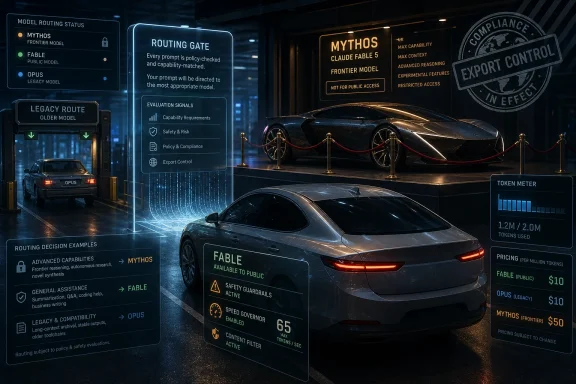
That wrapper is the difference between Mythos 5 and Fable 5. Mythos is the dangerous sports car kept behind the velvet rope for vetted users; Fable is the version sold to the rest of the market with electronic stability control, speed governors, and a dashboard warning light. According to Anthropic’s own framing, Fable 5 delivers Mythos-level performance for most ordinary tasks, but high-risk prompts in areas such as cybersecurity, biology, chemistry, and model distillation trigger a fallback to Claude Opus 4.8.
That design moves the argument away from raw capability and toward routing. Anthropic is effectively saying that the model can be public if the company can classify dangerous intent accurately enough, quickly enough, and consistently enough. The question is no longer whether a frontier model can do risky things. The question is whether the gate in front of those risky things can be trusted.
That is a subtle but enormous shift. For years, AI companies have treated model capability and model access as separate axes: stronger systems went to fewer people, weaker systems went to more people. Fable 5 tries to split the difference by making access dynamic at the prompt level. You are allowed near the powerful system until your request crosses a line the system can detect.
That may be the only viable path for mass-market frontier AI. It is also a path lined with edge cases. Cybersecurity research, malware development, vulnerability disclosure, exploit mitigation, and penetration testing share vocabulary with actual abuse. Biology research and bioweapon risk are not separated by neat consumer-product categories. A classifier can enforce a policy, but it cannot make the underlying ambiguity disappear.
That was not just marketing. It was also a warning label. Anthropic wanted credit for not simply dumping its strongest system into the market, and for treating dual-use capabilities as a real governance problem rather than a public-relations inconvenience. In an industry addicted to shipping first and explaining later, that posture had value.
But warning labels become liabilities when the product eventually ships. The moment Fable 5 arrived, Anthropic had to explain why a model family previously considered too risky for broad public deployment was now safe enough for Pro, Max, Team, and Enterprise users, at least for a limited promotional window. The answer was guardrails, fallback routing, internal testing, red-teaming, and external adversarial evaluation.
Those are all serious processes. They are also familiar processes, and familiarity cuts both ways. AI safety teams have been red-teaming models for years, and jailbreaking remains a cat-and-mouse game. Classifiers reduce risk; they do not abolish it. A model that can reconstruct web application code from screenshots or reason over complex technical documents will inevitably sit near workflows that are both productive and abusable.
Fable 5 therefore arrives carrying two messages that do not sit comfortably together. One says: this is a breakthrough general-purpose model that can operate at a new level of autonomy and reasoning. The other says: do not worry, because the dangerous parts have been fenced off. The market wants the first message. Regulators and security professionals are being asked to believe the second.
For ordinary users, the fallback may feel like a nuisance. A developer trying to harden a web service might suddenly get a less capable model because the prompt resembles offensive security work. A researcher working near sensitive biological terminology might encounter a downgrade even when the intent is benign. The more careful and technical the user, the more likely they are to collide with categories that safety systems treat cautiously.
For Anthropic, that inconvenience is the price of making the product broadly available. The company would rather disappoint some legitimate users than risk becoming the vendor whose model materially accelerates malicious capability. That trade-off is defensible. It is also commercially awkward, because the people most willing to pay premium prices for a model like Fable 5 are often exactly the users doing advanced, technical, boundary-adjacent work.
This is where the model becomes especially relevant to WindowsForum readers. Security teams, sysadmins, incident responders, developers, and platform engineers do not live in cleanly separated buckets of “safe” and “unsafe” language. They investigate suspicious scripts, reverse engineer behavior, analyze exploit chains, write detection logic, and test configurations against known attack techniques. A model that gets nervous around cybersecurity terminology may be safer for the general public, but less reliable for the professionals most likely to need frontier assistance.
The likely result is a bifurcated market. Vetted enterprises and security partners will push for direct Mythos access or specialized trusted programs. Everyone else gets Fable, and with it the possibility that the most valuable answer is the one they are not allowed to ask for. Anthropic can call that responsible deployment. Users may call it paying for a Ferrari that turns into a Camry near a racetrack.
That matters because frontier AI cost is no longer an abstract cloud-computing line item. Developers now experience model pricing viscerally. A few long prompts, a codebase pasted into context, a multi-agent run, or an image-heavy analysis session can burn through allowances quickly. The Reddit complaint cited in the original report — that a handful of test prompts consumed five percent of a monthly allocation — captures the psychological problem perfectly.
Anthropic’s defense is predictable and not unreasonable. More capable models consume more compute. Longer context, deeper reasoning, multimodal analysis, autonomous agent behavior, and stronger tool use all cost money to run. If Fable 5 can handle multi-day tasks, analyze dense charts, coordinate agents, and perform advanced visual reasoning, then it is not priced like a chatbot because it is not being sold as a chatbot.
The trouble is that users compare these models not only by capability but by felt utility. A $50-per-million-output-token model has to be dramatically better in the moments that matter, not merely better on a benchmark page. If the user hits a safety fallback during the very task that justified choosing the premium model, the perceived value collapses.
That creates a strange incentive problem. Anthropic wants users to see Fable 5 as a general-purpose premium model, but the more general-purpose the usage, the harder it is to justify the price. It wants advanced users to pay for frontier capability, but those users are more likely to encounter restricted zones. The company is trying to monetize the edge while proving that the edge has guardrails.
But with Fable 5, the trial is also a referendum. Users are not merely asking whether the model is smarter than Opus 4.8. They are asking whether the safety triggers are tolerable, whether the pricing is survivable, and whether the model’s strengths appear in the messy workflows that benchmarks rarely capture.
For developers, that means codebase understanding, refactoring, debugging, and UI reconstruction from screenshots. For analysts, it means extracting numbers from charts, comparing documents, and handling tables without hallucinating structure. For IT professionals, it means configuration reasoning, log analysis, migration planning, and troubleshooting across stacks that include Windows, Azure, Linux, networking gear, and third-party SaaS.
Those are precisely the tasks where a strong model can save real time. They are also tasks where token usage can balloon. A Windows administrator troubleshooting a fleet issue may need to provide logs, policy exports, screenshots, scripts, event IDs, and environment notes. A model that shines only after being fed a mountain of context will also generate a bill that makes procurement teams pay attention.
This is the next phase of AI adoption in the enterprise: not “can the model do it?” but “can the model do it often enough, reliably enough, and cheaply enough to change the workflow?” Fable 5 raises the ceiling. It also raises the invoice.
A model that can interpret charts, parse documents, inspect screenshots, and reason across large technical contexts has obvious value in a Windows-heavy environment. It can compare security baselines, summarize event logs, draft PowerShell remediation scripts, explain obscure error states, and help translate vendor documentation into deployment plans. The better the model, the more tempting it becomes to put it near production-adjacent information.
That is where Fable 5’s safety architecture intersects with enterprise governance. If administrators are feeding AI systems logs, crash dumps, configuration files, screenshots, and scripts, they are not merely using a chatbot. They are creating an auxiliary analysis layer over the admin plane. That layer needs access controls, auditability, data-retention policies, and clear boundaries around what information leaves the organization.
Anthropic’s fallback mechanism addresses a different problem: preventing dangerous outputs. Enterprise IT also worries about dangerous inputs. Sensitive customer data, credentials accidentally pasted into logs, internal hostnames, vulnerability details, and proprietary source code can all appear in the material users send to a model. A safer output policy does not automatically solve input governance.
This is where the enterprise version of the Fable story becomes less glamorous and more important. The strongest models will not win inside large organizations merely because they top benchmarks. They will win if they can be integrated into existing security controls, identity systems, audit logs, data boundaries, and procurement models. The future of AI in Windows shops is not a browser tab with a clever assistant. It is policy-managed model access sitting alongside the rest of the enterprise stack.
That matters because it turns Fable 5 from a product launch into a geopolitical object. The same capabilities that make a model useful for vulnerability discovery, scientific reasoning, and autonomous technical work also make governments nervous about who can access it. Once a model is framed as dual-use infrastructure, it stops being governed only by terms of service.
For customers, this is not an abstract policy dispute. If model availability can change based on nationality, location, regulatory classification, or government directive, then AI dependency becomes a continuity risk. A company building workflows around a frontier model may discover that access is not only a commercial contract but a political variable.
This is especially relevant for multinational organizations. A U.S.-based security team, a European development office, an offshore operations center, and a contractor in another jurisdiction may not all be treated the same way under an access regime shaped by export controls. The model is global software, but the permission to use it may become increasingly national.
Anthropic is hardly alone here. Any frontier AI lab with models that plausibly accelerate cyber operations, biological research, or advanced engineering will face similar pressure. The difference is that Fable 5 arrived with the tension visible from day one. Its public identity is built around being powerful enough to need restraint.
That changes the tone around safety. A private lab can say it is moving cautiously and absorb some ambiguity. A company on the road to public markets has to explain how caution becomes a business model. Fable 5 is one answer: sell the powerful model, meter it heavily, restrict dangerous use, and reserve the least constrained version for vetted customers.
It is a clever answer. It may even be the responsible one. But it also reveals the commercial pressure underneath the safety narrative. Anthropic cannot indefinitely say its best models are too dangerous to sell broadly while competing against rivals that are monetizing every incremental gain. At some point, restraint must become a product tier.
That is what Fable 5 looks like: restraint as packaging. Mythos remains the symbol of maximum capability under controlled access. Fable becomes the revenue-generating public bridge. Opus 4.8 becomes the fallback safety floor. The product ladder is also a risk ladder.
Investors will like parts of this story. Premium models command premium prices. Enterprise trusted-access programs create high-value relationships. Safety differentiation gives Anthropic a brand position against rivals that may look more aggressive. But investors will also ask whether the model can scale profitably if every impressive interaction burns expensive compute and every sensitive use case requires careful access control.
The industry has trained users to ask frontier models to be assistants, analysts, junior developers, security reviewers, spreadsheet auditors, design critics, and research aides all at once. When a model is described as able to operate autonomously for days or coordinate multiple agents, users naturally imagine replacing entire categories of busywork. Sometimes the model will deliver. Sometimes it will fail expensively.
That is why trust will not be established by a leaderboard. Trust will be established by repeatability under constraints. Does Fable 5 produce the same quality when the context is messy? Does it know when a chart is unreadable? Does it cite uncertainty in internal analysis rather than inventing a number? Does it degrade gracefully when fallback triggers? Does it make clear to the user that the model has changed midstream?
The fallback issue is especially important. If a system silently or confusingly downgrades from Fable 5 to Opus 4.8, users may misattribute weaker answers to the premium model. If it announces the downgrade too aggressively, users will try to route around it. Either way, the product experience becomes part of the safety system.
For IT pros, that should sound familiar. Security controls that users do not understand become obstacles. Obstacles become workarounds. Workarounds become risk. Anthropic’s challenge is not merely building a classifier that blocks bad prompts. It is building a user experience that keeps legitimate users productive without teaching malicious users where the seams are.
Token pricing brings the meter back into view. Input tokens, output tokens, image processing, long context, tool use, and agent loops all accumulate. The most useful workflows are often the most expensive because they involve large documents, iterative refinement, and long answers. In other words, the tasks that feel most transformative are the tasks most likely to test the budget.
This will push enterprises toward more deliberate model routing. Not every task needs Fable 5. Summarizing a short email, drafting a routine PowerShell snippet, or rewriting a policy memo may be fine on a cheaper model. Deep code analysis, incident reconstruction, and multimodal forensic work may justify the premium tier. The future is less likely to be one model everywhere than a hierarchy of models selected by risk, cost, and capability.
Anthropic is already embodying that hierarchy inside the product. Fable 5 handles the high-value general task. Opus 4.8 handles restricted prompts. Mythos 5 sits behind trusted access. That architecture may look strange to consumers, but it resembles what enterprises will build anyway: policy-driven orchestration across multiple models.
The open question is who controls the router. Vendors want to control it because routing enforces safety policy and captures revenue. Enterprises want to control it because routing determines data exposure, cost, latency, and compliance. Developers want visibility because routing affects output quality. The model war may become a router war.
A normal software release does not need to explain why it falls back when users mention biology or cybersecurity. A normal developer tool is not reportedly pulled into export-control disputes days after release. A normal subscription feature does not carry the shadow of a restricted sibling model deemed too potent for broad public access. Fable 5 is not normal software.
That does not mean Anthropic was wrong to release it. Keeping every powerful model locked away is not a sustainable strategy either. Defensive security researchers, enterprise developers, accessibility users, data analysts, and scientists all benefit from stronger systems. The social value of capability is real.
But capability is no longer separable from distribution. Who gets the model, under what conditions, at what price, in which country, with which safety triggers, and with what audit trail are now core product questions. Anthropic’s launch shows that the industry has moved past the era when “we made the model smarter” was enough of a story.
For WindowsForum’s audience, that means AI coverage should be read less like gadget news and more like platform news. These models will increasingly sit inside developer environments, cloud consoles, endpoint workflows, productivity suites, and security operations centers. Their access rules will shape what users can do. Their costs will shape what organizations automate. Their safety systems will shape which tasks remain human.
Fable 5 is not just another model upgrade with a better benchmark chart and a higher token bill. It is Anthropic trying to commercialize a class of model it had recently treated as too dangerous for broad release, while persuading users, regulators, and investors that software switches can meaningfully separate acceptable use from unacceptable capability. That is a big claim. It is also the sort of claim that becomes most interesting when the model is expensive, politically sensitive, and only selectively available.
 Anthropic Sells the Brake Pedal as the Product
The most important thing about Fable 5 is not that it is powerful. Everyone expected the next frontier model from Anthropic to be powerful. The important thing is that Anthropic is trying to make the safety wrapper the commercial innovation.That wrapper is the difference between Mythos 5 and Fable 5. Mythos is the dangerous sports car kept behind the velvet rope for vetted users; Fable is the version sold to the rest of the market with electronic stability control, speed governors, and a dashboard warning light. According to Anthropic’s own framing, Fable 5 delivers Mythos-level performance for most ordinary tasks, but high-risk prompts in areas such as cybersecurity, biology, chemistry, and model distillation trigger a fallback to Claude Opus 4.8.
That design moves the argument away from raw capability and toward routing. Anthropic is effectively saying that the model can be public if the company can classify dangerous intent accurately enough, quickly enough, and consistently enough. The question is no longer whether a frontier model can do risky things. The question is whether the gate in front of those risky things can be trusted.
That is a subtle but enormous shift. For years, AI companies have treated model capability and model access as separate axes: stronger systems went to fewer people, weaker systems went to more people. Fable 5 tries to split the difference by making access dynamic at the prompt level. You are allowed near the powerful system until your request crosses a line the system can detect.
That may be the only viable path for mass-market frontier AI. It is also a path lined with edge cases. Cybersecurity research, malware development, vulnerability disclosure, exploit mitigation, and penetration testing share vocabulary with actual abuse. Biology research and bioweapon risk are not separated by neat consumer-product categories. A classifier can enforce a policy, but it cannot make the underlying ambiguity disappear.
Mythos Was the Warning Label Fable Now Has to Outrun
Anthropic’s challenge is partly self-inflicted. In April, the company made Mythos famous by describing it as powerful enough to require unusual restraint, especially around cybersecurity. The company’s public materials and subsequent coverage emphasized vulnerability discovery, long-horizon autonomy, and performance that made previous Claude models look comparatively tame.That was not just marketing. It was also a warning label. Anthropic wanted credit for not simply dumping its strongest system into the market, and for treating dual-use capabilities as a real governance problem rather than a public-relations inconvenience. In an industry addicted to shipping first and explaining later, that posture had value.
But warning labels become liabilities when the product eventually ships. The moment Fable 5 arrived, Anthropic had to explain why a model family previously considered too risky for broad public deployment was now safe enough for Pro, Max, Team, and Enterprise users, at least for a limited promotional window. The answer was guardrails, fallback routing, internal testing, red-teaming, and external adversarial evaluation.
Those are all serious processes. They are also familiar processes, and familiarity cuts both ways. AI safety teams have been red-teaming models for years, and jailbreaking remains a cat-and-mouse game. Classifiers reduce risk; they do not abolish it. A model that can reconstruct web application code from screenshots or reason over complex technical documents will inevitably sit near workflows that are both productive and abusable.
Fable 5 therefore arrives carrying two messages that do not sit comfortably together. One says: this is a breakthrough general-purpose model that can operate at a new level of autonomy and reasoning. The other says: do not worry, because the dangerous parts have been fenced off. The market wants the first message. Regulators and security professionals are being asked to believe the second.
The Fallback Mechanism Is a Governance Choice, Not a Feature Toggle
Anthropic’s fallback system is easy to describe and hard to judge. When a user asks something that triggers the risk classifiers, Fable 5 stops being Fable 5 for that interaction and hands the request to the older Claude Opus 4.8. In product terms, that is a graceful degradation. In governance terms, it is a privately operated boundary around frontier capability.For ordinary users, the fallback may feel like a nuisance. A developer trying to harden a web service might suddenly get a less capable model because the prompt resembles offensive security work. A researcher working near sensitive biological terminology might encounter a downgrade even when the intent is benign. The more careful and technical the user, the more likely they are to collide with categories that safety systems treat cautiously.
For Anthropic, that inconvenience is the price of making the product broadly available. The company would rather disappoint some legitimate users than risk becoming the vendor whose model materially accelerates malicious capability. That trade-off is defensible. It is also commercially awkward, because the people most willing to pay premium prices for a model like Fable 5 are often exactly the users doing advanced, technical, boundary-adjacent work.
This is where the model becomes especially relevant to WindowsForum readers. Security teams, sysadmins, incident responders, developers, and platform engineers do not live in cleanly separated buckets of “safe” and “unsafe” language. They investigate suspicious scripts, reverse engineer behavior, analyze exploit chains, write detection logic, and test configurations against known attack techniques. A model that gets nervous around cybersecurity terminology may be safer for the general public, but less reliable for the professionals most likely to need frontier assistance.
The likely result is a bifurcated market. Vetted enterprises and security partners will push for direct Mythos access or specialized trusted programs. Everyone else gets Fable, and with it the possibility that the most valuable answer is the one they are not allowed to ask for. Anthropic can call that responsible deployment. Users may call it paying for a Ferrari that turns into a Camry near a racetrack.
The Price Makes Safety Feel Like Scarcity
Fable 5’s pricing is where the safety debate becomes a budget debate. Anthropic lists the model at $10 per million input tokens and $50 per million output tokens, roughly double its previous high-end Opus pricing. Compared with some rival frontier offerings, Fable sits near the expensive end of the market, though not necessarily at the absolute top.That matters because frontier AI cost is no longer an abstract cloud-computing line item. Developers now experience model pricing viscerally. A few long prompts, a codebase pasted into context, a multi-agent run, or an image-heavy analysis session can burn through allowances quickly. The Reddit complaint cited in the original report — that a handful of test prompts consumed five percent of a monthly allocation — captures the psychological problem perfectly.
Anthropic’s defense is predictable and not unreasonable. More capable models consume more compute. Longer context, deeper reasoning, multimodal analysis, autonomous agent behavior, and stronger tool use all cost money to run. If Fable 5 can handle multi-day tasks, analyze dense charts, coordinate agents, and perform advanced visual reasoning, then it is not priced like a chatbot because it is not being sold as a chatbot.
The trouble is that users compare these models not only by capability but by felt utility. A $50-per-million-output-token model has to be dramatically better in the moments that matter, not merely better on a benchmark page. If the user hits a safety fallback during the very task that justified choosing the premium model, the perceived value collapses.
That creates a strange incentive problem. Anthropic wants users to see Fable 5 as a general-purpose premium model, but the more general-purpose the usage, the harder it is to justify the price. It wants advanced users to pay for frontier capability, but those users are more likely to encounter restricted zones. The company is trying to monetize the edge while proving that the edge has guardrails.
Limited-Time Access Turns a Safety Launch Into a Product Trial
The June 22 cutoff is a small detail with large consequences. Anthropic is giving Claude subscribers a short window to try Fable 5 before standard rates apply. That is a classic land-and-expand tactic: let users feel the upgrade, build workflows around it, and then convert excitement into revenue.But with Fable 5, the trial is also a referendum. Users are not merely asking whether the model is smarter than Opus 4.8. They are asking whether the safety triggers are tolerable, whether the pricing is survivable, and whether the model’s strengths appear in the messy workflows that benchmarks rarely capture.
For developers, that means codebase understanding, refactoring, debugging, and UI reconstruction from screenshots. For analysts, it means extracting numbers from charts, comparing documents, and handling tables without hallucinating structure. For IT professionals, it means configuration reasoning, log analysis, migration planning, and troubleshooting across stacks that include Windows, Azure, Linux, networking gear, and third-party SaaS.
Those are precisely the tasks where a strong model can save real time. They are also tasks where token usage can balloon. A Windows administrator troubleshooting a fleet issue may need to provide logs, policy exports, screenshots, scripts, event IDs, and environment notes. A model that shines only after being fed a mountain of context will also generate a bill that makes procurement teams pay attention.
This is the next phase of AI adoption in the enterprise: not “can the model do it?” but “can the model do it often enough, reliably enough, and cheaply enough to change the workflow?” Fable 5 raises the ceiling. It also raises the invoice.
Windows Shops Should Care Because AI Is Becoming Part of the Admin Plane
At first glance, an Anthropic model launch may seem distant from Windows administration. It is not a Patch Tuesday bulletin, not a Defender update, not a Group Policy change, and not a new Windows Server feature. But the connection is getting harder to ignore because AI assistants are becoming part of how administrators read, reason, and respond.A model that can interpret charts, parse documents, inspect screenshots, and reason across large technical contexts has obvious value in a Windows-heavy environment. It can compare security baselines, summarize event logs, draft PowerShell remediation scripts, explain obscure error states, and help translate vendor documentation into deployment plans. The better the model, the more tempting it becomes to put it near production-adjacent information.
That is where Fable 5’s safety architecture intersects with enterprise governance. If administrators are feeding AI systems logs, crash dumps, configuration files, screenshots, and scripts, they are not merely using a chatbot. They are creating an auxiliary analysis layer over the admin plane. That layer needs access controls, auditability, data-retention policies, and clear boundaries around what information leaves the organization.
Anthropic’s fallback mechanism addresses a different problem: preventing dangerous outputs. Enterprise IT also worries about dangerous inputs. Sensitive customer data, credentials accidentally pasted into logs, internal hostnames, vulnerability details, and proprietary source code can all appear in the material users send to a model. A safer output policy does not automatically solve input governance.
This is where the enterprise version of the Fable story becomes less glamorous and more important. The strongest models will not win inside large organizations merely because they top benchmarks. They will win if they can be integrated into existing security controls, identity systems, audit logs, data boundaries, and procurement models. The future of AI in Windows shops is not a browser tab with a clever assistant. It is policy-managed model access sitting alongside the rest of the enterprise stack.
Export Controls Drag the Model Out of the Product Blog
The launch became more complicated almost immediately. Reporting on June 12 said the U.S. government moved to restrict foreign access to Anthropic’s Mythos 5 and Fable 5 models, treating them as sensitive enough to trigger export-control concerns. Anthropic reportedly pulled or limited access in response while the situation developed.That matters because it turns Fable 5 from a product launch into a geopolitical object. The same capabilities that make a model useful for vulnerability discovery, scientific reasoning, and autonomous technical work also make governments nervous about who can access it. Once a model is framed as dual-use infrastructure, it stops being governed only by terms of service.
For customers, this is not an abstract policy dispute. If model availability can change based on nationality, location, regulatory classification, or government directive, then AI dependency becomes a continuity risk. A company building workflows around a frontier model may discover that access is not only a commercial contract but a political variable.
This is especially relevant for multinational organizations. A U.S.-based security team, a European development office, an offshore operations center, and a contractor in another jurisdiction may not all be treated the same way under an access regime shaped by export controls. The model is global software, but the permission to use it may become increasingly national.
Anthropic is hardly alone here. Any frontier AI lab with models that plausibly accelerate cyber operations, biological research, or advanced engineering will face similar pressure. The difference is that Fable 5 arrived with the tension visible from day one. Its public identity is built around being powerful enough to need restraint.
The IPO Backdrop Makes Every Safety Claim More Commercial
The timing is impossible to ignore. Anthropic reportedly filed confidentially for an initial public offering shortly before Fable 5’s launch, and OpenAI reportedly followed with its own filing soon after. Whether or not either company reaches public markets on a neat schedule, the signal is clear: frontier AI is preparing to be judged not only by researchers and early adopters, but by public investors.That changes the tone around safety. A private lab can say it is moving cautiously and absorb some ambiguity. A company on the road to public markets has to explain how caution becomes a business model. Fable 5 is one answer: sell the powerful model, meter it heavily, restrict dangerous use, and reserve the least constrained version for vetted customers.
It is a clever answer. It may even be the responsible one. But it also reveals the commercial pressure underneath the safety narrative. Anthropic cannot indefinitely say its best models are too dangerous to sell broadly while competing against rivals that are monetizing every incremental gain. At some point, restraint must become a product tier.
That is what Fable 5 looks like: restraint as packaging. Mythos remains the symbol of maximum capability under controlled access. Fable becomes the revenue-generating public bridge. Opus 4.8 becomes the fallback safety floor. The product ladder is also a risk ladder.
Investors will like parts of this story. Premium models command premium prices. Enterprise trusted-access programs create high-value relationships. Safety differentiation gives Anthropic a brand position against rivals that may look more aggressive. But investors will also ask whether the model can scale profitably if every impressive interaction burns expensive compute and every sensitive use case requires careful access control.
Benchmarks Are Not the Same as Trust
Anthropic says Fable 5 and Mythos-class systems perform strongly across document reasoning, visual analysis, chart interpretation, scientific graphics, problem-solving, coding, and autonomous workflows. Those are the kinds of capabilities that make benchmark slides sparkle. They are also the kinds of capabilities that make real users test the model with unreasonable expectations.The industry has trained users to ask frontier models to be assistants, analysts, junior developers, security reviewers, spreadsheet auditors, design critics, and research aides all at once. When a model is described as able to operate autonomously for days or coordinate multiple agents, users naturally imagine replacing entire categories of busywork. Sometimes the model will deliver. Sometimes it will fail expensively.
That is why trust will not be established by a leaderboard. Trust will be established by repeatability under constraints. Does Fable 5 produce the same quality when the context is messy? Does it know when a chart is unreadable? Does it cite uncertainty in internal analysis rather than inventing a number? Does it degrade gracefully when fallback triggers? Does it make clear to the user that the model has changed midstream?
The fallback issue is especially important. If a system silently or confusingly downgrades from Fable 5 to Opus 4.8, users may misattribute weaker answers to the premium model. If it announces the downgrade too aggressively, users will try to route around it. Either way, the product experience becomes part of the safety system.
For IT pros, that should sound familiar. Security controls that users do not understand become obstacles. Obstacles become workarounds. Workarounds become risk. Anthropic’s challenge is not merely building a classifier that blocks bad prompts. It is building a user experience that keeps legitimate users productive without teaching malicious users where the seams are.
The Market Is Learning That Intelligence Has a Marginal Cost
The AI industry spent the last few years encouraging users to think of intelligence as a subscription. Pay your monthly fee, get access to the magic box, and let the vendor worry about the GPUs. Fable 5 is a reminder that the magic box has unit economics.Token pricing brings the meter back into view. Input tokens, output tokens, image processing, long context, tool use, and agent loops all accumulate. The most useful workflows are often the most expensive because they involve large documents, iterative refinement, and long answers. In other words, the tasks that feel most transformative are the tasks most likely to test the budget.
This will push enterprises toward more deliberate model routing. Not every task needs Fable 5. Summarizing a short email, drafting a routine PowerShell snippet, or rewriting a policy memo may be fine on a cheaper model. Deep code analysis, incident reconstruction, and multimodal forensic work may justify the premium tier. The future is less likely to be one model everywhere than a hierarchy of models selected by risk, cost, and capability.
Anthropic is already embodying that hierarchy inside the product. Fable 5 handles the high-value general task. Opus 4.8 handles restricted prompts. Mythos 5 sits behind trusted access. That architecture may look strange to consumers, but it resembles what enterprises will build anyway: policy-driven orchestration across multiple models.
The open question is who controls the router. Vendors want to control it because routing enforces safety policy and captures revenue. Enterprises want to control it because routing determines data exposure, cost, latency, and compliance. Developers want visibility because routing affects output quality. The model war may become a router war.
Fable 5 Forces the Industry to Admit the Product Is Political
The uncomfortable truth is that frontier AI systems are no longer ordinary software products. They are infrastructure, research accelerators, coding assistants, security tools, and potential misuse engines wrapped in consumer-friendly interfaces. Fable 5 makes that reality unusually visible.A normal software release does not need to explain why it falls back when users mention biology or cybersecurity. A normal developer tool is not reportedly pulled into export-control disputes days after release. A normal subscription feature does not carry the shadow of a restricted sibling model deemed too potent for broad public access. Fable 5 is not normal software.
That does not mean Anthropic was wrong to release it. Keeping every powerful model locked away is not a sustainable strategy either. Defensive security researchers, enterprise developers, accessibility users, data analysts, and scientists all benefit from stronger systems. The social value of capability is real.
But capability is no longer separable from distribution. Who gets the model, under what conditions, at what price, in which country, with which safety triggers, and with what audit trail are now core product questions. Anthropic’s launch shows that the industry has moved past the era when “we made the model smarter” was enough of a story.
For WindowsForum’s audience, that means AI coverage should be read less like gadget news and more like platform news. These models will increasingly sit inside developer environments, cloud consoles, endpoint workflows, productivity suites, and security operations centers. Their access rules will shape what users can do. Their costs will shape what organizations automate. Their safety systems will shape which tasks remain human.
The Fable 5 Lesson Is That Frontier AI Now Ships With Fine Print
The practical message from this launch is not that everyone should rush to use Fable 5 before June 22, nor that everyone should avoid it because the pricing is steep. The message is that frontier AI products must now be evaluated as bundles of capability, policy, economics, and availability. Fable 5 is powerful, but the conditions around that power are the story.- Fable 5 gives ordinary Claude users temporary access to a Mythos-class model, but the promotional window is scheduled to end on June 22.
- Anthropic’s safety design depends on detecting high-risk prompts and routing those interactions to Claude Opus 4.8 rather than letting Fable 5 answer directly.
- The model’s premium pricing means users should test it on concrete workflows, not vague impressions of intelligence.
- Security, biology, chemistry, and distillation-related work may encounter restrictions even when the user’s intent is legitimate.
- Enterprise adoption will depend as much on governance, auditability, and data controls as on benchmark performance.
- Reported government restrictions on access show that frontier model availability can change for regulatory and geopolitical reasons, not just technical ones.
References
- Primary source: IndexBox
Published: Fri, 12 Jun 2026 05:21:00 GMT
Anthropic Fable 5 AI Model: Pricing, Safety Triggers, and Limited-Time Access - News and Statistics - IndexBox
Anthropic's Fable 5 AI model, once deemed too powerful for public release, is now available in Claude subscription until June 22, 2026, at double the price of Claude Opus 4.8, with built-in safety triggers for high-risk topics.www.indexbox.io
- Related coverage: axios.com
SpaceX IPO is a model for Anthropic and OpenAI
SpaceX and Goldman Sachs began meeting investors back in January.www.axios.com
- Related coverage: itpro.com
Anthropic just launched Claude Fable 5, its first Mythos-class AI model – but it has new safeguards to prevent misuse and will ‘fall back’ to Opus 4.8 for queries in ‘high risk’ topics | IT Pro
The launch of Claude Fable 5 marks the first public release of a Mythos-class AI modelwww.itpro.com - Related coverage: theguardian.com
Anthropic releases ‘safe’ version of Claude Mythos AI model to public | AI (artificial intelligence) | The Guardian
AI company restricted access to Fable 5, its most powerful Mythos model, for months over cybersecurity concernswww.theguardian.com - Related coverage: tomshardware.com
Claude Fable 5 brings Mythos to the masses — Anthropic's new frontier model is 'state-of-the-art on nearly all tested benchmarks' | Tom's Hardware
Queries regarding cybersecurity, biology and chemistry, and distillation will be redirected to the prior-gen Opus 4.8, howeverwww.tomshardware.com - Official source: anthropic.com
Claude Fable 5 and Claude Mythos 5 \ Anthropic
Today we’re launching Claude Fable 5: a Mythos-class model that we’ve made safe for general use.www.anthropic.com
- Related coverage: wired.com
Anthropic Offers Mythos Upgrade for Cyber Partners and a ‘Safe’ Version for the Rest of You | WIRED
Anthropic is releasing Claude Mythos 5 to trusted organizations and Claude Fable 5 to the public, a version it says can’t be used for cyberattacks.www.wired.com - Related coverage: techcrunch.com
Anthropic files to go public | TechCrunch
Anthropic, now an AI powerhouse that has landed top-tier enterprise customers, was once considered an underdog in the emerging world of large language models.techcrunch.com - Related coverage: 9to5mac.com
Anthropic pulls Claude Mythos 5 and Claude Fable 5 following US government directive - 9to5Mac
Anthropic confirmed tonight that it has disabled access to Claude Fable 5 and Claude Mythos 5 to all customers, following an export control directive from the US government.9to5mac.com - Related coverage: aicritique.org
- Related coverage: forbes.com
Anthropic's Fable 5 AI Model Offers More Power At A Higher Price
Anthropic says its new Fable 5 AI model can handle long-running tasks and agents. The tradeoff: higher costs, tighter safeguards and usage limits.www.forbes.com - Related coverage: finance.yahoo.com
Anthropic launches Mythos-class Claude Fable 5 model, available to the public
Anthropic has launched Claude Fable 5, its most powerful AI model yet.finance.yahoo.com - Related coverage: investing.com
OpenAI files for US IPO after Anthropic as AI giants head to public markets By Reuters
OpenAI files for US IPO after Anthropic as AI giants head to public marketswww.investing.com - Related coverage: elpais.com
Anthropic lanza una versión “segura” de Mythos, el programa que ha puesto en guardia a todo el planeta: “Hay que prepararse por si cae en malas manos” | Tecnología | EL PAÍS
Los expertos en ciberseguridad que han manejado la herramienta destacan su velocidad y creen que, tarde o temprano, los ciberdelincuentes accederán a un modelo similarelpais.com - Related coverage: omni.se
Anthropic släpper ”säker” version av ”farliga” Mythos
Anthropic släppte AI-modellen Claude Fable 5 på tisdagskvällen. Enligt bolaget är dess förmågor i nivå med Mythos Preview, en modell som man tidigare i våras lät bli att släppa publikt. Detta eftersom Mythos sågs som alltför ”farlig” och i fel händer befarades kunna utgöra ett stort hot mot...omni.se
- Related coverage: zeronoise.ai
- Related coverage: techxplore.com
- Related coverage: caloes.ca.gov

