

Apple began distributing a second developer beta of AirPods firmware version 9 on June 23, 2026, alongside watchOS 27 beta 2, expanding testing of iOS 27-era audio features to supported AirPods models including AirPods Max 2. The release is small in the way firmware betas usually are, but it points to a larger Apple strategy: AirPods are becoming a software platform, not just an accessory line. For WindowsForum readers, the interesting part is not whether a custom equalizer makes cymbals brighter; it is how Apple keeps moving more personal-computing behavior into tightly managed, cross-device firmware.
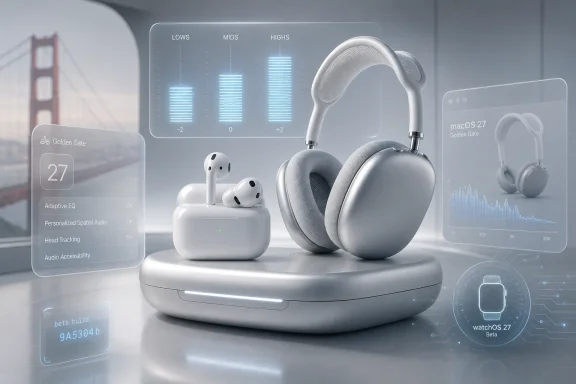
The headline feature in this AirPods beta cycle is custom EQ, a feature that would have sounded mundane on a Windows sound card in 2004 and strangely overdue on premium Apple headphones in 2026. Apple announced the capability at WWDC 2026 as part of its broader iOS 27, iPadOS 27, and macOS 27 Golden Gate platform push, and the first AirPods beta brought that promise into developer hands. The second beta, build 9A5304b, is less about spectacle than about making that new audio stack testable across the product line.
That product line matters. According to the reports, the beta is available for AirPods Pro 2 in both Lightning and USB-C case variants, AirPods Pro 3, AirPods 4, AirPods 4 with ANC, and AirPods Max 2. The inclusion of AirPods Max 2 is especially notable because 9to5Mac frames this as the first beta build for Apple’s newest over-ear headphones, making the Max line part of the same firmware experiment rather than a prestige product left on its own island.
Apple’s AirPods story has always had a split personality. The devices are marketed as effortless consumer audio products, yet they increasingly behave like tiny managed endpoints: firmware-controlled, feature-gated, OS-dependent, and deeply tied to Apple’s update calendar. A custom EQ slider is therefore not just a nice-to-have for listeners who want more bass; it is another example of Apple treating audio preferences as part of the operating system.
That is where the Windows angle comes in. Microsoft’s world still tends to expose audio as a stack of drivers, control panels, OEM utilities, spatial sound formats, Bluetooth profiles, and occasionally bewildering vendor apps. Apple’s counteroffer is a narrower lane with fewer knobs, but the knobs it does expose arrive as part of a choreographed platform release.
The lateness is not accidental. Apple often withholds granular controls until it can wrap them in a model of user experience it considers safe, consistent, and brand-compatible. The company’s default posture is that most people should not have to think about audio curves, codec behavior, or firmware versions; the device should simply sound like an AirPod.
But beta firmware tells a different story. The moment Apple exposes custom EQ, it also has to test how those curves interact with Adaptive Audio, ANC, Transparency mode, hearing health features, voice isolation, device switching, and app-specific playback. Modern AirPods are no longer passive speakers connected by Bluetooth; they are signal-processing devices with microphones, motion sensors, chips, and a relationship with every screen in Apple’s ecosystem.
That complexity explains why the feature is being staged through developer firmware rather than tossed into a public toggle and forgotten. Apple needs developers and early adopters to find the edges: settings that do not persist, profiles that sound different across devices, EQ curves that conflict with accessibility adjustments, and firmware that behaves differently depending on whether the source is an iPhone, iPad, Mac, or watch. A three-band adjustment can be simple for users and still be complicated for the platform.
That matters because AirPods Max 2 reportedly brought Apple’s newer H2-based feature set to the over-ear design, closing a gap that had made the original AirPods Max feel increasingly out of step with AirPods Pro. Features like adaptive listening modes and improved processing are only as useful as the firmware cadence behind them. Hardware parity without software parity would have made the Max line look ornamental.
The custom EQ feature is also more consequential on over-ear headphones than on earbuds. Earbuds are highly dependent on fit, seal, ear shape, and tip selection; over-ear headphones tend to give users a more stable baseline, which makes EQ changes easier to hear and easier to judge. If Apple wants AirPods Max 2 to appeal to users who care about tuning, the ability to participate in the same firmware beta program is a necessary move.
There is still a catch. AirPods firmware updates remain opaque compared with the update mechanisms PC users expect. Even when Apple adds a beta update setting, the actual install process still depends on proximity, charging state, paired devices, and Apple’s behind-the-scenes timing. This is Apple’s comfort zone: enough visibility to reassure testers, not enough control to let users treat AirPods like a manually flashed peripheral.
That asymmetry is the most important practical detail in the release. Apple’s beta path is increasingly easy to enter, but still difficult to exit. The reports note that the only way back to a stable release may be through Apple service, which is exactly the sort of friction that should keep curious users from experimenting on their primary headphones.
For developers, this may be acceptable. If you build apps that rely on AirPods behavior, Bluetooth audio routing, spatial audio, call handling, or low-latency media, testing prerelease firmware is part of the job. For everyday users, it is a risk wrapped in the thrill of getting a feature early.
Windows veterans will recognize the pattern, even if the mechanics differ. A BIOS beta, a preview GPU driver, or a Windows Insider build can unlock something useful before release, but it can also leave a machine in a liminal state where the fix is “wait for the next build.” Apple’s difference is that it hides more of the machinery, which can make the experience feel safer than it is.
Apple’s approach compresses that into fewer visible surfaces. The AirPods firmware, iOS settings pane, macOS integration, and Apple developer channel behave like one coordinated system. That coordination is the product’s appeal, but it also means users have fewer independent levers when something goes wrong.
This is the central trade-off of modern consumer computing. The old PC model gave users more control and more ways to break things. Apple gives users a polished path and then decides where the guardrails go. Custom EQ is a perfect example: Apple held the feature back for years, and now that it is arriving, it is arriving on Apple’s terms, through Apple’s beta channel, for Apple-selected devices.
For IT pros, the lesson is not that one model is obviously better. It is that peripherals are now part of endpoint management whether or not organizations treat them that way. A set of headphones can affect call quality, accessibility, conferencing reliability, privacy expectations, and user productivity. Firmware that once sounded like consumer trivia now belongs in the same conversation as laptop builds and mobile OS versions.
The update apparently does not include Siri AI, and reports say it may not yet be available for Apple Watch Ultra 3. Those two details are more revealing than the build number. Apple’s AI rollout remains staggered and cautious, while the Ultra hardware line appears to be following its own availability rhythm inside the beta program.
That is not unusual for Apple betas, but it complicates the public story. WWDC announcements tend to present platform updates as a unified wave. Developer beta cycles reveal the seams: features missing from one build, hardware excluded from another, AI functionality arriving later than the headline implied.
For Watch users, beta 2 is therefore less a destination than a checkpoint. Developers need it because complications, health workflows, notification behavior, workout integrations, and continuity features can break between major watchOS versions. Ordinary users should mostly read it as a sign that Apple’s 2026 platform release train is moving, not as an invitation to put prerelease software on the device that tracks their sleep, workouts, heart rate, and emergency interactions.
This is why AirPods custom EQ belongs in the same conversation as iOS 27 and macOS 27 Golden Gate. If the setting lives on an iPhone but affects audio from a Mac, if the firmware is installed through a paired device but used during a video call, and if preferences need to persist across contexts, then the feature is only as reliable as the platform glue around it. The software release is the product.
The same logic applies to watchOS. Apple Watch depends on the iPhone for setup, on iCloud for continuity, on AirPods for audio, on health services for data, and on developers for the apps that make its sensors useful. A beta delay or missing feature on one device can ripple across the experience.
This is the advantage Apple has over the classic Windows hardware ecosystem. Microsoft can improve Windows Bluetooth behavior, build better Settings pages, and pressure OEMs toward cleaner driver delivery, but it cannot dictate the entire chain from earbud firmware to phone OS to desktop app behavior. Apple can, and this beta is a small example of what that control enables.
That calm surface can obscure risk. Users may not understand that AirPods beta firmware is not like toggling a hidden setting. They may not realize that a custom EQ experiment could come with call instability, battery quirks, connection oddities, or incompatibilities with non-Apple devices. They may assume that because the toggle is in Settings, the rollback path is equally civilized.
This is where Apple’s consumer polish collides with developer reality. Betas are supposed to be messy. Firmware betas are especially messy because they live below the level where users can easily inspect, uninstall, or troubleshoot them.
The company deserves credit for making AirPods beta enrollment more discoverable than the old developer-device rituals. But discoverability is not the same as reversibility. A beta program that feels consumer-friendly can still carry developer-grade consequences.
Headsets used for Teams, Zoom, Discord, gaming, dictation, and accessibility are no longer dumb audio endpoints. They carry firmware, noise suppression models, sidetone behavior, microphone processing, battery management, and multipoint connection logic. When those layers change, the user experience changes even if Windows itself has not.
Microsoft has been trying to rationalize parts of this world through Windows Update, modern Settings pages, Bluetooth improvements, and device management hooks. But the PC ecosystem remains structurally different. A Dell laptop, a Logitech headset, an Intel Bluetooth radio, a Realtek audio stack, a Microsoft Teams client, and a Windows feature update may all have different release cadences.
Apple’s AirPods beta shows the opposite extreme. One vendor owns the client OS, much of the accessory firmware path, the hardware eligibility list, and the user-facing settings. That does not guarantee perfection, but it does make coordinated feature rollout easier.
For enterprises, neither model is painless. Apple’s integrated model can reduce support variation but increase dependence on vendor timing and opaque rollback paths. Windows’ heterogeneous model can increase complexity but preserve more room for staged deployment, driver pinning, vendor substitution, and forensic troubleshooting.
The line between entertainment audio and work audio has been erased by hybrid work. The same AirPods may handle a Spotify session, a FaceTime call, a Teams meeting, a Slack huddle, a Zoom webinar, and an accessibility workflow in the same afternoon. Firmware changes that alter sound processing therefore have workplace consequences.
Apple’s lack of a conventional manual update button also matters in managed environments. If a fleet of users reports different AirPods behavior on the same day, administrators may have to determine whether the cause is iOS, macOS, AirPods firmware, app updates, or a staged rollout that has not reached every device. That diagnosis is harder when the accessory update process is intentionally quiet.
This is not an argument against AirPods in the workplace. They are popular because they work well enough for millions of users and because Apple’s pairing and device-switching experience is often smoother than the alternatives. It is an argument for treating them as managed technology rather than lifestyle accessories.
But platform control is built out of exactly these small releases. Apple ships a beta, watches where it breaks, adjusts the firmware, aligns it with iOS and macOS, and keeps expanding what AirPods can do without asking users to buy new hardware every year. The pace is incremental, but the effect is cumulative.
For competitors, this is difficult to match. A headphone maker can ship excellent hardware. Microsoft can improve Windows. Android vendors can add their own features. But Apple’s advantage is the ability to make the earbud, phone, watch, tablet, and laptop behave like pieces of a single software organism.
The risk for Apple is that the same organism becomes too dependent on promised features arriving later. The reports that watchOS 27 beta 2 still lacks Siri AI fit a broader pattern in which AI-branded capabilities are announced with platform ambition but delivered in stages. Users may tolerate that when the delayed feature is experimental; they are less forgiving when the marketing makes it sound central.
 Apple’s Smallest Computers Keep Getting More Political
The headline feature in this AirPods beta cycle is custom EQ, a feature that would have sounded mundane on a Windows sound card in 2004 and strangely overdue on premium Apple headphones in 2026. Apple announced the capability at WWDC 2026 as part of its broader iOS 27, iPadOS 27, and macOS 27 Golden Gate platform push, and the first AirPods beta brought that promise into developer hands. The second beta, build 9A5304b, is less about spectacle than about making that new audio stack testable across the product line.That product line matters. According to the reports, the beta is available for AirPods Pro 2 in both Lightning and USB-C case variants, AirPods Pro 3, AirPods 4, AirPods 4 with ANC, and AirPods Max 2. The inclusion of AirPods Max 2 is especially notable because 9to5Mac frames this as the first beta build for Apple’s newest over-ear headphones, making the Max line part of the same firmware experiment rather than a prestige product left on its own island.
Apple’s AirPods story has always had a split personality. The devices are marketed as effortless consumer audio products, yet they increasingly behave like tiny managed endpoints: firmware-controlled, feature-gated, OS-dependent, and deeply tied to Apple’s update calendar. A custom EQ slider is therefore not just a nice-to-have for listeners who want more bass; it is another example of Apple treating audio preferences as part of the operating system.
That is where the Windows angle comes in. Microsoft’s world still tends to expose audio as a stack of drivers, control panels, OEM utilities, spatial sound formats, Bluetooth profiles, and occasionally bewildering vendor apps. Apple’s counteroffer is a narrower lane with fewer knobs, but the knobs it does expose arrive as part of a choreographed platform release.
The Custom EQ Is Late, But Its Timing Is the Point
For years, AirPods owners who wanted to meaningfully reshape sound had to work around Apple’s design philosophy. Accessibility settings, Headphone Accommodations, app-level EQs, and third-party music players could all modify the experience, but none offered the straightforward system-level “adjust lows, mids, and highs” control that many listeners expected from expensive wireless earbuds and headphones. Apple’s new custom equalizer finally moves that control into the AirPods settings flow.The lateness is not accidental. Apple often withholds granular controls until it can wrap them in a model of user experience it considers safe, consistent, and brand-compatible. The company’s default posture is that most people should not have to think about audio curves, codec behavior, or firmware versions; the device should simply sound like an AirPod.
But beta firmware tells a different story. The moment Apple exposes custom EQ, it also has to test how those curves interact with Adaptive Audio, ANC, Transparency mode, hearing health features, voice isolation, device switching, and app-specific playback. Modern AirPods are no longer passive speakers connected by Bluetooth; they are signal-processing devices with microphones, motion sensors, chips, and a relationship with every screen in Apple’s ecosystem.
That complexity explains why the feature is being staged through developer firmware rather than tossed into a public toggle and forgotten. Apple needs developers and early adopters to find the edges: settings that do not persist, profiles that sound different across devices, EQ curves that conflict with accessibility adjustments, and firmware that behaves differently depending on whether the source is an iPhone, iPad, Mac, or watch. A three-band adjustment can be simple for users and still be complicated for the platform.
AirPods Max 2 Finally Joins the Same Firmware Conversation
The reported arrival of a beta build for AirPods Max 2 gives the release more weight than a routine point update. Apple’s over-ear headphones have historically lived in a slightly awkward place: expensive enough to be treated as premium audio hardware, but software-dependent enough to share many assumptions with the earbuds. If AirPods Max 2 is now receiving the same beta firmware track, Apple is signaling that its headphones belong in one software family.That matters because AirPods Max 2 reportedly brought Apple’s newer H2-based feature set to the over-ear design, closing a gap that had made the original AirPods Max feel increasingly out of step with AirPods Pro. Features like adaptive listening modes and improved processing are only as useful as the firmware cadence behind them. Hardware parity without software parity would have made the Max line look ornamental.
The custom EQ feature is also more consequential on over-ear headphones than on earbuds. Earbuds are highly dependent on fit, seal, ear shape, and tip selection; over-ear headphones tend to give users a more stable baseline, which makes EQ changes easier to hear and easier to judge. If Apple wants AirPods Max 2 to appeal to users who care about tuning, the ability to participate in the same firmware beta program is a necessary move.
There is still a catch. AirPods firmware updates remain opaque compared with the update mechanisms PC users expect. Even when Apple adds a beta update setting, the actual install process still depends on proximity, charging state, paired devices, and Apple’s behind-the-scenes timing. This is Apple’s comfort zone: enough visibility to reassure testers, not enough control to let users treat AirPods like a manually flashed peripheral.
The Beta Door Opens, But Apple Keeps the Exit Narrow
Appleosophy’s warning is the part many users will skip and later regret: these builds are unstable developer betas, not ordinary firmware updates. Users on the latest iOS 27 beta can opt in from the AirPods section in Settings by enabling AirPods Beta Updates. Once installed, however, moving back to stable firmware is not treated like uninstalling an app or rolling back a driver.That asymmetry is the most important practical detail in the release. Apple’s beta path is increasingly easy to enter, but still difficult to exit. The reports note that the only way back to a stable release may be through Apple service, which is exactly the sort of friction that should keep curious users from experimenting on their primary headphones.
For developers, this may be acceptable. If you build apps that rely on AirPods behavior, Bluetooth audio routing, spatial audio, call handling, or low-latency media, testing prerelease firmware is part of the job. For everyday users, it is a risk wrapped in the thrill of getting a feature early.
Windows veterans will recognize the pattern, even if the mechanics differ. A BIOS beta, a preview GPU driver, or a Windows Insider build can unlock something useful before release, but it can also leave a machine in a liminal state where the fix is “wait for the next build.” Apple’s difference is that it hides more of the machinery, which can make the experience feel safer than it is.
Firmware Has Become the New Driver Layer
The AirPods beta is a reminder that the driver model has not disappeared; it has migrated into firmware, companion apps, and cloud-mediated update systems. On Windows, users are accustomed to seeing the mess. Bluetooth stacks, Realtek utilities, Intel drivers, OEM audio consoles, Dolby toggles, and Windows Update all compete for authority over sound.Apple’s approach compresses that into fewer visible surfaces. The AirPods firmware, iOS settings pane, macOS integration, and Apple developer channel behave like one coordinated system. That coordination is the product’s appeal, but it also means users have fewer independent levers when something goes wrong.
This is the central trade-off of modern consumer computing. The old PC model gave users more control and more ways to break things. Apple gives users a polished path and then decides where the guardrails go. Custom EQ is a perfect example: Apple held the feature back for years, and now that it is arriving, it is arriving on Apple’s terms, through Apple’s beta channel, for Apple-selected devices.
For IT pros, the lesson is not that one model is obviously better. It is that peripherals are now part of endpoint management whether or not organizations treat them that way. A set of headphones can affect call quality, accessibility, conferencing reliability, privacy expectations, and user productivity. Firmware that once sounded like consumer trivia now belongs in the same conversation as laptop builds and mobile OS versions.
watchOS 27 Beta 2 Lands in the Shadow of the Audio Story
Apple also released watchOS 27 beta 2 to developers, reportedly with build number 24R5305g. That update followed the second betas of iOS 27, iPadOS 27, macOS 27 Golden Gate, and related platforms, putting the Watch back into the usual post-WWDC cadence. The timing matters because Apple’s wearable strategy depends on coordinated releases across the phone, watch, headphones, and Mac.The update apparently does not include Siri AI, and reports say it may not yet be available for Apple Watch Ultra 3. Those two details are more revealing than the build number. Apple’s AI rollout remains staggered and cautious, while the Ultra hardware line appears to be following its own availability rhythm inside the beta program.
That is not unusual for Apple betas, but it complicates the public story. WWDC announcements tend to present platform updates as a unified wave. Developer beta cycles reveal the seams: features missing from one build, hardware excluded from another, AI functionality arriving later than the headline implied.
For Watch users, beta 2 is therefore less a destination than a checkpoint. Developers need it because complications, health workflows, notification behavior, workout integrations, and continuity features can break between major watchOS versions. Ordinary users should mostly read it as a sign that Apple’s 2026 platform release train is moving, not as an invitation to put prerelease software on the device that tracks their sleep, workouts, heart rate, and emergency interactions.
Apple’s 2026 Platform Bet Is About Continuity, Not Individual Features
The AirPods and watchOS betas landed a day after Apple pushed second betas for its larger operating systems. That sequence is typical, but it also illustrates Apple’s larger engineering posture. The iPhone, iPad, Mac, Watch, and AirPods are not separate products receiving coincidental updates; they are nodes in one release graph.This is why AirPods custom EQ belongs in the same conversation as iOS 27 and macOS 27 Golden Gate. If the setting lives on an iPhone but affects audio from a Mac, if the firmware is installed through a paired device but used during a video call, and if preferences need to persist across contexts, then the feature is only as reliable as the platform glue around it. The software release is the product.
The same logic applies to watchOS. Apple Watch depends on the iPhone for setup, on iCloud for continuity, on AirPods for audio, on health services for data, and on developers for the apps that make its sensors useful. A beta delay or missing feature on one device can ripple across the experience.
This is the advantage Apple has over the classic Windows hardware ecosystem. Microsoft can improve Windows Bluetooth behavior, build better Settings pages, and pressure OEMs toward cleaner driver delivery, but it cannot dictate the entire chain from earbud firmware to phone OS to desktop app behavior. Apple can, and this beta is a small example of what that control enables.
The Risk Is That Seamlessness Makes the System Harder to Read
Apple’s most powerful design trick is making complicated things look inevitable. AirPods update when they update. The Watch joins the beta when it joins the beta. Features appear in Settings when Apple decides the hardware, firmware, and OS are ready.That calm surface can obscure risk. Users may not understand that AirPods beta firmware is not like toggling a hidden setting. They may not realize that a custom EQ experiment could come with call instability, battery quirks, connection oddities, or incompatibilities with non-Apple devices. They may assume that because the toggle is in Settings, the rollback path is equally civilized.
This is where Apple’s consumer polish collides with developer reality. Betas are supposed to be messy. Firmware betas are especially messy because they live below the level where users can easily inspect, uninstall, or troubleshoot them.
The company deserves credit for making AirPods beta enrollment more discoverable than the old developer-device rituals. But discoverability is not the same as reversibility. A beta program that feels consumer-friendly can still carry developer-grade consequences.
Windows Users Should Watch the Accessory Layer
It may be tempting for WindowsForum readers to dismiss this as Apple ecosystem housekeeping. That would be a mistake. The broader industry is moving toward peripherals that are software-defined, cloud-updated, and increasingly dependent on vendor ecosystems.Headsets used for Teams, Zoom, Discord, gaming, dictation, and accessibility are no longer dumb audio endpoints. They carry firmware, noise suppression models, sidetone behavior, microphone processing, battery management, and multipoint connection logic. When those layers change, the user experience changes even if Windows itself has not.
Microsoft has been trying to rationalize parts of this world through Windows Update, modern Settings pages, Bluetooth improvements, and device management hooks. But the PC ecosystem remains structurally different. A Dell laptop, a Logitech headset, an Intel Bluetooth radio, a Realtek audio stack, a Microsoft Teams client, and a Windows feature update may all have different release cadences.
Apple’s AirPods beta shows the opposite extreme. One vendor owns the client OS, much of the accessory firmware path, the hardware eligibility list, and the user-facing settings. That does not guarantee perfection, but it does make coordinated feature rollout easier.
For enterprises, neither model is painless. Apple’s integrated model can reduce support variation but increase dependence on vendor timing and opaque rollback paths. Windows’ heterogeneous model can increase complexity but preserve more room for staged deployment, driver pinning, vendor substitution, and forensic troubleshooting.
The Consumer Feature That IT Will Eventually Have to Explain
Custom EQ sounds personal, almost frivolous. But IT departments have learned the hard way that personal settings become support tickets when they affect work. A user who boosts lows and cuts mids may complain that meeting audio sounds muffled. Another may enable beta firmware for better music playback and then discover unreliable call behavior.The line between entertainment audio and work audio has been erased by hybrid work. The same AirPods may handle a Spotify session, a FaceTime call, a Teams meeting, a Slack huddle, a Zoom webinar, and an accessibility workflow in the same afternoon. Firmware changes that alter sound processing therefore have workplace consequences.
Apple’s lack of a conventional manual update button also matters in managed environments. If a fleet of users reports different AirPods behavior on the same day, administrators may have to determine whether the cause is iOS, macOS, AirPods firmware, app updates, or a staged rollout that has not reached every device. That diagnosis is harder when the accessory update process is intentionally quiet.
This is not an argument against AirPods in the workplace. They are popular because they work well enough for millions of users and because Apple’s pairing and device-switching experience is often smoother than the alternatives. It is an argument for treating them as managed technology rather than lifestyle accessories.
The Real Beta Test Is Apple’s Patience
The most revealing part of this week’s release is how modest it appears. A second AirPods firmware beta. A watchOS beta build. A missing Siri AI feature. A reported hardware exception for Apple Watch Ultra 3. Nothing here looks like a thunderclap.But platform control is built out of exactly these small releases. Apple ships a beta, watches where it breaks, adjusts the firmware, aligns it with iOS and macOS, and keeps expanding what AirPods can do without asking users to buy new hardware every year. The pace is incremental, but the effect is cumulative.
For competitors, this is difficult to match. A headphone maker can ship excellent hardware. Microsoft can improve Windows. Android vendors can add their own features. But Apple’s advantage is the ability to make the earbud, phone, watch, tablet, and laptop behave like pieces of a single software organism.
The risk for Apple is that the same organism becomes too dependent on promised features arriving later. The reports that watchOS 27 beta 2 still lacks Siri AI fit a broader pattern in which AI-branded capabilities are announced with platform ambition but delivered in stages. Users may tolerate that when the delayed feature is experimental; they are less forgiving when the marketing makes it sound central.
A Small Firmware Build Carries a Large Platform Message
This beta cycle leaves a few concrete points for anyone deciding whether to install, support, or simply watch from the sidelines.- Apple’s second AirPods firmware beta for version 9 is build 9A5304b and is aimed at developers testing iOS 27-era features.
- The supported beta list reportedly includes AirPods Pro 2, AirPods Pro 3, AirPods 4, AirPods 4 with ANC, and AirPods Max 2.
- The custom EQ feature is the practical headline because it gives AirPods users direct control over lows, mids, and highs after years of more limited workarounds.
- Users should not install the AirPods beta on primary hardware unless they are prepared for instability and a difficult rollback path.
- watchOS 27 beta 2, reportedly build 24R5305g, continues Apple’s post-WWDC platform cadence but does not appear to include Siri AI yet.
- The broader story is that AirPods and Apple Watch are now fully software-governed endpoints, not accessories that merely hang off the side of the iPhone.
References
- Primary source: Appleosophy
Published: 2026-06-23T23:20:10.988479
Apple releases second betas of AirPods firmware and watchOS 27 to developers
Apple has started rolling out the second beta for AirPods version 9, two weeks after the release of the first beta. Apple also released watchOS 27 Beta 2. appleosophy.com
- Independent coverage: 9to5Mac
Published: Tue, 23 Jun 2026 21:32:00 GMT
Apple releases new AirPods beta firmware, including first build for AirPods Max 2 - 9to5Mac
Following the release of iOS 27 beta 2, Apple is rolling out the first firmware beta for AirPods Max 2, alongside second beta builds for other supported AirPods models.9to5mac.com - Related coverage: macrumors.com
Apple Releases Updated AirPods Beta Firmware With iOS 27 Features
Apple today released updated beta firmware for the AirPods Pro 2, AirPods Pro 3, AirPods 4, and AirPods Max 2. The firmware is limited to developers at the current time, and it has a build number of 9A5304b. In iOS 27, iPadOS 27, and macOS Golden Gate, Apple is adding a new AirPods interface and...www.macrumors.com - Related coverage: theapplepost.com
Apple releases new AirPods Max 2 firmware | The Apple Post
Apple has released a new firmware update for AirPods Max 2, bringing the headphones to version 8E258. As is often the case with AirPods firmware updates, Apple has not provided release notes or details on what’s included in the new software. AirPods Max 2 launched as a relatively modest update...www.theapplepost.com - Related coverage: macworld.com
Apple drops a surprise AirPods Max 2 update | Macworld
The new model finally has an H2 chip, and that's it.www.macworld.com - Official source: developer.apple.com
安装和使用 Apple Beta 版软件 - 支持 - Apple Developer
借助 Apple Beta 版软件,可以开发能够充分利用最新平台功能的 App,以及测试现有 App 的兼容性。developer.apple.com
- Related coverage: macwelt.de
Airpods: Apple veröffentlicht Beta-Firmware mit iOS-27-Funktionen - Macwelt
Drei Airpods-Modelle bekommen eine langersehnte Funktion – aber nur, wenn Sie bereits die Developer-Beta von iOS 27 installiert haben.www.macwelt.de - Related coverage: techradar.com
Apple finally launches AirPods Max 2, with all the features from AirPods Pro they've been missing — plus 'better Active Noise Cancellation, elevated sound quality' | TechRadar
5 years later, we get the H2 chip and a ton of new featureswww.techradar.com - Related coverage: whathifi.com
Apple announces custom AirPods EQ options coming with iOS 27 | What Hi-Fi?
AirPods are about to be more customisable than ever beforewww.whathifi.com - Related coverage: betaprofiles.dev
