

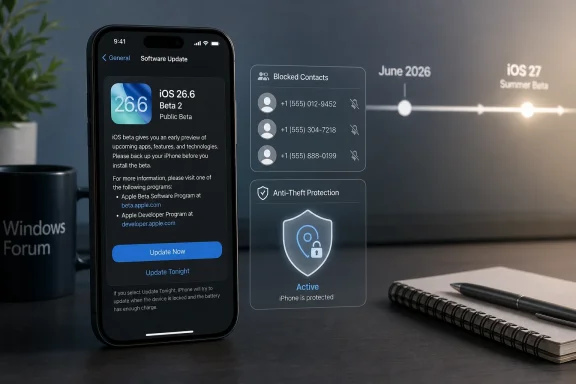
Apple released iOS 26.6 beta 2 to developers on June 15, 2026, followed by the public beta on June 16, continuing maintenance work on the iPhone’s current software line while iOS 27 begins its summer beta cycle ahead of a fall launch. That timing makes iOS 26.6 less glamorous than the WWDC software now absorbing the oxygen, but more relevant to the phones people actually rely on today. The visible changes appear modest: a revised limit around blocked contacts and signs of a new anti-theft feature still in development. The real story is Apple’s familiar late-cycle bargain: ship fewer new toys, reduce risk, and keep the installed base stable before the next platform reset.
The annual Apple software calendar has a way of turning attention into a trap. Once the next major iOS beta appears, the tech conversation sprints toward interface changes, AI promises, device compatibility, and whatever unfinished framework developers are now expected to digest before September. But for millions of iPhone owners, and for the administrators who manage fleets of them, the more consequential release is often the one Apple barely talks about.
iOS 26.6 beta 2 sits in that unglamorous category. It is not the big generational release. It is not the WWDC headliner. It is the update that arrives after most of the year’s features have already landed, when Apple’s job is less about persuasion and more about maintenance.
That makes expectations clearer. Users should not look to iOS 26.6 for a dramatic redesign or a new Apple Intelligence showcase. They should look for bug fixes, security hardening, compatibility cleanup, and the kind of incremental changes that suggest Apple is preparing the runway for both a final iOS 26-era public release and the much noisier iOS 27 transition.
The second beta also matters because it gives a rough signal about confidence. A first beta can be exploratory; a second beta begins to show whether Apple is merely patching rough edges or still moving parts around. So far, the evidence points to a restrained release, with only a couple of discoverable changes and no broad feature push.
That split is normal, but it is still awkward. Enthusiasts tend to treat the older branch as stale the moment the new developer beta appears. Enterprises do the opposite. They often see the late-cycle release as the one most likely to be mature enough for wider deployment, especially if earlier 26.x releases exposed regressions, battery complaints, app issues, or management wrinkles.
The point is not that iOS 26.6 is more important than iOS 27 in Apple’s grand strategy. It plainly is not. The point is that iOS 26.6 is closer to operational reality. It is the update that may be installed on production phones weeks before iOS 27 is trusted outside test rings.
That distinction should shape expectations. iOS 27 can afford to be ambitious and uneven because it is early pre-release software. iOS 26.6 has a different job: avoid surprise. In late-cycle maintenance releases, “nothing much changed” is not an insult. It is often the product brief.
Apple rarely frames such work as a marquee feature. Yet the iPhone is not just a communications device; it is a boundary-management device. Any change to blocking limits sits at the intersection of privacy, safety, and platform abuse mitigation.
The second clue, an apparent anti-theft feature in progress, fits the same pattern. Apple has spent years making stolen iPhones harder to reset, resell, and reuse. Activation Lock, Find My, Stolen Device Protection, and account recovery safeguards all belong to the same long campaign: make physical possession of the phone less valuable without the owner’s identity.
A still-developing anti-theft feature in iOS 26.6 would therefore not be an outlier. It would be part of Apple’s broader security posture, where the iPhone increasingly behaves like a consumer endpoint with enterprise-grade assumptions: credentials are valuable, location matters, biometrics are policy controls, and a stolen device is both a hardware loss and an identity risk.
Late-cycle releases are where vendors clean up those less visible layers. Apple does not need to sell iOS 26.6 as a new experience because the installed base has already bought into iOS 26. What it needs is a release that reduces support burden and lowers the probability that users enter the iOS 27 cycle already irritated.
For IT departments, that kind of release can be more useful than a feature release. A stable .6 update may become the preferred holding point for organizations that do not jump to iOS 27 immediately. It may also be the version used to validate line-of-business apps before the next compatibility wave hits.
The timing is especially important because Apple’s September releases are predictable in broad strokes but not in operational detail. New iPhones, new OS versions, new app SDK assumptions, and user-driven upgrade pressure all arrive together. A quieter iOS 26.6 gives administrators a chance to stabilize the present before the future starts filing tickets.
For enthusiasts with spare devices, that risk may be acceptable. For a primary iPhone tied to work authentication, travel, banking, medical apps, or two-factor login flows, the calculation is different. A minor beta can still carry major inconvenience if it breaks a must-have app or drains a battery at the wrong time.
The usual beta advice is dull because it remains correct. Back up first. Avoid installing on mission-critical devices. Read early reports before jumping in. Understand that leaving a beta path can be annoying, especially if backups were made on newer software than the release build you want to return to.
This is not anti-beta scolding. Apple’s beta ecosystem is one reason its fall releases arrive with broad third-party support. But users should be honest about why they are installing iOS 26.6 beta 2. If the motivation is curiosity, fine. If the motivation is stability, waiting for the public release is the more logical move.
Apple’s response has been to make theft less profitable and post-theft compromise harder. That approach can frustrate legitimate owners when recovery workflows become more restrictive, but the direction is rational. A phone that can authorize payments, unlock accounts, and approve identity challenges must resist coercion, shoulder-surfing, and rapid resale.
A late-cycle anti-theft improvement would also show how security features no longer wait for major releases. Apple, Microsoft, Google, and other platform vendors increasingly push protection changes through point releases because abuse does not follow keynote season. If a mitigation is ready in June, there is little reason to hold it for September merely because the branding would be cleaner.
For WindowsForum readers, this should feel familiar. Microsoft’s own endpoint security story has steadily moved from big-version thinking to continuous hardening through cumulative updates, Defender intelligence, identity controls, and cloud policy. Apple’s consumer language is different, but the operating model is converging: the endpoint is never finished.
That is why the iOS 26.6 branch deserves attention. It may become the last comfortable stop for users who want to avoid early iOS 27 churn. Apple’s challenge is to make that stop secure enough and polished enough that deferral does not become neglect.
The same dynamic applies to app developers. The iOS 27 SDK may be the future, but shipping apps still have to behave well on iOS 26.6. Developers cannot simply pivot to the new beta and assume the current production line is irrelevant.
There is also a reputational dimension. Apple’s annual cadence depends on trust that the previous version will not be abandoned the moment the next one is announced. A solid iOS 26.6 reinforces that trust. A messy one would feed the suspicion that Apple’s platform machine is too eager to move on.
Still, the earlier movement suggests Apple wants the 26.6 train well underway while iOS 27 gathers developer attention. That may indicate confidence, urgency, or simple scheduling efficiency. Without Apple saying more, certainty would be theatrical.
What matters more than the exact comparison is the overlap. Apple is now asking developers, testers, and IT teams to think about two iPhone software realities at once. One is the near-term maintenance release. The other is the next platform generation.
That overlap is where mistakes happen. Users install the wrong beta. Developers test the shiny build and miss a regression in the shipping branch. Organizations delay validation because the next major version feels more exciting. The practical advice is to resist the calendar’s pull and test according to deployment reality, not keynote gravity.
The iPhone is especially important because it often acts as the second factor for Microsoft 365, Entra ID, VPN access, password resets, and privileged workflows. If an iOS beta breaks authentication notifications, device compliance reporting, certificate handling, or managed app behavior, the help desk will not care that the issue began in Cupertino. It will land in the same queue as everything else.
That is why late-cycle iOS updates matter to Windows administrators. They affect conditional access posture. They affect mobile device management. They affect Outlook, Teams, OneDrive, Edge, Remote Desktop, and third-party security agents. In many environments, the iPhone is not an accessory to the Windows estate; it is a control surface for it.
The cautious approach is straightforward. Keep beta software out of production groups unless there is a defined test policy. Validate managed apps on iOS 26.6 before broad release. Watch for changes that affect device enrollment, compliance checks, network extensions, and authentication flows. Treat the iPhone like an endpoint, not a personal gadget that happens to receive corporate email.
But that restraint may be exactly what the platform needs. After a year of iOS 26 updates, Apple’s priority should be confidence rather than spectacle. A late-cycle build that improves abuse controls, tightens theft protection, and avoids unnecessary disruption would be a successful release even if most users cannot name a single new feature.
The best point releases are often invisible in retrospect. They are remembered only when they fail. If iOS 26.6 ships smoothly, users will move through it on the way to iOS 27 without ceremony, and that will be the point.
Apple’s challenge is that invisibility requires discipline. Adding half-finished features late in the cycle can create more risk than reward. If the anti-theft work is not ready, Apple should hold it. If the blocked-contacts change is ready, it should ship cleanly. The maintenance branch should not become a dumping ground for features that missed the main stage.
Apple’s iOS 26.6 beta 2 will not define the company’s 2026 software story; iOS 27 will do that. But it may define the quality of the handoff. If Apple can use this quiet release to harden the current platform, reduce friction, and avoid late-cycle instability, then the most forgettable iPhone update of the summer may also be one of the most useful.
 Apple’s Boring Beta Is the One Most People Should Watch
The annual Apple software calendar has a way of turning attention into a trap. Once the next major iOS beta appears, the tech conversation sprints toward interface changes, AI promises, device compatibility, and whatever unfinished framework developers are now expected to digest before September. But for millions of iPhone owners, and for the administrators who manage fleets of them, the more consequential release is often the one Apple barely talks about.iOS 26.6 beta 2 sits in that unglamorous category. It is not the big generational release. It is not the WWDC headliner. It is the update that arrives after most of the year’s features have already landed, when Apple’s job is less about persuasion and more about maintenance.
That makes expectations clearer. Users should not look to iOS 26.6 for a dramatic redesign or a new Apple Intelligence showcase. They should look for bug fixes, security hardening, compatibility cleanup, and the kind of incremental changes that suggest Apple is preparing the runway for both a final iOS 26-era public release and the much noisier iOS 27 transition.
The second beta also matters because it gives a rough signal about confidence. A first beta can be exploratory; a second beta begins to show whether Apple is merely patching rough edges or still moving parts around. So far, the evidence points to a restrained release, with only a couple of discoverable changes and no broad feature push.
The Calendar Has Already Moved to iOS 27
Apple’s software machine is now split across two tracks. On one track, iOS 27 is the future-facing beta, the version meant to carry Apple’s fall iPhone story and whatever strategic bets the company wants developers to internalize over the summer. On the other, iOS 26.6 is the near-term shipping candidate for current devices.That split is normal, but it is still awkward. Enthusiasts tend to treat the older branch as stale the moment the new developer beta appears. Enterprises do the opposite. They often see the late-cycle release as the one most likely to be mature enough for wider deployment, especially if earlier 26.x releases exposed regressions, battery complaints, app issues, or management wrinkles.
The point is not that iOS 26.6 is more important than iOS 27 in Apple’s grand strategy. It plainly is not. The point is that iOS 26.6 is closer to operational reality. It is the update that may be installed on production phones weeks before iOS 27 is trusted outside test rings.
That distinction should shape expectations. iOS 27 can afford to be ambitious and uneven because it is early pre-release software. iOS 26.6 has a different job: avoid surprise. In late-cycle maintenance releases, “nothing much changed” is not an insult. It is often the product brief.
Two Small Clues Point to Apple’s Actual Priorities
The two changes reported so far are telling precisely because they are not flashy. A change involving the number of contacts a user can block sounds minor until you remember how much of modern phone ownership is defensive. Spam calls, abusive messaging, scam attempts, harassment, and account-takeover lures all make contact blocking part of everyday personal security.Apple rarely frames such work as a marquee feature. Yet the iPhone is not just a communications device; it is a boundary-management device. Any change to blocking limits sits at the intersection of privacy, safety, and platform abuse mitigation.
The second clue, an apparent anti-theft feature in progress, fits the same pattern. Apple has spent years making stolen iPhones harder to reset, resell, and reuse. Activation Lock, Find My, Stolen Device Protection, and account recovery safeguards all belong to the same long campaign: make physical possession of the phone less valuable without the owner’s identity.
A still-developing anti-theft feature in iOS 26.6 would therefore not be an outlier. It would be part of Apple’s broader security posture, where the iPhone increasingly behaves like a consumer endpoint with enterprise-grade assumptions: credentials are valuable, location matters, biometrics are policy controls, and a stolen device is both a hardware loss and an identity risk.
The Late-Cycle Release Is Where Apple Cleans the Pipes
The lack of visible features is not evidence that little is happening. Operating systems accumulate friction over a year: modem behavior, Bluetooth edge cases, app compatibility regressions, background task issues, notification oddities, region-specific compliance changes, and battery-management tuning. The public only sees the parts that break loudly.Late-cycle releases are where vendors clean up those less visible layers. Apple does not need to sell iOS 26.6 as a new experience because the installed base has already bought into iOS 26. What it needs is a release that reduces support burden and lowers the probability that users enter the iOS 27 cycle already irritated.
For IT departments, that kind of release can be more useful than a feature release. A stable .6 update may become the preferred holding point for organizations that do not jump to iOS 27 immediately. It may also be the version used to validate line-of-business apps before the next compatibility wave hits.
The timing is especially important because Apple’s September releases are predictable in broad strokes but not in operational detail. New iPhones, new OS versions, new app SDK assumptions, and user-driven upgrade pressure all arrive together. A quieter iOS 26.6 gives administrators a chance to stabilize the present before the future starts filing tickets.
Public Beta Access Does Not Make This Production Software
The arrival of public beta 2 a day after the developer beta lowers the barrier to entry, but it does not change the risk profile. Apple’s public beta program is friendlier than the developer track, yet it is still pre-release software. The word public can mislead users into thinking the build is blessed for daily use in a way it is not.For enthusiasts with spare devices, that risk may be acceptable. For a primary iPhone tied to work authentication, travel, banking, medical apps, or two-factor login flows, the calculation is different. A minor beta can still carry major inconvenience if it breaks a must-have app or drains a battery at the wrong time.
The usual beta advice is dull because it remains correct. Back up first. Avoid installing on mission-critical devices. Read early reports before jumping in. Understand that leaving a beta path can be annoying, especially if backups were made on newer software than the release build you want to return to.
This is not anti-beta scolding. Apple’s beta ecosystem is one reason its fall releases arrive with broad third-party support. But users should be honest about why they are installing iOS 26.6 beta 2. If the motivation is curiosity, fine. If the motivation is stability, waiting for the public release is the more logical move.
The Security Angle Is Bigger Than the Feature List
If the anti-theft work materializes in iOS 26.6, it will land in a market that has already learned to think differently about phone theft. The modern stolen phone is not merely a lost gadget. It can be a portal into email, cloud storage, payment cards, password managers, workplace apps, photos, and social identity.Apple’s response has been to make theft less profitable and post-theft compromise harder. That approach can frustrate legitimate owners when recovery workflows become more restrictive, but the direction is rational. A phone that can authorize payments, unlock accounts, and approve identity challenges must resist coercion, shoulder-surfing, and rapid resale.
A late-cycle anti-theft improvement would also show how security features no longer wait for major releases. Apple, Microsoft, Google, and other platform vendors increasingly push protection changes through point releases because abuse does not follow keynote season. If a mitigation is ready in June, there is little reason to hold it for September merely because the branding would be cleaner.
For WindowsForum readers, this should feel familiar. Microsoft’s own endpoint security story has steadily moved from big-version thinking to continuous hardening through cumulative updates, Defender intelligence, identity controls, and cloud policy. Apple’s consumer language is different, but the operating model is converging: the endpoint is never finished.
Apple Is Still Managing the Installed Base, Not Just the Showcase
The iPhone installed base is too large for Apple to treat current-version maintenance as an afterthought. Even after iOS 27 ships, not every eligible device will move immediately. Some users wait. Some organizations defer. Some devices age into a support posture where stability matters more than novelty.That is why the iOS 26.6 branch deserves attention. It may become the last comfortable stop for users who want to avoid early iOS 27 churn. Apple’s challenge is to make that stop secure enough and polished enough that deferral does not become neglect.
The same dynamic applies to app developers. The iOS 27 SDK may be the future, but shipping apps still have to behave well on iOS 26.6. Developers cannot simply pivot to the new beta and assume the current production line is irrelevant.
There is also a reputational dimension. Apple’s annual cadence depends on trust that the previous version will not be abandoned the moment the next one is announced. A solid iOS 26.6 reinforces that trust. A messy one would feed the suspicion that Apple’s platform machine is too eager to move on.
The Comparison With Last Year Cuts Both Ways
The report notes that iOS 26.6 appears to be arriving a bit earlier in the cycle than the comparable iOS 18.6 beta did last year, relative to the next major beta. That kind of calendar comparison is useful, but only up to a point. Apple’s beta timing can shift for reasons outsiders cannot see: security fixes, carrier testing, hardware schedules, regulatory requirements, or internal readiness.Still, the earlier movement suggests Apple wants the 26.6 train well underway while iOS 27 gathers developer attention. That may indicate confidence, urgency, or simple scheduling efficiency. Without Apple saying more, certainty would be theatrical.
What matters more than the exact comparison is the overlap. Apple is now asking developers, testers, and IT teams to think about two iPhone software realities at once. One is the near-term maintenance release. The other is the next platform generation.
That overlap is where mistakes happen. Users install the wrong beta. Developers test the shiny build and miss a regression in the shipping branch. Organizations delay validation because the next major version feels more exciting. The practical advice is to resist the calendar’s pull and test according to deployment reality, not keynote gravity.
For Windows Shops, the iPhone Is Still Part of the Endpoint Estate
A Windows-focused audience may be tempted to treat iOS 26.6 as Apple-world trivia. That would be a mistake. In most modern organizations, the endpoint estate is mixed whether administrators like it or not. Windows PCs, Macs, iPhones, iPads, Android devices, cloud identities, VPN clients, passkeys, and authenticator apps all participate in the same security perimeter.The iPhone is especially important because it often acts as the second factor for Microsoft 365, Entra ID, VPN access, password resets, and privileged workflows. If an iOS beta breaks authentication notifications, device compliance reporting, certificate handling, or managed app behavior, the help desk will not care that the issue began in Cupertino. It will land in the same queue as everything else.
That is why late-cycle iOS updates matter to Windows administrators. They affect conditional access posture. They affect mobile device management. They affect Outlook, Teams, OneDrive, Edge, Remote Desktop, and third-party security agents. In many environments, the iPhone is not an accessory to the Windows estate; it is a control surface for it.
The cautious approach is straightforward. Keep beta software out of production groups unless there is a defined test policy. Validate managed apps on iOS 26.6 before broad release. Watch for changes that affect device enrollment, compliance checks, network extensions, and authentication flows. Treat the iPhone like an endpoint, not a personal gadget that happens to receive corporate email.
The Quiet Release May Be the Sensible One
There is a particular kind of disappointment that surrounds maintenance updates. Enthusiasts want visible changes, reviewers want screenshots, and social feeds reward novelty. A release like iOS 26.6 beta 2 resists that machinery.But that restraint may be exactly what the platform needs. After a year of iOS 26 updates, Apple’s priority should be confidence rather than spectacle. A late-cycle build that improves abuse controls, tightens theft protection, and avoids unnecessary disruption would be a successful release even if most users cannot name a single new feature.
The best point releases are often invisible in retrospect. They are remembered only when they fail. If iOS 26.6 ships smoothly, users will move through it on the way to iOS 27 without ceremony, and that will be the point.
Apple’s challenge is that invisibility requires discipline. Adding half-finished features late in the cycle can create more risk than reward. If the anti-theft work is not ready, Apple should hold it. If the blocked-contacts change is ready, it should ship cleanly. The maintenance branch should not become a dumping ground for features that missed the main stage.
The iOS 26.6 Betas Draw a Line Between Curiosity and Readiness
The practical reading of iOS 26.6 beta 2 is not complicated, but it is easy to lose in the noise around iOS 27. This is a maintenance release with a small visible surface area, a likely security-and-polish emphasis, and a role as the next shipping version before Apple’s fall transition.- Apple released iOS 26.6 beta 2 to developers on June 15, 2026, and the matching public beta followed on June 16.
- The update is expected to be modest, with reported changes involving blocked contacts and signs of an anti-theft feature in development.
- iOS 27 is now the strategic beta, but iOS 26.6 is the nearer-term release most users and organizations are more likely to encounter first.
- Public beta availability should not be confused with production readiness, especially on phones used for work, banking, travel, or authentication.
- IT teams should treat iOS 26.6 as part of endpoint validation, particularly where iPhones are tied to Microsoft 365, identity, compliance, and managed apps.
Apple’s iOS 26.6 beta 2 will not define the company’s 2026 software story; iOS 27 will do that. But it may define the quality of the handoff. If Apple can use this quiet release to harden the current platform, reduce friction, and avoid late-cycle instability, then the most forgettable iPhone update of the summer may also be one of the most useful.
References
- Primary source: 9to5Mac
Published: Tue, 16 Jun 2026 17:18:00 GMT
Apple releases iOS 26.6 beta 2 for iPhone, here’s what to expect [U] - 9to5Mac
June 16, 2026: A day later, iOS 26.6 public beta 2 is now available as well. While iOS 27 is...9to5mac.com - Related coverage: techradar.com
Here are 21 new features in iOS 27 that Apple didn't have time to mention during its WWDC 2026 keynote | TechRadar
There's a lot herewww.techradar.com - Related coverage: macrumors.com
Apple Seeds Second Public Betas of iOS 26.6, macOS Tahoe 26.6 and More
Apple today provided public beta testers with the second betas of iOS 26.6, iPadOS 26.6, macOS Tahoe 26.6, watchOS 26.6, and tvOS 26.6, with the software coming a day after Apple seeded the betas to developers and three weeks after the first public betas. After signing up to beta test the...www.macrumors.com - Related coverage: macdailynews.com
Apple releases second macOS 26.6, iOS 26.6, iPadOS 26.6, watchOS 26.6, tvOS 26.6, and visionOS 26.6 betas
Apple has just seeded the second developer betas for its current-generation operating systems, focusing primarily on stability…macdailynews.com - Official source: developer.apple.com
Releases - Apple Developer
Get the latest operating system releases and learn about updates to App Store Connect, TestFlight, and other developer tools.developer.apple.com
- Related coverage: macworld.com
iOS 26.6 beta 2 is here, but you won't see much that is new | Macworld
This update is likely to focus on bug fixes and security rather than new features.www.macworld.com
- Related coverage: iclarified.com
Apple Releases iOS 26.6 Beta and iPadOS 26.6 Beta to Developers [Download] - iClarified
Apple has released the first developer betas of iOS 26.6 and iPadOS 26.6 for testing ahead of WWDC 2026.www.iclarified.com - Related coverage: en.soydemac.com
Apple releases the second beta of iOS 26.6 and macOS 26.6 for developers
Apple releases the second beta of iOS 26.6 and macOS 26.6. Learn about the security improvements for Maps and the system changes before the official release.en.soydemac.com - Related coverage: mixvale.com.br
Apple lanza versiones beta de iOS 26.6, iPadOS 26.6, macOS 26.6 y más para desarrolladores
Apple ha lanzado las primeras versiones beta de iOS 26.6, iPadOS 26.6, macOS Tahoe 26.6, watchOS 26.6, tvOS 26.6, HomePod Software 26.6 y visionOS 26.6 para desarrolladores. Las pruebas ya están disponibles para descargar. La compañía también puso a disposición Release Candidates de macOS Sonoma...www.mixvale.com.br - Related coverage: tomshardware.com
Apple demonstrates cross-platform Siri upgrades in macOS 27 Golden Gate at WWDC — update brings Liquid Glass improvements and unifies AI strategy | Tom's Hardware
macOS 27 brings new AI features and, finally, matching corner radii.www.tomshardware.com - Related coverage: cincodias.elpais.com
