

Apple has not announced an Apple Watch that can measure blood glucose by itself as of June 2026, and the FDA says no smartwatch or smart ring has been cleared, authorized, or approved to estimate blood sugar without piercing the skin. The watch can display glucose readings from compatible continuous glucose monitors, but that is not the same as replacing a medical sensor. The distance between those two ideas is where the real story lives. Apple is not late to a simple feature; it is circling one of the hardest unsolved problems in consumer health technology.
The dream version of Apple Watch glucose tracking is easy to sell: glance at your wrist, see your blood sugar, avoid needles, and let software connect the dots between food, sleep, exercise, stress, and metabolism. It is the kind of pitch that fits perfectly into Apple’s decade-long campaign to turn the Watch from an iPhone accessory into a personal health computer.
But glucose is not steps, sleep stages, or a gentle reminder to stand up. For millions of people with diabetes, glucose readings affect insulin dosing, meals, exercise decisions, and emergency responses. A wrong number is not merely a bad chart; it can become a dangerous clinical signal.
That is why the Apple Watch blood sugar rumor cycle always runs into the same wall. The hardware industry moves by iteration, but glucose monitoring moves by validation. Apple can ship a new fitness metric with caveats; it cannot responsibly ship a blood sugar number unless that number survives clinical scrutiny, regulatory review, and the messy realities of everyday use.
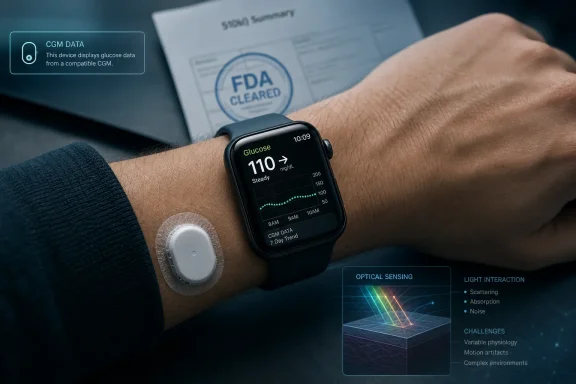
Dexcom’s Direct to Apple Watch feature narrowed the gap between “phone accessory” and “wrist-first” diabetes data. After setup, the Dexcom G7 sensor can connect directly to a compatible Apple Watch over Bluetooth, allowing users to see CGM readings without keeping an iPhone nearby. For people who run, commute, work out, or simply do not want to carry a phone every minute, that is a meaningful improvement.
It is still not noninvasive glucose tracking. The Dexcom sensor remains the medical device doing the glucose measurement, and it still uses an under-skin sensing mechanism. Apple Watch becomes a display and alert surface, not the biochemical instrument.
That difference matters because consumer tech companies are very good at collapsing user experience into product identity. If a number appears on the watch, many users naturally think the watch measured it. In glucose monitoring, that assumption can be dangerous.
That warning was not aimed specifically at Apple. In fact, Apple has not claimed that its watch can measure blood sugar noninvasively. The agency was targeting a broader marketplace of devices and marketing claims that implied a level of medical capability the products had not demonstrated.
Still, the warning defines the playing field for Apple, Samsung, Oura, Garmin, and every other company chasing metabolic sensing. If a product claims to estimate glucose without a skin-piercing sensor, it enters a medical-risk category where accuracy, labeling, intended use, and user behavior all matter.
The FDA’s concern is not academic. A falsely high glucose reading might lead someone to take too much insulin. A falsely low reading might cause someone to eat sugar unnecessarily or miss a developing hyperglycemic event. In either direction, the number can push real-world treatment decisions.
But patents are not roadmaps. Large technology companies patent aggressively because patents protect optionality. Some filings describe ideas that never leave the lab. Others become bargaining chips. Many are technically plausible but commercially impractical.
The more useful reading is not “Apple filed something, therefore Apple Watch glucose is imminent.” It is that Apple appears to view metabolic sensing as strategically important enough to fund long-term research. That tells us where Apple wants the Watch to go, not when it will get there.
For investors and gadget fans, patents create anticipation. For patients and clinicians, they should create caution. A patent can describe a method; it does not prove that the method works reliably across millions of wrists.
The wrist makes the problem worse. It moves constantly. The watch shifts during workouts and sleep. Skin contact changes with band tightness. Hydration varies. Temperature changes. Tattoos, skin tone, hair, and tissue composition can all complicate measurement.
A glucose meter or CGM is not perfect, but it is designed around a direct biochemical measurement. A noninvasive optical system is trying to infer a glucose-related value from an indirect signal buried in noise. That does not make the challenge impossible, but it makes consumer-grade reliability extraordinarily difficult.
The hardest part is not generating a number. Many devices can generate numbers. The hard part is generating a number that remains accurate enough, often enough, for the decisions users will make because they trust it.
That calibrated language is not accidental. Apple wants the Watch to feel medically useful without turning every feature into a clinical device. The company’s health strategy depends on trust: users must believe the Watch is helpful, doctors must not see it as a chaos machine, and regulators must not view Apple as playing fast and loose with medical claims.
Glucose would test that strategy harder than any Watch feature so far. If Apple calls it blood glucose monitoring, it invites medical-device expectations. If it calls it metabolic insights, users may still treat the data as actionable. If it hides behind wellness disclaimers, critics will ask why such a sensitive number is being presented at all.
This is where Apple’s marketing discipline becomes as important as its sensors. The feature name, user interface, warnings, data ranges, trend language, and integration with HealthKit would all shape how people behave.
The lesson is not that Apple cannot ship ambitious health sensors. It plainly can. The lesson is that medical-style sensing brings Apple into markets with incumbents, patents, regulators, clinical expectations, and competitors that do not behave like app developers in the App Store.
Glucose would be an even larger target. The diabetes technology market includes established CGM makers, insulin pump companies, health systems, insurers, and regulators. A credible Apple glucose feature would not merely add a chart to the Health app; it would alter competitive dynamics across a major medical-device category.
That gives Apple every reason to move slowly. A flawed launch would be worse than no launch. A weak glucose feature could damage the Watch’s health credibility, invite regulatory backlash, and create legal exposure.
Such a feature might tell users how their bodies appear to respond to meals, sleep, or exercise. It might focus on relative changes rather than absolute glucose values. It might be limited to users without diabetes, or explicitly state that it is not intended for medication decisions.
That approach would be commercially attractive but ethically delicate. A “wellness” glucose feature could still influence behavior in medically meaningful ways. Users do not always respect the boundaries written in fine print, especially when Apple’s interface turns complex physiology into simple rings, charts, and notifications.
For IT pros and technically minded users, this is the familiar problem of abstraction. The more elegantly a system hides uncertainty, the more likely users are to overtrust the output. In health, elegant abstraction can become clinical ambiguity.
The strongest evidence would be clinical studies, regulatory filings, peer-reviewed validation, or explicit language from Apple about intended use. A vague patent filing or a “still in development” report is not enough. Nor is a keynote segment about Apple’s commitment to health.
This is especially true because noninvasive glucose has a long history of promise. Researchers and companies have chased it for decades. The concept is compelling enough to attract investment again and again, but the market has not yet produced a mainstream wrist-worn device that regulators accept as a standalone glucose monitor.
Apple’s scale raises the stakes. If a small startup overclaims, regulators can swat it down. If Apple ships a glucose feature to tens of millions of wrists, the consequences are far larger.
For sysadmins, that means more employees bringing medically relevant devices into workplaces. For developers, it means more demand for secure integrations with health APIs, patient portals, insurance platforms, and wellness programs. For privacy-minded users, it means more intimate data flowing through cloud services, mobile operating systems, and third-party apps.
Apple’s advantage is vertical integration. It controls the watch, phone, operating system, Health app, privacy model, and much of the user experience. Microsoft, by contrast, has largely approached health through cloud, enterprise, identity, AI, and partner ecosystems rather than consumer wearables.
That difference matters. If Apple eventually owns a high-value metabolic data stream, it strengthens the iPhone as the center of personal health. Windows PCs may still be where people work, analyze, export, document, and communicate, but the primary health signal would live elsewhere.
Apple has built its health brand around privacy, and that gives it an advantage over ad-driven platforms. But privacy claims are only one layer of the problem. Users share data with apps, clinicians, caregivers, insurers, employers, fitness platforms, and research programs. Each connection expands the attack surface.
The security implications are not theoretical. Health data has high value because it is difficult to change and easy to exploit. A leaked password can be reset. A leaked metabolic profile cannot.
If Apple ever adds native glucose sensing, the company will need to make the privacy model legible. Users should know what is measured, where it is processed, what stays on-device, what syncs to iCloud, what apps can access, and how easily access can be revoked. The more medically meaningful the data becomes, the less acceptable vague consent screens become.
That commercial pressure creates incentives to blur language. Companies can talk about “glucose trends,” “metabolic health,” “blood sugar insights,” or “wellness indicators” while avoiding the strictest medical claims. The gray zone is profitable because it sells the promise of medical relevance without always accepting the burden of medical responsibility.
Apple is less likely than fly-by-night gadget vendors to make reckless claims, but it is not immune to market incentives. The Watch needs new reasons to upgrade. Health features have become one of the few remaining ways to make an annual wearable refresh feel consequential.
That is why scrutiny matters even when the company involved is reputable. Apple’s brand may make users more likely to trust the feature, not less. Trust is an asset, but in medical-adjacent technology it is also a risk multiplier.
Consumer electronics reporting often treats unreleased features as if they are merely waiting for production capacity. Medical sensing does not work that way. A prototype can be impressive in controlled conditions and still fail in the diversity of real-world wrists. A lab demo can become a research milestone without becoming a product.
Apple also has the luxury of patience. It does not need to be first if being first means being wrong. The Apple Watch became dominant by making health features feel mainstream, not by shipping every sensor before competitors.
So the safest forecast is not “next year” or “never.” It is that Apple will continue researching glucose because the prize is enormous, while refusing to launch until it has a version it can defend technically, medically, legally, and commercially.
A feature cleared for diabetes management would be a very different product from a wellness trend indicator. A sensor that requires calibration would be different from one that does not. A feature restricted to certain regions would suggest regulatory staging. A feature unavailable to users taking insulin would reveal Apple’s caution.
The same applies to integrations. If Apple allows third-party apps to access native glucose data, developers will build coaching, dieting, insurance, workplace wellness, and AI-analysis tools around it. If Apple walls it off, the company may be trying to limit misuse and liability.
In other words, the launch would not end the debate. It would start the next one: what Apple’s glucose number actually means, who can use it, and what decisions it should influence.
 Apple’s Most Anticipated Watch Feature Is Still a Medical Device Problem
The dream version of Apple Watch glucose tracking is easy to sell: glance at your wrist, see your blood sugar, avoid needles, and let software connect the dots between food, sleep, exercise, stress, and metabolism. It is the kind of pitch that fits perfectly into Apple’s decade-long campaign to turn the Watch from an iPhone accessory into a personal health computer.But glucose is not steps, sleep stages, or a gentle reminder to stand up. For millions of people with diabetes, glucose readings affect insulin dosing, meals, exercise decisions, and emergency responses. A wrong number is not merely a bad chart; it can become a dangerous clinical signal.
That is why the Apple Watch blood sugar rumor cycle always runs into the same wall. The hardware industry moves by iteration, but glucose monitoring moves by validation. Apple can ship a new fitness metric with caveats; it cannot responsibly ship a blood sugar number unless that number survives clinical scrutiny, regulatory review, and the messy realities of everyday use.
The Watch Can Show Glucose, But It Cannot Generate It
The most important distinction is also the one most easily blurred in headlines. Apple Watch can already show glucose data when paired with compatible continuous glucose monitors, including Dexcom’s G7 system. In that setup, the glucose reading comes from the CGM sensor, not from Apple’s watch hardware.Dexcom’s Direct to Apple Watch feature narrowed the gap between “phone accessory” and “wrist-first” diabetes data. After setup, the Dexcom G7 sensor can connect directly to a compatible Apple Watch over Bluetooth, allowing users to see CGM readings without keeping an iPhone nearby. For people who run, commute, work out, or simply do not want to carry a phone every minute, that is a meaningful improvement.
It is still not noninvasive glucose tracking. The Dexcom sensor remains the medical device doing the glucose measurement, and it still uses an under-skin sensing mechanism. Apple Watch becomes a display and alert surface, not the biochemical instrument.
That difference matters because consumer tech companies are very good at collapsing user experience into product identity. If a number appears on the watch, many users naturally think the watch measured it. In glucose monitoring, that assumption can be dangerous.
The FDA Drew a Bright Line Around Needle-Free Claims
The FDA’s 2024 warning was unusually direct for a consumer-wearables topic. The agency said people should not use smartwatches or smart rings that claim to measure blood glucose without piercing the skin. It also said it had not authorized, cleared, or approved any such device intended to measure or estimate glucose values on its own.That warning was not aimed specifically at Apple. In fact, Apple has not claimed that its watch can measure blood sugar noninvasively. The agency was targeting a broader marketplace of devices and marketing claims that implied a level of medical capability the products had not demonstrated.
Still, the warning defines the playing field for Apple, Samsung, Oura, Garmin, and every other company chasing metabolic sensing. If a product claims to estimate glucose without a skin-piercing sensor, it enters a medical-risk category where accuracy, labeling, intended use, and user behavior all matter.
The FDA’s concern is not academic. A falsely high glucose reading might lead someone to take too much insulin. A falsely low reading might cause someone to eat sugar unnecessarily or miss a developing hyperglycemic event. In either direction, the number can push real-world treatment decisions.
Patents Tell Us Apple Is Interested, Not That Apple Is Close
Apple’s patent activity and reported research make clear that the company has explored advanced health sensing for years. Bloomberg has reported that Apple’s noninvasive glucose work has involved silicon photonics and optical absorption spectroscopy, with the idea of using light to detect glucose-related signals beneath the skin. That is exactly the kind of moonshot Apple likes: deep hardware, custom silicon, sensors, software interpretation, and a potentially massive health-market payoff.But patents are not roadmaps. Large technology companies patent aggressively because patents protect optionality. Some filings describe ideas that never leave the lab. Others become bargaining chips. Many are technically plausible but commercially impractical.
The more useful reading is not “Apple filed something, therefore Apple Watch glucose is imminent.” It is that Apple appears to view metabolic sensing as strategically important enough to fund long-term research. That tells us where Apple wants the Watch to go, not when it will get there.
For investors and gadget fans, patents create anticipation. For patients and clinicians, they should create caution. A patent can describe a method; it does not prove that the method works reliably across millions of wrists.
The Wrist Is a Terrible Laboratory
Noninvasive glucose monitoring sounds straightforward until physics and biology get involved. A wearable can shine light into tissue and look for patterns, but glucose is only one small part of a complex optical environment. Skin, blood, water, fat, temperature, sweat, motion, pressure, and sensor placement all affect the signal.The wrist makes the problem worse. It moves constantly. The watch shifts during workouts and sleep. Skin contact changes with band tightness. Hydration varies. Temperature changes. Tattoos, skin tone, hair, and tissue composition can all complicate measurement.
A glucose meter or CGM is not perfect, but it is designed around a direct biochemical measurement. A noninvasive optical system is trying to infer a glucose-related value from an indirect signal buried in noise. That does not make the challenge impossible, but it makes consumer-grade reliability extraordinarily difficult.
The hardest part is not generating a number. Many devices can generate numbers. The hard part is generating a number that remains accurate enough, often enough, for the decisions users will make because they trust it.
Apple’s Health Strategy Has Always Advanced by Credibility
Apple has been careful, sometimes maddeningly so, in how it labels health features. Heart rate notifications, ECG, fall detection, cycle tracking, wrist temperature, sleep metrics, and cardio fitness all sit at different points on the wellness-to-medical spectrum. Some are regulated features. Others are framed as insights rather than diagnoses.That calibrated language is not accidental. Apple wants the Watch to feel medically useful without turning every feature into a clinical device. The company’s health strategy depends on trust: users must believe the Watch is helpful, doctors must not see it as a chaos machine, and regulators must not view Apple as playing fast and loose with medical claims.
Glucose would test that strategy harder than any Watch feature so far. If Apple calls it blood glucose monitoring, it invites medical-device expectations. If it calls it metabolic insights, users may still treat the data as actionable. If it hides behind wellness disclaimers, critics will ask why such a sensitive number is being presented at all.
This is where Apple’s marketing discipline becomes as important as its sensors. The feature name, user interface, warnings, data ranges, trend language, and integration with HealthKit would all shape how people behave.
The Masimo Fight Was a Warning Shot for Health Hardware
Apple’s blood oxygen dispute with Masimo is not a glucose story, but it is a useful preview of how complicated health sensors can become. A feature that looked like a routine smartwatch upgrade became entangled in patent litigation, import restrictions, software changes, and a redesigned user experience for affected U.S. models.The lesson is not that Apple cannot ship ambitious health sensors. It plainly can. The lesson is that medical-style sensing brings Apple into markets with incumbents, patents, regulators, clinical expectations, and competitors that do not behave like app developers in the App Store.
Glucose would be an even larger target. The diabetes technology market includes established CGM makers, insulin pump companies, health systems, insurers, and regulators. A credible Apple glucose feature would not merely add a chart to the Health app; it would alter competitive dynamics across a major medical-device category.
That gives Apple every reason to move slowly. A flawed launch would be worse than no launch. A weak glucose feature could damage the Watch’s health credibility, invite regulatory backlash, and create legal exposure.
The Most Likely First Step Is Not a CGM Replacement
If Apple eventually introduces glucose-related sensing, the first version may not be a full replacement for a CGM or finger-stick meter. It may appear as trend analysis, metabolic-response coaching, or risk-oriented wellness guidance. That would let Apple explore the category without immediately claiming to provide treatment-grade glucose readings.Such a feature might tell users how their bodies appear to respond to meals, sleep, or exercise. It might focus on relative changes rather than absolute glucose values. It might be limited to users without diabetes, or explicitly state that it is not intended for medication decisions.
That approach would be commercially attractive but ethically delicate. A “wellness” glucose feature could still influence behavior in medically meaningful ways. Users do not always respect the boundaries written in fine print, especially when Apple’s interface turns complex physiology into simple rings, charts, and notifications.
For IT pros and technically minded users, this is the familiar problem of abstraction. The more elegantly a system hides uncertainty, the more likely users are to overtrust the output. In health, elegant abstraction can become clinical ambiguity.
The Next Real Signal Will Come From Evidence, Not Rumor
The Apple rumor economy is very good at detecting supply-chain movement, display sizes, case materials, and chip names. It is less good at predicting regulated health features. A glucose sensor is not a new color option; it is a claim about biological measurement.The strongest evidence would be clinical studies, regulatory filings, peer-reviewed validation, or explicit language from Apple about intended use. A vague patent filing or a “still in development” report is not enough. Nor is a keynote segment about Apple’s commitment to health.
This is especially true because noninvasive glucose has a long history of promise. Researchers and companies have chased it for decades. The concept is compelling enough to attract investment again and again, but the market has not yet produced a mainstream wrist-worn device that regulators accept as a standalone glucose monitor.
Apple’s scale raises the stakes. If a small startup overclaims, regulators can swat it down. If Apple ships a glucose feature to tens of millions of wrists, the consequences are far larger.
Windows Users Should Care Because Health Data Is Becoming Platform Infrastructure
At first glance, Apple Watch glucose tracking looks like an Apple ecosystem story. But WindowsForum readers should recognize the broader shift: wearables are becoming health-data endpoints, and health data is becoming platform infrastructure.For sysadmins, that means more employees bringing medically relevant devices into workplaces. For developers, it means more demand for secure integrations with health APIs, patient portals, insurance platforms, and wellness programs. For privacy-minded users, it means more intimate data flowing through cloud services, mobile operating systems, and third-party apps.
Apple’s advantage is vertical integration. It controls the watch, phone, operating system, Health app, privacy model, and much of the user experience. Microsoft, by contrast, has largely approached health through cloud, enterprise, identity, AI, and partner ecosystems rather than consumer wearables.
That difference matters. If Apple eventually owns a high-value metabolic data stream, it strengthens the iPhone as the center of personal health. Windows PCs may still be where people work, analyze, export, document, and communicate, but the primary health signal would live elsewhere.
The Privacy Problem Is Bigger Than the Sensor
Glucose data is not just another biometric. It can reveal illness, pregnancy risk, eating habits, stress responses, medication routines, sleep disruption, exercise patterns, and socioeconomic realities. In aggregate, it is a remarkably sensitive behavioral dataset.Apple has built its health brand around privacy, and that gives it an advantage over ad-driven platforms. But privacy claims are only one layer of the problem. Users share data with apps, clinicians, caregivers, insurers, employers, fitness platforms, and research programs. Each connection expands the attack surface.
The security implications are not theoretical. Health data has high value because it is difficult to change and easy to exploit. A leaked password can be reset. A leaked metabolic profile cannot.
If Apple ever adds native glucose sensing, the company will need to make the privacy model legible. Users should know what is measured, where it is processed, what stays on-device, what syncs to iCloud, what apps can access, and how easily access can be revoked. The more medically meaningful the data becomes, the less acceptable vague consent screens become.
The Consumer Tech Industry Wants the Prize Before the Proof
The obsession with noninvasive glucose is not hard to understand. Diabetes is common, metabolic health is a booming consumer category, and subscription health services are attractive to hardware makers looking beyond device sales. A reliable wrist-based glucose feature would be one of the most important wearable breakthroughs since the smartwatch itself.That commercial pressure creates incentives to blur language. Companies can talk about “glucose trends,” “metabolic health,” “blood sugar insights,” or “wellness indicators” while avoiding the strictest medical claims. The gray zone is profitable because it sells the promise of medical relevance without always accepting the burden of medical responsibility.
Apple is less likely than fly-by-night gadget vendors to make reckless claims, but it is not immune to market incentives. The Watch needs new reasons to upgrade. Health features have become one of the few remaining ways to make an annual wearable refresh feel consequential.
That is why scrutiny matters even when the company involved is reputable. Apple’s brand may make users more likely to trust the feature, not less. Trust is an asset, but in medical-adjacent technology it is also a risk multiplier.
The Calendar Is the Least Reliable Part of the Story
Every year without Apple Watch glucose tracking produces a familiar cycle: patents surface, reports revive expectations, analysts speculate, and the next Watch launch arrives without the feature. That does not mean the research is fake. It means the timeline is unknowable from the outside.Consumer electronics reporting often treats unreleased features as if they are merely waiting for production capacity. Medical sensing does not work that way. A prototype can be impressive in controlled conditions and still fail in the diversity of real-world wrists. A lab demo can become a research milestone without becoming a product.
Apple also has the luxury of patience. It does not need to be first if being first means being wrong. The Apple Watch became dominant by making health features feel mainstream, not by shipping every sensor before competitors.
So the safest forecast is not “next year” or “never.” It is that Apple will continue researching glucose because the prize is enormous, while refusing to launch until it has a version it can defend technically, medically, legally, and commercially.
The Fine Print on the Wrist Will Matter More Than the Keynote
If Apple eventually unveils glucose-related Apple Watch technology, the most important words may not be in the keynote applause line. They will be in the intended-use statement, regulatory status, Health app disclaimers, developer documentation, and support pages.A feature cleared for diabetes management would be a very different product from a wellness trend indicator. A sensor that requires calibration would be different from one that does not. A feature restricted to certain regions would suggest regulatory staging. A feature unavailable to users taking insulin would reveal Apple’s caution.
The same applies to integrations. If Apple allows third-party apps to access native glucose data, developers will build coaching, dieting, insurance, workplace wellness, and AI-analysis tools around it. If Apple walls it off, the company may be trying to limit misuse and liability.
In other words, the launch would not end the debate. It would start the next one: what Apple’s glucose number actually means, who can use it, and what decisions it should influence.
The Glucose Watch Story Has Already Told Us What to Watch For
The practical state of play is narrower than the hype, but clearer than the rumor cycle suggests. Apple Watch is a useful glucose display for some CGM users today. It is not a standalone blood sugar monitor. The road from one to the other runs through clinical evidence and regulation, not just miniaturized sensors.- Apple has not announced a native Apple Watch blood glucose feature as of June 2026.
- The FDA says no smartwatch or smart ring has been cleared, authorized, or approved to measure or estimate blood glucose on its own without piercing the skin.
- Dexcom G7 can send CGM readings directly to compatible Apple Watch models, but the Dexcom sensor remains the device measuring glucose.
- Apple’s reported research and patent activity suggest serious interest in noninvasive glucose sensing, but they do not establish a release date or product readiness.
- Any future Apple feature described as “glucose insights” or “metabolic trends” should be treated differently from an FDA-cleared glucose monitor.
- People who need accurate glucose data for medical decisions should rely on authorized glucose meters or CGMs and clinical guidance.
References
- Primary source: TechRepublic
Published: Tue, 16 Jun 2026 16:57:07 GMT
Apple Watch Blood Sugar Tracking: Latest Timeline, Patents, and Challenges
Apple Watch blood sugar tracking remains unconfirmed. Here's the latest on the timeline, patents, technical challenges, and what Apple Watch can do now.www.techrepublic.com
- Related coverage: fda.gov
Smartwatches, Rings Claiming to Measure Glucose are not FDA-Authorized
Do not use smartwatches or smart rings to measure blood glucose. They are not authorized by the FDA. Using them could result in inaccurate blood glucose measurement, which can lead to serious injury or death if used to make medical decisions. Only use FDA-authorized devices to measure blood glucose.www.fda.gov - Related coverage: macrumors.com
Blood Oxygen Feature Finally Returning to Apple Watch in the US
Apple today announced that blood oxygen monitoring will return to Apple Watch models in the United States via a software update. Apple says that its blood oxygen monitoring feature has been "redesigned" for the Apple Watch Series 9, Apple Watch Series 10, and Apple Watch Ultra 2 in the...www.macrumors.com - Related coverage: macworld.com
Apple Watch blood-oxygen feature returns in iOS 18.6.1 and watchOS 11.6.1 | Macworld
The software update re-enables this feature on Series 9, 10, and Ultra 2 watches, but it works differently now.www.macworld.com - Related coverage: phonearena.com
Redesigned Apple Watch blood oxygen feature faces ITC scrutiny - PhoneArena
The ITC says that it has justification to see if Apple's revised pulse oximeter infringes on Masimo's patent.www.phonearena.com - Related coverage: dexcom.com
Dexcom Direct to Watch FAQs | Dexcom
Dexcom Direct to Watch connects the Dexcom G7 sensor directly to your Apple Watch* using Bluetooth. Get answers to all your questions on how it works.www.dexcom.com
- Related coverage: techcrunch.com
Apple's blood oxygen monitoring returns to its latest Apple Watches | TechCrunch
The change doesn’t affect previously sold models with the original version of the feature or units bought outside the U.S.techcrunch.com - Related coverage: 9to5mac.com
Apple releases watchOS 11.6.1, here's what's new - 9to5Mac
Apple has released watchOS 11.6.1 for Apple Watch, reintroducing the Blood Oxygen app for certain customers in the United States....9to5mac.com - Related coverage: engadget.com
Don't use smartwatches and rings that claim to measure blood sugar without needles, the FDA warns
"The FDA has not authorized, cleared, or approved any smartwatch or smart ring that is intended to measure or estimate blood glucose values on its own," the agency wrote in a safety communication, and asked consumers, patients, and caregivers to stay away from such devices.www.engadget.com - Related coverage: bloomberg.com
- Related coverage: techradar.com
Blood Oxygen tracking is back on the Apple Watch – but it's now a two-device experience | TechRadar
You won't see results on your wrist, thoughwww.techradar.com - Related coverage: tomsguide.com
The Apple Watch blood oxygen ban is over: Here’s what it means for Apple Watch wearers | Tom's Guide
Here's the latest update in the Masimo vs Apple casewww.tomsguide.com - Related coverage: t3.com
Apple Watch could finally fix its most controversial health feature | T3
The company is rumoured to be working on a complete overhaul of its blood oxygen sensing platformwww.t3.com - Related coverage: medicalxpress.com
- Related coverage: fedcircuitblog.com
- Related coverage: techxplore.com
