

Google’s Maps just stopped being a passive atlas and started acting like a travel-savvy companion, with a conversational AI at its core that can plan trips, answer follow-ups and surface contextual recommendations — all powered by the company’s Gemini large language model. (blog.google)
For two decades Google Maps sat at the intersection of navigation and discovery, collecting billions of edits, reviews and local signals to help people find their way. In October 2024 Google signaled a step-change: it began folding Gemini’s large-language capabilities into Maps to provide suggestions and summarize reviews, and it has since continued to expand those capabilities into navigation and route planning. The company now says more than 2 billion people turn to Maps each month — a scale that makes any AI feature added to Maps immediately consequential. (blog.google)
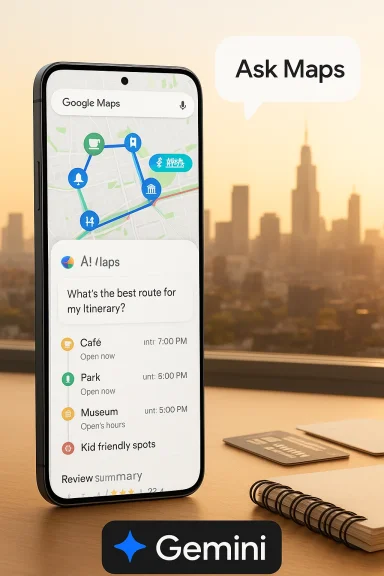
The latest and most visible iteration of that effort is Ask Maps: a Gemini-powered, conversational interface inside the Maps app that lets users ask natural-language questions like “find a cozy coffee shop with outdoor seating downtown” or “plan a kid-friendly weekend itinerary in Portland,” then receive an itinerary, recommendations and route options in reply. Google describes Ask Maps as inspiration curated with Gemini, combining the model’s reasoning and summarization abilities with Maps’ ground-truth data about places, reviews and live conditions. (blog.google)
Multiple outlets and on-the-ground tests indicate Ask Maps is designed for back-and-forth conversations — it handles follow-ups, refines suggestions based on feedback and holds onto context during a session — and that the feature is rolling out to mobile users first, with broader availability to follow. These aren’t incremental UI tweaks; they represent an architectural shift in how map data is surfaced and acted upon.
However, the technology is not a silver bullet. The big concerns — hallucination risk, privacy and the commercial dynamics around sponsored recommendations — are real and require ongoing scrutiny. The most responsible path forward for Google is to be explicit about data retention, show provenance for AI answers, and expose robust user controls so people and businesses can contest or correct outputs. Until then, Ask Maps is best understood as a powerful but evolving capability: promising, useful, and worthy of a cautious rollout and independent oversight.
Conclusion
Google’s Ask Maps marks a pivotal moment: it brings large-language reasoning into one of the world’s most consequential consumer products and, in doing so, reshapes how people will ask about and experience places. The result is an enticing mix of utility and new hazards — better planning, faster discovery and natural conversation on one side; amplified privacy risks, trust questions and business-impact uncertainty on the other. For users and local businesses alike, the sensible response is pragmatic curiosity: try the new conversational features, harden the facts you control (Business Profile, FAQs, schema), and watch carefully as Google proves that Gemini’s answers can be consistently accurate, accountable and safe at Maps’ mammoth scale. (blog.google)
Source: The Tech Buzz https://www.techbuzz.ai/articles/google-maps-gets-ai-copilot-with-gemini-integration/
 Background / Overview
For two decades Google Maps sat at the intersection of navigation and discovery, collecting billions of edits, reviews and local signals to help people find their way. In October 2024 Google signaled a step-change: it began folding Gemini’s large-language capabilities into Maps to provide suggestions and summarize reviews, and it has since continued to expand those capabilities into navigation and route planning. The company now says more than 2 billion people turn to Maps each month — a scale that makes any AI feature added to Maps immediately consequential. (blog.google)The latest and most visible iteration of that effort is Ask Maps: a Gemini-powered, conversational interface inside the Maps app that lets users ask natural-language questions like “find a cozy coffee shop with outdoor seating downtown” or “plan a kid-friendly weekend itinerary in Portland,” then receive an itinerary, recommendations and route options in reply. Google describes Ask Maps as inspiration curated with Gemini, combining the model’s reasoning and summarization abilities with Maps’ ground-truth data about places, reviews and live conditions. (blog.google)
Multiple outlets and on-the-ground tests indicate Ask Maps is designed for back-and-forth conversations — it handles follow-ups, refines suggestions based on feedback and holds onto context during a session — and that the feature is rolling out to mobile users first, with broader availability to follow. These aren’t incremental UI tweaks; they represent an architectural shift in how map data is surfaced and acted upon.
What Ask Maps Does — The Practical Features
Ask Maps bundles several capabilities that together make Maps feel like an AI copilot for local discovery and trip planning. Key capabilities include:- Natural-language search for places and activities: Ask Maps accepts conversational prompts — from specific requests (“cheap vegan dinner near me with outdoor seating”) to open-ended prompts (“things to do near the waterfront this weekend”). (blog.google)
- Multi-stop itinerary generation: Instead of listing options, the assistant can assemble an itinerary with multiple stops, order them by proximity or convenience, and suggest timings. Early reporting highlights the ability to plan weekend trips or road-trip routes.
- Follow-up understanding and memory: The system is built to accept follow-up questions and refine earlier answers — for example, narrowing a list to kid-friendly spots or adding accessibility details. Google frames this as conversational context that “sticks” during an Ask Maps session. (blog.google)
- Review summarization and grounded answers: Gemini summarizes user reviews and extracts what people commonly like or dislike about a place — a feature intended to save time when users are comparing venues. Google says these summaries are grounded in Maps’ data. (blog.google)
- Integration with live map signals: Recommendations are informed by Maps’ real-time traffic, transit schedules, opening hours and community edits — allowing the assistant to consider real-world constraints when planning or routing. (blog.google)
How It Works: Gemini + Maps Data
Ask Maps layers Gemini’s LLM capabilities on top of Google’s location graph and live telemetry. Google’s engineering blog specifies the pieces involved:- The language and reasoning engine (Gemini) handles open-ended questions, planning, summarization and chaining of tasks.
- The Maps knowledge graph supplies verified, structured facts about places (business info, hours, menus, photos) and community content like reviews and edits.
- Live sensors and telemetry (traffic, transit, Street View imagery) provide up-to-the-minute context for routing and arrival guidance. (blog.google)
Rollout and Availability: What’s Actually Shipping Now
There’s confusion in early coverage about the scope of the rollout, so here’s the verified timeline and scope based on company statements and independent reporting:- Google’s official product post (Oct 31, 2024) said Gemini-curated suggestions and Ask Maps experiences would start rolling out in the U.S. on Android and iOS that week, with similar experiences arriving in Search in the following months. That is Google’s primary public commitment. (blog.google)
- Associated Press and other outlets reported a broader March 2026 push that emphasized new features like Immersive Navigation alongside Ask Maps, noting the initial availability in the U.S. and India with plans to expand further. Those reports corroborate that the mobile app is the first landing point, with desktop and other regions coming later.
- Independent sites and APK teardowns found signs of an Ask Maps chip and conversational UI in testing builds prior to broad rollout; those teardowns track the feature’s progressive rollout and testing patterns. This suggests Google is phasing distribution and iterating based on telemetry.
Where the Numbers Don’t Line Up — Data Points and Discrepancies
Some publications repeat an older stat that “Google Maps has over 1 billion monthly active users.” While that figure is historically accurate, Google’s own October 2024 blog update claims more than 2 billion people turn to Maps each month — a materially larger figure and the one to favor when referencing Google’s current positioning. Google also quotes internal scale metrics such as “over 100 million map updates per day” and references a dataset of hundreds of millions of places (Google’s public post cites 250 million places). Independent news outlets have occasionally reported higher or lower place counts (300 million in some AP reporting), reflecting differences in counting methodologies and updates. Whenever you cite scale, prefer Google’s published numbers where available and note any alternate independent counts as caveats. (blog.google)Business and Local SEO Implications
Ask Maps changes the modalities through which local businesses are discovered and evaluated. The practical implications are significant:- Automated Q&A replacement: Google has been deprecating the old crowd-sourced Q&A model on Business Profiles in favor of AI-driven responses inside Maps and Search. The Q&A API was formally retired late in 2025, and industry sources documented that AI answers powered by Gemini are replacing public Q&A threads in many listings. For local marketers this means control over answers increasingly depends on structured site content and schema rather than reactive, community-sourced threads.
- Visibility and ranking shifts: If Gemini’s recommendations prioritize places based on signals other than traditional query-match ranking — such as the completeness of a business’s website FAQ or schema markup — businesses that invest in clear, structured data will likely win more AI-generated voice and conversational slots.
- Monetization pressure: Industry reporting and analyst commentary have flagged that moving to a synthesized AI answer could create new opportunities for monetization (sponsored suggestions, prioritized placements). Google has not publicly committed to a specific ad product inside Ask Maps, and executives specifically declined to say whether businesses would be able to pay for placement in Ask Maps recommendations. That uncertainty is worth noting for local advertisers and small businesses.
Privacy, Data Use, and Surveillance Concerns
Putting an LLM into a product that knows where you go and who you’ve reviewed raises immediate privacy questions:- Location and query logging: Maps already collects location history and search queries for a variety of legitimate uses (traffic, personalization, safety). Adding conversational histories to that mix creates an interlinked dataset that can be used to refine AI outputs — but it also concentrates sensitive behavioral signals. Users will want clarity on how long conversational sessions and context memory are retained, and whether those logs are used to train models beyond anonymized telemetry. Google’s statements emphasize on-device and contextual controls in some products, but public documentation on retention and opt-outs for Ask Maps is limited at launch. (blog.google)
- Data-grounding vs. hallucination: Google emphasizes grounding Gemini outputs in Maps’ authoritative sources to prevent hallucinations, but the industry knows that grounding isn’t an all-or-nothing guarantee. If Gemini synthesizes an answer that blends business website copy, review sentiment and inferred facts, there remains a non-trivial risk of inaccurate assertions reaching end users. Google claims to apply guardrails — but what those guardrails are, and how they behave at scale, is a live question. (blog.google)
- Consent and cross-product linking: There’s also the product-design choice about whether conversational context should traverse Google properties (Gmail, Calendar) to make truly personalized plans. Google has publicly discussed “Personal Context” features elsewhere in its ecosystem, but any cross-product use would raise consent, transparency and regulatory scrutiny questions. Google’s blog posts on Gemini emphasize privacy and control in broad strokes, but exact opt-in mechanics for cross-product context remain to be confirmed. (blog.google)
Safety and Hallucination Risks — Why Guardrails Matter
Turning a navigation app into an active assistant introduces real safety vectors:- Fabricated places or directions: Even rare hallucinations that invent locations or incorrectly assert a change to a road network could cause confusion or worse if a driver follows erroneous guidance. Google asserts that Maps relies on a structured knowledge base to back Gemini’s outputs, but the combination of generative inference and real-world navigational instructions demands unusually strong verification layers.
- Liability and user trust: When a map “recommends” a place or constructs an itinerary that includes paid bookings, who is responsible for errors? The legal and trust implications become thorny as AI-generated recommendations replace human-curated lists. Businesses, consumers and policymakers will be watching how Google frames disclaimers, corrections and redress.
- Accessibility and bias: LLMs can encode demographic and cultural biases. If Ask Maps’ recommendations systematically under-represent certain neighborhoods or business types, the product could entrench inequities in discovery. These are not theoretical: content filtering and ranking systems have had similar effects in the past, so independent audits and transparent metrics will be important. (blog.google)
Competitive Context: How Ask Maps Compares
Google is not the only company pursuing conversational AI for local discovery. A quick comparison:- Microsoft + OpenAI (Bing): Microsoft has integrated GPT-class models into Bing and its Edge browser to provide conversational answers and shopping assistance. Microsoft’s approach has emphasized web-summarized answers and plugins to perform tasks like bookings. Google’s differentiator is Maps’ proprietary local dataset and tighter integration with location telemetry.
- Apple Maps: Apple is prioritizing privacy and on-device inference in many of its AI features; its mapping product has been slower to embrace generative assistants but focuses on privacy-first experiences. Google’s advantage is scale and breadth of local data; Apple’s is stricter privacy defaults.
- Niche travel assistants: A growing ecosystem of travel and local discovery apps also offer itinerary-building features, but none approach the distribution or real-time telematics that Google Maps can marshal.
What Users and Businesses Should Do Now
For power users, local business owners, and product managers, the arrival of Ask Maps suggests several near-term steps:- Audit your Business Profile and website FAQ: Make sure hours, services, policies, and accessibility information are explicit and marked up with schema. AI systems increasingly rely on structured signals.
- Test Ask Maps in your region: If it’s available in your market, simulate queries your customers might ask and note where the assistant is accurate or missing facts. Use the in-app feedback options to report incorrect information.
- Revisit privacy defaults and consent: Individuals should check Maps’ conversational privacy controls, conversation history settings and location permissions. Organizing your privacy posture now reduces surprises later. (blog.google)
- Prepare for new ad and visibility formats: Marketers should watch Google’s product announcements for sponsored recommendation products and be ready to adapt local search strategies accordingly.
Strengths — Why This Is a Meaningful Product Shift
- Scale of impact: With Google’s Maps distribution, even incremental increases in assistant accuracy can help millions of users daily. Google’s claim of over two billion monthly users underlines that a successful Ask Maps can become a ubiquitous utility overnight — far larger than most consumer AI pilots. (blog.google)
- Data advantage: Google’s local graph, Street View imagery and review corpus provide a grounding dataset that many LLM-based services lack. That grounding is a genuine competitive edge for place-based tasks when implemented properly. (blog.google)
- Improved user flows: If Ask Maps reliably composes itineraries and reduces friction for planning multi-stop trips, it will materially improve discovery-to-action flow for users and potentially increase conversion for businesses.
Risks and Weaknesses — What Could Go Wrong
- Hallucination and safety: Even small hallucination rates are unacceptable when directions and place facts influence real-world movement. Guardrails are necessary but not sufficient until proven at scale.
- Opaque decisioning: If Gemini’s recommendations lack clear provenance (which review or dataset produced that claim?), businesses and users will find it difficult to correct errors or understand ranking decisions. (blog.google)
- Concentration of control: Replacing public Q&A threads with AI answers centralizes the answer-generation process within Google’s systems. While this may reduce spam, it also places editorial control in a closed model rather than a distributed community.
- Monetization uncertainty: If recommendations can be monetized, smaller businesses risk being squeezed unless Google provides transparent product mechanics and safeguards. Executives’ refusal to commit publicly to ad policies in Ask Maps has left a gap of uncertainty for local advertisers.
Final Assessment: Useful, Powerful — but Not Yet a Finished Product
Ask Maps represents a thoughtful next step for Map-based experiences. By embedding Gemini into Maps, Google is creating an AI-powered travel assistant that can synthesize reviews, live data and itinerary logic into human-friendly plans. That combination — scale, data and conversational intelligence — is likely to make Ask Maps a significant product if Google maintains strong grounding and transparent controls. (blog.google)However, the technology is not a silver bullet. The big concerns — hallucination risk, privacy and the commercial dynamics around sponsored recommendations — are real and require ongoing scrutiny. The most responsible path forward for Google is to be explicit about data retention, show provenance for AI answers, and expose robust user controls so people and businesses can contest or correct outputs. Until then, Ask Maps is best understood as a powerful but evolving capability: promising, useful, and worthy of a cautious rollout and independent oversight.
What to Watch Next
- Adoption metrics: How many monthly users actually engage Ask Maps versus traditional search boxes. Google’s scale means even small adoption percentages are meaningful. (blog.google)
- Accuracy audits: Independent tests that measure how often Ask Maps’ recommendations match verified facts and maps data. Expect third-party audits and user research to appear soon.
- Monetization products: Formal announcements about sponsored placements inside Ask Maps would change the economics for local advertisers. Google’s silence on this so far is notable.
- Privacy documentation: A public, granular privacy specification for conversational history, retention windows and opt-outs will be a bellwether for regulatory acceptance. (blog.google)
Conclusion
Google’s Ask Maps marks a pivotal moment: it brings large-language reasoning into one of the world’s most consequential consumer products and, in doing so, reshapes how people will ask about and experience places. The result is an enticing mix of utility and new hazards — better planning, faster discovery and natural conversation on one side; amplified privacy risks, trust questions and business-impact uncertainty on the other. For users and local businesses alike, the sensible response is pragmatic curiosity: try the new conversational features, harden the facts you control (Business Profile, FAQs, schema), and watch carefully as Google proves that Gemini’s answers can be consistently accurate, accountable and safe at Maps’ mammoth scale. (blog.google)
Source: The Tech Buzz https://www.techbuzz.ai/articles/google-maps-gets-ai-copilot-with-gemini-integration/
