

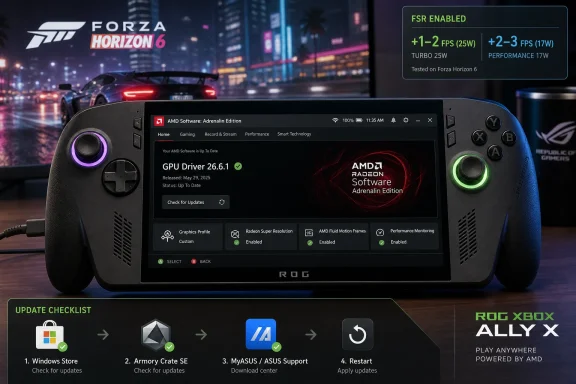
ASUS has released GPU driver 26.6.1 for the ROG Xbox Ally X in a July 2 driver package, and the action for owners is straightforward: update Windows Store apps first, install the driver through one ASUS delivery path, plug the handheld into power, restart, and confirm in AMD Adrenalin that version 26.6.1 dated May 29 is installed. Hardware by Okazaki reported on July 8, 2026 that the update specifically targets Forza Horizon 6 and produces modest measured gains: about 1–2 FPS at 25W and about 2–3 FPS at 17W using medium settings at 1080p with FSR enabled.
The practical takeaway is narrow but useful. This is not a platform-changing release, and it is not accompanied by a BIOS update, chipset driver, or broader companion package. For ROG Xbox Ally X owners who play Forza Horizon 6, it is a targeted graphics update worth installing because it is tied to a named optimization, has a verifiable end state, and appears to help most at the lower 17W power level. For everyone else, it is still a maintenance update that should be installed cleanly rather than rushed.
The new ROG Xbox Ally X GPU driver is version 26.6.1 in the AMD Adrenalin app, according to Hardware by Okazaki, and the ASUS package is dated July 2. Its headline purpose is straightforward: ASUS’s listing calls out Forza Horizon 6 by name for added optimizations. That makes this less a general platform refresh than a targeted graphics update aimed at one high-profile game.
That distinction matters. In the desktop PC world, a new graphics driver is often treated as routine maintenance, especially for users accustomed to frequent game-specific releases. In the handheld world, however, the OEM layer changes the stakes. Owners are not just waiting for GPU driver code; they are waiting for the device maker’s packaging, validation, delivery path, and integration with the control software that governs power profiles, display behavior, controller input, and update state.
The verified change is simple: ASUS has a new GPU driver package for the ROG Xbox Ally X, the installed driver should report as 26.6.1 in AMD Adrenalin, and Forza Horizon 6 is the named optimization target. Anything beyond that should be read carefully. The available report supports a targeted update and early performance measurements, not a sweeping claim about a broader platform refresh.
The practical result is modest but real. Testing cited by Hardware by Okazaki shows the new driver adding around 1–2 FPS at 25W and 2–3 FPS at 17W in Forza Horizon 6, using medium settings at 1080p with FSR enabled. That is not the sort of gain that changes the nature of the hardware. It is the sort of gain that may matter to players trying to hold a preferred frame-rate target on a handheld, especially at lower power levels where there is less headroom.
That makes troubleshooting simpler. If Forza Horizon 6 performance changes after installing this update, the likely cause is the graphics driver rather than a broader firmware or platform change. For users who have been cautious about handheld updates that can affect fan behavior, power behavior, sleep reliability, dock compatibility, or other system-level behavior, a narrow driver-only package is easier to evaluate.
But the same narrowness also limits the upside. A GPU driver can improve game-specific behavior, compatibility, latency behavior, or graphics-driver handling, but it cannot overhaul the entire platform. If a game’s behavior is constrained by CPU scheduling, storage behavior, memory pressure, firmware behavior, Windows background activity, or the game engine itself, this package should not be expected to solve all of that.
That is why the Forza Horizon 6 result lands as an incremental improvement rather than a dramatic leap. ASUS appears to have delivered an optimization pass for a named game, not a hidden performance mode. The physical limits of a handheld remain intact.
The bigger reported gain appears at 17W rather than 25W. That is an observation from the reported testing, not proof of a broad efficiency change across the platform. The supported conclusion is narrower: in the Forza Horizon 6 test conditions cited by Hardware by Okazaki, the 17W profile showed a larger FPS increase than the 25W profile.
For ordinary users, this can look suspicious. They install a July driver and then open Adrenalin only to see a May 29 date. On a Windows handheld, where multiple update surfaces already compete for attention, that kind of mismatch can make people wonder whether the update actually applied.
Hardware by Okazaki’s report provides the useful answer: the expected post-install state is version 26.6.1, dated May 29. In other words, the version number matters more than the date label. If the Adrenalin app shows 26.6.1 dated May 29, the update has landed as intended.
This is also where ASUS’s ecosystem layering becomes visible. The user may see the update through Armory Crate SE, MyASUS, or the ASUS support site. The graphics stack may identify itself through AMD Adrenalin. Windows Store updates may still need to be cleared before the process. To an enthusiast, that is manageable. To a console-style handheld owner, it is still more procedural than a single update button.
July 2 — The ASUS GPU driver package for the ROG Xbox Ally X is dated July 2.
July 8, 2026 — Hardware by Okazaki published its report on the ROG Xbox Ally X driver update and its early Forza Horizon 6 testing.
The cleanest approach is to choose one of those ASUS delivery paths and stick with it for the installation. Multiple routes are useful if one utility does not surface the update, but mixing methods mid-install can make it harder to know what happened if the update stalls or appears incomplete.
The pre-install advice is also clear. Hardware by Okazaki recommends updating through the Windows Store first because additional software for the ROG Xbox Ally X may be waiting there. That step should come before the GPU driver installation.
The power requirement is another practical detail. If the device is not plugged into a power supply when installation starts, the process stops and waits until power is connected. Once plugged in, the user must confirm and continue the installation, then restart to apply the changes.
That behavior is sensible. A graphics-driver install interrupted by a dying battery is exactly the sort of avoidable failure that can turn a routine update into a support incident. Anyone maintaining one of these devices should treat the process like laptop maintenance: update required software first, connect power, install through one chosen path, restart, and verify the final driver version.
Those numbers need to be read in context. The test conditions were medium settings, 1080p, with FSR enabled. Higher settings were not part of the cited comparison. The data therefore tells us something meaningful about the specific tested configuration, but not about every possible performance profile.
The 17W result is the more interesting of the two reported measurements because it shows the larger gain in the lower-power test condition. That does not prove a general platform-wide efficiency improvement. It does support a narrower reading: under the specific Forza Horizon 6 test settings reported, the update helped more at 17W than at 25W.
Still, this is not a miracle driver. The report does not claim a sweeping frame-rate leap, and it does not establish performance across a broad game library. The right reading is disciplined optimism: Forza Horizon 6 appears to run a little better under the tested settings, and the lower-power test condition appears to benefit more, but the update remains incremental.
That said, the evidence should stay in its lane. The available report supports a specific Forza Horizon 6 improvement at 17W. It does not prove that the ROG Xbox Ally X is now broadly more efficient across games, that battery life has improved, or that other titles will show the same pattern.
There is also a latency angle. Hardware by Okazaki reports lower average latency at 17W with the new driver. Average latency is not the whole story — frametime consistency, input latency, display behavior, and game engine pacing all matter — but it is more meaningful than FPS alone. A game can feel better even when the frame-rate average barely moves if frame delivery or responsiveness improves.
The most credible benefit of 26.6.1, based on the cited testing, is therefore modest: it appears to smooth and slightly improve Forza Horizon 6 under the tested conditions, especially at 17W. That is useful, but it should not be stretched into a broad claim about the whole platform.
That distinction is important because it separates two kinds of improvement. A driver can increase throughput, raising the number of frames the GPU can produce. It can also improve pacing or reduce hitching without meaningfully changing the average FPS. For handhelds, the second kind can be just as valuable, but it is harder to prove without controlled testing.
Stutter reduction depends on scene selection, shader compilation, asset streaming, background tasks, storage state, and whether the game has already cached data. Hardware by Okazaki’s cautious wording is appropriate: the report suggests a possible improvement, not a confirmed cross-title fix.
The responsible conclusion is that more testing is needed. Forza Horizon 6 is the named optimization target and the title with the clearest reported numbers. 007 First Light is, at this point, only a possible sign that the new driver may affect more than one game in limited circumstances.
None of that is inherently broken. It is part of the Windows handheld model: flexible, serviceable, and more PC-like than console-like. The problem is that each layer can use a slightly different language. One shows a package. One shows an app update. One shows a driver version. One shows a date. One may show nothing if it is already satisfied.
The July 2 versus May 29 date split is a perfect miniature version of that problem. The ASUS package is dated July 2, but the driver date shown inside Adrenalin should be May 29. Enthusiasts understand how that can happen. Many users do not. If Windows handhelds are going to keep moving toward console-style expectations, update tools need to make the expected final state obvious.
For IT pros and support-minded users, the answer is to document the expected final state. The target is not simply “latest driver installed.” It is “AMD Adrenalin reports 26.6.1 dated May 29.” That is concrete, checkable, and repeatable.
The broader lesson is that version clarity is now part of device quality. A driver that improves Forza Horizon 6 is useful. A driver that users can confidently install and verify is more useful still.
That is why targeted driver releases matter even when the measured gains are small. A 1–2 FPS improvement at 25W may not look dramatic in isolation, but it indicates that the game has received some degree of device-specific attention. A 2–3 FPS improvement at 17W is still modest, but it may be more relevant to users who spend time in lower-power handheld profiles.
Forza Horizon 6 is also the kind of game where uneven performance can be visible. Racing games involve constant motion, and hitches or inconsistent pacing can stand out quickly. That makes latency and smoothness important alongside average FPS.
The ROG Xbox Ally X sits in a difficult category. Its design and interface ambitions may invite console-like expectations, but its maintenance reality remains Windows. When a game needs optimization, the user may have to update Store components, install a GPU driver through a vendor utility or support download, restart, confirm the version in Adrenalin, and then return to normal use.
The good news is that the process is clear enough to follow. The less flattering news is that it remains a PC maintenance process. Driver 26.6.1 improves the device in a specific, verifiable way, but it also shows how many pieces still sit between a handheld owner and a fully updated game experience.
The source material does not report widespread installation failures or regressions. It does, however, describe a process that requires the device to be plugged in and restarted. That is enough to justify basic caution, especially for anyone managing more than one unit.
The absence of a BIOS or chipset update should reduce the fear factor. Users are not flashing firmware. They are not changing the core platform underneath Windows. They are installing a GPU package that can be verified afterward in Adrenalin.
For individual owners, the sensible path is simple: update through the Windows Store first, plug in, use one chosen ASUS delivery path, restart, and verify. For admins or fleet managers, the sensible path is to update one device first, confirm the version and behavior, then roll the same process across the remaining devices.
That is especially true because the improvement is incremental. There is no reason to turn a modest Forza Horizon 6 optimization into a rushed maintenance event. Install it, but install it cleanly.
Driver 26.6.1 is maintenance rather than spectacle. That makes it less exciting, but still important. A handheld gaming PC is sustained not only by its launch specifications but also by the updates that arrive when games need attention.
The available facts support a cautious view. ASUS has released a targeted GPU driver package dated July 2. Hardware by Okazaki reported on July 8, 2026 that it targets Forza Horizon 6 and produces small but measurable gains in the tested configuration. The update is driver-only, with no BIOS or chipset companion release identified in the report.
That is enough to call the release useful. It is not enough to draw broad conclusions about long-term update cadence, overall platform efficiency, or future game support. Those questions remain open and will depend on what happens with later releases.
That is not necessarily a weakness. The PC model gives users multiple ways to solve problems. It lets vendors ship targeted updates when a game needs attention. It also allows verification through tools like AMD Adrenalin, which is valuable when dates and package labels do not match cleanly.
The tradeoff is complexity. Driver 26.6.1 does not eliminate that complexity. It moves through it. Owners still need to know which update surface to use, why the Windows Store should be updated first, why power is required, why a restart matters, and why a May 29 driver date can be correct for a July 2 package.
For a device like the ROG Xbox Ally X, the real competition is not just other handheld PCs. It is the expectation that portable gaming should feel immediate. If a user has to understand ASUS support packages, AMD Adrenalin version labels, Armory Crate SE, MyASUS, and Windows Store dependencies, the platform is still asking for PC literacy.
That is why the update’s modest performance gains should not be dismissed, but also should not be oversold. They are part of the slow work of making a Windows handheld feel better in specific games. The update process itself shows the remaining gap between PC flexibility and console simplicity.
The best version of this future is not one where every handheld owner becomes a driver administrator. It is one where the device does the right thing, explains the final state clearly, and keeps game profiles current without making the user chase multiple update surfaces. Driver 26.6.1 is a useful step, but it is still a step.
The practical takeaway is narrow but useful. This is not a platform-changing release, and it is not accompanied by a BIOS update, chipset driver, or broader companion package. For ROG Xbox Ally X owners who play Forza Horizon 6, it is a targeted graphics update worth installing because it is tied to a named optimization, has a verifiable end state, and appears to help most at the lower 17W power level. For everyone else, it is still a maintenance update that should be installed cleanly rather than rushed.
 ASUS Ships the Kind of Update Handhelds Live or Die By
The new ROG Xbox Ally X GPU driver is version 26.6.1 in the AMD Adrenalin app, according to Hardware by Okazaki, and the ASUS package is dated July 2. Its headline purpose is straightforward: ASUS’s listing calls out Forza Horizon 6 by name for added optimizations. That makes this less a general platform refresh than a targeted graphics update aimed at one high-profile game.That distinction matters. In the desktop PC world, a new graphics driver is often treated as routine maintenance, especially for users accustomed to frequent game-specific releases. In the handheld world, however, the OEM layer changes the stakes. Owners are not just waiting for GPU driver code; they are waiting for the device maker’s packaging, validation, delivery path, and integration with the control software that governs power profiles, display behavior, controller input, and update state.
The verified change is simple: ASUS has a new GPU driver package for the ROG Xbox Ally X, the installed driver should report as 26.6.1 in AMD Adrenalin, and Forza Horizon 6 is the named optimization target. Anything beyond that should be read carefully. The available report supports a targeted update and early performance measurements, not a sweeping claim about a broader platform refresh.
The practical result is modest but real. Testing cited by Hardware by Okazaki shows the new driver adding around 1–2 FPS at 25W and 2–3 FPS at 17W in Forza Horizon 6, using medium settings at 1080p with FSR enabled. That is not the sort of gain that changes the nature of the hardware. It is the sort of gain that may matter to players trying to hold a preferred frame-rate target on a handheld, especially at lower power levels where there is less headroom.
The Update Is Narrow, Which Is Both Reassuring and Limiting
The most important constraint in this rollout is what ASUS did not ship. Per the source report, no BIOS update, chipset driver, or other companion release accompanied GPU driver 26.6.1. The graphics driver is the only component identified in this cycle.That makes troubleshooting simpler. If Forza Horizon 6 performance changes after installing this update, the likely cause is the graphics driver rather than a broader firmware or platform change. For users who have been cautious about handheld updates that can affect fan behavior, power behavior, sleep reliability, dock compatibility, or other system-level behavior, a narrow driver-only package is easier to evaluate.
But the same narrowness also limits the upside. A GPU driver can improve game-specific behavior, compatibility, latency behavior, or graphics-driver handling, but it cannot overhaul the entire platform. If a game’s behavior is constrained by CPU scheduling, storage behavior, memory pressure, firmware behavior, Windows background activity, or the game engine itself, this package should not be expected to solve all of that.
That is why the Forza Horizon 6 result lands as an incremental improvement rather than a dramatic leap. ASUS appears to have delivered an optimization pass for a named game, not a hidden performance mode. The physical limits of a handheld remain intact.
The bigger reported gain appears at 17W rather than 25W. That is an observation from the reported testing, not proof of a broad efficiency change across the platform. The supported conclusion is narrower: in the Forza Horizon 6 test conditions cited by Hardware by Okazaki, the 17W profile showed a larger FPS increase than the 25W profile.
The July 2 Package and the May 29 Driver Date Tell Different Parts of the Same Story
The update has an awkward but familiar wrinkle: the ASUS package is described as dated July 2, while the AMD Adrenalin app should show version 26.6.1 dated May 29 after installation. That is not necessarily a contradiction. Driver packaging, driver build dates, certification timing, and OEM publication dates do not always use the same calendar.For ordinary users, this can look suspicious. They install a July driver and then open Adrenalin only to see a May 29 date. On a Windows handheld, where multiple update surfaces already compete for attention, that kind of mismatch can make people wonder whether the update actually applied.
Hardware by Okazaki’s report provides the useful answer: the expected post-install state is version 26.6.1, dated May 29. In other words, the version number matters more than the date label. If the Adrenalin app shows 26.6.1 dated May 29, the update has landed as intended.
This is also where ASUS’s ecosystem layering becomes visible. The user may see the update through Armory Crate SE, MyASUS, or the ASUS support site. The graphics stack may identify itself through AMD Adrenalin. Windows Store updates may still need to be cleared before the process. To an enthusiast, that is manageable. To a console-style handheld owner, it is still more procedural than a single update button.
Timeline
May 29 — After installation, AMD Adrenalin should show GPU driver version 26.6.1 dated May 29.July 2 — The ASUS GPU driver package for the ROG Xbox Ally X is dated July 2.
July 8, 2026 — Hardware by Okazaki published its report on the ROG Xbox Ally X driver update and its early Forza Horizon 6 testing.
How Owners Should Install It
There are three stated routes for installing the driver: Armory Crate SE, MyASUS, and the direct ASUS support-site download. Hardware by Okazaki’s walkthrough favors the Armory Crate SE update center, but the report indicates the driver can also be obtained through MyASUS or ASUS’s support download path.The cleanest approach is to choose one of those ASUS delivery paths and stick with it for the installation. Multiple routes are useful if one utility does not surface the update, but mixing methods mid-install can make it harder to know what happened if the update stalls or appears incomplete.
The pre-install advice is also clear. Hardware by Okazaki recommends updating through the Windows Store first because additional software for the ROG Xbox Ally X may be waiting there. That step should come before the GPU driver installation.
The power requirement is another practical detail. If the device is not plugged into a power supply when installation starts, the process stops and waits until power is connected. Once plugged in, the user must confirm and continue the installation, then restart to apply the changes.
That behavior is sensible. A graphics-driver install interrupted by a dying battery is exactly the sort of avoidable failure that can turn a routine update into a support incident. Anyone maintaining one of these devices should treat the process like laptop maintenance: update required software first, connect power, install through one chosen path, restart, and verify the final driver version.
Action checklist for admins
- Update ROG Xbox Ally X software through the Windows Store before starting the GPU driver installation.
- Use one ASUS delivery path: Armory Crate SE, MyASUS, or the ASUS support download.
- Plug the device into a power supply before beginning the driver update.
- Restart after installation.
- Confirm in AMD Adrenalin that the driver reports version 26.6.1 dated May 29.
The Performance Story Is Smaller Than the Marketing Hook
Forza Horizon 6 is the named beneficiary of driver 26.6.1, and the early numbers reported by Hardware by Okazaki are specific enough to be useful. At 25W, the new driver is reported to be about 1–2 FPS faster than the previous driver. At 17W, the reported gain is about 2–3 FPS depending on the scene, with lower average latency.Those numbers need to be read in context. The test conditions were medium settings, 1080p, with FSR enabled. Higher settings were not part of the cited comparison. The data therefore tells us something meaningful about the specific tested configuration, but not about every possible performance profile.
Verified test details
- Game: Forza Horizon 6.
- Device: ROG Xbox Ally X.
- Driver: GPU driver 26.6.1.
- Settings: Medium.
- Resolution: 1080p.
- Upscaling: FSR enabled.
- 25W result: about 1–2 FPS faster than the previous driver.
- 17W result: about 2–3 FPS faster than the previous driver.
- Latency note: lower average latency was reported at 17W.
Commentary
For a desktop GPU review, 1–3 FPS would usually be treated as a small result unless it came with clear frametime or latency improvements. On a handheld, the same gain can be more noticeable when a game is already close to a user’s preferred frame-rate target. A small improvement may help a title feel steadier in some scenes, but the available report does not establish that this update transforms the game or applies similar gains across a broader library.The 17W result is the more interesting of the two reported measurements because it shows the larger gain in the lower-power test condition. That does not prove a general platform-wide efficiency improvement. It does support a narrower reading: under the specific Forza Horizon 6 test settings reported, the update helped more at 17W than at 25W.
Still, this is not a miracle driver. The report does not claim a sweeping frame-rate leap, and it does not establish performance across a broad game library. The right reading is disciplined optimism: Forza Horizon 6 appears to run a little better under the tested settings, and the lower-power test condition appears to benefit more, but the update remains incremental.
| Test condition | Settings | Reported gain | Latency note | Practical reading |
|---|---|---|---|---|
| 25W | Medium, 1080p, FSR enabled | 1–2 FPS | No major change reported | Small uplift, unlikely to transform play |
| 17W | Medium, 1080p, FSR enabled | 2–3 FPS | Lower average latency reported | More meaningful in the tested lower-power profile |
Lower Power Is Where This Driver Looks Most Useful
The 17W result deserves attention because handheld performance is not only a frame-rate contest. It is also a negotiation between speed, heat, noise, battery life, and comfort. A driver that adds 2–3 FPS at a lower power target may be more useful in practice than the raw number suggests, provided the user is playing in similar conditions to the reported test.That said, the evidence should stay in its lane. The available report supports a specific Forza Horizon 6 improvement at 17W. It does not prove that the ROG Xbox Ally X is now broadly more efficient across games, that battery life has improved, or that other titles will show the same pattern.
There is also a latency angle. Hardware by Okazaki reports lower average latency at 17W with the new driver. Average latency is not the whole story — frametime consistency, input latency, display behavior, and game engine pacing all matter — but it is more meaningful than FPS alone. A game can feel better even when the frame-rate average barely moves if frame delivery or responsiveness improves.
The most credible benefit of 26.6.1, based on the cited testing, is therefore modest: it appears to smooth and slightly improve Forza Horizon 6 under the tested conditions, especially at 17W. That is useful, but it should not be stretched into a broad claim about the whole platform.
007 First Light Hints at a Broader Stutter Story, but the Evidence Is Still Thin
Beyond Forza Horizon 6, the early picture is less certain. Hardware by Okazaki reports limited testing so far, with time spent in 007 First Light suggesting stutters may be slightly reduced on the new driver. FPS numbers, however, reportedly have not moved much.That distinction is important because it separates two kinds of improvement. A driver can increase throughput, raising the number of frames the GPU can produce. It can also improve pacing or reduce hitching without meaningfully changing the average FPS. For handhelds, the second kind can be just as valuable, but it is harder to prove without controlled testing.
Stutter reduction depends on scene selection, shader compilation, asset streaming, background tasks, storage state, and whether the game has already cached data. Hardware by Okazaki’s cautious wording is appropriate: the report suggests a possible improvement, not a confirmed cross-title fix.
The responsible conclusion is that more testing is needed. Forza Horizon 6 is the named optimization target and the title with the clearest reported numbers. 007 First Light is, at this point, only a possible sign that the new driver may affect more than one game in limited circumstances.
The Update Surfaces the Problem of Fragmented Trust
The ROG Xbox Ally X update process asks users to trust several different authorities. ASUS publishes the driver. Armory Crate SE can expose it in an update center. MyASUS can list it as well. The ASUS support site can provide the download. AMD Adrenalin confirms the installed version. The Windows Store may hold additional software that should be updated first.None of that is inherently broken. It is part of the Windows handheld model: flexible, serviceable, and more PC-like than console-like. The problem is that each layer can use a slightly different language. One shows a package. One shows an app update. One shows a driver version. One shows a date. One may show nothing if it is already satisfied.
The July 2 versus May 29 date split is a perfect miniature version of that problem. The ASUS package is dated July 2, but the driver date shown inside Adrenalin should be May 29. Enthusiasts understand how that can happen. Many users do not. If Windows handhelds are going to keep moving toward console-style expectations, update tools need to make the expected final state obvious.
For IT pros and support-minded users, the answer is to document the expected final state. The target is not simply “latest driver installed.” It is “AMD Adrenalin reports 26.6.1 dated May 29.” That is concrete, checkable, and repeatable.
The broader lesson is that version clarity is now part of device quality. A driver that improves Forza Horizon 6 is useful. A driver that users can confidently install and verify is more useful still.
Forza Horizon 6 Gets the Named Fix Because Big Games Set the Support Clock
The fact that Forza Horizon 6 is named in the listing should surprise no one. Major games often become practical support deadlines for PC gaming hardware, and handhelds have less room to hide rough performance than desktops. A desktop user may compensate with more GPU power, lower settings, or a different driver source. A handheld user has fewer margins.That is why targeted driver releases matter even when the measured gains are small. A 1–2 FPS improvement at 25W may not look dramatic in isolation, but it indicates that the game has received some degree of device-specific attention. A 2–3 FPS improvement at 17W is still modest, but it may be more relevant to users who spend time in lower-power handheld profiles.
Forza Horizon 6 is also the kind of game where uneven performance can be visible. Racing games involve constant motion, and hitches or inconsistent pacing can stand out quickly. That makes latency and smoothness important alongside average FPS.
The ROG Xbox Ally X sits in a difficult category. Its design and interface ambitions may invite console-like expectations, but its maintenance reality remains Windows. When a game needs optimization, the user may have to update Store components, install a GPU driver through a vendor utility or support download, restart, confirm the version in Adrenalin, and then return to normal use.
The good news is that the process is clear enough to follow. The less flattering news is that it remains a PC maintenance process. Driver 26.6.1 improves the device in a specific, verifiable way, but it also shows how many pieces still sit between a handheld owner and a fully updated game experience.
No BIOS Update Means Fewer Variables, Not No Risk
A driver-only release is usually lower-risk than a firmware update, but it is not risk-free. Graphics drivers sit in a sensitive part of the Windows experience. A bad install can affect game launch behavior, sleep and resume behavior, external display handling, video playback, overlays, and GPU control panels.The source material does not report widespread installation failures or regressions. It does, however, describe a process that requires the device to be plugged in and restarted. That is enough to justify basic caution, especially for anyone managing more than one unit.
The absence of a BIOS or chipset update should reduce the fear factor. Users are not flashing firmware. They are not changing the core platform underneath Windows. They are installing a GPU package that can be verified afterward in Adrenalin.
For individual owners, the sensible path is simple: update through the Windows Store first, plug in, use one chosen ASUS delivery path, restart, and verify. For admins or fleet managers, the sensible path is to update one device first, confirm the version and behavior, then roll the same process across the remaining devices.
That is especially true because the improvement is incremental. There is no reason to turn a modest Forza Horizon 6 optimization into a rushed maintenance event. Install it, but install it cleanly.
The ROG Xbox Ally X Is Being Judged on Cadence Now
The early life of any Windows handheld is dominated by hardware impressions: screen, controls, battery, thermals, ergonomics, and performance. Over time, the judgment shifts. Owners start asking whether the device receives useful drivers, whether game compatibility improves, whether vendor utilities become easier to live with, and whether the platform feels maintained.Driver 26.6.1 is maintenance rather than spectacle. That makes it less exciting, but still important. A handheld gaming PC is sustained not only by its launch specifications but also by the updates that arrive when games need attention.
The available facts support a cautious view. ASUS has released a targeted GPU driver package dated July 2. Hardware by Okazaki reported on July 8, 2026 that it targets Forza Horizon 6 and produces small but measurable gains in the tested configuration. The update is driver-only, with no BIOS or chipset companion release identified in the report.
That is enough to call the release useful. It is not enough to draw broad conclusions about long-term update cadence, overall platform efficiency, or future game support. Those questions remain open and will depend on what happens with later releases.
What This Release Says About Windows Handhelds in 2026
The ROG Xbox Ally X update is small enough to summarize in one sentence and large enough to reveal the state of the category. Windows handhelds are improving through driver packages, utility updates, Store components, restart prompts, and game-by-game tuning. That model gives users flexibility, but it also demands more attention than a sealed console-style update path.That is not necessarily a weakness. The PC model gives users multiple ways to solve problems. It lets vendors ship targeted updates when a game needs attention. It also allows verification through tools like AMD Adrenalin, which is valuable when dates and package labels do not match cleanly.
The tradeoff is complexity. Driver 26.6.1 does not eliminate that complexity. It moves through it. Owners still need to know which update surface to use, why the Windows Store should be updated first, why power is required, why a restart matters, and why a May 29 driver date can be correct for a July 2 package.
For a device like the ROG Xbox Ally X, the real competition is not just other handheld PCs. It is the expectation that portable gaming should feel immediate. If a user has to understand ASUS support packages, AMD Adrenalin version labels, Armory Crate SE, MyASUS, and Windows Store dependencies, the platform is still asking for PC literacy.
That is why the update’s modest performance gains should not be dismissed, but also should not be oversold. They are part of the slow work of making a Windows handheld feel better in specific games. The update process itself shows the remaining gap between PC flexibility and console simplicity.
The best version of this future is not one where every handheld owner becomes a driver administrator. It is one where the device does the right thing, explains the final state clearly, and keeps game profiles current without making the user chase multiple update surfaces. Driver 26.6.1 is a useful step, but it is still a step.
The Useful Facts Behind the Modest Frame Gains
For ROG Xbox Ally X owners, the release is worth installing because it is targeted, verifiable, and tied to a named game optimization rather than vague performance language. The gains are not large, but they are measurable in the reported Forza Horizon 6 test conditions. The update is also narrow enough that users can evaluate it without wondering whether a BIOS or chipset change altered the broader platform.- GPU driver 26.6.1 is the ROG Xbox Ally X graphics update reported by Hardware by Okazaki on July 8, 2026.
- The ASUS package is dated July 2.
- AMD Adrenalin should show version 26.6.1 dated May 29 after installation.
- Forza Horizon 6 is the named optimization target.
- Reported Forza Horizon 6 gains are about 1–2 FPS at 25W and 2–3 FPS at 17W under medium settings, 1080p, with FSR enabled.
- Lower average latency was reported at 17W.
- No BIOS update, chipset driver, or other companion release accompanied this rollout.
- The install requires external power and a restart.
- Users should update through the Windows Store before beginning the GPU driver installation.
- Users should install through one ASUS delivery path: Armory Crate SE, MyASUS, or the ASUS support download.
References
- Primary source: NoobFeed
Published: 2026-07-08T16:03:07.932263
New GPU Driver 26.6.1 Arrives for ROG Xbox Ally X: What Changed? | NoobFeed
ASUS has released a new GPU driver for the ROG Xbox Ally X, and the update focuses squarely on Forza Horizon 6 performance. Handheld gaming devices depend...www.noobfeed.com
