

On June 23, 2026, the AI agent-builder market spans hyperscale cloud platforms, Microsoft and Salesforce business suites, open-source orchestration frameworks, and no-code automation tools competing to turn large language models into production software workers. The useful question is no longer whether an agent can summarize a document or draft an email. It is whether a platform can connect reasoning, data access, workflow execution, governance, cost control, and human oversight without creating a new operational mess. The “best” tool in 2026 is therefore less a universal winner than a map of trade-offs: control versus speed, ecosystem depth versus portability, and impressive demos versus maintainable production systems.
The phrase AI agent builder now covers an awkwardly wide field. Some products are developer frameworks for stateful orchestration. Others are visual workflow tools with AI nodes. Others are enterprise platforms bolted directly into Microsoft 365, Salesforce CRM, Google Cloud, or AWS. That breadth is a sign of market maturity, but also a warning: buyers are increasingly comparing tools that solve different problems.
The common thread is that agents are expected to do more than talk. They retrieve information, call APIs, update records, write files, route tasks, ask for approval, and sometimes coordinate with other agents. That changes the risk model. A hallucinated chatbot answer is embarrassing; a hallucinated workflow that updates a CRM, emails a customer, or triggers a refund is operationally dangerous.
This is why the strongest platforms in 2026 are not merely wrappers around a language model. They provide some combination of orchestration, tool access, memory, observability, deployment, permissions, evaluation, and cost controls. The better platforms treat agent behavior as software behavior, not magic.
That distinction matters for WindowsForum readers because many organizations will meet agents first through familiar enterprise surfaces: Microsoft Teams, SharePoint, Dynamics, Salesforce, AWS, Google Cloud, Zapier, or internal automation stacks. The agent platform your company chooses may be less about model quality and more about where your data already lives.
The developer appeal is obvious. Teams can define custom tools, connect proprietary APIs, route tasks between specialized agents, and embed agent behavior inside their own applications. That is very different from buying a no-code “AI workforce” product and accepting its abstractions. OpenAI’s platform gives engineering teams room to build the thing they actually want.
But 2026 also made the OpenAI story more complicated. OpenAI’s visual Agent Builder has been scheduled to wind down, with availability ending after November 30, 2026. That does not make OpenAI irrelevant as an agent platform, but it does change the buying calculus for teams that were attracted specifically to the visual canvas. The durable bet is on the underlying APIs, SDKs, tool-calling patterns, and model ecosystem—not on assuming every experimental product surface will survive unchanged.
That makes OpenAI strongest for teams that already think like software builders. It is not the lowest-friction choice for a sales operations manager who wants to automate lead follow-up by Friday. It is a serious platform for teams comfortable owning architecture, testing, deployment, monitoring, and cost management.
That matters enormously. A useful internal agent often needs access to SharePoint documents, Teams conversations, Dataverse records, Power Automate workflows, identity controls, and Microsoft 365 permissions. Copilot Studio can build agents that work inside this environment rather than forcing IT to construct every bridge from scratch.
Microsoft has also leaned into the idea that agents are not only chatbots. Copilot Studio supports internal employee agents, customer-facing agents, voice-enabled scenarios, Power Platform connectors, Azure AI Search, tools, prompts, workflows, and governance features. In practice, that means a company can build a help-desk agent for Teams, a customer-service agent for a website, or a process agent that triggers approvals and updates records.
The catch is Microsoft licensing, which remains a full-time sport. Copilot Studio now revolves around Copilot Credits and tenant-level capacity models for many scenarios, while Microsoft 365 Copilot licensing affects what employees can access internally. For IT administrators, the technical question is only half the problem. The financial architecture needs just as much attention, especially as agents move from pilots to daily usage.
Google’s strength is the integrated AI platform view. Teams can work with Gemini models, model catalogs, search, evaluation tooling, storage, data services, and deployment infrastructure under the same cloud umbrella. That is attractive for data-heavy organizations that want agents grounded in internal systems rather than floating above them as disconnected SaaS bots.
AWS makes a similar argument through Amazon Bedrock Agents and Bedrock AgentCore. Bedrock Agents provide model orchestration, knowledge bases, API actions, Lambda integration, retrieval-augmented generation, and multi-agent collaboration. AgentCore extends the story toward production deployment, authentication, debugging, tracing, and operating agents at scale.
For AWS-native teams, Bedrock’s biggest strength is optionality. Organizations can choose among multiple foundation-model providers through Bedrock while still using AWS identity, security, storage, compute, and monitoring patterns. That avoids some forms of model lock-in, though it replaces them with cloud-platform dependency.
The trade-off for both Google and AWS is complexity. These are not tools for someone who wants to drag three boxes onto a canvas and call it a deployment. They are platforms for cloud engineers, ML teams, and enterprise developers who already understand IAM, networking, storage, monitoring, and production architecture. They scale well, but they expect you to bring adult supervision.
For Salesforce-heavy organizations, that proximity is powerful. A support agent that can read case history, search knowledge articles, escalate a ticket, update fields, and draft a customer reply is more useful than a generic assistant that needs fragile integrations for every action. The same logic applies to sales development, lead qualification, account research, and customer success workflows.
Agentforce also reflects where the agent market is heading commercially. Salesforce now supports usage models such as Flex Credits, conversation-based pricing, user-based licensing, and enterprise bundles. That flexibility helps different departments adopt agents, but it also means costs can become hard to forecast if agents start performing many small actions across high-volume workflows.
The more fundamental limitation is data hygiene. Agentforce is only as good as the Salesforce environment beneath it. If records are duplicated, fields are stale, processes are inconsistent, or permissions are chaotic, an agent will not magically fix the CRM. It may simply automate the consequences faster.
CrewAI focuses on role-based multi-agent orchestration. Developers can define specialized agents with different responsibilities, tools, and workflows. That model fits research, analysis, software tasks, operations workflows, and scenarios where one agent gathers information, another validates, and another executes. It is powerful, but multi-agent systems can quickly become harder to debug than single-agent workflows.
LangGraph, from the LangChain ecosystem, is more explicitly an orchestration framework. Its graph-based approach is designed for stateful, long-running, branching workflows with retries, persistence, memory, and human-in-the-loop checkpoints. If you need an agent workflow that pauses, resumes, branches, retries after failure, or waits for approval, LangGraph is one of the serious developer options.
Dify and Flowise move closer to visual AI application building. Dify combines AI app development, workflows, prompt tooling, RAG pipelines, model management, and LLMOps-style features. Flowise offers visual construction of chatflows, agentflows, RAG workflows, tool integrations, and embedded assistants. Both are attractive to teams that want open-source flexibility without building every interface from scratch.
The price of open source is operational responsibility. Self-hosting sounds liberating until someone must patch it, secure it, scale it, monitor it, back it up, and explain why a workflow failed at 2:13 a.m. Open-source agent builders are best for teams that value control enough to pay for it in engineering time.
Relevance AI presents itself around AI workforces, with no-code agents for sales, operations, research, customer success, and marketing. It is a good fit for business teams that want agents to qualify leads, enrich CRMs, prepare research, perform outreach, or coordinate repeatable processes. Its strength is accessibility; its weakness is that very specialized orchestration may push beyond what a no-code abstraction wants to expose.
Lindy is more assistant-like. It targets email, calendars, meetings, follow-ups, CRM updates, scheduling, and administrative work. That makes it attractive for founders, consultants, recruiters, salespeople, and small teams. It is not the platform you choose to build a deeply customized multi-agent architecture, but it may be exactly what a busy operator wants.
Zapier Agents benefits from Zapier’s enormous integration catalog. If the job is to connect thousands of SaaS tools, monitor events, retrieve data, and trigger actions, Zapier has a structural advantage. The risk is the familiar Zapier problem: workflows that begin as charming no-code automations can become sprawling systems whose logic is distributed across triggers, tables, actions, and exceptions.
Gumloop sits between AI automation and agent building, using a visual node-based builder for workflows, agents, document processing, data tasks, and business automations. It is especially interesting for teams that want AI-native workflows without writing everything in code. As with any visual system, complexity eventually has a shape: too many nodes, too many branches, too many agents, and too few people who understand the whole thing.
n8n remains one of the most flexible automation platforms in the group. Its open-source roots, self-hosting options, broad integrations, custom code support, and AI nodes make it attractive for technical operations teams that want automation without SaaS-only constraints. It is less purely an “agent builder” than a workflow engine that can incorporate agentic behavior, which may actually make it more practical for many IT departments.
Voiceflow is the specialist. It is built for designing, deploying, and managing conversational experiences across chat and voice. For customer support, digital assistants, lead capture, and self-service flows, its design canvas, collaboration tools, analytics, evaluations, and deployment controls are well aligned. For back-office process automation, other tools are usually a better fit.
If the answer is engineering, OpenAI APIs, LangGraph, CrewAI, Dify, Flowise, Bedrock, or Vertex AI may be appropriate. These tools offer control, flexibility, and deeper architecture choices. They also assume the organization can test, monitor, deploy, and maintain software-like systems.
If the answer is IT administration, Microsoft Copilot Studio, Salesforce Agentforce, AWS Bedrock, and Google Vertex AI may be safer because they align with existing identity, governance, data, and cloud controls. These platforms reduce integration friction inside their ecosystems, though they may increase licensing and platform dependency.
If the answer is a business operations team, Relevance AI, Lindy, Zapier Agents, Gumloop, n8n, and Voiceflow may deliver value faster. They abstract away much of the engineering work and focus on practical workflows. The risk is that business teams may deploy agents faster than the organization can govern them.
This is why pilot projects should be chosen carefully. A low-risk internal knowledge assistant is not the same as an agent that updates financial records or contacts customers. The first tests whether the platform can retrieve and summarize. The second tests whether the organization is ready to let probabilistic software act.
A traditional SaaS license might charge by seat. An agent system may charge by model tokens, tool calls, workflow runs, credits, storage, vector search, API invocations, executions, and supporting infrastructure. A poorly designed agent can spend money in loops. A successful agent can also become expensive simply because people actually use it.
Microsoft Copilot Studio uses Copilot Credits for metered consumption across many scenarios. Salesforce Agentforce uses Flex Credits and other licensing models depending on deployment type. Zapier counts tasks. Gumloop uses credits. Cloud platforms charge across models and infrastructure. Open-source tools may be free to download but still incur model, hosting, storage, and operational costs.
This makes observability and cost attribution mandatory. Teams need to know which agent ran, what it called, how many tokens it used, what actions it performed, what data it accessed, what it cost, and whether it succeeded. Without that, an agent platform becomes a budget leak with a friendly chat interface.
The practical advice is simple: do not evaluate agent platforms only by monthly subscription price. Evaluate the total cost of a successful deployment. The moment an agent becomes useful, usage rises. If the pricing model cannot be explained to finance, procurement, and IT operations, the pilot is not ready for production.
Salesforce Agentforce is the pragmatic choice for companies whose customer workflows already live in Salesforce. CrewAI and LangGraph are best for developers who need multi-agent or stateful orchestration with real control. Dify and Flowise are attractive open-source visual platforms for teams that want RAG, workflows, and deployment flexibility. n8n, Zapier Agents, Gumloop, Relevance AI, Lindy, and Voiceflow serve the faster-moving no-code and low-code market, each with a different center of gravity.
The decision should start with three questions. Where does the data live? Who will maintain the agent? What actions is the agent allowed to take? If those answers are vague, the platform choice is premature.
For Windows-heavy organizations, Microsoft Copilot Studio will often be the path of least resistance, especially where Teams, SharePoint, Power Platform, and Entra ID already define work. But “least resistance” does not always mean “best architecture.” A product team building an embedded SaaS agent may be better served by OpenAI, LangGraph, or Dify. A cloud-native AWS shop may prefer Bedrock. A sales-led Salesforce organization may get faster value from Agentforce than from a generic framework.
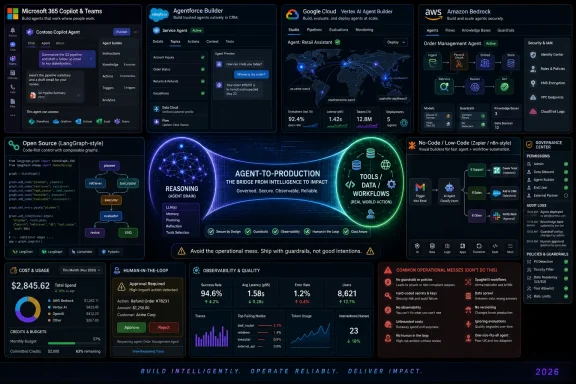 The Agent Builder Market Has Outgrown the Chatbot Era
The phrase AI agent builder now covers an awkwardly wide field. Some products are developer frameworks for stateful orchestration. Others are visual workflow tools with AI nodes. Others are enterprise platforms bolted directly into Microsoft 365, Salesforce CRM, Google Cloud, or AWS. That breadth is a sign of market maturity, but also a warning: buyers are increasingly comparing tools that solve different problems.The common thread is that agents are expected to do more than talk. They retrieve information, call APIs, update records, write files, route tasks, ask for approval, and sometimes coordinate with other agents. That changes the risk model. A hallucinated chatbot answer is embarrassing; a hallucinated workflow that updates a CRM, emails a customer, or triggers a refund is operationally dangerous.
This is why the strongest platforms in 2026 are not merely wrappers around a language model. They provide some combination of orchestration, tool access, memory, observability, deployment, permissions, evaluation, and cost controls. The better platforms treat agent behavior as software behavior, not magic.
That distinction matters for WindowsForum readers because many organizations will meet agents first through familiar enterprise surfaces: Microsoft Teams, SharePoint, Dynamics, Salesforce, AWS, Google Cloud, Zapier, or internal automation stacks. The agent platform your company chooses may be less about model quality and more about where your data already lives.
OpenAI’s Developer Advantage Comes With a Calendar Warning
OpenAI remains one of the most important names in agent development because it controls both frontier models and a fast-moving developer platform. Its agent tooling has included the Responses API, tool calling, file search, web search, computer-use-style capabilities, tracing, guardrails, and SDK-based orchestration. For software teams building product-embedded assistants, research copilots, customer support agents, or internal workflow agents, OpenAI offers a direct path to powerful model behavior without routing everything through a larger enterprise suite.The developer appeal is obvious. Teams can define custom tools, connect proprietary APIs, route tasks between specialized agents, and embed agent behavior inside their own applications. That is very different from buying a no-code “AI workforce” product and accepting its abstractions. OpenAI’s platform gives engineering teams room to build the thing they actually want.
But 2026 also made the OpenAI story more complicated. OpenAI’s visual Agent Builder has been scheduled to wind down, with availability ending after November 30, 2026. That does not make OpenAI irrelevant as an agent platform, but it does change the buying calculus for teams that were attracted specifically to the visual canvas. The durable bet is on the underlying APIs, SDKs, tool-calling patterns, and model ecosystem—not on assuming every experimental product surface will survive unchanged.
That makes OpenAI strongest for teams that already think like software builders. It is not the lowest-friction choice for a sales operations manager who wants to automate lead follow-up by Friday. It is a serious platform for teams comfortable owning architecture, testing, deployment, monitoring, and cost management.
Microsoft Turns the Agent Into an Office Worker
Microsoft Copilot Studio is the most obvious choice for organizations whose business already runs through Microsoft 365, Teams, SharePoint, Power Platform, Dataverse, Dynamics 365, and Azure. Its advantage is not that it is the most elegant agent framework. Its advantage is that it lives where enterprise work already happens.That matters enormously. A useful internal agent often needs access to SharePoint documents, Teams conversations, Dataverse records, Power Automate workflows, identity controls, and Microsoft 365 permissions. Copilot Studio can build agents that work inside this environment rather than forcing IT to construct every bridge from scratch.
Microsoft has also leaned into the idea that agents are not only chatbots. Copilot Studio supports internal employee agents, customer-facing agents, voice-enabled scenarios, Power Platform connectors, Azure AI Search, tools, prompts, workflows, and governance features. In practice, that means a company can build a help-desk agent for Teams, a customer-service agent for a website, or a process agent that triggers approvals and updates records.
The catch is Microsoft licensing, which remains a full-time sport. Copilot Studio now revolves around Copilot Credits and tenant-level capacity models for many scenarios, while Microsoft 365 Copilot licensing affects what employees can access internally. For IT administrators, the technical question is only half the problem. The financial architecture needs just as much attention, especially as agents move from pilots to daily usage.
Google and AWS Sell Agents as Cloud Infrastructure
Google’s Vertex AI Agent Builder and broader Gemini enterprise tooling make the most sense for organizations already committed to Google Cloud. The core pitch is that agents should sit close to enterprise data, model management, search, evaluation, observability, and cloud-native deployment controls. If your data estate lives in Google Cloud, that is a persuasive argument.Google’s strength is the integrated AI platform view. Teams can work with Gemini models, model catalogs, search, evaluation tooling, storage, data services, and deployment infrastructure under the same cloud umbrella. That is attractive for data-heavy organizations that want agents grounded in internal systems rather than floating above them as disconnected SaaS bots.
AWS makes a similar argument through Amazon Bedrock Agents and Bedrock AgentCore. Bedrock Agents provide model orchestration, knowledge bases, API actions, Lambda integration, retrieval-augmented generation, and multi-agent collaboration. AgentCore extends the story toward production deployment, authentication, debugging, tracing, and operating agents at scale.
For AWS-native teams, Bedrock’s biggest strength is optionality. Organizations can choose among multiple foundation-model providers through Bedrock while still using AWS identity, security, storage, compute, and monitoring patterns. That avoids some forms of model lock-in, though it replaces them with cloud-platform dependency.
The trade-off for both Google and AWS is complexity. These are not tools for someone who wants to drag three boxes onto a canvas and call it a deployment. They are platforms for cloud engineers, ML teams, and enterprise developers who already understand IAM, networking, storage, monitoring, and production architecture. They scale well, but they expect you to bring adult supervision.
Salesforce Agentforce Is the CRM’s Bid to Become the Workflow Brain
Salesforce Agentforce is the clearest example of an enterprise application vendor turning its existing system of record into an agent platform. Its value is not abstract model orchestration. Its value is proximity to customer data: accounts, opportunities, cases, knowledge articles, service workflows, sales activities, marketing data, and Customer 360 context.For Salesforce-heavy organizations, that proximity is powerful. A support agent that can read case history, search knowledge articles, escalate a ticket, update fields, and draft a customer reply is more useful than a generic assistant that needs fragile integrations for every action. The same logic applies to sales development, lead qualification, account research, and customer success workflows.
Agentforce also reflects where the agent market is heading commercially. Salesforce now supports usage models such as Flex Credits, conversation-based pricing, user-based licensing, and enterprise bundles. That flexibility helps different departments adopt agents, but it also means costs can become hard to forecast if agents start performing many small actions across high-volume workflows.
The more fundamental limitation is data hygiene. Agentforce is only as good as the Salesforce environment beneath it. If records are duplicated, fields are stale, processes are inconsistent, or permissions are chaotic, an agent will not magically fix the CRM. It may simply automate the consequences faster.
Open Source Wins When Control Matters More Than Convenience
CrewAI, LangGraph, Dify, and Flowise represent the other side of the market: tools for teams that want more control, portability, and customization than large SaaS platforms usually provide. They are not interchangeable, but they share a common posture. They assume the builder wants to design the agent system, not merely configure it.CrewAI focuses on role-based multi-agent orchestration. Developers can define specialized agents with different responsibilities, tools, and workflows. That model fits research, analysis, software tasks, operations workflows, and scenarios where one agent gathers information, another validates, and another executes. It is powerful, but multi-agent systems can quickly become harder to debug than single-agent workflows.
LangGraph, from the LangChain ecosystem, is more explicitly an orchestration framework. Its graph-based approach is designed for stateful, long-running, branching workflows with retries, persistence, memory, and human-in-the-loop checkpoints. If you need an agent workflow that pauses, resumes, branches, retries after failure, or waits for approval, LangGraph is one of the serious developer options.
Dify and Flowise move closer to visual AI application building. Dify combines AI app development, workflows, prompt tooling, RAG pipelines, model management, and LLMOps-style features. Flowise offers visual construction of chatflows, agentflows, RAG workflows, tool integrations, and embedded assistants. Both are attractive to teams that want open-source flexibility without building every interface from scratch.
The price of open source is operational responsibility. Self-hosting sounds liberating until someone must patch it, secure it, scale it, monitor it, back it up, and explain why a workflow failed at 2:13 a.m. Open-source agent builders are best for teams that value control enough to pay for it in engineering time.
No-Code Platforms Sell Speed, but Speed Is Not Governance
Relevance AI, Lindy, Zapier Agents, Gumloop, n8n, and Voiceflow are all competing for teams that want results without becoming agent-framework specialists. Their shared promise is speed: connect apps, describe work, build workflows visually, and let AI handle the drudgery.Relevance AI presents itself around AI workforces, with no-code agents for sales, operations, research, customer success, and marketing. It is a good fit for business teams that want agents to qualify leads, enrich CRMs, prepare research, perform outreach, or coordinate repeatable processes. Its strength is accessibility; its weakness is that very specialized orchestration may push beyond what a no-code abstraction wants to expose.
Lindy is more assistant-like. It targets email, calendars, meetings, follow-ups, CRM updates, scheduling, and administrative work. That makes it attractive for founders, consultants, recruiters, salespeople, and small teams. It is not the platform you choose to build a deeply customized multi-agent architecture, but it may be exactly what a busy operator wants.
Zapier Agents benefits from Zapier’s enormous integration catalog. If the job is to connect thousands of SaaS tools, monitor events, retrieve data, and trigger actions, Zapier has a structural advantage. The risk is the familiar Zapier problem: workflows that begin as charming no-code automations can become sprawling systems whose logic is distributed across triggers, tables, actions, and exceptions.
Gumloop sits between AI automation and agent building, using a visual node-based builder for workflows, agents, document processing, data tasks, and business automations. It is especially interesting for teams that want AI-native workflows without writing everything in code. As with any visual system, complexity eventually has a shape: too many nodes, too many branches, too many agents, and too few people who understand the whole thing.
n8n remains one of the most flexible automation platforms in the group. Its open-source roots, self-hosting options, broad integrations, custom code support, and AI nodes make it attractive for technical operations teams that want automation without SaaS-only constraints. It is less purely an “agent builder” than a workflow engine that can incorporate agentic behavior, which may actually make it more practical for many IT departments.
Voiceflow is the specialist. It is built for designing, deploying, and managing conversational experiences across chat and voice. For customer support, digital assistants, lead capture, and self-service flows, its design canvas, collaboration tools, analytics, evaluations, and deployment controls are well aligned. For back-office process automation, other tools are usually a better fit.
The Best Tool Depends on Who Owns the Failure
The most important selection criterion in 2026 is not the demo. It is ownership. When an agent makes a bad decision, calls the wrong tool, leaks data, burns through credits, or silently fails, who is responsible for diagnosing and fixing the system?If the answer is engineering, OpenAI APIs, LangGraph, CrewAI, Dify, Flowise, Bedrock, or Vertex AI may be appropriate. These tools offer control, flexibility, and deeper architecture choices. They also assume the organization can test, monitor, deploy, and maintain software-like systems.
If the answer is IT administration, Microsoft Copilot Studio, Salesforce Agentforce, AWS Bedrock, and Google Vertex AI may be safer because they align with existing identity, governance, data, and cloud controls. These platforms reduce integration friction inside their ecosystems, though they may increase licensing and platform dependency.
If the answer is a business operations team, Relevance AI, Lindy, Zapier Agents, Gumloop, n8n, and Voiceflow may deliver value faster. They abstract away much of the engineering work and focus on practical workflows. The risk is that business teams may deploy agents faster than the organization can govern them.
This is why pilot projects should be chosen carefully. A low-risk internal knowledge assistant is not the same as an agent that updates financial records or contacts customers. The first tests whether the platform can retrieve and summarize. The second tests whether the organization is ready to let probabilistic software act.
Pricing Has Become the Hidden Architecture
Agent pricing is increasingly metered, credit-based, token-based, action-based, or some combination of all four. That is not an accounting detail. It changes how systems should be designed.A traditional SaaS license might charge by seat. An agent system may charge by model tokens, tool calls, workflow runs, credits, storage, vector search, API invocations, executions, and supporting infrastructure. A poorly designed agent can spend money in loops. A successful agent can also become expensive simply because people actually use it.
Microsoft Copilot Studio uses Copilot Credits for metered consumption across many scenarios. Salesforce Agentforce uses Flex Credits and other licensing models depending on deployment type. Zapier counts tasks. Gumloop uses credits. Cloud platforms charge across models and infrastructure. Open-source tools may be free to download but still incur model, hosting, storage, and operational costs.
This makes observability and cost attribution mandatory. Teams need to know which agent ran, what it called, how many tokens it used, what actions it performed, what data it accessed, what it cost, and whether it succeeded. Without that, an agent platform becomes a budget leak with a friendly chat interface.
The practical advice is simple: do not evaluate agent platforms only by monthly subscription price. Evaluate the total cost of a successful deployment. The moment an agent becomes useful, usage rises. If the pricing model cannot be explained to finance, procurement, and IT operations, the pilot is not ready for production.
The 2026 Shortlist Belongs to the Stack You Already Trust
There is no single best AI agent builder in 2026, but there are clear category winners. OpenAI remains a strong developer-first option, especially for teams building custom product experiences and agentic applications. Microsoft Copilot Studio is the obvious candidate for Microsoft 365 organizations. Google Vertex AI Agent Builder belongs on the shortlist for Google Cloud data estates. Amazon Bedrock Agents and AgentCore are natural fits for AWS-native teams.Salesforce Agentforce is the pragmatic choice for companies whose customer workflows already live in Salesforce. CrewAI and LangGraph are best for developers who need multi-agent or stateful orchestration with real control. Dify and Flowise are attractive open-source visual platforms for teams that want RAG, workflows, and deployment flexibility. n8n, Zapier Agents, Gumloop, Relevance AI, Lindy, and Voiceflow serve the faster-moving no-code and low-code market, each with a different center of gravity.
The decision should start with three questions. Where does the data live? Who will maintain the agent? What actions is the agent allowed to take? If those answers are vague, the platform choice is premature.
For Windows-heavy organizations, Microsoft Copilot Studio will often be the path of least resistance, especially where Teams, SharePoint, Power Platform, and Entra ID already define work. But “least resistance” does not always mean “best architecture.” A product team building an embedded SaaS agent may be better served by OpenAI, LangGraph, or Dify. A cloud-native AWS shop may prefer Bedrock. A sales-led Salesforce organization may get faster value from Agentforce than from a generic framework.
Fifteen Names, Five Real Buying Decisions
The agent-builder market looks crowded because vendors are converging on the same vocabulary. Underneath the branding, the practical choices are narrower. Buyers are really choosing among ecosystem platforms, developer frameworks, open-source builders, no-code automation systems, and specialized conversational tools.- OpenAI is strongest for developer-led agent applications, but teams should plan around durable APIs and SDKs rather than assuming every visual product surface will remain available indefinitely.
- Microsoft Copilot Studio is the strongest fit for organizations already standardized on Microsoft 365, Teams, SharePoint, Power Platform, Dynamics, and Azure governance.
- Google Vertex AI Agent Builder and Amazon Bedrock Agents make the most sense when agents are part of a broader cloud architecture rather than a standalone business automation project.
- Salesforce Agentforce is compelling when customer data and business process already live in Salesforce, but CRM quality and credit consumption will determine real-world success.
- CrewAI, LangGraph, Dify, and Flowise are the best options when portability, customization, and engineering control matter more than turnkey convenience.
- Relevance AI, Lindy, Zapier Agents, Gumloop, n8n, and Voiceflow are best judged by the work they make simple, not by whether they satisfy a purist definition of agentic AI.
References
- Primary source: Hostinger
Published: 2026-06-23T18:50:09.291413
15 best AI agent builders in 2026
Compare the best AI agent builder tools by use case, features, pros, cons, and pricing to choose the right platform.www.hostinger.com - Official source: platform.openai.com
Agent Builder | OpenAI API
Use the OpenAI Agent Builder to start from templates, compose nodes, preview runs, and export workflows to code. platform.openai.com
