

In July 2026, the best Nintendo Switch emulator for Windows 11 and Windows 10 is not a single clean answer but a split between Eden for active development and Ryubing for stability. That answer comes with a large asterisk: the Switch emulation scene has become legally pressured, fragmented, and unusually volatile. The old names that once defined the category are either dead, frozen, or living on through forks that may move servers without warning. For Windows users, the real choice is no longer “which emulator is fastest,” but “which project still exists, which one you trust, and how much instability you are willing to accept.”
For years, Switch emulation on Windows was easy to describe. Yuzu was the fast-moving, performance-minded option, while Ryujinx was the accuracy-first rival with a reputation for stability. If you had a strong enough CPU, a Vulkan-capable GPU, and legally dumped games, you could usually pick one of those two and get on with the experiment.
That era ended in 2024. Nintendo sued the Yuzu developers, and the case ended quickly with a $2.4 million settlement and the shutdown of Yuzu’s development and distribution. The collateral damage was immediate: Citra, the well-known Nintendo 3DS emulator maintained by the same organization, disappeared with it.
Ryujinx lasted longer, but not by much. In October 2024, the project went offline after Nintendo contacted its lead developer, who reportedly agreed to stop working on it and remove project assets under his control. That left the Windows Switch emulation scene in a strange condition: the code had not vanished from the internet, but the institutional projects had.
The result is the fork economy. Eden, Ryubing, Sudachi, Citron, and other names all represent attempts to keep some version of Yuzu or Ryujinx alive. Some are serious development efforts. Some are preservation projects. Some are dead names kept alive by search-engine spam and malware-adjacent download pages.
That is why a 2026 recommendation has to begin with status, not benchmarks. An emulator that topped a chart in 2023 is irrelevant if its official builds are gone, its GitHub organization is empty, or its “download” links now point to a site nobody should trust.
Its main argument is momentum. Eden has continued shipping builds, game-specific fixes, renderer updates, and performance work while other projects have slowed or frozen. For a scene where compatibility can change quickly, that matters more than nostalgia for the old brand names.
The tradeoff is that Eden is no longer a frictionless GitHub download in the way older emulators often were. Nintendo’s 2026 DMCA activity targeted several Switch emulator projects, including Eden-related repositories, and the project’s public footprint has shifted away from the simple, centralized model casual users expect. That does not make the emulator unusable, but it does mean users need to be more careful about where they get it.
Performance is Eden’s strongest pitch. Like Yuzu before it, Eden tends to reward modern CPUs with strong single-core performance and GPUs with solid Vulkan support. Architecture-optimized builds can offer meaningful gains on newer Ryzen and Intel systems, especially when paired with enough RAM and fast storage.
The weak point is predictability. Fast-moving nightly builds can fix one game and break another. Shader compilation stutter remains part of the experience, especially the first time a game renders a new area or effect. Users who want a set-and-forget appliance may find Eden’s pace exhausting.
For Windows 11 and Windows 10 users with current hardware, Eden is the best answer if “best” means most alive. It is the emulator to watch, but also the one most likely to force you to pay attention.
The appeal is stability. Ryujinx built its reputation on accuracy and broad compatibility rather than sheer speed, and Ryubing inherits much of that behavior. It tends to be less surprising in long play sessions and less hostile to users who do not want to babysit settings.
That matters because Switch emulation is already complicated enough. Users must deal with controller setup, firmware compatibility, shader caches, GPU drivers, and game-specific quirks. An emulator that simply crashes less often has a value that no synthetic benchmark captures.
The problem is development status. Ryubing has reportedly entered maintenance mode after leadership changes, which means users should not expect major new breakthroughs. Bug fixes and small compatibility updates are one thing; a full new wave of performance engineering is another.
That makes Ryubing an excellent recommendation for older or less adventurous Windows users. If your goal is to run a broad library with minimal friction, it may still beat Eden in lived experience. If your goal is to chase the newest demanding releases, Eden has the more convincing trajectory.
In 2026, Ryubing is not the future of Switch emulation. It is the stable branch of the past that still works.
But Sudachi does not have Eden’s momentum or Ryubing’s stability story. Its update cadence has been uneven, and its public presence is muddier than it should be. That matters because emulator discovery is now a security problem as much as a convenience problem.
Search for almost any post-Yuzu emulator name and you will find a thicket of copycat pages, ad-heavy download portals, and suspicious “official” mirrors. Sudachi is especially vulnerable to that problem because its name is widely reused by sites trying to capture desperate search traffic. In 2026, finding the real project can be harder than using the software.
On a capable PC, Sudachi can still run games well. It carries forward many of the performance characteristics that made Yuzu popular, including strong results on modern hardware and the usual first-run shader stutter. But “usable” is not the same as “best.”
Sudachi is best treated as a fallback for users who know exactly why they want it. Beginners should not start here. Users who want active development should look at Eden. Users who want predictable behavior should look at Ryubing.
That is the pattern now. A project can be relevant in January and effectively gone by March. Guides that look current at a glance may be wrong before Google stops ranking them.
Yuzu is even simpler: it is dead. Official development and distribution ended in March 2024 as part of the Nintendo settlement. Anything claiming to be a fresh Yuzu release in 2026 is not an official continuation.
That does not mean every archived copy of Yuzu on the internet is automatically malware. It does mean the trust chain is broken. Once a project is dead and unofficial mirrors become the only source, users lose the ability to distinguish preservation from repackaging.
For Windows users, this is the point where nostalgia becomes a bad security model. There are still maintained alternatives. There is no good reason to install a random Yuzu mirror from a download farm.
The CPU is the heart of the problem. Strong single-thread performance matters more than a big core count alone, because emulation workloads often bottleneck on latency-sensitive translation and synchronization. A modern six-core processor will usually feel much better than an older many-core workstation chip with weak per-core speed.
The GPU matters too, but not in the same way it does for native PC gaming. A Vulkan-capable dedicated GPU is strongly preferred, and more VRAM helps when pushing higher resolutions or using texture mods. Integrated graphics can sometimes handle lighter games, but users should keep expectations low.
Memory and storage are the quiet difference-makers. Eight gigabytes of RAM is a practical floor, but 16GB is the comfortable recommendation. An SSD helps with loading and shader cache behavior, especially over repeated sessions.
Windows 11 does not offer a magical advantage over Windows 10 here. Driver freshness, CPU generation, GPU support, and background system load matter more than the OS version alone. A clean Windows 10 install on strong hardware will usually beat a bloated Windows 11 laptop with thermal throttling.
The best experience comes from treating the emulator like a demanding PC game with extra translation overhead. Update GPU drivers, use an SSD, close unnecessary background tasks, and expect per-game tuning.
Nintendo’s recent strategy, however, has focused less on abstract emulation and more on circumvention, keys, firmware, and the way modern console security works. The company’s argument against Yuzu centered on claims that the emulator enabled circumvention of technological protection measures and facilitated piracy at scale. The case ended in settlement rather than a fully litigated ruling that neatly settled the law.
That leaves users and developers in a gray zone. The legal status of emulator code may be one question, while the handling of encryption keys, firmware, and game files is another. For ordinary users, the clearest line remains the game content itself.
Downloading copyrighted Switch games, firmware, or keys from the internet is where the risk becomes obvious. Dumping files from hardware and games you own may be treated differently depending on jurisdiction, but it is not something users should assume is universally protected. Local law matters, and so does how the files are obtained and used.
This is also why reputable emulator projects avoid bundling Nintendo keys, firmware, or game files. If a site offers an emulator package that includes “everything you need,” that is not a convenience feature. It is a warning sign.
The safest practical rule is straightforward: separate the emulator from copyrighted content, avoid mirrors promising preconfigured game libraries, and assume that anything packaged with keys or commercial games is trouble.
Nintendo Switch Pro Controllers and Joy-Cons can work as well, including motion controls in emulators that support them. The experience varies by Bluetooth adapter, driver stack, and emulator input layer. Joy-Cons in particular can be fiddly, especially if you expect them to behave exactly like they do on the console.
Online play is where expectations need a hard reset. These emulators do not connect to Nintendo Switch Online. They cannot turn your Windows PC into a legitimate Nintendo network client, and users should distrust any claim that they can.
What exists instead is local or LAN-style multiplayer, sometimes stretched over the internet through tunneling or VPN tools. That can be useful for certain games, but it is not the same thing as official matchmaking, cloud saves, or Nintendo’s account infrastructure.
This distinction matters because online functionality is a common malware hook. Fake emulator sites know users want “online support,” so they advertise it aggressively. In practice, official Nintendo services remain off-limits.
For most Windows users, the right expectation is simple: use emulators for local play, single-player games, modding, testing, and preservation-minded use cases. If Nintendo Switch Online is central to how you play, use a Switch.
Nintendo continues updating Switch system software, and emulator compatibility does not automatically track every firmware release the moment it appears. An emulator build may work best with a particular firmware range, while a too-new firmware dump can cause boot failures, missing services, or strange game behavior.
That creates a mismatch between console instincts and emulator reality. On a real Switch, users are trained to update because the system tells them to. In emulation, the “latest firmware” may be the wrong answer until the emulator catches up.
This is one reason Ryubing’s conservative posture appeals to some users. A stable emulator paired with known-good firmware can be less frustrating than a nightly build chasing the newest changes. Eden may move faster, but faster movement also means users must read release notes and community reports.
The best advice is not to hoard every update or blindly install the newest dump. Match firmware to the emulator’s documented support, keep backups of working configurations, and change one variable at a time when troubleshooting.
The original Switch became unusually approachable for emulation because of a mix of hardware characteristics, documentation work, homebrew research, and years of developer effort. That history cannot simply be copied forward on a schedule. Emulation is not a product launch category.
Developers and users should expect meaningful Switch 2 emulation to take years, not months. Even if experimental research exists, there is a large gap between “a proof of concept boots something” and “ordinary Windows users can play commercial games reliably.” The latter requires graphics work, input systems, timing accuracy, file handling, firmware understanding, and thousands of bug reports.
Legal pressure will also shape the scene differently this time. Nintendo has already shown that it is willing to use lawsuits, settlements, takedown notices, and platform pressure against emulator projects it sees as threatening. That will push more development into private channels and make public progress harder to verify.
For Windows users, the message is boring but necessary: do not install anything advertising itself as a polished Switch 2 emulator in 2026. At best, it is vaporware. At worst, it is malware with a logo.
For most Windows users, the recommendation splits cleanly. Eden is the pick if you want the emulator with the strongest visible development pulse. Ryubing is the pick if you want a calmer experience built on Ryujinx’s stability-first legacy.
Sudachi remains viable only for a narrower audience. If you know the Yuzu family well and can verify the source, it may do what you need. If you are new to Switch emulation, it is not where I would send you first.
The security advice is just as important as the performance advice. Do not download from random “emulator hub” sites. Do not trust bundles that include firmware, keys, or games. Do not assume the top search result is legitimate.
The irony is that Windows itself is not the hard part. Windows 10 and Windows 11 both provide a perfectly capable base for Switch emulation. The hard part is the trust model around the software.
Eden wins on forward motion. Ryubing wins on steadiness. Sudachi survives as a specialist option. Yuzu and Citron should be treated as historical names, not active recommendations.
That may sound less satisfying than a neat winner, but it is more honest. The Switch scene is too unstable for permanent rankings. A good recommendation today needs an expiration date.
For Windows users trying to make a practical decision, the shape is clear:
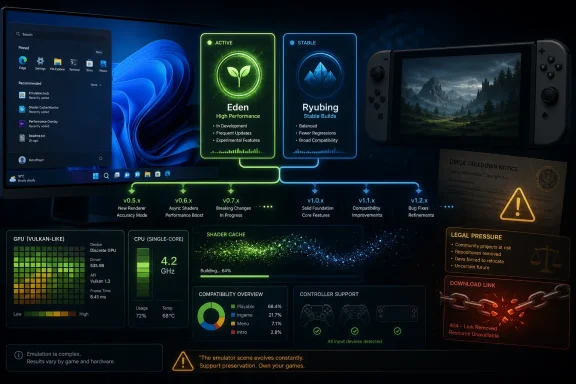 Nintendo Turned a Hobbyist Scene Into a Moving Target
For years, Switch emulation on Windows was easy to describe. Yuzu was the fast-moving, performance-minded option, while Ryujinx was the accuracy-first rival with a reputation for stability. If you had a strong enough CPU, a Vulkan-capable GPU, and legally dumped games, you could usually pick one of those two and get on with the experiment.That era ended in 2024. Nintendo sued the Yuzu developers, and the case ended quickly with a $2.4 million settlement and the shutdown of Yuzu’s development and distribution. The collateral damage was immediate: Citra, the well-known Nintendo 3DS emulator maintained by the same organization, disappeared with it.
Ryujinx lasted longer, but not by much. In October 2024, the project went offline after Nintendo contacted its lead developer, who reportedly agreed to stop working on it and remove project assets under his control. That left the Windows Switch emulation scene in a strange condition: the code had not vanished from the internet, but the institutional projects had.
The result is the fork economy. Eden, Ryubing, Sudachi, Citron, and other names all represent attempts to keep some version of Yuzu or Ryujinx alive. Some are serious development efforts. Some are preservation projects. Some are dead names kept alive by search-engine spam and malware-adjacent download pages.
That is why a 2026 recommendation has to begin with status, not benchmarks. An emulator that topped a chart in 2023 is irrelevant if its official builds are gone, its GitHub organization is empty, or its “download” links now point to a site nobody should trust.
Eden Is the Fastest-Moving Answer, Which Is Both Its Strength and Its Problem
Eden is the current pick for users who want the most actively developed Nintendo Switch emulator on Windows. It descends from the Yuzu codebase and emerged after the earlier fork churn that followed Yuzu’s shutdown. In practical terms, that means it inherits Yuzu’s performance-oriented DNA while trying to keep pace with newer games and modern Windows hardware.Its main argument is momentum. Eden has continued shipping builds, game-specific fixes, renderer updates, and performance work while other projects have slowed or frozen. For a scene where compatibility can change quickly, that matters more than nostalgia for the old brand names.
The tradeoff is that Eden is no longer a frictionless GitHub download in the way older emulators often were. Nintendo’s 2026 DMCA activity targeted several Switch emulator projects, including Eden-related repositories, and the project’s public footprint has shifted away from the simple, centralized model casual users expect. That does not make the emulator unusable, but it does mean users need to be more careful about where they get it.
Performance is Eden’s strongest pitch. Like Yuzu before it, Eden tends to reward modern CPUs with strong single-core performance and GPUs with solid Vulkan support. Architecture-optimized builds can offer meaningful gains on newer Ryzen and Intel systems, especially when paired with enough RAM and fast storage.
The weak point is predictability. Fast-moving nightly builds can fix one game and break another. Shader compilation stutter remains part of the experience, especially the first time a game renders a new area or effect. Users who want a set-and-forget appliance may find Eden’s pace exhausting.
For Windows 11 and Windows 10 users with current hardware, Eden is the best answer if “best” means most alive. It is the emulator to watch, but also the one most likely to force you to pay attention.
Ryubing Keeps the Ryujinx Philosophy Alive, But Not the Old Ambition
Ryubing is the community continuation of the Ryujinx line, and for many users it will be the more sensible choice. Where Eden feels like a forward charge, Ryubing feels like a preservation effort: less dramatic, less ambitious, but often easier to live with.The appeal is stability. Ryujinx built its reputation on accuracy and broad compatibility rather than sheer speed, and Ryubing inherits much of that behavior. It tends to be less surprising in long play sessions and less hostile to users who do not want to babysit settings.
That matters because Switch emulation is already complicated enough. Users must deal with controller setup, firmware compatibility, shader caches, GPU drivers, and game-specific quirks. An emulator that simply crashes less often has a value that no synthetic benchmark captures.
The problem is development status. Ryubing has reportedly entered maintenance mode after leadership changes, which means users should not expect major new breakthroughs. Bug fixes and small compatibility updates are one thing; a full new wave of performance engineering is another.
That makes Ryubing an excellent recommendation for older or less adventurous Windows users. If your goal is to run a broad library with minimal friction, it may still beat Eden in lived experience. If your goal is to chase the newest demanding releases, Eden has the more convincing trajectory.
In 2026, Ryubing is not the future of Switch emulation. It is the stable branch of the past that still works.
Sudachi Is the Yuzu Familiarity Play, Not the First Recommendation
Sudachi is another Yuzu-derived fork, and its greatest advantage is familiarity. Users who were comfortable with Yuzu’s layout, configuration style, and performance tradeoffs will recognize much of the same basic shape here. Vulkan and OpenGL support, resolution scaling, shader caching, and common Switch game formats are all part of the package.But Sudachi does not have Eden’s momentum or Ryubing’s stability story. Its update cadence has been uneven, and its public presence is muddier than it should be. That matters because emulator discovery is now a security problem as much as a convenience problem.
Search for almost any post-Yuzu emulator name and you will find a thicket of copycat pages, ad-heavy download portals, and suspicious “official” mirrors. Sudachi is especially vulnerable to that problem because its name is widely reused by sites trying to capture desperate search traffic. In 2026, finding the real project can be harder than using the software.
On a capable PC, Sudachi can still run games well. It carries forward many of the performance characteristics that made Yuzu popular, including strong results on modern hardware and the usual first-run shader stutter. But “usable” is not the same as “best.”
Sudachi is best treated as a fallback for users who know exactly why they want it. Beginners should not start here. Users who want active development should look at Eden. Users who want predictable behavior should look at Ryubing.
Citron and Yuzu Are Search Results, Not Recommendations
Citron is a useful warning about how fast this scene changes. It was briefly one of the names people mentioned when discussing Yuzu successors, but it reportedly collapsed in early 2026 after internal conflict and harassment around the project. Its servers, site, and repository disappeared, leaving behind the usual debris of stale guides and opportunistic mirrors.That is the pattern now. A project can be relevant in January and effectively gone by March. Guides that look current at a glance may be wrong before Google stops ranking them.
Yuzu is even simpler: it is dead. Official development and distribution ended in March 2024 as part of the Nintendo settlement. Anything claiming to be a fresh Yuzu release in 2026 is not an official continuation.
That does not mean every archived copy of Yuzu on the internet is automatically malware. It does mean the trust chain is broken. Once a project is dead and unofficial mirrors become the only source, users lose the ability to distinguish preservation from repackaging.
For Windows users, this is the point where nostalgia becomes a bad security model. There are still maintained alternatives. There is no good reason to install a random Yuzu mirror from a download farm.
Windows Hardware Still Matters More Than Emulator Branding
Switch emulation is demanding because a Windows PC is not simply “running a Switch game.” It is translating the behavior of Nintendo’s ARM-based console environment into something an x86 Windows machine can execute, while also converting graphics work intended for the Switch GPU into calls your PC GPU understands. That translation is expensive.The CPU is the heart of the problem. Strong single-thread performance matters more than a big core count alone, because emulation workloads often bottleneck on latency-sensitive translation and synchronization. A modern six-core processor will usually feel much better than an older many-core workstation chip with weak per-core speed.
The GPU matters too, but not in the same way it does for native PC gaming. A Vulkan-capable dedicated GPU is strongly preferred, and more VRAM helps when pushing higher resolutions or using texture mods. Integrated graphics can sometimes handle lighter games, but users should keep expectations low.
Memory and storage are the quiet difference-makers. Eight gigabytes of RAM is a practical floor, but 16GB is the comfortable recommendation. An SSD helps with loading and shader cache behavior, especially over repeated sessions.
Windows 11 does not offer a magical advantage over Windows 10 here. Driver freshness, CPU generation, GPU support, and background system load matter more than the OS version alone. A clean Windows 10 install on strong hardware will usually beat a bloated Windows 11 laptop with thermal throttling.
The best experience comes from treating the emulator like a demanding PC game with extra translation overhead. Update GPU drivers, use an SSD, close unnecessary background tasks, and expect per-game tuning.
The Legal Risk Is Not Just a Footnote Anymore
Emulators have long occupied a complicated but important space in software history. Clean-room emulation, reverse engineering, interoperability, preservation, and homebrew development are not the same thing as piracy. That distinction still matters.Nintendo’s recent strategy, however, has focused less on abstract emulation and more on circumvention, keys, firmware, and the way modern console security works. The company’s argument against Yuzu centered on claims that the emulator enabled circumvention of technological protection measures and facilitated piracy at scale. The case ended in settlement rather than a fully litigated ruling that neatly settled the law.
That leaves users and developers in a gray zone. The legal status of emulator code may be one question, while the handling of encryption keys, firmware, and game files is another. For ordinary users, the clearest line remains the game content itself.
Downloading copyrighted Switch games, firmware, or keys from the internet is where the risk becomes obvious. Dumping files from hardware and games you own may be treated differently depending on jurisdiction, but it is not something users should assume is universally protected. Local law matters, and so does how the files are obtained and used.
This is also why reputable emulator projects avoid bundling Nintendo keys, firmware, or game files. If a site offers an emulator package that includes “everything you need,” that is not a convenience feature. It is a warning sign.
The safest practical rule is straightforward: separate the emulator from copyrighted content, avoid mirrors promising preconfigured game libraries, and assume that anything packaged with keys or commercial games is trouble.
Controllers, Multiplayer, and the Missing Nintendo Online Dream
On Windows, controller support is one of the more mature parts of Switch emulation. Xbox controllers are usually the easiest path because Windows supports them cleanly. PlayStation controllers, including DualShock and DualSense models, are also commonly supported, though some setups may need extra configuration.Nintendo Switch Pro Controllers and Joy-Cons can work as well, including motion controls in emulators that support them. The experience varies by Bluetooth adapter, driver stack, and emulator input layer. Joy-Cons in particular can be fiddly, especially if you expect them to behave exactly like they do on the console.
Online play is where expectations need a hard reset. These emulators do not connect to Nintendo Switch Online. They cannot turn your Windows PC into a legitimate Nintendo network client, and users should distrust any claim that they can.
What exists instead is local or LAN-style multiplayer, sometimes stretched over the internet through tunneling or VPN tools. That can be useful for certain games, but it is not the same thing as official matchmaking, cloud saves, or Nintendo’s account infrastructure.
This distinction matters because online functionality is a common malware hook. Fake emulator sites know users want “online support,” so they advertise it aggressively. In practice, official Nintendo services remain off-limits.
For most Windows users, the right expectation is simple: use emulators for local play, single-player games, modding, testing, and preservation-minded use cases. If Nintendo Switch Online is central to how you play, use a Switch.
Firmware Compatibility Is a Quiet Source of Breakage
Switch emulators generally require firmware and encryption keys to boot commercial games. That is not optional, and it is also one of the areas where users most often make mistakes. Newer is not always better.Nintendo continues updating Switch system software, and emulator compatibility does not automatically track every firmware release the moment it appears. An emulator build may work best with a particular firmware range, while a too-new firmware dump can cause boot failures, missing services, or strange game behavior.
That creates a mismatch between console instincts and emulator reality. On a real Switch, users are trained to update because the system tells them to. In emulation, the “latest firmware” may be the wrong answer until the emulator catches up.
This is one reason Ryubing’s conservative posture appeals to some users. A stable emulator paired with known-good firmware can be less frustrating than a nightly build chasing the newest changes. Eden may move faster, but faster movement also means users must read release notes and community reports.
The best advice is not to hoard every update or blindly install the newest dump. Match firmware to the emulator’s documented support, keep backups of working configurations, and change one variable at a time when troubleshooting.
Switch 2 Emulation Is Not the Escape Hatch
The arrival of newer Nintendo hardware changes the emotional temperature around Switch emulation, but it does not make Switch 2 emulation suddenly practical. A new console generation brings different hardware, newer security assumptions, and a fresh legal incentive for Nintendo to act early and aggressively.The original Switch became unusually approachable for emulation because of a mix of hardware characteristics, documentation work, homebrew research, and years of developer effort. That history cannot simply be copied forward on a schedule. Emulation is not a product launch category.
Developers and users should expect meaningful Switch 2 emulation to take years, not months. Even if experimental research exists, there is a large gap between “a proof of concept boots something” and “ordinary Windows users can play commercial games reliably.” The latter requires graphics work, input systems, timing accuracy, file handling, firmware understanding, and thousands of bug reports.
Legal pressure will also shape the scene differently this time. Nintendo has already shown that it is willing to use lawsuits, settlements, takedown notices, and platform pressure against emulator projects it sees as threatening. That will push more development into private channels and make public progress harder to verify.
For Windows users, the message is boring but necessary: do not install anything advertising itself as a polished Switch 2 emulator in 2026. At best, it is vaporware. At worst, it is malware with a logo.
The Practical Windows Pick Depends on Your Appetite for Chaos
Choosing a Switch emulator in 2026 is less like choosing a browser and more like choosing a Linux kernel branch during a legal storm. The software may work beautifully on the right machine, but the surrounding ecosystem is unstable. Names change, repositories move, maintainers burn out, and download pages disappear.For most Windows users, the recommendation splits cleanly. Eden is the pick if you want the emulator with the strongest visible development pulse. Ryubing is the pick if you want a calmer experience built on Ryujinx’s stability-first legacy.
Sudachi remains viable only for a narrower audience. If you know the Yuzu family well and can verify the source, it may do what you need. If you are new to Switch emulation, it is not where I would send you first.
The security advice is just as important as the performance advice. Do not download from random “emulator hub” sites. Do not trust bundles that include firmware, keys, or games. Do not assume the top search result is legitimate.
The irony is that Windows itself is not the hard part. Windows 10 and Windows 11 both provide a perfectly capable base for Switch emulation. The hard part is the trust model around the software.
The Emulator Ranking Has Become a Risk Ranking
The old way to rank emulators was by speed, compatibility, and interface polish. Those still matter, but they no longer tell the whole story. In 2026, the best emulator is also the one with the clearest development status, the least suspicious distribution path, and the most realistic future.Eden wins on forward motion. Ryubing wins on steadiness. Sudachi survives as a specialist option. Yuzu and Citron should be treated as historical names, not active recommendations.
That may sound less satisfying than a neat winner, but it is more honest. The Switch scene is too unstable for permanent rankings. A good recommendation today needs an expiration date.
For Windows users trying to make a practical decision, the shape is clear:
- Eden is the best choice for users who want active development and are comfortable following a project that may change hosting or build channels.
- Ryubing is the best choice for users who value stability, broad compatibility, and a less fussy setup over cutting-edge performance.
- Sudachi is only worth considering if you specifically want a Yuzu-like fork and can verify that you are downloading it from a legitimate source.
- Yuzu should be avoided in 2026 because official development ended in 2024 and unofficial mirrors are a security risk.
- Citron should be ignored because the project is discontinued and surviving download links are not a trustworthy basis for a Windows setup.
- No current Switch emulator connects to Nintendo Switch Online, and any site promising full official online support should be treated with suspicion.
References
- Primary source: H2S Media
Published: 2026-07-03T13:03:09.403233
- Related coverage: arstechnica.com
Switch emulator makers agree to pay $2.4 million to settle Nintendo lawsuit - Ars Technica
Yuzu devs shut down emulator they now say is "primarily designed" to break DRM.arstechnica.com - Related coverage: nintendowire.com
Nintendo to receive $2.4 million from Team Yuzu, development/distribution of emulator will cease – Nintendo Wire
March 4th, 2024: This page has been updated with Yuzu's official statement.nintendowire.com
- Related coverage: androidauthority.com
Nintendo Switch emulator creators to pay Nintendo $2.4 million in damages (Update)
Tropic Haze, the creators of the Switch emulator Yuzu, has agreed to a permanent injunction and to pay Nintendo $2.4 million in damages .www.androidauthority.com - Related coverage: itechpost.com
Nintendo Switch, 3DS Emulator Agrees to $2.4 Million Settlement Over Copyright Lawsuit
Yuzu, a Nintendo Switch and 3DS emulator, has agreed to pay $2.4 million in settlement after the gaming giant filed a massive copyright lawsuit against it.www.itechpost.com - Related coverage: gamesradar.com
Switch modder landed with a $2 million fee after settling lawsuit with Nintendo over selling modded consoles and piracy-enabling flash carts | GamesRadar+
The modder is also banned from handling, promoting, selling mods or helping others mod their consoleswww.gamesradar.com

- Official source: github.com
dmca/2026/02/2026-02-12-nintendo.md at master · github/dmca · GitHub
Repository with text of DMCA takedown notices as received. GitHub does not endorse or adopt any assertion contained in the following notices. Users identified in the notices are presumed innocent until proven guilty. Additional information about our DMCA policy can be found at -... github.com
- Related coverage: techtimes.com
Nintendo Switch Emulator Yuzu Gives Up Lawsuit, Pays $2.4 Million to Nintendo
Nintendo’s lawsuit against Yuzu Emulator gets settled with Yuzu paying $2.4 Million. Nintendo Switch emulator pioneer Yuzu has reportedly settled the emulation lawsuit from Nintendo, agreeing to paywww.techtimes.com - Related coverage: games24.blog
DMCA Crackdown: Nintendo Forces Emulators Off GitHub — Devs Explain - Games24.blog
Nintendo has launched a new wave of DMCA takedowns against several Switch-adjacent emulators hosted on GitHub, prompting projects to pull releases, mirror elsew…games24.blog - Related coverage: gigazine.net
Nintendo Switch emulator Yuzu, which was sued by Nintendo, agrees to pay damages and the release ends immediately - GIGAZINE
The news blog specialized in Japanese culture, odd news, gadgets and all other funny stuffs. Updated everyday.gigazine.net - Related coverage: gamedeveloper.com
Switch emulator Yuzu reaches $2.4 million settlement with Nintendo
Along with the settlement, Nintendo will have effectively wiped the Yuzu off the face of the internet.www.gamedeveloper.com - Related coverage: gamenguide.com
Ryujinx Switch Emulator Shuts Down After Nintendo Doubles Down With Crackdown on Piracy
Nintendo continues its crackdown on piracy as it has forced the maker of the Ryujinx Switch emulator to shut down operations and remove their assets online.www.gamenguide.com - Related coverage: pcgamer.com
'They can never kill emulation': Players vexed as Nintendo continues its siege on Switch emulation, handing DMCAs to various emulators on GitHub | PC Gamer
It might be time to back up some files.www.pcgamer.com - Related coverage: as.com
- Related coverage: tomshardware.com
Nintendo secures $2 million settlement against Switch modder — Modded Hardware creator agreed to stop selling backup devices, but continued to, prompting lawsuit | Tom's Hardware
Permanent injunction bans modder Ryan Daly from selling or possessing devices that defeat Switch protection mechanisms.www.tomshardware.com
