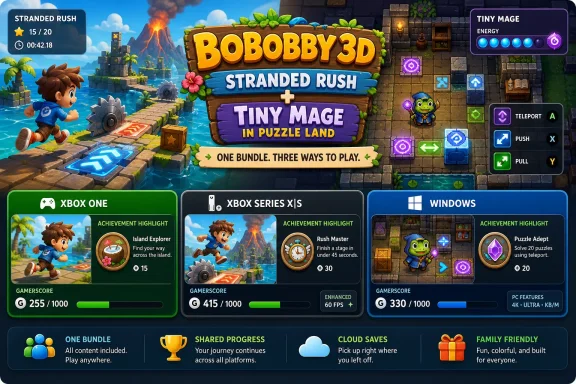
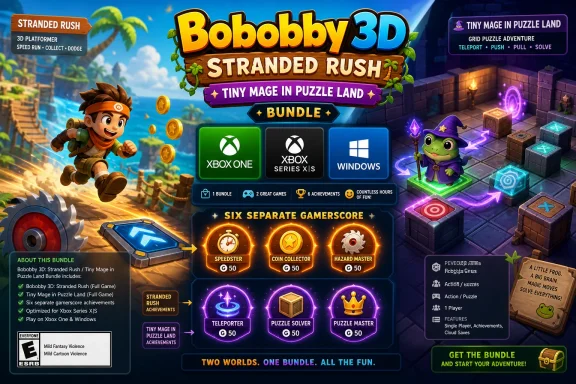
Microsoft’s Polish Xbox store is now listing Bobobby 3D: Stranded Rush / Tiny Mage in Puzzle Land (Bundle) from Sweet Bread Games, a six-product Xbox package that combines two small indie games across Xbox One, Xbox Series X|S, and Windows versions. That sounds like a simple storefront note, but it is really a neat little snapshot of how the modern Xbox marketplace works. The bundle sells playtime, platform coverage, and—quite explicitly—separate Gamerscore stacks as part of the value proposition. For Xbox players, it is less a blockbuster announcement than a reminder that the store’s quiet corners increasingly have their own economy.
The listing is plain about what buyers get: two games, three versions each, six products in one package. Bobobby 3D: Stranded Rush is the 3D platformer half, built around 20 tropical-island levels, double jumps, spin attacks, collectibles, hazards, and a no-time-limit structure. Tiny Mage in Puzzle Land is the puzzle half, a 2D pixel-art Sokoban-inspired game starring a frog mage who teleports, pushes, and pulls objects through 40 puzzle rooms.
This is not the sort of release that dominates showcases or subscription-service headlines. It is the sort of release that lives in the Xbox store’s daily churn, where small publishers compete with price, genre clarity, achievement value, and platform multiplication. The notable phrase in the listing is not “tropical islands” or “frog mage,” charming as both are. It is the promise that each version has “its own separate gamerscore to be achieved.”
That sentence understands its audience. Xbox has always treated achievements as a platform language, but the indie storefront has turned that language into a retail feature. A bundle like this does not merely say, “Here are two games.” It says, “Here are six entries in your library, six achievement lists, and a compact tour through Microsoft’s console-and-PC ecosystem.”
That framing is important because Xbox players have been trained to think of platform compatibility in several overlapping ways. Sometimes a purchase gets you Smart Delivery, where one entitlement serves the right console version automatically. Sometimes a title is Xbox Play Anywhere, letting one purchase cover console and PC with shared progress. Sometimes, as here, the store treats versions as separate products bundled together.
For a casual buyer, the distinction can be blurry. A game that runs on Xbox One and Xbox Series X|S may appear functionally unified from the couch. A Windows version may look like a bonus, especially if the player is already inside the Microsoft Store or Xbox app on PC. But for achievement hunters and library organizers, separate product entries are not a footnote. They are the point.
The Bobobby / Tiny Mage bundle leans into that reality without pretending to be something larger than it is. It is not pitching sprawling campaigns, online worlds, or cinematic production. It is pitching compact, approachable games multiplied across platforms. In the current Xbox store, that is a recognizable format, and it has become one of the ways small developers can make visibility and perceived value stretch further.
That design pitch is almost aggressively modest, and that is not a criticism. Modern 3D platformers often split between nostalgia-heavy precision games and larger collectathons that demand a meaningful investment. Bobobby appears to sit in the middle: small enough to finish without a lifestyle change, structured enough to reward completionists, and readable enough for younger or less experienced players.
The two-action-button emphasis also matters. When a store page says a platformer has only jump and spin as action inputs, it is making an accessibility argument as much as a design argument. The game is selling clarity. It wants to reassure the parent buying something for a child, the casual player browsing during a sale, and the achievement hunter who wants a predictable route through the list.
The collectible structure is the hook that gives a simple platformer a second layer. Defeating enemies, smashing crates, collecting coins, and grabbing timed diamonds turn levels into checklists. That can be busywork in a weak game, but it can also be exactly what the genre needs at small scale: a reason to replay a stage without inflating the design beyond its budget.
That is a tidy puzzle premise because it turns magical freedom into a limited budget. Teleporting across a room, pushing boxes from a distance, and pulling them closer all sound empowering. The energy limit turns those powers into decisions. A good puzzle game is not about having tools; it is about making the player regret using them in the wrong order.
The store page says there are 40 puzzle rooms, which is a sensible number for this type of release. It is enough to develop a ruleset and introduce variations, but not so many that the premise sounds padded. The mention that players can skip a difficult puzzle is also revealing. This is not being marketed as a punishment device for genre purists; it is being positioned as a cute, approachable puzzle game that still wants to challenge the player.
That is an increasingly common indie compromise. Developers want the legitimacy that comes with “challenging puzzle rooms,” but storefront conversion depends on not scaring off the broader family-and-kids audience. A skip option is the pressure valve. It lets the game claim difficulty while avoiding the dead-end frustration that can make a small puzzle title disappear from a backlog forever.
Achievement stacking is not new. Xbox players have long noticed that separate regional, platform, or generation-specific versions can carry separate achievement lists. What has changed is how plainly some store listings now advertise that fact. The achievement list has moved from metadata to marketing.
For some players, that is harmless fun. If a small platformer or puzzle game provides a pleasant evening and a clean completion, a separate Windows stack is a bonus. For others, it is part of a larger distortion in the store, where a product’s value is measured less by its design than by how quickly it can feed a profile number.
The Bobobby / Tiny Mage bundle sits right on that line. Nothing in the listing suggests deception; it is transparent about what is included. But the bundle’s construction makes clear that Microsoft’s store architecture allows small games to be packaged as platform-specific achievement opportunities. That can be useful for players who enjoy the chase, but it also raises the old question of whether Gamerscore still signals accomplishment when the marketplace has learned to optimize around it.
That is not necessarily bad. Separate versions can help developers support platform-specific builds, certification requirements, performance targets, and achievement lists. A Windows version may have different input assumptions from a console version. A Series X|S version may carry store badges or technical expectations that the Xbox One version does not.
But the player-facing experience can become confusing. The Xbox brand spent years pushing the idea that buying a game should be simple across devices. Bundles that include distinct Xbox One, Series, and Windows products complicate that story, even when they are generous. The player gets more, but must also understand more.
The difference between “this game works everywhere” and “this bundle contains separate versions for everywhere” is subtle until it affects saves, achievements, installation choices, or library clutter. For enthusiasts, that subtlety is part of the hobby. For ordinary buyers, it is another reason the store can feel like a maze of nearly identical tiles.
That makes the wording unusually important. Bobobby is described with a kind of cheerful specificity: no time limit, floating beach balls, moving saw blades, timed platforms, boost pads, enemies, crates, coins, diamonds. Tiny Mage is described through verbs: teleport, push, pull, plan, execute. The prose may be simple, but it understands that a tiny game must explain itself quickly.
The bundle also benefits from genre pairing. Platformers and Sokoban-style puzzle games appeal to overlapping but distinct moods. One is movement, timing, and collection; the other is planning, positioning, and resource use. Together they create the feeling of a varied mini-library rather than a two-pack of near-duplicates.
That matters on a store where low-cost indies can blur into one another. A bundle must answer a basic question: why buy this package instead of one of the dozens of other small games on sale? Here, the answer is variety, family-friendly presentation, and achievement multiplicity. It may not be glamorous, but it is coherent.
For parents, that matters. For players looking for a low-stress completion, it matters too. The store copy repeatedly uses words like “comfortable,” “simple,” “cute,” “soothing,” and “all ages.” The bundle wants to be legible as safe entertainment.
The interesting part is that “family-friendly” and “achievement-friendly” now overlap more than they once did. A short, approachable game can be sold to children, casual players, and completionists at the same time. That creates a strange but effective triangle: the same simplicity that makes a game accessible also makes it attractive to players optimizing for Gamerscore.
There is a risk in that convergence. If the market rewards games primarily for being short, stackable, and easy to complete, developers may have incentives to flatten challenge and ambition. But there is also a legitimate audience for compact games that respect time. Not every release needs to be a forever game. Sometimes the healthiest thing in a bloated library is a game that knows exactly how small it is.
That has practical consequences. A player with an Xbox console and a Windows handheld or laptop can move between devices, even if saves and entitlements depend on the specific version. A player focused on achievements can treat the Windows build as a separate run. A family with mixed hardware can potentially install different versions in different places.
But Windows also exposes the limits of Microsoft’s unified gaming vision. The company wants Xbox to mean an ecosystem rather than a box under the TV. Yet store listings still routinely make buyers parse whether a title supports cloud saves, Play Anywhere, keyboard and mouse, separate PC builds, or console-only entitlements. The brand promise is simple; the implementation is granular.
This bundle makes that granularity visible. It does not hide the fact that Windows is a separate product entry. It uses that separation as part of the pitch. For the enthusiast audience, that honesty is useful. For everyone else, it is a reminder that the Xbox ecosystem is unified in account identity, but not always in product architecture.
That dual audience is powerful. A store page can tell one player, “Here is a cute platformer and puzzle game.” It can tell another, “Here are six lists.” The same bundle carries both messages without changing the product itself.
Microsoft has historically benefited from this culture because achievements create stickiness. They make players care about where they play, not just what they play. A third-party indie game on Xbox is not merely software; it is a contribution to a persistent profile that may stretch back to the Xbox 360 era.
But the more explicitly games market around Gamerscore, the more fragile the meaning of that score becomes. A hard-earned completion in a demanding game and a rapid completion in a deliberately easy title both raise the same visible number. That tension has existed for years, but bundles like this make it harder to pretend the marketplace is not aware of it.
The real issue is signaling. Players should be able to understand at a glance whether a purchase is cross-buy, whether saves move across devices, whether achievements are shared or separate, and whether a Series version is functionally different from an Xbox One version. Microsoft’s storefront has improved over the years, but it still asks shoppers to infer too much from badges and product names.
Bundles like Bobobby / Tiny Mage are transparent in one sense and complicated in another. They list the included products clearly. They also depend on a store environment where separate versions are normalized enough that players may not immediately grasp the practical differences.
Better storefront language would help everyone. Achievement hunters would know exactly what they are buying. Parents would avoid duplicate-version confusion. PC players would know whether they are getting a native Windows build with Xbox services or merely another store entitlement. Developers would benefit because fewer buyers would feel surprised after purchase.
Bobobby promises a breezy 3D platforming loop with collectibles and hazards. Tiny Mage promises compact puzzle rooms built around three magic abilities and an energy limit. The bundle promises six products and separate Gamerscore. No one is being told this is the next great Xbox epic.
That clarity should not be underestimated. The digital storefront is full of games that overreach in their descriptions, leaning on genre buzzwords and cinematic language that the product cannot support. Here, the pitch is almost mechanical: these are the games, these are the versions, these are the activities, these are the rewards.
For a certain kind of Xbox player, that is enough. The appeal is not mystery. It is predictability. In a market where attention is scarce and backlogs are absurd, a small game that tells you exactly what it is can be more persuasive than a larger one that demands faith.
The Bobobby 3D: Stranded Rush / Tiny Mage in Puzzle Land bundle is not important because it is large; it is important because it is ordinary in a revealing way. It shows an Xbox store where small developers package platform versions as value, where Windows is both a gaming destination and an achievement multiplier, and where Gamerscore remains powerful enough to be advertised alongside levels, puzzles, and characters. Microsoft’s next challenge is not stopping bundles like this from existing, but making the ecosystem around them clearer, cleaner, and more honest for the players who no longer know whether they are buying a game, a version, or a stack.
 Microsoft’s Smallest Storefront Listings Tell the Bigger Xbox Story
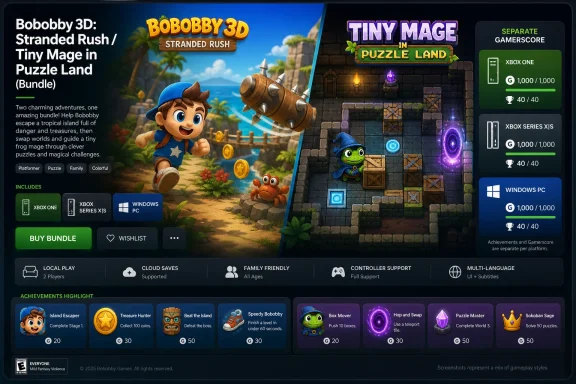
The listing is plain about what buyers get: two games, three versions each, six products in one package. Bobobby 3D: Stranded Rush is the 3D platformer half, built around 20 tropical-island levels, double jumps, spin attacks, collectibles, hazards, and a no-time-limit structure. Tiny Mage in Puzzle Land is the puzzle half, a 2D pixel-art Sokoban-inspired game starring a frog mage who teleports, pushes, and pulls objects through 40 puzzle rooms.This is not the sort of release that dominates showcases or subscription-service headlines. It is the sort of release that lives in the Xbox store’s daily churn, where small publishers compete with price, genre clarity, achievement value, and platform multiplication. The notable phrase in the listing is not “tropical islands” or “frog mage,” charming as both are. It is the promise that each version has “its own separate gamerscore to be achieved.”
That sentence understands its audience. Xbox has always treated achievements as a platform language, but the indie storefront has turned that language into a retail feature. A bundle like this does not merely say, “Here are two games.” It says, “Here are six entries in your library, six achievement lists, and a compact tour through Microsoft’s console-and-PC ecosystem.”
The Bundle Is Selling Coverage as Much as Content
On paper, the package is straightforward. One game is a family-friendly 3D platformer, the other a family-friendly puzzle game, and both are split across Xbox One, Xbox Series X|S, and Windows. The store page presents that structure as abundance: three versions per game, six products total.That framing is important because Xbox players have been trained to think of platform compatibility in several overlapping ways. Sometimes a purchase gets you Smart Delivery, where one entitlement serves the right console version automatically. Sometimes a title is Xbox Play Anywhere, letting one purchase cover console and PC with shared progress. Sometimes, as here, the store treats versions as separate products bundled together.
For a casual buyer, the distinction can be blurry. A game that runs on Xbox One and Xbox Series X|S may appear functionally unified from the couch. A Windows version may look like a bonus, especially if the player is already inside the Microsoft Store or Xbox app on PC. But for achievement hunters and library organizers, separate product entries are not a footnote. They are the point.
The Bobobby / Tiny Mage bundle leans into that reality without pretending to be something larger than it is. It is not pitching sprawling campaigns, online worlds, or cinematic production. It is pitching compact, approachable games multiplied across platforms. In the current Xbox store, that is a recognizable format, and it has become one of the ways small developers can make visibility and perceived value stretch further.
Bobobby Is Built for the Comfort-Food Platformer Slot
Bobobby 3D: Stranded Rush reads like a deliberately uncomplicated 3D platformer. The player runs, double jumps, and spins through 20 levels, with beach balls for bouncing, saw blades to dodge, timed platforms, boost pads, enemies, crates, coins, and timed diamonds. The store copy stresses that there is no time limit, even while nudging players toward faster clears and complete collection.That design pitch is almost aggressively modest, and that is not a criticism. Modern 3D platformers often split between nostalgia-heavy precision games and larger collectathons that demand a meaningful investment. Bobobby appears to sit in the middle: small enough to finish without a lifestyle change, structured enough to reward completionists, and readable enough for younger or less experienced players.
The two-action-button emphasis also matters. When a store page says a platformer has only jump and spin as action inputs, it is making an accessibility argument as much as a design argument. The game is selling clarity. It wants to reassure the parent buying something for a child, the casual player browsing during a sale, and the achievement hunter who wants a predictable route through the list.
The collectible structure is the hook that gives a simple platformer a second layer. Defeating enemies, smashing crates, collecting coins, and grabbing timed diamonds turn levels into checklists. That can be busywork in a weak game, but it can also be exactly what the genre needs at small scale: a reason to replay a stage without inflating the design beyond its budget.
Tiny Mage Turns Sokoban Into a Resource Puzzle
Tiny Mage in Puzzle Land has the more interesting mechanical pitch. Sokoban-inspired games live and die by constraint, and Sweet Bread’s twist is to give the frog mage three abilities: teleport, push, and pull. The catch is energy. Use too much magic and the apprentice mage gets tired and falls asleep.That is a tidy puzzle premise because it turns magical freedom into a limited budget. Teleporting across a room, pushing boxes from a distance, and pulling them closer all sound empowering. The energy limit turns those powers into decisions. A good puzzle game is not about having tools; it is about making the player regret using them in the wrong order.
The store page says there are 40 puzzle rooms, which is a sensible number for this type of release. It is enough to develop a ruleset and introduce variations, but not so many that the premise sounds padded. The mention that players can skip a difficult puzzle is also revealing. This is not being marketed as a punishment device for genre purists; it is being positioned as a cute, approachable puzzle game that still wants to challenge the player.
That is an increasingly common indie compromise. Developers want the legitimacy that comes with “challenging puzzle rooms,” but storefront conversion depends on not scaring off the broader family-and-kids audience. A skip option is the pressure valve. It lets the game claim difficulty while avoiding the dead-end frustration that can make a small puzzle title disappear from a backlog forever.
The Real Product Is Six Achievement Lists in a Trench Coat
The storefront’s most revealing line is that each version has its own separate Gamerscore. That is not accidental copy. It is a direct appeal to a specific Xbox subculture that treats achievements as a metagame, a diary, a scoreboard, and sometimes a shopping filter.Achievement stacking is not new. Xbox players have long noticed that separate regional, platform, or generation-specific versions can carry separate achievement lists. What has changed is how plainly some store listings now advertise that fact. The achievement list has moved from metadata to marketing.
For some players, that is harmless fun. If a small platformer or puzzle game provides a pleasant evening and a clean completion, a separate Windows stack is a bonus. For others, it is part of a larger distortion in the store, where a product’s value is measured less by its design than by how quickly it can feed a profile number.
The Bobobby / Tiny Mage bundle sits right on that line. Nothing in the listing suggests deception; it is transparent about what is included. But the bundle’s construction makes clear that Microsoft’s store architecture allows small games to be packaged as platform-specific achievement opportunities. That can be useful for players who enjoy the chase, but it also raises the old question of whether Gamerscore still signals accomplishment when the marketplace has learned to optimize around it.
Xbox’s Cross-Generation Era Created This Marketplace
This sort of bundle exists because Xbox is still living in a long cross-generation tail. The Xbox One remains part of the active store ecosystem, the Xbox Series X|S has its own optimized listings, and Windows continues to sit beside console as both a Microsoft platform and a PC storefront. For a large publisher, this matrix is often abstracted away by entitlement systems and automatic version delivery. For smaller games, the matrix can become the product.That is not necessarily bad. Separate versions can help developers support platform-specific builds, certification requirements, performance targets, and achievement lists. A Windows version may have different input assumptions from a console version. A Series X|S version may carry store badges or technical expectations that the Xbox One version does not.
But the player-facing experience can become confusing. The Xbox brand spent years pushing the idea that buying a game should be simple across devices. Bundles that include distinct Xbox One, Series, and Windows products complicate that story, even when they are generous. The player gets more, but must also understand more.
The difference between “this game works everywhere” and “this bundle contains separate versions for everywhere” is subtle until it affects saves, achievements, installation choices, or library clutter. For enthusiasts, that subtlety is part of the hobby. For ordinary buyers, it is another reason the store can feel like a maze of nearly identical tiles.
Small Games Are Using the Store Like a Shelf, Not a Stage
Big Xbox releases use the store as the final stop in a long marketing campaign. Small games often use the store as the campaign itself. The capsule description, platform badges, price, screenshots, achievements, and bundle contents do almost all the work.That makes the wording unusually important. Bobobby is described with a kind of cheerful specificity: no time limit, floating beach balls, moving saw blades, timed platforms, boost pads, enemies, crates, coins, diamonds. Tiny Mage is described through verbs: teleport, push, pull, plan, execute. The prose may be simple, but it understands that a tiny game must explain itself quickly.
The bundle also benefits from genre pairing. Platformers and Sokoban-style puzzle games appeal to overlapping but distinct moods. One is movement, timing, and collection; the other is planning, positioning, and resource use. Together they create the feeling of a varied mini-library rather than a two-pack of near-duplicates.
That matters on a store where low-cost indies can blur into one another. A bundle must answer a basic question: why buy this package instead of one of the dozens of other small games on sale? Here, the answer is variety, family-friendly presentation, and achievement multiplicity. It may not be glamorous, but it is coherent.
The Family-Friendly Label Does Real Commercial Work
Both games sit comfortably in the family-and-kids lane. That label is not just about age ratings or cute protagonists. It is a commercial signal that the games are low-risk purchases: no mature content concerns, no complex online commitments, no obvious demand for high-end reflexes or genre literacy.For parents, that matters. For players looking for a low-stress completion, it matters too. The store copy repeatedly uses words like “comfortable,” “simple,” “cute,” “soothing,” and “all ages.” The bundle wants to be legible as safe entertainment.
The interesting part is that “family-friendly” and “achievement-friendly” now overlap more than they once did. A short, approachable game can be sold to children, casual players, and completionists at the same time. That creates a strange but effective triangle: the same simplicity that makes a game accessible also makes it attractive to players optimizing for Gamerscore.
There is a risk in that convergence. If the market rewards games primarily for being short, stackable, and easy to complete, developers may have incentives to flatten challenge and ambition. But there is also a legitimate audience for compact games that respect time. Not every release needs to be a forever game. Sometimes the healthiest thing in a bloated library is a game that knows exactly how small it is.
Windows Is the Quiet Multiplier in the Bundle
The Windows versions are easy to overlook, but they are central to the bundle’s value proposition. Xbox on PC has spent years becoming less of a side project and more of a parallel surface for the same account, store, and achievement identity. In a bundle like this, Windows is not just another platform. It is another completion path.That has practical consequences. A player with an Xbox console and a Windows handheld or laptop can move between devices, even if saves and entitlements depend on the specific version. A player focused on achievements can treat the Windows build as a separate run. A family with mixed hardware can potentially install different versions in different places.
But Windows also exposes the limits of Microsoft’s unified gaming vision. The company wants Xbox to mean an ecosystem rather than a box under the TV. Yet store listings still routinely make buyers parse whether a title supports cloud saves, Play Anywhere, keyboard and mouse, separate PC builds, or console-only entitlements. The brand promise is simple; the implementation is granular.
This bundle makes that granularity visible. It does not hide the fact that Windows is a separate product entry. It uses that separation as part of the pitch. For the enthusiast audience, that honesty is useful. For everyone else, it is a reminder that the Xbox ecosystem is unified in account identity, but not always in product architecture.
The Achievement Economy Has Become Storefront Grammar
Achievements began as a platform-wide reward system, but they have become a way of writing store copy. Phrases like “separate gamerscore” are not technical trivia anymore. They are retail grammar, instantly understood by the players who care and mostly ignored by those who do not.That dual audience is powerful. A store page can tell one player, “Here is a cute platformer and puzzle game.” It can tell another, “Here are six lists.” The same bundle carries both messages without changing the product itself.
Microsoft has historically benefited from this culture because achievements create stickiness. They make players care about where they play, not just what they play. A third-party indie game on Xbox is not merely software; it is a contribution to a persistent profile that may stretch back to the Xbox 360 era.
But the more explicitly games market around Gamerscore, the more fragile the meaning of that score becomes. A hard-earned completion in a demanding game and a rapid completion in a deliberately easy title both raise the same visible number. That tension has existed for years, but bundles like this make it harder to pretend the marketplace is not aware of it.
The Store Needs Better Signals, Not Fewer Small Games
It would be easy to sneer at bundles built around small games and separate achievement stacks. That would be the wrong lesson. The Xbox store should have room for tiny platformers, cozy puzzle games, family releases, budget experiments, and achievement-bait curiosities. A healthy platform is not only measured by its prestige releases.The real issue is signaling. Players should be able to understand at a glance whether a purchase is cross-buy, whether saves move across devices, whether achievements are shared or separate, and whether a Series version is functionally different from an Xbox One version. Microsoft’s storefront has improved over the years, but it still asks shoppers to infer too much from badges and product names.
Bundles like Bobobby / Tiny Mage are transparent in one sense and complicated in another. They list the included products clearly. They also depend on a store environment where separate versions are normalized enough that players may not immediately grasp the practical differences.
Better storefront language would help everyone. Achievement hunters would know exactly what they are buying. Parents would avoid duplicate-version confusion. PC players would know whether they are getting a native Windows build with Xbox services or merely another store entitlement. Developers would benefit because fewer buyers would feel surprised after purchase.
Sweet Bread’s Package Shows the Indie Store at Its Most Honest
What makes this bundle interesting is that it is not pretending to be grander than it is. The games are described in direct terms. The platform split is explicit. The achievement angle is stated outright. There is a kind of honesty in that.Bobobby promises a breezy 3D platforming loop with collectibles and hazards. Tiny Mage promises compact puzzle rooms built around three magic abilities and an energy limit. The bundle promises six products and separate Gamerscore. No one is being told this is the next great Xbox epic.
That clarity should not be underestimated. The digital storefront is full of games that overreach in their descriptions, leaning on genre buzzwords and cinematic language that the product cannot support. Here, the pitch is almost mechanical: these are the games, these are the versions, these are the activities, these are the rewards.
For a certain kind of Xbox player, that is enough. The appeal is not mystery. It is predictability. In a market where attention is scarce and backlogs are absurd, a small game that tells you exactly what it is can be more persuasive than a larger one that demands faith.
The Six-Slice Bundle Says the Quiet Part Out Loud
The practical reading of the listing is simple, but the store dynamics behind it are more revealing.- The bundle includes two games, Bobobby 3D: Stranded Rush and Tiny Mage in Puzzle Land, split across Xbox One, Xbox Series X|S, and Windows versions.
- Bobobby 3D: Stranded Rush is positioned as a short, accessible 3D platformer with 20 levels, simple controls, hazards, enemies, and a completionist collectible layer.
- Tiny Mage in Puzzle Land is positioned as a 40-room Sokoban-style puzzle game built around teleport, push, and pull abilities constrained by limited magic energy.
- The listing explicitly markets separate Gamerscore for each version, making achievement stacking part of the bundle’s retail appeal.
- The package illustrates both the strength and confusion of the Xbox ecosystem, where one account spans console and PC but individual products may still be separated by platform and generation.
The Bobobby 3D: Stranded Rush / Tiny Mage in Puzzle Land bundle is not important because it is large; it is important because it is ordinary in a revealing way. It shows an Xbox store where small developers package platform versions as value, where Windows is both a gaming destination and an achievement multiplier, and where Gamerscore remains powerful enough to be advertised alongside levels, puzzles, and characters. Microsoft’s next challenge is not stopping bundles like this from existing, but making the ecosystem around them clearer, cleaner, and more honest for the players who no longer know whether they are buying a game, a version, or a stack.
References
- Primary source: Microsoft
Published: Fri, 19 Jun 2026 01:20:01 GMT
Kup produkt Bobobby 3D: Stranded Rush / Tiny Mage in Puzzle Land (Bundle) | Xbox
Play through two different journeys with the speedy Bobobby and the clever Frog Mage! This bundle includes two games. Each game comes with 3 different versions, totaling 6 products in this package. Each version has its own separate gamerscore to be achieved! Games and versions included in this...www.microsoft.com - Related coverage: xbox.com
Buy Tiny Mage in Puzzle Land (Xbox Series) | Xbox
Tiny Mage in Puzzle Land is a 2D pixel art puzzle game inspired by sokoban with unique twists! Help the frog mage solve 40 challenging puzzle rooms using his three magical abilities to cross gaps, build bridges on lakes and navigate objects from one point to another! ✓ TELEPORT: With the press...www.xbox.com - Related coverage: news.xbox.com
Tiny Mage in Puzzle Land Archives - XBOX Wire
 news.xbox.com
- Related coverage: thexboxhub.com
Tiny Mage in Puzzle Land Might Be A Hidden Gem | TheXboxHub
Tiny Mage in Puzzle Land launches on Xbox and PC, delivering a charming sokoban-style puzzle game with clever magic mechanics and 40 brain-teasing levels. www.thexboxhub.com
- Official source: apps.microsoft.com
Buy Creepy Redneck Dinosaur Mansion 3 | Xbox
MATCH DNA BUBBLES IN AN UNDERGROUND LAB TO KEEP YOUR PSYCHIC CLONE FROM INVADING YOUR MIND AND TURNING YOU INTO A CANNIBAL. This is the match-3 survival horror comedy RPG metroidvania you didn't know you needed.apps.microsoft.com - Related coverage: releases.com
Tiny Lands 2 Release Dates
Check out all the release dates for the PC, Switch, Xbox Series X & PlayStation 5 versions of the game Tiny Lands 2. Watch the latest trailers, view images, and track the game's progress to stay updated on its release dates.www.releases.com
- Related coverage: insidexbox.de
Tiny Lands: Deluxe Edition bringt Puzzle-Entspannung auf XBOX und PlayStation
Tiny Lands: Deluxe Edition erscheint am 2. Oktober 2025 für XBOX, PlayStation und Nintendo Switch. Das entspannende Puzzle-Spiel bringt über 200 handgefertigte Level, alle bisher veröffentlichten DLCs sowie optimierte Steuerung für die Konsolen. Mit Tiny Lands: Deluxe Edition erwartet dich ab...www.insidexbox.de - Related coverage: gameflip.com
Bobobby 3D: Stranded Rush / Tiny Mage in Puzzle Land (Bundle) (Global Code) - Xbox Series X|S 游戏 - Gameflip
Release date: 19/June.PLAYABLE NOW ! ! ..2 Games / 3 Platforms...gameflip.com - Related coverage: xboxx.ru
Новости и Прогнозы
 xboxx.ru
- Related coverage: trueachievements.com
Frobbutt 3D (Xbox One) News and Videos | TrueAchievements
All the latest Frobbutt 3D (Xbox One) news, sales, achievements, videos and screenshots.www.trueachievements.com
- Related coverage: gematsu.com
Dodo Duckie! adds Xbox Series version - Gematsu
2D and 3D perspective-swapping puzzle platformer Dodo Duckie! will launch for Xbox Series alongside its previously announced PC (Steam) version on July 23…www.gematsu.com - Related coverage: epix-ssl.xbox.com