

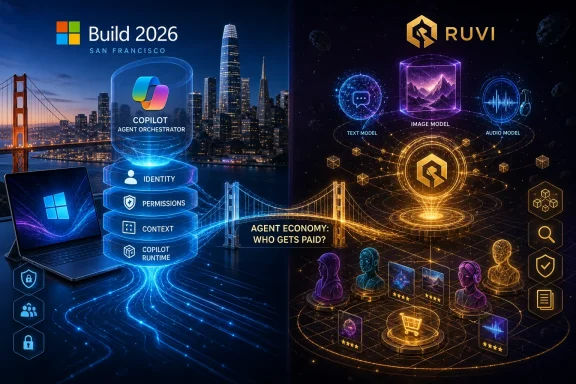
Microsoft used Build 2026 in San Francisco on June 2–3 to push Copilot, Microsoft IQ, Work IQ APIs, Scout, native Windows AI capabilities, and the broader Copilot Runtime into a single agent-oriented platform strategy for Windows, developers, and enterprise customers. The company did not merely announce another chatbot feature; it made clear that the next Windows platform war will be fought over context, permissions, workflows, and who gets to monetize the labor around AI. That is why the comparison with Ruvi, a crypto-funded “decentralized AI superapp” now promoting live models and a token economy, is more revealing than the press-release framing first suggests. Microsoft is selling trust through integration; Ruvi is selling upside through participation.
The phrase “Copilot super app” is useful marketing shorthand, but it risks flattening what Microsoft actually laid out at Build. The company’s more consequential move was to describe an operating environment where AI agents are no longer bolted onto apps but treated as a native software layer. Windows becomes the local surface, Copilot becomes the user-facing broker, and Microsoft IQ becomes the memory-and-context fabric that makes agents useful inside organizations.
That matters because agents are only as good as the systems they can see and the actions they are allowed to take. A generic model can draft an email. An enterprise agent with access to Teams, Outlook, SharePoint, GitHub, Fabric, business data, and organizational relationships can infer what the user is trying to accomplish and execute more of the surrounding work. Microsoft’s bet is that the moat is not the model alone; it is the trusted graph of work.
Build 2026 also showed Microsoft’s determination to make this stack feel less like a web service and more like a platform. The GitHub Copilot app, Copilot Studio agent tooling, Microsoft Foundry integrations, and Windows-side AI runtime pieces all point in the same direction. Microsoft wants developers to build for an environment where local compute, cloud models, enterprise context, identity, governance, and app permissions are coordinated under Redmond’s roof.
That is not inherently sinister. In the enterprise, centralization often means auditability, compliance, support, and predictable procurement. But it does mean the value created by user behavior, organizational context, and repetitive work patterns flows back into a platform whose economics are ultimately Microsoft’s.
Microsoft’s answer is familiar: the Microsoft account, Entra identity, Microsoft 365 permissions, Graph-connected data, Copilot subscriptions, Azure-hosted models, and developer tooling that keeps the ecosystem inside the Microsoft commercial orbit. The company is not simply improving Windows with AI. It is trying to make Windows and Microsoft 365 the place where agentic work is authorized, metered, governed, and billed.
For IT pros, that is both comforting and concerning. It is comforting because Microsoft can integrate these capabilities with the controls enterprises already use. It is concerning because each new layer of AI abstraction makes it harder to tell where the operating system ends, where the productivity suite begins, and where a new class of metered automation starts.
The old Windows platform captured value when developers wrote applications for it. The new one captures value when agents perform work through it. That is a profound shift. If Microsoft succeeds, the most important “app” on Windows may not be a traditional executable at all, but a trusted agent acting across many applications on the user’s behalf.
The company describes itself as a decentralized AI superapp combining text, image, video, audio, templates, agents, marketplaces, and contributor rewards. Its public materials promote more than 20 live AI models, a Cyberscope audit, thousands of holders, and a fixed 5 billion token supply. It also promotes a phased presale, token bonuses, staking expectations, and buyback-and-burn mechanics funded by platform revenue.
That framing is deliberately designed to appeal to people who believe the AI boom has a compensation problem. Generative AI systems are trained, tuned, improved, prompted, corrected, and validated by huge amounts of human activity, but the resulting value is usually captured by the model provider, cloud vendor, or application owner. Ruvi’s argument is that contributors should have a direct economic stake in the system they help improve.
The difficult part is separating a genuinely interesting product idea from the gravitational pull of token-sale marketing. A unified creative AI workspace is plausible. A contributor economy around model improvement is also plausible. But presales, target listing prices, APY ranges, bonuses, and buyback language belong to a different risk category than Microsoft announcing APIs at Build.
A decentralized AI superapp tries to reverse that assumption. If users contribute training signals, improve outputs, build templates, operate in marketplaces, or generate demand for AI tools, the token can theoretically become the accounting mechanism for that value. In a best-case scenario, the system turns participation into ownership and replaces platform rent with network incentives.
But decentralization also introduces hard questions that marketing language tends to skip. Who verifies that training contributions are useful? Who prevents low-quality or adversarial data from being rewarded? Who arbitrates copyright disputes around generated media? Who decides which models are integrated, which outputs are allowed, and how revenue is actually allocated?
Microsoft answers those questions with bureaucracy, contracts, compliance tools, and centralized control. Crypto projects often answer them with smart contracts, audits, community governance, and incentive design. Neither answer is perfect. The difference is that Microsoft’s risks are operational and institutional, while Ruvi’s are also financial and market-structural.
This is not the first time a dominant platform has provoked a counter-platform movement. Windows pushed open source into the mainstream. App stores created resentment around platform fees. Cloud centralization fueled interest in edge computing, self-hosting, and decentralized infrastructure. AI is now repeating the pattern at higher speed because models depend so visibly on human-created data and user feedback.
The contrast is particularly sharp because Microsoft’s AI future is deeply permissioned. In a large organization, that is the selling point. An agent that can touch documents, calendars, source code, customer records, and internal processes must be wrapped in identity controls, audit logs, data loss prevention, and administrative policy.
Ruvi’s story is more populist. It says the creative and training work that makes AI better should produce tokenized rewards for participants. That may resonate with independent creators and crypto-native users, but it does not automatically answer the governance demands of regulated organizations. A bank, hospital, defense contractor, or school district is unlikely to replace Microsoft’s agent stack with a tokenized AI marketplace simply because the latter has more participatory economics.
That does not make the project illegitimate, but it does change how readers should evaluate it. A product announcement asks whether the software works. A token presale asks whether the economics, incentives, liquidity, disclosures, custody model, contract security, and buyer expectations are sound. Ruvi is trying to be both a product story and an investment story, and that dual identity raises the burden of proof.
The public Ruvi materials do show a coherent product narrative: unified generative AI tools, multiple model categories, token-powered access, contributor rewards, and marketplace ambitions. They also point to an audit and a fixed non-mintable supply. Those are meaningful claims, but they are not the same as evidence of durable revenue, long-term demand, healthy secondary-market liquidity, or regulatory safety.
This distinction matters because crypto projects often borrow the language of software traction while selling financial exposure. “Live models” and “holders” are not interchangeable metrics. A product can exist and still fail to produce sustainable token value. A token can trade actively and still fail to support a useful product. The hard question for Ruvi is whether AI usage will be large, recurring, and economically connected enough to support the token mechanics being advertised.
But the same structure also solves problems enterprises care about. Microsoft can offer service-level commitments, compliance documentation, admin consoles, data residency options, security integrations, and predictable support channels. It can absorb model churn, billing complexity, and infrastructure operations in ways a smaller decentralized project may struggle to match.
The company also has an installed base that no AI startup can replicate quickly. Windows remains the daily work environment for huge numbers of users. Microsoft 365 is already where documents, mail, meetings, chat, and enterprise files live. GitHub is where much of the developer workflow sits. Azure is already approved inside many enterprises that would never onboard a new crypto-AI vendor without months of review.
That is why Build 2026 was not simply a developer conference. It was a reminder that Microsoft’s AI strategy is built on distribution. The company does not need every user to seek out a new AI platform. It can place agentic features inside the tools people already open every morning.
The danger for Microsoft is that users eventually notice how much unpaid behavioral labor goes into improving AI systems. Every correction, accepted suggestion, prompt pattern, workflow preference, and organizational signal has value. If that value is captured entirely by vendors, backlash is predictable.
The danger for Ruvi is that token incentives can distort the very contribution economy they are supposed to improve. If rewards are too generous, the system invites spam and gaming. If rewards are too weak, contributors drift back to mainstream tools. If token value depends more on presale momentum than product utility, the “decentralized AI” story risks becoming a financial wrapper around ordinary SaaS functionality.
Trust will therefore mean different things in each camp. For Microsoft, trust means administrative control, enterprise security, privacy promises, and compliance posture. For Ruvi, trust means transparent contracts, credible audits, real usage, honest economics, and proof that contributors are rewarded for value rather than merely recruited as liquidity.
But local AI does not automatically mean local control. A Windows agent may run pieces of inference on the device while still depending on cloud services for context, orchestration, policy, authentication, and premium model access. The silicon may be under your desk, but the business logic may still live in the cloud.
That distinction will matter as Copilot matures. Users may reasonably ask which tasks happen locally, which data leaves the device, which actions are logged, and which features require paid cloud entitlements. IT administrators will ask the same questions in more formal language: retention, telemetry, permissions, auditability, eDiscovery, data boundaries, and incident response.
Ruvi’s decentralized story attacks this anxiety from a different direction. It implies that users should not have to trust a single corporation to mediate every AI workflow. Yet decentralization also does not guarantee privacy or safety. Depending on the implementation, on-chain activity can be public, wallets can be compromised, and token-based access can create its own metadata trail.
The cost is dependency. Once a developer builds agents around Microsoft’s identity model, data connectors, context APIs, workflow tools, and deployment surfaces, switching becomes harder. That is not new; platform lock-in has been part of software since the beginning. What is new is that the locked-in layer may now include institutional knowledge and automated work patterns, not just code.
Ruvi’s appeal to developers and creators is that it promises a different dependency: participation in a tokenized network rather than subordination to a software giant. But that is still a dependency. Developers would be betting on Ruvi’s token economics, marketplace design, model integrations, community growth, and long-term governance.
The practical choice is not between dependence and independence. It is between different forms of dependence. Microsoft offers institutional stability at the price of centralized economics. Ruvi offers participatory upside at the price of volatility and unproven durability.
Buyback-and-burn language is common in crypto projects because it creates a simple scarcity narrative. If revenue buys tokens and removes them from circulation, holders may expect upward pressure on price. But that mechanism depends on actual revenue, transparent execution, liquidity conditions, and demand that survives beyond the presale window.
The same caution applies to APY projections. Yield funded by real platform revenue is different from yield funded by emissions or promotional reserves. Users should want to know how revenue is measured, how frequently buybacks occur, who controls the contracts, whether audits cover all relevant code, and what legal claims token holders actually have.
This is where the comparison with Microsoft becomes almost unfair. Microsoft’s economics may be centralized, but they are legible: subscriptions, cloud consumption, enterprise agreements, developer services, and app ecosystems. Ruvi’s economics may be more participatory, but they require buyers to understand token design, smart-contract risk, market liquidity, and regulatory uncertainty.
Microsoft’s model treats those traces as context inside a governed productivity environment. The user receives convenience, the organization receives automation, and Microsoft receives platform revenue. That may be an acceptable trade in the enterprise, especially if productivity gains are real and administrators retain control.
Ruvi’s model argues that participation itself should be monetized. If users help train, improve, route, or evaluate AI outputs, they should receive $RUVI. That is a more radical framing, and it aligns with broader Web3 ideas about user-owned networks.
The unresolved issue is whether users actually want ownership-like exposure or simply want better tools at a fair price. Most people do not want to manage wallets, evaluate audits, track token unlocks, or think about liquidity while creating a video ad or drafting copy. Crypto-native users may accept that complexity. Mainstream creators may not.
That does not mean Ruvi is the inevitable beneficiary. The field is crowded with AI apps, creator tools, agent builders, decentralized compute projects, data-labeling networks, and tokenized AI marketplaces. Many will fail. Some will be useful without becoming large. A few may become important precisely because they solve narrow problems rather than promising to collapse the entire stack.
Ruvi’s broad “superapp” ambition is both its selling point and its risk. Combining text, image, video, audio, agents, marketplaces, and rewards into one experience sounds efficient. It also creates execution pressure across multiple categories where specialized competitors are already strong.
Microsoft can absorb that complexity because it already owns the productivity substrate. Ruvi has to earn every workflow. Its product will need to be not just philosophically better aligned with contributors, but practically better enough to change habits.
Ruvi is worth watching for a different reason. It represents a counterargument that the AI platform economy should be shared with users and contributors rather than captured by the largest vendors. Whether Ruvi itself proves durable is uncertain, but the complaint it is exploiting is real.
That makes the story bigger than a token presale. Microsoft is telling developers and enterprises that the safest way into agentic AI is through its stack. Ruvi is telling creators and investors that the fairest way into AI is through a tokenized network. Both claims can be partly true, and both can fail in practice.
The next year will test which users care more about governance and convenience, and which care more about ownership and upside. Enterprises will likely choose Microsoft first. Independent creators, crypto investors, and AI power users may experiment elsewhere. The frontier will be messy because AI is not becoming one product; it is becoming a new economic layer across computing.
 Microsoft’s Real Build Message Was Control of the Agent Layer
The phrase “Copilot super app” is useful marketing shorthand, but it risks flattening what Microsoft actually laid out at Build. The company’s more consequential move was to describe an operating environment where AI agents are no longer bolted onto apps but treated as a native software layer. Windows becomes the local surface, Copilot becomes the user-facing broker, and Microsoft IQ becomes the memory-and-context fabric that makes agents useful inside organizations.That matters because agents are only as good as the systems they can see and the actions they are allowed to take. A generic model can draft an email. An enterprise agent with access to Teams, Outlook, SharePoint, GitHub, Fabric, business data, and organizational relationships can infer what the user is trying to accomplish and execute more of the surrounding work. Microsoft’s bet is that the moat is not the model alone; it is the trusted graph of work.
Build 2026 also showed Microsoft’s determination to make this stack feel less like a web service and more like a platform. The GitHub Copilot app, Copilot Studio agent tooling, Microsoft Foundry integrations, and Windows-side AI runtime pieces all point in the same direction. Microsoft wants developers to build for an environment where local compute, cloud models, enterprise context, identity, governance, and app permissions are coordinated under Redmond’s roof.
That is not inherently sinister. In the enterprise, centralization often means auditability, compliance, support, and predictable procurement. But it does mean the value created by user behavior, organizational context, and repetitive work patterns flows back into a platform whose economics are ultimately Microsoft’s.
The “Super App” Is Less an App Than a Settlement System
Consumer tech tends to use “super app” to mean a single interface that absorbs many daily tasks. In Microsoft’s world, the more important concept is not the interface but the settlement layer underneath it. Who authenticates the user? Who sees the organization graph? Who prices the API calls? Who decides which agents can act, which data they can touch, and which workflows become premium features?Microsoft’s answer is familiar: the Microsoft account, Entra identity, Microsoft 365 permissions, Graph-connected data, Copilot subscriptions, Azure-hosted models, and developer tooling that keeps the ecosystem inside the Microsoft commercial orbit. The company is not simply improving Windows with AI. It is trying to make Windows and Microsoft 365 the place where agentic work is authorized, metered, governed, and billed.
For IT pros, that is both comforting and concerning. It is comforting because Microsoft can integrate these capabilities with the controls enterprises already use. It is concerning because each new layer of AI abstraction makes it harder to tell where the operating system ends, where the productivity suite begins, and where a new class of metered automation starts.
The old Windows platform captured value when developers wrote applications for it. The new one captures value when agents perform work through it. That is a profound shift. If Microsoft succeeds, the most important “app” on Windows may not be a traditional executable at all, but a trusted agent acting across many applications on the user’s behalf.
Ruvi Arrives With the Opposite Story and the Same Ambition
Ruvi’s pitch is almost a mirror image of Microsoft’s. Instead of asking users and creators to enter a governed enterprise cloud, it argues that AI workflows should be unified in a decentralized product powered by a token. Instead of subscriptions flowing to one platform owner, Ruvi says usage, training contributions, and platform revenue can be reflected in the $RUVI economy.The company describes itself as a decentralized AI superapp combining text, image, video, audio, templates, agents, marketplaces, and contributor rewards. Its public materials promote more than 20 live AI models, a Cyberscope audit, thousands of holders, and a fixed 5 billion token supply. It also promotes a phased presale, token bonuses, staking expectations, and buyback-and-burn mechanics funded by platform revenue.
That framing is deliberately designed to appeal to people who believe the AI boom has a compensation problem. Generative AI systems are trained, tuned, improved, prompted, corrected, and validated by huge amounts of human activity, but the resulting value is usually captured by the model provider, cloud vendor, or application owner. Ruvi’s argument is that contributors should have a direct economic stake in the system they help improve.
The difficult part is separating a genuinely interesting product idea from the gravitational pull of token-sale marketing. A unified creative AI workspace is plausible. A contributor economy around model improvement is also plausible. But presales, target listing prices, APY ranges, bonuses, and buyback language belong to a different risk category than Microsoft announcing APIs at Build.
The Decentralization Pitch Solves One Problem and Creates Several More
Ruvi’s strongest critique of closed AI platforms is straightforward: centralized systems extract value from user behavior without giving users a meaningful share of the upside. Microsoft’s Copilot stack may make work faster, but it does not turn the employee, prompt engineer, designer, or data contributor into an economic participant in the platform. In most enterprise settings, that is not even the design goal.A decentralized AI superapp tries to reverse that assumption. If users contribute training signals, improve outputs, build templates, operate in marketplaces, or generate demand for AI tools, the token can theoretically become the accounting mechanism for that value. In a best-case scenario, the system turns participation into ownership and replaces platform rent with network incentives.
But decentralization also introduces hard questions that marketing language tends to skip. Who verifies that training contributions are useful? Who prevents low-quality or adversarial data from being rewarded? Who arbitrates copyright disputes around generated media? Who decides which models are integrated, which outputs are allowed, and how revenue is actually allocated?
Microsoft answers those questions with bureaucracy, contracts, compliance tools, and centralized control. Crypto projects often answer them with smart contracts, audits, community governance, and incentive design. Neither answer is perfect. The difference is that Microsoft’s risks are operational and institutional, while Ruvi’s are also financial and market-structural.
Windows IT Pros Should Read This as a Platform Fight, Not a Coin Story
For a WindowsForum audience, the most interesting part of Ruvi is not whether a presale buyer can turn $500 into a larger number at listing. That is speculative finance, and it should be treated as such. The more important point is that Microsoft’s agentic Windows strategy is creating a reaction: users, creators, and investors are looking for alternatives where AI usage does not automatically become another subscription line item controlled by a hyperscaler.This is not the first time a dominant platform has provoked a counter-platform movement. Windows pushed open source into the mainstream. App stores created resentment around platform fees. Cloud centralization fueled interest in edge computing, self-hosting, and decentralized infrastructure. AI is now repeating the pattern at higher speed because models depend so visibly on human-created data and user feedback.
The contrast is particularly sharp because Microsoft’s AI future is deeply permissioned. In a large organization, that is the selling point. An agent that can touch documents, calendars, source code, customer records, and internal processes must be wrapped in identity controls, audit logs, data loss prevention, and administrative policy.
Ruvi’s story is more populist. It says the creative and training work that makes AI better should produce tokenized rewards for participants. That may resonate with independent creators and crypto-native users, but it does not automatically answer the governance demands of regulated organizations. A bank, hospital, defense contractor, or school district is unlikely to replace Microsoft’s agent stack with a tokenized AI marketplace simply because the latter has more participatory economics.
The Press Release Gives Ruvi Momentum, But Not Proof
The submitted release leans heavily on urgency: Phase 3 pricing, a move from $0.020 to $0.028, a $0.10 listing target, VIP bonuses, 100 percent unlock language, and APY expectations. Those are not incidental details. They are the engine of the pitch.That does not make the project illegitimate, but it does change how readers should evaluate it. A product announcement asks whether the software works. A token presale asks whether the economics, incentives, liquidity, disclosures, custody model, contract security, and buyer expectations are sound. Ruvi is trying to be both a product story and an investment story, and that dual identity raises the burden of proof.
The public Ruvi materials do show a coherent product narrative: unified generative AI tools, multiple model categories, token-powered access, contributor rewards, and marketplace ambitions. They also point to an audit and a fixed non-mintable supply. Those are meaningful claims, but they are not the same as evidence of durable revenue, long-term demand, healthy secondary-market liquidity, or regulatory safety.
This distinction matters because crypto projects often borrow the language of software traction while selling financial exposure. “Live models” and “holders” are not interchangeable metrics. A product can exist and still fail to produce sustainable token value. A token can trade actively and still fail to support a useful product. The hard question for Ruvi is whether AI usage will be large, recurring, and economically connected enough to support the token mechanics being advertised.
Microsoft’s Weakness Is Also Its Strength
Microsoft’s closed-loop economics are easy to criticize. The company collects subscriptions, sells cloud consumption, embeds Copilot into Microsoft 365, exposes APIs to developers, and keeps users inside its account, identity, and governance systems. That is the opposite of the user-owned economy Ruvi is describing.But the same structure also solves problems enterprises care about. Microsoft can offer service-level commitments, compliance documentation, admin consoles, data residency options, security integrations, and predictable support channels. It can absorb model churn, billing complexity, and infrastructure operations in ways a smaller decentralized project may struggle to match.
The company also has an installed base that no AI startup can replicate quickly. Windows remains the daily work environment for huge numbers of users. Microsoft 365 is already where documents, mail, meetings, chat, and enterprise files live. GitHub is where much of the developer workflow sits. Azure is already approved inside many enterprises that would never onboard a new crypto-AI vendor without months of review.
That is why Build 2026 was not simply a developer conference. It was a reminder that Microsoft’s AI strategy is built on distribution. The company does not need every user to seek out a new AI platform. It can place agentic features inside the tools people already open every morning.
The Agent Economy Will Be Won on Trust, Not Slogans
Both Microsoft and Ruvi are chasing the same broad future: software that can reason across tasks, assemble outputs across media types, and act with less direct human steering. The disagreement is over who owns the rails. Microsoft says the rails should be governed, integrated, enterprise-ready, and connected to its productivity empire. Ruvi says the rails should be open to participants and economically shared through a token.The danger for Microsoft is that users eventually notice how much unpaid behavioral labor goes into improving AI systems. Every correction, accepted suggestion, prompt pattern, workflow preference, and organizational signal has value. If that value is captured entirely by vendors, backlash is predictable.
The danger for Ruvi is that token incentives can distort the very contribution economy they are supposed to improve. If rewards are too generous, the system invites spam and gaming. If rewards are too weak, contributors drift back to mainstream tools. If token value depends more on presale momentum than product utility, the “decentralized AI” story risks becoming a financial wrapper around ordinary SaaS functionality.
Trust will therefore mean different things in each camp. For Microsoft, trust means administrative control, enterprise security, privacy promises, and compliance posture. For Ruvi, trust means transparent contracts, credible audits, real usage, honest economics, and proof that contributors are rewarded for value rather than merely recruited as liquidity.
The Windows Angle Is Local AI With Cloud Economics
Windows users should pay attention to the Copilot Runtime because it points toward a hybrid future. Microsoft is not betting only on giant cloud models. It is also positioning Windows PCs, especially AI PCs with NPUs, as local execution environments for certain vision, language, and speech tasks. That could improve latency, privacy, and offline capability for some workloads.But local AI does not automatically mean local control. A Windows agent may run pieces of inference on the device while still depending on cloud services for context, orchestration, policy, authentication, and premium model access. The silicon may be under your desk, but the business logic may still live in the cloud.
That distinction will matter as Copilot matures. Users may reasonably ask which tasks happen locally, which data leaves the device, which actions are logged, and which features require paid cloud entitlements. IT administrators will ask the same questions in more formal language: retention, telemetry, permissions, auditability, eDiscovery, data boundaries, and incident response.
Ruvi’s decentralized story attacks this anxiety from a different direction. It implies that users should not have to trust a single corporation to mediate every AI workflow. Yet decentralization also does not guarantee privacy or safety. Depending on the implementation, on-chain activity can be public, wallets can be compromised, and token-based access can create its own metadata trail.
Developers Are Being Asked to Choose Their Dependency
Build 2026’s agent story is especially consequential for developers. Microsoft is offering a deep stack: GitHub Copilot for coding, Copilot Studio for agent building, Foundry for model and app infrastructure, Microsoft IQ for context, and Windows APIs for local AI capabilities. For many teams, that is an attractive consolidation of tools that were previously scattered across vendors.The cost is dependency. Once a developer builds agents around Microsoft’s identity model, data connectors, context APIs, workflow tools, and deployment surfaces, switching becomes harder. That is not new; platform lock-in has been part of software since the beginning. What is new is that the locked-in layer may now include institutional knowledge and automated work patterns, not just code.
Ruvi’s appeal to developers and creators is that it promises a different dependency: participation in a tokenized network rather than subordination to a software giant. But that is still a dependency. Developers would be betting on Ruvi’s token economics, marketplace design, model integrations, community growth, and long-term governance.
The practical choice is not between dependence and independence. It is between different forms of dependence. Microsoft offers institutional stability at the price of centralized economics. Ruvi offers participatory upside at the price of volatility and unproven durability.
The Crypto Layer Demands a Higher Skepticism
Any discussion of $RUVI has to be clearer than the press release. A fixed supply, audit, presale structure, and stated buyback-and-burn plan do not eliminate market risk. They also do not ensure that the token will appreciate, that staking rewards will persist, or that a listing target will be reached.Buyback-and-burn language is common in crypto projects because it creates a simple scarcity narrative. If revenue buys tokens and removes them from circulation, holders may expect upward pressure on price. But that mechanism depends on actual revenue, transparent execution, liquidity conditions, and demand that survives beyond the presale window.
The same caution applies to APY projections. Yield funded by real platform revenue is different from yield funded by emissions or promotional reserves. Users should want to know how revenue is measured, how frequently buybacks occur, who controls the contracts, whether audits cover all relevant code, and what legal claims token holders actually have.
This is where the comparison with Microsoft becomes almost unfair. Microsoft’s economics may be centralized, but they are legible: subscriptions, cloud consumption, enterprise agreements, developer services, and app ecosystems. Ruvi’s economics may be more participatory, but they require buyers to understand token design, smart-contract risk, market liquidity, and regulatory uncertainty.
The Agent Race Is Becoming a Fight Over Who Gets Paid
The biggest idea underneath both announcements is compensation. AI systems are increasingly built from human traces: documents, workflows, feedback, prompts, labels, edits, preferences, and organizational context. The question is whether that activity remains invisible input or becomes an explicit economic asset.Microsoft’s model treats those traces as context inside a governed productivity environment. The user receives convenience, the organization receives automation, and Microsoft receives platform revenue. That may be an acceptable trade in the enterprise, especially if productivity gains are real and administrators retain control.
Ruvi’s model argues that participation itself should be monetized. If users help train, improve, route, or evaluate AI outputs, they should receive $RUVI. That is a more radical framing, and it aligns with broader Web3 ideas about user-owned networks.
The unresolved issue is whether users actually want ownership-like exposure or simply want better tools at a fair price. Most people do not want to manage wallets, evaluate audits, track token unlocks, or think about liquidity while creating a video ad or drafting copy. Crypto-native users may accept that complexity. Mainstream creators may not.
The Build 2026 Moment Makes Ruvi’s Pitch More Timely
Ruvi benefits from timing. Microsoft’s Build 2026 announcements make the centralization of AI feel concrete. The more Microsoft describes Windows as agent-native, the easier it becomes for challengers to say that the future of AI work should not be locked inside one company’s stack.That does not mean Ruvi is the inevitable beneficiary. The field is crowded with AI apps, creator tools, agent builders, decentralized compute projects, data-labeling networks, and tokenized AI marketplaces. Many will fail. Some will be useful without becoming large. A few may become important precisely because they solve narrow problems rather than promising to collapse the entire stack.
Ruvi’s broad “superapp” ambition is both its selling point and its risk. Combining text, image, video, audio, agents, marketplaces, and rewards into one experience sounds efficient. It also creates execution pressure across multiple categories where specialized competitors are already strong.
Microsoft can absorb that complexity because it already owns the productivity substrate. Ruvi has to earn every workflow. Its product will need to be not just philosophically better aligned with contributors, but practically better enough to change habits.
The Practical Reading for WindowsForum Readers
For Windows enthusiasts and IT professionals, the near-term reality is clear: Microsoft’s agent platform will arrive through tools you already administer, deploy, license, or troubleshoot. The Copilot Runtime, Microsoft IQ, Work IQ APIs, Scout-style agents, and native AI app push are not distant abstractions. They are the next layer of Microsoft’s desktop and enterprise strategy.Ruvi is worth watching for a different reason. It represents a counterargument that the AI platform economy should be shared with users and contributors rather than captured by the largest vendors. Whether Ruvi itself proves durable is uncertain, but the complaint it is exploiting is real.
That makes the story bigger than a token presale. Microsoft is telling developers and enterprises that the safest way into agentic AI is through its stack. Ruvi is telling creators and investors that the fairest way into AI is through a tokenized network. Both claims can be partly true, and both can fail in practice.
The next year will test which users care more about governance and convenience, and which care more about ownership and upside. Enterprises will likely choose Microsoft first. Independent creators, crypto investors, and AI power users may experiment elsewhere. The frontier will be messy because AI is not becoming one product; it is becoming a new economic layer across computing.
The Bet Behind Copilot and $RUVI Is Bigger Than Either Brand
Microsoft’s Build 2026 announcements confirm that the company sees Windows as an agent host, Microsoft 365 as a context engine, and Copilot as the interface through which more work will be delegated. Ruvi’s campaign confirms that a competing narrative is gaining traction: AI platforms should reward the people whose usage, feedback, and creative labor make them better.- Microsoft’s Build 2026 strategy is best understood as a platform play around agents, context, identity, governance, and developer tooling.
- The “Copilot super app” idea is less important than Microsoft’s effort to make Windows and Microsoft 365 the trusted runtime for AI work.
- Ruvi’s decentralized AI superapp pitch is compelling because it attacks the value-capture problem at the center of closed AI platforms.
- Ruvi’s token economics, presale pricing, staking projections, and buyback claims should be evaluated as speculative crypto claims, not as ordinary software features.
- Enterprise IT will likely prize Microsoft’s governance and integration, while creators and crypto-native users may be more receptive to Ruvi’s participation model.
- The long-term fight is over whether AI users remain customers of platforms or become economic participants in them.
References
- Primary source: openpr.com
Published: 2026-06-10T23:50:08.219915
Microsoft Unveils a Copilot Super App at Build 2026 While Ruvi
Press release - Institutional Business Press - Microsoft Unveils a Copilot Super App at Build 2026 While Ruvi (RUVI) Ships a Decentralized AI Superapp - published on openPR.comwww.openpr.com - Official source: blogs.microsoft.com
Microsoft Build 2026: Be yourself at work - The Official Microsoft Blog
Platforms shift when developers build. We explore, choose tools, dream, create. This platform shift comes with more information than ever, ready at your fingertips. This shift, it’s about building fast AND THEN: it’s about building, operating, optimizing and observing. Securing your...blogs.microsoft.com - Related coverage: ruvi.io
Ruvi AI — The AI Superapp Powered by Web3.
Generate text, images, video, and audio with 20+ AI models — one platform, one token. Earn $RUVI by contributing to community-driven model training.ruvi.io - Related coverage: docs.ruvi.io
Presale Structure · Ruvi AI
Presale Structure. Section 12 of 19 of the Ruvi AI Whitepaper. Early access to the Ruvi ecosystem.docs.ruvi.io - Related coverage: tomsguide.com
Biggest Microsoft Build 2026 announcements — agentic AI, RTX Spark Dev Box, GitHub Copilot app, new MAI models, and more | Tom's Guide
All the big news from Microsoft's AI-focused eventwww.tomsguide.com - Related coverage: globenewswire.com
Ruvi AI (RUVI) Launches Major Ecosystem Upgrade Featuring
DUBAI, United Arab Emirates, May 29, 2026 (GLOBE NEWSWIRE) -- Ruvi AI has launched a major ecosystem upgrade featuring 20+ autonomous AI agents given its...www.globenewswire.com
- Related coverage: linkloot.io
Microsoft Build 2026 puts agent context, Scout, and MAI models into one developer stack – Blog | LinkLoot
Microsoft used Build 2026 to frame its agent platform around Microsoft IQ, the Scout personal agent, new MAI models, Frontier Tuning, Agent 365, and local or...linkloot.io - Related coverage: presale.ruvi.io
- Official source: learn.microsoft.com
New and planned features for Microsoft Copilot Studio, 2026 release wave 1 | Microsoft Learn
Summary of planned features for Microsoft Copilot Studio.learn.microsoft.com - Official source: partner.microsoft.com
Microsoft Build 2026: Turning innovation into partner growth
Microsoft Build 2026 highlights AI, agents, and platform updates that create new opportunities for partners to build, scale, and deliver customer solutions.partner.microsoft.com
- Related coverage: geekwire.com
Mary Jo Foley: No Copilot 'Super App' at Microsoft Build, but plenty of agentic fodder – GeekWire
Microsoft teased its rumored Copilot "Super App" at Build but didn't demo it. Longtime Microsoft watcher Mary Jo Foley assesses the no-show, explains why the initiative matters, and considers what the company actually did announce.www.geekwire.com - Official source: news.microsoft.com
Microsoft Build Live
The home for real-time coverage of the news as it is announced from Microsoft Build, June 2-3, 2026.news.microsoft.com - Related coverage: windowscentral.com
"Agents are only as good as the context we give them": Microsoft IQ connects AI agents to your workspace data and the web | Windows Central
The newly unveiled Microsoft IQ data stack and Scout assistant turn generic AI into a personalized workplace tool.www.windowscentral.com - Related coverage: techradar.com
From code-first to intent-first: Microsoft Build 2026 could be the end of programming as we know it | TechRadar
Redefining what it means to be a developer with agentic AIwww.techradar.com
