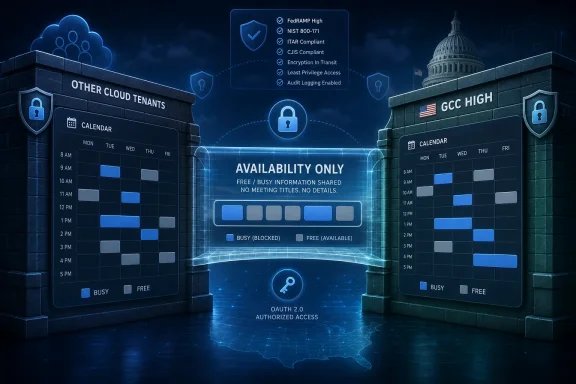
CalendarBridge announced on June 30, 2026, in Miami that its calendar synchronization platform now supports Microsoft 365 GCC High, giving eligible government contractors, public sector partners, and security-conscious organizations a way to sync availability across controlled Microsoft cloud tenants without merging accounts or exposing full meeting details. The announcement is not the sort of infrastructure news that makes consumer tech feeds light up, but it lands directly in one of enterprise IT’s most stubborn daily pain points. In government-adjacent work, the calendar is not just a convenience layer; it is where operational security, tenant boundaries, contracting relationships, and human availability collide. CalendarBridge is betting that the next frontier in collaboration is not another chat app, but making the old calendar safer across organizations that are not supposed to fully trust one another.
The pitch is deceptively simple: people who live in several calendars should not have to pretend they only live in one. A contractor may have a home company calendar, a client-issued Microsoft 365 account, a program-specific tenant, a personal calendar, and perhaps a Google or iCloud schedule sitting off to the side. Each account may be legitimate, each boundary may be necessary, and yet the person still has only one Tuesday afternoon.
That is the practical gap CalendarBridge is trying to close with GCC High support. Microsoft 365 GCC High is not merely another SKU in the Microsoft cloud catalog; it is part of the U.S. government cloud universe designed for agencies, defense contractors, and organizations handling more sensitive compliance workloads than standard commercial Microsoft 365 was built to address. For users in that world, the usual consumer-grade answer — “just share your calendar” — can be a nonstarter.
The announcement is therefore less about adding one more calendar source and more about acknowledging that government cloud adoption has created a collaboration paradox. The same isolation that helps protect controlled work can also make routine scheduling brittle, slow, and annoyingly manual. The stricter the boundary, the more likely users are to invent informal bridges around it.
Those informal bridges are exactly where IT departments get nervous. Manual holds, forwarded invites, duplicate events, and ad hoc calendar sharing are not only inefficient; they are easy to forget, hard to audit, and often much more revealing than users realize. A meeting title can leak a program name. An attendee list can expose a vendor relationship. A location field can say too much.
But those same customers are often the least able to centralize everything neatly. A consultant might support multiple agencies. A systems integrator might work across several prime contractors. A small manufacturer in a defense supply chain might have one foot in commercial Microsoft 365 and another in GCC High because of contract requirements.
The result is a world where identity, data, and collaboration live in separate compartments by design. That design is good security architecture, but bad social plumbing. It keeps the wrong people out, but it also makes it harder for the right people to find an open slot for a status meeting.
CalendarBridge’s claim is that availability can cross those boundaries without dragging the rest of the meeting record along with it. Its support for busy-only synchronization is the important detail here. The calendar entry that appears in another account does not need to say “classified-adjacent supplier review with Acme Subsystems”; it only needs to say, in effect, “unavailable.”
That sounds small until you consider how much sensitive business context hides in ordinary calendar metadata. Subjects, attendees, locations, conferencing links, and descriptions often create a shadow map of an organization’s priorities. In a highly controlled environment, reducing that map to availability status is not a cosmetic privacy feature; it is the entire security argument.
In commercial environments, the workaround might be harmless enough: subscribe to an internet calendar feed, forward invites, or maintain a personal “busy” calendar. In government and regulated settings, those moves can carry more risk. The problem is not that users are careless; it is that the collaboration surface area has outgrown the default assumptions of the tools.
Microsoft 365 tenants are excellent at representing organizational boundaries. They are less elegant at representing modern professional lives that span multiple organizations at once. That mismatch is especially visible in contracting-heavy sectors, where users may be provisioned into client tenants but remain accountable to their employer, other clients, and internal program teams.
CalendarBridge is positioning itself as a controlled alternative to that mess. The platform says it can synchronize availability across Microsoft 365, Google, Outlook, iCloud, and now Microsoft 365 GCC High environments, while allowing separate accounts and organizations to remain separate. That last clause is the one administrators will care about most.
No one in this market wants to hear that the solution is to collapse tenants, merge domains, or loosen access boundaries. Those moves are heavy, politically difficult, and often inappropriate. A viable calendar bridge has to work because the boundaries remain intact, not because they are quietly dissolved.
The company also says it does not require access to email, files, contacts, or global address books, and that calendar data passes through transiently for synchronization without storing event details. Those claims are central to the product’s fit for privacy-conscious customers. They do not eliminate the need for procurement review, security assessment, or tenant admin scrutiny, but they show CalendarBridge understands the first objection it will face.
That objection is simple: why should a third-party service touch calendars in GCC High at all? The answer has to be narrower than “because it is convenient.” Convenience alone is not enough in environments where administrators are trained to distrust data sprawl.
The stronger answer is risk reduction. If a managed sync layer can prevent users from forwarding sensitive invites, copying event details into commercial calendars, or maintaining sloppy manual duplicates, then the third-party service may reduce net exposure. That calculation depends on implementation details, contractual assurances, logging, data handling, and customer configuration, but it is the right frame.
This is where CalendarBridge’s busy-only model matters. A sync tool that copies full meeting content everywhere would be hard to defend in sensitive environments. A sync tool that propagates only the minimum signal needed to avoid double-booking has a much cleaner story.
That segmentation creates opportunity for companies that can bridge the seams without flattening the architecture. CalendarBridge is not trying to replace Microsoft 365 or Google Calendar. It is trying to make the seams less painful for people whose calendars are distributed across those systems.
This is an increasingly important niche because Microsoft itself is both the platform provider and the boundary setter. GCC High customers rely on Microsoft’s cloud architecture to meet requirements that commercial tenants may not satisfy. But Microsoft’s first-party collaboration model still assumes that many workflows happen inside a tenant or within sanctioned cross-tenant sharing arrangements.
That leaves room for specialized tools focused on one narrow workflow. Availability synchronization is narrow enough to be tractable, but important enough to matter. It is one of those enterprise problems that looks trivial from the outside and becomes maddening only after a user has three Microsoft identities, two client calendars, and a compliance officer watching the data flows.
There is also a timing element. As more small and mid-sized contractors confront cybersecurity and compliance requirements tied to federal work, GCC High is no longer only a concern for large defense primes. Smaller organizations increasingly find themselves pulled into government-grade environments without the large IT staffs that traditionally managed them. For those firms, a product that reduces administrative friction without requiring endpoint software or tenant consolidation has an obvious appeal.
In government contracting, that metadata can be even more revealing. A subject line might identify a program. An attendee list might expose a subcontractor relationship. A recurring meeting cadence might show which phase of a project is underway. Even a simple location field can disclose enough to matter.
This is why “busy-only” is not just a user preference. It is a data minimization strategy. The most privacy-preserving version of calendar sync is the one that answers the scheduling question without exporting the business context.
There is a subtle cultural shift here as well. For years, calendar sharing has been treated as an all-or-nothing trust gesture. Inside a company, that may be acceptable. Across tenants, clients, agencies, and contractor teams, it is increasingly out of step with how work actually happens.
CalendarBridge’s announcement fits into a broader movement toward purpose-limited interoperability. The goal is not to make every system fully visible to every other system. The goal is to move just enough signal across the boundary to make the workflow function.
In practice, the success of GCC High support will depend on how organizations configure and govern it. A tool that can share too much information must be locked down to share only what the organization intends. Admins will need to understand consent flows, tenant permissions, user eligibility, logging, and revocation.
There is also the question of policy fit. Some organizations may be comfortable with busy-only synchronization between GCC High and commercial calendars. Others may restrict synchronization to controlled tenants only. Still others may forbid third-party calendar services entirely for certain programs.
That variation is not a weakness in the announcement; it is the reality of the market. Government cloud customers are not a monolith. A state contractor, a defense supplier, a systems integrator, and a public sector consultancy may all use GCC High for different reasons and under different contractual obligations.
The best version of CalendarBridge’s pitch is not “trust us, it is safe.” It is “configure the minimum necessary synchronization for the collaboration problem you actually have.” That is a more mature message, and it is the one most likely to survive contact with enterprise security teams.
That control plane has become fragmented. Microsoft 365, Google Workspace, Outlook.com, iCloud, and specialized government tenants all maintain their own versions of the truth. Users become the replication engine, manually copying availability from one world to another.
Manual replication is both unreliable and unsafe. It breaks when people forget. It leaks when people copy too much. It creates stale state when a meeting changes in one calendar but not another. It makes the human being responsible for synchronizing systems that were supposed to reduce administrative burden in the first place.
CalendarBridge’s model is to automate that replication while reducing the payload. The event does not need to travel as a full-fidelity object. Availability is the object. That is a cleaner abstraction and one that maps well to regulated collaboration.
The deeper significance is that cross-tenant work is becoming normal enough to need its own tooling layer. Identity federation, guest accounts, external sharing policies, and tenant-to-tenant migration tools have all addressed parts of the problem. Calendar availability sits in a different category: mundane, constant, and operationally essential.
A consultant working across multiple public sector clients may receive separate accounts in several tenants. A defense supplier may keep internal business operations in one Microsoft 365 environment while maintaining GCC High for regulated work. A program manager may need to coordinate across company leadership, client stakeholders, and external partners without revealing what each group is doing.
That is not an edge case anymore. It is the operating model for a large slice of the public sector ecosystem. The fact that ordinary scheduling becomes difficult is a symptom of a larger architectural truth: collaboration no longer maps neatly to the corporate directory.
This is where CalendarBridge’s support for GCC High could matter beyond the size of the company itself. If it works as advertised, it gives smaller organizations a practical way to preserve tenant separation while reducing the human cost of that separation. That matters because compliance regimes often impose enterprise-grade expectations on organizations that do not have enterprise-scale IT teams.
The announcement also arrives at a symbolic moment. CalendarBridge frames the launch around the United States marking its 250th anniversary, a marketing flourish that could have felt forced. But there is a real public sector angle beneath it: the machinery of government and its contractor ecosystem increasingly depends on commercial cloud tools adapted for controlled environments.
Feature breadth matters, but trust matters more. A government contractor is not merely asking whether the sync works. It is asking what data is touched, where it flows, what is retained, who can access it, what permissions are granted, and whether the service can be justified to customers and auditors.
That gives CalendarBridge both an opening and a burden. The opening is that many generic sync tools are not built for this audience, and many collaboration platforms assume a less restrictive operating model. The burden is that security-conscious buyers will scrutinize the product more heavily than ordinary productivity users.
The company’s emphasis on no password collection, no endpoint software, no access to email or files, and transient handling of calendar data is therefore not incidental. It is the product narrative. CalendarBridge is trying to differentiate not by saying it can see more, but by saying it can work while seeing less.
That is the right direction for this market. In regulated collaboration, the winning tool is often the one that does the least necessary thing reliably. The enemy is not merely inconvenience; it is overexposure disguised as integration.
That is where edge services emerge. They do not replace the platform. They fill the spaces where platform-level assumptions break down. CalendarBridge’s GCC High support is exactly that kind of edge service.
For WindowsForum readers, the point is not that everyone should immediately plug a third-party sync service into a government tenant. The point is that the need exists because the modern Microsoft estate is more fragmented than the old Office monoculture. Enterprises now run commercial tenants, government tenants, guest identities, external collaboration policies, and multi-cloud productivity stacks all at once.
This fragmentation is not a failure, exactly. It is the cost of serving different regulatory, geographic, and security needs through cloud services. But the cost is real, and it often lands on users in the form of duplicated work.
The vendors that thrive around Microsoft 365 over the next decade will likely be the ones that respect Microsoft’s boundaries while smoothing the user experience between them. CalendarBridge is making that argument through scheduling. Others will make it through records management, workflow automation, secure messaging, identity governance, and compliance reporting.
But enterprise IT is built out of these supposedly boring problems. The tools people touch every hour often matter more than the grand platform announcements. If availability data is wrong, meetings fail. If meetings fail, projects slow down. If users fix the problem with copy-and-paste workarounds, security teams inherit a mess.
CalendarBridge’s move also reflects a broader truth about compliance technology: the goal is not to make controlled environments feel uncontrolled. It is to make them usable enough that people stop trying to escape them. A secure system that forces users into shadow workflows is not as secure as it looks on paper.
That is why calendar synchronization deserves attention. It is a small workflow that exposes the tension between isolation and collaboration. The better a government cloud becomes at isolation, the more important it becomes to design safe, narrow forms of interoperability.
The most interesting claim in CalendarBridge’s announcement is not real-time sync or platform breadth. It is the promise that organizations can maintain accurate availability without merging domains, consolidating tenants, installing endpoint software, or exposing unnecessary meeting information. If that promise holds under scrutiny, it addresses the problem at the right layer.
Those questions are not signs of skepticism for its own sake. They are the normal questions any service should face when entering the GCC High orbit. Calendar data may not be email, but it is still organizational data.
The operational reality will also matter. Real-time synchronization sounds straightforward until calendars contain recurring meetings, private events, cancellations, tentative holds, all-day blocks, out-of-office entries, delegated calendars, and time zone changes. A sync product earns trust by handling the weird cases quietly.
For end users, the ideal experience is that nothing dramatic happens. Their calendars simply stop lying to one another. For administrators, the ideal experience is that the sync is narrow, observable, revocable, and boring.
That last word is praise. In sensitive environments, boring infrastructure is good infrastructure. It does not surprise the user, it does not surprise the auditor, and it does not become the next incident report.
 The Small Calendar Fix Points at a Bigger Government Cloud Problem
The pitch is deceptively simple: people who live in several calendars should not have to pretend they only live in one. A contractor may have a home company calendar, a client-issued Microsoft 365 account, a program-specific tenant, a personal calendar, and perhaps a Google or iCloud schedule sitting off to the side. Each account may be legitimate, each boundary may be necessary, and yet the person still has only one Tuesday afternoon.That is the practical gap CalendarBridge is trying to close with GCC High support. Microsoft 365 GCC High is not merely another SKU in the Microsoft cloud catalog; it is part of the U.S. government cloud universe designed for agencies, defense contractors, and organizations handling more sensitive compliance workloads than standard commercial Microsoft 365 was built to address. For users in that world, the usual consumer-grade answer — “just share your calendar” — can be a nonstarter.
The announcement is therefore less about adding one more calendar source and more about acknowledging that government cloud adoption has created a collaboration paradox. The same isolation that helps protect controlled work can also make routine scheduling brittle, slow, and annoyingly manual. The stricter the boundary, the more likely users are to invent informal bridges around it.
Those informal bridges are exactly where IT departments get nervous. Manual holds, forwarded invites, duplicate events, and ad hoc calendar sharing are not only inefficient; they are easy to forget, hard to audit, and often much more revealing than users realize. A meeting title can leak a program name. An attendee list can expose a vendor relationship. A location field can say too much.
GCC High Turns Scheduling into a Security Boundary
Microsoft’s government cloud lineup exists because one size of cloud does not fit every regulatory or national-security-adjacent workload. GCC, GCC High, and DoD environments occupy different places on the isolation and compliance spectrum, with GCC High aimed at organizations that need elevated controls, U.S. data residency expectations, and support for workloads tied to federal requirements. That makes GCC High attractive to defense industrial base contractors, public sector partners, and regulated suppliers whose business depends on being able to work inside government-aligned environments.But those same customers are often the least able to centralize everything neatly. A consultant might support multiple agencies. A systems integrator might work across several prime contractors. A small manufacturer in a defense supply chain might have one foot in commercial Microsoft 365 and another in GCC High because of contract requirements.
The result is a world where identity, data, and collaboration live in separate compartments by design. That design is good security architecture, but bad social plumbing. It keeps the wrong people out, but it also makes it harder for the right people to find an open slot for a status meeting.
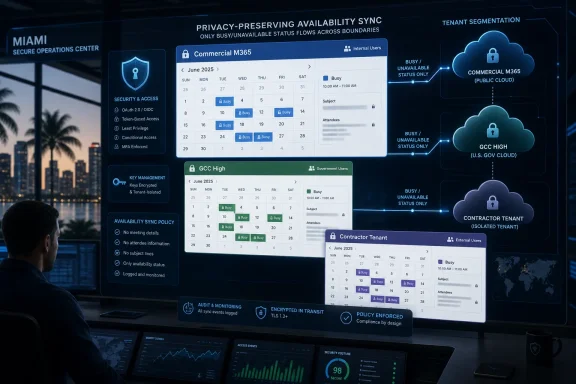
CalendarBridge’s claim is that availability can cross those boundaries without dragging the rest of the meeting record along with it. Its support for busy-only synchronization is the important detail here. The calendar entry that appears in another account does not need to say “classified-adjacent supplier review with Acme Subsystems”; it only needs to say, in effect, “unavailable.”
That sounds small until you consider how much sensitive business context hides in ordinary calendar metadata. Subjects, attendees, locations, conferencing links, and descriptions often create a shadow map of an organization’s priorities. In a highly controlled environment, reducing that map to availability status is not a cosmetic privacy feature; it is the entire security argument.
The Workaround Economy Was Always the Weak Link
Every IT pro has seen the workaround economy in action. Users faced with a process that blocks everyday work will invent their own process, and if the official system does not support the reality of multi-tenant work, the unofficial system will. Calendars are especially vulnerable because the pain is immediate and personal: missing a meeting, double-booking a client, or appearing unavailable to the wrong team creates consequences today.In commercial environments, the workaround might be harmless enough: subscribe to an internet calendar feed, forward invites, or maintain a personal “busy” calendar. In government and regulated settings, those moves can carry more risk. The problem is not that users are careless; it is that the collaboration surface area has outgrown the default assumptions of the tools.
Microsoft 365 tenants are excellent at representing organizational boundaries. They are less elegant at representing modern professional lives that span multiple organizations at once. That mismatch is especially visible in contracting-heavy sectors, where users may be provisioned into client tenants but remain accountable to their employer, other clients, and internal program teams.
CalendarBridge is positioning itself as a controlled alternative to that mess. The platform says it can synchronize availability across Microsoft 365, Google, Outlook, iCloud, and now Microsoft 365 GCC High environments, while allowing separate accounts and organizations to remain separate. That last clause is the one administrators will care about most.
No one in this market wants to hear that the solution is to collapse tenants, merge domains, or loosen access boundaries. Those moves are heavy, politically difficult, and often inappropriate. A viable calendar bridge has to work because the boundaries remain intact, not because they are quietly dissolved.
OAuth Is the Quiet Center of the Trust Pitch
CalendarBridge says its authorization model uses OAuth2 and does not collect or store passwords. That is table stakes for a modern SaaS product, but in this context it deserves more than a passing mention. Any service asking to sit between calendars in a government-adjacent environment is asking for trust at a sensitive junction.The company also says it does not require access to email, files, contacts, or global address books, and that calendar data passes through transiently for synchronization without storing event details. Those claims are central to the product’s fit for privacy-conscious customers. They do not eliminate the need for procurement review, security assessment, or tenant admin scrutiny, but they show CalendarBridge understands the first objection it will face.
That objection is simple: why should a third-party service touch calendars in GCC High at all? The answer has to be narrower than “because it is convenient.” Convenience alone is not enough in environments where administrators are trained to distrust data sprawl.
The stronger answer is risk reduction. If a managed sync layer can prevent users from forwarding sensitive invites, copying event details into commercial calendars, or maintaining sloppy manual duplicates, then the third-party service may reduce net exposure. That calculation depends on implementation details, contractual assurances, logging, data handling, and customer configuration, but it is the right frame.
This is where CalendarBridge’s busy-only model matters. A sync tool that copies full meeting content everywhere would be hard to defend in sensitive environments. A sync tool that propagates only the minimum signal needed to avoid double-booking has a much cleaner story.
Microsoft’s Cloud Segmentation Created a Market for Careful Bridges
The rise of GCC High reflects a broader enterprise trend: cloud platforms are becoming more specialized, not less. The early SaaS dream was that everyone would work in one global service with universal collaboration. The real world has moved toward sovereign clouds, industry clouds, government clouds, regional controls, data residency commitments, and tenant-level segmentation.That segmentation creates opportunity for companies that can bridge the seams without flattening the architecture. CalendarBridge is not trying to replace Microsoft 365 or Google Calendar. It is trying to make the seams less painful for people whose calendars are distributed across those systems.
This is an increasingly important niche because Microsoft itself is both the platform provider and the boundary setter. GCC High customers rely on Microsoft’s cloud architecture to meet requirements that commercial tenants may not satisfy. But Microsoft’s first-party collaboration model still assumes that many workflows happen inside a tenant or within sanctioned cross-tenant sharing arrangements.
That leaves room for specialized tools focused on one narrow workflow. Availability synchronization is narrow enough to be tractable, but important enough to matter. It is one of those enterprise problems that looks trivial from the outside and becomes maddening only after a user has three Microsoft identities, two client calendars, and a compliance officer watching the data flows.
There is also a timing element. As more small and mid-sized contractors confront cybersecurity and compliance requirements tied to federal work, GCC High is no longer only a concern for large defense primes. Smaller organizations increasingly find themselves pulled into government-grade environments without the large IT staffs that traditionally managed them. For those firms, a product that reduces administrative friction without requiring endpoint software or tenant consolidation has an obvious appeal.
Calendar Metadata Is More Sensitive Than People Admit
The calendar has always been a strangely underappreciated data source. Security teams obsess over email, files, chats, and identity logs, while calendars often sit in the background as operational wallpaper. Yet a calendar can reveal who is meeting whom, which projects are active, when executives are traveling, which vendors are engaged, and when sensitive deadlines are approaching.In government contracting, that metadata can be even more revealing. A subject line might identify a program. An attendee list might expose a subcontractor relationship. A recurring meeting cadence might show which phase of a project is underway. Even a simple location field can disclose enough to matter.
This is why “busy-only” is not just a user preference. It is a data minimization strategy. The most privacy-preserving version of calendar sync is the one that answers the scheduling question without exporting the business context.
There is a subtle cultural shift here as well. For years, calendar sharing has been treated as an all-or-nothing trust gesture. Inside a company, that may be acceptable. Across tenants, clients, agencies, and contractor teams, it is increasingly out of step with how work actually happens.
CalendarBridge’s announcement fits into a broader movement toward purpose-limited interoperability. The goal is not to make every system fully visible to every other system. The goal is to move just enough signal across the boundary to make the workflow function.
The Product’s Appeal Depends on Administrative Discipline
CalendarBridge’s feature list reads like it was written for the security review meeting. Real-time sync, configurable privacy controls, OAuth2 authorization, no password storage, no endpoint software, no access to email or files, and no requirement to merge tenants are exactly the claims that matter to a cautious IT buyer. But claims are only the beginning of the conversation.In practice, the success of GCC High support will depend on how organizations configure and govern it. A tool that can share too much information must be locked down to share only what the organization intends. Admins will need to understand consent flows, tenant permissions, user eligibility, logging, and revocation.
There is also the question of policy fit. Some organizations may be comfortable with busy-only synchronization between GCC High and commercial calendars. Others may restrict synchronization to controlled tenants only. Still others may forbid third-party calendar services entirely for certain programs.
That variation is not a weakness in the announcement; it is the reality of the market. Government cloud customers are not a monolith. A state contractor, a defense supplier, a systems integrator, and a public sector consultancy may all use GCC High for different reasons and under different contractual obligations.
The best version of CalendarBridge’s pitch is not “trust us, it is safe.” It is “configure the minimum necessary synchronization for the collaboration problem you actually have.” That is a more mature message, and it is the one most likely to survive contact with enterprise security teams.
The Calendar Becomes a Cross-Tenant Control Plane
One way to understand this announcement is to stop thinking of the calendar as a personal productivity app. In multi-tenant organizations, the calendar becomes a lightweight control plane for coordination. It tells teams whether a person can be engaged, when work can move, and whether operational commitments collide.That control plane has become fragmented. Microsoft 365, Google Workspace, Outlook.com, iCloud, and specialized government tenants all maintain their own versions of the truth. Users become the replication engine, manually copying availability from one world to another.
Manual replication is both unreliable and unsafe. It breaks when people forget. It leaks when people copy too much. It creates stale state when a meeting changes in one calendar but not another. It makes the human being responsible for synchronizing systems that were supposed to reduce administrative burden in the first place.
CalendarBridge’s model is to automate that replication while reducing the payload. The event does not need to travel as a full-fidelity object. Availability is the object. That is a cleaner abstraction and one that maps well to regulated collaboration.
The deeper significance is that cross-tenant work is becoming normal enough to need its own tooling layer. Identity federation, guest accounts, external sharing policies, and tenant-to-tenant migration tools have all addressed parts of the problem. Calendar availability sits in a different category: mundane, constant, and operationally essential.
Government Contractors Are the Perfect Stress Test
Government contractors are a natural test case because they live with contradictory demands. They need to collaborate closely with clients, primes, subcontractors, and agencies. They also need to respect contractual boundaries, data handling rules, and compartmentalized environments.A consultant working across multiple public sector clients may receive separate accounts in several tenants. A defense supplier may keep internal business operations in one Microsoft 365 environment while maintaining GCC High for regulated work. A program manager may need to coordinate across company leadership, client stakeholders, and external partners without revealing what each group is doing.
That is not an edge case anymore. It is the operating model for a large slice of the public sector ecosystem. The fact that ordinary scheduling becomes difficult is a symptom of a larger architectural truth: collaboration no longer maps neatly to the corporate directory.
This is where CalendarBridge’s support for GCC High could matter beyond the size of the company itself. If it works as advertised, it gives smaller organizations a practical way to preserve tenant separation while reducing the human cost of that separation. That matters because compliance regimes often impose enterprise-grade expectations on organizations that do not have enterprise-scale IT teams.
The announcement also arrives at a symbolic moment. CalendarBridge frames the launch around the United States marking its 250th anniversary, a marketing flourish that could have felt forced. But there is a real public sector angle beneath it: the machinery of government and its contractor ecosystem increasingly depends on commercial cloud tools adapted for controlled environments.
The Competitive Question Is Trust, Not Features
Calendar synchronization is not a new idea. The consumer and small-business markets have seen plenty of tools that promise to keep Google, Outlook, Apple, and Microsoft calendars aligned. What changes in GCC High is the evaluation criterion.Feature breadth matters, but trust matters more. A government contractor is not merely asking whether the sync works. It is asking what data is touched, where it flows, what is retained, who can access it, what permissions are granted, and whether the service can be justified to customers and auditors.
That gives CalendarBridge both an opening and a burden. The opening is that many generic sync tools are not built for this audience, and many collaboration platforms assume a less restrictive operating model. The burden is that security-conscious buyers will scrutinize the product more heavily than ordinary productivity users.
The company’s emphasis on no password collection, no endpoint software, no access to email or files, and transient handling of calendar data is therefore not incidental. It is the product narrative. CalendarBridge is trying to differentiate not by saying it can see more, but by saying it can work while seeing less.
That is the right direction for this market. In regulated collaboration, the winning tool is often the one that does the least necessary thing reliably. The enemy is not merely inconvenience; it is overexposure disguised as integration.
Microsoft’s Own Ecosystem Leaves Space at the Edges
Microsoft has spent years expanding the capabilities of its government cloud environments, and the company’s public documentation increasingly treats GCC, GCC High, and DoD as distinct operational realities rather than footnotes. Still, no platform vendor can solve every cross-boundary workflow, especially when the boundary itself is part of the product’s value.That is where edge services emerge. They do not replace the platform. They fill the spaces where platform-level assumptions break down. CalendarBridge’s GCC High support is exactly that kind of edge service.
For WindowsForum readers, the point is not that everyone should immediately plug a third-party sync service into a government tenant. The point is that the need exists because the modern Microsoft estate is more fragmented than the old Office monoculture. Enterprises now run commercial tenants, government tenants, guest identities, external collaboration policies, and multi-cloud productivity stacks all at once.
This fragmentation is not a failure, exactly. It is the cost of serving different regulatory, geographic, and security needs through cloud services. But the cost is real, and it often lands on users in the form of duplicated work.
The vendors that thrive around Microsoft 365 over the next decade will likely be the ones that respect Microsoft’s boundaries while smoothing the user experience between them. CalendarBridge is making that argument through scheduling. Others will make it through records management, workflow automation, secure messaging, identity governance, and compliance reporting.
The Announcement Is Modest, but the Implication Is Not
It would be easy to dismiss this as a niche SaaS press release. A calendar sync company added support for a specialized Microsoft environment. For most consumers, that is about as exciting as a printer driver update.But enterprise IT is built out of these supposedly boring problems. The tools people touch every hour often matter more than the grand platform announcements. If availability data is wrong, meetings fail. If meetings fail, projects slow down. If users fix the problem with copy-and-paste workarounds, security teams inherit a mess.
CalendarBridge’s move also reflects a broader truth about compliance technology: the goal is not to make controlled environments feel uncontrolled. It is to make them usable enough that people stop trying to escape them. A secure system that forces users into shadow workflows is not as secure as it looks on paper.
That is why calendar synchronization deserves attention. It is a small workflow that exposes the tension between isolation and collaboration. The better a government cloud becomes at isolation, the more important it becomes to design safe, narrow forms of interoperability.
The most interesting claim in CalendarBridge’s announcement is not real-time sync or platform breadth. It is the promise that organizations can maintain accurate availability without merging domains, consolidating tenants, installing endpoint software, or exposing unnecessary meeting information. If that promise holds under scrutiny, it addresses the problem at the right layer.
The Real Test Will Be the Admin Console, Not the Press Release
The press release gives the broad strokes, but administrators will want to see the controls. They will want to know whether sync behavior can be standardized across users, whether busy-only mode can be enforced, how consent is granted, how accounts are disconnected, and what logs are available. They will also want clarity on data paths, retention, support boundaries, and contractual terms for regulated customers.Those questions are not signs of skepticism for its own sake. They are the normal questions any service should face when entering the GCC High orbit. Calendar data may not be email, but it is still organizational data.
The operational reality will also matter. Real-time synchronization sounds straightforward until calendars contain recurring meetings, private events, cancellations, tentative holds, all-day blocks, out-of-office entries, delegated calendars, and time zone changes. A sync product earns trust by handling the weird cases quietly.
For end users, the ideal experience is that nothing dramatic happens. Their calendars simply stop lying to one another. For administrators, the ideal experience is that the sync is narrow, observable, revocable, and boring.
That last word is praise. In sensitive environments, boring infrastructure is good infrastructure. It does not surprise the user, it does not surprise the auditor, and it does not become the next incident report.
The CalendarBridge Move That Government Tenants Should Actually Notice
CalendarBridge’s GCC High support is a narrow product update with broad lessons for anyone managing Microsoft 365 in regulated or multi-tenant environments. The announcement matters less because it changes the calendar market overnight than because it highlights where the market is heading: toward smaller, safer bridges across increasingly specialized cloud estates.- CalendarBridge now supports Microsoft 365 GCC High for eligible customers that need calendar synchronization across controlled Microsoft government cloud environments.
- The company is positioning busy-only synchronization as a way to preserve availability visibility without exposing meeting subjects, attendees, locations, or other sensitive details.
- The practical target is the contractor, consultant, systems integrator, or public sector partner juggling multiple tenants and calendar systems.
- The security pitch depends on narrow permissions, OAuth2 authorization, no password collection, no endpoint software, and limited handling of calendar data.
- Administrators should treat the feature as a governance decision, not merely a productivity add-on, because calendar metadata can reveal more than users expect.
- The larger story is that government cloud isolation creates real collaboration friction, and the safest tools will be those that move only the minimum necessary signal across boundaries.
References
- Primary source: GlobeNewswire
Published: Tue, 30 Jun 2026 13:00:00 GMT
CalendarBridge Announces Support for Microsoft 365 GCC High
New capability extends CalendarBridge’s secure calendar synchronization platform to government contractors, public sector partners, and organizations in...www.globenewswire.com - Official source: learn.microsoft.com
Understand Microsoft U.S. government cloud environments for Microsoft 365 and Microsoft 365 Copilot | Microsoft Learn
Get an overview of how Microsoft government clouds evolved, why different government cloud environments exist, when to use each environment, and how Microsoft 365 and Microsoft 365 Copilot differ across government cloud subscriptions.learn.microsoft.com - Official source: support.microsoft.com
GCC information | Microsoft Support
This article answers the most Frequently Asked Questions about GCC information for Microsoft Forms.support.microsoft.com - Official source: microsoft.com
Your request has been blocked. This could be due to several reasons.
www.microsoft.com
- Related coverage: techtarget.com
Understanding Microsoft 365 GCC High and other licenses | TechTarget
Microsoft 365 GCC High provides many of the same services as the public versions of Microsoft 365. Learn the security benefits that help it stand out.www.techtarget.com - Related coverage: help.calendarbridge.com

What calendar types are supported? - CalendarBridge Help
Which calendar types CalendarBridge supports — Google and Microsoft/Exchange Online for real-time syncing, iCloud and Internet (.ics) calendars for periodic syncing, and what is not supported.
help.calendarbridge.com
- Related coverage: blog.getagency.com
What Is Microsoft GCC High? Architecture, Licensing, and Use Cases | Agency Insights
Learn what Microsoft GCC High is, how its physically separated architecture works, licensing requirements, migration paths, and when defense contractors need it for ITAR, DFARS, and CMMC compliance.blog.getagency.com - Related coverage: ironorbit.com
PR header
About IronOrbit For over 25 years, IronOrbit has delivered tailored IT solutions, 24/7 US-based support, and exceptional customer experiences. As a trusted provider of secure cloud services, IronOrbit empowers businesses to achieve digital transformation with confidence. IronOrbit’s ongoing...www.ironorbit.com
- Official source: download.microsoft.com
- Related coverage: pcgit.com