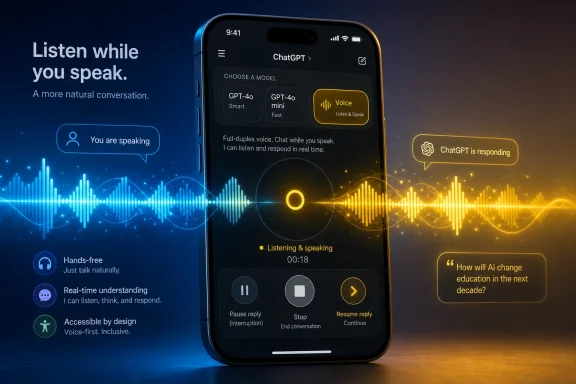
OpenAI is testing a new bidirectional voice experience in the ChatGPT app in June 2026, according to user reports and app-code sightings, with early demonstrations showing the assistant speaking while listening, interrupting naturally, counting alongside a user, and correcting mistakes in real time. The feature has not been formally announced, and “gpt-bidi-1” remains an unofficial label rather than a confirmed product name. But if the reports hold, this is not merely a nicer voice skin for ChatGPT. It is OpenAI trying to move voice AI from turn-taking software toward something that behaves more like a participant.
The first wave of AI voice assistants taught users a rigid ritual: speak, stop, wait, listen. Even when the synthetic voice sounded pleasant, the interaction model remained closer to a walkie-talkie than a conversation. The human had to adapt to the machine’s tempo.
ChatGPT’s Advanced Voice Mode changed that expectation by making speech feel more responsive, expressive, and emotionally textured. GPT-4o’s launch in 2024 gave OpenAI a credible argument that voice could be a native input and output channel rather than a transcript wrapped in text-to-speech. But the basic structure still preserved a boundary between “your turn” and “the model’s turn.”
The reported bidirectional mode attacks that boundary directly. The important detail in the circulating banana-counting demo is not that ChatGPT can count fruit. It is that the model appears to remain engaged while the user is still speaking, then corrects the count without waiting for a clean conversational handoff.
That is a subtle product shift with large consequences. A voice assistant that can listen while speaking can become a coach, tutor, accessibility aide, call-center agent, troubleshooting companion, or real-time collaborator in ways that a polite answer machine cannot.
Counting is a useful stress test because it requires timing, perception, short-term state, and interruption handling. If the assistant waits too long, it feels dumb. If it talks over the user too aggressively, it feels rude. If it loses track, the illusion collapses instantly.
That makes the demo more revealing than a polished marketing exchange. It shows the model trying to occupy the messy middle of conversation, where humans overlap, hesitate, self-correct, and revise as they go. Voice interfaces have historically failed there because they treated speech as completed input rather than live activity.
This is why “bidirectional” is more than a technical nickname. It describes a product philosophy: the assistant should not merely receive and emit audio, but continuously negotiate a shared conversational space.
That distinction matters. AI communities often treat discovered strings, app flags, and unreleased labels as product announcements. Sometimes they are. Sometimes they are scaffolding, test hooks, internal names, or dead branches that never become user-facing features.
The more credible reading is that OpenAI is experimenting with a next-generation voice path and exposing it to a narrow slice of ChatGPT users. That fits the company’s pattern with voice: tease capability, test cautiously, widen availability only after safety and performance issues become more predictable.
For users, the practical advice is simple. Do not assume “gpt-bidi-1” is a selectable model that will appear tomorrow for every account. Treat it as a reported internal or community label for a capability OpenAI appears to be preparing.
The real bottleneck is turn-taking. Human conversation depends on tiny timing cues: intake breaths, half-starts, overlaps, affirmations, repairs, and interruptions that do not always mean “stop talking.” A competent human listener knows the difference between “mm-hm” as encouragement and “wait” as a correction.
Traditional assistant pipelines struggle because they wait for endpoint detection. The system listens until it thinks the user has stopped, transcribes the input, sends it to a language model, generates a response, and then speaks. That pipeline can be optimized, but it still assumes conversation is a sequence of completed blocks.
A bidirectional system implies something more fluid. The assistant has to monitor live audio while producing output, decide whether a user’s interjection should alter the response, and avoid the social penalty of bulldozing the person it is meant to help. That is a harder problem than making the voice sound charming.
The current voice assistant model is tolerable for simple commands. It is far less useful when the user needs to say, “No, not that window,” “I already tried that,” or “Wait, I’m seeing a different error.” In troubleshooting, interruption is not rude; it is essential context.
That is where bidirectional voice could become genuinely practical. Imagine asking an assistant to guide you through BitLocker recovery, printer setup, Hyper-V networking, or BIOS settings while it adapts in real time to what you say next. The assistant would need to slow down, stop, restate, correct, and react without requiring the user to restart the prompt each time.
This is also why Microsoft will be watching closely. Copilot’s long-term value on Windows depends not only on model intelligence but on whether the assistant can fit into real workflows. If ChatGPT’s voice layer begins to feel more natural than the operating system’s built-in assistant, the platform owner has a user-experience problem.
For a help desk, this could be transformative. A voice AI that can guide employees through password resets, device enrollment, VPN setup, or application troubleshooting without rigid call-tree pacing would reduce friction. It could interrupt when the user is about to take the wrong step and correct them before the mistake becomes a ticket escalation.
For regulated industries, the risk calculus is different. Live audio can contain names, customer data, health information, trade secrets, credentials spoken aloud, and background conversations from people who never consented to interacting with an AI system. The more natural the assistant becomes, the easier it is for users to forget that a cloud service may be processing the conversation.
Admins will want knobs before they want magic. They will ask whether bidirectional voice can be disabled, logged, restricted by tenant policy, excluded from sensitive apps, or routed through enterprise data controls. If OpenAI wants this mode to be more than a consumer spectacle, manageability will matter as much as latency.
Bad interruption is equally powerful. It feels arrogant, patronizing, or creepy. A voice assistant that jumps in too early may make users feel monitored rather than helped. A system that corrects too confidently may turn a useful feature into a source of irritation.
This is the design challenge OpenAI faces. The assistant must learn when interruption is welcome, when silence is better, and when uncertainty should be expressed gently. “Actually, that’s seven” works in a counting exercise because the stakes are low and the correction is immediate. The same behavior in a medical conversation, coding session, or emotional discussion could land very differently.
The best version of this technology will probably need personality controls that are not cosmetic. Users may want modes for tutor, companion, meeting assistant, accessibility support, language practice, or technical walkthrough. Each context has a different etiquette for interruption.
Early testers have reportedly described both impressive responsiveness and lingering rough edges, including audio artifacts, awkward filler sounds, and imperfect timing. That is not surprising. Real-time voice systems are unforgiving because every flaw is experienced socially, not just technically.
Text chat lets a model pause invisibly. Voice does not. The silence becomes part of the conversation, and users interpret it as confusion, hesitation, or disinterest. Filler sounds can help, but only if they feel natural rather than pasted on.
This is why the rollout, if it continues, is likely to be gradual. A bidirectional voice model that works beautifully in controlled demos may behave unpredictably across accents, microphones, background noise, children’s voices, crowded rooms, Bluetooth latency, and weak mobile networks. The public internet will test all of that within hours.
OpenAI’s recent work on realtime voice models and streaming transcription points in that direction. Developers want models that can handle speech as a live medium, not as a file upload. Consumers want assistants that can move between text, speech, images, and video without feeling like separate products stitched together.
That convergence is important. A voice assistant that can hear interruptions while speaking becomes more useful when paired with camera input, screen context, and tool use. At that point, the assistant is not just answering questions; it is participating in tasks.
The danger is that every step toward naturalness increases user trust faster than reliability improves. A model that sounds attentive may still misunderstand. A model that corrects quickly may still be wrong. The more human the interface becomes, the more responsibility the product has to signal uncertainty.
Generative AI reopened the race by making assistants conversational rather than command-driven. But conversation alone is not enough if the assistant still makes the user wait at every boundary. The next competitive frontier is interruptibility.
If ChatGPT can reliably speak and listen at the same time, it puts pressure on every assistant that still feels like a customer-service menu with a nicer voice. Gemini Live, Siri, Alexa, Copilot, and enterprise bot platforms will all be judged against the same human benchmark: can I talk normally, or do I have to perform for the machine?
The answer will shape adoption. People may tolerate awkwardness in a demo, but they will not use voice all day if it requires unnatural pacing. The winning voice assistant will not be the one that sounds most human in a vacuum; it will be the one that lets the user remain human.
An assistant that can interrupt has more power over the user’s attention. It can redirect, correct, encourage, discourage, or escalate a conversation before the user has finished expressing intent. That can be beneficial in tutoring or safety-critical workflows, but it also demands restraint.
There are obvious child-safety and dependency concerns. A voice that listens continuously and responds emotionally can become more companion-like than a text box. OpenAI has already had to navigate user attachment to AI personalities; more natural voice interaction will intensify that problem.
There are also workplace concerns. If an AI assistant participates in meetings or support calls with overlapping speech, who controls the record? Who decides when it may interrupt? How are corrections distinguished from suggestions? These are governance questions, not merely model benchmarks.
This matters because AI product discourse often converts leaks into expectations. A feature spotted in one account becomes a presumed rollout. A model name found in code becomes a product promise. A short video becomes proof of general reliability.
The better interpretation is narrower and more interesting. OpenAI seems to be probing whether ChatGPT can handle live, overlapping speech in a consumer setting. That alone is significant, even before the company turns it into a launch.
For users, the feature’s absence from official documentation should temper the hype. For competitors, it should not. The direction of travel is clear enough.
Those scenarios are where conversational AI either becomes infrastructure or stays a party trick. Real users do not speak in demo cadence. They mumble, backtrack, interrupt themselves, change topics, and expect the other party to keep up.
A bidirectional system must also know when not to prove its intelligence. The most impressive assistant may be the one that stays quiet for an extra beat because it understands the user is thinking. Natural conversation is not constant talking; it is timing.
If OpenAI gets that right, voice becomes more than an input method. It becomes a mode of shared attention.
A few concrete points are worth holding onto as the hype cycle accelerates:
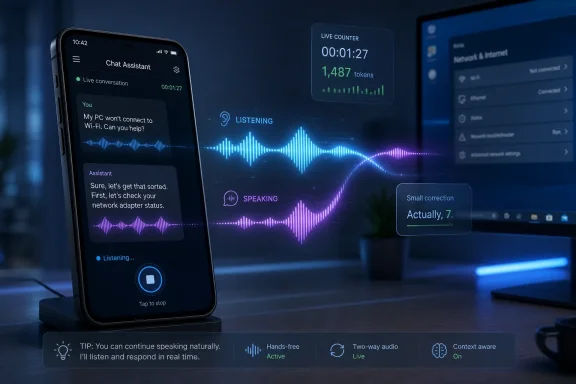 OpenAI’s Real Voice Ambition Was Never Just Better Speech
The first wave of AI voice assistants taught users a rigid ritual: speak, stop, wait, listen. Even when the synthetic voice sounded pleasant, the interaction model remained closer to a walkie-talkie than a conversation. The human had to adapt to the machine’s tempo.ChatGPT’s Advanced Voice Mode changed that expectation by making speech feel more responsive, expressive, and emotionally textured. GPT-4o’s launch in 2024 gave OpenAI a credible argument that voice could be a native input and output channel rather than a transcript wrapped in text-to-speech. But the basic structure still preserved a boundary between “your turn” and “the model’s turn.”
The reported bidirectional mode attacks that boundary directly. The important detail in the circulating banana-counting demo is not that ChatGPT can count fruit. It is that the model appears to remain engaged while the user is still speaking, then corrects the count without waiting for a clean conversational handoff.
That is a subtle product shift with large consequences. A voice assistant that can listen while speaking can become a coach, tutor, accessibility aide, call-center agent, troubleshooting companion, or real-time collaborator in ways that a polite answer machine cannot.
The Banana Demo Matters Because It Exposes the Interface
The viral clip described by early users is almost comically mundane: a person counts bananas, ChatGPT counts along, and the system corrects itself or the user midstream. “Eight… actually, that’s seven” is not the kind of phrase that sounds revolutionary on paper. In interface terms, however, it signals a different class of interaction.Counting is a useful stress test because it requires timing, perception, short-term state, and interruption handling. If the assistant waits too long, it feels dumb. If it talks over the user too aggressively, it feels rude. If it loses track, the illusion collapses instantly.
That makes the demo more revealing than a polished marketing exchange. It shows the model trying to occupy the messy middle of conversation, where humans overlap, hesitate, self-correct, and revise as they go. Voice interfaces have historically failed there because they treated speech as completed input rather than live activity.
This is why “bidirectional” is more than a technical nickname. It describes a product philosophy: the assistant should not merely receive and emit audio, but continuously negotiate a shared conversational space.
“gpt-bidi-1” Is a Leak Name, Not a Launch Plan
The name “gpt-bidi-1” has spread because it gives the community something concrete to grab. It sounds like a model identifier, and it neatly captures the rumored capability: bidirectional audio. But OpenAI has not publicly confirmed that model name, announced a rollout schedule, or explained whether the feature is powered by a distinct model, a new voice stack, or a product-layer orchestration around existing realtime systems.That distinction matters. AI communities often treat discovered strings, app flags, and unreleased labels as product announcements. Sometimes they are. Sometimes they are scaffolding, test hooks, internal names, or dead branches that never become user-facing features.
The more credible reading is that OpenAI is experimenting with a next-generation voice path and exposing it to a narrow slice of ChatGPT users. That fits the company’s pattern with voice: tease capability, test cautiously, widen availability only after safety and performance issues become more predictable.
For users, the practical advice is simple. Do not assume “gpt-bidi-1” is a selectable model that will appear tomorrow for every account. Treat it as a reported internal or community label for a capability OpenAI appears to be preparing.
The Upgrade Is About Turn-Taking, Not Tone
Most consumer discussion of voice AI gets stuck on realism. Does the model laugh? Does it breathe? Does it sound warm, flat, excited, tired, flirtatious, bored? Those things matter because people respond emotionally to voices, but they are not the hardest part of voice computing.The real bottleneck is turn-taking. Human conversation depends on tiny timing cues: intake breaths, half-starts, overlaps, affirmations, repairs, and interruptions that do not always mean “stop talking.” A competent human listener knows the difference between “mm-hm” as encouragement and “wait” as a correction.
Traditional assistant pipelines struggle because they wait for endpoint detection. The system listens until it thinks the user has stopped, transcribes the input, sends it to a language model, generates a response, and then speaks. That pipeline can be optimized, but it still assumes conversation is a sequence of completed blocks.
A bidirectional system implies something more fluid. The assistant has to monitor live audio while producing output, decide whether a user’s interjection should alter the response, and avoid the social penalty of bulldozing the person it is meant to help. That is a harder problem than making the voice sound charming.
The Windows Angle Is Hands-Free Computing That Finally Feels Useful
For Windows users, this kind of voice capability matters less as a novelty and more as a possible interface layer. A genuinely bidirectional assistant could be useful while repairing a PC, configuring a router, following PowerShell instructions, comparing settings screens, or walking through a driver problem while both hands are busy.The current voice assistant model is tolerable for simple commands. It is far less useful when the user needs to say, “No, not that window,” “I already tried that,” or “Wait, I’m seeing a different error.” In troubleshooting, interruption is not rude; it is essential context.
That is where bidirectional voice could become genuinely practical. Imagine asking an assistant to guide you through BitLocker recovery, printer setup, Hyper-V networking, or BIOS settings while it adapts in real time to what you say next. The assistant would need to slow down, stop, restate, correct, and react without requiring the user to restart the prompt each time.
This is also why Microsoft will be watching closely. Copilot’s long-term value on Windows depends not only on model intelligence but on whether the assistant can fit into real workflows. If ChatGPT’s voice layer begins to feel more natural than the operating system’s built-in assistant, the platform owner has a user-experience problem.
Enterprise IT Will Hear Opportunity and Risk at the Same Time
The same qualities that make bidirectional voice exciting for consumers make it complicated for enterprise IT. A system that listens continuously while speaking may be more useful, but it also raises sharper questions about audio capture, retention, consent, auditability, and compliance.For a help desk, this could be transformative. A voice AI that can guide employees through password resets, device enrollment, VPN setup, or application troubleshooting without rigid call-tree pacing would reduce friction. It could interrupt when the user is about to take the wrong step and correct them before the mistake becomes a ticket escalation.
For regulated industries, the risk calculus is different. Live audio can contain names, customer data, health information, trade secrets, credentials spoken aloud, and background conversations from people who never consented to interacting with an AI system. The more natural the assistant becomes, the easier it is for users to forget that a cloud service may be processing the conversation.
Admins will want knobs before they want magic. They will ask whether bidirectional voice can be disabled, logged, restricted by tenant policy, excluded from sensitive apps, or routed through enterprise data controls. If OpenAI wants this mode to be more than a consumer spectacle, manageability will matter as much as latency.
The Social Problem Is Harder Than the Audio Problem
There is a reason people are excited by an AI that can interrupt. Good interruption is one of the hidden skills of conversation. A teacher interrupts before a student reinforces a mistake. A doctor interrupts to clarify a symptom. A colleague interrupts to prevent wasted effort.Bad interruption is equally powerful. It feels arrogant, patronizing, or creepy. A voice assistant that jumps in too early may make users feel monitored rather than helped. A system that corrects too confidently may turn a useful feature into a source of irritation.
This is the design challenge OpenAI faces. The assistant must learn when interruption is welcome, when silence is better, and when uncertainty should be expressed gently. “Actually, that’s seven” works in a counting exercise because the stakes are low and the correction is immediate. The same behavior in a medical conversation, coding session, or emotional discussion could land very differently.
The best version of this technology will probably need personality controls that are not cosmetic. Users may want modes for tutor, companion, meeting assistant, accessibility support, language practice, or technical walkthrough. Each context has a different etiquette for interruption.
Latency Is the Feature Users Will Judge First
OpenAI can talk about intelligence, architecture, and next-generation audio models, but users will judge bidirectional voice by a brutal standard: does it feel fast enough to disappear? A delay of a few hundred milliseconds can be acceptable. A delay of a second or two can make the interaction feel broken.Early testers have reportedly described both impressive responsiveness and lingering rough edges, including audio artifacts, awkward filler sounds, and imperfect timing. That is not surprising. Real-time voice systems are unforgiving because every flaw is experienced socially, not just technically.
Text chat lets a model pause invisibly. Voice does not. The silence becomes part of the conversation, and users interpret it as confusion, hesitation, or disinterest. Filler sounds can help, but only if they feel natural rather than pasted on.
This is why the rollout, if it continues, is likely to be gradual. A bidirectional voice model that works beautifully in controlled demos may behave unpredictably across accents, microphones, background noise, children’s voices, crowded rooms, Bluetooth latency, and weak mobile networks. The public internet will test all of that within hours.
OpenAI’s Voice Stack Is Becoming a Product Platform
The reported bidirectional experiment also fits a broader OpenAI strategy. Voice is no longer a side feature attached to a chatbot. It is becoming a platform layer for apps, agents, tutoring, translation, customer support, and ambient computing.OpenAI’s recent work on realtime voice models and streaming transcription points in that direction. Developers want models that can handle speech as a live medium, not as a file upload. Consumers want assistants that can move between text, speech, images, and video without feeling like separate products stitched together.
That convergence is important. A voice assistant that can hear interruptions while speaking becomes more useful when paired with camera input, screen context, and tool use. At that point, the assistant is not just answering questions; it is participating in tasks.
The danger is that every step toward naturalness increases user trust faster than reliability improves. A model that sounds attentive may still misunderstand. A model that corrects quickly may still be wrong. The more human the interface becomes, the more responsibility the product has to signal uncertainty.
This Is Also a Shot Across the Bow of Every Voice Assistant
Apple, Google, Amazon, Microsoft, and OpenAI all understand the same thing: the old voice assistant era stalled because command interfaces were too brittle. Users learned a handful of supported phrases, discovered the limits, and retreated to touchscreens and keyboards.Generative AI reopened the race by making assistants conversational rather than command-driven. But conversation alone is not enough if the assistant still makes the user wait at every boundary. The next competitive frontier is interruptibility.
If ChatGPT can reliably speak and listen at the same time, it puts pressure on every assistant that still feels like a customer-service menu with a nicer voice. Gemini Live, Siri, Alexa, Copilot, and enterprise bot platforms will all be judged against the same human benchmark: can I talk normally, or do I have to perform for the machine?
The answer will shape adoption. People may tolerate awkwardness in a demo, but they will not use voice all day if it requires unnatural pacing. The winning voice assistant will not be the one that sounds most human in a vacuum; it will be the one that lets the user remain human.
The Safety Debate Will Move From Outputs to Interaction
Most AI safety debates focus on what models say: misinformation, harmful advice, bias, persuasion, or hallucination. Bidirectional voice adds a second layer: how models behave in the flow of interaction.An assistant that can interrupt has more power over the user’s attention. It can redirect, correct, encourage, discourage, or escalate a conversation before the user has finished expressing intent. That can be beneficial in tutoring or safety-critical workflows, but it also demands restraint.
There are obvious child-safety and dependency concerns. A voice that listens continuously and responds emotionally can become more companion-like than a text box. OpenAI has already had to navigate user attachment to AI personalities; more natural voice interaction will intensify that problem.
There are also workplace concerns. If an AI assistant participates in meetings or support calls with overlapping speech, who controls the record? Who decides when it may interrupt? How are corrections distinguished from suggestions? These are governance questions, not merely model benchmarks.
The Unannounced Status Is Part of the Story
Because OpenAI has not formally announced the feature, the responsible stance is cautious. The evidence so far appears to come from user sightings, social video, and reported app references. That is enough to say OpenAI appears to be testing something meaningful, but not enough to declare final branding, availability, pricing, or technical architecture.This matters because AI product discourse often converts leaks into expectations. A feature spotted in one account becomes a presumed rollout. A model name found in code becomes a product promise. A short video becomes proof of general reliability.
The better interpretation is narrower and more interesting. OpenAI seems to be probing whether ChatGPT can handle live, overlapping speech in a consumer setting. That alone is significant, even before the company turns it into a launch.
For users, the feature’s absence from official documentation should temper the hype. For competitors, it should not. The direction of travel is clear enough.
The First Real Test Will Be Ordinary Use
The banana-counting clip is useful, but the true test will be boring daily life. Can the assistant help someone cook while timers are going off? Can it guide a student through pronunciation without talking over them? Can it sit in a troubleshooting session without inventing certainty? Can it remain helpful when the user is frustrated, distracted, or wrong?Those scenarios are where conversational AI either becomes infrastructure or stays a party trick. Real users do not speak in demo cadence. They mumble, backtrack, interrupt themselves, change topics, and expect the other party to keep up.
A bidirectional system must also know when not to prove its intelligence. The most impressive assistant may be the one that stays quiet for an extra beat because it understands the user is thinking. Natural conversation is not constant talking; it is timing.
If OpenAI gets that right, voice becomes more than an input method. It becomes a mode of shared attention.
The Evidence Points to a Bigger Leap Than the Name Suggests
The label “gpt-bidi-1” sounds like an internal model version, but the underlying change is bigger than a model swap. It suggests an effort to rebuild the social mechanics of AI voice around simultaneity, interruption, and correction.A few concrete points are worth holding onto as the hype cycle accelerates:
- OpenAI has not officially confirmed “gpt-bidi-1” as a public model name or announced general availability for the reported bidirectional voice mode.
- Early user reports describe a ChatGPT voice experience that can speak while listening, count alongside a user, and correct mistakes during an ongoing exchange.
- The most important technical shift is not a more realistic voice but a more natural handling of conversational overlap and interruption.
- The feature could make voice AI more useful for tutoring, accessibility, troubleshooting, customer support, and hands-free computing.
- Enterprise adoption will depend on controls for privacy, logging, compliance, tenant policy, and data handling.
- The product will succeed or fail on timing, because even a smart assistant feels clumsy if its interruptions arrive too early or too late.
References
- Primary source: thewincentral.com
Published: 2026-06-21T08:10:16.515625
ChatGPT's New Voice Mode Feels Surprisingly Human - WinCentral
ChatGPT's new bidirectional voice mode can interrupt naturally, count with users, and correct mistakes in real time, creating more human-like conversations. - Read in AI News on WinCentral thewincentral.com
- Related coverage: testingcatalog.com
OpenAI prepares major ChatGPT voice upgrade with GPT-Bidi-1
OpenAI is preparing to launch GPT-Bidi-1, a bidirectional audio model for ChatGPT's voice mode, hinting at a major upgrade in voice conversation. www.testingcatalog.com
- Related coverage: techcrunch.com
OpenAI launches new voice intelligence features in its API | TechCrunch
The new features could be handy for customer service systems, but OpenAI says they have applications that work across a variety of other fields, including education and creator platforms.techcrunch.com - Related coverage: gptzone.net
OpenAI Prepara Nuevo Modo de Voz Conversacional en ChatGPT Potenciado con GPT-Bidi-1 Avanzado
ChatGPT podría cambiar pronto con GPT-Bidi-1: voz en tiempo real, interrupciones fluidas y mayor inteligencia. El lanzamiento parece cercano 🚀 Entérate aquí. gptzone.net
- Related coverage: theaidaily.nl
GPT-Bidi-1: OpenAI's nieuwe stem voor ChatGPT uitgelegd | TheAIDaily
OpenAI bouwt aan GPT-Bidi-1, een stemmodel dat luistert en praat tegelijk. Wat het kan, wanneer het komt en wat het betekent voor AI aan de telefoon.theaidaily.nl - Official source: openai.com
Advancing voice intelligence with new models in the API | OpenAI
Explore new realtime voice models in the OpenAI API that can reason, translate, and transcribe speech, enabling more natural and intelligent voice experiences.openai.com
- Related coverage: au.investing.com
ChatGPT’s voice mode to get smoother with new real-time model, report says By Investing.com
ChatGPT’s voice mode to get smoother with new real-time model, report saysau.investing.com - Related coverage: macrumors.com
ChatGPT Voice Mode Now Works Inside Your Existing Conversation
OpenAI has updated the voice feature in its ChatGPT app so that voice conversations now happen directly inside an ongoing chat instead of forcing users into a separate voice-only session. The change means responses now appear in real-time with text – plus any visuals like images and maps – as...www.macrumors.com - Related coverage: pcworld.com
ChatGPT now speaks even more naturally with fewer interruptions | PCWorld
OpenAI has updated ChatGPT's Advanced Voice Mode feature, promising a more realistic and pleasant conversation experience.www.pcworld.com - Related coverage: 9to5mac.com
ChatGPT just made voice mode even more capable - 9to5Mac
ChatGPT has an impressive voice mode that offers a very natural, conversational flow. The latest update to ChatGPT now combines...9to5mac.com - Related coverage: techradar.com
ChatGPT users complain about losing Standard voice mode | TechRadar
They don't want the “calm, grounded, and safe” sound of ChatGPT to fall silentwww.techradar.com - Related coverage: axios.com
OpenAI rolls out new ChatGPT personalities and speed updates
The company says the updates make ChatGPT more customizable and smarter.www.axios.com
- Related coverage: tomsguide.com
ChatGPT now lets you enable Voice mode directly inside your chat without switching — here's how | Tom's Guide
ChatGPT now blends voice and text in one chat, with the new interface available to all users.www.tomsguide.com - Related coverage: cincodias.elpais.com