

Pew Research Center’s June 17, 2026 survey of 5,119 U.S. adults found that ChatGPT is the most-used AI chatbot in the United States, with 44 percent of adults saying they use it, ahead of Google Gemini, Microsoft Copilot, Meta AI, Grok, Claude, and Character.ai. The more important finding is not simply that OpenAI is winning the popularity contest. It is that Americans are folding chatbots into the most ordinary habit on the internet: looking things up. For Microsoft, Google, Meta, and every publisher still built around search referrals, that is the strategic earthquake hiding inside a consumer survey.
The Pew numbers reinforce a basic truth about consumer technology: first impressions can harden into infrastructure. ChatGPT did not merely launch early; it arrived at the exact moment when the public needed a simple name for a strange new behavior. “Using AI” became, for many people, “asking ChatGPT.”
That linguistic advantage matters. Google can put Gemini into Android, Search, Workspace, and Chrome. Microsoft can wire Copilot into Windows, Edge, Microsoft 365, and GitHub. Meta can place its assistant in front of billions of social users. Yet Pew’s ranking suggests that distribution alone has not erased the cultural head start OpenAI gained in late 2022.
That is especially striking because ChatGPT is not the most unavoidable chatbot in American digital life. Microsoft has placed Copilot buttons in Windows and Office-adjacent surfaces. Google has made AI summaries increasingly visible in Search. Meta AI appears across social apps many people open compulsively. Still, the chatbot Americans most commonly say they use is the one that became famous as a destination rather than a feature.
This is the consumer software equivalent of the iPod lesson: the best-known device is not always the one with the deepest integration, but the one that defines the category in the public imagination. ChatGPT’s lead is partly technical, partly brand, and partly timing. Competitors can copy features faster than they can copy the moment when millions of people first realized that a chatbot could answer, draft, summarize, and improvise.
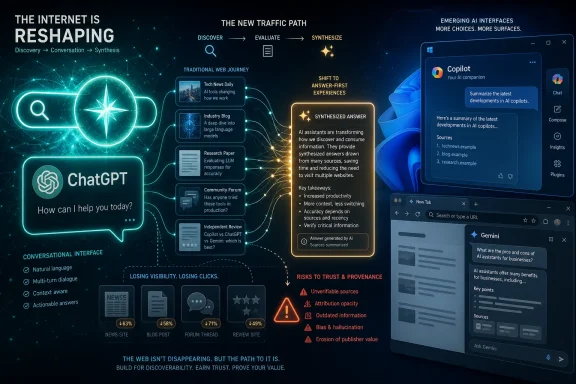
This distinction matters because search is not a side business of the internet. It is the navigation layer for commerce, publishing, software support, travel, shopping, medicine, education, and troubleshooting. If chatbots become a mainstream front end for search, the fight is not merely over which assistant writes the best poem or generates the weirdest image. It is over who mediates access to knowledge.
That should worry publishers more than the novelty of AI image generation. A user who asks a chatbot for a direct answer may never click the article, forum post, review, documentation page, or vendor support note that helped produce it. Google has argued that AI summaries can expose users to more links, but the basic behavioral risk is obvious: the more complete the answer appears at the top, the weaker the incentive to go elsewhere.
For Windows users, this shift is familiar in miniature. Anyone who has searched for an error code, a driver problem, a Blue Screen message, or an obscure Group Policy setting knows that the old web search experience was messy but link-rich. You bounced between Microsoft Learn, Reddit, vendor forums, ancient blog posts, Stack Overflow answers, and community threads. A chatbot compresses that journey into a conversational answer, but compression is not the same as verification.
The convenience is real. So is the opacity. When a chatbot turns the web into a paragraph, it also turns the provenance of that paragraph into a trust problem.
Yet consumer adoption does not automatically follow from operating-system real estate. A button on the taskbar is not the same as a habit. If users do not know why they should invoke Copilot instead of opening ChatGPT, Gemini, or a search box, Microsoft’s distribution advantage becomes visual clutter rather than behavioral lock-in.
That is not to say Copilot is failing. In enterprise and developer contexts, Microsoft’s AI strategy is broader than consumer chatbot popularity. GitHub Copilot remains important for coding. Microsoft 365 Copilot targets knowledge workers already living inside Word, Outlook, Teams, and Excel. Azure gives Microsoft a back-end role in the AI economy even when the consumer brand on the front end belongs to someone else.
But Pew’s consumer data suggests that Windows integration alone has not made Copilot the default mental model for AI. This is a problem of intent. People go to ChatGPT to ask an AI. They encounter Copilot while doing something else.
That distinction may define the next phase of the market. Assistants that are summoned intentionally can build trust and identity. Assistants that appear everywhere can feel either helpful or invasive, depending on whether they solve a problem at the right moment. Microsoft’s challenge is to make Copilot feel less like another surface-level feature and more like a reason to stay inside the Windows and Microsoft 365 universe.
That is a more radical strategy than it first appears. ChatGPT asks users to form a new habit. Google can alter an old one. If AI Overviews and related search features become the normal way people encounter answers, Google does not need Gemini to beat ChatGPT as a destination in order to make AI the first layer of search.
This is where the publisher anxiety becomes acute. For two decades, the web’s uneasy bargain was that search engines could crawl content because they sent traffic back. AI summaries complicate that bargain by offering users a synthesized answer before the click. Even if links remain visible, the user’s need may already be satisfied.
The web has lived through snippets, knowledge panels, answer boxes, and zero-click searches. AI summaries are different in degree if not in kind. They do not merely extract a date, definition, or weather forecast; they can synthesize a process, compare products, summarize a debate, or explain a technical fix. The more capable the summary, the more the original sites become invisible suppliers.
For communities like WindowsForum, the danger is not just lost traffic. It is the gradual erosion of the public troubleshooting commons. Forums are valuable because real people report real edge cases: the update that breaks one audio driver, the registry tweak that works only on a particular build, the enterprise workaround that Microsoft’s official page does not mention. If those discussions are consumed mainly as training material or answer fodder, the incentive to contribute weakens.
That should not surprise anyone who has watched consumer tech cycles long enough. Visual generation is impressive in screenshots and easy to market. It produces viral examples, good conference demos, and obvious before-and-after comparisons. But most people do not wake up needing to generate an image. They do wake up needing to answer a question.
This does not mean image generation is irrelevant. It matters for creators, advertisers, meme culture, design workflows, game assets, and the broader fight over copyright and synthetic media. It also has a social-platform logic: if a company can make users generate more content inside its app, it can keep them engaged longer.
But as a mainstream consumer utility, image generation still looks more like a feature than a daily habit. Search-like assistance is different. It attaches to errands, homework, tech support, shopping, travel planning, health questions, workplace writing, and idle curiosity. That gives chatbots a far larger surface area than the flashy creative tools that dominate launch events.
The mismatch between vendor hype and user behavior is a warning. The AI industry often talks as if people are desperate to become synthetic media producers. Pew’s data points to something more mundane and more disruptive: people want answers with less friction.
But usefulness is not the same as confidence. The consumer AI market is expanding inside a cloud of skepticism. People use chatbots while also worrying that AI is inaccurate, manipulative, job-displacing, privacy-invasive, or socially corrosive. This is not hypocrisy. It is the normal pattern of technology adoption when convenience arrives before governance.
Windows administrators understand this tradeoff better than most. The tool that saves time can also create risk at scale. A chatbot that drafts PowerShell commands may speed up routine work, but it can also hallucinate parameters, flatten security context, or suggest actions that are unsafe in a production environment. The issue is not whether AI is useful; it is whether the user knows when to stop trusting it.
That is why AI adoption in professional environments will remain uneven. A consumer can tolerate an imperfect dinner recommendation. A sysadmin cannot casually accept a made-up fix for a domain controller, a BitLocker recovery issue, or an Intune policy conflict. The higher the stakes, the more AI needs auditability, source visibility, and institutional controls.
This is where Microsoft has a credible enterprise argument. Companies already manage identity, compliance, retention, and device policy through Microsoft infrastructure. If Copilot can be governed through familiar administrative frameworks, it may win in workplaces even where ChatGPT remains the consumer name people recognize first.
AI is dissolving those boundaries. A user can ask a chatbot to summarize a web page, generate a spreadsheet formula, draft an email, explain a Windows setting, plan a trip, compare laptops, or write code. The assistant becomes an interface that cuts across the browser, the OS, and the productivity suite.
That is why every major platform company is fighting so aggressively here. The winning assistant could become the new command line for ordinary users. Not a literal terminal, but a natural-language layer that routes intent: find this, change that, write this, explain that, book this, fix that.
For Microsoft, the strategic prize is obvious. If Copilot becomes the place where users express intent inside Windows, Microsoft can make the OS feel newly central after years in which the browser absorbed much of the action. If it does not, Windows risks becoming the substrate on which users run someone else’s assistant.
For Google, the threat is equally existential. Search is not just a product; it is the economic engine that shaped the modern web. If users increasingly expect direct synthesized answers, Google must provide them or watch answer-seeking migrate elsewhere. But by providing them, Google may weaken the ecosystem of sites that make search valuable in the first place.
For OpenAI, the challenge is different. ChatGPT has the consumer mindshare, but it does not own the operating system, the dominant browser, the dominant search business, or the workplace suite. Its lead is powerful, but it must be defended through product quality, partnerships, subscriptions, developer ecosystems, and a brand that remains trusted as AI becomes more contested.
That means the practical question for Windows enthusiasts is no longer whether AI belongs on the PC. It is already there. The better question is whether users understand where it runs, what data it can see, how answers are produced, and how to disable or manage features they do not want.
This is where the AI PC marketing push intersects with real concerns. On-device AI promises lower latency, more privacy-preserving workloads, and features that do not always require a cloud round trip. But most consumer chatbot experiences still rely heavily on cloud models. The distinction between local inference and remote processing will matter more as AI becomes tied to files, screenshots, emails, calendars, and system state.
Administrators will need clearer controls. Home users will need clearer language. “AI-powered” is not enough. People need to know whether a feature sends content to a server, whether prompts are retained, whether enterprise data is used for training, whether generated answers are grounded in approved sources, and whether the assistant can take actions or merely suggest them.
The consumer survey tells us adoption is rising. The Windows reality tells us governance is lagging. That gap is where the next round of support headaches will live.
The old search economy was imperfect, but it preserved a visible path from query to source. A user searched, saw results, clicked a page, and perhaps saw ads, subscribed, joined a forum, or returned later. AI answers interrupt that path. They can satisfy the user before the publisher ever gets a visit.
Some publishers will adapt by licensing content, building direct audiences, tightening paywalls, or focusing on formats that AI cannot easily replace. Others will see their informational pages slowly hollowed out. The most vulnerable content is the kind that answers simple, common questions. The most defensible content will be original reporting, expert community discussion, proprietary data, strong voices, and deeply contextual analysis.
That should sound familiar to forum communities. A single answer to “How do I fix this update error?” can be summarized by a chatbot. A living thread full of diagnostics, failed attempts, hardware variations, screenshots, and follow-up corrections is harder to replace. The value shifts from static answer to evolving evidence.
But even forums need to think carefully about visibility. If AI systems ingest community knowledge without sending readers back, communities become unpaid infrastructure. That is not sustainable forever. The next phase of the web may require new norms around attribution, licensing, bot access, and the difference between indexing for discovery and extraction for substitution.
One reason is that chatbot quality remains uneven. Models improve rapidly, but users still encounter hallucinations, bland answers, outdated claims, and unjustified confidence. In low-stakes contexts, that may be tolerable. In health, finance, law, education, security, and systems administration, it is a barrier.
Another reason is that the user interface is still primitive. A chat box is flexible, but it is also inefficient for many tasks. The next winner may not look like a chatbot at all. It may look like an assistant embedded into workflows, a browser that can reason across tabs, an OS agent that can operate settings safely, or a search engine that lets users inspect sources as easily as they read summaries.
There is also the regulation problem. As AI becomes more central to information access, governments will care more about privacy, competition, copyright, misinformation, and consumer protection. Companies that trained users to trust a black box may find themselves pressured to expose more of how the box works.
The Pew survey captures a moment in the adoption curve, not the end state. Americans are trying AI, but they have not granted it unlimited authority. They are using chatbots as tools, not yet treating them as institutions.
That puts AI squarely in the path of the web’s most valuable behavior. Search built Google, shaped online advertising, fed publishers, and trained users to expect instant access to knowledge. If chatbots capture even a fraction of that intent, the competitive and economic consequences will be enormous.
For Microsoft, the opportunity is to turn Copilot from an installed feature into a trusted interface for work and Windows. For Google, the challenge is to remake search without destroying the web that search depends on. For OpenAI, the task is to defend a brand lead against companies that own more surfaces. For users, the responsibility is to enjoy the convenience without mistaking fluency for truth.
 ChatGPT Wins Because It Became the Verb Before the Market Formed
The Pew numbers reinforce a basic truth about consumer technology: first impressions can harden into infrastructure. ChatGPT did not merely launch early; it arrived at the exact moment when the public needed a simple name for a strange new behavior. “Using AI” became, for many people, “asking ChatGPT.”That linguistic advantage matters. Google can put Gemini into Android, Search, Workspace, and Chrome. Microsoft can wire Copilot into Windows, Edge, Microsoft 365, and GitHub. Meta can place its assistant in front of billions of social users. Yet Pew’s ranking suggests that distribution alone has not erased the cultural head start OpenAI gained in late 2022.
That is especially striking because ChatGPT is not the most unavoidable chatbot in American digital life. Microsoft has placed Copilot buttons in Windows and Office-adjacent surfaces. Google has made AI summaries increasingly visible in Search. Meta AI appears across social apps many people open compulsively. Still, the chatbot Americans most commonly say they use is the one that became famous as a destination rather than a feature.
This is the consumer software equivalent of the iPod lesson: the best-known device is not always the one with the deepest integration, but the one that defines the category in the public imagination. ChatGPT’s lead is partly technical, partly brand, and partly timing. Competitors can copy features faster than they can copy the moment when millions of people first realized that a chatbot could answer, draft, summarize, and improvise.
The Real Product Category Is Search With a Personality
The survey’s most revealing point is that Americans are not primarily using chatbots for the futuristic scenarios vendors prefer to demonstrate. They are using them to find information. That makes the AI boom less like the birth of a new media format and more like the mutation of search.This distinction matters because search is not a side business of the internet. It is the navigation layer for commerce, publishing, software support, travel, shopping, medicine, education, and troubleshooting. If chatbots become a mainstream front end for search, the fight is not merely over which assistant writes the best poem or generates the weirdest image. It is over who mediates access to knowledge.
That should worry publishers more than the novelty of AI image generation. A user who asks a chatbot for a direct answer may never click the article, forum post, review, documentation page, or vendor support note that helped produce it. Google has argued that AI summaries can expose users to more links, but the basic behavioral risk is obvious: the more complete the answer appears at the top, the weaker the incentive to go elsewhere.
For Windows users, this shift is familiar in miniature. Anyone who has searched for an error code, a driver problem, a Blue Screen message, or an obscure Group Policy setting knows that the old web search experience was messy but link-rich. You bounced between Microsoft Learn, Reddit, vendor forums, ancient blog posts, Stack Overflow answers, and community threads. A chatbot compresses that journey into a conversational answer, but compression is not the same as verification.
The convenience is real. So is the opacity. When a chatbot turns the web into a paragraph, it also turns the provenance of that paragraph into a trust problem.
Microsoft’s Copilot Problem Is Not Access, It Is Intent
Microsoft’s placement in the Pew ranking is uncomfortable because no major platform owner has pushed harder to make AI feel native to everyday computing. Copilot has been embedded across Windows, Edge, Bing, Microsoft 365, and developer workflows. The company has also framed AI PCs and on-device inference as the next stage of the Windows ecosystem.Yet consumer adoption does not automatically follow from operating-system real estate. A button on the taskbar is not the same as a habit. If users do not know why they should invoke Copilot instead of opening ChatGPT, Gemini, or a search box, Microsoft’s distribution advantage becomes visual clutter rather than behavioral lock-in.
That is not to say Copilot is failing. In enterprise and developer contexts, Microsoft’s AI strategy is broader than consumer chatbot popularity. GitHub Copilot remains important for coding. Microsoft 365 Copilot targets knowledge workers already living inside Word, Outlook, Teams, and Excel. Azure gives Microsoft a back-end role in the AI economy even when the consumer brand on the front end belongs to someone else.
But Pew’s consumer data suggests that Windows integration alone has not made Copilot the default mental model for AI. This is a problem of intent. People go to ChatGPT to ask an AI. They encounter Copilot while doing something else.
That distinction may define the next phase of the market. Assistants that are summoned intentionally can build trust and identity. Assistants that appear everywhere can feel either helpful or invasive, depending on whether they solve a problem at the right moment. Microsoft’s challenge is to make Copilot feel less like another surface-level feature and more like a reason to stay inside the Windows and Microsoft 365 universe.
Google Is Defending the Castle by Remodeling the Gate
Google’s Gemini ranking behind ChatGPT should not be mistaken for weakness. Google’s strongest AI play is not necessarily convincing users to visit a standalone Gemini chatbot. It is changing Search itself so that AI-generated answers become part of the default experience.That is a more radical strategy than it first appears. ChatGPT asks users to form a new habit. Google can alter an old one. If AI Overviews and related search features become the normal way people encounter answers, Google does not need Gemini to beat ChatGPT as a destination in order to make AI the first layer of search.
This is where the publisher anxiety becomes acute. For two decades, the web’s uneasy bargain was that search engines could crawl content because they sent traffic back. AI summaries complicate that bargain by offering users a synthesized answer before the click. Even if links remain visible, the user’s need may already be satisfied.
The web has lived through snippets, knowledge panels, answer boxes, and zero-click searches. AI summaries are different in degree if not in kind. They do not merely extract a date, definition, or weather forecast; they can synthesize a process, compare products, summarize a debate, or explain a technical fix. The more capable the summary, the more the original sites become invisible suppliers.
For communities like WindowsForum, the danger is not just lost traffic. It is the gradual erosion of the public troubleshooting commons. Forums are valuable because real people report real edge cases: the update that breaks one audio driver, the registry tweak that works only on a particular build, the enterprise workaround that Microsoft’s official page does not mention. If those discussions are consumed mainly as training material or answer fodder, the incentive to contribute weakens.
The Image-Generation Boom Is Louder Than Its User Base
One of the more useful correctives in the Pew data is the gap between industry spectacle and consumer behavior. AI image and video generation dominate product demos, social media gimmicks, and platform announcements, but the survey suggests that a much smaller share of adults use chatbots for that purpose than for information-seeking.That should not surprise anyone who has watched consumer tech cycles long enough. Visual generation is impressive in screenshots and easy to market. It produces viral examples, good conference demos, and obvious before-and-after comparisons. But most people do not wake up needing to generate an image. They do wake up needing to answer a question.
This does not mean image generation is irrelevant. It matters for creators, advertisers, meme culture, design workflows, game assets, and the broader fight over copyright and synthetic media. It also has a social-platform logic: if a company can make users generate more content inside its app, it can keep them engaged longer.
But as a mainstream consumer utility, image generation still looks more like a feature than a daily habit. Search-like assistance is different. It attaches to errands, homework, tech support, shopping, travel planning, health questions, workplace writing, and idle curiosity. That gives chatbots a far larger surface area than the flashy creative tools that dominate launch events.
The mismatch between vendor hype and user behavior is a warning. The AI industry often talks as if people are desperate to become synthetic media producers. Pew’s data points to something more mundane and more disruptive: people want answers with less friction.
Productivity Gains Are Real, But So Is the Trust Deficit
The survey’s productivity signal is meaningful. A sizable minority of respondents say chatbots help them get things done and stay informed. That lines up with what many office workers, students, developers, and administrators have already discovered: AI is useful when the task involves summarizing, drafting, translating, restructuring, brainstorming, or narrowing a search space.But usefulness is not the same as confidence. The consumer AI market is expanding inside a cloud of skepticism. People use chatbots while also worrying that AI is inaccurate, manipulative, job-displacing, privacy-invasive, or socially corrosive. This is not hypocrisy. It is the normal pattern of technology adoption when convenience arrives before governance.
Windows administrators understand this tradeoff better than most. The tool that saves time can also create risk at scale. A chatbot that drafts PowerShell commands may speed up routine work, but it can also hallucinate parameters, flatten security context, or suggest actions that are unsafe in a production environment. The issue is not whether AI is useful; it is whether the user knows when to stop trusting it.
That is why AI adoption in professional environments will remain uneven. A consumer can tolerate an imperfect dinner recommendation. A sysadmin cannot casually accept a made-up fix for a domain controller, a BitLocker recovery issue, or an Intune policy conflict. The higher the stakes, the more AI needs auditability, source visibility, and institutional controls.
This is where Microsoft has a credible enterprise argument. Companies already manage identity, compliance, retention, and device policy through Microsoft infrastructure. If Copilot can be governed through familiar administrative frameworks, it may win in workplaces even where ChatGPT remains the consumer name people recognize first.
The Browser, the OS, and the Assistant Are Collapsing Into One Layer
The old software map was easy to understand. The operating system launched applications. The browser opened the web. The search engine found pages. The assistant, if it existed at all, was a novelty.AI is dissolving those boundaries. A user can ask a chatbot to summarize a web page, generate a spreadsheet formula, draft an email, explain a Windows setting, plan a trip, compare laptops, or write code. The assistant becomes an interface that cuts across the browser, the OS, and the productivity suite.
That is why every major platform company is fighting so aggressively here. The winning assistant could become the new command line for ordinary users. Not a literal terminal, but a natural-language layer that routes intent: find this, change that, write this, explain that, book this, fix that.
For Microsoft, the strategic prize is obvious. If Copilot becomes the place where users express intent inside Windows, Microsoft can make the OS feel newly central after years in which the browser absorbed much of the action. If it does not, Windows risks becoming the substrate on which users run someone else’s assistant.
For Google, the threat is equally existential. Search is not just a product; it is the economic engine that shaped the modern web. If users increasingly expect direct synthesized answers, Google must provide them or watch answer-seeking migrate elsewhere. But by providing them, Google may weaken the ecosystem of sites that make search valuable in the first place.
For OpenAI, the challenge is different. ChatGPT has the consumer mindshare, but it does not own the operating system, the dominant browser, the dominant search business, or the workplace suite. Its lead is powerful, but it must be defended through product quality, partnerships, subscriptions, developer ecosystems, and a brand that remains trusted as AI becomes more contested.
The Windows User Is Becoming an AI User by Default
Even users who never install a dedicated chatbot app are increasingly surrounded by AI-mediated computing. Windows includes Copilot surfaces. Edge includes AI features. Search engines generate summaries. Office apps offer drafting and analysis. Phone keyboards, messaging apps, and photo tools quietly add generative features.That means the practical question for Windows enthusiasts is no longer whether AI belongs on the PC. It is already there. The better question is whether users understand where it runs, what data it can see, how answers are produced, and how to disable or manage features they do not want.
This is where the AI PC marketing push intersects with real concerns. On-device AI promises lower latency, more privacy-preserving workloads, and features that do not always require a cloud round trip. But most consumer chatbot experiences still rely heavily on cloud models. The distinction between local inference and remote processing will matter more as AI becomes tied to files, screenshots, emails, calendars, and system state.
Administrators will need clearer controls. Home users will need clearer language. “AI-powered” is not enough. People need to know whether a feature sends content to a server, whether prompts are retained, whether enterprise data is used for training, whether generated answers are grounded in approved sources, and whether the assistant can take actions or merely suggest them.
The consumer survey tells us adoption is rising. The Windows reality tells us governance is lagging. That gap is where the next round of support headaches will live.
Publishers Are Being Asked to Feed the Machine That Replaces the Visit
The article that surfaced Pew’s findings framed one of the most important consequences plainly: if people get answers from AI summaries, they may not click through. That is not a side effect for publishers. It is the business model problem at the center of the AI web.The old search economy was imperfect, but it preserved a visible path from query to source. A user searched, saw results, clicked a page, and perhaps saw ads, subscribed, joined a forum, or returned later. AI answers interrupt that path. They can satisfy the user before the publisher ever gets a visit.
Some publishers will adapt by licensing content, building direct audiences, tightening paywalls, or focusing on formats that AI cannot easily replace. Others will see their informational pages slowly hollowed out. The most vulnerable content is the kind that answers simple, common questions. The most defensible content will be original reporting, expert community discussion, proprietary data, strong voices, and deeply contextual analysis.
That should sound familiar to forum communities. A single answer to “How do I fix this update error?” can be summarized by a chatbot. A living thread full of diagnostics, failed attempts, hardware variations, screenshots, and follow-up corrections is harder to replace. The value shifts from static answer to evolving evidence.
But even forums need to think carefully about visibility. If AI systems ingest community knowledge without sending readers back, communities become unpaid infrastructure. That is not sustainable forever. The next phase of the web may require new norms around attribution, licensing, bot access, and the difference between indexing for discovery and extraction for substitution.
The Market Is Still Young Enough to Surprise Everyone
ChatGPT’s lead is real, but it is not destiny. Consumer technology markets can look settled shortly before they reorganize around a new distribution channel. The browser changed software. The smartphone changed the browser. Social feeds changed publishing. AI assistants may now change search, but the final form is not yet obvious.One reason is that chatbot quality remains uneven. Models improve rapidly, but users still encounter hallucinations, bland answers, outdated claims, and unjustified confidence. In low-stakes contexts, that may be tolerable. In health, finance, law, education, security, and systems administration, it is a barrier.
Another reason is that the user interface is still primitive. A chat box is flexible, but it is also inefficient for many tasks. The next winner may not look like a chatbot at all. It may look like an assistant embedded into workflows, a browser that can reason across tabs, an OS agent that can operate settings safely, or a search engine that lets users inspect sources as easily as they read summaries.
There is also the regulation problem. As AI becomes more central to information access, governments will care more about privacy, competition, copyright, misinformation, and consumer protection. Companies that trained users to trust a black box may find themselves pressured to expose more of how the box works.
The Pew survey captures a moment in the adoption curve, not the end state. Americans are trying AI, but they have not granted it unlimited authority. They are using chatbots as tools, not yet treating them as institutions.
The Numbers Point to a Search War, Not a Chatbot Fad
The safest reading of the data is also the most consequential: consumer AI has crossed from curiosity into habit, but the habit is mostly informational. People are not primarily asking machines to create fantasy art or replace every professional workflow. They are asking machines to help them know things faster.That puts AI squarely in the path of the web’s most valuable behavior. Search built Google, shaped online advertising, fed publishers, and trained users to expect instant access to knowledge. If chatbots capture even a fraction of that intent, the competitive and economic consequences will be enormous.
For Microsoft, the opportunity is to turn Copilot from an installed feature into a trusted interface for work and Windows. For Google, the challenge is to remake search without destroying the web that search depends on. For OpenAI, the task is to defend a brand lead against companies that own more surfaces. For users, the responsibility is to enjoy the convenience without mistaking fluency for truth.
The Pew Snapshot Leaves a Trail Microsoft Cannot Ignore
The most concrete lessons from the survey are not abstract predictions about artificial general intelligence. They are nearer, more practical, and more disruptive to the way people already use PCs and the web.- ChatGPT remains the consumer AI brand to beat in the United States, even as rivals benefit from deeper platform integration.
- Americans are using chatbots chiefly as answer engines, which makes AI a direct challenge to traditional search behavior.
- Microsoft’s Copilot strategy has distribution through Windows and Microsoft 365, but distribution has not yet translated into consumer mindshare on ChatGPT’s level.
- AI image and video generation may dominate demos, but everyday utility appears to be centered on information, productivity, and discovery.
- Publishers and forums face a structural risk if AI systems summarize their work without preserving traffic, attribution, or community participation.
- Windows users and administrators should treat AI features as part of the computing environment that now requires privacy, security, and governance decisions.
References
- Primary source: Social Media Today
Published: 2026-06-28T22:50:26.295239
ChatGPT is the most popular AI tool for people in the US | Social Media Today
Most users are turning to artificial intelligence for help with searches, with less than a quarter using them for image generation, according to research from Pew.www.socialmediatoday.com
- Related coverage: pewresearch.org
ChatGPT use among Americans roughly doubled since 2023 | Pew Research Center
Use for work, to learn something new, or for entertainment has risen since March 2023. Adults under 30 are especially likely to use the chatbot in these ways.www.pewresearch.org - Related coverage: spglobal.com
- Related coverage: techradar.com
OpenAI reveals ChatGPT’s most popular features – and the top one might surprise you | TechRadar
New data reveals what people actually do with ChatGPT – and it’s not just generating textwww.techradar.com - Related coverage: axios.com
Social media users flee X, flock to TikTok and Reddit according to Pew Research
The same fragmentation that reshaped news is now reshaping social media.www.axios.com
