

Check Point Software’s announcement that it is teaming with Microsoft to deliver “enterprise‑grade AI security” for Microsoft Copilot Studio elevates runtime protection from a checkbox to a visible part of the agent development lifecycle, but the deal’s practical value will hinge on integration fidelity, data residency, and whether the claimed protections actually stop modern prompt-based attacks in production.
Enterprises building generative-AI agents with Microsoft Copilot Studio face a new class of risks: prompt injection, inadvertent data leakage, model misuse and compliance drift when agents act autonomously on sensitive systems. Check Point says its integration brings runtime AI Guardrails, Data Loss Prevention (DLP) and Threat Prevention directly into Copilot Studio workflows to offer continuous protection during agent execution. The vendor frames this as an extension of its Infinity security stack — applying prevention-first controls at the moment an agent calls tools, accesses knowledge sources, or takes actions on behalf of users. Microsoft’s own product pages and documentation for Copilot Studio already describe Responsible AI filters, runtime content moderation and developer-facing guardrails intended to reduce harmful or unsafe outputs, and Microsoft has been publicly expanding agent-aware governance (Purview, Entra, DLP) and runtime telemetry to help organizations control agent behavior. Those platform-level controls are complementary but not identical to the prevention-first runtime inspection Check Point is advertising.
That said, the announcement should be treated as the start of a technical conversation, not an automatic clearance to deploy. Enterprises must validate the integration model, data residency, latency behavior and how enforcement will be administered across maker teams and security operations. Without independent Microsoft technical confirmation and real-world validation against adversarial prompt attacks, the integration remains promising but not yet proven at enterprise scale. Robust pilots, clear contractual protections, and a layered defense posture will be essential for any organization that wants to deploy agentic Copilot Studio workflows securely.
Key takeaways for Windows and enterprise IT leaders:
Source: The Globe and Mail Check Point Software Collaborates with Microsoft to Deliver Enterprise-Grade AI Security for Microsoft Copilot Studio
 Background
Enterprises building generative-AI agents with Microsoft Copilot Studio face a new class of risks: prompt injection, inadvertent data leakage, model misuse and compliance drift when agents act autonomously on sensitive systems. Check Point says its integration brings runtime AI Guardrails, Data Loss Prevention (DLP) and Threat Prevention directly into Copilot Studio workflows to offer continuous protection during agent execution. The vendor frames this as an extension of its Infinity security stack — applying prevention-first controls at the moment an agent calls tools, accesses knowledge sources, or takes actions on behalf of users. Microsoft’s own product pages and documentation for Copilot Studio already describe Responsible AI filters, runtime content moderation and developer-facing guardrails intended to reduce harmful or unsafe outputs, and Microsoft has been publicly expanding agent-aware governance (Purview, Entra, DLP) and runtime telemetry to help organizations control agent behavior. Those platform-level controls are complementary but not identical to the prevention-first runtime inspection Check Point is advertising. What Check Point and Microsoft say they’re delivering
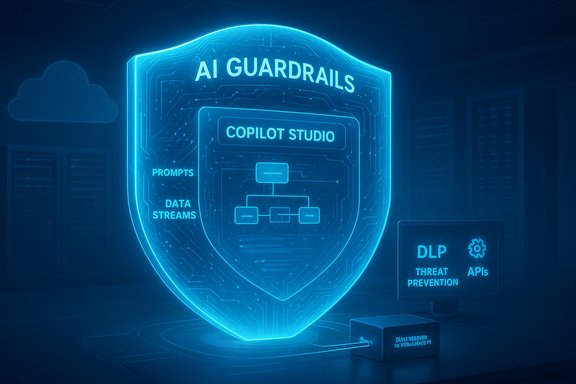
The announcement lists three headline capabilities Check Point will bring to Copilot Studio environments:- Runtime AI Guardrails — continuous runtime protection intended to prevent prompt injection, data leakage, and model misuse while each agent executes.
- Data Loss and Threat Prevention — integrated DLP and threat engines that inspect every tool call and workflow inside the agent runtime.
- Enterprise‑Grade Scale and Precision — a unified security bundle designed for large‑scale deployments with low latency and consistent policy enforcement.
Why this matters: the problem space for Copilot Studio adopters
Copilot Studio is now widely positioned as the enterprise surface for building agentic automation — low-code agents that can read tenant data, call connectors, and execute actions on behalf of users. That capability produces both opportunity and risk:- Agents can access large volumes of sensitive data (documents in SharePoint, CRM records, HR databases) and then issue outbound calls to external services or APIs.
- Prompt injection and retrieval-layer attacks can trick agents into returning or exfiltrating privileged information.
- Autonomous agent actions magnify the blast radius: a single corrupted agent could write back to business systems, modify entitlements, or execute workflows incorrectly.
- Governance needs are continuous: policy drift, model updates and new connectors change risk posture after agents are published.
Technical surface: how a runtime protection layer typically works
To evaluate Check Point’s claims it helps to understand the common architecture of runtime guardrail services:- Agents call external tools, connectors or model endpoints as part of a workflow.
- A runtime protection layer intercepts the tool call (or is invoked as a middleware) and inspects:
- The prompt and retrieval context for injection patterns.
- The set of data being surfaced to the model (to enforce DLP).
- The intended outbound action (API call parameters, file writes).
- The layer applies policy decisions (allow, block, transform, redact) and logs telemetry for audit.
- For blocked or potentially risky actions, the system can:
- Stop execution and surface a human review workflow.
- Redact sensitive fields and continue in a degraded mode.
- Quarantine the session and raise alerts to SOC channels.
Strengths and immediate upsides
- Prevention‑first stance. Check Point’s approach is consistent with modern security best practices that prioritize blocking dangerous actions over simply alerting — for agent runtimes this reduces the chance of automated exfiltration or dangerous actions at the moment they would execute.
- Extends existing enterprise DLP practices into agents. Enterprises already rely on DLP to protect email, file shares and endpoints. Applying the same classification and redaction logic to agent tool calls creates continuity of policy and reduces leakage risk.
- Operational visibility and telemetry. Third‑party runtime layers often provide richer audit trails specific to model inputs/outputs and tool calls than platform-level logs alone. That matters for compliance, incident response and forensic analysis.
- Complementary to Microsoft’s guardrails. Microsoft’s Copilot Studio invests heavily in Responsible AI filters, Purview integration and tenant controls; an external inline protection layer can fill gaps and provide independent enforcement that does not rely solely on platform-side moderation.
- Vendor experience with threat prevention. Check Point’s pedigree in network and cloud threat prevention (Infinity Platform) brings mature detection engines and signature-based/heuristic protections to a new problem set — agent runtime risk — which could be more powerful than first-generation, ML-only guardrails.
Real risks and open questions
The announcement is forward-looking and promising, but several practical and security risks remain and should be evaluated carefully by IT and security teams.1. Independent confirmation and scope of the integration
Check Point’s release and the syndication of that release are explicit; however, an independent co-published Microsoft announcement or technical integration guide is not visible in Microsoft’s public documentation (at the time of reporting). That makes it essential for procurement and security teams to validate:- Whether the integration is a joint, supported product offering or a partner solution that uses documented Copilot Studio APIs.
- Where enforcement occurs (tenant-controlled appliance or Check Point-managed cloud) and associated contractual protections for data handling.
2. Data residency, telemetry and compliance
Every inline inspection capability must process prompts, responses and possibly tenant data. Enterprises in regulated sectors require guarantees about:- Where inspection occurs (which cloud regions).
- Retention policies for telemetry and conversation transcripts.
- Whether redaction and transformation happen before any external storage or third‑party processing.
Check Point’s materials claim “seamless protection,” but specifics about data residency and customer-managed keys will determine whether regulated organizations can adopt the integrated stack.
3. Latency and operational performance
Real-time inspection of every tool call risks introducing latency into agent flows. For many agent scenarios — synchronous user interactions, low-latency automation — even small delays degrade user experience. The vendor promises low-latency, but enterprises should validate:- End-to-end roundtrip time under production load.
- Service SLOs and fail-open versus fail-closed behavior during outages.
- Whether the protection supports batch or asynchronous flows differently than synchronous calls.
4. Evolving threat vectors and bypass techniques
Prompt injection and RAG-layer attacks are a rapidly evolving space. Attackers who adapt to any single detection methodology can circumvent protections. Key concerns:- Rule-based detection must be continuously updated; attackers will craft evasive prompts and use chained interactions.
- ML-based detectors can be fooled by adversarial inputs.
- Agents with multi-agent coordination or UI automation paths (virtual mouse/keyboard) introduce new surfaces that are harder to mediate.
Relying on a single vendor control is risky — multiple overlapping controls (tenant-side policies, Purview DLP, inline inspection, human-in-the-loop validation) remain necessary.
5. Operational complexity and agent lifecycle management
Embedding runtime checks into development workflows is attractive, but it adds governance obligations:- Who owns policy definition between security and maker teams?
- How are false positives handled without stalling business workflows?
- How are agent templates and solutions tested and certified for safe execution?
The more enforcement points you add, the more lifecycle friction you'll likely need to manage.
Practical advice for enterprise IT and security teams
Security teams evaluating Check Point’s Copilot Studio integration (or any third‑party runtime guardrail solution) should validate these items before pilot rollouts:- Confirm the integration model
- Is the service delivered as a tenant-side gateway, a Microsoft‑endorsed partner connector, or a vendor-hosted proxy?
- Where is the inspection performed and where is data stored?
- Test with representative agent workloads
- Simulate synchronous user queries, long-running autonomous agent runs, and UI automation flows.
- Measure end-to-end latency and identify fail-open/fail-closed behavior.
- Validate policy coverage and false-positive handling
- Provide security and maker teams with a joint policy playbook and escalation flow.
- Run a staged rollout with human-in-the-loop review gates for high-risk actions.
- Confirm compliance controls
- Ensure regional processing, customer-managed keys, and retention/erasure policies match regulatory requirements.
- Audit whether logs and telemetry contain PII and whether that telemetry is accessible only to authorized roles.
- Integrate with existing tooling
- Connect runtime guardrail alerts to SIEM/SOAR (for example, Microsoft Sentinel).
- Ensure incidents can be triaged and replayed with sufficient context for forensic analysis.
- Adopt an agent risk classification model
- Classify agents by risk (read-only Q&A vs. action-capable agents that write to systems) and enforce stricter controls for higher-risk classes.
- Plan for adversarial testing
- Include prompt-injection and RAG-focused adversarial exercises in red-team plans.
- Periodically re-evaluate guardrail efficacy against new attack patterns.
Market context: this is not a solo move
Check Point’s play sits within a much broader market response. Other security vendors are launching Copilot‑aware DLP and runtime protections, and Microsoft itself continues to add agent-aware telemetry and prompt-injection detection inside Defender and Copilot control systems. This market momentum validates the need for runtime security, but it also means differentiation will come from integration fidelity, low-latency enforcement, and governance ergonomics. Consider these parallel developments:- Microsoft has published responsible AI filters, content moderation, and agent governance tooling for Copilot Studio and is actively expanding runtime protections and telemetry across its security stack. Those platform-first controls should be treated as baseline capabilities, not replacements for specialized runtime inspection when risk profiles demand it.
- Several third‑party vendors are offering Copilot-specific DLP and agent runtime products that focus on real-time interception of model calls and connector traffic; these products often emphasize tenant control, SaaS connectors and enterprise policy translation. A competitive field makes it easier for enterprises to evaluate different enforcement models (gateway, SDK, or API-proxy).
Cross‑checking key corporate claims
- Check Point frequently includes the claim that it protects “over 100,000 organizations globally” in corporate releases and investor materials; that number is repeatedly presented in Check Point press and investor communications. Enterprises should accept such marketing claims with standard verification (reference in investor filings or audited disclosures) but the number aligns with the company’s long-standing market position.
- The headline capabilities — runtime guardrails, DLP extension, threat prevention — are coherent with Check Point’s existing product portfolio and its stated Infinity platform strategy. The novelty is packaging that functionality specifically for Copilot Studio agent runtimes.
- Microsoft’s public documentation corroborates the need for agent-aware controls and shows Microsoft is building platform-level guardrails; however, Microsoft has not (in public docs at the moment) posted a standalone co-branded engineering guide that describes how a Check Point runtime deployment is provisioned inside Copilot Studio tenants. That gap is important: it means organizations should validate technical implementation and support boundaries directly with both vendors before trusting a production rollout.
Buying checklist: what to get in writing
When negotiating a runtime guardrails contract or trial, insist on the following specifics in writing:- Scope of integration and supportability with Copilot Studio APIs and Microsoft Entra identity primitives.
- Data flow diagrams showing exactly where prompts, recovered context and telemetry traverse.
- Data residency guarantees and encryption-at-rest/transit assurances, including customer-managed key options.
- SLAs for latency, throughput and availability, plus clear fail-open/fail-closed semantics.
- Audit and evidence access for compliance reviews and incident response.
- Roadmap alignment: how will the vendor keep pace with model and platform changes (new model endpoints, multi-model routing, agent SDK changes)?
- A jointly owned runbook for incident response in the event an agent misbehaves or is exploited.
What to watch next
- A Microsoft co-announcement or technical integration guide confirming implementation patterns and support boundaries; this will materially alter risk assessments for regulated customers.
- Independent technical reviews and benchmark reports showing whether runtime guardrails can reliably block prompt-injection and RAG-layer exfiltration without unacceptable latency.
- Community reporting on false-positive rates when DLP is applied to complex, multi-source retrieval contexts — high false positives degrade adoption.
- Enterprise case studies documenting how policies were defined across development, security, and compliance teams for action-capable agents.
Conclusion
Check Point’s move to bring runtime AI Guardrails, DLP and Threat Prevention into Microsoft Copilot Studio answers a real and growing need: agents change the attack surface, and organizations must move from design-time governance to continuous runtime enforcement. The concept aligns with Microsoft’s platform evolution toward agent-aware controls, and Check Point’s prevention-first heritage gives the announcement engineering credibility.That said, the announcement should be treated as the start of a technical conversation, not an automatic clearance to deploy. Enterprises must validate the integration model, data residency, latency behavior and how enforcement will be administered across maker teams and security operations. Without independent Microsoft technical confirmation and real-world validation against adversarial prompt attacks, the integration remains promising but not yet proven at enterprise scale. Robust pilots, clear contractual protections, and a layered defense posture will be essential for any organization that wants to deploy agentic Copilot Studio workflows securely.
Key takeaways for Windows and enterprise IT leaders:
- Treat runtime guardrails as part of a layered defense, not a single-point solution.
- Validate enforcement architecture, telemetry retention and SLAs before deployment.
- Establish clear policy ownership between security and maker teams to prevent governance drift.
- Require adversarial testing and operational runbooks as part of any rollout.
Source: The Globe and Mail Check Point Software Collaborates with Microsoft to Deliver Enterprise-Grade AI Security for Microsoft Copilot Studio
