

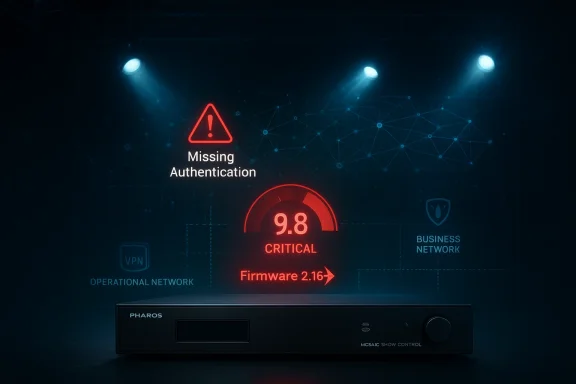
The latest CISA advisory on Pharos Controls’ Mosaic Show Controller is a reminder that even niche show-control platforms can present critical attack paths when authentication is missing from core functions. CISA says Mosaic Show Controller firmware 2.15.3 is affected by CVE-2026-2417, a missing authentication for a critical function flaw that could let an unauthenticated attacker execute arbitrary commands with root privileges. The advisory rates the issue CVSS 3.1 9.8 Critical and recommends upgrading to version 2.16 or later.
Pharos Controls occupies a specialized but important corner of the broader operational technology ecosystem. Its controllers are used in architectural, entertainment, and commercial lighting environments where reliability, remote management, and timing precision matter as much as raw functionality. That combination makes the platform attractive to venues and facilities operators, but it also means a compromise can affect visible public spaces and operational continuity at the same time. Pharos’ own documentation has long emphasized remote access, controller web interfaces, and remote management workflows as core features, which is exactly why authentication failures in that surface area are so consequential. (dl.pharoscontrols.com)
What makes this advisory especially notable is not just the severity score, but the privilege level reported in the exploitation path. CISA says a remote attacker could bypass authentication and run commands as root, which implies full device compromise rather than a limited configuration issue. In practical terms, that could mean manipulating lighting behavior, disrupting show operations, altering configuration, or using the controller as a foothold into a poorly segmented network. (dl.pharoscontrols.com)
This is also a useful case study in how small OT and building-control devices can become high-value targets. These systems are often deployed in mixed business networks, sometimes with remote access enabled for installers, integrators, and service vendors. Pharos’ own networking guidance acknowledges both LAN and internet-viable access patterns for controllers, reinforcing the importance of strict segmentation, least privilege, and careful exposure management. (dl.pharoscontrols.com)
The fact that no public exploitation has been reported to CISA yet should not invite complacency. The exposure profile is exactly the sort that tends to attract opportunistic scanning once advisories become public, especially when the fix path is straightforward and the vulnerable version is named explicitly. In other words, defenders should treat this as a patch-now event rather than a monitor-and-wait issue. (dl.pharoscontrols.com)
The relevant technical weakness is straightforward in concept but severe in impact. If a critical action can be invoked without authentication, the attacker does not need credentials, social engineering, or a stolen session to reach the dangerous path. That makes the flaw especially attractive for automated exploitation, because the attacker’s barrier to entry is reduced to network reachability and knowledge of the exposed service. (dl.pharoscontrols.com)
The controller’s own ecosystem makes it clear that remote management is an intended feature rather than an unusual edge case. Pharos documentation describes built-in web interfaces, remote troubleshooting, cloud-based file transfer, and web-accessible control workflows. That convenience is part of the product’s appeal, but it also increases the attack surface, because every management pathway becomes a potential entry point if authentication or authorization fails. (dl.pharoscontrols.com)
That matters because show controllers often sit at the intersection of physical experience and digital control. An attacker who reaches the firmware’s critical function can potentially alter output behavior, disrupt scheduled events, or leave the device in an unstable state. If the controller is integrated with broader automation or signage systems, the blast radius can extend beyond lighting alone. (dl.pharoscontrols.com)
That is where planning matters. A firmware upgrade should be treated as a controlled maintenance event, not a casual click-through, because show systems may have dependencies on timing, triggers, or configuration states. Organizations should validate the upgrade in a staging environment where possible, confirm rollback options, and check whether the controller’s project file and related interfaces behave as expected after the update. (dl.pharoscontrols.com)
Pharos’ own networking guidance, written long before this advisory, already pointed toward the importance of managed switches, isolation, and careful access design. The company notes that controllers can be connected to the building network and even isolated via a managed switch so they can be accessed without talking to other network devices. That kind of design remains one of the best defenses against a compromised controller becoming a broader network problem. (dl.pharoscontrols.com)
What is particularly striking is how often these incidents begin with a “simple” authentication problem. A missing login check can be enough to collapse multiple layers of intended protection, especially if the service was assumed to be trusted because it lived inside an OT network. The older the deployment, the more likely it is that assumptions about trust boundaries have drifted away from reality. (dl.pharoscontrols.com)
For enterprises, the risk is not only service disruption but also reputational damage. A compromised lighting controller in a public venue can create visible failures, operational confusion, and unnecessary incident response costs. Even where safety is not directly endangered, the embarrassment of a public-facing control failure can drive immediate business impact. (dl.pharoscontrols.com)
Security teams should use this moment to audit the full lifecycle of their control systems, not just the one firmware build. That means inventorying devices, checking who can reach them, reviewing remote support channels, and confirming that upgrade and rollback processes are documented. It also means acknowledging that “it’s just a lighting controller” is not a sufficient security model anymore. (dl.pharoscontrols.com)
Source: CISA Pharos Controls Mosaic Show Controller | CISA
 Overview
Pharos Controls occupies a specialized but important corner of the broader operational technology ecosystem. Its controllers are used in architectural, entertainment, and commercial lighting environments where reliability, remote management, and timing precision matter as much as raw functionality. That combination makes the platform attractive to venues and facilities operators, but it also means a compromise can affect visible public spaces and operational continuity at the same time. Pharos’ own documentation has long emphasized remote access, controller web interfaces, and remote management workflows as core features, which is exactly why authentication failures in that surface area are so consequential. (dl.pharoscontrols.com)What makes this advisory especially notable is not just the severity score, but the privilege level reported in the exploitation path. CISA says a remote attacker could bypass authentication and run commands as root, which implies full device compromise rather than a limited configuration issue. In practical terms, that could mean manipulating lighting behavior, disrupting show operations, altering configuration, or using the controller as a foothold into a poorly segmented network. (dl.pharoscontrols.com)
This is also a useful case study in how small OT and building-control devices can become high-value targets. These systems are often deployed in mixed business networks, sometimes with remote access enabled for installers, integrators, and service vendors. Pharos’ own networking guidance acknowledges both LAN and internet-viable access patterns for controllers, reinforcing the importance of strict segmentation, least privilege, and careful exposure management. (dl.pharoscontrols.com)
The fact that no public exploitation has been reported to CISA yet should not invite complacency. The exposure profile is exactly the sort that tends to attract opportunistic scanning once advisories become public, especially when the fix path is straightforward and the vulnerable version is named explicitly. In other words, defenders should treat this as a patch-now event rather than a monitor-and-wait issue. (dl.pharoscontrols.com)
What CISA Says Happened
CISA’s advisory identifies the issue as a Missing Authentication for Critical Function vulnerability in Mosaic Show Controller firmware 2.15.3. The agency states that exploitation could allow an unauthenticated attacker to execute arbitrary commands with root privileges, which is the kind of outcome that security teams usually associate with complete device takeover. The advisory places the flaw in the commercial facilities sector and marks it as globally deployed, underscoring that this is not a regional or isolated concern. (dl.pharoscontrols.com)The relevant technical weakness is straightforward in concept but severe in impact. If a critical action can be invoked without authentication, the attacker does not need credentials, social engineering, or a stolen session to reach the dangerous path. That makes the flaw especially attractive for automated exploitation, because the attacker’s barrier to entry is reduced to network reachability and knowledge of the exposed service. (dl.pharoscontrols.com)
Why the root context matters
The mention of root privileges is the most alarming part of the disclosure. Root access means the attacker is not merely changing a show file or toggling a user-facing setting; they are operating at the device’s highest privilege level. That creates the possibility of persistent tampering, system sabotage, or lateral movement depending on how the controller is integrated into the wider environment. (dl.pharoscontrols.com)- The flaw requires no authentication.
- The attack can be initiated remotely over the network.
- The outcome includes arbitrary command execution.
- The reported privilege level is root, not a limited user context. (dl.pharoscontrols.com)
Why Mosaic Show Controller Matters in the Field
Pharos platforms are designed for environments where lighting is mission-critical to the experience and, in some venues, to safety or compliance. Museums, entertainment spaces, commercial facilities, and public installations depend on these controllers to manage scenes, triggers, and timelines with precision. A disruption here may not be life-threatening in the way a compromised PLC can be, but it can still produce significant operational, reputational, and financial damage. (dl.pharoscontrols.com)The controller’s own ecosystem makes it clear that remote management is an intended feature rather than an unusual edge case. Pharos documentation describes built-in web interfaces, remote troubleshooting, cloud-based file transfer, and web-accessible control workflows. That convenience is part of the product’s appeal, but it also increases the attack surface, because every management pathway becomes a potential entry point if authentication or authorization fails. (dl.pharoscontrols.com)
Convenience versus exposure
This is the classic OT and building-controls tradeoff: the same openness that helps integrators support a project remotely can also widen exposure. The difference between a securely managed remote service and an internet-exposed controller is often just a matter of configuration discipline, and that discipline is not always consistent across deployments. In practice, the easiest path for a technician is often the easiest path for an attacker too. (dl.pharoscontrols.com)- Remote support is useful during commissioning and maintenance.
- Web interfaces increase operational flexibility.
- Cloud workflows simplify firmware and project updates.
- Every added convenience also widens the security control surface. (dl.pharoscontrols.com)
The Technical Risk Profile
The advisory’s CVSS vector — AV:N/AC:L/PR:N/UI:N/S:U/C:H/I:H/A:H — tells the story in compact form. Network attackability, low complexity, no privileges required, and no user interaction make the issue operationally dangerous from a defender’s perspective. High impact to confidentiality, integrity, and availability means the compromise can affect secrecy, behavior, and uptime in one sweep. (dl.pharoscontrols.com)That matters because show controllers often sit at the intersection of physical experience and digital control. An attacker who reaches the firmware’s critical function can potentially alter output behavior, disrupt scheduled events, or leave the device in an unstable state. If the controller is integrated with broader automation or signage systems, the blast radius can extend beyond lighting alone. (dl.pharoscontrols.com)
From auth bypass to full compromise
In many product advisories, missing authentication is bad but contained. Here, CISA’s description indicates the flaw is a stepping stone to full command execution, which shifts it from a policy problem to a direct system integrity issue. That distinction matters because defenders need to treat the device as potentially hostile once exposed, not merely misconfigured. (dl.pharoscontrols.com)- Missing authentication is the enabling flaw.
- Arbitrary command execution is the exploitation goal.
- Root privileges make post-exploitation control extensive.
- Network visibility is enough to make the device targetable. (dl.pharoscontrols.com)
The Patch Path and Its Operational Implications
Pharos’ mitigation advice is direct: upgrade Mosaic Show Controller to version 2.16 or later. In security terms, that is the cleanest possible remedy because it suggests a vendor-fixed software path rather than a workaround-dependent outcome. But in OT environments, even clean fixes can be operationally messy if change windows are tight or if the controller sits in a critical production environment. (dl.pharoscontrols.com)That is where planning matters. A firmware upgrade should be treated as a controlled maintenance event, not a casual click-through, because show systems may have dependencies on timing, triggers, or configuration states. Organizations should validate the upgrade in a staging environment where possible, confirm rollback options, and check whether the controller’s project file and related interfaces behave as expected after the update. (dl.pharoscontrols.com)
What admins should do first
Before touching the firmware, teams should confirm which controllers are exposed, which are reachable only on internal segments, and which are managed through remote access tools. That inventory is essential because the most dangerous systems are often the ones no one realizes are still accessible. In parallel, log review and network monitoring can help identify whether a vulnerable device has already been probed. (dl.pharoscontrols.com)- Identify every Mosaic Show Controller instance and verify the firmware version.
- Prioritize any system running 2.15.3 or any system with unclear version provenance.
- Restrict network exposure immediately if upgrade cannot happen at once.
- Apply the vendor fix to 2.16 or later as soon as testing allows.
- Review remote access, firewall rules, and segmentation after the patch. (dl.pharoscontrols.com)
Network Exposure and Segmentation
CISA recommends minimizing network exposure for control system devices and keeping them off the public internet. That guidance is especially relevant here because a network-reachable unauthenticated flaw is only useful to an attacker if they can find the target in the first place. Reducing exposure is often the fastest way to reduce actual risk while patching is being scheduled. (dl.pharoscontrols.com)Pharos’ own networking guidance, written long before this advisory, already pointed toward the importance of managed switches, isolation, and careful access design. The company notes that controllers can be connected to the building network and even isolated via a managed switch so they can be accessed without talking to other network devices. That kind of design remains one of the best defenses against a compromised controller becoming a broader network problem. (dl.pharoscontrols.com)
Segmentation is not optional
This is where many real-world deployments fail. A controller may be secure enough in isolation, but if it is flattened into the same broadcast domain as business IT, guest Wi-Fi, or remote support tooling, the environment becomes dramatically easier to attack. Segmentation does not eliminate the bug; it limits what the bug can reach. (dl.pharoscontrols.com)- Remove direct internet exposure wherever possible.
- Place controllers behind firewalls and access controls.
- Separate control networks from business networks.
- Restrict remote administration to tightly controlled pathways. (dl.pharoscontrols.com)
How This Fits the Current OT Threat Landscape
The security community has spent years warning that internet-facing industrial and building-control devices are attractive targets because they combine high impact with low visibility. CISA’s broader guidance on control-system security repeatedly emphasizes defense-in-depth, segmentation, and proactive hardening, and this advisory fits that pattern exactly. The specifics change from vendor to vendor, but the defensive lesson stays the same. (dl.pharoscontrols.com)What is particularly striking is how often these incidents begin with a “simple” authentication problem. A missing login check can be enough to collapse multiple layers of intended protection, especially if the service was assumed to be trusted because it lived inside an OT network. The older the deployment, the more likely it is that assumptions about trust boundaries have drifted away from reality. (dl.pharoscontrols.com)
From lighting control to broader security posture
A vulnerability like this is not only about one product line. It’s a stress test for the maturity of the organization managing it. If a commercial facility can quickly inventory its controllers, assess exposure, and validate patch deployment, that is a sign of healthy operational security. If the answer requires weeks of detective work, the problem is probably larger than a single firmware flaw. (dl.pharoscontrols.com)- Mature environments know where controllers are deployed.
- Mature environments separate operations from IT access.
- Mature environments can patch without improvisation.
- Mature environments monitor for anomalous controller behavior. (dl.pharoscontrols.com)
Enterprise Versus Consumer Impact
This vulnerability is primarily an enterprise and infrastructure issue, not a consumer one. The affected product is a professional show-controller platform used in commercial facilities and managed installations, which means the likely victims are operators, integrators, venue managers, and facilities teams. That distinction matters because the remediation burden will fall on organizations with service windows, contractual dependencies, and uptime expectations rather than on a single end user. (dl.pharoscontrols.com)For enterprises, the risk is not only service disruption but also reputational damage. A compromised lighting controller in a public venue can create visible failures, operational confusion, and unnecessary incident response costs. Even where safety is not directly endangered, the embarrassment of a public-facing control failure can drive immediate business impact. (dl.pharoscontrols.com)
Why managed environments need special care
Managed environments often have multiple parties involved: the facility owner, a systems integrator, a maintenance vendor, and sometimes a remote support provider. That complexity increases the chance that one party assumes another has already handled patching or segmentation. The result is a gap that attackers can exploit long after an advisory has been published. (dl.pharoscontrols.com)- Commercial facilities should verify firmware versions across all sites.
- Integrators should confirm upgrade procedures with clients.
- Remote access accounts should be reviewed for necessity and scope.
- Service contracts should include patch-response expectations. (dl.pharoscontrols.com)
Strengths and Opportunities
The silver lining is that the issue appears to have a clear remediation path and a vendor-specified fixed version. That gives defenders a concrete target, and the surrounding documentation suggests that Pharos already operates in an ecosystem where remote management and firmware handling are established workflows. If organizations use this moment well, they can improve not only patch status but also their broader control-system governance. (dl.pharoscontrols.com)- A vendor fix is available in 2.16 or later.
- The flaw has a clearly identified affected version.
- CISA published mitigation guidance quickly.
- Organizations can bundle patching with network hardening.
- Asset inventory can be improved during remediation.
- Remote access policies can be tightened at the same time.
- The incident can drive better segmentation and monitoring. (dl.pharoscontrols.com)
Risks and Concerns
The downside is obvious: a network-reachable unauthenticated root-level flaw is exactly the sort of issue that can be exploited quickly once discovered. Even if no public exploitation is currently known, exposure alone can be enough for opportunistic scanning, especially in environments where controllers are reachable from broader networks. The risk is compounded if organizations delay firmware upgrades because the devices are embedded in live production spaces. (dl.pharoscontrols.com)- Remote exploitation requires no credentials.
- Root-level control increases impact dramatically.
- Public exposure would make targeting easier.
- Delayed patching creates a prolonged risk window.
- Weak segmentation could let attackers move laterally.
- Third-party support access may widen the attack surface.
- Legacy operational assumptions may hide the device from inventory. (dl.pharoscontrols.com)
Looking Ahead
The next few weeks will reveal whether this advisory remains a contained vendor-specific issue or becomes part of a broader campaign against exposed control devices. History suggests that once a critical unauthenticated flaw is publicly disclosed, defenders have a narrow window to patch before attackers begin systematic probing. That is why the most important question is not whether the vulnerability is serious — it clearly is — but how many deployments still have version 2.15.3 in the wild. (dl.pharoscontrols.com)Security teams should use this moment to audit the full lifecycle of their control systems, not just the one firmware build. That means inventorying devices, checking who can reach them, reviewing remote support channels, and confirming that upgrade and rollback processes are documented. It also means acknowledging that “it’s just a lighting controller” is not a sufficient security model anymore. (dl.pharoscontrols.com)
- Verify whether any Mosaic Show Controller instances are externally reachable.
- Confirm whether any deployment is still on firmware 2.15.3.
- Schedule upgrades to 2.16 or later.
- Review firewall rules and VPN exposure.
- Check logs for suspicious controller access or command activity. (dl.pharoscontrols.com)
Source: CISA Pharos Controls Mosaic Show Controller | CISA
Last edited:
