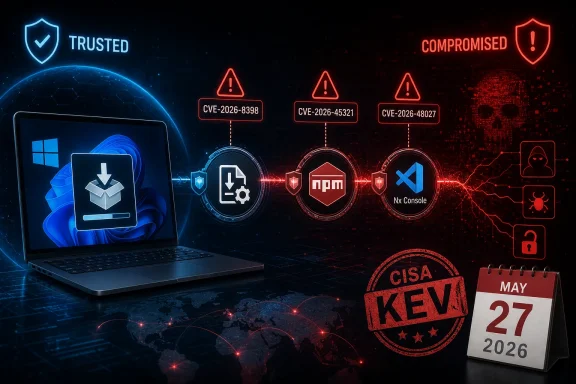
CISA added CVE-2026-8398, CVE-2026-45321, and CVE-2026-48027 to its Known Exploited Vulnerabilities Catalog on May 27, 2026, after confirming active exploitation affecting DAEMON Tools Lite, TanStack packages, and the Nx Console developer extension. The move is more than another federal patching notice. It is a warning that the software supply chain is now being exploited through trusted installers, package registries, and developer tooling with frightening speed. For Windows users and IT administrators, the lesson is blunt: the thing you installed from the “right” place can still be the thing that opens the door.
CISA’s Known Exploited Vulnerabilities Catalog has always been more than a list of bad bugs. It is the U.S. government’s way of saying that a vulnerability has crossed from theoretical risk into operational reality. When a CVE lands in KEV, defenders are no longer debating whether someone could exploit it; they are being told that someone already has.
The three additions on May 27 form a particularly uncomfortable cluster because they are not classic perimeter bugs. They are not simply another VPN appliance flaw, another Exchange server bug, or another forgotten web shell path. They sit inside the trust fabric of everyday software acquisition: a Windows utility installer, an npm package family, and a Visual Studio Code extension.
That matters because defenders have spent years improving patch workflows around known assets and exposed services. Supply-chain compromise attacks the assumptions beneath those workflows. The user believes the download came from the vendor, the developer believes the package came from the registry, and the engineer believes the extension came from the official marketplace.
CISA’s federal deadline mechanics still matter. Binding Operational Directive 22-01 requires Federal Civilian Executive Branch agencies to remediate KEV-listed vulnerabilities by due dates set in the catalog. But for private organizations, the larger message is not compliance; it is triage. KEV is increasingly becoming a curated list of things attackers are using because they work.
That is especially troubling in the Windows ecosystem because utilities like DAEMON Tools Lite often live in the gray zone between consumer convenience and enterprise nuisance. They may not be approved business applications, but they are exactly the sort of tool that appears on developer laptops, lab machines, help desk systems, and unmanaged endpoints. In many environments, the security team only discovers them after an incident.
The reported DAEMON Tools compromise also cuts against one of the oldest pieces of user advice in security: download software only from the official site. That advice remains better than grabbing random mirrors, but it is no longer enough. If the official distribution channel is compromised, the user can do everything “right” and still install a backdoor.
The Windows angle here is not incidental. A trojanized installer signed or distributed through a trusted path can blend into normal endpoint noise. It may look like a routine application update, a help desk install, or a power user’s harmless utility. By the time suspicious behavior appears, the initial execution may already be buried under a legitimate product name.
For administrators, the practical response is not simply “remove DAEMON Tools.” It is to ask whether the organization can identify who installed affected versions, when they did it, and what credentials or network access those machines had afterward. If the answer is no, the vulnerability management program is not actually managing this kind of vulnerability.
This is the sort of incident that makes traditional vulnerability language feel inadequate. The problem is not that a function mishandled input or a server exposed a dangerous endpoint. The problem is that attackers were able to exploit trust relationships around GitHub Actions, package publishing, and developer credentials to deliver malicious code through normal dependency channels.
Modern development pipelines are full of these invisible handoffs. A pull request triggers automation. Automation receives tokens. Tokens publish packages. Packages are resolved by build tools. Build tools run on developer machines and CI runners that often have access to still more secrets. Each step is defensible in isolation, but chained together they become a conveyor belt.
The TanStack case also illustrates why package compromise is so difficult to contain. A malicious version may only be available for a short period, but dependency managers are designed to fetch, cache, and reuse packages quickly. Developers may not remember exactly when they installed or updated a dependency. CI logs may disappear before security teams know what to search for.
For WindowsForum readers, this is not just a “Linux and JavaScript people” problem. Much of the modern Windows application stack is built using cross-platform tools, Electron shells, npm dependencies, GitHub-hosted automation, and VS Code-based workflows. A compromised npm package can land on a Windows workstation just as easily as on a Linux build server.
This is where the story becomes especially relevant to Microsoft-centric shops. Visual Studio Code is not a niche editor. It is a default development environment across startups, enterprises, contractors, and open-source projects. Extensions are effectively executable software that many organizations allow to update automatically.
The attack path reportedly traced back to a contributor’s machine that had previously encountered a malicious TanStack package. That stolen credential then became a stepping stone to publish a malicious Nx Console extension. In other words, one supply-chain event fed another, moving from package registry compromise to developer token theft to extension marketplace abuse.
That is the nightmare scenario for software supply-chain defense: not a single poisoned well, but a cascade. The attacker does not need to breach every target directly. They breach a developer, use that developer’s trust to breach a tool, and let the tool run wherever developers have installed it.
The lesson is uncomfortable for IT departments that still treat developer workstations as ordinary endpoints. A developer laptop may hold GitHub tokens, npm credentials, SSH keys, cloud access, signing permissions, CI secrets, and access to private repositories. In practice, it is often closer to production infrastructure than to a standard office PC.
This is the same distinction that makes code signing both useful and insufficient. A signature can establish provenance, but provenance is not purity. If the authorized signer is breached, the attacker inherits the aura of legitimacy.
Enterprise policy often lags behind that reality. Many organizations tightly control browser extensions but allow broad freedom inside IDEs. They restrict local administrator rights but let development tools execute arbitrary post-install scripts. They monitor PowerShell but overlook build hooks, package managers, and editor extensions.
The attacker’s view is more pragmatic. If the developer environment has credentials and weak guardrails, it is a target. If an extension update can run inside that environment, it is a delivery mechanism. If the marketplace provides scale and legitimacy, it is part of the attack surface.
That does not mean organizations should ban extensions or freeze developers in unusable environments. It means extension governance needs to become a real control. Approved lists, version pinning, delayed auto-update channels, and telemetry around extension installation are not bureaucratic luxuries anymore.
That makes the KEV listing important beyond the federal enterprise. CISA is effectively saying that these are not merely interesting incidents for security blogs. They are known exploited vulnerabilities significant enough to warrant prioritized remediation. For defenders drowning in scanners and CVSS scores, that signal is valuable.
CVSS tells you what a vulnerability might allow under a model. KEV tells you someone is using it. That distinction is crucial when security teams face thousands of findings and limited maintenance windows. A medium-seeming issue under active exploitation may deserve more attention than a theoretically critical flaw buried behind compensating controls.
The problem is that supply-chain incidents do not always fit neatly into patch Tuesday muscle memory. There may be no single patch to deploy. Remediation can involve uninstalling a version, rotating credentials, checking package lockfiles, auditing CI logs, invalidating tokens, and searching endpoints for post-compromise artifacts.
That is why KEV-driven vulnerability management needs to merge with incident response. When malicious code has already run under trusted context, “update to a safe version” is only the first step. The more serious question is what the malicious code saw, stole, or changed before it was removed.
This is particularly hard in mixed environments where Windows endpoints are used to build software that ultimately runs elsewhere. A developer may use Windows 11, VS Code, WSL, Docker Desktop, npm, GitHub CLI, Azure tooling, and a dozen extensions. Each layer brings its own update channel and credential store.
The DAEMON Tools case is the easy one to understand because it resembles the old world: find the application, check the version, remove or update it, scan the endpoint. The TanStack and Nx cases require a broader mental model. You may need to know which developers resolved certain package versions during a small time window, which extensions auto-updated, and which secrets were present on those machines.
This is where endpoint detection, software inventory, and developer platform telemetry need to meet. Security teams should be able to answer whether affected versions were present, whether suspicious child processes launched from developer tools, and whether credentials were used from unexpected locations afterward. If those questions require a week of Slack archaeology, the attacker already has the advantage.
There is also a cultural issue. Developers often resist locked-down environments because friction slows shipping. Security teams often respond with blanket controls that break legitimate workflows. The better answer is shared visibility: developers keep useful tools, but high-risk update channels and credential scopes are governed like production dependencies.
That changes the rhythm of response. Patching a vulnerable component may close the entry point, but stolen credentials remain valid until revoked. If attackers captured GitHub tokens, npm tokens, SSH keys, cloud credentials, or API secrets, the real blast radius extends beyond the original endpoint.
Credential rotation is painful because it forces organizations to confront how poorly secrets are tracked. Many teams do not know which token belongs to which workflow, which key is still used, or which service account has excessive permissions. Supply-chain attacks exploit that ambiguity.
The minimum response for suspected exposure should include revoking developer tokens, rotating package registry credentials, reviewing OAuth app authorizations, checking cloud audit logs, and searching for unusual repository or package activity. That is not overreaction. It is the natural consequence of malware running inside a trusted developer context.
Longer term, organizations need to reduce the value of any single stolen token. Short-lived credentials, scoped permissions, hardware-backed authentication, protected branches, mandatory review for publishing workflows, and separate release identities all help. None is perfect, but together they make the attacker’s chain longer and noisier.
Still, compliance can be misleading if it becomes a box-checking exercise. Marking CVE-2026-48027 as remediated because Nx Console is updated misses the point if stolen credentials remain active. Marking CVE-2026-45321 as resolved because a package version is no longer in a lockfile ignores cached artifacts and downstream builds. Marking CVE-2026-8398 as closed because DAEMON Tools was uninstalled ignores what happened while the backdoored version was present.
A useful KEV program should start with exposure but end with assurance. Was the affected software present? Did malicious code execute? What privileges did it have? What secrets were reachable? What did logs show after the exposure window? Which controls failed to catch the event?
Those questions are more expensive than patch deployment, but they are also more honest. Supply-chain compromise is not a defective lightbulb to replace. It is a possible intrusion path to investigate.
This is where smaller organizations may struggle most. They may lack EDR history, centralized developer tooling logs, or mature secrets management. For them, CISA’s catalog can still serve as a prioritization tool: when KEV names a component you use, stop treating it as routine maintenance and start treating it as a potential incident.
The user interface is also better from the attacker’s perspective. Instead of tricking a victim into running an unknown executable, the attacker rides along with an update, dependency resolution, or extension refresh. The target’s own tools perform the installation.
This is why the old division between “user security” and “developer security” is collapsing. Developers are users, but with production-adjacent privileges. Their tools are applications, but also build infrastructure. Their endpoints are workstations, but also credential hubs.
Windows environments are deeply exposed to this shift because Windows remains a dominant developer desktop, even when the deployed workload is Linux, cloud-native, or web-based. The compromise path may begin in npm and end in Azure, GitHub, or a private repository, while the malware runs happily on a Windows laptop in between.
Microsoft’s ecosystem is not uniquely at fault here, but it is central to the practical response. VS Code extension policy, Defender telemetry, Intune software inventory, GitHub enterprise controls, Entra ID conditional access, and Windows endpoint hardening all become pieces of the same puzzle. Treating them as separate administrative islands is a gift to attackers.
CISA’s latest KEV update is a small notice with a large implication: attackers are no longer merely exploiting software after it is installed; they are increasingly exploiting the systems that decide what gets installed in the first place. The next defensive frontier for Windows shops will not be another dashboard of missing patches, but a tighter accounting of trust — which publishers can update code, which tools can run in developer contexts, which credentials survive compromise, and how quickly an organization can prove what happened when the trusted path turns hostile.
 CISA’s Latest KEV Entry Is Really a Supply-Chain Alarm Bell
CISA’s Known Exploited Vulnerabilities Catalog has always been more than a list of bad bugs. It is the U.S. government’s way of saying that a vulnerability has crossed from theoretical risk into operational reality. When a CVE lands in KEV, defenders are no longer debating whether someone could exploit it; they are being told that someone already has.The three additions on May 27 form a particularly uncomfortable cluster because they are not classic perimeter bugs. They are not simply another VPN appliance flaw, another Exchange server bug, or another forgotten web shell path. They sit inside the trust fabric of everyday software acquisition: a Windows utility installer, an npm package family, and a Visual Studio Code extension.
That matters because defenders have spent years improving patch workflows around known assets and exposed services. Supply-chain compromise attacks the assumptions beneath those workflows. The user believes the download came from the vendor, the developer believes the package came from the registry, and the engineer believes the extension came from the official marketplace.
CISA’s federal deadline mechanics still matter. Binding Operational Directive 22-01 requires Federal Civilian Executive Branch agencies to remediate KEV-listed vulnerabilities by due dates set in the catalog. But for private organizations, the larger message is not compliance; it is triage. KEV is increasingly becoming a curated list of things attackers are using because they work.
DAEMON Tools Lite Shows the Old Windows Download Model Is Still Fragile
CVE-2026-8398 concerns DAEMON Tools Lite, a familiar name to anyone who has mounted disc images on Windows systems over the last two decades. According to public vulnerability records and vendor-linked reporting, the issue involved official Windows installation packages distributed from the legitimate DAEMON Tools website during a roughly month-long window beginning in early April 2026. The classification, “embedded malicious code,” says the quiet part out loud: this was not just a bug in software, but malicious code traveling with software users reasonably trusted.That is especially troubling in the Windows ecosystem because utilities like DAEMON Tools Lite often live in the gray zone between consumer convenience and enterprise nuisance. They may not be approved business applications, but they are exactly the sort of tool that appears on developer laptops, lab machines, help desk systems, and unmanaged endpoints. In many environments, the security team only discovers them after an incident.
The reported DAEMON Tools compromise also cuts against one of the oldest pieces of user advice in security: download software only from the official site. That advice remains better than grabbing random mirrors, but it is no longer enough. If the official distribution channel is compromised, the user can do everything “right” and still install a backdoor.
The Windows angle here is not incidental. A trojanized installer signed or distributed through a trusted path can blend into normal endpoint noise. It may look like a routine application update, a help desk install, or a power user’s harmless utility. By the time suspicious behavior appears, the initial execution may already be buried under a legitimate product name.
For administrators, the practical response is not simply “remove DAEMON Tools.” It is to ask whether the organization can identify who installed affected versions, when they did it, and what credentials or network access those machines had afterward. If the answer is no, the vulnerability management program is not actually managing this kind of vulnerability.
TanStack Turns a Package Registry Into an Identity Attack
CVE-2026-45321, tied to TanStack, belongs to a different but related failure mode. TanStack is a major JavaScript ecosystem used by developers building modern web applications, and its packages flow through npm into build systems around the world. In this case, public advisories describe a compromise involving malicious package publication under trusted project identity.This is the sort of incident that makes traditional vulnerability language feel inadequate. The problem is not that a function mishandled input or a server exposed a dangerous endpoint. The problem is that attackers were able to exploit trust relationships around GitHub Actions, package publishing, and developer credentials to deliver malicious code through normal dependency channels.
Modern development pipelines are full of these invisible handoffs. A pull request triggers automation. Automation receives tokens. Tokens publish packages. Packages are resolved by build tools. Build tools run on developer machines and CI runners that often have access to still more secrets. Each step is defensible in isolation, but chained together they become a conveyor belt.
The TanStack case also illustrates why package compromise is so difficult to contain. A malicious version may only be available for a short period, but dependency managers are designed to fetch, cache, and reuse packages quickly. Developers may not remember exactly when they installed or updated a dependency. CI logs may disappear before security teams know what to search for.
For WindowsForum readers, this is not just a “Linux and JavaScript people” problem. Much of the modern Windows application stack is built using cross-platform tools, Electron shells, npm dependencies, GitHub-hosted automation, and VS Code-based workflows. A compromised npm package can land on a Windows workstation just as easily as on a Linux build server.
Nx Console Proves the Developer Workstation Is Production Infrastructure
CVE-2026-48027 concerns Nx Console, a Visual Studio Code extension used by developers working with Nx workspaces and monorepos. Public postmortem material from the Nx project described a malicious version of the extension, v18.95.0, published on May 18, 2026, to extension marketplaces during a narrow exposure window. The project later said current versions beginning with the fixed release line were safe and urged affected users to treat machines that installed the malicious version as compromised.This is where the story becomes especially relevant to Microsoft-centric shops. Visual Studio Code is not a niche editor. It is a default development environment across startups, enterprises, contractors, and open-source projects. Extensions are effectively executable software that many organizations allow to update automatically.
The attack path reportedly traced back to a contributor’s machine that had previously encountered a malicious TanStack package. That stolen credential then became a stepping stone to publish a malicious Nx Console extension. In other words, one supply-chain event fed another, moving from package registry compromise to developer token theft to extension marketplace abuse.
That is the nightmare scenario for software supply-chain defense: not a single poisoned well, but a cascade. The attacker does not need to breach every target directly. They breach a developer, use that developer’s trust to breach a tool, and let the tool run wherever developers have installed it.
The lesson is uncomfortable for IT departments that still treat developer workstations as ordinary endpoints. A developer laptop may hold GitHub tokens, npm credentials, SSH keys, cloud access, signing permissions, CI secrets, and access to private repositories. In practice, it is often closer to production infrastructure than to a standard office PC.
The Marketplace Badge Was Never a Security Boundary
The Nx Console incident also exposes a weakness in how users interpret software marketplaces. A verified publisher badge, a familiar extension name, and a listing inside the official VS Code ecosystem create a feeling of safety. But a marketplace can prove that a package came through an authorized account without proving that the account was not compromised.This is the same distinction that makes code signing both useful and insufficient. A signature can establish provenance, but provenance is not purity. If the authorized signer is breached, the attacker inherits the aura of legitimacy.
Enterprise policy often lags behind that reality. Many organizations tightly control browser extensions but allow broad freedom inside IDEs. They restrict local administrator rights but let development tools execute arbitrary post-install scripts. They monitor PowerShell but overlook build hooks, package managers, and editor extensions.
The attacker’s view is more pragmatic. If the developer environment has credentials and weak guardrails, it is a target. If an extension update can run inside that environment, it is a delivery mechanism. If the marketplace provides scale and legitimacy, it is part of the attack surface.
That does not mean organizations should ban extensions or freeze developers in unusable environments. It means extension governance needs to become a real control. Approved lists, version pinning, delayed auto-update channels, and telemetry around extension installation are not bureaucratic luxuries anymore.
KEV Is Becoming a Map of What Attackers Actually Value
The common thread across these three vulnerabilities is not a shared vendor or a shared platform. It is attacker preference. Each case involves a route into systems through trusted software distribution rather than noisy exploitation of an exposed service.That makes the KEV listing important beyond the federal enterprise. CISA is effectively saying that these are not merely interesting incidents for security blogs. They are known exploited vulnerabilities significant enough to warrant prioritized remediation. For defenders drowning in scanners and CVSS scores, that signal is valuable.
CVSS tells you what a vulnerability might allow under a model. KEV tells you someone is using it. That distinction is crucial when security teams face thousands of findings and limited maintenance windows. A medium-seeming issue under active exploitation may deserve more attention than a theoretically critical flaw buried behind compensating controls.
The problem is that supply-chain incidents do not always fit neatly into patch Tuesday muscle memory. There may be no single patch to deploy. Remediation can involve uninstalling a version, rotating credentials, checking package lockfiles, auditing CI logs, invalidating tokens, and searching endpoints for post-compromise artifacts.
That is why KEV-driven vulnerability management needs to merge with incident response. When malicious code has already run under trusted context, “update to a safe version” is only the first step. The more serious question is what the malicious code saw, stole, or changed before it was removed.
Windows Administrators Need to Inventory More Than Windows
For many Windows administrators, the traditional inventory is still built around operating systems, installed applications, hardware, and perhaps browser versions. That is no longer enough. The attack surface now includes developer extensions, package lockfiles, local package caches, CI runners, and automation tokens.This is particularly hard in mixed environments where Windows endpoints are used to build software that ultimately runs elsewhere. A developer may use Windows 11, VS Code, WSL, Docker Desktop, npm, GitHub CLI, Azure tooling, and a dozen extensions. Each layer brings its own update channel and credential store.
The DAEMON Tools case is the easy one to understand because it resembles the old world: find the application, check the version, remove or update it, scan the endpoint. The TanStack and Nx cases require a broader mental model. You may need to know which developers resolved certain package versions during a small time window, which extensions auto-updated, and which secrets were present on those machines.
This is where endpoint detection, software inventory, and developer platform telemetry need to meet. Security teams should be able to answer whether affected versions were present, whether suspicious child processes launched from developer tools, and whether credentials were used from unexpected locations afterward. If those questions require a week of Slack archaeology, the attacker already has the advantage.
There is also a cultural issue. Developers often resist locked-down environments because friction slows shipping. Security teams often respond with blanket controls that break legitimate workflows. The better answer is shared visibility: developers keep useful tools, but high-risk update channels and credential scopes are governed like production dependencies.
Credential Rotation Is the New Patch Tuesday
In all three cases, but especially TanStack and Nx Console, remediation cannot stop at version replacement. Malicious code inside developer tooling is rarely interested only in persistence on one machine. It is interested in secrets, tokens, and access paths that can be replayed elsewhere.That changes the rhythm of response. Patching a vulnerable component may close the entry point, but stolen credentials remain valid until revoked. If attackers captured GitHub tokens, npm tokens, SSH keys, cloud credentials, or API secrets, the real blast radius extends beyond the original endpoint.
Credential rotation is painful because it forces organizations to confront how poorly secrets are tracked. Many teams do not know which token belongs to which workflow, which key is still used, or which service account has excessive permissions. Supply-chain attacks exploit that ambiguity.
The minimum response for suspected exposure should include revoking developer tokens, rotating package registry credentials, reviewing OAuth app authorizations, checking cloud audit logs, and searching for unusual repository or package activity. That is not overreaction. It is the natural consequence of malware running inside a trusted developer context.
Longer term, organizations need to reduce the value of any single stolen token. Short-lived credentials, scoped permissions, hardware-backed authentication, protected branches, mandatory review for publishing workflows, and separate release identities all help. None is perfect, but together they make the attacker’s chain longer and noisier.
Federal Deadlines Are a Floor, Not a Strategy
BOD 22-01 applies directly to federal civilian agencies, but its influence reaches far beyond government. Cyber insurers, auditors, boards, and enterprise customers increasingly treat KEV exposure as a sign of vulnerability management maturity. If CISA says a vulnerability is exploited and an organization leaves it unaddressed, the burden of explanation shifts to the defender.Still, compliance can be misleading if it becomes a box-checking exercise. Marking CVE-2026-48027 as remediated because Nx Console is updated misses the point if stolen credentials remain active. Marking CVE-2026-45321 as resolved because a package version is no longer in a lockfile ignores cached artifacts and downstream builds. Marking CVE-2026-8398 as closed because DAEMON Tools was uninstalled ignores what happened while the backdoored version was present.
A useful KEV program should start with exposure but end with assurance. Was the affected software present? Did malicious code execute? What privileges did it have? What secrets were reachable? What did logs show after the exposure window? Which controls failed to catch the event?
Those questions are more expensive than patch deployment, but they are also more honest. Supply-chain compromise is not a defective lightbulb to replace. It is a possible intrusion path to investigate.
This is where smaller organizations may struggle most. They may lack EDR history, centralized developer tooling logs, or mature secrets management. For them, CISA’s catalog can still serve as a prioritization tool: when KEV names a component you use, stop treating it as routine maintenance and start treating it as a potential incident.
The Software Supply Chain Has Become the User Interface for Attackers
There is a reason attackers keep returning to software supply chains. They offer scale, stealth, and trust. A single compromised package or extension can reach many downstream machines without phishing each user or scanning each network.The user interface is also better from the attacker’s perspective. Instead of tricking a victim into running an unknown executable, the attacker rides along with an update, dependency resolution, or extension refresh. The target’s own tools perform the installation.
This is why the old division between “user security” and “developer security” is collapsing. Developers are users, but with production-adjacent privileges. Their tools are applications, but also build infrastructure. Their endpoints are workstations, but also credential hubs.
Windows environments are deeply exposed to this shift because Windows remains a dominant developer desktop, even when the deployed workload is Linux, cloud-native, or web-based. The compromise path may begin in npm and end in Azure, GitHub, or a private repository, while the malware runs happily on a Windows laptop in between.
Microsoft’s ecosystem is not uniquely at fault here, but it is central to the practical response. VS Code extension policy, Defender telemetry, Intune software inventory, GitHub enterprise controls, Entra ID conditional access, and Windows endpoint hardening all become pieces of the same puzzle. Treating them as separate administrative islands is a gift to attackers.
The Concrete Work Starts After the Alert
CISA’s May 27 additions should push organizations into action, but not panic. The immediate job is to determine exposure and assume that trusted channels may have delivered untrusted code. That requires a narrower, more disciplined response than a generic “patch everything” scramble.- Organizations should identify any installations of DAEMON Tools Lite in the affected Windows version range and review those endpoints for signs of malware execution or unusual persistence.
- Development teams should audit dependency histories for affected TanStack package versions and preserve relevant CI logs before retention windows erase useful evidence.
- Anyone who installed or auto-updated to Nx Console v18.95.0 during the May 18 exposure window should treat the host as compromised and rotate reachable credentials.
- Security teams should review GitHub, npm, cloud, SSH, and CI/CD token usage for suspicious activity following the relevant exposure periods.
- Administrators should revisit extension governance for Visual Studio Code and other IDEs, especially where auto-update behavior intersects with privileged developer access.
- Vulnerability management teams should treat KEV-listed supply-chain compromises as incident-response triggers, not merely as patch tickets.
CISA’s latest KEV update is a small notice with a large implication: attackers are no longer merely exploiting software after it is installed; they are increasingly exploiting the systems that decide what gets installed in the first place. The next defensive frontier for Windows shops will not be another dashboard of missing patches, but a tighter accounting of trust — which publishers can update code, which tools can run in developer contexts, which credentials survive compromise, and how quickly an organization can prove what happened when the trusted path turns hostile.
References
- Primary source: CISA
Published: 2026-05-27T12:00:00+00:00
- Related coverage: labs.cloudsecurityalliance.org
CISA KEV Alert: Fortinet, Adobe, and Microsoft Under Attack
PDF documentlabs.cloudsecurityalliance.org
- Related coverage: hivepro.com
- Related coverage: runzero.com
- Related coverage: cisco.com