

CISA on May 26, 2026 republished ABB’s advisory for CVE-2025-7745, a medium-severity buffer over-read flaw in ABB AC500 V2 PLC firmware that can expose fragments of earlier Modbus responses when unsupported function codes are sent to the device’s Modbus server. The bug is not a headline-grabbing remote-code-execution catastrophe, and that is precisely why it deserves attention. Industrial security is often lost in the gray zone between “not critical” and “not acceptable,” where old firmware, permissive networks, and legacy protocol assumptions quietly accumulate risk.
The ABB AC500 V2 issue is narrow on paper. Send unsupported Modbus function codes to the PLC’s Modbus server, and the device may return an invalid response padded with fragments of previous responses. ABB describes the exposure as a buffer over-read, mapped to CWE-126, with a CVSS 3.1 score of 5.8.
That number will tempt some organizations to file the advisory under “routine maintenance.” There is no integrity impact in the CVSS vector, no direct availability impact, no required privileges, no user interaction, and no complex exploitation path. In ordinary enterprise software, that combination might sound like a Tuesday chore.
In operational technology, however, confidentiality is not a luxury field on a scoring rubric. A PLC’s communications can reveal process state, engineering assumptions, register layout, device behavior, and operational rhythm. Even if the leaked data is only a fragment, it may still be enough to help an attacker map a control environment that was never designed to be chatty with strangers.
The more important point is that the affected component is a Modbus server in a PLC deployed across critical manufacturing, energy, and water and wastewater environments. Modbus is old, simple, widely understood, and still everywhere. A bug in how a device handles unsupported function codes is not just a malformed-packet curiosity; it is a reminder that legacy protocol surfaces remain exposed in places where “just patch it” can be a months-long engineering project.
That matters because industrial advisories often live in a split reality. Vendors publish them, vulnerability databases ingest them, security teams skim them, and asset owners discover months later that the relevant device is buried behind a vendor support contract, a maintenance window, or a decade-old engineering workstation. Republication by CISA makes the advisory harder to ignore and easier to prioritize in governance processes.
The advisory also lands with an awkward footnote: the fixed version, AC500 V2 firmware 2.5.3, was released in 2016. That means the vulnerable versions are not merely “behind.” They are behind a fix that has existed for roughly a decade. This is not unusual in OT, but it is uncomfortable.
In consumer technology, a ten-year-old fix would usually end the discussion. In industrial environments, it starts one. Why is the older firmware still present? Was the PLC validated with a particular machine builder package? Is the site running a frozen image because downtime costs more than the perceived exposure? Did the control network drift from isolated to reachable through layers of remote access and integration middleware?
The advisory’s real value is not that it identifies one buffer over-read. It forces asset owners to ask whether their controls still match the assumptions under which that old firmware was allowed to remain in production.
That design history still shapes the risk. If an attacker can send crafted or unsupported function codes to a PLC’s Modbus server, the defender’s first question should not be whether the specific bug is catastrophic. The first question should be why that attacker can reach the Modbus server at all.
ABB’s mitigation language reflects this reality. The vendor recommends not using the Modbus server to send sensitive data, because fragments may remain accessible after the original response, and warns that unsupported function codes can produce invalid responses with negative effects on requesting Modbus clients. CISA’s recommendations are the standard OT security canon: minimize network exposure, keep control systems off the public internet, isolate control networks from business networks, and use hardened remote access such as updated VPNs when remote access is unavoidable.
Those recommendations can sound boilerplate because they are repeated so often. But boilerplate in OT security is often a sign that the same failure mode keeps producing different advisories. Protocols built for trusted segments are repeatedly connected to broader networks, often through convenience, telemetry, remote maintenance, or corporate integration.
A medium-severity Modbus leak becomes much more concerning when it sits on a flat plant network, behind a shared VPN, or near an engineering station that also handles email and vendor downloads. The vulnerability is not just in a buffer. It is in the brittle assumption that only trusted systems can ask the PLC weird questions.
But fragments can still matter. Industrial attackers often begin with reconnaissance: identifying device types, register maps, process variables, polling behavior, connected clients, and operational timing. A sliver of prior response data might reveal how a system is being queried, what values are changing, or which parts of the address space are in use.
This is especially relevant because successful OT intrusions usually depend less on Hollywood-style zero-days than on patient environment understanding. Attackers benefit from knowing which devices speak which protocol, which data points are meaningful, and how operators expect the process to behave. Information leakage can reduce that uncertainty.
The CVSS vector captures only part of that strategic picture. It says the attack is network-accessible, low-complexity, requires no privileges and no user interaction, changes scope, and has low confidentiality impact. That is technically fair. It is also incomplete as a risk-management story.
For a single isolated PLC, the practical impact may be modest. For a fleet of legacy controllers in a water facility, a manufacturing cell, or an energy site with inconsistent segmentation, the same bug becomes another low-friction probe surface. The attacker may not win with CVE-2025-7745 alone, but the defender may lose context one fragment at a time.
That sounds simple until it meets a production line. PLC firmware upgrades are not equivalent to updating a browser. They require compatibility checks, backups, vendor documentation, engineering validation, possible retesting of communications with HMIs and SCADA systems, and a maintenance window that operations will actually approve.
The uncomfortable detail is that 2.5.3 was released in 2016. If a site is still running firmware at or below 2.5.2 in 2026, there may be a reason. It may be a bad reason, but it is still a reason that security teams must understand before demanding action.
The correct response is not to treat the patch as optional. It is to treat patching as an engineering change. Inventory the controllers, confirm firmware versions, identify dependencies, stage upgrades where possible, and document compensating controls where immediate updates are not feasible.
That last phrase is often abused, but here it has real meaning. If a controller cannot be upgraded quickly, its Modbus exposure should be aggressively reduced. Only known clients should reach it. Unsupported function-code traffic should be treated as suspicious. Remote access paths should be reviewed with the assumption that an attacker will look for the easiest route into the control segment.
This kind of confusion is not merely cosmetic. Industrial cybersecurity depends on precise product identification, because plants often contain gear from multiple vendors, integrators, and machine builders. A wrong vendor name in an acknowledgment will not change the vulnerability, but ambiguity in advisories can slow triage when teams are already sorting through hundreds of assets.
The CISA notice also includes an “advisory conversion” disclaimer explaining that the ICSA is a verbatim republication of ABB’s CSAF advisory and is provided as-is for visibility. That is useful transparency. It also means defenders should read converted advisories with care, especially when product trees, version ranges, and vendor language have been transformed across formats.
The revision history helps establish the timeline. ABB’s initial version appeared on July 23, 2025. A minor correction to the affected product version in the product tree followed on May 22, 2026. CISA republished the advisory on May 26, 2026. That sequence suggests the most recent development is not the discovery of a new bug but the cleanup and redistribution of an existing one.
For asset owners, the lesson is practical: do not rely on one field in one advisory. Confirm the product, firmware, and applicability against vendor documentation and actual device inventory. In OT, the difference between “not affected,” “fixed,” and “known affected” is not paperwork; it is whether a maintenance crew needs to touch a live control system.
That makes Windows environments part of the exposure chain. A PLC vulnerability may be reachable only from an internal control network, but the path to that network may run through a domain-joined workstation, a poorly segmented remote desktop server, or a VPN client installed on a contractor laptop. The PLC is the target; Windows is often the route.
This is where IT and OT arguments collide. IT teams tend to think in terms of patch cadence, endpoint detection, identity, and network controls. OT teams tend to think in terms of uptime, safety, vendor certification, and deterministic behavior. Both are right, and neither can solve this class of problem alone.
For Windows administrators supporting industrial sites, the advisory should trigger a review of adjacency. Which Windows hosts can reach AC500 V2 devices over Modbus TCP? Which users can log into those hosts? Are engineering laptops allowed to bridge corporate Wi-Fi and control networks? Are firewall rules written by asset role, or by historical convenience?
The vulnerability itself lives in ABB firmware. The blast radius is shaped by Windows-era enterprise habits: flat networks, shared credentials, unmanaged remote access, and incomplete asset inventories. Treating it as “an OT issue” is how low-severity findings become high-consequence incidents.
This does not mean every malformed Modbus request is malicious. Misconfigured clients, vendor tools, scanners, and troubleshooting sessions can produce strange traffic. But in a control network, weird traffic deserves context, not indifference.
A practical detection strategy begins with baselining known clients. The PLC should not be answering arbitrary systems. If the only legitimate Modbus clients are a SCADA server and a gateway, then requests from an engineering workstation, a file server, or a remote access subnet should be treated as an exception.
Packet inspection can help, but it is not a substitute for architecture. If the network permits any host on a broad subnet to query a PLC’s Modbus server, detection becomes cleanup after a design failure. Segmentation is not exciting, but it is the difference between a vulnerability that requires physical or tightly controlled access and one that can be tickled from a compromised office machine.
The same applies to vulnerability scanning. Aggressive scanners and unsupported protocol probes can behave unpredictably around industrial devices. Any testing for CVE-2025-7745 should be coordinated with OT staff and performed in a controlled manner, ideally against representative equipment before touching production systems.
In many industrial environments, that answer is scattered. Operations owns uptime. Engineering owns logic and vendor coordination. IT owns parts of the network. Security owns risk reporting. Procurement owns vendor relationships. The machine builder may own the original system image. Nobody, in practice, owns the firmware backlog.
This is why OT security programs often stall at inventory. Knowing that an AC500 V2 exists is useful. Knowing its firmware version is better. Knowing whether it can be upgraded, who must approve the upgrade, when the next outage window occurs, and what compensating controls apply until then is the difference between awareness and risk reduction.
The ABB advisory should therefore become a ticket, not just a notice. It should have an owner, an affected asset list, a target state, a decision deadline, and a record of compensating controls. If the answer is “we cannot patch now,” the next sentence should be “here is how we are reducing reachable exposure until we can.”
This is the discipline that separates mature OT security from advisory theater. The goal is not to eliminate every medium vulnerability overnight. The goal is to prevent old, understood, network-reachable weaknesses from lingering indefinitely because they fall between teams.
The challenge is that many organizations agree with those statements while maintaining exceptions that hollow them out. A vendor VPN terminates too broadly. A historian needs to feed business analytics. A remote desktop host straddles environments. A temporary firewall rule becomes permanent. A commissioning laptop becomes a trusted device because it has always been there.
CVE-2025-7745 is a good test case because it does not require an advanced attacker if the network path exists. The CVSS vector says no privileges are required and the attack complexity is low. That does not mean the internet can necessarily reach every affected PLC. It means the security boundary is the network.
If the Modbus server is reachable only from a small set of known systems, the risk is constrained. If it is reachable from broad internal ranges, the advisory becomes more urgent. If it is reachable from remote access infrastructure shared by vendors and administrators, the organization should assume the vulnerability is part of a larger attack surface.
The enduring mistake is to treat “not internet-facing” as a synonym for “safe.” Modern intrusions move laterally. Ransomware groups, espionage actors, and opportunistic criminals all understand that internal networks are often softer than the perimeter. In that world, internal protocol exposure is still exposure.
The work is unglamorous, but it is specific:
ABB’s AC500 V2 buffer over-read will probably not be remembered as the defining ICS vulnerability of 2026, and that is exactly why it is useful: it shows how much of industrial cybersecurity is decided before the exploit, in firmware hygiene, network design, remote-access discipline, and the willingness to treat small leaks in old systems as signals of larger architectural debt.
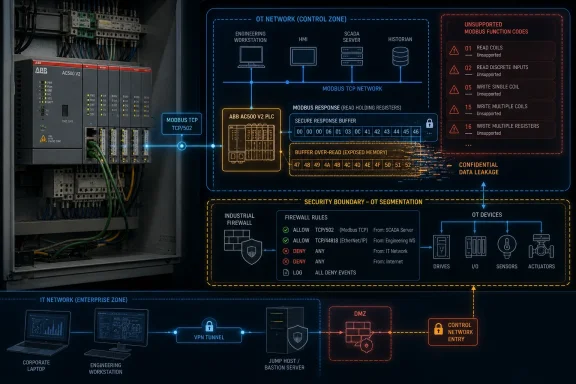 The Vulnerability Is Small, but the Trust Boundary Is Not
The ABB AC500 V2 issue is narrow on paper. Send unsupported Modbus function codes to the PLC’s Modbus server, and the device may return an invalid response padded with fragments of previous responses. ABB describes the exposure as a buffer over-read, mapped to CWE-126, with a CVSS 3.1 score of 5.8.That number will tempt some organizations to file the advisory under “routine maintenance.” There is no integrity impact in the CVSS vector, no direct availability impact, no required privileges, no user interaction, and no complex exploitation path. In ordinary enterprise software, that combination might sound like a Tuesday chore.
In operational technology, however, confidentiality is not a luxury field on a scoring rubric. A PLC’s communications can reveal process state, engineering assumptions, register layout, device behavior, and operational rhythm. Even if the leaked data is only a fragment, it may still be enough to help an attacker map a control environment that was never designed to be chatty with strangers.
The more important point is that the affected component is a Modbus server in a PLC deployed across critical manufacturing, energy, and water and wastewater environments. Modbus is old, simple, widely understood, and still everywhere. A bug in how a device handles unsupported function codes is not just a malformed-packet curiosity; it is a reminder that legacy protocol surfaces remain exposed in places where “just patch it” can be a months-long engineering project.
CISA’s Republication Turns a Vendor Advisory into an Operator Problem
ABB’s original advisory was issued in July 2025, with a later correction to affected product version information in May 2026. CISA’s May 26, 2026 republication does not appear to introduce a new exploit chain or change the technical substance of the vulnerability. It does something more mundane and more useful: it pushes the notice into the workflow of U.S.-focused industrial defenders.That matters because industrial advisories often live in a split reality. Vendors publish them, vulnerability databases ingest them, security teams skim them, and asset owners discover months later that the relevant device is buried behind a vendor support contract, a maintenance window, or a decade-old engineering workstation. Republication by CISA makes the advisory harder to ignore and easier to prioritize in governance processes.
The advisory also lands with an awkward footnote: the fixed version, AC500 V2 firmware 2.5.3, was released in 2016. That means the vulnerable versions are not merely “behind.” They are behind a fix that has existed for roughly a decade. This is not unusual in OT, but it is uncomfortable.
In consumer technology, a ten-year-old fix would usually end the discussion. In industrial environments, it starts one. Why is the older firmware still present? Was the PLC validated with a particular machine builder package? Is the site running a frozen image because downtime costs more than the perceived exposure? Did the control network drift from isolated to reachable through layers of remote access and integration middleware?
The advisory’s real value is not that it identifies one buffer over-read. It forces asset owners to ask whether their controls still match the assumptions under which that old firmware was allowed to remain in production.
Modbus Remains the Protocol That Assumes the Network Is Honest
The flaw sits in Modbus handling, and that detail should shape how defenders read the advisory. Modbus was not built around modern assumptions of hostile networks, authenticated sessions, encrypted channels, or least-privilege command paths. It was designed for straightforward industrial communications in environments where network access itself was treated as the security boundary.That design history still shapes the risk. If an attacker can send crafted or unsupported function codes to a PLC’s Modbus server, the defender’s first question should not be whether the specific bug is catastrophic. The first question should be why that attacker can reach the Modbus server at all.
ABB’s mitigation language reflects this reality. The vendor recommends not using the Modbus server to send sensitive data, because fragments may remain accessible after the original response, and warns that unsupported function codes can produce invalid responses with negative effects on requesting Modbus clients. CISA’s recommendations are the standard OT security canon: minimize network exposure, keep control systems off the public internet, isolate control networks from business networks, and use hardened remote access such as updated VPNs when remote access is unavoidable.
Those recommendations can sound boilerplate because they are repeated so often. But boilerplate in OT security is often a sign that the same failure mode keeps producing different advisories. Protocols built for trusted segments are repeatedly connected to broader networks, often through convenience, telemetry, remote maintenance, or corporate integration.
A medium-severity Modbus leak becomes much more concerning when it sits on a flat plant network, behind a shared VPN, or near an engineering station that also handles email and vendor downloads. The vulnerability is not just in a buffer. It is in the brittle assumption that only trusted systems can ask the PLC weird questions.
The CVSS Score Understates the Intelligence Value of Fragments
The disclosed impact is confidentiality. Specifically, an attacker could access fragments of earlier Modbus telegrams sent by the PLC. That is not the same as dumping a program, changing logic, stopping a process, or taking over a controller.But fragments can still matter. Industrial attackers often begin with reconnaissance: identifying device types, register maps, process variables, polling behavior, connected clients, and operational timing. A sliver of prior response data might reveal how a system is being queried, what values are changing, or which parts of the address space are in use.
This is especially relevant because successful OT intrusions usually depend less on Hollywood-style zero-days than on patient environment understanding. Attackers benefit from knowing which devices speak which protocol, which data points are meaningful, and how operators expect the process to behave. Information leakage can reduce that uncertainty.
The CVSS vector captures only part of that strategic picture. It says the attack is network-accessible, low-complexity, requires no privileges and no user interaction, changes scope, and has low confidentiality impact. That is technically fair. It is also incomplete as a risk-management story.
For a single isolated PLC, the practical impact may be modest. For a fleet of legacy controllers in a water facility, a manufacturing cell, or an energy site with inconsistent segmentation, the same bug becomes another low-friction probe surface. The attacker may not win with CVE-2025-7745 alone, but the defender may lose context one fragment at a time.
The Fix Exists, but the Maintenance Window Is the Hard Part
ABB states that AC500 V2 firmware version 2.5.3 and later resolve the vulnerability. The affected range is AC500 V2 firmware through 2.5.2, with the advisory’s version history noting a correction to the affected product version in May 2026. In plain terms, operators should verify whether their AC500 V2 devices are running at least 2.5.3.That sounds simple until it meets a production line. PLC firmware upgrades are not equivalent to updating a browser. They require compatibility checks, backups, vendor documentation, engineering validation, possible retesting of communications with HMIs and SCADA systems, and a maintenance window that operations will actually approve.
The uncomfortable detail is that 2.5.3 was released in 2016. If a site is still running firmware at or below 2.5.2 in 2026, there may be a reason. It may be a bad reason, but it is still a reason that security teams must understand before demanding action.
The correct response is not to treat the patch as optional. It is to treat patching as an engineering change. Inventory the controllers, confirm firmware versions, identify dependencies, stage upgrades where possible, and document compensating controls where immediate updates are not feasible.
That last phrase is often abused, but here it has real meaning. If a controller cannot be upgraded quickly, its Modbus exposure should be aggressively reduced. Only known clients should reach it. Unsupported function-code traffic should be treated as suspicious. Remote access paths should be reviewed with the assumption that an attacker will look for the easiest route into the control segment.
The Advisory’s Oddities Are a Warning About Supply-Chain Clarity
One line in the provided advisory text is likely to raise eyebrows: the acknowledgments say Reid Wightman of Dragos reported the vulnerabilities to Schneider Electric, even though the affected product is ABB AC500 V2. Elsewhere, the CVE record and ABB advisory credit Reid Wightman of Dragos for responsible disclosure to ABB. The discrepancy appears to be an artifact or editorial error in the converted advisory text rather than a technical statement about Schneider Electric products.This kind of confusion is not merely cosmetic. Industrial cybersecurity depends on precise product identification, because plants often contain gear from multiple vendors, integrators, and machine builders. A wrong vendor name in an acknowledgment will not change the vulnerability, but ambiguity in advisories can slow triage when teams are already sorting through hundreds of assets.
The CISA notice also includes an “advisory conversion” disclaimer explaining that the ICSA is a verbatim republication of ABB’s CSAF advisory and is provided as-is for visibility. That is useful transparency. It also means defenders should read converted advisories with care, especially when product trees, version ranges, and vendor language have been transformed across formats.
The revision history helps establish the timeline. ABB’s initial version appeared on July 23, 2025. A minor correction to the affected product version in the product tree followed on May 22, 2026. CISA republished the advisory on May 26, 2026. That sequence suggests the most recent development is not the discovery of a new bug but the cleanup and redistribution of an existing one.
For asset owners, the lesson is practical: do not rely on one field in one advisory. Confirm the product, firmware, and applicability against vendor documentation and actual device inventory. In OT, the difference between “not affected,” “fixed,” and “known affected” is not paperwork; it is whether a maintenance crew needs to touch a live control system.
Windows Shops Still Own Part of the OT Risk
WindowsForum readers may reasonably ask why an ABB PLC advisory belongs in a Windows-centered publication. The answer is that Windows is often the connective tissue around industrial control systems. Engineering workstations, HMI nodes, historian servers, remote access jump boxes, patch servers, and vendor support laptops frequently run Windows, even when the controller itself does not.That makes Windows environments part of the exposure chain. A PLC vulnerability may be reachable only from an internal control network, but the path to that network may run through a domain-joined workstation, a poorly segmented remote desktop server, or a VPN client installed on a contractor laptop. The PLC is the target; Windows is often the route.
This is where IT and OT arguments collide. IT teams tend to think in terms of patch cadence, endpoint detection, identity, and network controls. OT teams tend to think in terms of uptime, safety, vendor certification, and deterministic behavior. Both are right, and neither can solve this class of problem alone.
For Windows administrators supporting industrial sites, the advisory should trigger a review of adjacency. Which Windows hosts can reach AC500 V2 devices over Modbus TCP? Which users can log into those hosts? Are engineering laptops allowed to bridge corporate Wi-Fi and control networks? Are firewall rules written by asset role, or by historical convenience?
The vulnerability itself lives in ABB firmware. The blast radius is shaped by Windows-era enterprise habits: flat networks, shared credentials, unmanaged remote access, and incomplete asset inventories. Treating it as “an OT issue” is how low-severity findings become high-consequence incidents.
Detection Starts With the Traffic That Should Not Exist
The advisory’s exploit condition is useful for defenders because it involves unsupported Modbus function codes. That gives security teams something concrete to watch for, assuming they have visibility into control traffic. In a mature environment, unsupported or unusual Modbus function-code traffic to a PLC should be rare enough to investigate.This does not mean every malformed Modbus request is malicious. Misconfigured clients, vendor tools, scanners, and troubleshooting sessions can produce strange traffic. But in a control network, weird traffic deserves context, not indifference.
A practical detection strategy begins with baselining known clients. The PLC should not be answering arbitrary systems. If the only legitimate Modbus clients are a SCADA server and a gateway, then requests from an engineering workstation, a file server, or a remote access subnet should be treated as an exception.
Packet inspection can help, but it is not a substitute for architecture. If the network permits any host on a broad subnet to query a PLC’s Modbus server, detection becomes cleanup after a design failure. Segmentation is not exciting, but it is the difference between a vulnerability that requires physical or tightly controlled access and one that can be tickled from a compromised office machine.
The same applies to vulnerability scanning. Aggressive scanners and unsupported protocol probes can behave unpredictably around industrial devices. Any testing for CVE-2025-7745 should be coordinated with OT staff and performed in a controlled manner, ideally against representative equipment before touching production systems.
The Old-Firmware Problem Is Really an Accountability Problem
The most striking fact in the advisory is not the CVE number or the CVSS score. It is the existence of a fixed firmware release from 2016. If a site is still exposed in 2026, the technical question quickly becomes organizational: who owns the decision to remain on vulnerable firmware?In many industrial environments, that answer is scattered. Operations owns uptime. Engineering owns logic and vendor coordination. IT owns parts of the network. Security owns risk reporting. Procurement owns vendor relationships. The machine builder may own the original system image. Nobody, in practice, owns the firmware backlog.
This is why OT security programs often stall at inventory. Knowing that an AC500 V2 exists is useful. Knowing its firmware version is better. Knowing whether it can be upgraded, who must approve the upgrade, when the next outage window occurs, and what compensating controls apply until then is the difference between awareness and risk reduction.
The ABB advisory should therefore become a ticket, not just a notice. It should have an owner, an affected asset list, a target state, a decision deadline, and a record of compensating controls. If the answer is “we cannot patch now,” the next sentence should be “here is how we are reducing reachable exposure until we can.”
This is the discipline that separates mature OT security from advisory theater. The goal is not to eliminate every medium vulnerability overnight. The goal is to prevent old, understood, network-reachable weaknesses from lingering indefinitely because they fall between teams.
The Real Test Is Whether Modbus Is Still Treated as Local
CISA’s recommended practices are familiar because they are the bedrock of ICS defense. Minimize exposure. Keep control systems off the internet. Place control networks and remote devices behind firewalls. Isolate them from business networks. Use secure remote access methods and keep those methods updated.The challenge is that many organizations agree with those statements while maintaining exceptions that hollow them out. A vendor VPN terminates too broadly. A historian needs to feed business analytics. A remote desktop host straddles environments. A temporary firewall rule becomes permanent. A commissioning laptop becomes a trusted device because it has always been there.
CVE-2025-7745 is a good test case because it does not require an advanced attacker if the network path exists. The CVSS vector says no privileges are required and the attack complexity is low. That does not mean the internet can necessarily reach every affected PLC. It means the security boundary is the network.
If the Modbus server is reachable only from a small set of known systems, the risk is constrained. If it is reachable from broad internal ranges, the advisory becomes more urgent. If it is reachable from remote access infrastructure shared by vendors and administrators, the organization should assume the vulnerability is part of a larger attack surface.
The enduring mistake is to treat “not internet-facing” as a synonym for “safe.” Modern intrusions move laterally. Ransomware groups, espionage actors, and opportunistic criminals all understand that internal networks are often softer than the perimeter. In that world, internal protocol exposure is still exposure.
The AC500 V2 Advisory Leaves Operators With a Concrete Short List
The practical response to this advisory is neither panic nor dismissal. It is a disciplined check of firmware, reachability, and process assumptions. ABB has identified a fixed firmware line; CISA has amplified the notice; operators now need to decide whether the affected devices exist in their environments and whether those devices are reachable by systems that have no business talking Modbus to them.The work is unglamorous, but it is specific:
- Organizations should identify all ABB AC500 V2 controllers and verify whether any are running firmware version 2.5.2 or earlier.
- Sites that can upgrade should move affected controllers to firmware version 2.5.3 or later through a controlled OT change-management process.
- Sites that cannot upgrade immediately should restrict Modbus access to known, necessary clients and block broad network reachability.
- Security teams should monitor for unsupported or unusual Modbus function-code traffic directed at AC500 V2 devices.
- Administrators should review Windows-based engineering workstations, HMI systems, jump hosts, and VPN paths that can reach PLC networks.
- Risk owners should document any decision to defer firmware updates, including the operational reason, compensating controls, and next review date.
ABB’s AC500 V2 buffer over-read will probably not be remembered as the defining ICS vulnerability of 2026, and that is exactly why it is useful: it shows how much of industrial cybersecurity is decided before the exploit, in firmware hygiene, network design, remote-access discipline, and the willingness to treat small leaks in old systems as signals of larger architectural debt.
References
- Primary source: CISA
Published: 2026-05-26T12:00:00+00:00

ABB AC500 V2 | CISA
www.cisa.gov
- Related coverage: johnsoncontrols.com
