

CISA on May 28, 2026, warned that Jinan USR IOT Technology Limited’s PUSR USR-W610 RS232/485 to Wi-Fi/Ethernet converter firmware version 7.03T.07 contains hard-coded plaintext administrator credentials that can be extracted from the firmware and used to access device services. The advisory is small, but the blast radius is not: this is the kind of flaw that turns a humble serial gateway into a standing invitation for network intrusion. It also lands in a sector where replacement cycles are slow, asset inventories are incomplete, and “just patch it” often means “first find it.” The real story is not merely that one converter has a bad secret baked into its firmware; it is that industrial networking still depends on boxes that were never designed for the threat model now surrounding them.
The USR-W610 is not a glamorous device. It is the sort of converter that sits between legacy RS232 or RS485 equipment and modern IP networks, translating serial communications into Wi-Fi or Ethernet connectivity so older machinery can keep talking in newer environments. In critical manufacturing, that makes it useful, cheap, and easy to forget.
That last quality is what makes the advisory matter. A serial-to-network converter often lives in the space between operational technology and ordinary IT, where ownership is blurry and monitoring is uneven. It may not be a Windows server, a PLC, or a firewall, but it can still provide a path into environments where downtime is expensive and visibility is limited.
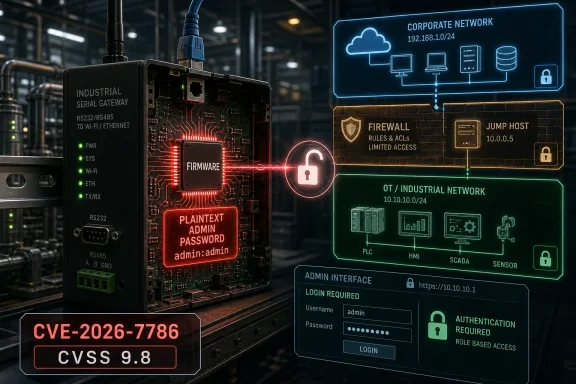
CISA’s description is blunt: the firmware contains plaintext administrative credentials embedded in the firmware image. An attacker who obtains and analyzes that firmware can extract the credentials and use them to authenticate to device services. The vulnerability is tracked as CVE-2026-7786 and carries a CVSS v3.1 score of 9.8, the familiar “critical” rating reserved for network-reachable bugs with low attack complexity and no user interaction.
The plain-English version is worse than the scorecard. This is not a speculative side channel or a difficult race condition. It is a secret that should not be there, stored in a way that turns firmware possession into administrative access.
That chain matters because users cannot rotate away a credential they do not know exists. If a password is set by an administrator, the administrator can change it. If a password is burned into firmware, the customer’s options narrow to segmentation, compensating controls, firmware replacement, or device removal. In industrial settings, those options often require maintenance windows, engineering approval, and a risk conversation that touches production, safety, and compliance.
CISA’s advisory says successful exploitation could allow an attacker to gain administrator access to the device. That phrasing should not be softened into “device compromise” and filed away. Administrator access to a gateway can mean configuration changes, traffic observation, network pivoting, service disruption, or the quiet manipulation of how legacy equipment is exposed to the rest of the network.
The important nuance is that CISA says no known public exploitation specifically targeting this vulnerability has been reported to the agency at the time of publication. That is reassuring only in the narrowest sense. It means defenders are not responding to a confirmed campaign, not that the vulnerability is harmless or that exploitation would be difficult once the credential is known.
That is not a criticism of CISA so much as an indictment of the industrial device ecosystem. When a vendor does not coordinate, customers are left to infer their own path forward. Is there a fixed firmware? Is version 7.03T.07 the only affected release because it is the only one tested, or because the vulnerable code was introduced there? Are older firmware branches affected? Are there hidden service ports that matter more than the web interface? Those are not academic questions when the affected device may be wired into a production line.
This is where vulnerability management becomes procurement history. The cheapest converter installed five years ago can become the most expensive security conversation in the building if the vendor cannot or will not provide a reliable fix. Asset owners then have to decide whether to isolate the device, replace it, or accept the residual risk.
For WindowsForum readers who spend their days in Microsoft estates, this may sound distant from the usual patch Tuesday grind. It is not. The same networks that run Windows engineering workstations, historians, jump boxes, remote access tools, and file shares frequently touch industrial equipment indirectly. A weak OT edge device is not a Windows vulnerability, but it can become a Windows incident.
That does not mean every device is immediately exploitable from the internet. CISA’s recommended practices focus on minimizing network exposure, ensuring control system devices are not internet-accessible, placing them behind firewalls, and isolating control system networks from business networks. Those recommendations imply the most important variable is not the code alone, but where the box sits.
If a USR-W610 is exposed directly to the public internet, the risk is obvious. If it is tucked behind a firewall but reachable from broad corporate address space, the risk is still serious because a compromised workstation can become the staging point. If it is accessible only from a tightly controlled engineering VLAN through monitored jump hosts, the flaw remains ugly but more manageable.
That distinction is not an excuse for inaction. It is a reminder that industrial security is usually won or lost in architecture before it is won or lost in patching. A hard-coded credential is a software defect; being able to reach the affected service from too many places is an operational defect.
That pattern matters more than any single CVE. When an embedded device accumulates authentication, credential, and management-plane weaknesses, defenders should treat it as a platform risk rather than a one-off bug. The question stops being “Can we mitigate this CVE?” and becomes “Do we trust this device class in this part of the network?”
Industrial sites often resist that framing because replacement is disruptive. A serial gateway may have been validated with a particular machine, configured by a vendor integrator, and left untouched because it works. The cost of changing it is not just the price of new hardware; it is the testing, downtime, documentation, and possible finger-pointing if something breaks.
Still, cumulative security debt has a way of converting inconvenience into urgency. A device that bridges old equipment into IP networks carries more responsibility than its price tag suggests. If its management plane is fragile, the organization inherits that fragility.
This does not make firmware distribution bad. Customers need firmware, researchers need to inspect it, and transparency is preferable to obscurity. The failure is shipping a credential whose secrecy depends on nobody looking.
For attackers, firmware analysis has the appeal of scale. A secret extracted once can potentially be tested wherever matching devices exist. That is especially dangerous for products deployed worldwide, as CISA says the USR-W610 is. The global deployment detail does not prove widespread exposure, but it does mean defenders should assume the affected product may exist outside any one regional procurement channel.
For defenders, the lesson is uncomfortable but useful. Firmware should be treated as evidence, not magic. If an organization relies on embedded devices in sensitive networks, it needs an inventory process that tracks firmware versions, management interfaces, vendor support status, and whether those devices can be reached from corporate or remote-access segments.
A vulnerable converter can sit near Windows systems in several ways. It may be managed from a Windows workstation. It may be reachable from a Windows jump server. It may feed data into applications running on Windows. It may be documented in a spreadsheet on a file share and forgotten until an incident responder asks what a strange IP address does.
That means Windows hardening still matters around a non-Windows device. Credential hygiene, privileged access management, host firewalls, EDR coverage, RDP restrictions, PowerShell logging, and network segmentation all shape whether a compromise of one component becomes a broader incident. The converter is the weak link only if the surrounding architecture lets it be.
This is also where identity and network boundaries collide. If engineering workstations have broad access to OT devices and ordinary corporate services, compromise of either side can bleed into the other. The right response to the advisory is not panic over a single model number; it is a careful review of which Windows systems can talk to industrial management interfaces and why.
But generic advice becomes useful only when translated into local action. For the USR-W610, that means finding devices first. Search asset inventories, DHCP logs, wireless controller records, switch MAC tables, firewall rules, procurement data, and maintenance documentation. The device may be labeled as PUSR, USR IOT, USR-W610, serial converter, Wi-Fi serial server, Ethernet converter, or simply as part of a machine vendor’s supplied package.
Once found, the next step is exposure mapping. Determine whether the management interface is reachable from the internet, corporate LANs, VPN pools, vendor remote-access networks, engineering workstations, or only from a restricted OT management segment. If the device is reachable from more places than necessary, reduce that reach before debating firmware strategy.
Then comes compensating control. Disable unnecessary services if the device supports it. Restrict inbound access with firewall rules. Require access through a jump host. Monitor connections to the device. Capture known-good configuration. Consider replacing the device if the vendor cannot provide a fixed firmware or a credible support response.
Attackers do not need public exploit chatter to exploit hard-coded credentials. They need the credential, a reachable service, and a reason to care. Industrial gateways are attractive because they can help with reconnaissance and persistence in places where defenders have fewer sensors than they do in enterprise IT.
The absence of reported exploitation is most useful for prioritization. It may mean emergency shutdowns are not warranted if the device is already isolated. It may mean a planned maintenance window is acceptable for low-exposure sites. It does not mean internet exposure can wait, or that flat network access from corporate endpoints is acceptable.
This is the familiar tension in vulnerability management: not every critical CVE is an immediate crisis, but every critical CVE demands a decision. The worst outcome is neither panic nor delay; it is ambiguity. Someone must own the device, own the risk, and own the timeline.
The broader supply-chain issue is not only where the vendor is headquartered or where the product is deployed. It is whether the vendor can participate in coordinated vulnerability disclosure, publish timely fixes, document affected versions, and give customers enough information to make safe decisions. When that process breaks, customers become their own product security teams.
That is an unreasonable burden for many small manufacturers, utilities, and industrial operators. They bought a converter to solve a connectivity problem, not to inherit firmware reverse-engineering obligations. Yet the advisory shows why procurement language increasingly needs to include vulnerability handling, firmware support windows, secure update mechanisms, and disclosure responsiveness.
For new purchases, buyers should ask whether the vendor has a security contact, publishes advisories, signs firmware, supports credential rotation, and documents end-of-life dates. For existing deployments, the question is harsher: if the vendor disappeared tomorrow, could the organization still operate and secure the device safely?
Replacement is not always simple. Serial communication settings, Wi-Fi behavior, Ethernet configuration, protocol timing, and machine-vendor support requirements can make a converter seem more specialized than it appears. A drop-in replacement may still require validation, especially in production environments.
But replacement should be considered when a device combines critical exposure with uncertain vendor support. A converter that cannot be trusted to protect its own administrative access should not sit in a privileged network position indefinitely. If it must remain, it should be treated like an untrusted legacy system and boxed in accordingly.
The practical middle ground is staged risk reduction. First remove internet exposure. Then limit internal reachability. Then verify firmware and configuration. Then engage the vendor or integrator. Then plan replacement if no satisfactory fix emerges. That order gives teams a path that improves security even before the final procurement decision is made.
The answer is often incomplete. Serial gateways, media converters, protocol bridges, wireless adapters, unmanaged switches, vendor modems, and engineering laptops form the connective tissue of industrial operations. They are small enough to be overlooked and important enough to matter.
A vulnerability like CVE-2026-7786 turns that ambiguity into risk. If a team cannot quickly determine whether it has affected devices, the first remediation task is inventory, not patching. That can feel unsatisfying because it does not produce an immediate fix, but it produces something more durable: control.
Good inventory also changes the quality of future responses. The next advisory involving a serial gateway should not trigger a scavenger hunt through cabinets and vendor binders. It should trigger a query, a network validation step, and a known escalation path.
The next phase of industrial security will not be won by advisories alone. It will be won by organizations that know where their edge devices are, isolate them before a CVE makes the news, and demand that vendors treat firmware secrets as security liabilities rather than manufacturing conveniences. CVE-2026-7786 is a critical flaw in one product version, but it is also a reminder that the industrial network perimeter is no longer the firewall; it is every forgotten box that can still authenticate as administrator.
 A Serial Gateway Becomes an Identity Crisis
The USR-W610 is not a glamorous device. It is the sort of converter that sits between legacy RS232 or RS485 equipment and modern IP networks, translating serial communications into Wi-Fi or Ethernet connectivity so older machinery can keep talking in newer environments. In critical manufacturing, that makes it useful, cheap, and easy to forget.That last quality is what makes the advisory matter. A serial-to-network converter often lives in the space between operational technology and ordinary IT, where ownership is blurry and monitoring is uneven. It may not be a Windows server, a PLC, or a firewall, but it can still provide a path into environments where downtime is expensive and visibility is limited.
CISA’s description is blunt: the firmware contains plaintext administrative credentials embedded in the firmware image. An attacker who obtains and analyzes that firmware can extract the credentials and use them to authenticate to device services. The vulnerability is tracked as CVE-2026-7786 and carries a CVSS v3.1 score of 9.8, the familiar “critical” rating reserved for network-reachable bugs with low attack complexity and no user interaction.
The plain-English version is worse than the scorecard. This is not a speculative side channel or a difficult race condition. It is a secret that should not be there, stored in a way that turns firmware possession into administrative access.
Hard-Coded Credentials Are Not a Bug Class, They Are a Governance Failure
Hard-coded credentials have been embarrassing vendors for decades because they represent a failure at multiple layers at once. The developer knew, or inherited, an account that needed to exist. The build process allowed it into production. The product security review did not catch it. The release process shipped it. The vendor support model then left customers dependent on whatever the manufacturer chooses to do next.That chain matters because users cannot rotate away a credential they do not know exists. If a password is set by an administrator, the administrator can change it. If a password is burned into firmware, the customer’s options narrow to segmentation, compensating controls, firmware replacement, or device removal. In industrial settings, those options often require maintenance windows, engineering approval, and a risk conversation that touches production, safety, and compliance.
CISA’s advisory says successful exploitation could allow an attacker to gain administrator access to the device. That phrasing should not be softened into “device compromise” and filed away. Administrator access to a gateway can mean configuration changes, traffic observation, network pivoting, service disruption, or the quiet manipulation of how legacy equipment is exposed to the rest of the network.
The important nuance is that CISA says no known public exploitation specifically targeting this vulnerability has been reported to the agency at the time of publication. That is reassuring only in the narrowest sense. It means defenders are not responding to a confirmed campaign, not that the vulnerability is harmless or that exploitation would be difficult once the credential is known.
The Vendor Silence Is Part of the Vulnerability
The most consequential line in the advisory may be the one saying Jinan USR IOT Technology Limited did not respond to CISA’s attempts at coordination. In ordinary enterprise software, a critical vulnerability disclosure usually comes with a patched version, a mitigation matrix, a vendor statement, and a clock that starts ticking for administrators. Here, CISA’s remediation guidance is essentially to contact the vendor and keep systems up to date.That is not a criticism of CISA so much as an indictment of the industrial device ecosystem. When a vendor does not coordinate, customers are left to infer their own path forward. Is there a fixed firmware? Is version 7.03T.07 the only affected release because it is the only one tested, or because the vulnerable code was introduced there? Are older firmware branches affected? Are there hidden service ports that matter more than the web interface? Those are not academic questions when the affected device may be wired into a production line.
This is where vulnerability management becomes procurement history. The cheapest converter installed five years ago can become the most expensive security conversation in the building if the vendor cannot or will not provide a reliable fix. Asset owners then have to decide whether to isolate the device, replace it, or accept the residual risk.
For WindowsForum readers who spend their days in Microsoft estates, this may sound distant from the usual patch Tuesday grind. It is not. The same networks that run Windows engineering workstations, historians, jump boxes, remote access tools, and file shares frequently touch industrial equipment indirectly. A weak OT edge device is not a Windows vulnerability, but it can become a Windows incident.
The Score Is Critical Because the Attack Path Is Boring
A 9.8 CVSS score can sometimes feel abstract. In this case, the path to harm is almost offensively mundane: obtain firmware, inspect it, extract a credential, authenticate over the network, and administer the device. No phishing email is required. No victim clicks a link. No local foothold is assumed by the vector string.That does not mean every device is immediately exploitable from the internet. CISA’s recommended practices focus on minimizing network exposure, ensuring control system devices are not internet-accessible, placing them behind firewalls, and isolating control system networks from business networks. Those recommendations imply the most important variable is not the code alone, but where the box sits.
If a USR-W610 is exposed directly to the public internet, the risk is obvious. If it is tucked behind a firewall but reachable from broad corporate address space, the risk is still serious because a compromised workstation can become the staging point. If it is accessible only from a tightly controlled engineering VLAN through monitored jump hosts, the flaw remains ugly but more manageable.
That distinction is not an excuse for inaction. It is a reminder that industrial security is usually won or lost in architecture before it is won or lost in patching. A hard-coded credential is a software defect; being able to reach the affected service from too many places is an operational defect.
The Earlier USR-W610 Advisories Made This Less Surprising
This is not the first time the USR-W610 has appeared in industrial security advisories this year. Earlier reporting around the same product family described multiple weaknesses affecting the device, including issues involving weak password handling, cleartext transmission of sensitive information, insufficiently protected credentials, and missing authentication for critical functions. The new advisory is narrower, but it fits the same pattern.That pattern matters more than any single CVE. When an embedded device accumulates authentication, credential, and management-plane weaknesses, defenders should treat it as a platform risk rather than a one-off bug. The question stops being “Can we mitigate this CVE?” and becomes “Do we trust this device class in this part of the network?”
Industrial sites often resist that framing because replacement is disruptive. A serial gateway may have been validated with a particular machine, configured by a vendor integrator, and left untouched because it works. The cost of changing it is not just the price of new hardware; it is the testing, downtime, documentation, and possible finger-pointing if something breaks.
Still, cumulative security debt has a way of converting inconvenience into urgency. A device that bridges old equipment into IP networks carries more responsibility than its price tag suggests. If its management plane is fragile, the organization inherits that fragility.
Firmware Is the New Password Vault Attack Surface
The advisory’s most interesting phrase is “firmware analysis.” It points to a reality that defenders sometimes underweight: attackers do not need to find your exact device first if they can analyze the same firmware offline. Embedded firmware images routinely contain file systems, scripts, binaries, configuration defaults, keys, certificates, and forgotten diagnostic artifacts. When vendors publish firmware updates without protecting secrets, they also publish a map.This does not make firmware distribution bad. Customers need firmware, researchers need to inspect it, and transparency is preferable to obscurity. The failure is shipping a credential whose secrecy depends on nobody looking.
For attackers, firmware analysis has the appeal of scale. A secret extracted once can potentially be tested wherever matching devices exist. That is especially dangerous for products deployed worldwide, as CISA says the USR-W610 is. The global deployment detail does not prove widespread exposure, but it does mean defenders should assume the affected product may exist outside any one regional procurement channel.
For defenders, the lesson is uncomfortable but useful. Firmware should be treated as evidence, not magic. If an organization relies on embedded devices in sensitive networks, it needs an inventory process that tracks firmware versions, management interfaces, vendor support status, and whether those devices can be reached from corporate or remote-access segments.
The Windows Angle Is the Jump Box, Not the Converter
Windows administrators may be tempted to categorize this as an OT team problem. That division is tidy on an org chart and dangerous on a network diagram. Industrial environments often rely on Windows systems for engineering software, remote desktop access, data collection, domain services, update staging, and vendor support sessions.A vulnerable converter can sit near Windows systems in several ways. It may be managed from a Windows workstation. It may be reachable from a Windows jump server. It may feed data into applications running on Windows. It may be documented in a spreadsheet on a file share and forgotten until an incident responder asks what a strange IP address does.
That means Windows hardening still matters around a non-Windows device. Credential hygiene, privileged access management, host firewalls, EDR coverage, RDP restrictions, PowerShell logging, and network segmentation all shape whether a compromise of one component becomes a broader incident. The converter is the weak link only if the surrounding architecture lets it be.
This is also where identity and network boundaries collide. If engineering workstations have broad access to OT devices and ordinary corporate services, compromise of either side can bleed into the other. The right response to the advisory is not panic over a single model number; it is a careful review of which Windows systems can talk to industrial management interfaces and why.
CISA’s Mitigations Are Generic Because the Fix Is Local
CISA’s recommended practices will look familiar to anyone who has read an ICS advisory: minimize exposure, keep control system devices off the internet, put them behind firewalls, isolate control networks from business networks, and use secure remote access such as VPNs when remote connectivity is required. The repetition is easy to mock. It is also necessary because the same architectural failures keep turning product bugs into incidents.But generic advice becomes useful only when translated into local action. For the USR-W610, that means finding devices first. Search asset inventories, DHCP logs, wireless controller records, switch MAC tables, firewall rules, procurement data, and maintenance documentation. The device may be labeled as PUSR, USR IOT, USR-W610, serial converter, Wi-Fi serial server, Ethernet converter, or simply as part of a machine vendor’s supplied package.
Once found, the next step is exposure mapping. Determine whether the management interface is reachable from the internet, corporate LANs, VPN pools, vendor remote-access networks, engineering workstations, or only from a restricted OT management segment. If the device is reachable from more places than necessary, reduce that reach before debating firmware strategy.
Then comes compensating control. Disable unnecessary services if the device supports it. Restrict inbound access with firewall rules. Require access through a jump host. Monitor connections to the device. Capture known-good configuration. Consider replacing the device if the vendor cannot provide a fixed firmware or a credible support response.
“No Known Exploitation” Is Not a Waiting Strategy
The advisory says CISA has not received reports of known public exploitation specifically targeting this vulnerability. That sentence will be copied into risk registers as a reason to defer work. It should instead be read as a narrow statement about current reporting, not a guarantee about attacker interest.Attackers do not need public exploit chatter to exploit hard-coded credentials. They need the credential, a reachable service, and a reason to care. Industrial gateways are attractive because they can help with reconnaissance and persistence in places where defenders have fewer sensors than they do in enterprise IT.
The absence of reported exploitation is most useful for prioritization. It may mean emergency shutdowns are not warranted if the device is already isolated. It may mean a planned maintenance window is acceptable for low-exposure sites. It does not mean internet exposure can wait, or that flat network access from corporate endpoints is acceptable.
This is the familiar tension in vulnerability management: not every critical CVE is an immediate crisis, but every critical CVE demands a decision. The worst outcome is neither panic nor delay; it is ambiguity. Someone must own the device, own the risk, and own the timeline.
The Supply Chain Lesson Is Written in Plaintext
Industrial cybersecurity has spent years warning about sophisticated supply-chain attacks, but many real-world failures remain painfully basic. A plaintext administrative credential in firmware is not a nation-state masterstroke. It is a preventable design mistake with outsized consequences because the affected product lives in environments where availability and trust matter.The broader supply-chain issue is not only where the vendor is headquartered or where the product is deployed. It is whether the vendor can participate in coordinated vulnerability disclosure, publish timely fixes, document affected versions, and give customers enough information to make safe decisions. When that process breaks, customers become their own product security teams.
That is an unreasonable burden for many small manufacturers, utilities, and industrial operators. They bought a converter to solve a connectivity problem, not to inherit firmware reverse-engineering obligations. Yet the advisory shows why procurement language increasingly needs to include vulnerability handling, firmware support windows, secure update mechanisms, and disclosure responsiveness.
For new purchases, buyers should ask whether the vendor has a security contact, publishes advisories, signs firmware, supports credential rotation, and documents end-of-life dates. For existing deployments, the question is harsher: if the vendor disappeared tomorrow, could the organization still operate and secure the device safely?
The Real Remediation May Be Replacement
CISA’s advisory does not identify a patched firmware version. It says the vendor did not respond to coordination attempts and encourages users to contact the vendor and keep systems up to date. That leaves replacement on the table earlier than many organizations would like.Replacement is not always simple. Serial communication settings, Wi-Fi behavior, Ethernet configuration, protocol timing, and machine-vendor support requirements can make a converter seem more specialized than it appears. A drop-in replacement may still require validation, especially in production environments.
But replacement should be considered when a device combines critical exposure with uncertain vendor support. A converter that cannot be trusted to protect its own administrative access should not sit in a privileged network position indefinitely. If it must remain, it should be treated like an untrusted legacy system and boxed in accordingly.
The practical middle ground is staged risk reduction. First remove internet exposure. Then limit internal reachability. Then verify firmware and configuration. Then engage the vendor or integrator. Then plan replacement if no satisfactory fix emerges. That order gives teams a path that improves security even before the final procurement decision is made.
The Small Box That Forces a Bigger Inventory Conversation
The USR-W610 advisory is useful because it forces a question many organizations avoid: do you actually know what is connected to your industrial network? Not in the abstract, not in a compliance spreadsheet last updated during an audit, but in a way that connects device model, firmware version, IP address, physical location, business owner, and network exposure.The answer is often incomplete. Serial gateways, media converters, protocol bridges, wireless adapters, unmanaged switches, vendor modems, and engineering laptops form the connective tissue of industrial operations. They are small enough to be overlooked and important enough to matter.
A vulnerability like CVE-2026-7786 turns that ambiguity into risk. If a team cannot quickly determine whether it has affected devices, the first remediation task is inventory, not patching. That can feel unsatisfying because it does not produce an immediate fix, but it produces something more durable: control.
Good inventory also changes the quality of future responses. The next advisory involving a serial gateway should not trigger a scavenger hunt through cabinets and vendor binders. It should trigger a query, a network validation step, and a known escalation path.
The Defender’s Checklist for This Particular Converter
This advisory is not a reason to tear apart every industrial network overnight, but it is a reason to move from vague concern to concrete action. The USR-W610 sits at the intersection of legacy connectivity and modern attack paths, and that intersection deserves more attention than it usually gets.- Organizations should identify whether any PUSR or Jinan USR IOT USR-W610 devices are deployed, especially units running firmware version 7.03T.07.
- Administrators should verify that affected devices are not reachable from the public internet or broad corporate networks.
- OT and IT teams should restrict management access to known engineering hosts or jump systems and monitor connections to the device.
- Security teams should treat the lack of vendor coordination as a risk factor when deciding whether segmentation is enough or replacement is required.
- Procurement teams should use this incident to require clearer firmware support, vulnerability disclosure, and credential-management commitments from embedded-device vendors.
- Incident response teams should investigate suspicious access to affected devices if logs, firewall records, or network telemetry show unexpected management connections.
The next phase of industrial security will not be won by advisories alone. It will be won by organizations that know where their edge devices are, isolate them before a CVE makes the news, and demand that vendors treat firmware secrets as security liabilities rather than manufacturing conveniences. CVE-2026-7786 is a critical flaw in one product version, but it is also a reminder that the industrial network perimeter is no longer the firewall; it is every forgotten box that can still authenticate as administrator.
References
- Primary source: CISA
Published: 2026-05-28T12:00:00+00:00
- Related coverage: hendryadrian.com
Jinan USR IOT Technology Limited (PUSR) USR-W610 | CISA
Multiple critical vulnerabilities (CVE-2026-25715, CVE-2026-24455, CVE-2026-26049, CVE-2026-26048) in the Jinan USR IOT PUSR USR-W610 (...www.hendryadrian.com - Related coverage: incibe.es
Múltiples vulnerabilidades en USR-W610 de Jinan USR IOT Technology Limited | INCIBE-CERT | INCIBE
Abhishek Pandey y Ranit Pradhan de Payatu Security Consulting han informado de 4 vulnerabilidades, 1 dwww.incibe.es
- Related coverage: radar.offseq.com
CVE-2026-24455: CWE-319 in Jinan USR IOT Technology Limited (PUSR) USR-W610 - Live Threat Intelligence - Threat Radar | OffSeq.com
Detailed information about CVE-2026-24455: CWE-319 in Jinan USR IOT Technology Limited (PUSR) USR-W610 affecting Jinan USR IOT Technology Limited (PUSR) USR-W61radar.offseq.com - Related coverage: beyondmachines.net
Critical Vulnerabilities Reported in PUSR USR-W610 Industrial IoT Devices
CISA and Jinan USR IOT Technology Limited report four vulnerabilities in its USR-W610 industrial converters, including a critical flaw that allows full administrative access via blank credentials. As the product is end-of-life and will not receive patches.beyondmachines.net
- Related coverage: windowsforum.com
High Severity ICS Advisory Hits USR W610 Serial Gateway (CVE-2026-25715 to CVE-2026-26048) | Windows Forum
Jinan USR IOT Technology’s USR‑W610 serial‑to‑Wi‑Fi/ Ethernet converter is the subject of a high‑severity Industrial Control Systems advisory that names...windowsforum.com
- Related coverage: hivepro.com
