

CISA on June 4, 2026 republished Hitachi Energy’s May 26 advisory for ITT600 SA Explorer, warning that two high-severity libexpat-related vulnerabilities can let an attacker trigger denial of service when IEC 61850 server simulation is used in affected versions. That sentence is the operational core of the bulletin, but it undersells the real lesson. This is not a story about a dramatic grid compromise or a remote takeover of substation endpoints. It is a reminder that engineering workstations, test utilities, and protocol simulators have become part of the industrial attack surface whether asset owners treat them that way or not.
Hitachi Energy’s ITT600 SA Explorer is not a household name outside substation automation circles, but it occupies a familiar and sensitive niche. It is a Windows-based engineering and testing tool used to inspect, troubleshoot, simulate, and validate IEC 61850 environments — the digital language of modern substations, protection devices, and automation systems.
The advisory is careful to say that the vulnerabilities affect the ITT600 Explorer product, not IEC 61850 system endpoints themselves. That distinction matters. A vulnerable copy of ITT600 is not the same as a vulnerable relay, bay controller, or protection IED sitting in the field.
But the distinction should not be mistaken for comfort. In industrial environments, tools often travel farther than production systems. Laptops move between substations. Test benches mirror live networks. Engineering stations connect to segmented environments precisely because they need privileged visibility. A denial-of-service bug in such a tool may not trip a breaker, but it can blind or delay the people responsible for diagnosing one.
The affected product versions are ITT600 Explorer before 2.1 SP6 and ITT600 Explorer 2.1 SP6 and earlier, depending on which of the two CVEs is in view. Hitachi Energy’s immediate fix is to update to 2.1 SP6 HF1, with version 2.2 positioned as the future upgrade path when available.
That makes this a straightforward patch story on paper. In the field, however, straightforward patch stories in operational technology rarely stay straightforward for long.
The first issue, CVE-2024-8176, is a stack overflow vulnerability in libexpat, the widely used XML parsing library. In this product, the vulnerable code path is tied to IEC 61850 functionality, and exploitation depends on the IEC 61850 server simulation feature being used. A crafted IEC 61850 message can trigger denial of service and, depending on environment and library usage, may lead to exploitable memory corruption.
The second issue, CVE-2025-59375, also sits in libexpat. Here the problem is uncontrolled resource allocation: a small document submitted for parsing can cause large dynamic memory allocations. Again, Hitachi Energy says ITT600 is affected only when IEC 61850 server simulation is used.
That condition is doing a lot of work. It means organizations that never use server simulation have a narrower exposure. It also means organizations that do use simulation — often the ones doing integration testing, commissioning, or troubleshooting — are exposed at exactly the moment the tool is placed into a more active role on the network.
Industrial advisories frequently contain these “only if” clauses, and they are important. They can prevent overreaction. But they can also create a false sense of exemption if asset owners do not know how their engineers actually use the software during maintenance windows, factory acceptance testing, or emergency support.
That is not negligence by default. Industrial vendors have legitimate reasons to test cautiously. A patch that destabilizes an engineering tool used during commissioning can create operational risk of its own. But the result is an awkward inversion: the more critical the environment, the more conservative the update process, and therefore the longer third-party components may remain exposed.
This is one reason parser bugs are especially persistent in operational technology. They are not glamorous, but they are reusable. Attackers do not need to understand every nuance of a power utility’s protection scheme if they can make a trusted tool choke on a crafted input. Defensive teams, meanwhile, have to map not just products but embedded libraries across software that may not behave like ordinary enterprise inventory.
The advisory’s wording also hints at a useful boundary. The vulnerabilities do not appear to be framed as direct compromise of deployed IEC 61850 endpoints. They are framed as attacks against the testing tool when a specific simulation function is in use. That narrows the blast radius, but it does not erase the operational effect of losing the tool during a live investigation or commissioning sequence.
In WindowsForum terms, this is the industrial equivalent of a driver utility, hypervisor console, or firmware flashing application becoming the weakest point in a workflow. The vulnerable application is not the production workload. It is the thing trusted to manage, inspect, or emulate the production workload.
A vendor PSIRT bulletin tends to reach product owners, support contacts, and security mailing lists. A CISA ICS advisory lands in the broader workflow of vulnerability managers, managed security providers, auditors, and critical infrastructure defenders. It becomes a queue item. It becomes something a compliance team may ask about. It becomes a reason to look for a piece of software that may otherwise be missing from the asset register.
The release chronology is also useful. Hitachi Energy’s initial public release was May 26, 2026. CISA’s republication followed on June 4, 2026. That nine-day gap is not unusual for ICS advisory handling, but it is a reminder that vendor security information and government-facing operational alerts do not always appear simultaneously.
For defenders, the chronology matters less than the action. If ITT600 SA Explorer is installed anywhere in the environment, the question is whether it is at 2.1 SP6 HF1 or whether a compensating control exists until the update can be applied. If the tool is not installed, the advisory is still a prompt to check engineering laptops, vendor jump boxes, and offline test machines — the places inventory tools often miss.
The advisory also says Hitachi Energy’s internal team reported the vulnerabilities. That is a better fact pattern than active exploitation, public proof-of-concept code, or a third-party disclosure race. There is no need to inflate the story into a crisis. But there is also no reason to let “internally reported” become a synonym for “safe to ignore.”
The practical wrinkle in this case is that the affected thing may not be a rack-mounted control system device. It may be a Windows workstation or laptop used by protection engineers. It may connect only occasionally. It may live in a contractor’s kit. It may be patched outside the central IT process or not patched at all unless a project requires it.
That is where Windows administrators and OT engineers often talk past each other. IT wants agents, central inventory, update rings, and vulnerability dashboards. OT wants validated toolchains, stable configurations, and the ability to keep working when a substation visit has a fixed maintenance window. Both sides are right, and both sides can create risk when they pretend the other side’s constraints are optional.
The ITT600 advisory is a small but useful test case for whether an organization has bridged that gap. Can it identify where the tool is installed? Can it determine whether server simulation is used? Can it confirm the exact installed version? Can it update without breaking project files, licensing, or compatibility with existing substation configurations?
Those are not abstract governance questions. They are the difference between a vulnerability that is remediated in a week and one that remains on a forgotten laptop until the next outage review.
During commissioning, simulation can be a safety mechanism. During troubleshooting, it can be the fastest way to separate a device fault from a configuration fault. During training, it can keep less experienced staff away from live systems. In other words, the vulnerable mode may be used by the very teams trying to reduce risk elsewhere.
That is why mitigation cannot be reduced to “do not use the feature” unless the organization understands the consequences. Disabling or avoiding server simulation might be appropriate temporarily, but it may also push engineers toward less controlled workarounds. In industrial environments, workarounds have a way of becoming undocumented architecture.
The better approach is boring and specific: update the product where possible, restrict who can send traffic to machines running the tool, keep simulation environments segmented, and treat engineering workstations as privileged assets. If server simulation must remain in use before the update is applied, it should not be exposed to broad network segments where untrusted or poorly controlled traffic can reach it.
The advisory’s CVSS vector says network attack complexity is low and no privileges are required. That does not mean the whole internet can exploit every installation. It means that once an attacker can reach the vulnerable service or parsing path, the exploit conditions are not supposed to be especially demanding. Network segmentation is therefore not decorative. It is part of the vulnerability’s real-world severity.
Organizations will want to test the hotfix against existing project files, licensing arrangements, operating system baselines, and workflow integrations. They should also verify whether multiple versions are installed side by side, whether portable installation media exist, and whether contractors bring their own copies into controlled environments.
This is where many vulnerability programs stumble. They track servers and cloud workloads better than they track specialist desktop applications. They know which Windows builds are deployed, but not always which engineering packages sit on which machines. They can report missing cumulative updates, but not always whether a niche substation tool is at SP6 or SP6 HF1.
For Windows administrators supporting OT groups, the answer is not to force every engineering laptop into the same update model as office desktops. The answer is to create a separate, explicit model for engineering assets. Those machines need asset ownership, approved software lists, controlled update windows, backup and rollback plans, and a path for emergency remediation when a vendor advisory crosses a risk threshold.
That sounds bureaucratic until the day an engineering laptop fails during a maintenance window and nobody knows whether the failure was caused by malware, a vulnerable parser, an incompatible hotfix, or an unsupported workaround. Good process is not paperwork for its own sake. It is how teams make changes without improvising under operational pressure.
But the pattern is larger than ITT600. Industrial environments are full of tools that parse complex files, emulate protocols, discover devices, ingest network traffic, and run on Windows systems that sit between corporate IT and operational equipment. They are powerful because they understand the control environment. They are risky for the same reason.
The industry has spent years teaching itself to protect programmable logic controllers, remote terminal units, protection relays, and SCADA servers. It has been slower to elevate the software used to configure and test those systems. Attackers notice these asymmetries. So do incident responders, who often find that the path into an OT environment runs through credentials, laptops, remote access tooling, or vendor support workflows rather than through a cinematic exploit against a field device.
There is also a supply-chain angle, though not the sensational kind. The vulnerable component is a library. The affected product is a vendor application. The operational impact belongs to the asset owner. Responsibility is distributed, but remediation still has to happen somewhere concrete: on a machine, in a maintenance plan, under an accountable owner.
That is the uncomfortable beauty of advisories like this. They collapse abstract cybersecurity language into a simple inventory question: where is this software, who uses it, and what version is installed?
A hardened Windows engineering workstation can reduce risk materially. Local administrator rights can be constrained. Application control can limit unauthorized tools. Firewalls can restrict inbound traffic. EDR can help, where operational constraints allow it. Removable media policies can reduce one of the oldest and most persistent OT infection paths.
But those controls must be designed with the engineering workflow in mind. A workstation that cannot run required vendor tools will be bypassed. A security agent that interferes with packet capture or protocol simulation will be disabled. A patch policy that breaks a commissioning tool the night before a site visit will teach engineers to avoid central management.
The goal is not to make OT Windows machines identical to office laptops. The goal is to make them visible, governed, and defensible without making them useless. ITT600’s libexpat issue is exactly the kind of advisory that can start that conversation because it is specific enough to act on and limited enough not to trigger panic.
It also reinforces why “air-gapped” should be treated as a claim to verify, not a strategy to recite. Engineering laptops cross boundaries. Vendor support sessions cross boundaries. File transfers cross boundaries. Even when production networks are well segmented, the support ecosystem around them can be porous.
Until updates are applied, exposure should be reduced around systems running the tool. That means limiting which networks can reach engineering workstations, avoiding unnecessary simulation exposure, keeping test environments isolated, and ensuring remote access paths are patched and controlled. The advisory’s generic mitigations become much more useful when translated into the specific topology around the workstation.
Security teams should also resist the urge to treat this as solely an OT problem. If the vulnerable software runs on Windows, then Windows inventory, endpoint hardening, software deployment, and access control all matter. If those functions stop at the business network boundary, they are stopping too early.
The best outcome from this advisory would be more than a hotfix. It would be an updated inventory of engineering tools, a cleaner owner map for OT workstations, and a habit of tracking third-party libraries in specialized industrial software. That may sound ambitious for a two-CVE bulletin, but small advisories are often where mature programs prove themselves.
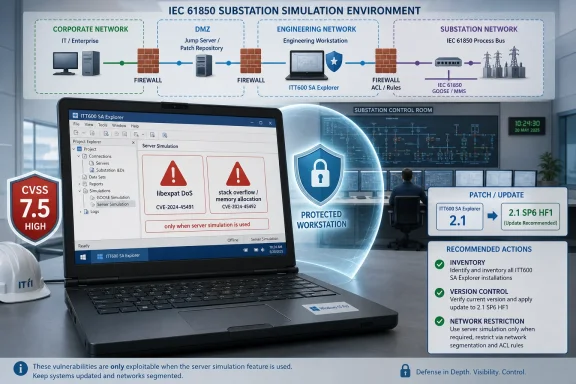 The Weak Link Is the Tool Sitting Beside the Substation
Hitachi Energy’s ITT600 SA Explorer is not a household name outside substation automation circles, but it occupies a familiar and sensitive niche. It is a Windows-based engineering and testing tool used to inspect, troubleshoot, simulate, and validate IEC 61850 environments — the digital language of modern substations, protection devices, and automation systems.The advisory is careful to say that the vulnerabilities affect the ITT600 Explorer product, not IEC 61850 system endpoints themselves. That distinction matters. A vulnerable copy of ITT600 is not the same as a vulnerable relay, bay controller, or protection IED sitting in the field.
But the distinction should not be mistaken for comfort. In industrial environments, tools often travel farther than production systems. Laptops move between substations. Test benches mirror live networks. Engineering stations connect to segmented environments precisely because they need privileged visibility. A denial-of-service bug in such a tool may not trip a breaker, but it can blind or delay the people responsible for diagnosing one.
The affected product versions are ITT600 Explorer before 2.1 SP6 and ITT600 Explorer 2.1 SP6 and earlier, depending on which of the two CVEs is in view. Hitachi Energy’s immediate fix is to update to 2.1 SP6 HF1, with version 2.2 positioned as the future upgrade path when available.
That makes this a straightforward patch story on paper. In the field, however, straightforward patch stories in operational technology rarely stay straightforward for long.
A High CVSS Score Meets a Narrow Trigger
Both vulnerabilities carry a CVSS 3.1 base score of 7.5, which puts them in the high-severity bracket. The vector is network-adjacent in practical consequence: no privileges, no user interaction, low attack complexity, and high impact to availability. Confidentiality and integrity are not the advertised problem; keeping the tool running is.The first issue, CVE-2024-8176, is a stack overflow vulnerability in libexpat, the widely used XML parsing library. In this product, the vulnerable code path is tied to IEC 61850 functionality, and exploitation depends on the IEC 61850 server simulation feature being used. A crafted IEC 61850 message can trigger denial of service and, depending on environment and library usage, may lead to exploitable memory corruption.
The second issue, CVE-2025-59375, also sits in libexpat. Here the problem is uncontrolled resource allocation: a small document submitted for parsing can cause large dynamic memory allocations. Again, Hitachi Energy says ITT600 is affected only when IEC 61850 server simulation is used.
That condition is doing a lot of work. It means organizations that never use server simulation have a narrower exposure. It also means organizations that do use simulation — often the ones doing integration testing, commissioning, or troubleshooting — are exposed at exactly the moment the tool is placed into a more active role on the network.
Industrial advisories frequently contain these “only if” clauses, and they are important. They can prevent overreaction. But they can also create a false sense of exemption if asset owners do not know how their engineers actually use the software during maintenance windows, factory acceptance testing, or emergency support.
The XML Parser Is the Quiet Guest in the Control Room
The presence of libexpat is unsurprising. XML parsing is woven deeply into modern software, and IEC 61850 environments use structured configuration and messaging concepts that naturally intersect with parser-heavy code. The uncomfortable part is not that an industrial tool embeds a common open-source library. The uncomfortable part is that common libraries can become long-lived dependencies inside specialized engineering software that is updated on a slower and more cautious cadence than consumer or enterprise applications.That is not negligence by default. Industrial vendors have legitimate reasons to test cautiously. A patch that destabilizes an engineering tool used during commissioning can create operational risk of its own. But the result is an awkward inversion: the more critical the environment, the more conservative the update process, and therefore the longer third-party components may remain exposed.
This is one reason parser bugs are especially persistent in operational technology. They are not glamorous, but they are reusable. Attackers do not need to understand every nuance of a power utility’s protection scheme if they can make a trusted tool choke on a crafted input. Defensive teams, meanwhile, have to map not just products but embedded libraries across software that may not behave like ordinary enterprise inventory.
The advisory’s wording also hints at a useful boundary. The vulnerabilities do not appear to be framed as direct compromise of deployed IEC 61850 endpoints. They are framed as attacks against the testing tool when a specific simulation function is in use. That narrows the blast radius, but it does not erase the operational effect of losing the tool during a live investigation or commissioning sequence.
In WindowsForum terms, this is the industrial equivalent of a driver utility, hypervisor console, or firmware flashing application becoming the weakest point in a workflow. The vulnerable application is not the production workload. It is the thing trusted to manage, inspect, or emulate the production workload.
CISA’s Republication Turns a Vendor Bulletin Into an Operations Signal
The CISA posting is not an original investigation so much as a republication of Hitachi Energy’s CSAF advisory. That matters because CISA explicitly says the content is provided as-is and that technical responsibility remains with the vendor. Still, republication by CISA changes the audience.A vendor PSIRT bulletin tends to reach product owners, support contacts, and security mailing lists. A CISA ICS advisory lands in the broader workflow of vulnerability managers, managed security providers, auditors, and critical infrastructure defenders. It becomes a queue item. It becomes something a compliance team may ask about. It becomes a reason to look for a piece of software that may otherwise be missing from the asset register.
The release chronology is also useful. Hitachi Energy’s initial public release was May 26, 2026. CISA’s republication followed on June 4, 2026. That nine-day gap is not unusual for ICS advisory handling, but it is a reminder that vendor security information and government-facing operational alerts do not always appear simultaneously.
For defenders, the chronology matters less than the action. If ITT600 SA Explorer is installed anywhere in the environment, the question is whether it is at 2.1 SP6 HF1 or whether a compensating control exists until the update can be applied. If the tool is not installed, the advisory is still a prompt to check engineering laptops, vendor jump boxes, and offline test machines — the places inventory tools often miss.
The advisory also says Hitachi Energy’s internal team reported the vulnerabilities. That is a better fact pattern than active exploitation, public proof-of-concept code, or a third-party disclosure race. There is no need to inflate the story into a crisis. But there is also no reason to let “internally reported” become a synonym for “safe to ignore.”
Engineering Laptops Are Now Part of the Perimeter
CISA’s recommended practices are familiar because they appear across a large number of industrial control advisories: minimize network exposure, keep control system devices off the open internet, place control networks behind firewalls, isolate them from business networks, and use secure remote access when remote access is required. The boilerplate quality of this advice does not make it wrong. It makes it easy to skip.The practical wrinkle in this case is that the affected thing may not be a rack-mounted control system device. It may be a Windows workstation or laptop used by protection engineers. It may connect only occasionally. It may live in a contractor’s kit. It may be patched outside the central IT process or not patched at all unless a project requires it.
That is where Windows administrators and OT engineers often talk past each other. IT wants agents, central inventory, update rings, and vulnerability dashboards. OT wants validated toolchains, stable configurations, and the ability to keep working when a substation visit has a fixed maintenance window. Both sides are right, and both sides can create risk when they pretend the other side’s constraints are optional.
The ITT600 advisory is a small but useful test case for whether an organization has bridged that gap. Can it identify where the tool is installed? Can it determine whether server simulation is used? Can it confirm the exact installed version? Can it update without breaking project files, licensing, or compatibility with existing substation configurations?
Those are not abstract governance questions. They are the difference between a vulnerability that is remediated in a week and one that remains on a forgotten laptop until the next outage review.
The Server Simulation Caveat Is Where the Real Risk Hides
The phrase “only affected if IEC61850 server simulation is used” should be read operationally, not merely technically. Simulation is not an obscure checkbox in a lab for many industrial teams. It is how engineers reproduce behavior, validate configurations, and test interactions before touching live equipment.During commissioning, simulation can be a safety mechanism. During troubleshooting, it can be the fastest way to separate a device fault from a configuration fault. During training, it can keep less experienced staff away from live systems. In other words, the vulnerable mode may be used by the very teams trying to reduce risk elsewhere.
That is why mitigation cannot be reduced to “do not use the feature” unless the organization understands the consequences. Disabling or avoiding server simulation might be appropriate temporarily, but it may also push engineers toward less controlled workarounds. In industrial environments, workarounds have a way of becoming undocumented architecture.
The better approach is boring and specific: update the product where possible, restrict who can send traffic to machines running the tool, keep simulation environments segmented, and treat engineering workstations as privileged assets. If server simulation must remain in use before the update is applied, it should not be exposed to broad network segments where untrusted or poorly controlled traffic can reach it.
The advisory’s CVSS vector says network attack complexity is low and no privileges are required. That does not mean the whole internet can exploit every installation. It means that once an attacker can reach the vulnerable service or parsing path, the exploit conditions are not supposed to be especially demanding. Network segmentation is therefore not decorative. It is part of the vulnerability’s real-world severity.
Patch Management Still Has to Respect the Substation Calendar
Hitachi Energy’s fix is to update to ITT600 Explorer 2.1 SP6 HF1. The vendor also points to an upgrade to version 2.2 when available. For ordinary Windows desktop software, that would be close to the end of the story. For an industrial engineering tool, it is the beginning of a change-management sequence.Organizations will want to test the hotfix against existing project files, licensing arrangements, operating system baselines, and workflow integrations. They should also verify whether multiple versions are installed side by side, whether portable installation media exist, and whether contractors bring their own copies into controlled environments.
This is where many vulnerability programs stumble. They track servers and cloud workloads better than they track specialist desktop applications. They know which Windows builds are deployed, but not always which engineering packages sit on which machines. They can report missing cumulative updates, but not always whether a niche substation tool is at SP6 or SP6 HF1.
For Windows administrators supporting OT groups, the answer is not to force every engineering laptop into the same update model as office desktops. The answer is to create a separate, explicit model for engineering assets. Those machines need asset ownership, approved software lists, controlled update windows, backup and rollback plans, and a path for emergency remediation when a vendor advisory crosses a risk threshold.
That sounds bureaucratic until the day an engineering laptop fails during a maintenance window and nobody knows whether the failure was caused by malware, a vulnerable parser, an incompatible hotfix, or an unsupported workaround. Good process is not paperwork for its own sake. It is how teams make changes without improvising under operational pressure.
The Advisory Is Small, but the Pattern Is Not
Taken alone, this bulletin is modest. Two high-severity vulnerabilities. One affected product family. A constrained feature condition. A vendor hotfix. No public claim of active exploitation in the advisory text. No direct statement that live IEC 61850 endpoints are vulnerable.But the pattern is larger than ITT600. Industrial environments are full of tools that parse complex files, emulate protocols, discover devices, ingest network traffic, and run on Windows systems that sit between corporate IT and operational equipment. They are powerful because they understand the control environment. They are risky for the same reason.
The industry has spent years teaching itself to protect programmable logic controllers, remote terminal units, protection relays, and SCADA servers. It has been slower to elevate the software used to configure and test those systems. Attackers notice these asymmetries. So do incident responders, who often find that the path into an OT environment runs through credentials, laptops, remote access tooling, or vendor support workflows rather than through a cinematic exploit against a field device.
There is also a supply-chain angle, though not the sensational kind. The vulnerable component is a library. The affected product is a vendor application. The operational impact belongs to the asset owner. Responsibility is distributed, but remediation still has to happen somewhere concrete: on a machine, in a maintenance plan, under an accountable owner.
That is the uncomfortable beauty of advisories like this. They collapse abstract cybersecurity language into a simple inventory question: where is this software, who uses it, and what version is installed?
The Windows Angle Is Not Incidental
For this readership, the Windows connection is more than platform trivia. Many industrial engineering suites run on Windows because that is where the vendor ecosystem, driver support, user familiarity, and field workflows have historically lived. That makes Windows administration a first-class part of OT security, even when the devices being managed are not Windows devices at all.A hardened Windows engineering workstation can reduce risk materially. Local administrator rights can be constrained. Application control can limit unauthorized tools. Firewalls can restrict inbound traffic. EDR can help, where operational constraints allow it. Removable media policies can reduce one of the oldest and most persistent OT infection paths.
But those controls must be designed with the engineering workflow in mind. A workstation that cannot run required vendor tools will be bypassed. A security agent that interferes with packet capture or protocol simulation will be disabled. A patch policy that breaks a commissioning tool the night before a site visit will teach engineers to avoid central management.
The goal is not to make OT Windows machines identical to office laptops. The goal is to make them visible, governed, and defensible without making them useless. ITT600’s libexpat issue is exactly the kind of advisory that can start that conversation because it is specific enough to act on and limited enough not to trigger panic.
It also reinforces why “air-gapped” should be treated as a claim to verify, not a strategy to recite. Engineering laptops cross boundaries. Vendor support sessions cross boundaries. File transfers cross boundaries. Even when production networks are well segmented, the support ecosystem around them can be porous.
The Practical Lesson Is Hiding in a Parser Bug
The concrete response to this advisory is not complicated, but it does require coordination. Asset owners should identify installations of ITT600 SA Explorer, determine whether IEC 61850 server simulation is used, and update affected installations to 2.1 SP6 HF1 where feasible. They should plan for version 2.2 as the next vendor-supported step when it becomes available.Until updates are applied, exposure should be reduced around systems running the tool. That means limiting which networks can reach engineering workstations, avoiding unnecessary simulation exposure, keeping test environments isolated, and ensuring remote access paths are patched and controlled. The advisory’s generic mitigations become much more useful when translated into the specific topology around the workstation.
Security teams should also resist the urge to treat this as solely an OT problem. If the vulnerable software runs on Windows, then Windows inventory, endpoint hardening, software deployment, and access control all matter. If those functions stop at the business network boundary, they are stopping too early.
The best outcome from this advisory would be more than a hotfix. It would be an updated inventory of engineering tools, a cleaner owner map for OT workstations, and a habit of tracking third-party libraries in specialized industrial software. That may sound ambitious for a two-CVE bulletin, but small advisories are often where mature programs prove themselves.
The Fix Is Simple; Finding Every Copy May Not Be
The operational message is plain: patch the tool, reduce exposure, and do not confuse a limited vulnerability with an irrelevant one. The affected feature condition narrows the risk, but the environments where that feature is used may be among the most sensitive.- Organizations using ITT600 SA Explorer should verify whether any installations are running 2.1 SP6 or earlier.
- Sites that use IEC 61850 server simulation should treat this advisory as higher priority than sites that never enable the feature.
- The immediate vendor remediation is ITT600 Explorer 2.1 SP6 HF1, with version 2.2 identified as a future upgrade path.
- Engineering workstations should be inventoried and segmented with the same seriousness applied to servers and control assets.
- Temporary mitigation should focus on limiting network reachability to machines running the tool, not merely filing the advisory as an application bug.
- Patch testing should include real project files and field workflows so the fix does not create a new operational failure.
References
- Primary source: CISA
Published: 2026-06-04T12:00:00+00:00

Hitachi Energy ITT600 Explorer | CISA
www.cisa.gov
- Related coverage: hitachienergy.com
Release of ITT600 SA Explorer version 2.1 Service Pack 2 | Hitachi Energy
Integrated Testing Tool ITT600 SA Explorer is designed for easy diagnosis and troubleshooting of IEC 61850-compliant substation automation systems and applications. The tool features convenient navigation, comprehensive presentation of application data and support for consistency checks, both...www.hitachienergy.com - Related coverage: scribd.com
- Related coverage: aviatrix.ai
Hitachi Energy RTU500 Vulnerabilities Disclosed in 2026
Multiple vulnerabilities in Hitachi Energy's RTU500 series could lead to unauthorized access and device outages. Immediate updates and mitigations are recommended.aviatrix.ai - Related coverage: assurantcyber.com
Hitachi Energy RTU500 Product - ASSURANT™
Hitachi Energy RTU500 Product All CISA Advisories, CISA, March 3, 2026 View CSAF Summary Hitachi Energy is aware of vulnerabilities that affect RTU500 product versions listed in this document. Successful exploitation of these vulnerabilities can result in the exposure of low-value user... www.assurantcyber.com
- Related coverage: industrialcyber.co
CISA issues ICS advisories highlighting hardware flaws in Hitachi Energy, Mitsubishi Electric industrial systems - Industrial Cyber
US CISA issues ICS advisories highlighting hardware vulnerabilities in Hitachi Energy and Mitsubishi Electric industrial systems. industrialcyber.co
- Related coverage: johnsoncontrols.com
