

Microsoft is adding Anthropic’s Claude Fable 5 to Microsoft 365 Copilot in June 2026, extending Copilot’s model-choice strategy across work apps and enterprise AI services while keeping access subject to Microsoft 365 admin controls and regional data-processing rules. The headline is not simply that Copilot has another brain. It is that Microsoft is steadily turning the familiar Office stack into a brokered market for frontier models, with Word, Excel, PowerPoint, Copilot Chat, Researcher, Copilot Studio, and agents becoming the distribution layer. That is a much bigger shift than a model upgrade, because it changes what administrators are really buying when they license Copilot.
The old pitch for Microsoft 365 Copilot was straightforward: take a powerful language model, ground it in Microsoft Graph, and let it work inside the productivity apps where employees already live. That pitch still matters, but it no longer captures the shape of the product. Copilot is becoming less like a single assistant and more like a managed routing system for different AI models, different workloads, and different compliance envelopes.
Claude Fable 5 gives Microsoft a useful symbol for that transition. Anthropic’s newest model is being positioned around deeper reasoning, long-running tasks, document interpretation, research, coding, and planning rather than merely quick text generation. Whether it proves to be dramatically better in day-to-day enterprise work will depend on the prompts, the data, the app integration, and the guardrails. But the strategic meaning is already clear: Microsoft wants customers to stop thinking of Copilot as “the Microsoft model” and start thinking of it as the interface through which the enterprise consumes AI.
That matters because AI procurement is getting messy. Enterprises are no longer asking only whether OpenAI, Anthropic, Google, Meta, or another vendor has the best model on a given benchmark this month. They are asking who can deliver the model inside the tools their users already use, with identity, logging, data loss controls, permissions, retention policies, and admin switches attached. Microsoft’s answer is blunt: the model race can continue, but the control plane should live in Microsoft 365.
This is also why the addition of Claude Fable 5 is more consequential than a typical feature update. A better model inside a standalone chatbot is interesting. A better model inside Word, Excel, Outlook, PowerPoint, Copilot Chat, and agent workflows is a deployment decision with implications for training, governance, licensing, security review, and shadow IT.
That promise maps neatly onto Microsoft 365. Office work is rarely a single prompt and a single answer. A finance manager wants a model to interpret spreadsheets, explain variance, draft commentary, and prepare a slide narrative. A lawyer wants it to compare contracts and flag meaningful deviations. A product manager wants it to digest emails, meetings, specifications, bug reports, and customer feedback without losing the thread.
The catch is that “deeper reasoning” is not a magic phrase. Enterprise users will judge Fable 5 on whether it makes fewer brittle assumptions, handles internal documents more carefully, and can work through ambiguous business tasks without inventing confidence. The model’s raw capability may be impressive, but the practical value inside Microsoft 365 will come from the plumbing around it: retrieval, permission trimming, app context, file handling, auditability, and UI cues that show when Anthropic’s model is being used.
That last detail is not cosmetic. Once Copilot becomes multi-model, transparency becomes part of trust. Users and admins need to know when work is being processed by which provider, under what terms, and outside which data boundary. Model choice is powerful only if it does not become model confusion.
That is the right design pattern, but it also makes deployment more complicated. The arrival of Claude Fable 5 is not the same thing as every user in every tenant suddenly getting a new model everywhere. Availability can vary by region, app, feature, license, rollout wave, and admin configuration. In some cases, Anthropic models are tied to specific experiences such as Researcher, Copilot Studio, Power Platform, Excel agent mode, or the Word, Excel, and PowerPoint agents.
This is where Microsoft’s enterprise instincts show. The company knows that CIOs do not want every model vendor plugged directly into every employee’s workflow by default. They want centralized enablement, security group scoping, provider-level controls, and contractual clarity. Microsoft’s promise is that customers can get the benefit of Anthropic’s models without turning their Microsoft 365 estate into a set of unmanaged API experiments.
But admins should not mistake “available through Microsoft” for “identical to Microsoft-hosted models.” Microsoft has been explicit that Anthropic model integrations can involve data processing outside certain Microsoft data-boundary commitments, including the EU Data Boundary and some in-country processing guarantees. That does not make the feature unusable; it makes it a governance decision. The checkbox matters because the data path matters.
This is classic platform strategy. If models become interchangeable enough, the winning layer is distribution, identity, data access, workflow integration, and billing. If models remain differentiated, the winning layer is still distribution, identity, data access, workflow integration, and billing—because customers will want access to the best model for each task without rebuilding their environment around each vendor.
For Microsoft, either outcome is acceptable. If OpenAI leads a given workload, Copilot can use OpenAI models. If Anthropic leads on long-context reasoning, document work, or agentic planning, Copilot can expose Claude. If smaller models are cheaper or faster for routine tasks, Microsoft can route those too. The customer experiences “Copilot,” while Microsoft manages the complexity underneath.
That is good business. It may also be good enterprise architecture, provided Microsoft gives administrators enough visibility into model selection and performance. The danger is that “multi-model” becomes a marketing abstraction: a promise of choice without meaningful control, benchmarking, or cost transparency. If organizations cannot tell which model produced which output, why it was selected, what data it saw, and how it affected cost or risk, the strategy becomes harder to defend.
But the real productivity challenge is not that employees lack prose. It is that organizations drown in half-structured information. The modern Microsoft 365 tenant is a swamp of files, Teams chats, SharePoint sites, OneDrive folders, emails, meetings, and spreadsheets with inconsistent naming conventions. A frontier model can only help if it is connected to the right context and constrained by the right permissions.
That is why Copilot’s integration with Microsoft Graph remains the center of gravity. A powerful model without enterprise grounding becomes a clever generalist. A powerful model grounded in an organization’s actual documents and communications can become useful, but also more sensitive. The more capable the model, the more important it becomes that permissions are clean, retention rules are understood, and oversharing in SharePoint is not treated as a harmless inconvenience.
This is the uncomfortable truth behind every Copilot upgrade. Better reasoning amplifies good information architecture, and it also amplifies bad information architecture. If a tenant is full of stale access grants, orphaned groups, and broadly shared folders, a stronger model may simply become a more fluent way to surface problems that were already there.
That shift raises the bar for governance. A chatbot that gives a bad answer can waste time or mislead a user. An agent that takes a bad action can create files, send messages, trigger processes, or propagate errors across a workflow. This is why enterprises should treat agent enablement as an operational change, not merely a feature toggle.
Claude Fable 5 may be well suited to long-running and multi-step workflows, but that is exactly why it deserves careful rollout. The more capable the model, the more organizations should define where autonomy begins and ends. Human approval, logging, rollback, least-privilege access, and clear ownership of generated artifacts will matter more as these systems move from drafting assistance to task execution.
There is also a cultural dimension. Employees may trust an agent embedded in Microsoft 365 more than they trust an external AI tool, because it looks official and appears in familiar apps. That trust is useful, but it can become dangerous if users assume Copilot output has been verified merely because it came through Microsoft’s interface. The interface can reduce friction; it cannot remove judgment.
The good news is that Microsoft is not presenting Anthropic integration as a consumer-style plug-in free-for-all. Anthropic operates under Microsoft’s subprocessor framework for these services, and administrators have controls to enable or disable access. Microsoft also says Copilot respects user permissions and compliance policies when grounding responses in organizational data.
The less comfortable news is that not every commitment is identical across every processing path. Anthropic models may be excluded from certain data-boundary or in-country processing commitments. Government and heavily regulated tenants may face additional limitations or deployment constraints. Organizations with strict residency requirements should not assume that “inside Copilot” automatically means “inside every existing Microsoft boundary.”
This is where IT departments should be boring on purpose. Before enabling Claude Fable 5 broadly, admins should read the relevant Microsoft 365 Message Center posts, verify regional defaults, check subprocessor settings, scope pilots through security groups, and document where Anthropic models are allowed. The goal is not to block useful AI. The goal is to avoid discovering the data-processing implications after enthusiastic users have already built workflows around them.
But productivity software has a long history of promising transformation and delivering uneven adoption. The gap is rarely the feature list. It is training, workflow design, organizational trust, and the willingness to redesign processes around what the tools actually do well. Copilot with Claude Fable 5 will not automatically make a sales team write better proposals or a finance team produce better forecasts.
The winners will be organizations that pair model access with clear use cases. Legal review, project documentation, customer support analysis, executive briefing prep, code review, and spreadsheet explanation are all candidates. “Everyone gets the new model; go be productive” is not a strategy. It is a license allocation.
There is also the question of measurement. Enterprises should ask whether Claude Fable 5 improves task completion time, reduces rework, increases quality, or merely creates more polished first drafts. Those are different outcomes. A model that writes beautifully but requires heavy fact-checking may be less valuable than a model that produces plainer output with better grounding and fewer surprises.
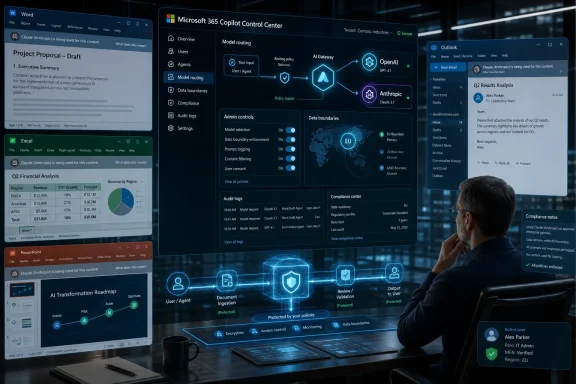 Microsoft Is Selling the Office Suite as an AI Switching Yard
The old pitch for Microsoft 365 Copilot was straightforward: take a powerful language model, ground it in Microsoft Graph, and let it work inside the productivity apps where employees already live. That pitch still matters, but it no longer captures the shape of the product. Copilot is becoming less like a single assistant and more like a managed routing system for different AI models, different workloads, and different compliance envelopes.Claude Fable 5 gives Microsoft a useful symbol for that transition. Anthropic’s newest model is being positioned around deeper reasoning, long-running tasks, document interpretation, research, coding, and planning rather than merely quick text generation. Whether it proves to be dramatically better in day-to-day enterprise work will depend on the prompts, the data, the app integration, and the guardrails. But the strategic meaning is already clear: Microsoft wants customers to stop thinking of Copilot as “the Microsoft model” and start thinking of it as the interface through which the enterprise consumes AI.
That matters because AI procurement is getting messy. Enterprises are no longer asking only whether OpenAI, Anthropic, Google, Meta, or another vendor has the best model on a given benchmark this month. They are asking who can deliver the model inside the tools their users already use, with identity, logging, data loss controls, permissions, retention policies, and admin switches attached. Microsoft’s answer is blunt: the model race can continue, but the control plane should live in Microsoft 365.
This is also why the addition of Claude Fable 5 is more consequential than a typical feature update. A better model inside a standalone chatbot is interesting. A better model inside Word, Excel, Outlook, PowerPoint, Copilot Chat, and agent workflows is a deployment decision with implications for training, governance, licensing, security review, and shadow IT.
Claude Fable 5 Arrives With the Usual Frontier-Model Promise—and the Usual Fine Print
Anthropic is presenting Claude Fable 5 as a major step up for sustained reasoning and complex work. The model is tied to the company’s broader Mythos-class ambitions, which have been discussed in terms of high capability and high caution. In plain English, this is the kind of model vendors want enterprises to imagine handling the hard, messy work that earlier chatbots only approximated: reading long source material, planning multi-step projects, building software, extracting insight from documents, and keeping track of context over longer sessions.That promise maps neatly onto Microsoft 365. Office work is rarely a single prompt and a single answer. A finance manager wants a model to interpret spreadsheets, explain variance, draft commentary, and prepare a slide narrative. A lawyer wants it to compare contracts and flag meaningful deviations. A product manager wants it to digest emails, meetings, specifications, bug reports, and customer feedback without losing the thread.
The catch is that “deeper reasoning” is not a magic phrase. Enterprise users will judge Fable 5 on whether it makes fewer brittle assumptions, handles internal documents more carefully, and can work through ambiguous business tasks without inventing confidence. The model’s raw capability may be impressive, but the practical value inside Microsoft 365 will come from the plumbing around it: retrieval, permission trimming, app context, file handling, auditability, and UI cues that show when Anthropic’s model is being used.
That last detail is not cosmetic. Once Copilot becomes multi-model, transparency becomes part of trust. Users and admins need to know when work is being processed by which provider, under what terms, and outside which data boundary. Model choice is powerful only if it does not become model confusion.
The Real Upgrade Is Not in Word; It Is in the Admin Center
For WindowsForum readers who administer Microsoft 365 tenants, the more important part of this story is not the demo reel. It is the switchboard. Microsoft’s documentation around Anthropic models already makes clear that administrators can control whether Anthropic operates as a Microsoft subprocessor and whether Claude-based capabilities are exposed to users in supported Copilot experiences.That is the right design pattern, but it also makes deployment more complicated. The arrival of Claude Fable 5 is not the same thing as every user in every tenant suddenly getting a new model everywhere. Availability can vary by region, app, feature, license, rollout wave, and admin configuration. In some cases, Anthropic models are tied to specific experiences such as Researcher, Copilot Studio, Power Platform, Excel agent mode, or the Word, Excel, and PowerPoint agents.
This is where Microsoft’s enterprise instincts show. The company knows that CIOs do not want every model vendor plugged directly into every employee’s workflow by default. They want centralized enablement, security group scoping, provider-level controls, and contractual clarity. Microsoft’s promise is that customers can get the benefit of Anthropic’s models without turning their Microsoft 365 estate into a set of unmanaged API experiments.
But admins should not mistake “available through Microsoft” for “identical to Microsoft-hosted models.” Microsoft has been explicit that Anthropic model integrations can involve data processing outside certain Microsoft data-boundary commitments, including the EU Data Boundary and some in-country processing guarantees. That does not make the feature unusable; it makes it a governance decision. The checkbox matters because the data path matters.
Copilot’s Multi-Model Strategy Is a Hedge Against the Model Race
Microsoft’s deep OpenAI partnership remains one of the defining bets of the modern AI market, but the company is no longer pretending that one model family will answer every enterprise need forever. By bringing Anthropic models into Microsoft 365 Copilot, Microsoft is hedging against model commoditization while strengthening its own position as the application and governance layer.This is classic platform strategy. If models become interchangeable enough, the winning layer is distribution, identity, data access, workflow integration, and billing. If models remain differentiated, the winning layer is still distribution, identity, data access, workflow integration, and billing—because customers will want access to the best model for each task without rebuilding their environment around each vendor.
For Microsoft, either outcome is acceptable. If OpenAI leads a given workload, Copilot can use OpenAI models. If Anthropic leads on long-context reasoning, document work, or agentic planning, Copilot can expose Claude. If smaller models are cheaper or faster for routine tasks, Microsoft can route those too. The customer experiences “Copilot,” while Microsoft manages the complexity underneath.
That is good business. It may also be good enterprise architecture, provided Microsoft gives administrators enough visibility into model selection and performance. The danger is that “multi-model” becomes a marketing abstraction: a promise of choice without meaningful control, benchmarking, or cost transparency. If organizations cannot tell which model produced which output, why it was selected, what data it saw, and how it affected cost or risk, the strategy becomes harder to defend.
Word, Excel, and Outlook Are Where the Model Meets the Mess
The user-facing promise is easy to understand. In Word, Claude Fable 5 could help with longer drafting tasks, policy documents, proposals, reports, and revisions that require memory across sections. In Excel, it could help explain trends, generate formulas, interpret tables, and turn raw numbers into business commentary. In Outlook, it could support higher-quality email drafting, summarization, and follow-up planning.But the real productivity challenge is not that employees lack prose. It is that organizations drown in half-structured information. The modern Microsoft 365 tenant is a swamp of files, Teams chats, SharePoint sites, OneDrive folders, emails, meetings, and spreadsheets with inconsistent naming conventions. A frontier model can only help if it is connected to the right context and constrained by the right permissions.
That is why Copilot’s integration with Microsoft Graph remains the center of gravity. A powerful model without enterprise grounding becomes a clever generalist. A powerful model grounded in an organization’s actual documents and communications can become useful, but also more sensitive. The more capable the model, the more important it becomes that permissions are clean, retention rules are understood, and oversharing in SharePoint is not treated as a harmless inconvenience.
This is the uncomfortable truth behind every Copilot upgrade. Better reasoning amplifies good information architecture, and it also amplifies bad information architecture. If a tenant is full of stale access grants, orphaned groups, and broadly shared folders, a stronger model may simply become a more fluent way to surface problems that were already there.
Agents Make the Stakes Higher Than Chat
Microsoft’s enthusiasm for agents is not incidental to the Claude Fable 5 story. Models that can sustain reasoning over longer tasks are much more valuable when they are allowed to act: draft a document, prepare a spreadsheet, build a presentation, query systems, summarize meetings, open workflows, or coordinate across tools. The move from chatbot to agent is the move from advice to execution.That shift raises the bar for governance. A chatbot that gives a bad answer can waste time or mislead a user. An agent that takes a bad action can create files, send messages, trigger processes, or propagate errors across a workflow. This is why enterprises should treat agent enablement as an operational change, not merely a feature toggle.
Claude Fable 5 may be well suited to long-running and multi-step workflows, but that is exactly why it deserves careful rollout. The more capable the model, the more organizations should define where autonomy begins and ends. Human approval, logging, rollback, least-privilege access, and clear ownership of generated artifacts will matter more as these systems move from drafting assistance to task execution.
There is also a cultural dimension. Employees may trust an agent embedded in Microsoft 365 more than they trust an external AI tool, because it looks official and appears in familiar apps. That trust is useful, but it can become dangerous if users assume Copilot output has been verified merely because it came through Microsoft’s interface. The interface can reduce friction; it cannot remove judgment.
Security Teams Will Read the Data Boundary Notes First
For security and compliance teams, the most important words in this story are not “frontier model” or “advanced reasoning.” They are “subprocessor,” “admin setting,” “data processing,” and “available by default.” Microsoft’s model-choice architecture puts third-party AI inside the enterprise productivity perimeter, which means the risk review belongs inside normal governance processes.The good news is that Microsoft is not presenting Anthropic integration as a consumer-style plug-in free-for-all. Anthropic operates under Microsoft’s subprocessor framework for these services, and administrators have controls to enable or disable access. Microsoft also says Copilot respects user permissions and compliance policies when grounding responses in organizational data.
The less comfortable news is that not every commitment is identical across every processing path. Anthropic models may be excluded from certain data-boundary or in-country processing commitments. Government and heavily regulated tenants may face additional limitations or deployment constraints. Organizations with strict residency requirements should not assume that “inside Copilot” automatically means “inside every existing Microsoft boundary.”
This is where IT departments should be boring on purpose. Before enabling Claude Fable 5 broadly, admins should read the relevant Microsoft 365 Message Center posts, verify regional defaults, check subprocessor settings, scope pilots through security groups, and document where Anthropic models are allowed. The goal is not to block useful AI. The goal is to avoid discovering the data-processing implications after enthusiastic users have already built workflows around them.
The Productivity Pitch Is Real, but It Is Not Self-Executing
Microsoft and Anthropic will naturally emphasize the upside. Better document analysis, smarter drafting, deeper research, stronger coding support, and more capable agents are all plausible benefits. In many organizations, even modest improvements in summarization, email triage, spreadsheet explanation, and report drafting can add up quickly.But productivity software has a long history of promising transformation and delivering uneven adoption. The gap is rarely the feature list. It is training, workflow design, organizational trust, and the willingness to redesign processes around what the tools actually do well. Copilot with Claude Fable 5 will not automatically make a sales team write better proposals or a finance team produce better forecasts.
The winners will be organizations that pair model access with clear use cases. Legal review, project documentation, customer support analysis, executive briefing prep, code review, and spreadsheet explanation are all candidates. “Everyone gets the new model; go be productive” is not a strategy. It is a license allocation.
There is also the question of measurement. Enterprises should ask whether Claude Fable 5 improves task completion time, reduces rework, increases quality, or merely creates more polished first drafts. Those are different outcomes. A model that writes beautifully but requires heavy fact-checking may be less valuable than a model that produces plainer output with better grounding and fewer surprises.
The Copilot Upgrade That Admins Should Not Treat as a Press Release
The practical lesson is that Claude Fable 5 inside Microsoft 365 Copilot is both a capability upgrade and a governance event. It gives users access to a more ambitious model class from within Microsoft’s productivity environment, but it also asks administrators to understand where model choice intersects with data protection, regional rules, and agentic workflows.- Microsoft 365 Copilot is evolving from a single-assistant product into a governed multi-model platform for enterprise work.
- Claude Fable 5 is being positioned for deeper reasoning, long-form analysis, coding, planning, and complex document-heavy workflows.
- Administrators should verify Anthropic subprocessor settings, regional availability, user scoping, and app-specific behavior before broad rollout.
- The most important security questions involve data boundaries, permission trimming, auditability, and whether users can identify when Claude models are in use.
- The biggest productivity gains will come from targeted workflows, not from simply making another model available to everyone.
- Agent scenarios deserve stricter controls than chat scenarios because they move Copilot from generating suggestions toward taking actions.
References
- Primary source: thewincentral.com
Published: 2026-06-11T17:24:11.647143
Microsoft 365 Copilot Gets Anthropic Claude Fable 5: All You Need to Know - WinCentral
Microsoft is rolling out Anthropic Claude Fable 5 to Microsoft 365 Copilot, bringing advanced reasoning, research, coding, and AI agent capabilities to enterprise users. - Read in Microsoft 365 News on WinCentral thewincentral.com
- Related coverage: techradar.com
Anthropic spent months saying Mythos was too dangerous to release — then it launched a public version called Fable 5 that it warns ‘comes with risks’ | TechRadar
Anthropic says Fable 5 brings Mythos-class AI to ordinary Claude users — but only after the addition of extensive safety controls.www.techradar.com - Related coverage: axios.com
Anthropic releases Claude Mythos-level model
Fable 5 includes safeguards to help protect against hacking and bio-terrorism.www.axios.com
- Official source: learn.microsoft.com
Copilot in Microsoft 365 apps with Anthropic models | Microsoft Learn
Learn about the new toggle for Microsoft 365 apps for Anthropic in Europe.learn.microsoft.com - Official source: anthropic.com
Claude Fable \ Anthropic
Next generation of intelligence for the hardest knowledge work and coding problems.www.anthropic.com - Official source: microsoft.com
Expanding model choice in Microsoft 365 Copilot | Microsoft 365 Blog
We’re excited to announce that we’re expanding the models that power Microsoft 365 Copilot with the addition of Anthropic models.www.microsoft.com
- Related coverage: tomshardware.com
Claude Fable 5 brings Mythos to the masses — Anthropic's new frontier model is 'state-of-the-art on nearly all tested benchmarks' | Tom's Hardware
Queries regarding cybersecurity, biology and chemistry, and distillation will be redirected to the prior-gen Opus 4.8, howeverwww.tomshardware.com - Official source: techcommunity.microsoft.com
Available today: Anthropic Claude Opus 4.8 in Microsoft 365 Copilot | Microsoft Community Hub
Expanding model choice in Microsoft 365 Copilot: Anthropic's Claude Opus 4.8 is rolling out today in Copilot Cowork. techcommunity.microsoft.com
- Official source: support.microsoft.com
Utiliser Claude avec le chercheur dans Microsoft 365 Copilot | Microsoft Support
Utiliser Claude avec le chercheur dans Microsoft 365 Copilotsupport.microsoft.com - Related coverage: elpais.com
Anthropic lanza una versión “segura” de Mythos, el programa que ha puesto en guardia a todo el planeta: “Hay que prepararse por si cae en malas manos” | Tecnología | EL PAÍS
Los expertos en ciberseguridad que han manejado la herramienta destacan su velocidad y creen que, tarde o temprano, los ciberdelincuentes accederán a un modelo similarelpais.com - Related coverage: as.com
Los expertos coinciden: “Claude Fable 5 es tan ridículo que me hace temer por el futuro de la ingeniería” - Meristation
Claude Fable 5 sorprende a expertos en IA por su capacidad para programar, jugar y trabajar durante tareas largas.as.com - Related coverage: omni.se
Anthropic släpper ”säker” version av ”farliga” Mythos
Anthropic släppte AI-modellen Claude Fable 5 på tisdagskvällen. Enligt bolaget är dess förmågor i nivå med Mythos Preview, en modell som man tidigare i våras lät bli att släppa publikt. Detta eftersom Mythos sågs som alltför ”farlig” och i fel händer befarades kunna utgöra ett stort hot mot...omni.se
- Related coverage: svd.se
Anthropic släpper Mythos och Fable 5 – och dubblar priserna
God morgon! Anthropic släpper nya modeller och höjer priserna, svensk debut på New York-börsen, och Google imponerar med realtidsöversättning. www.svd.se
- Official source: cdn-dynmedia-1.microsoft.com
Microsoft Copilot for Microsoft 365
Microsoft Copilot for Microsoft 365cdn-dynmedia-1.microsoft.com
- Official source: download.microsoft.com
- Related coverage: ncacpa.org
