

Anthropic released Claude Fable 5 on June 9, 2026, as a generally available Mythos-class model, and early benchmark disclosures and developer reports say it beats OpenAI’s ChatGPT 5.5 most clearly on long-horizon coding, large-codebase migration, and autonomous software-engineering tasks. That is the factual core behind the latest Geeky Gadgets write-up, but the more interesting story is not a scoreboard. Fable 5 is another sign that frontier AI is moving away from chatty pair-programming and toward expensive, supervised software agents that can hold an entire project in their heads. For Windows developers and IT shops, the question is no longer whether AI can write a function; it is whether it can safely touch the repo, the build system, the ticket queue, and the deployment pipeline without turning convenience into operational risk.
For the first few years of the coding-assistant boom, the comparison was easy to understand. One model completed a Python function; another explained a SQL query; a third generated a React component with fewer hallucinated props. The practical value was real, but the workflow still revolved around the human developer as navigator, reviewer, and repair crew.
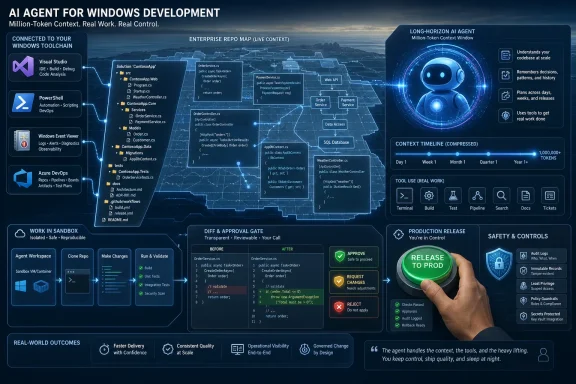
Claude Fable 5 is being sold on a different axis. Its headline capability is not just sharper syntax but persistence: the ability to stay oriented across very large bodies of code, long instruction chains, screenshots, tool outputs, and self-generated notes. Anthropic says Fable 5 can operate across million-token-scale context and longer autonomous sessions than previous Claude models, which is precisely the territory where traditional chatbots tend to become forgetful, repetitive, or dangerously confident.
That matters because most serious software work is not a coding puzzle. It is an archaeological dig through old assumptions, inconsistent naming, flaky tests, hidden business logic, and a build process that only one departed engineer truly understood. A model that can keep more of that mess in memory has an advantage that does not show up when all you ask for is “write a function to parse CSV.”
The Geeky Gadgets framing leans into this point by emphasizing “complex coding tasks,” production-ready code, operating-system-style clones, games, simulations, and interactive systems. Some of those examples belong in the demo-reel category, and demos have always flattered AI systems. But the underlying claim is serious: Fable 5 appears optimized for the kind of software work where the hard part is not emitting code, but maintaining a coherent plan over many dependent steps.
The caution is that not all benchmarks measure the same thing. A score on a repository-level bug-fixing benchmark is more relevant to a sysadmin maintaining internal automation than a score on a contest-math benchmark. A benchmark that rewards clean, production-quality patches is more meaningful for engineering teams than one that rewards a plausible answer in a browser window. “Beats ChatGPT 5.5” is only useful if we ask: beats it at what, under what tools, at what cost, and with how much human review?
The strongest claim for Fable 5 is not that it wins every possible evaluation. It is that its reported advantages cluster around long-horizon, tool-using, codebase-aware work. That is the class of work where a model can save days instead of minutes, but also the class of work where a wrong move can break authentication, corrupt data migrations, or introduce a security regression that sleeps quietly until the worst possible moment.
That distinction is important for WindowsForum readers because Windows development and administration are full of long-context problems. Modern PowerShell estates, Intune policies, Group Policy Objects, Azure integrations, line-of-business apps, MSI packaging, driver quirks, legacy .NET services, and hybrid identity plumbing all punish shallow reasoning. A model that can keep more of the system in view is more useful than one that merely writes prettier snippets.
That changes the prompt from “fix this error” to something closer to “read the failing test, inspect the related modules, compare the current implementation with the migration guide, find the root cause, propose a patch, update the tests, and explain what could break.” The latter is the job. The former is a Stack Overflow search wearing a tuxedo.
For Windows shops, this could be especially relevant in modernization projects. Think of a team moving old .NET Framework services to modern .NET, replacing brittle VBScript with PowerShell, refactoring WinForms utilities, or untangling an internal app that authenticates against Active Directory in three different ways. The bottleneck is often not raw coding speed; it is institutional memory. A long-context model can become a temporary map of the system.
But context is not magic. Feeding a model more files also means feeding it more contradictions, stale comments, dead code, secrets, and misleading examples. The bigger the window, the more important the selection discipline becomes. Fable 5 may be better at using the haystack, but someone still has to decide whether the haystack belongs in the prompt.
Production readiness is a process. It includes tests, review, observability, rollback planning, dependency checks, threat modeling, performance profiling, and an understanding of how the change behaves under failure. A model can help with all of those. It cannot be allowed to replace all of them.
Fable 5’s value may be highest when it is treated as an unusually capable senior assistant rather than an autonomous committer. Let it draft the migration. Let it explain the assumptions. Let it generate tests that humans would not have had time to write. Let it search for parallel bugs across a codebase. But if it is touching billing, identity, device management, security policy, or data retention, it belongs behind the same gates as any other risky change.
That is not anti-AI conservatism. It is how serious IT survives hype cycles. The more capable the agent, the more tempting it becomes to skip the boring guardrails that make capability safe.
That matters for developers. A model that is brilliant until it refuses a security-hardening task, a malware-analysis lab, a binary-reversing exercise, or a dual-use networking question can be frustrating in exactly the workflows where advanced users need the most help. Anthropic says it has tuned the safeguards conservatively, which is understandable given the power of the model. It also means teams should test Fable 5 against their own workload rather than assuming benchmark performance will translate cleanly into every engineering domain.
This is where the “less restricted” Mythos 5 story becomes relevant. Anthropic is positioning Mythos 5 for trusted users in cybersecurity, infrastructure, and scientific research, while keeping the broader Fable 5 release inside stricter guardrails. That split is a preview of where frontier AI access may be heading: not one universal model for everyone, but tiered access based on risk, use case, monitoring, and institutional trust.
For IT administrators, that tiering has obvious echoes. Enterprises already live with role-based access control, conditional access, privileged identity management, and audit logs. Frontier AI may be pulled into the same governance model. The future coding assistant may not just ask what you want it to build; it may ask whether your organization is allowed to make that request with that model in that jurisdiction.
This is why the Geeky Gadgets article’s nod to accessibility needs a little skepticism. Usage-based pricing can make a frontier model available to a solo developer for occasional high-value tasks. It does not make continuous autonomous coding cheap. If a team starts feeding entire repositories, test logs, screenshots, and documentation into repeated agent loops, the economics look less like autocomplete and more like cloud compute.
That may still be a bargain if the model compresses a two-month migration into a week, or if it finds a security flaw before attackers do. The problem is that organizations are bad at measuring avoided labor and avoided incidents. They are much better at seeing a monthly invoice.
The likely outcome is a tiered workflow. Cheaper models will handle everyday completion, explanation, and boilerplate. Premium models like Fable 5 will be escalated for ugly migrations, architecture analysis, high-value debugging, and projects where context depth changes the outcome. The frontier model becomes less like a default assistant and more like an expensive specialist you call when the problem is big enough.
It will show up in code migrations nobody wants to do. It will show up in PowerShell refactors, build-pipeline cleanup, documentation reconstruction, test generation, and old internal tools that need to be dragged into a supportable state before the last person who understands them retires. It will show up when a team asks an agent to inspect a repo, identify the ten files that matter, and explain why a flaky installer fails only on a certain Windows build.
That is why Fable 5’s vision capabilities are not just a creative-design feature. A model that can interpret screenshots, diagrams, UI states, logs, and source code together is potentially useful for diagnosing the kind of problem that crosses the boundary between application and environment. Windows troubleshooting has always involved that boundary: the code says one thing, Event Viewer says another, the screenshot shows a third, and the user’s reproduction steps are missing the one action that matters.
If Fable 5 is materially better at stitching those signals together, it could become valuable in support engineering and internal tooling even before it becomes trusted as a full coding agent. The best first use may not be “build the product.” It may be “explain the mess.”
OpenAI’s advantage has often been distribution: ChatGPT, Codex-style tooling, API familiarity, enterprise plans, and a massive user base already trained to reach for its interface. Anthropic’s advantage has often been tone, long-form reasoning, coding feel, and a reputation among many developers for more careful outputs. Fable 5 sharpens Anthropic’s case, but it does not erase the platform question.
For a Windows-heavy organization, the winning model may be the one that fits the least awkwardly into Visual Studio, VS Code, GitHub, Azure DevOps, Microsoft 365, Entra ID, and existing compliance processes. A model with a higher benchmark score can still lose a procurement battle if it creates more governance friction. Conversely, a model that performs fewer tasks but fits cleanly into the toolchain may be adopted more widely.
This is where Microsoft’s relationship with OpenAI remains strategically important, even when Anthropic has the better benchmark headline. The AI coding market is not a drag race. It is an enterprise plumbing contest with a leaderboard attached.
A coding assistant that answers a prompt can be wrong in one place. An autonomous coding agent can be wrong across a chain of decisions. It can misunderstand the ticket, edit the wrong abstraction, create tests that validate its own mistaken behavior, suppress a warning, and generate a persuasive summary that makes the whole thing look intentional.
The answer is not to ban autonomy. The answer is to contain it. Sandboxed environments, read-only exploration modes, explicit diff review, test isolation, branch policies, secret scanning, dependency auditing, and mandatory human approval are not optional extras. They are the difference between an agentic workflow and a roulette wheel with syntax highlighting.
The irony is that Fable 5’s improved reliability may increase risk by increasing trust. Bad tools are easy to distrust. Good tools invite delegation. The danger point is when a model becomes useful enough that teams stop checking the parts they no longer understand.
There are already signs that real-world impressions are mixed in the usual way. Some developers report striking one-shot fixes and better long-horizon behavior. Others describe cost concerns, false positives from safety filters, or tasks where GPT-5.5 remains competitive. That spread is not a contradiction; it is what happens when frontier models leave benchmark labs and meet real software.
For WindowsForum’s audience, the best stance is neither cynicism nor cheerleading. Fable 5 looks like a real capability jump in the class of coding tasks that require memory, planning, and tool use. It also looks expensive, governed, and operationally serious in a way that makes casual experimentation a poor proxy for production adoption.
The right evaluation is local. Put it on your actual codebase. Give it a contained migration. Ask it to explain a gnarly PowerShell module. Have it generate tests around a fragile installer. Make it diagnose a Windows-specific bug from logs, screenshots, and source. Then measure not whether it sounded smart, but whether it reduced human time without increasing review burden or defect risk.
 Fable 5 Turns the Coding Race Into a Context Race
For the first few years of the coding-assistant boom, the comparison was easy to understand. One model completed a Python function; another explained a SQL query; a third generated a React component with fewer hallucinated props. The practical value was real, but the workflow still revolved around the human developer as navigator, reviewer, and repair crew.Claude Fable 5 is being sold on a different axis. Its headline capability is not just sharper syntax but persistence: the ability to stay oriented across very large bodies of code, long instruction chains, screenshots, tool outputs, and self-generated notes. Anthropic says Fable 5 can operate across million-token-scale context and longer autonomous sessions than previous Claude models, which is precisely the territory where traditional chatbots tend to become forgetful, repetitive, or dangerously confident.
That matters because most serious software work is not a coding puzzle. It is an archaeological dig through old assumptions, inconsistent naming, flaky tests, hidden business logic, and a build process that only one departed engineer truly understood. A model that can keep more of that mess in memory has an advantage that does not show up when all you ask for is “write a function to parse CSV.”
The Geeky Gadgets framing leans into this point by emphasizing “complex coding tasks,” production-ready code, operating-system-style clones, games, simulations, and interactive systems. Some of those examples belong in the demo-reel category, and demos have always flattered AI systems. But the underlying claim is serious: Fable 5 appears optimized for the kind of software work where the hard part is not emitting code, but maintaining a coherent plan over many dependent steps.
The Benchmark Win Is Real, but It Is Not the Whole Win
Benchmarks are the coin of the realm in AI marketing, and Fable 5 arrives with plenty of them. Anthropic’s own launch materials place the model at or near the top on software-engineering, vision, knowledge-work, and agentic evaluations, while third-party summaries have highlighted large gaps against GPT-5.5 on repository-level coding tests. Geeky Gadgets points to results such as Frontier Code-style evaluations as evidence that the model is unusually strong at complex implementation tasks.The caution is that not all benchmarks measure the same thing. A score on a repository-level bug-fixing benchmark is more relevant to a sysadmin maintaining internal automation than a score on a contest-math benchmark. A benchmark that rewards clean, production-quality patches is more meaningful for engineering teams than one that rewards a plausible answer in a browser window. “Beats ChatGPT 5.5” is only useful if we ask: beats it at what, under what tools, at what cost, and with how much human review?
The strongest claim for Fable 5 is not that it wins every possible evaluation. It is that its reported advantages cluster around long-horizon, tool-using, codebase-aware work. That is the class of work where a model can save days instead of minutes, but also the class of work where a wrong move can break authentication, corrupt data migrations, or introduce a security regression that sleeps quietly until the worst possible moment.
That distinction is important for WindowsForum readers because Windows development and administration are full of long-context problems. Modern PowerShell estates, Intune policies, Group Policy Objects, Azure integrations, line-of-business apps, MSI packaging, driver quirks, legacy .NET services, and hybrid identity plumbing all punish shallow reasoning. A model that can keep more of the system in view is more useful than one that merely writes prettier snippets.
The Million-Token Window Is a Business Feature, Not a Party Trick
A million-token context window sounds like a spec-sheet flex until you map it onto the work developers actually do. A large enterprise repository can include application code, infrastructure templates, test logs, migration scripts, incident notes, API documentation, and years of accumulated conventions. The value of a huge context window is that the model can be shown the surrounding evidence before it starts changing things.That changes the prompt from “fix this error” to something closer to “read the failing test, inspect the related modules, compare the current implementation with the migration guide, find the root cause, propose a patch, update the tests, and explain what could break.” The latter is the job. The former is a Stack Overflow search wearing a tuxedo.
For Windows shops, this could be especially relevant in modernization projects. Think of a team moving old .NET Framework services to modern .NET, replacing brittle VBScript with PowerShell, refactoring WinForms utilities, or untangling an internal app that authenticates against Active Directory in three different ways. The bottleneck is often not raw coding speed; it is institutional memory. A long-context model can become a temporary map of the system.
But context is not magic. Feeding a model more files also means feeding it more contradictions, stale comments, dead code, secrets, and misleading examples. The bigger the window, the more important the selection discipline becomes. Fable 5 may be better at using the haystack, but someone still has to decide whether the haystack belongs in the prompt.
“Production-Ready” Still Needs a Production Gate
Geeky Gadgets repeats a phrase that has become unavoidable in AI coverage: production-ready code. It is a useful shorthand, but it is also one of the most dangerous phrases in the industry. Code is not production-ready because an AI model says so, or because it compiles once, or because a demo looks impressive on YouTube.Production readiness is a process. It includes tests, review, observability, rollback planning, dependency checks, threat modeling, performance profiling, and an understanding of how the change behaves under failure. A model can help with all of those. It cannot be allowed to replace all of them.
Fable 5’s value may be highest when it is treated as an unusually capable senior assistant rather than an autonomous committer. Let it draft the migration. Let it explain the assumptions. Let it generate tests that humans would not have had time to write. Let it search for parallel bugs across a codebase. But if it is touching billing, identity, device management, security policy, or data retention, it belongs behind the same gates as any other risky change.
That is not anti-AI conservatism. It is how serious IT survives hype cycles. The more capable the agent, the more tempting it becomes to skip the boring guardrails that make capability safe.
Anthropic’s Safety Story Is Also a Product Constraint
Anthropic is unusually explicit about the safety tradeoff around Fable 5. The company says the generally available model is built from the same underlying class as Mythos 5, but with safeguards that route or restrict certain sensitive requests. In practice, that means some benign work may be blocked, downgraded, or handled by a less capable model if it trips a classifier.That matters for developers. A model that is brilliant until it refuses a security-hardening task, a malware-analysis lab, a binary-reversing exercise, or a dual-use networking question can be frustrating in exactly the workflows where advanced users need the most help. Anthropic says it has tuned the safeguards conservatively, which is understandable given the power of the model. It also means teams should test Fable 5 against their own workload rather than assuming benchmark performance will translate cleanly into every engineering domain.
This is where the “less restricted” Mythos 5 story becomes relevant. Anthropic is positioning Mythos 5 for trusted users in cybersecurity, infrastructure, and scientific research, while keeping the broader Fable 5 release inside stricter guardrails. That split is a preview of where frontier AI access may be heading: not one universal model for everyone, but tiered access based on risk, use case, monitoring, and institutional trust.
For IT administrators, that tiering has obvious echoes. Enterprises already live with role-based access control, conditional access, privileged identity management, and audit logs. Frontier AI may be pulled into the same governance model. The future coding assistant may not just ask what you want it to build; it may ask whether your organization is allowed to make that request with that model in that jurisdiction.
The Price Tag Ends the Illusion of Free Intelligence
Fable 5’s pricing, as announced by Anthropic, starts at $10 per million input tokens and $50 per million output tokens. Those numbers are not shocking at the frontier-model tier, but they are high enough to force a more disciplined conversation. A million-token context window is only cheap in a blog post; in a real workflow, long prompts, tool traces, retries, and generated code can turn a speculative agent run into a visible line item.This is why the Geeky Gadgets article’s nod to accessibility needs a little skepticism. Usage-based pricing can make a frontier model available to a solo developer for occasional high-value tasks. It does not make continuous autonomous coding cheap. If a team starts feeding entire repositories, test logs, screenshots, and documentation into repeated agent loops, the economics look less like autocomplete and more like cloud compute.
That may still be a bargain if the model compresses a two-month migration into a week, or if it finds a security flaw before attackers do. The problem is that organizations are bad at measuring avoided labor and avoided incidents. They are much better at seeing a monthly invoice.
The likely outcome is a tiered workflow. Cheaper models will handle everyday completion, explanation, and boilerplate. Premium models like Fable 5 will be escalated for ugly migrations, architecture analysis, high-value debugging, and projects where context depth changes the outcome. The frontier model becomes less like a default assistant and more like an expensive specialist you call when the problem is big enough.
Windows Developers Will Feel This First in the Boring Work
The splashiest examples around Fable 5 involve visual games, CAD environments, simulations, and operating-system-style clones. Those demos are fun, and they reveal something about multimodal reasoning. But the first meaningful impact for Windows professionals will probably be much less glamorous.It will show up in code migrations nobody wants to do. It will show up in PowerShell refactors, build-pipeline cleanup, documentation reconstruction, test generation, and old internal tools that need to be dragged into a supportable state before the last person who understands them retires. It will show up when a team asks an agent to inspect a repo, identify the ten files that matter, and explain why a flaky installer fails only on a certain Windows build.
That is why Fable 5’s vision capabilities are not just a creative-design feature. A model that can interpret screenshots, diagrams, UI states, logs, and source code together is potentially useful for diagnosing the kind of problem that crosses the boundary between application and environment. Windows troubleshooting has always involved that boundary: the code says one thing, Event Viewer says another, the screenshot shows a third, and the user’s reproduction steps are missing the one action that matters.
If Fable 5 is materially better at stitching those signals together, it could become valuable in support engineering and internal tooling even before it becomes trusted as a full coding agent. The best first use may not be “build the product.” It may be “explain the mess.”
The ChatGPT Comparison Misses the Platform War
Comparing Claude Fable 5 with ChatGPT 5.5 is inevitable, but the model-to-model framing is too narrow. Developers do not buy abstract intelligence. They buy workflows. They buy integrations with IDEs, GitHub, ticketing systems, terminals, cloud environments, documentation stores, and corporate identity.OpenAI’s advantage has often been distribution: ChatGPT, Codex-style tooling, API familiarity, enterprise plans, and a massive user base already trained to reach for its interface. Anthropic’s advantage has often been tone, long-form reasoning, coding feel, and a reputation among many developers for more careful outputs. Fable 5 sharpens Anthropic’s case, but it does not erase the platform question.
For a Windows-heavy organization, the winning model may be the one that fits the least awkwardly into Visual Studio, VS Code, GitHub, Azure DevOps, Microsoft 365, Entra ID, and existing compliance processes. A model with a higher benchmark score can still lose a procurement battle if it creates more governance friction. Conversely, a model that performs fewer tasks but fits cleanly into the toolchain may be adopted more widely.
This is where Microsoft’s relationship with OpenAI remains strategically important, even when Anthropic has the better benchmark headline. The AI coding market is not a drag race. It is an enterprise plumbing contest with a leaderboard attached.
Autonomy Is the Feature That Makes Everyone Nervous
The most consequential word around Fable 5 is not “coding.” It is “autonomous.” Anthropic and early testers describe the model as better at long-running work, self-checking, tool use, and multi-step execution. That is exactly what developers have wanted since the first coding assistants appeared, and it is exactly what security teams have feared.A coding assistant that answers a prompt can be wrong in one place. An autonomous coding agent can be wrong across a chain of decisions. It can misunderstand the ticket, edit the wrong abstraction, create tests that validate its own mistaken behavior, suppress a warning, and generate a persuasive summary that makes the whole thing look intentional.
The answer is not to ban autonomy. The answer is to contain it. Sandboxed environments, read-only exploration modes, explicit diff review, test isolation, branch policies, secret scanning, dependency auditing, and mandatory human approval are not optional extras. They are the difference between an agentic workflow and a roulette wheel with syntax highlighting.
The irony is that Fable 5’s improved reliability may increase risk by increasing trust. Bad tools are easy to distrust. Good tools invite delegation. The danger point is when a model becomes useful enough that teams stop checking the parts they no longer understand.
The Real Test Begins After the Demo Window Closes
The most important evaluations of Fable 5 will not be launch-day benchmark charts. They will be the quiet reports from teams that use it for three months on messy, proprietary work. Does it still perform well when the repo is undocumented? Does it behave consistently when requirements change midstream? Does it produce maintainable patches after the fifth iteration? Does it know when to stop?There are already signs that real-world impressions are mixed in the usual way. Some developers report striking one-shot fixes and better long-horizon behavior. Others describe cost concerns, false positives from safety filters, or tasks where GPT-5.5 remains competitive. That spread is not a contradiction; it is what happens when frontier models leave benchmark labs and meet real software.
For WindowsForum’s audience, the best stance is neither cynicism nor cheerleading. Fable 5 looks like a real capability jump in the class of coding tasks that require memory, planning, and tool use. It also looks expensive, governed, and operationally serious in a way that makes casual experimentation a poor proxy for production adoption.
The right evaluation is local. Put it on your actual codebase. Give it a contained migration. Ask it to explain a gnarly PowerShell module. Have it generate tests around a fragile installer. Make it diagnose a Windows-specific bug from logs, screenshots, and source. Then measure not whether it sounded smart, but whether it reduced human time without increasing review burden or defect risk.
The Practical Read for Windows Shops Testing Fable 5
Fable 5 deserves attention because it changes where AI coding assistants may be useful, but it should be introduced like any powerful new automation system: deliberately, with scope, auditability, and rollback. The teams that benefit first will be the ones that pair ambition with restraint.- Fable 5 appears strongest when the task requires sustained context, multi-step reasoning, and codebase-wide awareness rather than isolated snippet generation.
- The model’s large context window is most valuable when teams curate the input carefully and include tests, documentation, logs, and architectural constraints.
- Its premium pricing makes it better suited to high-value migrations, difficult debugging, and agentic workflows than routine autocomplete.
- Anthropic’s safeguards are part of the product experience, and teams working in security, infrastructure, or dual-use domains should test for false positives before depending on it.
- Windows-heavy organizations should judge Fable 5 by integration fit, governance requirements, and review workflow rather than benchmark rank alone.
- No coding agent should be allowed to merge meaningful changes without tests, human review, and the same security controls applied to human contributors.
References
- Primary source: Geeky Gadgets
Published: Fri, 12 Jun 2026 10:21:55 GMT
Claude Fable 5 Review: Anthropic's New AI Model Tested - Geeky Gadgets
Learn how Claude Fable 5 outperforms previous AI models in benchmarks, software engineering, and complex vision tasks.www.geeky-gadgets.com - Related coverage: blockchain-council.org
Claude Fable 5 vs ChatGPT: 2026 Comparison
Claude Fable 5 vs ChatGPT compared on coding, reasoning, cost, safety, long context, and best use cases for professionals.www.blockchain-council.org - Related coverage: digitalapplied.com
Claude Fable 5 vs GPT-5.5: Benchmarks & Cost Compared
Claude Fable 5 leads the benchmarks; GPT-5.5 costs half as much and owns Codex. We compare coding, knowledge work, long context, and cost to find the fit.www.digitalapplied.com - Official source: anthropic.com
Claude Fable 5 and Claude Mythos 5 \ Anthropic
Today we’re launching Claude Fable 5: a Mythos-class model that we’ve made safe for general use.www.anthropic.com - Related coverage: llm-stats.com
Claude Fable 5: Review, Benchmarks and Pricing
Claude Fable 5 is Anthropic's general-access Mythos-class model: 95% on SWE-bench Verified, 80% on SWE-bench Pro, and $10/$50 per million token pricing.llm-stats.com - Related coverage: datacamp.com
Claude Fable 5 vs GPT-5.5: Benchmarks & Pricing | DataCamp
Claude Fable 5 scores higher on SWE-Bench Pro and reasoning, but GPT-5.5 is cheaper, more accessible, and better at extreme long-context work. A full comparison. www.datacamp.com
- Related coverage: endorlabs.com
Claude Fable 5: Mythos-grade hype, record cheating, and a few hall-of-fame entries | Blog | Endor Labs
We benchmarked Claude Fable 5 on 200 real-world coding tasks for the Agent Security League.www.endorlabs.com - Related coverage: runfreetools.com
Claude Fable 5 Benchmarks: Best 2026 Scorecard vs GPT
Explore the claude fable 5 benchmarks—SWE‑bench Verified, SWE‑bench Pro, GDPval‑AA.runfreetools.com - Related coverage: techradar.com
Claude just beat GPT-5, Gemini, and Grok in real-world job tasks, according to OpenAI’s own study | TechRadar
OpenAI is measuring how AI really performswww.techradar.com - Related coverage: unicoconnect.com
Claude Fable 5 & Mythos 5, Benchmarks & Verdict | Unico Connect
Anthropic's Claude Fable 5 and Mythos 5, explained. Benchmarks (80.3% on SWE-bench Pro), pricing ($10/$50 per million tokens), real results, safety, and what they mean for teams building with Claude. unicoconnect.com
- Related coverage: tomsguide.com
Claude 4.5 just beat ChatGPT at its own game — and no one’s talking about it | Tom's Guide
Claude 4.5 quietly beat ChatGPT 5 in reasoning, creativity, and emotional intelligence tests — here’s why it might be the smartest AI you’re not using.www.tomsguide.com - Related coverage: edenai.co
Claude Fable 5 vs GPT-5.5 Benchmark
Compare Claude Fable 5 vs GPT-5.5 across coding, reasoning, reliability, multimodal performance, and API pricing to choose the right model in 2026.www.edenai.co - Related coverage: goml.io
- Official source: platform.claude.com
Présentation de Claude Fable 5 et Claude Mythos 5 - Claude Platform Docs
Capacités, modifications de l'API et disponibilité de Claude Fable 5 et Claude Mythos 5.platform.claude.com
