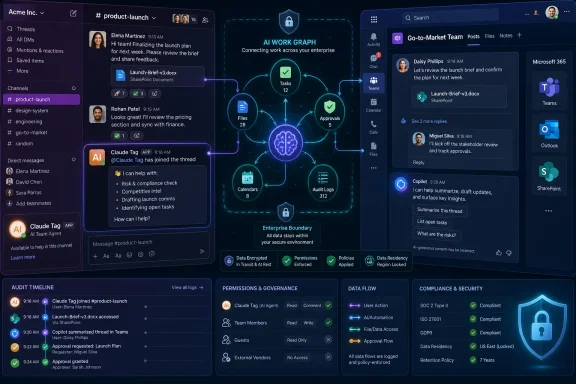
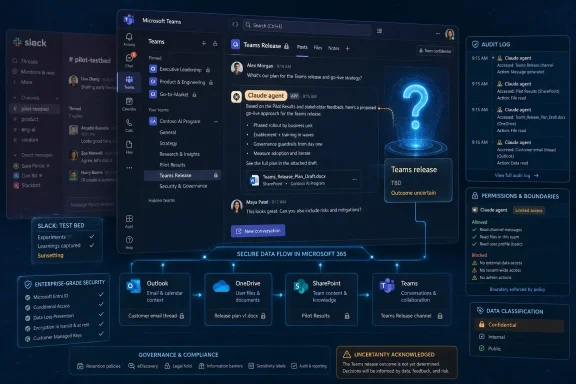
Anthropic launched Claude Tag in beta for Claude Enterprise and Team customers on June 23, 2026, starting with Slack rather than Microsoft Teams, while Teams users currently have access only through Claude’s Microsoft 365 connector rather than a native in-channel assistant. That distinction matters more than the product name suggests. Claude Tag is not merely another chatbot integration; it is Anthropic’s bid to make AI a persistent participant in workplace collaboration. For Microsoft-centric organizations, the story is less “Claude comes to Teams” than “Claude is circling the Teams estate, but has not yet moved in.”
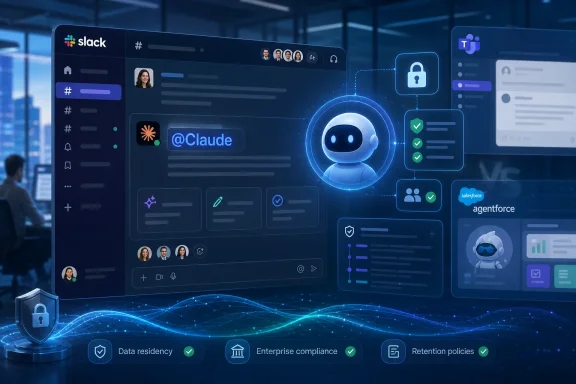
The first version of Claude Tag lives in Slack because Slack is exactly the kind of noisy, semi-structured workplace stream where an AI assistant can look most useful. A team can summon Claude by mentioning it in a channel, hand it a task, and let it work in the background while the conversation continues. The promise is not a prettier prompt box; it is a shared assistant that can read the room.
That is a meaningful shift from the usual one-user, one-chat model of enterprise AI. In the old pattern, every employee keeps a private thread with an assistant, pastes in context, receives an answer, and then manually translates that answer back into the team’s workflow. Claude Tag tries to collapse that loop by making the assistant part of the thread itself.
Anthropic calls this “multiplayer” context, and the phrase is doing real work. The assistant is meant to follow a conversation across multiple people, remember what has already been said, and operate against approved tools or data sources. In theory, Claude becomes less like a search box and more like a junior colleague who was present for the meeting.
That is also why Slack-first matters. Slack has long encouraged a culture of channels, mentions, bots, and app-driven workflows. Anthropic is inserting Claude into a collaboration environment that already tolerates software behaving like a participant.
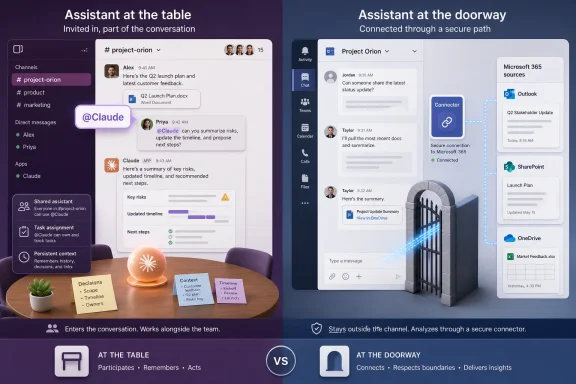
But a connector is not the same thing as Claude Tag inside Teams. The Microsoft 365 connector makes Teams content available to Claude; Claude Tag makes Claude available to the team conversation. That is a subtle architectural difference with big practical consequences.
In the connector model, the user goes to Claude and asks it to reason over Microsoft 365 data. In the Slack Tag model, the team stays inside the channel and assigns work to Claude as part of the discussion. One is retrieval and analysis across enterprise content; the other is participation in the workflow itself.
That gap is why the current Teams framing deserves caution. Native Teams support may be a logical next step, and Anthropic has said more workplace tools are coming. But as of now, Microsoft Teams users do not have the same embedded, mention-driven Claude Tag experience Slack users are testing.
This is where the integration politics get interesting. Microsoft Teams is not just another chat app. It is identity, compliance, meetings, files, channels, governance, and licensing all wrapped into one enterprise surface. A native Claude Tag for Teams would have to operate inside a more tightly managed Microsoft environment than Slack’s app ecosystem.
That does not make it impossible. It makes it commercially and technically sensitive. A Teams-native Claude Tag would sit close to Microsoft’s own Copilot value proposition, especially if it could read channel history, follow meetings, generate work items, summarize decisions, and act across Microsoft 365 services.
The connector route is therefore safer. It lets Anthropic say Claude works with Microsoft 365 while avoiding the more provocative claim that Claude is a Teams-native teammate. It also gives IT departments a more familiar permission model: connect an account, respect existing access controls, and let Claude search or analyze what the user is already allowed to see.
Persistent context raises hard questions. Which channel history does Claude retain? How are permissions enforced when multiple users with different access rights participate in the same conversation? What happens when a user mentions Claude in a channel that contains sensitive customer data, unreleased product plans, or regulated information?
Anthropic’s enterprise pitch leans heavily on admin controls and permission boundaries. That is necessary, but it is not magic. The more useful an AI assistant becomes, the more it needs access to the messy internal material that organizations are least comfortable exposing.
This is where Teams integration would face a tougher enterprise audience. Microsoft 365 tenants often carry years of accumulated access drift, abandoned groups, stale SharePoint permissions, and private Teams channels whose boundaries are understood more by habit than by documentation. An assistant that can reason across that environment may reveal as much about governance debt as it does about productivity gains.
That does not make the figure meaningless. It means the number should be treated as evidence of what is possible in a highly optimized environment, not as a forecast for a Windows admin team, a bank’s compliance department, or a midsize manufacturer running hybrid Microsoft 365. Internal dogfooding often produces real breakthroughs, but it rarely maps cleanly onto ordinary enterprise adoption.
The more interesting signal is not the percentage itself but the workflow behind it. Anthropic is implying that Claude Tag is not just answering questions; it is receiving tasks, operating asynchronously, and participating in engineering work over time. That is the agentic future every AI vendor is trying to sell, stripped of the slideware.
For developers and IT pros, the caution is familiar. AI-generated code can accelerate routine work, but it also moves review burden around rather than eliminating it. If Claude Tag becomes a shared coding participant in chat, organizations will need clear rules about repository access, code review, secrets handling, and accountability when generated changes make it into production.
In Slack, Claude Tag can look conversational and lively. Mention the assistant, ask it to summarize a thread, chase down a bug, or gather context, and it feels like the future of collaborative AI. In Teams, the same idea must contend with Microsoft’s administrative gravity: Entra ID, Purview, retention policies, eDiscovery, conditional access, data residency, and the politics of Copilot licensing.
That does not mean Teams users are left with nothing. The Microsoft 365 connector is arguably more useful than a shallow bot for many knowledge workers. If Claude can search Teams conversations, Outlook threads, SharePoint documents, and OneDrive files while respecting existing permissions, it can answer the kinds of questions that consume hours in large organizations.
But it is still a bridge. The user must leave the flow of the Teams conversation and ask Claude to inspect Microsoft 365 content. The assistant is not yet sitting in the channel, watching a decision unfold, and volunteering to draft the follow-up.
That is the difference between AI as a research tool and AI as a coworker. Anthropic has shipped the latter for Slack and the former for Microsoft 365.
But these workarounds usually lack the depth of a native implementation. They can route text between systems, but they rarely understand channel context, identity boundaries, enterprise permissions, or long-running project state as deeply as a first-party integration can. The result can be useful automation without the full “shared teammate” experience.
There is also an operational cost. Every third-party bridge becomes another surface to audit, license, monitor, and explain to the security team. In regulated environments, “we connected Teams to an external AI through an automation service” is not the sentence that makes risk officers relax.
For smaller organizations, the calculus may be different. A simple Teams-to-Claude workflow that summarizes a channel or drafts a response could save time immediately. The problem is that the most transformative use cases are also the ones that demand the strongest governance.
The winner may not be the model with the best benchmark score. It may be the assistant that is present at the moment work is assigned. In that sense, @Claude in Slack is a strategic land grab: Anthropic is trying to occupy the conversational point where decisions turn into tasks.
That is why the Teams question matters. If Claude remains outside Teams, Microsoft can argue that Copilot is the natural assistant for Microsoft-centric organizations. If Claude becomes a native Teams participant, enterprise customers gain more leverage and more complexity.
Admins should expect this pattern to repeat. AI vendors will increasingly compete not just on chat quality, but on where their assistants can be summoned, what context they can retain, and which systems they are allowed to touch. The battle is moving from model comparison charts to workplace surfaces.
That distinction should guide pilots. If the goal is enterprise search, document analysis, and cross-Microsoft 365 reasoning, the connector deserves evaluation. If the goal is an in-channel AI teammate that can be mentioned, assigned work, and kept in shared context, Slack currently has the more complete Claude Tag experience.
IT teams should also separate vendor roadmaps from deployed capabilities. “Coming to more tools” is not the same as available, documented, governable Teams support. Microsoft 365 environments are too central to business operations to build policy on assumed future integrations.
The practical approach is boring but correct: test what exists, document what data it can reach, define acceptable use, and watch the roadmap. The organizations that benefit most from these tools will be the ones that treat AI assistants as systems to govern, not novelties to install.
For now, Microsoft Teams remains on the outside of the native Claude Tag experience. That may change, and the existence of the Microsoft 365 connector suggests Anthropic understands how important Microsoft’s enterprise footprint is. But the current product line is clear: Slack gets the embedded teammate; Microsoft 365 gets connected context.
That may be enough to influence buying conversations. Enterprises rarely standardize on one collaboration tool, one AI model, or one workflow surface forever. If Claude proves useful in Slack and useful against Microsoft 365 content, the pressure for a Teams-native version will build from customers rather than marketing copy.
 Anthropic Starts Where Work Chat Is Already Messy
The first version of Claude Tag lives in Slack because Slack is exactly the kind of noisy, semi-structured workplace stream where an AI assistant can look most useful. A team can summon Claude by mentioning it in a channel, hand it a task, and let it work in the background while the conversation continues. The promise is not a prettier prompt box; it is a shared assistant that can read the room.That is a meaningful shift from the usual one-user, one-chat model of enterprise AI. In the old pattern, every employee keeps a private thread with an assistant, pastes in context, receives an answer, and then manually translates that answer back into the team’s workflow. Claude Tag tries to collapse that loop by making the assistant part of the thread itself.
Anthropic calls this “multiplayer” context, and the phrase is doing real work. The assistant is meant to follow a conversation across multiple people, remember what has already been said, and operate against approved tools or data sources. In theory, Claude becomes less like a search box and more like a junior colleague who was present for the meeting.
That is also why Slack-first matters. Slack has long encouraged a culture of channels, mentions, bots, and app-driven workflows. Anthropic is inserting Claude into a collaboration environment that already tolerates software behaving like a participant.
The Teams Story Is a Connector, Not a Seat at the Table
The Microsoft Teams angle is more complicated. Claude can already reach into parts of Microsoft 365 through Anthropic’s connector, including Teams conversations, Outlook, SharePoint, and OneDrive. That gives users a way to ask Claude about Microsoft work content without downloading files and re-uploading them into a chat window.But a connector is not the same thing as Claude Tag inside Teams. The Microsoft 365 connector makes Teams content available to Claude; Claude Tag makes Claude available to the team conversation. That is a subtle architectural difference with big practical consequences.
In the connector model, the user goes to Claude and asks it to reason over Microsoft 365 data. In the Slack Tag model, the team stays inside the channel and assigns work to Claude as part of the discussion. One is retrieval and analysis across enterprise content; the other is participation in the workflow itself.
That gap is why the current Teams framing deserves caution. Native Teams support may be a logical next step, and Anthropic has said more workplace tools are coming. But as of now, Microsoft Teams users do not have the same embedded, mention-driven Claude Tag experience Slack users are testing.
Microsoft’s Walled Garden Has an AI Door, But Not Everyone Gets a Key
For WindowsForum readers, the obvious comparison is Microsoft Copilot. Microsoft has spent years positioning Copilot as the native AI layer across Windows, Microsoft 365, Teams, Outlook, Edge, and the administrative stack. Anthropic’s Microsoft 365 connector does not replace that strategy; it exposes the fact that many enterprises want model choice even inside Microsoft’s productivity kingdom.This is where the integration politics get interesting. Microsoft Teams is not just another chat app. It is identity, compliance, meetings, files, channels, governance, and licensing all wrapped into one enterprise surface. A native Claude Tag for Teams would have to operate inside a more tightly managed Microsoft environment than Slack’s app ecosystem.
That does not make it impossible. It makes it commercially and technically sensitive. A Teams-native Claude Tag would sit close to Microsoft’s own Copilot value proposition, especially if it could read channel history, follow meetings, generate work items, summarize decisions, and act across Microsoft 365 services.
The connector route is therefore safer. It lets Anthropic say Claude works with Microsoft 365 while avoiding the more provocative claim that Claude is a Teams-native teammate. It also gives IT departments a more familiar permission model: connect an account, respect existing access controls, and let Claude search or analyze what the user is already allowed to see.
Persistent Context Is the Feature and the Risk
Claude Tag’s most important promise is persistence. Anthropic is selling the idea that Claude can remain aware of the project over time, not merely respond to an isolated prompt. That is exactly what teams want from AI, and exactly what security teams will want to examine.Persistent context raises hard questions. Which channel history does Claude retain? How are permissions enforced when multiple users with different access rights participate in the same conversation? What happens when a user mentions Claude in a channel that contains sensitive customer data, unreleased product plans, or regulated information?
Anthropic’s enterprise pitch leans heavily on admin controls and permission boundaries. That is necessary, but it is not magic. The more useful an AI assistant becomes, the more it needs access to the messy internal material that organizations are least comfortable exposing.
This is where Teams integration would face a tougher enterprise audience. Microsoft 365 tenants often carry years of accumulated access drift, abandoned groups, stale SharePoint permissions, and private Teams channels whose boundaries are understood more by habit than by documentation. An assistant that can reason across that environment may reveal as much about governance debt as it does about productivity gains.
The 65 Percent Coding Claim Is a Product Pitch in Disguise
Anthropic’s claim that an internal version of Claude Tag generates 65 percent of its product team’s code is the kind of statistic that makes executives lean forward and developers narrow their eyes. It is impressive, but it is also context-dependent. Anthropic is an AI company full of people building AI tools with deep familiarity with Claude’s strengths and failure modes.That does not make the figure meaningless. It means the number should be treated as evidence of what is possible in a highly optimized environment, not as a forecast for a Windows admin team, a bank’s compliance department, or a midsize manufacturer running hybrid Microsoft 365. Internal dogfooding often produces real breakthroughs, but it rarely maps cleanly onto ordinary enterprise adoption.
The more interesting signal is not the percentage itself but the workflow behind it. Anthropic is implying that Claude Tag is not just answering questions; it is receiving tasks, operating asynchronously, and participating in engineering work over time. That is the agentic future every AI vendor is trying to sell, stripped of the slideware.
For developers and IT pros, the caution is familiar. AI-generated code can accelerate routine work, but it also moves review burden around rather than eliminating it. If Claude Tag becomes a shared coding participant in chat, organizations will need clear rules about repository access, code review, secrets handling, and accountability when generated changes make it into production.
Slack Gets the Showpiece, Teams Gets the Enterprise Reality
Slack is the better demo. Teams is the bigger enterprise prize. That tension explains much of the current story.In Slack, Claude Tag can look conversational and lively. Mention the assistant, ask it to summarize a thread, chase down a bug, or gather context, and it feels like the future of collaborative AI. In Teams, the same idea must contend with Microsoft’s administrative gravity: Entra ID, Purview, retention policies, eDiscovery, conditional access, data residency, and the politics of Copilot licensing.
That does not mean Teams users are left with nothing. The Microsoft 365 connector is arguably more useful than a shallow bot for many knowledge workers. If Claude can search Teams conversations, Outlook threads, SharePoint documents, and OneDrive files while respecting existing permissions, it can answer the kinds of questions that consume hours in large organizations.
But it is still a bridge. The user must leave the flow of the Teams conversation and ask Claude to inspect Microsoft 365 content. The assistant is not yet sitting in the channel, watching a decision unfold, and volunteering to draft the follow-up.
That is the difference between AI as a research tool and AI as a coworker. Anthropic has shipped the latter for Slack and the former for Microsoft 365.
Third-Party Workarounds Fill the Gap, With All the Usual Caveats
Automation platforms can already connect Claude-like capabilities to Teams workflows. Zapier-style integrations can move messages, trigger prompts, post summaries, and create lightweight bridges between chat systems and AI services. For some teams, that may be enough.But these workarounds usually lack the depth of a native implementation. They can route text between systems, but they rarely understand channel context, identity boundaries, enterprise permissions, or long-running project state as deeply as a first-party integration can. The result can be useful automation without the full “shared teammate” experience.
There is also an operational cost. Every third-party bridge becomes another surface to audit, license, monitor, and explain to the security team. In regulated environments, “we connected Teams to an external AI through an automation service” is not the sentence that makes risk officers relax.
For smaller organizations, the calculus may be different. A simple Teams-to-Claude workflow that summarizes a channel or drafts a response could save time immediately. The problem is that the most transformative use cases are also the ones that demand the strongest governance.
The Real Competition Is Over Where Work Happens
The Claude Tag launch is part of a larger fight over the interface for enterprise AI. Microsoft wants Copilot to be the native layer for Microsoft 365. Salesforce wants Slack to remain a programmable collaboration hub. OpenAI, Anthropic, Google, and others want their models to become the agents that act across all of it.The winner may not be the model with the best benchmark score. It may be the assistant that is present at the moment work is assigned. In that sense, @Claude in Slack is a strategic land grab: Anthropic is trying to occupy the conversational point where decisions turn into tasks.
That is why the Teams question matters. If Claude remains outside Teams, Microsoft can argue that Copilot is the natural assistant for Microsoft-centric organizations. If Claude becomes a native Teams participant, enterprise customers gain more leverage and more complexity.
Admins should expect this pattern to repeat. AI vendors will increasingly compete not just on chat quality, but on where their assistants can be summoned, what context they can retain, and which systems they are allowed to touch. The battle is moving from model comparison charts to workplace surfaces.
For Windows Shops, the Sensible Move Is to Treat Claude as Adjacent Until It Is Native
Microsoft-heavy organizations should not mistake Claude’s Microsoft 365 connector for a full Teams rollout of Claude Tag. The connector may be valuable, but it belongs in a different category. It lets Claude analyze Microsoft content; it does not turn Claude into a Teams channel participant.That distinction should guide pilots. If the goal is enterprise search, document analysis, and cross-Microsoft 365 reasoning, the connector deserves evaluation. If the goal is an in-channel AI teammate that can be mentioned, assigned work, and kept in shared context, Slack currently has the more complete Claude Tag experience.
IT teams should also separate vendor roadmaps from deployed capabilities. “Coming to more tools” is not the same as available, documented, governable Teams support. Microsoft 365 environments are too central to business operations to build policy on assumed future integrations.
The practical approach is boring but correct: test what exists, document what data it can reach, define acceptable use, and watch the roadmap. The organizations that benefit most from these tools will be the ones that treat AI assistants as systems to govern, not novelties to install.
The Signal Beneath the Slack Demo
The narrow reading is that Anthropic launched a Slack bot with better memory. The broader reading is that workplace AI is moving from private prompting to shared delegation. Claude Tag is interesting because it makes that shift visible.For now, Microsoft Teams remains on the outside of the native Claude Tag experience. That may change, and the existence of the Microsoft 365 connector suggests Anthropic understands how important Microsoft’s enterprise footprint is. But the current product line is clear: Slack gets the embedded teammate; Microsoft 365 gets connected context.
That may be enough to influence buying conversations. Enterprises rarely standardize on one collaboration tool, one AI model, or one workflow surface forever. If Claude proves useful in Slack and useful against Microsoft 365 content, the pressure for a Teams-native version will build from customers rather than marketing copy.
The Admin’s Short List Before the Hype Cycle Moves On
Claude Tag is not just another AI announcement because it changes the social shape of how assistants are used at work. Before Windows and Microsoft 365 shops treat it as a Teams story, they should keep the product boundaries clear.- Claude Tag launched in beta on June 23, 2026, for Claude Enterprise and Team customers, with Slack as the first supported collaboration platform.
- Microsoft Teams does not currently have the same native @Claude channel experience that Slack users are testing.
- Claude’s Microsoft 365 connector can access and analyze Teams conversations and other Microsoft 365 content under existing permission controls.
- The connector model is useful, but it is not equivalent to a persistent AI teammate embedded directly inside Teams.
- Any pilot should be reviewed through identity, retention, data access, compliance, and audit requirements before broad deployment.
- Third-party automation can bridge Claude and Teams, but it introduces additional governance and reliability questions.
References
- Primary source: Crypto Briefing
Published: Tue, 30 Jun 2026 18:57:23 GMT
Anthropic's Claude Tag eyes Microsoft Teams integration after Slack-first launch
Claude Tag by Anthropic expands beyond Slack, targeting Microsoft Teams with AI to streamline team collaboration and conversation context.cryptobriefing.com - Related coverage: techradar.com
'Bringing Claude Tag into Slack is about making AI multiplayer': You can now tag Claude directly in Slack | TechRadar
Slack now lets you tag @Claude for helpwww.techradar.com - Related coverage: itpro.com
Meet Claude Tag, Anthropic’s new AI teammate that works in Slack | IT Pro
Anthropic has unveiled Claude Tag, a new agent designed to act as a virtual teammate within Slack.www.itpro.com - Official source: anthropic.com
Introducing Claude Tag \ Anthropic
Claude Tag is a new way for teams to work with Claude.www.anthropic.com - Official source: claude.com
Microsoft 365 Connector | Claude by Anthropic
Access SharePoint, OneDrive, Outlook, and Teams context directly in Claude claude.com
- Related coverage: digitalapplied.com
Claude Tag in Slack: Multiplayer AI Teamwork in 2026
Anthropic's Claude Tag (beta June 23, 2026) gives teams one shared @Claude in Slack that anyone can steer — a persistent, multiplayer AI teammate, not a bot.www.digitalapplied.com
- Related coverage: oquilia.com
Anthropic's Claude Tag turns Slack into an always-on AI colleague | Oquilia
Anthropic's new Claude Tag embeds an always-on assistant inside Slack, quietly learning how your company works. The real contest is over who owns enterprise memory.www.oquilia.com - Official source: support.claude.com
Microsoft 365 connector security guide | Claude Help Center
support.claude.com
- Related coverage: tech.co
Anthropic Announces Claude Tags to Access AI in Slack - Tech.co
Learn more about the new feature from Anthropic called Claude Tags, which makes the AI system available in Slack and other messaging platforms.tech.co - Related coverage: androidauthority.com
Claude is now in Slack — and it’s ready to do your chores
Anthropic is rolling out Claude Tag to Slack. The new integration will replace the old Claude in Slack appwww.androidauthority.com - Related coverage: thenewstack.io
- Related coverage: windowscentral.com
Claude AI now plugs into Outlook, Teams, and OneDrive | Windows Central
Microsoft's AI diversification continues as it pulls away from overreliance on OpenAI.www.windowscentral.com - Related coverage: tomshardware.com
Anthropic files for IPO — Claude maker races OpenAI and SpaceX to Wall Street | Tom's Hardware
No price or number of shares have been set yet.www.tomshardware.com - Related coverage: zeronoise.ai
- Related coverage: newsroom.ibm.com
IBM and Anthropic Partner to Advance Enterprise Software Development with Proven Security and Governance
PDF documentnewsroom.ibm.com
- Official source: www-cdn.anthropic.com
- Related coverage: techxplore.com