

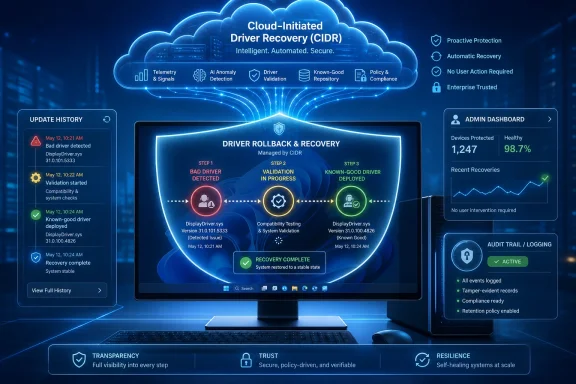
Microsoft announced Cloud-Initiated Driver Recovery on May 12, 2026, a Windows Update feature that lets Microsoft remotely roll back faulty drivers to known-good versions, with validation running through August and automatic support in the Hardware Dev Center publishing process planned for September 2026. The pitch is simple: if Windows Update delivers a bad driver, Windows should be able to undo the damage without asking users to become device-driver archaeologists. The real story is larger than convenience, because Microsoft is moving yet another part of Windows repair from the local machine into the cloud-controlled servicing pipeline. That may be exactly what Windows needs, but it also raises the bar for transparency when the rollback button no longer belongs solely to the person at the keyboard.
For decades, the Windows driver model has carried a bargain that users never really signed but constantly paid for. Microsoft supplied the operating system, hardware vendors supplied the drivers, and Windows Update increasingly became the delivery truck that dropped both onto the same doorstep. When the delivery went wrong, the blame could ricochet among Microsoft, the OEM, the silicon vendor, and the unlucky user staring at Device Manager.
Cloud-Initiated Driver Recovery, or CIDR, is Microsoft’s attempt to stop treating that failure mode as a local troubleshooting exercise. If a driver distributed through Windows Update is later identified as problematic during Microsoft’s shiproom evaluation process, Microsoft can initiate recovery from the cloud and replace it with a previously known-good version through the Windows Update pipeline. No new client agent is required, and Microsoft says the hardware partner does not need to submit a fresh fix before remediation begins.
That matters because the old model was slow in precisely the situations where speed counts. A bad graphics, storage, network, audio, Bluetooth, or chipset driver does not feel like an abstract quality metric when it breaks sleep, kills Wi-Fi, destabilizes gaming, triggers blue screens, or leaves a docking station behaving like a haunted peripheral. The user may not even know that the thing that broke was a driver, much less which one.
The feature is also a tacit admission that driver rollback as a self-service feature has never been good enough. Yes, Windows has long had a rollback option in Device Manager, and enterprise admins have policies, rings, reporting, and deployment tools. But a capability that requires a user to identify the device class, open the right properties pane, and hope the rollback button is not grayed out is not a consumer-grade safety net. It is a test of whether the user already knows the answer.
Microsoft’s driver ecosystem has spent years moving toward more cloud-mediated control. Driver and firmware servicing through Windows Update for Business, Intune integration, commercial approval flows, and hardware partner dashboards all reflect the same institutional logic: the driver problem is too large, too varied, and too risky to manage as a collection of one-off downloads from vendor support pages. Cloud-Initiated Driver Recovery extends that logic from deployment into remediation.
The interesting shift is that Microsoft is not merely improving detection. It is inserting a cloud-triggered reversal path into the publishing process. That turns Windows Update from a distribution mechanism into a live quality-control system with an undo function.
This is a more honest architecture for modern Windows. The operating system already depends on cloud intelligence for update targeting, safeguard holds, reputation checks, and staged rollouts. Pretending driver servicing is still a purely local affair is comforting but increasingly fictional. The question is not whether cloud coordination belongs in Windows maintenance; it is whether Microsoft can operate that coordination with enough precision that users trust it more than the mess it replaces.
A cloud-initiated rollback fits the real-world pattern of driver failures better than manual recovery does. Many driver issues are not instantly catastrophic. They appear as random wake failures, stuttering audio, missing external monitors, fingerprint readers that stop authenticating, or battery drain that nobody connects to last Tuesday’s update. By the time a user suspects the driver, the trail has gone cold.
If Microsoft can identify the bad package centrally and push recovery to affected systems, it can shrink the window in which millions of machines are quietly degraded. That is the strongest argument for CIDR: the fix can follow the same broad path as the mistake. Windows Update caused the exposure; Windows Update should also be able to close it.
There is also a psychological gain here. Windows Update has trained users to fear the reboot, and drivers have been a major reason why. A reliable rollback mechanism will not eliminate that fear, but it can make the update bargain less brittle. The user may still dislike being updated, but they are less likely to feel abandoned after the update goes sideways.
But enterprise IT does not evaluate reliability features only by asking whether they fix problems. It asks who decides, how fast the action propagates, whether it respects deployment rings, how it is logged, how it interacts with existing driver approval workflows, and whether rollback could create its own compatibility regression. A driver may be globally “bad” and still be locally necessary for a specific peripheral, security product, imaging workflow, or OEM build.
Microsoft’s framing suggests CIDR is tied to drivers delivered through Windows Update and to the Hardware Dev Center publishing process, not to every driver an organization installs through vendor packages, imaging tools, or device-management scripts. That boundary is important. It means CIDR is not a universal driver time machine; it is a recovery path for a specific Microsoft-mediated supply chain.
That limitation should reassure some admins and disappoint others. It reduces the chance that Microsoft will meddle with every bespoke driver stack in the enterprise. It also means organizations with messy legacy hardware, custom industrial peripherals, or vendor-supplied installers may see little benefit unless those drivers flow through Windows Update in the first place.
In the old remediation path, a partner often had to submit a replacement driver or users had to unwind the problem themselves. That placed the hardware vendor closer to the center of the fix. CIDR lets Microsoft move first, which is better for users but less flattering for partners whose updates caused the problem.
This is the right trade. The Windows ecosystem is too large for a remediation model that waits for every vendor to move at the same pace. A bad driver at scale is a platform incident, not merely a partner defect. Microsoft is the only actor with enough distribution reach to undo it quickly.
Still, there is a quiet tension here. Hardware vendors may prefer more control over how rollbacks are staged, messaged, and paired with replacement releases. Microsoft, meanwhile, has a platform reputation to defend and a user base that blames Windows when anything delivered by Windows Update breaks. CIDR is Microsoft saying that the platform’s reliability cannot be held hostage by the slowest remediation path.
That distinction matters. If a user installs a driver directly from a GPU vendor, motherboard utility, printer installer, gaming peripheral suite, VPN client, anti-cheat package, or storage controller tool, CIDR may not be the relevant recovery channel. If a driver is technically stable but poorly matched to one niche device configuration, the issue may not rise quickly enough to central detection. If the system cannot boot or cannot reach Windows Update, other recovery tools still matter.
The feature also depends on the quality of the “known-good” choice. Rolling back to the previous version is usually sensible, but not always harmless. Older drivers can carry their own bugs, performance regressions, or security weaknesses. In security-sensitive environments, a rollback is not automatically a win unless administrators can understand what changed and why.
That is why Microsoft’s reporting and audit trail will matter almost as much as the rollback mechanism. Users may not need to do anything, but admins need to know what was done. A silent fix is convenient at home; in a regulated enterprise, silence can be a liability.
This is not inherently sinister. In fact, it is probably unavoidable. The Windows installed base is too diverse for static local recovery tools to handle modern failure patterns at speed. A cloud service can notice that a specific driver is causing trouble across a population of devices long before any single user or admin has enough evidence to prove the pattern.
But the shift changes what users should demand from Microsoft. If the company wants the authority to fix more things automatically, it owes the ecosystem better explanations when it does so. That means clear event logs, admin-facing reports, user-visible update history, and plain-language descriptions that do not reduce every intervention to a vague “quality improvement.”
Windows has often suffered from a trust deficit around updates because too much happens behind the curtain. CIDR could improve that trust if the curtain opens a little. If it becomes another silent servicing mechanism that users only discover after something changes, Microsoft will have solved one frustration while feeding another.
Driver problems have always had outsized symbolic weight because they make Windows feel chaotic. A bad Start menu change annoys people; a bad driver can take away sound, networking, display output, biometrics, printing, or basic system stability. When that happens after Windows Update, the platform looks careless.
Microsoft’s latest recovery push is a response to that perception. The company is trying to make Windows less dependent on heroic end-user troubleshooting and more capable of fleet-scale self-correction. That is the right priority, especially as more PCs are managed remotely and more users expect mobile-style recovery rather than desktop-era spelunking.
The September 2026 target for automatic support in the Hardware Dev Center publishing process is also telling. Microsoft is not presenting CIDR as a speculative science project; it is positioning it as an operational change in the driver pipeline. The validation period through August gives hardware partners and Microsoft a runway to test the workflow before it becomes part of routine publishing.
For home users, the ideal experience is that Windows Update installs a driver, Microsoft later discovers the package is causing trouble, and the affected systems quietly return to the safer version. Maybe the user sees a note in update history. Maybe a restart is required. What they should not need is a forum thread, a vendor cleanup utility, a registry edit, and three contradictory Reddit comments.
For IT departments, the ideal experience is different but compatible. They need reporting, controls, and predictable interaction with deployment rings. They need to know whether the rollback applies to all affected machines or only those in specific cohorts. They need to verify that the rollback does not collide with Intune driver policies, Windows Update for Business settings, Autopatch, or internal change-management windows.
For Microsoft, the ideal experience is reputational. Every successful rollback is one less example of “Windows Update broke my PC” becoming folk wisdom. That phrase has haunted the platform because it compresses years of real user pain into a simple accusation. CIDR will not erase that history, but it gives Microsoft a credible answer: if Windows Update can ship the problem, it can also ship the reversal.
A rollback can be a fix, but it is also a change. It alters code running close to the hardware, sometimes at a level where performance, security, and device compatibility are tightly linked. In an unmanaged household, that may be an acceptable invisible trade. In a business, it needs to be visible, attributable, and reversible under policy.
Microsoft should therefore treat CIDR as part of the Windows servicing contract, not merely as a convenience feature. The mechanism should leave understandable traces. It should be documented in update history. It should surface in admin consoles. It should distinguish between a driver blocked before broad distribution and a driver actively rolled back after reaching devices.
The company also needs to be careful with language. “Known-good” is useful shorthand, but it is not a guarantee. It means good enough according to available signals, for the affected population, at that point in time. Mature admins understand this; consumer marketing often does not.
Windows is not Linux on a hobbyist workstation, and it is not a locked-down appliance either. It is a massive compatibility platform serving gamers, accountants, hospitals, factories, schools, developers, kiosk fleets, and people who just want Bluetooth headphones to work. That breadth is Windows’ superpower and its permanent liability.
CIDR is an attempt to manage that liability at platform scale. It recognizes that driver failures are not rare edge cases to be left to message boards and vendor utilities. They are predictable byproducts of a vast hardware ecosystem, and predictable failures deserve engineered recovery paths.
The move also subtly reframes Windows Update itself. Instead of being just the thing that delivers updates, it becomes the thing that can revoke or reverse them when the platform’s quality signals demand it. That is a healthier model, provided Microsoft does not confuse central authority with infallibility.
The trust questions will be harder. Will users understand why a driver changed? Will admins get enough notice? Will hardware partners cooperate with Microsoft’s quality determinations? Will the Windows community see this as a safety net or as another cloud switch wired into their PCs?
The answer may depend on the first visible incidents. If CIDR quietly rescues systems from a high-profile bad driver, Microsoft will have a strong proof point. If it rolls back a driver in a way that surprises admins or breaks a specialized workflow, the backlash will write itself. Reliability automation gets praised when it removes pain and distrusted when it removes agency.
Microsoft can reduce that risk by over-communicating in the places professionals actually look. Event Viewer entries, Intune reporting, Windows Update history, release health dashboards, and Hardware Dev Center feedback should tell the same story. The more coherent the record, the less CIDR will feel like a mysterious cloud hand reaching into the driver store.
The practical read is straightforward:
Source: Digital Trends Windows 11 will clean up its own driver mess so you don’t have to
 Microsoft Moves the Rollback Button Into the Cloud
For decades, the Windows driver model has carried a bargain that users never really signed but constantly paid for. Microsoft supplied the operating system, hardware vendors supplied the drivers, and Windows Update increasingly became the delivery truck that dropped both onto the same doorstep. When the delivery went wrong, the blame could ricochet among Microsoft, the OEM, the silicon vendor, and the unlucky user staring at Device Manager.Cloud-Initiated Driver Recovery, or CIDR, is Microsoft’s attempt to stop treating that failure mode as a local troubleshooting exercise. If a driver distributed through Windows Update is later identified as problematic during Microsoft’s shiproom evaluation process, Microsoft can initiate recovery from the cloud and replace it with a previously known-good version through the Windows Update pipeline. No new client agent is required, and Microsoft says the hardware partner does not need to submit a fresh fix before remediation begins.
That matters because the old model was slow in precisely the situations where speed counts. A bad graphics, storage, network, audio, Bluetooth, or chipset driver does not feel like an abstract quality metric when it breaks sleep, kills Wi-Fi, destabilizes gaming, triggers blue screens, or leaves a docking station behaving like a haunted peripheral. The user may not even know that the thing that broke was a driver, much less which one.
The feature is also a tacit admission that driver rollback as a self-service feature has never been good enough. Yes, Windows has long had a rollback option in Device Manager, and enterprise admins have policies, rings, reporting, and deployment tools. But a capability that requires a user to identify the device class, open the right properties pane, and hope the rollback button is not grayed out is not a consumer-grade safety net. It is a test of whether the user already knows the answer.
The Old Driver Problem Was Always a Governance Problem
Windows drivers are awkward because they sit at the seam between operating-system trust and hardware-vendor autonomy. Microsoft cannot personally author every driver for the vast universe of Windows PCs, yet users experience the result as “Windows broke my computer.” That perception is not always technically fair, but it is operationally accurate: if Windows Update installed the component, Windows owns the user’s pain.Microsoft’s driver ecosystem has spent years moving toward more cloud-mediated control. Driver and firmware servicing through Windows Update for Business, Intune integration, commercial approval flows, and hardware partner dashboards all reflect the same institutional logic: the driver problem is too large, too varied, and too risky to manage as a collection of one-off downloads from vendor support pages. Cloud-Initiated Driver Recovery extends that logic from deployment into remediation.
The interesting shift is that Microsoft is not merely improving detection. It is inserting a cloud-triggered reversal path into the publishing process. That turns Windows Update from a distribution mechanism into a live quality-control system with an undo function.
This is a more honest architecture for modern Windows. The operating system already depends on cloud intelligence for update targeting, safeguard holds, reputation checks, and staged rollouts. Pretending driver servicing is still a purely local affair is comforting but increasingly fictional. The question is not whether cloud coordination belongs in Windows maintenance; it is whether Microsoft can operate that coordination with enough precision that users trust it more than the mess it replaces.
The Promise Is Less Heroic Troubleshooting
The obvious beneficiary is the ordinary Windows 11 user who does not want to learn the difference between a DCH graphics package, an optional driver, an OEM-customized audio stack, and whatever Windows Update decided was “best” this week. That user does not need another support article. They need the bad component to disappear.A cloud-initiated rollback fits the real-world pattern of driver failures better than manual recovery does. Many driver issues are not instantly catastrophic. They appear as random wake failures, stuttering audio, missing external monitors, fingerprint readers that stop authenticating, or battery drain that nobody connects to last Tuesday’s update. By the time a user suspects the driver, the trail has gone cold.
If Microsoft can identify the bad package centrally and push recovery to affected systems, it can shrink the window in which millions of machines are quietly degraded. That is the strongest argument for CIDR: the fix can follow the same broad path as the mistake. Windows Update caused the exposure; Windows Update should also be able to close it.
There is also a psychological gain here. Windows Update has trained users to fear the reboot, and drivers have been a major reason why. A reliable rollback mechanism will not eliminate that fear, but it can make the update bargain less brittle. The user may still dislike being updated, but they are less likely to feel abandoned after the update goes sideways.
Enterprise IT Will Like the Concept and Worry About the Control Plane
For administrators, CIDR lands in more complicated territory. On paper, automatic rollback of faulty Windows Update drivers is a gift to help desks. Anything that reduces tickets about broken Wi-Fi, flickering displays, missing smart-card readers, or unstable docking stations is welcome, especially in hybrid fleets where physical access to devices is limited.But enterprise IT does not evaluate reliability features only by asking whether they fix problems. It asks who decides, how fast the action propagates, whether it respects deployment rings, how it is logged, how it interacts with existing driver approval workflows, and whether rollback could create its own compatibility regression. A driver may be globally “bad” and still be locally necessary for a specific peripheral, security product, imaging workflow, or OEM build.
Microsoft’s framing suggests CIDR is tied to drivers delivered through Windows Update and to the Hardware Dev Center publishing process, not to every driver an organization installs through vendor packages, imaging tools, or device-management scripts. That boundary is important. It means CIDR is not a universal driver time machine; it is a recovery path for a specific Microsoft-mediated supply chain.
That limitation should reassure some admins and disappoint others. It reduces the chance that Microsoft will meddle with every bespoke driver stack in the enterprise. It also means organizations with messy legacy hardware, custom industrial peripherals, or vendor-supplied installers may see little benefit unless those drivers flow through Windows Update in the first place.
The Hardware Partners Lose a Little Friction and a Little Cover
Microsoft says hardware partners do not need to take action for the rollback itself. They will be notified when a driver is rejected or flagged, and they are still expected to monitor quality metrics and respond to shiproom feedback. That sounds cooperative, but it changes the balance of power.In the old remediation path, a partner often had to submit a replacement driver or users had to unwind the problem themselves. That placed the hardware vendor closer to the center of the fix. CIDR lets Microsoft move first, which is better for users but less flattering for partners whose updates caused the problem.
This is the right trade. The Windows ecosystem is too large for a remediation model that waits for every vendor to move at the same pace. A bad driver at scale is a platform incident, not merely a partner defect. Microsoft is the only actor with enough distribution reach to undo it quickly.
Still, there is a quiet tension here. Hardware vendors may prefer more control over how rollbacks are staged, messaged, and paired with replacement releases. Microsoft, meanwhile, has a platform reputation to defend and a user base that blames Windows when anything delivered by Windows Update breaks. CIDR is Microsoft saying that the platform’s reliability cannot be held hostage by the slowest remediation path.
This Is Not a Magic Shield Against Every Bad Driver
The danger with a feature like Cloud-Initiated Driver Recovery is that the name sounds more comprehensive than the first implementation is likely to be. It does not mean Windows 11 can automatically diagnose every driver-induced crash on every PC and calmly restore perfection before breakfast. It means Microsoft has a mechanism to reverse certain problematic drivers delivered through Windows Update after they are identified in the company’s quality process.That distinction matters. If a user installs a driver directly from a GPU vendor, motherboard utility, printer installer, gaming peripheral suite, VPN client, anti-cheat package, or storage controller tool, CIDR may not be the relevant recovery channel. If a driver is technically stable but poorly matched to one niche device configuration, the issue may not rise quickly enough to central detection. If the system cannot boot or cannot reach Windows Update, other recovery tools still matter.
The feature also depends on the quality of the “known-good” choice. Rolling back to the previous version is usually sensible, but not always harmless. Older drivers can carry their own bugs, performance regressions, or security weaknesses. In security-sensitive environments, a rollback is not automatically a win unless administrators can understand what changed and why.
That is why Microsoft’s reporting and audit trail will matter almost as much as the rollback mechanism. Users may not need to do anything, but admins need to know what was done. A silent fix is convenient at home; in a regulated enterprise, silence can be a liability.
Windows Recovery Is Becoming a Cloud Service
CIDR fits into a broader trend: Microsoft is turning Windows resilience into a connected service rather than a set of local escape hatches. Quick machine recovery, cloud remediation, Windows Recovery Environment improvements, Windows Backup for Organizations, and update deployment intelligence all point in the same direction. The PC is still personal, but its repair logic increasingly depends on a service-side brain.This is not inherently sinister. In fact, it is probably unavoidable. The Windows installed base is too diverse for static local recovery tools to handle modern failure patterns at speed. A cloud service can notice that a specific driver is causing trouble across a population of devices long before any single user or admin has enough evidence to prove the pattern.
But the shift changes what users should demand from Microsoft. If the company wants the authority to fix more things automatically, it owes the ecosystem better explanations when it does so. That means clear event logs, admin-facing reports, user-visible update history, and plain-language descriptions that do not reduce every intervention to a vague “quality improvement.”
Windows has often suffered from a trust deficit around updates because too much happens behind the curtain. CIDR could improve that trust if the curtain opens a little. If it becomes another silent servicing mechanism that users only discover after something changes, Microsoft will have solved one frustration while feeding another.
The Timing Is Not Accidental
The May 2026 announcement arrives at a moment when Microsoft is trying to sell Windows 11 as both more resilient and more manageable. Windows 10 is already beyond its mainstream consumer comfort zone, AI PCs are competing for attention, and IT departments are still balancing hardware refresh cycles, security baselines, and user resistance to change. In that climate, “Windows can undo bad drivers automatically” is more than a technical feature. It is a reputational repair campaign.Driver problems have always had outsized symbolic weight because they make Windows feel chaotic. A bad Start menu change annoys people; a bad driver can take away sound, networking, display output, biometrics, printing, or basic system stability. When that happens after Windows Update, the platform looks careless.
Microsoft’s latest recovery push is a response to that perception. The company is trying to make Windows less dependent on heroic end-user troubleshooting and more capable of fleet-scale self-correction. That is the right priority, especially as more PCs are managed remotely and more users expect mobile-style recovery rather than desktop-era spelunking.
The September 2026 target for automatic support in the Hardware Dev Center publishing process is also telling. Microsoft is not presenting CIDR as a speculative science project; it is positioning it as an operational change in the driver pipeline. The validation period through August gives hardware partners and Microsoft a runway to test the workflow before it becomes part of routine publishing.
The Best Version of CIDR Is Boring
If Cloud-Initiated Driver Recovery works well, most users should never learn its acronym. The best reliability features are boring. They prevent a bad week from becoming a support saga and then vanish into the background.For home users, the ideal experience is that Windows Update installs a driver, Microsoft later discovers the package is causing trouble, and the affected systems quietly return to the safer version. Maybe the user sees a note in update history. Maybe a restart is required. What they should not need is a forum thread, a vendor cleanup utility, a registry edit, and three contradictory Reddit comments.
For IT departments, the ideal experience is different but compatible. They need reporting, controls, and predictable interaction with deployment rings. They need to know whether the rollback applies to all affected machines or only those in specific cohorts. They need to verify that the rollback does not collide with Intune driver policies, Windows Update for Business settings, Autopatch, or internal change-management windows.
For Microsoft, the ideal experience is reputational. Every successful rollback is one less example of “Windows Update broke my PC” becoming folk wisdom. That phrase has haunted the platform because it compresses years of real user pain into a simple accusation. CIDR will not erase that history, but it gives Microsoft a credible answer: if Windows Update can ship the problem, it can also ship the reversal.
The Catch Is That Automation Needs Accountability
There is a familiar pattern in Windows servicing: Microsoft adds automation to reduce friction, then users and admins ask for the knobs that automation removed. CIDR will be no different. The consumer story is “you do not have to do anything.” The enterprise story cannot stop there.A rollback can be a fix, but it is also a change. It alters code running close to the hardware, sometimes at a level where performance, security, and device compatibility are tightly linked. In an unmanaged household, that may be an acceptable invisible trade. In a business, it needs to be visible, attributable, and reversible under policy.
Microsoft should therefore treat CIDR as part of the Windows servicing contract, not merely as a convenience feature. The mechanism should leave understandable traces. It should be documented in update history. It should surface in admin consoles. It should distinguish between a driver blocked before broad distribution and a driver actively rolled back after reaching devices.
The company also needs to be careful with language. “Known-good” is useful shorthand, but it is not a guarantee. It means good enough according to available signals, for the affected population, at that point in time. Mature admins understand this; consumer marketing often does not.
The Driver Mess Was Never Just the User’s Mess
There is something almost overdue about Microsoft taking more direct responsibility for bad Windows Update drivers. The old advice often implied that users should be grateful for automatic maintenance until something broke, at which point they were expected to know how to reverse-engineer the maintenance. That was never a serious model for a mainstream operating system.Windows is not Linux on a hobbyist workstation, and it is not a locked-down appliance either. It is a massive compatibility platform serving gamers, accountants, hospitals, factories, schools, developers, kiosk fleets, and people who just want Bluetooth headphones to work. That breadth is Windows’ superpower and its permanent liability.
CIDR is an attempt to manage that liability at platform scale. It recognizes that driver failures are not rare edge cases to be left to message boards and vendor utilities. They are predictable byproducts of a vast hardware ecosystem, and predictable failures deserve engineered recovery paths.
The move also subtly reframes Windows Update itself. Instead of being just the thing that delivers updates, it becomes the thing that can revoke or reverse them when the platform’s quality signals demand it. That is a healthier model, provided Microsoft does not confuse central authority with infallibility.
The September Test Will Be About Trust, Not Just Telemetry
When Microsoft begins automatic support for CIDR in the Hardware Dev Center publishing process, the technical questions will be obvious. How quickly can Microsoft detect a faulty driver? How narrowly can it target affected systems? How often does rollback succeed? How many cases require reboot? How does the feature behave on metered networks, managed fleets, and devices with update deferrals?The trust questions will be harder. Will users understand why a driver changed? Will admins get enough notice? Will hardware partners cooperate with Microsoft’s quality determinations? Will the Windows community see this as a safety net or as another cloud switch wired into their PCs?
The answer may depend on the first visible incidents. If CIDR quietly rescues systems from a high-profile bad driver, Microsoft will have a strong proof point. If it rolls back a driver in a way that surprises admins or breaks a specialized workflow, the backlash will write itself. Reliability automation gets praised when it removes pain and distrusted when it removes agency.
Microsoft can reduce that risk by over-communicating in the places professionals actually look. Event Viewer entries, Intune reporting, Windows Update history, release health dashboards, and Hardware Dev Center feedback should tell the same story. The more coherent the record, the less CIDR will feel like a mysterious cloud hand reaching into the driver store.
A Smaller Repair Button With Bigger Implications
Cloud-Initiated Driver Recovery is not the biggest Windows feature Microsoft will ship in 2026, but it may be one of the more revealing. It shows the company betting that Windows reliability depends less on asking users to troubleshoot better and more on making the servicing system capable of admitting and reversing its own mistakes.The practical read is straightforward:
- Microsoft announced Cloud-Initiated Driver Recovery on May 12, 2026, with validation planned through August and automatic Hardware Dev Center publishing support planned for September 2026.
- The feature applies to problematic drivers delivered through Windows Update, not necessarily to every driver installed through vendor tools or manual downloads.
- Microsoft can initiate rollback from the cloud and use the existing Windows Update pipeline to replace the faulty package with a known-good version.
- Hardware partners are notified and still expected to monitor quality metrics, but they do not need to submit a replacement before Microsoft can start recovery.
- Home users should see fewer cases where a bad Windows Update driver leaves them hunting through Device Manager for a fix.
- Enterprise admins should watch closely for logging, policy integration, reporting, and change-control behavior before treating CIDR as a complete driver-risk solution.
Source: Digital Trends Windows 11 will clean up its own driver mess so you don’t have to
