

A small but consequential change in the AMD Linux display driver — removing a register read from the DCN35 DMCUB diagnostic collection — was merged to upstream kernels to close CVE-2024-47662, a local, availability‑focused flaw that can hang the display microcontroller interface and block a critical diagnostic/hardware entry path for some DCN3.5 hardware.
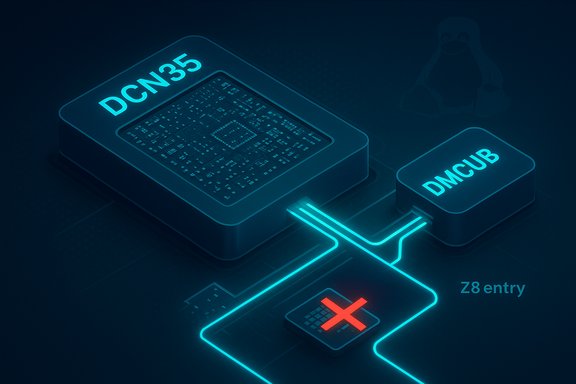
The vulnerability tracked as CVE‑2024‑47662 lives in the Linux kernel’s AMD DRM display stack and centers on the DCN35 (Display Core Next 3.5) path that collects DMCUB (Display Microcontroller Unit B) diagnostic registers. Multiple vulnerability aggregators summarize the issue succinctly: certain registers that the driver should not read were included in the diagnostic collection, and reading them during a DMCUB timeout can trigger a security violation that blocks Z8 entry (a hardware/diagnostic transition referenced in the upstream note). The remedial action was to simply remove the offending register read from the DCN35 diagnostic collection. Why this matters operationally: the bug’s severity is not about leaking secrets or elevating privileges — it’s about availability. When the condition is hit, the DMCUB diagnostic path can stall or place the microcontroller into a state that prevents normal recovery, producing driver hangs, pageflip timeouts or other display subsystem instability that in many deployments forces a driver reload or system reboot. Public trackers rate the issue Medium with a CVSS v3.1 base score of 5.5 (AV:L/AC:L/PR:L/UI:N/S:U/C:N/I:N/A:H).
In the DCN35 path the driver’s diagnostic collector included one or more registers that, according to the upstream note, should not be read by the driver. Under normal operation reading them might be harmless, but if a DMCUB operation has timed out the attempt to read those registers can trigger a security violation or otherwise prevent the microcontroller from entering the expected recovery or Z8 state. The result is a blocked or stalled diagnostic flow and a dependable local availability failure.
Recommended, prioritized steps:
Practical checklist for immediate action:
Source: MSRC Security Update Guide - Microsoft Security Response Center
 Background / Overview
The vulnerability tracked as CVE‑2024‑47662 lives in the Linux kernel’s AMD DRM display stack and centers on the DCN35 (Display Core Next 3.5) path that collects DMCUB (Display Microcontroller Unit B) diagnostic registers. Multiple vulnerability aggregators summarize the issue succinctly: certain registers that the driver should not read were included in the diagnostic collection, and reading them during a DMCUB timeout can trigger a security violation that blocks Z8 entry (a hardware/diagnostic transition referenced in the upstream note). The remedial action was to simply remove the offending register read from the DCN35 diagnostic collection. Why this matters operationally: the bug’s severity is not about leaking secrets or elevating privileges — it’s about availability. When the condition is hit, the DMCUB diagnostic path can stall or place the microcontroller into a state that prevents normal recovery, producing driver hangs, pageflip timeouts or other display subsystem instability that in many deployments forces a driver reload or system reboot. Public trackers rate the issue Medium with a CVSS v3.1 base score of 5.5 (AV:L/AC:L/PR:L/UI:N/S:U/C:N/I:N/A:H). Technical anatomy: what went wrong
DCN35, DMCUB and the diagnostic collection
Modern AMD GPUs contain tiny on‑chip microcontrollers (DMCUs) which the kernel driver interacts with for power management, link training, and low‑level diagnostics. One of these microcontrollers is DMCUB. When the kernel triggers diagnostics (for example, after a timeout or fault), the driver collects a set of registers and internal status words from the microcontroller to aid debugging.In the DCN35 path the driver’s diagnostic collector included one or more registers that, according to the upstream note, should not be read by the driver. Under normal operation reading them might be harmless, but if a DMCUB operation has timed out the attempt to read those registers can trigger a security violation or otherwise prevent the microcontroller from entering the expected recovery or Z8 state. The result is a blocked or stalled diagnostic flow and a dependable local availability failure.
The fix: remove the register read
Upstream maintainers chose the narrowest, lowest‑risk approach: remove the offending register reads from the DCN35 DMCUB diagnostic collection. That change avoids making speculative assumptions about what registers are safe to access during a timeout and prevents the driver from forcing the microcontroller into a non‑recoverable state during diagnostics. The upstream commit(s) implementing this change are recorded in public CVE trackers and kernel stable patch references.Why this pattern is preferred
This is a classic defensive maintenance pattern in kernel hardware drivers: when a register access can produce a hardware state transition or fault during error handling, the safest course is to shrink the error‑path surface area rather than attempt complex recovery inside the driver. Small, surgical removals or guards are easy to backport, test, and reason about — and they avoid creating new assumptions about hardware behavior in exceptional conditions. Multiple similar DRM fixes followed this pattern over recent kernel cycles.Scope, exposure and exploitability
- Attack vector: Local. Exploitation requires code running on the host that can exercise the display driver diagnostic path (for example, by provoking a DMCUB timeout via repeated modeset/stream operations, or by interacting with debug interfaces).
- Privileges required: Low. On many desktop systems unprivileged processes can reach display driver paths indirectly through compositors, media players, or sandboxed GPU runtimes. Systems that restrict access to /dev/dri and limit device exposure to untrusted users are less exposed.
- Impact: Availability (High). The direct consequence is a denial‑of‑service on the graphics pipeline — driver hang, pageflip timeouts, or forced reboot. There is no public evidence that this CVE permits information disclosure or privilege escalation by itself.
- Real‑world exploitation: No public, widespread exploitation has been reported at disclosure time. Trackers indicate very low EPSS values and few if any public PoCs; however, local DoS primitives are easy to weaponize in shared or multi‑tenant environments, so operational risk is non‑zero.
Detection: logs, symptoms and forensic signals
When this class of driver/firmware interaction bug fires, the operational artifacts are typically obvious:- Kernel logs (dmesg / journalctl -k) containing DRM/amdgpu errors, pageflip timeouts, or microcontroller/mailbox timeouts.
- Repeated compositor crashes or frozen displays after modeset or hot‑plug events.
- Driver watchdog or GPU reset messages around diagnostic collection or DMCU mailbox interactions.
- Reproducible hangs when exercising a specific monitor, adapter, or dock (not every topology will reach the problematic register access).
Mitigation and remediation guidance
The only definitive remediation is to run a kernel that contains the upstream fix; because this is a kernel driver change the fix takes effect only after booting into an updated kernel.Recommended, prioritized steps:
- Inventory affected systems. Identify hosts that load the AMD GPU DRM modules and expose /dev/dri device nodes:
- uname -r to view the running kernel.
- lsmod | grep amdgpu to confirm the AMD driver is loaded.
- ls -l /dev/dri/* to inspect device node access.
- Patch via vendor/distribution kernel updates. Consult your distribution’s security tracker or package changelog for kernel packages that reference CVE‑2024‑47662 or the stable commit(s) associated with the fix. Major distributions have already mapped the CVE into kernel package advisories and provided updated images. Reboot into the patched kernel to make the remediation effective.
- Short‑term compensating controls when immediate patching is not possible:
- Restrict access to DRM device nodes through udev rules and group membership changes so untrusted users or containers cannot directly exercise DRM ioctls.
- Remove /dev/dri device passthrough from untrusted containers and CI runners.
- Avoid repeatedly hot‑plugging or reconfiguring displays, and avoid using uncertified adapters or hubs that can provoke link training or microcontroller timeouts in sensitive fleets.
- Test and validate after patching:
- Boot patched kernels in a staging pool with representative hardware (multi‑monitor, docks, MST hubs).
- Exercise display reconfiguration scenarios and monitor dmesg/journalctl for recurrence of prior oops or mailbox timeouts.
- Monitor for regressions for several days of typical workloads; display‑driver changes are sensitive to unusual topologies.
Operational risk analysis and prioritization
- High priority: multi‑tenant systems, VDI/VDP servers, CI runners, shared developer machines, kiosk/public‑access systems, or any environment where untrusted local actors or containers have access to GPU devices. In these setups the local DoS primitive can be weaponized for denial of service with little complexity.
- Medium priority: single‑user developer desktops where users are trusted and update cadence is aggressive; still patch in the next maintenance window.
- Lower priority (but not exempt): air‑gapped or controlled embedded devices with vendor kernels. The “long tail” of vendor/OEM kernels that don’t receive regular upstream backports is the recurrent risk factor for lingering exposure. Vendors with custom kernel trees may lag upstream and should be engaged to obtain fixes.
What administrators and OEMs should do now
- Operators: confirm package changelogs and kernel images from your distro. Install vendor-supplied kernel updates that list CVE‑2024‑47662 or the associated upstream commit IDs, then reboot. If you cannot reboot immediately, isolate affected hosts, revoke /dev/dri access where possible, and schedule prompt maintenance.
- OEMs and vendors with custom kernels: inspect your kernel source tree for the diagnostic collection code in the DCN35 DMCUB path. If your builds do not include the upstream commit that removes the register reads, prioritize a vendor backport and coordinated firmware/kernel image release. Embedded and appliance vendors should treat this as a high‑priority maintenance item for affected hardware.
- Incident responders: collect and preserve kernel oops traces, serial console logs, and pre‑ and post‑crash dmesg output. Those artifacts map directly to upstream commits and will be required when working with vendor support or when backporting fixes into custom trees.
Critical assessment — strengths of the response and residual risks
Notable strengths- The remediation itself is minimal and focused: removing a problematic register read is a conservative change that eliminates the crash/window without altering normal operation for correct hardware. This low‑risk edit is easy to backport to stable kernel branches, minimizing regression exposure. Public trackers and stable‑tree patches are available to distributors, which accelerates patch propagation.
- The operational guidance available from distributions and incident‑response writeups is practical and prioritized toward availability‑first risk management: inventory, patch, restrict device exposure, and collect logs for forensics. Those playbooks are well‑matched to the nature of the flaw.
- The long tail: embedded devices, OEM kernels, and vendor images can lag upstream fixes for months. Those fleets are the most likely to remain vulnerable beyond desktop and server patch cycles. Confirm vendor support timelines for who owns remediation for appliance and SoC images.
- Incomplete transparency in some advisories: vendor trackers sometimes lag or provide shorthand mapping to kernel commits rather than explicit package names. Operators should not assume a kernel is fixed solely because a distribution announced a fix; verify package changelogs contain the upstream stable commit that implements the removal.
- Hardware‑specific terminology: phrases like “blocks Z8 entry” are present in upstream notes but represent firmware/hardware transitions that aren’t widely documented outside the kernel tree. Treat such claims as vendor/hardware specific and flag them as specialized rather than broadly generalizable. Where a claim cannot be independently confirmed outside the kernel commit text, label it as such during triage.
Closing analysis and practical checklist
CVE‑2024‑47662 is a reminder that driver‑level diagnostic and microcontroller interactions are a recurring source of availability issues. The bug was closed with a narrowly scoped code removal that should be trivial to backport and validate; nonetheless, the operational impact can be significant in multi‑tenant or GPU‑exposed environments.Practical checklist for immediate action:
- Run uname -r; identify AMGPU/DRM modules: lsmod | grep amdgpu.
- Check your distro security tracker / package changelog for CVE‑2024‑47662 or the upstream stable commit references, then install the kernel package that contains the fix and reboot.
- If you cannot patch immediately, revoke or restrict /dev/dri access from untrusted users and containers and avoid repeated display reconfiguration on production hosts.
- Preserve kernel logs and serial console dumps for any incidents to enable mapping to upstream commits and vendor advisories.
Source: MSRC Security Update Guide - Microsoft Security Response Center
