

CISA republished ABB’s advisory for CVE-2025-7705 on May 28, 2026, warning that all versions of the ABB Busch-Welcome 2 Wire Door Opener Actuator models 83330 and 83330-500 can allow physical unauthorized building access if left in a default compatibility-mode configuration. The headline is not that a smart-door component has a software bug; it is that a small installation state can become a physical security failure. This is the kind of advisory that looks modest on a CVSS chart and much larger when mapped onto an apartment lobby, office entrance, or mixed-use building. For WindowsForum readers, the lesson is familiar from PCs and servers alike: defaults are policy, whether vendors admit it or not.
The vulnerability is classified under CWE-489, active debug code, and carries a CVSS 3.1 base score of 6.8, marked medium. That score is doing exactly what the scoring system is designed to do: it penalizes the issue because the attack vector is physical rather than network-based. There is no claim here of internet-scale wormability, no remote exploit chain, and no evidence in the advisory of active exploitation.
But door hardware is not an abstract asset. If exploitation can lead to unauthorized physical access to a building, the difference between “medium” and “high” starts to feel academic to the people responsible for that building. The advisory’s own impact language is blunt: a successful attacker could gain physical, unauthorized access where the product is installed.
That is why this case deserves more attention than its severity label might imply. In enterprise IT, a medium-severity bug in a rarely used subsystem may sit in a remediation queue for weeks. In building access control, the equivalent delay can mean a lobby, service door, or controlled interior entrance remains dependent on a misconfigured actuator.
Instead, the mitigation is procedural and local. ABB instructs customers to operate the installed Busch-Welcome system, toggle the actuator’s mode switch from “Door-Open” to “Light,” wait one second, switch it back to “Door-Open,” and then restart the system with a mains power reset. During boot, the system is expected to recalibrate and correct the misconfiguration automatically.
That is an unusually physical remediation for a vulnerability advisory. Nobody is pushing a package through Intune, staging a GPO, or approving a firmware bundle in a maintenance window. Someone has to know where the device is, reach it, manipulate it correctly, and power-cycle the system.
This is the operational reality of embedded building technology. The assets may have digital identifiers and CVEs, but the fix still looks like facilities work. The risk lives at the intersection of cybersecurity, electrical installation, and property management.
That lag does not necessarily imply new exploitation or a changed technical condition. The CISA notice explicitly describes the posting as a verbatim republication intended to increase visibility. In other words, this is less a new disclosure than a wider broadcast.
Still, CISA republication changes the audience. A vendor advisory may be read by integrators and customers already tracking ABB’s security portal. A CISA ICS advisory is more likely to enter vulnerability-management systems, third-party risk dashboards, government alerts, and managed security service workflows.
That matters because many building automation and access-control components fall through ordinary IT asset inventories. They are installed by contractors, maintained by facilities teams, and only occasionally visible to security staff. CISA’s involvement is a reminder that the boundary between “building system” and “information system” has mostly collapsed.
But door systems invert part of that logic. The asset being attacked is, by definition, placed at the boundary between authorized and unauthorized space. Requiring physical access near the building is not always a meaningful barrier if the attacker’s objective is entry into that building.
The advisory says no privileges and no user interaction are required, with low attack complexity. That combination should make building owners pause. The exploit is not portrayed as technically elaborate; the constraint is that an attacker must be physically present.
For residential and commercial properties, that may still be enough to justify prompt mitigation. A front entrance, service corridor, or shared facility area does not need to be internet-exposed to be security-sensitive. Many of the worst building-security failures happen at exactly this layer, where convenience, legacy compatibility, and installation assumptions meet real-world access control.
The danger is that compatibility modes frequently preserve weaker assumptions. They can relax checks, allow fallback behavior, expose legacy logic, or keep diagnostic pathways alive. In IT terms, this is the smart-building equivalent of leaving SMBv1 reachable because one old copier still depends on it.
The advisory’s CWE classification, active debug code, sharpens that concern. Debug and service behaviors are not always vulnerabilities when properly constrained. They become vulnerabilities when they survive into production paths in a way attackers can abuse.
What makes CVE-2025-7705 uncomfortable is not simply that the bug exists. It is that the mitigation appears to correct a default or inherited state through recalibration rather than a normal update. That suggests a system whose secure posture may depend on installation state as much as product version.
The problem is verification. In software patching, administrators can query version numbers, scan endpoints, review deployment telemetry, and produce reports. Here, the obvious question is how a property owner or security team proves that every affected actuator in every relevant location has been toggled, recalibrated, and power-cycled.
That gap is not unique to ABB. It is a recurring problem in operational technology and building automation. Remediations often depend on field procedures, but vulnerability-management programs want machine-readable evidence.
For larger portfolios, the practical burden is not the one-second wait. It is finding the devices, confirming model numbers, scheduling access, avoiding disruption to residents or tenants, and documenting completion. The work is simple only after the asset inventory is already correct.
Building systems add another layer of ambiguity. An actuator may not have an IP address visible to the SOC. It may not authenticate to Active Directory. It may never appear in an endpoint dashboard. Yet it can still determine whether a door opens.
That is why the CISA guidance around minimizing exposure, isolating control systems, using firewalls, and securing remote access should be read broadly rather than literally. For this specific CVE, the exploit path is physical, not a public internet scan. But the general principle remains: special-purpose systems need boundaries, documentation, and ownership.
The organizations most likely to handle this well are not necessarily those with the largest security budgets. They are the ones where facilities, IT, security, and vendors can quickly answer a basic question: “Where is this installed, and who can touch it today?”
CVE-2025-7705 is a small but useful example. The product is not a general-purpose computer. It is not a Windows server. It is not a cloud workload. Yet the vulnerability is tracked with a CVE, scored with CVSS, mapped to a CWE, published through PSIRT and CISA channels, and remediated through a documented procedure.
That is progress, but it is uneven progress. The disclosure machinery is mature enough to describe the risk. The field machinery may not be mature enough to guarantee that every affected installation is corrected quickly.
This gap is where many real-world security failures live. Vendors can publish advisories, agencies can amplify them, and researchers can catalog them, but the final mile is still a person with access to the equipment and enough context to know why the procedure matters.
The most important practical question is not whether every WindowsForum reader has this exact actuator. Most will not. The question is whether their organization has a process for handling advisories on devices that are not traditional IT endpoints but still govern access, safety, or operations.
That process needs to include procurement records, installer documentation, maintenance contracts, and physical inspection. It also needs a way to translate a CVE into a work order. Otherwise, advisories like this become security theater: acknowledged in a spreadsheet, unresolved at the wall.
The door controller is not just a facilities component anymore. It is a security control with software-defined behavior. Once that is accepted, vulnerability response cannot stop at laptops, servers, and firewalls.
The advisory does not describe a firmware replacement, a redesigned authentication mechanism, or a universal remote check. It also does not claim known exploitation. That restrained language is normal for vendor PSIRT communications, but it leaves administrators with operational uncertainty.
Can a site easily determine whether the affected compatibility mode state is present before mitigation? Can a maintenance contractor confirm the recalibration succeeded? Are there edge cases where power resets fail to apply the intended correction? The advisory’s public text does not answer those questions in detail.
That does not make the mitigation suspect. It means organizations should treat the procedure as a security maintenance task, not a casual suggestion. If a door actuator can grant access under the wrong condition, the remediation deserves the same tracking discipline as a patch for a badge reader, camera gateway, or VPN appliance.
That local context should drive urgency. A medium score may be acceptable for a component behind multiple compensating controls. It may be unacceptable for a primary entrance where physical access has high consequence.
This is where security programs need to mature beyond global severity labels. Risk is not just the product of exploitability and impact in the abstract. It is also the product of placement, exposure, monitoring, and what an attacker gains after crossing that threshold.
For many organizations, the right response will be fast and boring: identify the devices, perform the mitigation, document the work, and update installation standards. Boring is a compliment here. Physical access control should not become interesting.
The next phase of smart-building security will not be won by pretending every actuator, relay, intercom, and gateway is a server. It will be won by building processes that respect their physical nature while still applying modern security discipline. CVE-2025-7705 is small enough to fix with a toggle and a power reset, but large enough to show why the industry can no longer afford to keep door hardware outside the cybersecurity conversation.
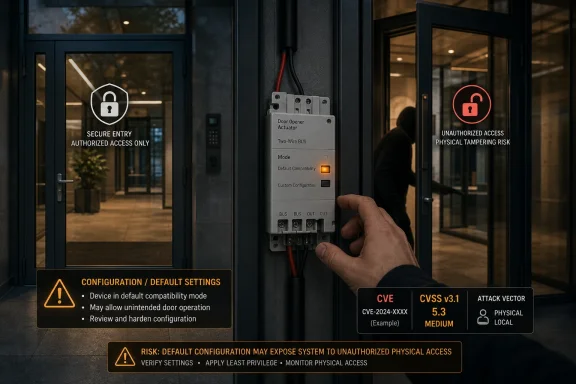 A Medium Score Hides a Door-Sized Problem
The vulnerability is classified under CWE-489, active debug code, and carries a CVSS 3.1 base score of 6.8, marked medium. That score is doing exactly what the scoring system is designed to do: it penalizes the issue because the attack vector is physical rather than network-based. There is no claim here of internet-scale wormability, no remote exploit chain, and no evidence in the advisory of active exploitation.But door hardware is not an abstract asset. If exploitation can lead to unauthorized physical access to a building, the difference between “medium” and “high” starts to feel academic to the people responsible for that building. The advisory’s own impact language is blunt: a successful attacker could gain physical, unauthorized access where the product is installed.
That is why this case deserves more attention than its severity label might imply. In enterprise IT, a medium-severity bug in a rarely used subsystem may sit in a remediation queue for weeks. In building access control, the equivalent delay can mean a lobby, service door, or controlled interior entrance remains dependent on a misconfigured actuator.
The Vulnerability Is a Configuration Story, Not a Patch Story
The affected products are ABB’s Switch Actuator 4 DU, model 83330, and Switch actuator, door/light 4 DU, model 83330-500. ABB says all versions are affected. That phrasing matters because it does not point administrators toward a firmware version threshold or a tidy “upgrade to version X” answer.Instead, the mitigation is procedural and local. ABB instructs customers to operate the installed Busch-Welcome system, toggle the actuator’s mode switch from “Door-Open” to “Light,” wait one second, switch it back to “Door-Open,” and then restart the system with a mains power reset. During boot, the system is expected to recalibrate and correct the misconfiguration automatically.
That is an unusually physical remediation for a vulnerability advisory. Nobody is pushing a package through Intune, staging a GPO, or approving a firmware bundle in a maintenance window. Someone has to know where the device is, reach it, manipulate it correctly, and power-cycle the system.
This is the operational reality of embedded building technology. The assets may have digital identifiers and CVEs, but the fix still looks like facilities work. The risk lives at the intersection of cybersecurity, electrical installation, and property management.
CISA’s Republication Turns a Vendor Note Into an ICS Signal
The advisory history is also important. ABB’s PSIRT initially released the advisory on July 21, 2025. CISA republished it on May 28, 2026, as ICSA-26-148-04, converting the vendor’s CSAF advisory into the agency’s industrial control systems advisory format.That lag does not necessarily imply new exploitation or a changed technical condition. The CISA notice explicitly describes the posting as a verbatim republication intended to increase visibility. In other words, this is less a new disclosure than a wider broadcast.
Still, CISA republication changes the audience. A vendor advisory may be read by integrators and customers already tracking ABB’s security portal. A CISA ICS advisory is more likely to enter vulnerability-management systems, third-party risk dashboards, government alerts, and managed security service workflows.
That matters because many building automation and access-control components fall through ordinary IT asset inventories. They are installed by contractors, maintained by facilities teams, and only occasionally visible to security staff. CISA’s involvement is a reminder that the boundary between “building system” and “information system” has mostly collapsed.
Physical Attack Vector Does Not Mean Low Urgency
Security teams often triage physical-vector vulnerabilities below remote ones, and usually for good reason. A remote unauthenticated exploit against an exposed service can scale quickly. A vulnerability requiring physical proximity is constrained by geography, access, and time.But door systems invert part of that logic. The asset being attacked is, by definition, placed at the boundary between authorized and unauthorized space. Requiring physical access near the building is not always a meaningful barrier if the attacker’s objective is entry into that building.
The advisory says no privileges and no user interaction are required, with low attack complexity. That combination should make building owners pause. The exploit is not portrayed as technically elaborate; the constraint is that an attacker must be physically present.
For residential and commercial properties, that may still be enough to justify prompt mitigation. A front entrance, service corridor, or shared facility area does not need to be internet-exposed to be security-sensitive. Many of the worst building-security failures happen at exactly this layer, where convenience, legacy compatibility, and installation assumptions meet real-world access control.
Compatibility Mode Is the Oldest Trade-Off in the Book
The root issue is described as authentication bypass due to compatibility mode being enabled by default. Compatibility modes are often born from practical engineering pressure. Vendors need old and new components to coexist, installers need systems to work across generations, and customers do not want an upgrade to strand existing hardware.The danger is that compatibility modes frequently preserve weaker assumptions. They can relax checks, allow fallback behavior, expose legacy logic, or keep diagnostic pathways alive. In IT terms, this is the smart-building equivalent of leaving SMBv1 reachable because one old copier still depends on it.
The advisory’s CWE classification, active debug code, sharpens that concern. Debug and service behaviors are not always vulnerabilities when properly constrained. They become vulnerabilities when they survive into production paths in a way attackers can abuse.
What makes CVE-2025-7705 uncomfortable is not simply that the bug exists. It is that the mitigation appears to correct a default or inherited state through recalibration rather than a normal update. That suggests a system whose secure posture may depend on installation state as much as product version.
The Fix Is Simple Enough to Be Dangerous
ABB’s mitigation steps are concise, which is good. They are also easy to underestimate, which is not. A toggle, a one-second wait, and a power reset sound like something any site technician can perform between calls.The problem is verification. In software patching, administrators can query version numbers, scan endpoints, review deployment telemetry, and produce reports. Here, the obvious question is how a property owner or security team proves that every affected actuator in every relevant location has been toggled, recalibrated, and power-cycled.
That gap is not unique to ABB. It is a recurring problem in operational technology and building automation. Remediations often depend on field procedures, but vulnerability-management programs want machine-readable evidence.
For larger portfolios, the practical burden is not the one-second wait. It is finding the devices, confirming model numbers, scheduling access, avoiding disruption to residents or tenants, and documenting completion. The work is simple only after the asset inventory is already correct.
The Windows Admin Lesson Is Asset Inventory, Again
Windows administrators know this story under different names. Unsupported runtimes, forgotten print servers, aging VPN clients, stale BIOS settings, and unmanaged kiosk machines all share the same pattern: the thing outside the clean management plane becomes the thing that determines the risk.Building systems add another layer of ambiguity. An actuator may not have an IP address visible to the SOC. It may not authenticate to Active Directory. It may never appear in an endpoint dashboard. Yet it can still determine whether a door opens.
That is why the CISA guidance around minimizing exposure, isolating control systems, using firewalls, and securing remote access should be read broadly rather than literally. For this specific CVE, the exploit path is physical, not a public internet scan. But the general principle remains: special-purpose systems need boundaries, documentation, and ownership.
The organizations most likely to handle this well are not necessarily those with the largest security budgets. They are the ones where facilities, IT, security, and vendors can quickly answer a basic question: “Where is this installed, and who can touch it today?”
Smart Buildings Have Inherited IT’s Worst Habits
The building-automation industry has spent years absorbing the vocabulary of IT: IP gateways, mobile apps, cloud services, remote diagnostics, firmware updates, and security advisories. It has been slower to inherit IT’s discipline around lifecycle management. The result is a hybrid world where connected physical systems are treated as infrastructure until something goes wrong, then suddenly treated as software.CVE-2025-7705 is a small but useful example. The product is not a general-purpose computer. It is not a Windows server. It is not a cloud workload. Yet the vulnerability is tracked with a CVE, scored with CVSS, mapped to a CWE, published through PSIRT and CISA channels, and remediated through a documented procedure.
That is progress, but it is uneven progress. The disclosure machinery is mature enough to describe the risk. The field machinery may not be mature enough to guarantee that every affected installation is corrected quickly.
This gap is where many real-world security failures live. Vendors can publish advisories, agencies can amplify them, and researchers can catalog them, but the final mile is still a person with access to the equipment and enough context to know why the procedure matters.
The Door Controller Is Now Part of the Threat Model
Security-minded organizations should resist the temptation to treat this as a niche European building-system issue. ABB lists the deployment area as worldwide and the critical infrastructure sector as commercial facilities. That is broad enough to include offices, residential complexes, campuses, retail sites, and multi-tenant properties.The most important practical question is not whether every WindowsForum reader has this exact actuator. Most will not. The question is whether their organization has a process for handling advisories on devices that are not traditional IT endpoints but still govern access, safety, or operations.
That process needs to include procurement records, installer documentation, maintenance contracts, and physical inspection. It also needs a way to translate a CVE into a work order. Otherwise, advisories like this become security theater: acknowledged in a spreadsheet, unresolved at the wall.
The door controller is not just a facilities component anymore. It is a security control with software-defined behavior. Once that is accepted, vulnerability response cannot stop at laptops, servers, and firewalls.
ABB’s Narrow Mitigation Leaves Broader Questions Open
ABB’s recommended action is targeted: toggle the mode, wait, switch back, power reset, allow recalibration. The company also recommends checking the Busch-Welcome two-wire system handbook for security advice on correct installation. That is sensible, but it puts weight back on site-specific installation quality.The advisory does not describe a firmware replacement, a redesigned authentication mechanism, or a universal remote check. It also does not claim known exploitation. That restrained language is normal for vendor PSIRT communications, but it leaves administrators with operational uncertainty.
Can a site easily determine whether the affected compatibility mode state is present before mitigation? Can a maintenance contractor confirm the recalibration succeeded? Are there edge cases where power resets fail to apply the intended correction? The advisory’s public text does not answer those questions in detail.
That does not make the mitigation suspect. It means organizations should treat the procedure as a security maintenance task, not a casual suggestion. If a door actuator can grant access under the wrong condition, the remediation deserves the same tracking discipline as a patch for a badge reader, camera gateway, or VPN appliance.
The Real Severity Is Local
CVSS is useful because it standardizes comparison. It is also limited because it cannot know the importance of a specific door. The same affected actuator could protect a low-risk interior utility space or a high-value entrance into a corporate office, residential lobby, lab, or restricted operational area.That local context should drive urgency. A medium score may be acceptable for a component behind multiple compensating controls. It may be unacceptable for a primary entrance where physical access has high consequence.
This is where security programs need to mature beyond global severity labels. Risk is not just the product of exploitability and impact in the abstract. It is also the product of placement, exposure, monitoring, and what an attacker gains after crossing that threshold.
For many organizations, the right response will be fast and boring: identify the devices, perform the mitigation, document the work, and update installation standards. Boring is a compliment here. Physical access control should not become interesting.
The One-Second Toggle Deserves a Work Order
The concrete action list is short, but the governance around it should not be improvised. Treat the ABB procedure as a formal remediation task with an owner, completion evidence, and a follow-up check.- Organizations should identify whether ABB Busch-Welcome 2 Wire Door Opener Actuator models 83330 or 83330-500 are installed at any managed property.
- Site teams should perform ABB’s mode-switch toggle and mains power reset procedure for affected installations as soon as practical.
- Security and facilities teams should document which entrances, cabinets, or controlled areas were inspected and remediated.
- Administrators should not rely on the CVSS medium label alone when the affected component controls a meaningful physical boundary.
- Future building-system purchases should require clear vulnerability-notification channels, asset records, and maintenance ownership before installation.
The next phase of smart-building security will not be won by pretending every actuator, relay, intercom, and gateway is a server. It will be won by building processes that respect their physical nature while still applying modern security discipline. CVE-2025-7705 is small enough to fix with a toggle and a power reset, but large enough to show why the industry can no longer afford to keep door hardware outside the cybersecurity conversation.
References
- Primary source: CISA
Published: 2026-05-28T12:00:00+00:00

ABB Busch-Welcome 2 Wire Door Opener Actuator | CISA
www.cisa.gov
- Related coverage: incibe.es
Evasión de autenticación en Busch-Welcome 2 wire de ABB | INCIBE-CERT | INCIBE
ABB informa de 1 vulnerabilidad de severidad alta que, en caso de ser explotada, permitiría a un atacawww.incibe.es
- Related coverage: cyber.gc.ca
[Control systems] ABB security advisory (AV25-441) - Canadian Centre for Cyber Security
[Control systems] ABB security advisory (AV25-441)www.cyber.gc.ca - Related coverage: psirt.bosch.com
Public advisories containing security information from Bosch and its brands | Bosch PSIRT
Find here all public security advisories from Bosch and its brands including information about vulnerabilities, updates, and recommendationspsirt.bosch.com
- Related coverage: ami.com
Security Advisories from the AMI Security Team - AMI
Discover essential Security Advisories from the AMI Security Team, dedicated to rapid response and product security.www.ami.com - Related coverage: library.e.abb.com
- Related coverage: manuals.busch-jaeger.de
