

CVE-2026-11007 is a medium-severity Chrome for Android WebView vulnerability, published June 4, 2026 and modified June 8, that affected versions before 149.0.7827.53 and could let a remote attacker leak cross-origin data after compromising the renderer process. The uncomfortable part is not the word medium; it is the condition attached to the bug. A renderer compromise is already a serious foothold, and this flaw describes what can happen when a browser’s compartmentalization fails to hold the next line. For WindowsForum readers, the lesson is broader than Android: the modern browser is no longer just an app, but a shared security boundary for operating systems, embedded views, identity flows, and enterprise workflows.
Chrome vulnerability write-ups often read like minimalist poetry: a component, a weakness class, a version number, and a carefully clipped sentence about what an attacker could do. CVE-2026-11007 follows that pattern. It is an insufficient validation of untrusted input issue in WebView, assigned CWE-20, and tied to Google Chrome on Android before version 149.0.7827.53.
That phrasing can make the bug sound smaller than it is. There is no claim here of a one-click full device takeover, no public exploit chain described in the record, and no active-exploitation flag in the supplied details. But the stated impact — leaking cross-origin data through a crafted HTML page — lands directly on one of the browser’s most important promises.
The web’s security model depends on origins behaving like walls. A banking session, a corporate single sign-on page, a webmail tab, and a malicious page are supposed to coexist without casually reading from one another. When a bug allows cross-origin data leakage, even under a prerequisite such as renderer compromise, it is not merely a data-handling mistake. It is a crack in the model users and administrators rely on without ever seeing it.
The renderer prerequisite matters, and it should temper panic. An attacker first needs to compromise the renderer process, which means CVE-2026-11007 is more likely to function as part of a chain than as a standalone headline exploit. But chained exploitation is how serious browser attacks often work. One bug gets code running in a constrained place; another bug turns that foothold into something more useful.
That is why a WebView vulnerability is not quite the same as a conventional tab bug. A user may never consciously open Chrome and still encounter Chromium-rendered content inside another app. In enterprise environments, that may include mobile device management enrollment pages, SaaS authentication screens, internal dashboards, or custom line-of-business applications that assume WebView is a safe container.
The supplied CVE text is specific to Google Chrome on Android rather than Windows desktop Chrome. Yet the release reference points to the broader Chrome stable channel update, and Android releases often track the same security-fix cadence as desktop releases unless Google says otherwise. That matters operationally because administrators rarely patch “a CVE” in isolation. They patch a channel, a browser family, and the downstream apps that depend on that runtime.
The practical implication is that Android fleet owners should not treat this as a niche mobile-app problem. If an organization uses Android devices for field work, point-of-sale workflows, healthcare intake, logistics, warehouse scanning, or privileged identity tasks, WebView becomes part of the security boundary for the business process itself. A cross-origin leak in that context may expose tokens, session data, or sensitive page contents depending on the shape of the exploit chain.
A vulnerability that becomes useful after renderer compromise is therefore a second-stage problem. It does not necessarily get the attacker into the renderer, but it may help the attacker do something valuable once there. That is why defenders should resist the temptation to down-rank it simply because it requires another bug or foothold.
Modern browser exploitation is increasingly about composition. A memory corruption issue, a type confusion bug, or a logic flaw may provide the first beachhead. A sandbox escape, origin bypass, data leak, or policy confusion then converts that beachhead into meaningful compromise. CVE-2026-11007 sits in that latter class as described: not the front door, but a door between rooms that should have stayed locked.
The CVSS vector contributed by CISA-ADP reflects this tension. It scores the issue as network exploitable, low attack complexity, no privileges required, user interaction required, unchanged scope, high confidentiality impact, and no integrity or availability impact. That is a fairly crisp description of a browser data-leak bug: the victim has to be induced into interaction, but the attacker’s prize is information.
That makes cross-origin leakage disproportionately important. Confidentiality bugs are sometimes treated as less dramatic than remote code execution, but browser confidentiality is identity confidentiality. If an attacker can read the right cross-origin data, they may not need to execute code on the operating system at all.
The consequences depend heavily on what data is exposed. It could be page contents, response data, tokens, account identifiers, private application state, or other information that should be isolated. The public CVE description does not provide enough detail to say which data classes were reachable, and responsible reporting should not invent specificity where the record is silent.
But the abstract risk is clear. Enterprises have spent years moving applications into browsers and mobile webviews because web delivery is fast, cross-platform, and easy to update. That same consolidation means browser-origin boundaries now protect more business data than many native application sandboxes ever did.
That last detail is important because the user-visible description says “Google Chrome on Android,” and the CPE configuration reflects that by associating the vulnerable Chrome application with the Android operating system. The record also includes the usual NVD prompt asking whether a CPE is missing, which is less a smoking gun than a reminder that CPE mapping is often imperfect, delayed, or awkward for platform-embedded software.
In this case, the CPE shown in the change history does not look obviously absent; it looks like NVD modeled the issue as an Android-specific Chrome/WebView exposure. The awkwardness is structural. WebView is not just a standalone product in the way “Chrome for Windows” is. It is a browser component, a system-provided runtime, and an app dependency, depending on how the device and OS version are packaged.
That is where vulnerability management tools can stumble. A scanner may see Chrome. An MDM console may report Android System WebView. A device inventory may show an OS build. A package manager may expose a Play Store component. The CVE, meanwhile, is written in the language of Chrome on Android before a specific Chromium version. Mapping those layers cleanly is the real operational challenge.
For desktop Windows fleets, Chrome version visibility is comparatively mature. Administrators can query installed versions, enforce updates through Chrome policies, manage Edge and Chrome separately, and track patch compliance through endpoint management suites. Android WebView introduces more variability because browser engine updates may arrive through the Play Store, OEM channels, managed Google Play policies, or OS images depending on the device class.
This is where a medium CVE can expose a high-friction process. If an organization cannot quickly answer which Android devices are running a vulnerable WebView/Chrome runtime, the issue is not just CVE-2026-11007. It is the organization’s inability to reason about browser-engine exposure inside mobile apps.
The same lesson applies to Windows, even though this specific CVE is Android-scoped. Microsoft Edge WebView2 has become a common runtime for Windows applications, and Chromium’s security model increasingly sits beneath desktop software that users do not think of as browsers. The component boundary has moved; asset management practices have not always followed.
Version precision matters because browser updates roll out fast and unevenly. A user may assume Chrome is “up to date” because the browser usually updates itself. An enterprise administrator may assume mobile devices are current because the MDM compliance profile says the OS is acceptable. Neither assumption is good enough when the vulnerable component is a browser runtime with its own release cadence.
This is especially true in the days after a large Chrome security release. Public advisories, CVE databases, vulnerability scanners, and vendor blogs often normalize at different speeds. One source may show a CVE before another has enriched it. A scanner may flag the desktop package while missing the embedded runtime. A device may report the OS version but not the WebView package version.
The remedy is mundane but essential: verify the installed Chromium/WebView version, not merely the device model or Android release. For managed fleets, that means policy-backed updates and reporting. For individual users, it means updating Chrome and Android System WebView through the Play Store where applicable, then checking that the reported version has moved beyond the vulnerable range.
CVE-2026-11007 is a good example. The issue tracker reference exists, but public access may be limited. The NVD entry supplies the vulnerability class, affected product, version threshold, and impact. That is enough to patch, but not enough to build a complete exploitability story.
In the absence of detail, security teams should avoid both extremes. It is wrong to inflate the issue into a confirmed in-the-wild exploit if the public record does not say that. It is also wrong to dismiss the bug because it is medium severity and requires renderer compromise. The most accurate reading is narrower and more useful: this is a confidentiality-impacting WebView flaw that could improve an attacker’s position inside a browser exploit chain.
That kind of disciplined interpretation matters for user trust. Security news already suffers from severity inflation, with every patch Tuesday and browser release framed as a crisis. The better argument is that CVE-2026-11007 is not the biggest Chrome bug of the year, but it is a revealing one. It shows how much sensitive activity now depends on browser internals that are invisible to ordinary users.
Many organizations now have Windows laptops, Android handhelds, iOS devices, ChromeOS endpoints, and unmanaged contractor machines touching the same identity provider and cloud applications. A data leak in Android WebView can matter to a Windows shop if the same accounts, tokens, SaaS apps, or privileged workflows cross device boundaries. Endpoint categories are administrative conveniences; attackers do not have to respect them.
There is also an architectural parallel. On Windows, Chromium appears not only as Chrome and Edge but also inside Electron apps, WebView2-based enterprise software, collaboration tools, launchers, dashboards, and vendor utilities. The exact CVE may not apply to those components, but the patching philosophy does: embedded browser runtimes deserve first-class inventory and update treatment.
This is the broader story of 2026 browser security. The browser is the operating system for many enterprise workflows, and the operating system increasingly delegates chunks of user experience back to browser engines. The old line between “browser patch” and “platform patch” has become less useful than administrators want it to be.
A crafted HTML page is not an exotic delivery vehicle. It is the web’s native payload format. If the attacker already has a renderer compromise available, persuading a user to render content is not the hard part of the chain; it is the normal operating condition of browsing.
That does not mean every user is equally exposed. Hardened browsing environments, reduced attack surface, site isolation features, timely updates, and cautious handling of untrusted links all matter. But user interaction in a browser CVE should be read as “the victim must browse,” not as “the victim must do something implausibly reckless.”
On mobile, the interaction surface is even broader because embedded web content can appear inside apps the user already trusts. A link opened inside a social app, a login screen displayed inside a business app, or a help article rendered inside a vendor app may all rely on WebView. The user thinks they are interacting with the app; the security boundary is being enforced by the browser engine underneath.
That last distinction is where many patch programs fail. A policy that allows updates is not the same as an update installed on every device. A dashboard that shows a compliant OS version is not the same as a patched browser runtime. A vulnerability scanner that understands desktop Chrome may not understand Android WebView with equal fidelity.
Security teams should also review whether mobile apps in their environment depend on embedded web authentication flows. If sensitive apps rely heavily on WebView, patch urgency should rise even for medium-rated browser confidentiality bugs. The risk is not that every app is exploitable in the same way; it is that the exposed data, if reachable, may be business-critical.
For individual users, the advice is simpler. Update Chrome, update Android System WebView if it appears separately on the device, and avoid delaying browser updates because they seem routine. Browser patches are routine precisely because the browser is under constant attack and constant repair.
The record also shows the vulnerability-data pipeline operating in stages. Chrome published the CVE. CISA-ADP supplied a CVSS vector. NIST added initial analysis and CPE mapping. That staggered enrichment is normal, but it means defenders who wait for every database field to settle may be slower than the update channel itself.
The CPE concern should therefore be reframed. The presence or absence of a tidy CPE is less important than whether administrators can identify affected Chrome/WebView versions across Android endpoints. A vulnerability database can point in the right direction, but it cannot substitute for local asset truth.
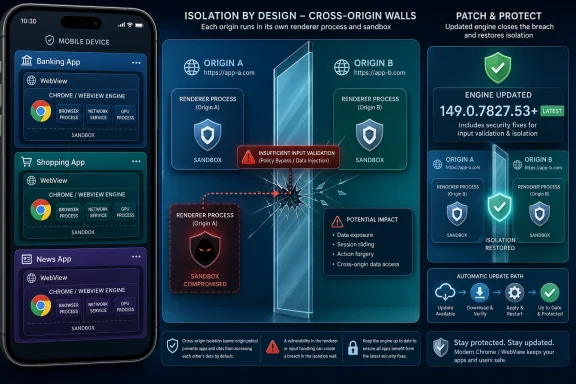 A Medium Bug With a High-Value Boundary
Chrome vulnerability write-ups often read like minimalist poetry: a component, a weakness class, a version number, and a carefully clipped sentence about what an attacker could do. CVE-2026-11007 follows that pattern. It is an insufficient validation of untrusted input issue in WebView, assigned CWE-20, and tied to Google Chrome on Android before version 149.0.7827.53.That phrasing can make the bug sound smaller than it is. There is no claim here of a one-click full device takeover, no public exploit chain described in the record, and no active-exploitation flag in the supplied details. But the stated impact — leaking cross-origin data through a crafted HTML page — lands directly on one of the browser’s most important promises.
The web’s security model depends on origins behaving like walls. A banking session, a corporate single sign-on page, a webmail tab, and a malicious page are supposed to coexist without casually reading from one another. When a bug allows cross-origin data leakage, even under a prerequisite such as renderer compromise, it is not merely a data-handling mistake. It is a crack in the model users and administrators rely on without ever seeing it.
The renderer prerequisite matters, and it should temper panic. An attacker first needs to compromise the renderer process, which means CVE-2026-11007 is more likely to function as part of a chain than as a standalone headline exploit. But chained exploitation is how serious browser attacks often work. One bug gets code running in a constrained place; another bug turns that foothold into something more useful.
WebView Is Where Browser Risk Becomes Platform Risk
WebView is easy to underestimate because most users do not launch it directly. On Android, it is the browser engine inside other apps: login screens, payment flows, embedded help pages, ads, account linking, captive portals, and internal enterprise applications. Chrome is not just a browser icon on the home screen; it is part of the plumbing through which apps render the web.That is why a WebView vulnerability is not quite the same as a conventional tab bug. A user may never consciously open Chrome and still encounter Chromium-rendered content inside another app. In enterprise environments, that may include mobile device management enrollment pages, SaaS authentication screens, internal dashboards, or custom line-of-business applications that assume WebView is a safe container.
The supplied CVE text is specific to Google Chrome on Android rather than Windows desktop Chrome. Yet the release reference points to the broader Chrome stable channel update, and Android releases often track the same security-fix cadence as desktop releases unless Google says otherwise. That matters operationally because administrators rarely patch “a CVE” in isolation. They patch a channel, a browser family, and the downstream apps that depend on that runtime.
The practical implication is that Android fleet owners should not treat this as a niche mobile-app problem. If an organization uses Android devices for field work, point-of-sale workflows, healthcare intake, logistics, warehouse scanning, or privileged identity tasks, WebView becomes part of the security boundary for the business process itself. A cross-origin leak in that context may expose tokens, session data, or sensitive page contents depending on the shape of the exploit chain.
The Renderer Compromise Caveat Is Not a Comfort Blanket
The phrase “who had compromised the renderer process” is doing a lot of work. Chrome’s multi-process architecture exists precisely to constrain untrusted web content. Renderers handle complex, hostile inputs — HTML, CSS, JavaScript, media, fonts, and more — while sandboxing and browser-process checks are supposed to limit what a renderer can access.A vulnerability that becomes useful after renderer compromise is therefore a second-stage problem. It does not necessarily get the attacker into the renderer, but it may help the attacker do something valuable once there. That is why defenders should resist the temptation to down-rank it simply because it requires another bug or foothold.
Modern browser exploitation is increasingly about composition. A memory corruption issue, a type confusion bug, or a logic flaw may provide the first beachhead. A sandbox escape, origin bypass, data leak, or policy confusion then converts that beachhead into meaningful compromise. CVE-2026-11007 sits in that latter class as described: not the front door, but a door between rooms that should have stayed locked.
The CVSS vector contributed by CISA-ADP reflects this tension. It scores the issue as network exploitable, low attack complexity, no privileges required, user interaction required, unchanged scope, high confidentiality impact, and no integrity or availability impact. That is a fairly crisp description of a browser data-leak bug: the victim has to be induced into interaction, but the attacker’s prize is information.
Cross-Origin Data Is the Browser’s Crown Jewel
Cross-origin protections are among the oldest and most important ideas in web security. The same-origin policy and its descendants are why a malicious site cannot simply read another site’s DOM, scrape a banking page in an adjacent tab, or harvest a corporate app’s data because the browser happens to have an authenticated session. Users do not understand this boundary in detail, but they depend on it every day.That makes cross-origin leakage disproportionately important. Confidentiality bugs are sometimes treated as less dramatic than remote code execution, but browser confidentiality is identity confidentiality. If an attacker can read the right cross-origin data, they may not need to execute code on the operating system at all.
The consequences depend heavily on what data is exposed. It could be page contents, response data, tokens, account identifiers, private application state, or other information that should be isolated. The public CVE description does not provide enough detail to say which data classes were reachable, and responsible reporting should not invent specificity where the record is silent.
But the abstract risk is clear. Enterprises have spent years moving applications into browsers and mobile webviews because web delivery is fast, cross-platform, and easy to update. That same consolidation means browser-origin boundaries now protect more business data than many native application sandboxes ever did.
The NVD Record Shows the Patch Machinery at Work
The chronology is straightforward. Chrome submitted the CVE on June 4, 2026. CISA-ADP added a CVSS 3.1 vector on June 8. NIST then added initial analysis the same day, including a CPE configuration that combines Google Chrome versions before 149.0.7827.53 with Android.That last detail is important because the user-visible description says “Google Chrome on Android,” and the CPE configuration reflects that by associating the vulnerable Chrome application with the Android operating system. The record also includes the usual NVD prompt asking whether a CPE is missing, which is less a smoking gun than a reminder that CPE mapping is often imperfect, delayed, or awkward for platform-embedded software.
In this case, the CPE shown in the change history does not look obviously absent; it looks like NVD modeled the issue as an Android-specific Chrome/WebView exposure. The awkwardness is structural. WebView is not just a standalone product in the way “Chrome for Windows” is. It is a browser component, a system-provided runtime, and an app dependency, depending on how the device and OS version are packaged.
That is where vulnerability management tools can stumble. A scanner may see Chrome. An MDM console may report Android System WebView. A device inventory may show an OS build. A package manager may expose a Play Store component. The CVE, meanwhile, is written in the language of Chrome on Android before a specific Chromium version. Mapping those layers cleanly is the real operational challenge.
The CPE Question Is Really an Inventory Question
“Are we missing a CPE here?” is a reasonable question, but it is not the only one administrators should ask. A technically perfect CPE would not automatically tell every organization whether its devices are vulnerable. The more useful question is whether your inventory can identify the Chromium/WebView runtime version actually present on managed Android devices.For desktop Windows fleets, Chrome version visibility is comparatively mature. Administrators can query installed versions, enforce updates through Chrome policies, manage Edge and Chrome separately, and track patch compliance through endpoint management suites. Android WebView introduces more variability because browser engine updates may arrive through the Play Store, OEM channels, managed Google Play policies, or OS images depending on the device class.
This is where a medium CVE can expose a high-friction process. If an organization cannot quickly answer which Android devices are running a vulnerable WebView/Chrome runtime, the issue is not just CVE-2026-11007. It is the organization’s inability to reason about browser-engine exposure inside mobile apps.
The same lesson applies to Windows, even though this specific CVE is Android-scoped. Microsoft Edge WebView2 has become a common runtime for Windows applications, and Chromium’s security model increasingly sits beneath desktop software that users do not think of as browsers. The component boundary has moved; asset management practices have not always followed.
Patch Version Numbers Matter More Than Severity Labels
The fix line in the record is clear: versions before 149.0.7827.53 are affected. For Windows and macOS, the corresponding Chrome stable update appears in the 149.0.7827.53/54 range, while Linux is listed at 149.0.7827.53 in the same release family. The Android/WebView relevance is tied to Chrome on Android before 149.0.7827.53.Version precision matters because browser updates roll out fast and unevenly. A user may assume Chrome is “up to date” because the browser usually updates itself. An enterprise administrator may assume mobile devices are current because the MDM compliance profile says the OS is acceptable. Neither assumption is good enough when the vulnerable component is a browser runtime with its own release cadence.
This is especially true in the days after a large Chrome security release. Public advisories, CVE databases, vulnerability scanners, and vendor blogs often normalize at different speeds. One source may show a CVE before another has enriched it. A scanner may flag the desktop package while missing the embedded runtime. A device may report the OS version but not the WebView package version.
The remedy is mundane but essential: verify the installed Chromium/WebView version, not merely the device model or Android release. For managed fleets, that means policy-backed updates and reporting. For individual users, it means updating Chrome and Android System WebView through the Play Store where applicable, then checking that the reported version has moved beyond the vulnerable range.
Google’s Sparse Advisory Style Leaves Room for Misreadings
Google’s Chrome security notes are intentionally terse. That is not unusual; browser vendors often restrict details until most users have had time to update. The trade-off is that defenders must make decisions from a narrow public record, especially when bug tracker entries require permissions.CVE-2026-11007 is a good example. The issue tracker reference exists, but public access may be limited. The NVD entry supplies the vulnerability class, affected product, version threshold, and impact. That is enough to patch, but not enough to build a complete exploitability story.
In the absence of detail, security teams should avoid both extremes. It is wrong to inflate the issue into a confirmed in-the-wild exploit if the public record does not say that. It is also wrong to dismiss the bug because it is medium severity and requires renderer compromise. The most accurate reading is narrower and more useful: this is a confidentiality-impacting WebView flaw that could improve an attacker’s position inside a browser exploit chain.
That kind of disciplined interpretation matters for user trust. Security news already suffers from severity inflation, with every patch Tuesday and browser release framed as a crisis. The better argument is that CVE-2026-11007 is not the biggest Chrome bug of the year, but it is a revealing one. It shows how much sensitive activity now depends on browser internals that are invisible to ordinary users.
Android Users Are the Direct Audience, but Windows Admins Should Still Care
A Windows-focused community might be tempted to treat this as someone else’s patch. The affected wording is Android-specific, and Windows desktop Chrome is not the named vulnerable configuration in the supplied CVE description. But Windows administrators increasingly manage heterogeneous fleets, and the browser engine has become a cross-platform dependency rather than a single executable on a single OS.Many organizations now have Windows laptops, Android handhelds, iOS devices, ChromeOS endpoints, and unmanaged contractor machines touching the same identity provider and cloud applications. A data leak in Android WebView can matter to a Windows shop if the same accounts, tokens, SaaS apps, or privileged workflows cross device boundaries. Endpoint categories are administrative conveniences; attackers do not have to respect them.
There is also an architectural parallel. On Windows, Chromium appears not only as Chrome and Edge but also inside Electron apps, WebView2-based enterprise software, collaboration tools, launchers, dashboards, and vendor utilities. The exact CVE may not apply to those components, but the patching philosophy does: embedded browser runtimes deserve first-class inventory and update treatment.
This is the broader story of 2026 browser security. The browser is the operating system for many enterprise workflows, and the operating system increasingly delegates chunks of user experience back to browser engines. The old line between “browser patch” and “platform patch” has become less useful than administrators want it to be.
User Interaction Still Means Real-World Exposure
The CVSS vector includes user interaction, which often sounds reassuring. It should not. In browser security, user interaction may mean visiting a crafted page, tapping a link, opening content in an embedded view, or following a workflow that an attacker can plausibly induce through phishing, advertising, messaging, or compromised sites.A crafted HTML page is not an exotic delivery vehicle. It is the web’s native payload format. If the attacker already has a renderer compromise available, persuading a user to render content is not the hard part of the chain; it is the normal operating condition of browsing.
That does not mean every user is equally exposed. Hardened browsing environments, reduced attack surface, site isolation features, timely updates, and cautious handling of untrusted links all matter. But user interaction in a browser CVE should be read as “the victim must browse,” not as “the victim must do something implausibly reckless.”
On mobile, the interaction surface is even broader because embedded web content can appear inside apps the user already trusts. A link opened inside a social app, a login screen displayed inside a business app, or a help article rendered inside a vendor app may all rely on WebView. The user thinks they are interacting with the app; the security boundary is being enforced by the browser engine underneath.
The Real Fix Is Fast Update Assurance
There is no glamorous mitigation here. Update Chrome on Android and ensure the WebView runtime is at or beyond the fixed version. For enterprises, confirm that managed devices can receive the update and that reporting proves installation rather than merely policy intent.That last distinction is where many patch programs fail. A policy that allows updates is not the same as an update installed on every device. A dashboard that shows a compliant OS version is not the same as a patched browser runtime. A vulnerability scanner that understands desktop Chrome may not understand Android WebView with equal fidelity.
Security teams should also review whether mobile apps in their environment depend on embedded web authentication flows. If sensitive apps rely heavily on WebView, patch urgency should rise even for medium-rated browser confidentiality bugs. The risk is not that every app is exploitable in the same way; it is that the exposed data, if reachable, may be business-critical.
For individual users, the advice is simpler. Update Chrome, update Android System WebView if it appears separately on the device, and avoid delaying browser updates because they seem routine. Browser patches are routine precisely because the browser is under constant attack and constant repair.
The Signal Hidden in This CVE
CVE-2026-11007 is small enough to be overlooked and specific enough to teach the right lesson. It is not a banner-grabbing remote-code-execution announcement, but it touches the boundary that keeps web identities, sessions, and application data separated. In modern computing, that is critical infrastructure.The record also shows the vulnerability-data pipeline operating in stages. Chrome published the CVE. CISA-ADP supplied a CVSS vector. NIST added initial analysis and CPE mapping. That staggered enrichment is normal, but it means defenders who wait for every database field to settle may be slower than the update channel itself.
The CPE concern should therefore be reframed. The presence or absence of a tidy CPE is less important than whether administrators can identify affected Chrome/WebView versions across Android endpoints. A vulnerability database can point in the right direction, but it cannot substitute for local asset truth.
The Version Number Is the Message
CVE-2026-11007 leaves administrators with a handful of concrete actions, and none require guessing at exploit details that Google has not published. The important move is to treat the browser runtime as a managed security dependency wherever it appears.- Chrome on Android versions before 149.0.7827.53 should be considered affected by CVE-2026-11007.
- The described impact is cross-origin data leakage after renderer compromise, which makes the bug most relevant as part of an exploit chain.
- The medium severity label should not obscure the high confidentiality impact in the contributed CVSS 3.1 vector.
- Android fleet owners should verify the actual Chrome or WebView runtime version installed, not merely the Android OS version.
- Windows administrators should treat this as a reminder that Chromium-based embedded runtimes need the same inventory discipline as full browsers.
- The available public record does not establish active exploitation, so the right posture is prompt patching without exaggerated claims.
References
- Primary source: NVD / Chromium
Published: 2026-06-09T07:00:22-07:00
NVD - CVE-2026-11007
 nvd.nist.gov
- Security advisory: MSRC
Published: 2026-06-09T07:00:22-07:00
Original feed URL
Security Update Guide - Microsoft Security Response Center
 msrc.microsoft.com
- Official source: nist.gov
National Vulnerability Database
NIST maintains the National Vulnerability Database (NVD), a repository of information on software and hardware flaws that can compromise computer security. This is a key piece of the nation’s cybersecurity infrastructure.www.nist.gov - Related coverage: govcert.gov.hk
GovCERT.HK - Security Alert (A26-06-08): Multiple Vulnerabilities in Google Chrome
Security Alert (A26-06-08): Multiple Vulnerabilities in Google Chromewww.govcert.gov.hk
- Related coverage: labs.cloudsecurityalliance.org
NVD Enrichment Triage: Enterprise Vulnerability Programs Must Adapt
PDF documentlabs.cloudsecurityalliance.org
