

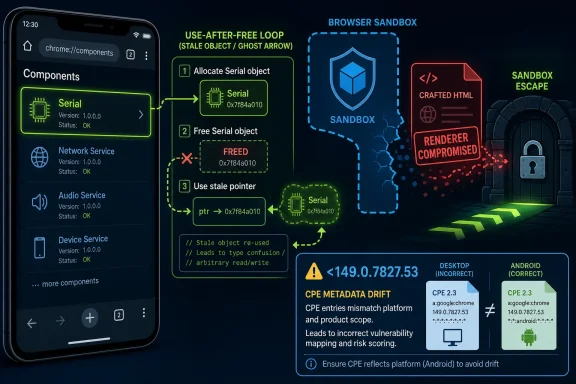
On June 4, 2026, Chrome published CVE-2026-11012, a use-after-free flaw in Chrome for Android’s Serial component fixed before version 149.0.7827.53 that could let an attacker who had already compromised the renderer attempt a sandbox escape through a crafted HTML page. The awkward part is not only the vulnerability; it is the way the public metadata describes it. NVD’s initial enrichment ties Chrome to Android through a compound CPE configuration, while the vendor reference points at a desktop stable-channel update. That mismatch is exactly the kind of small bookkeeping problem that can turn into a patch-management blind spot.
Chromium labels CVE-2026-11012 as a medium-severity issue, and in isolation that makes sense. The attacker does not get a clean one-click path from a blank browser session to device compromise. The public description says the renderer process must already be compromised, and user interaction is still part of the attack model through a crafted HTML page.
But browser security does not work in isolation. Modern exploitation is chained: one bug gets code running inside the renderer, another crosses a privilege boundary, and a third may persist or steal data. In that context, a sandbox escape is not a side note. It is the step that turns “the browser contained the blast” into “the browser became the door.”
That is why CISA-ADP’s CVSS 3.1 score of 8.3 looks more alarming than Chromium’s medium label. The vector is network-accessible, requires no privileges, requires user interaction, has high attack complexity, and changes scope with high confidentiality, integrity, and availability impact. In plain English: hard to exploit, but painful if it lands.
That makes it an interesting place for a memory-safety bug. Browser vendors have spent years pushing risky operations behind permission prompts, origin restrictions, sandbox boundaries, and broker processes. A use-after-free in such a component is not just a bad pointer; it is a reminder that even carefully mediated web-to-device pathways are still implemented in unsafe languages and complex lifetimes.
The public description does not say the attacker can simply request serial access and win. It says a compromised renderer could potentially use a crafted HTML page to escape the sandbox. That distinction matters. This is not a warning that every serial-enabled web app is instantly dangerous, but it is a warning that privileged browser subsystems remain attractive follow-on targets once the renderer falls.
For consumers, the practical answer is simple: update Chrome from the Play Store and restart the browser. For enterprises, the answer is less satisfying. Android devices used for field work, kiosks, inventory scanners, healthcare workflows, or bring-your-own-device access may not all be visible in the same management console.
That is where a “medium” browser bug can become a governance problem. The vulnerability does not have to be wormable or broadly exploited to matter. It only has to be present on a device that has access to sensitive web sessions, corporate identity tokens, admin portals, or line-of-business apps.
The visible CPE structure reportedly includes
That is the dangerous part. A missing or imprecise CPE does not create the vulnerability, but it can hide the vulnerable population. Security teams do not patch what their tooling does not flag, and mobile browser inventory remains weaker than desktop browser inventory in many organizations.
This is not unusual in the Chromium world. Chrome’s codebase is shared, fixes land across branches, and release notes often group many issues under a single stable-channel announcement. But for defenders, naming precision matters. If the affected product says Chrome on Android and the reference says desktop, some teams will assume the record is wrong, incomplete, or irrelevant to their environment.
The right response is not to overrule the CVE description with the release-note title. It is to treat the version boundary as the anchor: Chrome before 149.0.7827.53 is the vulnerable line identified for Android, and organizations should verify whether their scanner, MDM, EMM, or vulnerability platform recognizes that mobile-app condition.
Chrome has invested heavily in mitigations, sandboxing, process isolation, fuzzing, and memory-safety work. Those layers have made exploitation harder. They have not made memory-lifetime bugs disappear.
That is why the “attacker must already have compromised the renderer” condition should not lull anyone into complacency. The renderer is the part of the browser most directly exposed to hostile web content. Chrome’s architecture assumes renderer compromise may happen, then tries to contain it. A sandbox escape bug attacks that second assumption.
Here, NVD had not yet assigned its own CVSS score at the time reflected in the supplied record, while CISA-ADP had supplied a high-severity CVSS 3.1 vector. The weakness was clear, the affected version was clear, and the publication date was clear. The ambiguity lived in the product mapping and advisory context.
That is where automated patching pipelines can become brittle. If a scanner keys only off NVD severity, it may under-prioritize the issue while NVD enrichment is incomplete. If it keys off vendor severity, it sees medium. If it keys off CISA-ADP, it sees high. If it misreads the CPE, it may miss Android entirely.
For desktop Chrome, the record is less direct because the CVE text names Android. Still, Chrome 149.0.7827.53/54 also arrived as a desktop stable-channel security update, and the broader release appears to include a substantial set of fixes. The safest enterprise posture is to keep all Chrome channels current unless a controlled rollback is absolutely necessary.
The important distinction is between patch action and vulnerability accounting. Patch action can be broad: update Chrome. Vulnerability accounting should be precise: identify whether CVE-2026-11012 applies to Chrome on Android in your asset model, and whether your tools represent that condition accurately.
That difference between formally valid and operationally useful is not pedantry. Security databases are consumed by humans, scanners, dashboards, procurement systems, compliance tools, and ticketing workflows. A CPE that is technically adequate for NVD matching may still be ambiguous enough to cause missed remediation in the field.
If you maintain a vulnerability platform, this is the place to add local logic. Treat Chrome Android app versions below 149.0.7827.53 as affected. Do not wait for the prettiest possible CPE record before creating detection content. If NVD later refines the configuration, you can adjust the mapping; the patch threshold is already known.
This is especially true for organizations that treat mobile browsers as user-managed conveniences. Chrome on Android is often the front end for SSO, cloud dashboards, CRM systems, ticketing portals, admin consoles, and internal web apps. A browser sandbox escape on a phone is not automatically a domain compromise, but it can intersect with identity, session theft, and device trust in uncomfortable ways.
The better policy is boring: enforce browser updates where possible, monitor versions where enforcement is weak, and treat mobile browsers as part of the endpoint estate. If a device can access privileged resources, its browser version is security-relevant.
The CPE detail should be read as an implementation clue, not the whole truth. If your tool shows Chrome before 149.0.7827.53 and Android as an AND condition, verify that it actually matches installed Chrome Android apps. If it does not, the vulnerability may be present even when the dashboard looks clean.
That is the larger point: vulnerability intelligence is not finished when a CVE is published. It matures over days as NVD enriches records, vendors clarify advisories, third parties score risk, and scanners normalize product identifiers. The gap between publication and operational clarity is where defenders need judgment.
 The Bug Is Medium Only If You Ignore the Chain
Chromium labels CVE-2026-11012 as a medium-severity issue, and in isolation that makes sense. The attacker does not get a clean one-click path from a blank browser session to device compromise. The public description says the renderer process must already be compromised, and user interaction is still part of the attack model through a crafted HTML page.But browser security does not work in isolation. Modern exploitation is chained: one bug gets code running inside the renderer, another crosses a privilege boundary, and a third may persist or steal data. In that context, a sandbox escape is not a side note. It is the step that turns “the browser contained the blast” into “the browser became the door.”
That is why CISA-ADP’s CVSS 3.1 score of 8.3 looks more alarming than Chromium’s medium label. The vector is network-accessible, requires no privileges, requires user interaction, has high attack complexity, and changes scope with high confidentiality, integrity, and availability impact. In plain English: hard to exploit, but painful if it lands.
Chrome’s Serial Surface Is Small, But It Sits Near Dangerous Boundaries
The “Serial” in the CVE name points to Chrome’s Web Serial plumbing, the browser machinery that can connect web content to serial devices under controlled conditions. This is not the everyday web surface most users consciously think about. It is a capability layer built for cases where a web app needs to talk to hardware.That makes it an interesting place for a memory-safety bug. Browser vendors have spent years pushing risky operations behind permission prompts, origin restrictions, sandbox boundaries, and broker processes. A use-after-free in such a component is not just a bad pointer; it is a reminder that even carefully mediated web-to-device pathways are still implemented in unsafe languages and complex lifetimes.
The public description does not say the attacker can simply request serial access and win. It says a compromised renderer could potentially use a crafted HTML page to escape the sandbox. That distinction matters. This is not a warning that every serial-enabled web app is instantly dangerous, but it is a warning that privileged browser subsystems remain attractive follow-on targets once the renderer falls.
The Android Label Changes the Operational Math
The CVE text specifically names Google Chrome on Android prior to 149.0.7827.53. That matters because Android Chrome patching does not look like enterprise desktop Chrome patching. On managed Windows fleets, administrators can often force update policies, monitor installed versions, and audit browser builds through endpoint management. On Android, the patch path may run through Google Play, OEM constraints, managed-device policy, user behavior, and sometimes corporate tolerance for delayed updates.For consumers, the practical answer is simple: update Chrome from the Play Store and restart the browser. For enterprises, the answer is less satisfying. Android devices used for field work, kiosks, inventory scanners, healthcare workflows, or bring-your-own-device access may not all be visible in the same management console.
That is where a “medium” browser bug can become a governance problem. The vulnerability does not have to be wormable or broadly exploited to matter. It only has to be present on a device that has access to sensitive web sessions, corporate identity tokens, admin portals, or line-of-business apps.
The CPE Entry Is Doing Too Much Work
The user-facing concern here is sharp: are we missing a CPE? Based on the NVD change record, the configuration added by NIST appears to express Chrome as the vulnerable application and Android as the operating environment. That is a common pattern for platform-specific application vulnerabilities, but it can be confusing because it reads like an AND condition rather than a standalone “Chrome for Android” product identity.The visible CPE structure reportedly includes
cpe:2.3:a:google:chrome:* up to, but excluding, 149.0.7827.53, and cpe:2.3:o:google:android:- as the OS side of the configuration. In vulnerability scanners and asset systems, that can be interpreted correctly if the product model understands applications on operating systems. In less sophisticated inventories, it can look like either “all Chrome before 149.0.7827.53” or “only Chrome paired with a generic Android OS CPE,” depending on how the tool consumes NVD data.That is the dangerous part. A missing or imprecise CPE does not create the vulnerability, but it can hide the vulnerable population. Security teams do not patch what their tooling does not flag, and mobile browser inventory remains weaker than desktop browser inventory in many organizations.
The Desktop Reference Muddying the Water Is Not Harmless
The NVD record’s vendor reference points to a Chrome stable-channel update for desktop. That may be where the broader Chrome 149 security bundle was documented, or it may simply be the public advisory bucket Google used for a set of fixes landing around the same release. Either way, it creates a documentation wrinkle: the CVE description says Android, while the prominent release-note reference says desktop.This is not unusual in the Chromium world. Chrome’s codebase is shared, fixes land across branches, and release notes often group many issues under a single stable-channel announcement. But for defenders, naming precision matters. If the affected product says Chrome on Android and the reference says desktop, some teams will assume the record is wrong, incomplete, or irrelevant to their environment.
The right response is not to overrule the CVE description with the release-note title. It is to treat the version boundary as the anchor: Chrome before 149.0.7827.53 is the vulnerable line identified for Android, and organizations should verify whether their scanner, MDM, EMM, or vulnerability platform recognizes that mobile-app condition.
Use-After-Free Remains the Browser Bug That Refuses to Retire
CVE-2026-11012 is classified as CWE-416, use after free. The category is familiar because it is stubborn. Software frees memory, some stale reference still points to the freed object, and under the right conditions an attacker shapes what occupies that memory next. The result can be corruption, control-flow manipulation, or a path to code execution.Chrome has invested heavily in mitigations, sandboxing, process isolation, fuzzing, and memory-safety work. Those layers have made exploitation harder. They have not made memory-lifetime bugs disappear.
That is why the “attacker must already have compromised the renderer” condition should not lull anyone into complacency. The renderer is the part of the browser most directly exposed to hostile web content. Chrome’s architecture assumes renderer compromise may happen, then tries to contain it. A sandbox escape bug attacks that second assumption.
The Real Risk Is Not One CVE, But Metadata Drift
For WindowsForum readers, the most useful lesson may not be the mechanics of Web Serial at all. It is the metadata drift around modern vulnerabilities. A single CVE now has a vendor severity, a CVSS score from an enrichment provider, an NVD status that may lag behind, a CPE configuration that may be revised, and third-party scanners racing to interpret all of it.Here, NVD had not yet assigned its own CVSS score at the time reflected in the supplied record, while CISA-ADP had supplied a high-severity CVSS 3.1 vector. The weakness was clear, the affected version was clear, and the publication date was clear. The ambiguity lived in the product mapping and advisory context.
That is where automated patching pipelines can become brittle. If a scanner keys only off NVD severity, it may under-prioritize the issue while NVD enrichment is incomplete. If it keys off vendor severity, it sees medium. If it keys off CISA-ADP, it sees high. If it misreads the CPE, it may miss Android entirely.
Security Teams Should Patch the Version, Then Argue About the Record
The pragmatic move is straightforward: make sure Chrome for Android is at 149.0.7827.53 or later. If your environment has already moved beyond that version, the immediate exposure from this CVE should be closed. If you manage Android devices, check the app version directly rather than relying only on an NVD-derived dashboard.For desktop Chrome, the record is less direct because the CVE text names Android. Still, Chrome 149.0.7827.53/54 also arrived as a desktop stable-channel security update, and the broader release appears to include a substantial set of fixes. The safest enterprise posture is to keep all Chrome channels current unless a controlled rollback is absolutely necessary.
The important distinction is between patch action and vulnerability accounting. Patch action can be broad: update Chrome. Vulnerability accounting should be precise: identify whether CVE-2026-11012 applies to Chrome on Android in your asset model, and whether your tools represent that condition accurately.
The CPE Question Deserves a Real Answer
So, are we missing a CPE? Possibly not in the strict NVD sense, because the record appears to model the vulnerability as Google Chrome running on Android. But from an operator’s perspective, the current representation can still feel incomplete if there is no clean, obvious CPE that says “Google Chrome for Android” as a distinct affected package.That difference between formally valid and operationally useful is not pedantry. Security databases are consumed by humans, scanners, dashboards, procurement systems, compliance tools, and ticketing workflows. A CPE that is technically adequate for NVD matching may still be ambiguous enough to cause missed remediation in the field.
If you maintain a vulnerability platform, this is the place to add local logic. Treat Chrome Android app versions below 149.0.7827.53 as affected. Do not wait for the prettiest possible CPE record before creating detection content. If NVD later refines the configuration, you can adjust the mapping; the patch threshold is already known.
The Patch Lesson Hidden in Chrome 149
Chrome 149 is also a reminder that browser patching has become a continuous operational function, not a monthly ritual. The stable-channel update cadence, the spread across Windows, macOS, Linux, Android, and downstream Chromium packages, and the speed with which CVE metadata propagates all create an environment where “we patch browsers eventually” is no longer a serious policy.This is especially true for organizations that treat mobile browsers as user-managed conveniences. Chrome on Android is often the front end for SSO, cloud dashboards, CRM systems, ticketing portals, admin consoles, and internal web apps. A browser sandbox escape on a phone is not automatically a domain compromise, but it can intersect with identity, session theft, and device trust in uncomfortable ways.
The better policy is boring: enforce browser updates where possible, monitor versions where enforcement is weak, and treat mobile browsers as part of the endpoint estate. If a device can access privileged resources, its browser version is security-relevant.
The Useful Reading of a Messy Record
The cleanest interpretation of CVE-2026-11012 is this: it is a Chrome for Android sandbox-escape-class issue, fixed at 149.0.7827.53, requiring a prior renderer compromise and user interaction, with public scoring that ranges from Chromium’s medium label to CISA-ADP’s high CVSS assessment. That spread is not a contradiction so much as a difference in framing. Chromium is classifying the bug in its internal severity taxonomy; CVSS is describing impact if the exploit chain succeeds.The CPE detail should be read as an implementation clue, not the whole truth. If your tool shows Chrome before 149.0.7827.53 and Android as an AND condition, verify that it actually matches installed Chrome Android apps. If it does not, the vulnerability may be present even when the dashboard looks clean.
That is the larger point: vulnerability intelligence is not finished when a CVE is published. It matures over days as NVD enriches records, vendors clarify advisories, third parties score risk, and scanners normalize product identifiers. The gap between publication and operational clarity is where defenders need judgment.
Chrome’s Android Patch Is the Part That Cannot Wait
The practical response to CVE-2026-11012 is narrower than the surrounding confusion, and that is a good thing.- Chrome for Android installations older than 149.0.7827.53 should be treated as exposed to CVE-2026-11012.
- The flaw is a use-after-free in the Serial component and is classified under CWE-416.
- The attack described publicly requires a compromised renderer process and a crafted HTML page, which makes it a chainable sandbox-escape risk rather than a simple standalone drive-by.
- Chromium’s medium severity should not obscure the high-impact nature of a successful sandbox escape.
- Asset and vulnerability teams should verify that their CPE matching detects Chrome on Android correctly instead of assuming the NVD configuration will map cleanly in every tool.
- The safest near-term remediation is to update Chrome across Android fleets and then reconcile scanner metadata afterward.
References
- Primary source: NVD / Chromium
Published: 2026-06-09T07:00:28-07:00
NVD - CVE-2026-11012
 nvd.nist.gov
- Security advisory: MSRC
Published: 2026-06-09T07:00:28-07:00
Original feed URL
Security Update Guide - Microsoft Security Response Center
 msrc.microsoft.com
- Related coverage: security.snyk.io
Use After Free in chromium | CVE-2026-11012 | Snyk
Use After Free in chromium | CVE-2026-11012security.snyk.io - Related coverage: vuldb.com
CVE-2026-11012 Google Chrome Serial use after free (ID 497000 / EUVD-2026-34461)
A security vulnerability has been detected in Google Chrome on Android. This vulnerability is documented as CVE-2026-11012. The affected component should be upgraded.vuldb.com - Related coverage: govcert.gov.hk
GovCERT.HK - Security Alert (A26-06-08): Multiple Vulnerabilities in Google Chrome
Security Alert (A26-06-08): Multiple Vulnerabilities in Google Chromewww.govcert.gov.hk
