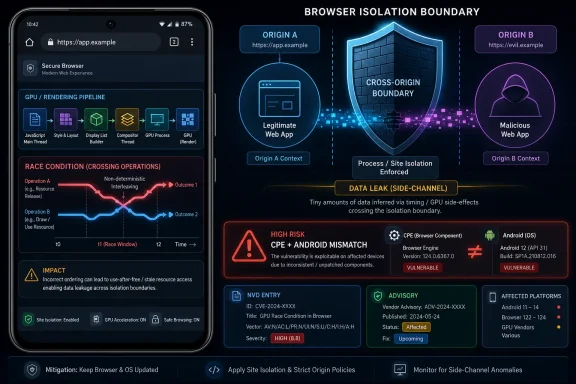
Google Chrome on Android before version 149.0.7827.53 is listed as vulnerable to CVE-2026-11064, a medium-severity GPU race condition disclosed June 4, 2026, that can let an attacker with renderer compromise leak cross-origin data through a crafted HTML page. The awkward part is not the bug description but the metadata around it: NVD’s configuration ties Chrome to Android, while the cited Google advisory is a desktop stable-channel post. For defenders, that mismatch is not trivia. It is exactly the kind of vulnerability-record ambiguity that turns a clean patch signal into asset-management noise.
CVE-2026-11064 is not a generic “all Chromium everywhere” panic item. The public description names Google Chrome on Android, prior to 149.0.7827.53, and places the defect in the GPU component. The attacker model also matters: this is not described as a one-click remote code execution bug from a clean browser state, but as a cross-origin data leak after the renderer process has already been compromised.
That makes the bug both less dramatic and more operationally interesting. Modern browsers assume renderers are hostile often enough that the rest of the architecture is designed around containing them. A renderer compromise is bad, but a renderer compromise that can then reach across origin boundaries is worse because it erodes one of the browser’s core containment promises.
The CVSS 3.1 vector assigned by CISA-ADP lands at 6.5, with network attack vector, low attack complexity, no privileges required, user interaction required, unchanged scope, high confidentiality impact, and no integrity or availability impact. That score feels roughly aligned with the prose: serious for data exposure, but not a standalone system takeover.
The weakness mapping to CWE-457, use of an uninitialized variable, also fits the browser-security genre. GPU paths are full of asynchronous state, shared buffers, driver abstractions, and timing-sensitive code. A race in that territory can produce precisely the sort of stale or uninitialized state that becomes visible across boundaries the browser is supposed to enforce.
That does not mean every Chrome CPE on every platform is affected. It also does not mean the Android OS itself contains the vulnerable code. It means the vulnerable software condition is Chrome, and the platform qualifier is Android.
Where the metadata gets uncomfortable is the product naming. The CPE shown in the user-provided record appears as
A Windows admin looking only at
The trouble is that not all scanners, dashboards, software-bill-of-materials tools, or risk reports preserve that logic cleanly. Some flatten CPE matches into a single vulnerable-product list. Others display only the application CPE and bury the platform condition. Still others ingest CVE data faster than they ingest corrected or enriched configuration logic.
That is how a medium Android browser issue becomes a spreadsheet argument in a Windows shop. The CVE looks like “Google Chrome before 149.0.7827.53.” The advisory link points to a Chrome stable-channel update for desktop. The description says Android. The CPE configuration says Chrome plus Android. Each piece is individually understandable; together, they create enough ambiguity to generate false positives.
This is not just a nuisance. In mature environments, vulnerability triage is a competition for attention. Every false positive burns the same queue time as a real exposure. If desktop Chrome fleets are incorrectly swept into an Android-only CVE, administrators may spend cycles proving non-applicability while more urgent browser fixes wait.
Still, for a vulnerability database, references are not decorative. They are part of the evidentiary chain defenders use to decide whether a finding applies. If the only public vendor advisory prominently discusses desktop builds, while the vulnerability text says Android, a cautious analyst has to reconcile those facts rather than assume the database is self-explanatory.
There are several plausible explanations. The same underlying Chromium fix may have landed in the 149.0.7827.53 train, even if the public post was written for desktop. The Android advisory may be delayed, less visible, or folded into another release channel note. The CVE entry may also have inherited a convenient release reference that is technically related but editorially misleading.
That distinction matters because Chrome version numbers now span a product family. Desktop Chrome, Chrome for Android, Chromium builds in Linux distributions, WebView-related components, and Chromium-derived browsers may all share code ancestry without sharing identical exposure. A GPU race reachable in Chrome on Android should not be lazily translated into “all Chromium products are vulnerable” unless the vendor or downstream maintainers say so.
On Android, the browser’s relationship with the rest of the platform is different from desktop Chrome. App sandboxing, GPU services, hardware acceleration, driver behavior, WebView-adjacent assumptions, and mobile browsing patterns all change the practical risk. A crafted HTML page is not exotic; it is the ordinary delivery format of the web.
Cross-origin data leakage is also not an abstract browser-theory problem. The web’s same-origin policy is one of the central rules preventing one site from reading another site’s data. If an attacker can use a compromised renderer and a GPU race to leak cross-origin information, the impact can be session data, page contents, tokens, or other sensitive material depending on exploitability and context.
The public description does not prove a turnkey exploit exists. It does not say the issue is exploited in the wild. It does not describe an end-to-end compromise chain. But it describes a bug class and architecture location that belong in the “patch promptly” bucket, especially on managed Android fleets where Chrome is a primary access path to corporate applications.
CVE-2026-11064 is a confidentiality issue, not an integrity or availability issue in the published scoring. That makes it less visible than a crash or code-execution flaw. Data leaks, however, are often what attackers actually want after they have gained a foothold. Browser cookies, embedded app state, account context, and sensitive page data can be more valuable than a theatrical exploit demo.
The required user interaction also should not be overread. In web attacks, “user interaction” often means the victim must visit or be navigated to a crafted page. That is a meaningful mitigation compared with a wormable service bug, but it is not a high bar in phishing-heavy environments.
For WindowsForum readers, the practical split is straightforward. If you manage Android endpoints, verify Chrome for Android is at least 149.0.7827.53. If you manage Windows desktops, do not ignore Chrome updates, but do not let this specific CVE’s Android wording be silently expanded into a desktop exposure without corroboration.
This is both helpful and dangerous. It is helpful because downstream maintainers often know whether their packaged Chromium contains the fixed commit or needs a rebuild. It is dangerous because asset owners may treat every downstream tracker entry as proof of practical exploitability on their platform.
The right reading is narrower: if your distribution ships Chromium and its security team has associated the CVE with the package, follow that distribution’s update guidance. If your commercial scanner flags desktop Google Chrome solely because the broad CPE says Chrome before 149.0.7827.53, check whether the AND platform condition was preserved.
Version comparisons also need care. Chrome 149.0.7827.53 is the fixed threshold in the CVE description, but Google released later 149.0.7827.102 and .103 builds shortly afterward for other Chrome security issues, including a separate V8 flaw reportedly exploited in the wild. In practice, “at least .53” may answer this CVE, while “current stable” is the safer operational answer.
A more explicit Android Chrome app CPE, if one exists and is accepted in the CPE dictionary, could help. So could an advisory reference that points directly to the relevant Android Chrome release note rather than a desktop stable-channel post. The current configuration’s AND clause is technically meaningful, but many readers will never see the logic tree; they will see the product string and the version threshold.
There is also a case for adding affected software context outside CPEs. CPE was designed for standardized platform naming, not for perfectly modeling modern app ecosystems. Mobile apps distributed through app stores, browser components embedded in other products, and shared open-source engines all strain the model.
That is why vulnerability intelligence teams increasingly rely on more than CPE. Package URLs, vendor product identifiers, mobile app IDs, SBOM relationships, and scanner-specific detection logic all fill gaps that CPE alone cannot. CVE-2026-11064 is a tidy example of why: the vulnerable thing is Chrome, the relevant platform is Android, the shared codebase is Chromium, and the reference link points at a desktop release channel.
A good triage process should ask four questions. Does the CVE description name our platform? Does the CPE configuration preserve platform logic? Does the vendor advisory match the product we run? Does our scanner’s detection method prove the vulnerable code is present, or merely match a broad version string?
For Chrome on managed Android, the action is boring in the best possible way: update. Chrome’s release cadence is fast, mobile browser exposure is high, and the fixed version is already identified. For desktop Chrome on Windows, the action is also to remain current, but the justification should be current Chrome security posture rather than a misapplied Android-only CVE.
For security teams maintaining exception records, this CVE deserves careful wording. “Not applicable to Windows desktop Chrome based on current public description; applies to Chrome on Android prior to 149.0.7827.53” is much better than “false positive.” The former preserves the possibility that downstream evidence changes; the latter shuts down future review.
 The Vulnerability Is Narrower Than the Database Row Makes It Look
CVE-2026-11064 is not a generic “all Chromium everywhere” panic item. The public description names Google Chrome on Android, prior to 149.0.7827.53, and places the defect in the GPU component. The attacker model also matters: this is not described as a one-click remote code execution bug from a clean browser state, but as a cross-origin data leak after the renderer process has already been compromised.That makes the bug both less dramatic and more operationally interesting. Modern browsers assume renderers are hostile often enough that the rest of the architecture is designed around containing them. A renderer compromise is bad, but a renderer compromise that can then reach across origin boundaries is worse because it erodes one of the browser’s core containment promises.
The CVSS 3.1 vector assigned by CISA-ADP lands at 6.5, with network attack vector, low attack complexity, no privileges required, user interaction required, unchanged scope, high confidentiality impact, and no integrity or availability impact. That score feels roughly aligned with the prose: serious for data exposure, but not a standalone system takeover.
The weakness mapping to CWE-457, use of an uninitialized variable, also fits the browser-security genre. GPU paths are full of asynchronous state, shared buffers, driver abstractions, and timing-sensitive code. A race in that territory can produce precisely the sort of stale or uninitialized state that becomes visible across boundaries the browser is supposed to enforce.
The CPE Question Is Really a Product-Boundary Question
The user-facing question — “are we missing a CPE here?” — has a deceptively simple answer: yes, possibly, but not necessarily in the way scanners or vulnerability dashboards might imply. The NVD configuration shown uses an AND relationship: a vulnerable Google Chrome application CPE up to, but excluding, 149.0.7827.53, combined with the Android operating-system CPE. That is a common way to express “this app is vulnerable when running on this platform.”That does not mean every Chrome CPE on every platform is affected. It also does not mean the Android OS itself contains the vulnerable code. It means the vulnerable software condition is Chrome, and the platform qualifier is Android.
Where the metadata gets uncomfortable is the product naming. The CPE shown in the user-provided record appears as
cpe:2.3:a:google:chrome:*:*:*:*:*:*:*:*, not a more explicitly Android-specific Chrome package identifier. In CPE language, that is not unusual; CPEs often describe vendor and product more broadly than app-store packaging would. But for inventory systems, the broadness matters.A Windows admin looking only at
google:chrome could incorrectly flag desktop Chrome installations, even though the CVE description says Android. A mobile-device-management administrator looking only for an Android operating-system CVE could miss that this is really a Chrome app update problem. The vulnerability record is trying to encode both facts, but the resulting shape is easy to misread.NVD’s AND Logic Helps, but It Does Not Save Every Scanner
The presence of an AND configuration is important. It is supposed to tell downstream tooling that two conditions must be true: the asset has a vulnerable Chrome version, and the asset is on Android. That is more precise than a flat list of affected products.The trouble is that not all scanners, dashboards, software-bill-of-materials tools, or risk reports preserve that logic cleanly. Some flatten CPE matches into a single vulnerable-product list. Others display only the application CPE and bury the platform condition. Still others ingest CVE data faster than they ingest corrected or enriched configuration logic.
That is how a medium Android browser issue becomes a spreadsheet argument in a Windows shop. The CVE looks like “Google Chrome before 149.0.7827.53.” The advisory link points to a Chrome stable-channel update for desktop. The description says Android. The CPE configuration says Chrome plus Android. Each piece is individually understandable; together, they create enough ambiguity to generate false positives.
This is not just a nuisance. In mature environments, vulnerability triage is a competition for attention. Every false positive burns the same queue time as a real exposure. If desktop Chrome fleets are incorrectly swept into an Android-only CVE, administrators may spend cycles proving non-applicability while more urgent browser fixes wait.
The Desktop Advisory Link Is the Odd Note in the Chord
The most conspicuous mismatch is the reference to Google’s stable-channel update for desktop. The CVE description names Chrome on Android, but the linked Chrome Releases post is framed around Windows, macOS, and Linux. That does not automatically invalidate the CVE record. Google often batches Chromium security metadata around release trains, and CVE references can point to umbrella release notes rather than perfectly platform-specific advisories.Still, for a vulnerability database, references are not decorative. They are part of the evidentiary chain defenders use to decide whether a finding applies. If the only public vendor advisory prominently discusses desktop builds, while the vulnerability text says Android, a cautious analyst has to reconcile those facts rather than assume the database is self-explanatory.
There are several plausible explanations. The same underlying Chromium fix may have landed in the 149.0.7827.53 train, even if the public post was written for desktop. The Android advisory may be delayed, less visible, or folded into another release channel note. The CVE entry may also have inherited a convenient release reference that is technically related but editorially misleading.
That distinction matters because Chrome version numbers now span a product family. Desktop Chrome, Chrome for Android, Chromium builds in Linux distributions, WebView-related components, and Chromium-derived browsers may all share code ancestry without sharing identical exposure. A GPU race reachable in Chrome on Android should not be lazily translated into “all Chromium products are vulnerable” unless the vendor or downstream maintainers say so.
Android Makes the Renderer Story More Complicated
The phrase “renderer process compromise” can lull people into thinking this CVE is only a second-stage curiosity. In reality, browser exploit chains are often built from exactly this kind of component interaction. One bug gets code execution or stronger influence in the renderer; another bug leaks data, weakens isolation, or helps escape a sandbox; a third bug does the final privilege move.On Android, the browser’s relationship with the rest of the platform is different from desktop Chrome. App sandboxing, GPU services, hardware acceleration, driver behavior, WebView-adjacent assumptions, and mobile browsing patterns all change the practical risk. A crafted HTML page is not exotic; it is the ordinary delivery format of the web.
Cross-origin data leakage is also not an abstract browser-theory problem. The web’s same-origin policy is one of the central rules preventing one site from reading another site’s data. If an attacker can use a compromised renderer and a GPU race to leak cross-origin information, the impact can be session data, page contents, tokens, or other sensitive material depending on exploitability and context.
The public description does not prove a turnkey exploit exists. It does not say the issue is exploited in the wild. It does not describe an end-to-end compromise chain. But it describes a bug class and architecture location that belong in the “patch promptly” bucket, especially on managed Android fleets where Chrome is a primary access path to corporate applications.
Medium Severity Still Deserves a Fast Browser Patch
The browser world has trained users to notice only the words “critical” and “zero-day.” That is a mistake. A medium-severity browser vulnerability can be a meaningful risk when it breaks a core isolation boundary or composes well with other bugs.CVE-2026-11064 is a confidentiality issue, not an integrity or availability issue in the published scoring. That makes it less visible than a crash or code-execution flaw. Data leaks, however, are often what attackers actually want after they have gained a foothold. Browser cookies, embedded app state, account context, and sensitive page data can be more valuable than a theatrical exploit demo.
The required user interaction also should not be overread. In web attacks, “user interaction” often means the victim must visit or be navigated to a crafted page. That is a meaningful mitigation compared with a wormable service bug, but it is not a high bar in phishing-heavy environments.
For WindowsForum readers, the practical split is straightforward. If you manage Android endpoints, verify Chrome for Android is at least 149.0.7827.53. If you manage Windows desktops, do not ignore Chrome updates, but do not let this specific CVE’s Android wording be silently expanded into a desktop exposure without corroboration.
Linux Distribution Trackers Add Noise and a Hint
One interesting wrinkle is that Debian’s tracker lists Chromium source-package status against CVE-2026-11064, including vulnerable and fixed package versions. That does not necessarily mean the original Google Chrome for Android issue is exploitable on every Debian Chromium build. Distribution trackers often map CVEs to source packages conservatively because shared Chromium code may be present even when platform reachability is unclear.This is both helpful and dangerous. It is helpful because downstream maintainers often know whether their packaged Chromium contains the fixed commit or needs a rebuild. It is dangerous because asset owners may treat every downstream tracker entry as proof of practical exploitability on their platform.
The right reading is narrower: if your distribution ships Chromium and its security team has associated the CVE with the package, follow that distribution’s update guidance. If your commercial scanner flags desktop Google Chrome solely because the broad CPE says Chrome before 149.0.7827.53, check whether the AND platform condition was preserved.
Version comparisons also need care. Chrome 149.0.7827.53 is the fixed threshold in the CVE description, but Google released later 149.0.7827.102 and .103 builds shortly afterward for other Chrome security issues, including a separate V8 flaw reportedly exploited in the wild. In practice, “at least .53” may answer this CVE, while “current stable” is the safer operational answer.
The Missing CPE May Be Less Important Than the Missing Clarity
If we were editing the vulnerability record for maximum defensive clarity, the improvement would not simply be “add another CPE.” It would be to make the affected-platform logic impossible to miss. The public record should clearly distinguish Chrome on Android from desktop Chrome, Android OS itself, Android System WebView, and Chromium-derived packages.A more explicit Android Chrome app CPE, if one exists and is accepted in the CPE dictionary, could help. So could an advisory reference that points directly to the relevant Android Chrome release note rather than a desktop stable-channel post. The current configuration’s AND clause is technically meaningful, but many readers will never see the logic tree; they will see the product string and the version threshold.
There is also a case for adding affected software context outside CPEs. CPE was designed for standardized platform naming, not for perfectly modeling modern app ecosystems. Mobile apps distributed through app stores, browser components embedded in other products, and shared open-source engines all strain the model.
That is why vulnerability intelligence teams increasingly rely on more than CPE. Package URLs, vendor product identifiers, mobile app IDs, SBOM relationships, and scanner-specific detection logic all fill gaps that CPE alone cannot. CVE-2026-11064 is a tidy example of why: the vulnerable thing is Chrome, the relevant platform is Android, the shared codebase is Chromium, and the reference link points at a desktop release channel.
Enterprise Patch Teams Should Treat This as a Test Case
The useful lesson for IT teams is not that CVE-2026-11064 is the week’s most terrifying browser bug. It is that the vulnerability record exposes a recurring weakness in patch operations: many organizations still treat CVE metadata as if it were a verdict, when it is often closer to a structured clue.A good triage process should ask four questions. Does the CVE description name our platform? Does the CPE configuration preserve platform logic? Does the vendor advisory match the product we run? Does our scanner’s detection method prove the vulnerable code is present, or merely match a broad version string?
For Chrome on managed Android, the action is boring in the best possible way: update. Chrome’s release cadence is fast, mobile browser exposure is high, and the fixed version is already identified. For desktop Chrome on Windows, the action is also to remain current, but the justification should be current Chrome security posture rather than a misapplied Android-only CVE.
For security teams maintaining exception records, this CVE deserves careful wording. “Not applicable to Windows desktop Chrome based on current public description; applies to Chrome on Android prior to 149.0.7827.53” is much better than “false positive.” The former preserves the possibility that downstream evidence changes; the latter shuts down future review.
The Practical Reading of CVE-2026-11064
CVE-2026-11064 is not a headline-grabbing zero-day, but it is a useful diagnostic for whether a vulnerability program can read nuance under pressure. The correct response is to patch Android Chrome, validate scanner logic, and avoid turning one platform-specific browser flaw into a fleet-wide false alarm.- Chrome on Android versions before 149.0.7827.53 should be treated as vulnerable to CVE-2026-11064.
- The NVD configuration shown appears to use Chrome plus Android as a combined condition, not as two independent vulnerable products.
- The desktop Chrome advisory reference is confusing and should not be read by itself as proof that Windows, macOS, or Linux Chrome are affected by this specific Android-described issue.
- The bug requires user interaction and a compromised renderer process, but it can still matter because cross-origin data leakage undermines a central browser security boundary.
- Security teams should verify that their scanners preserve NVD’s AND logic before opening desktop Chrome remediation tickets for this CVE.
- The safer operational posture remains to keep Chrome current across all platforms, because later 149.0.7827.x updates address additional browser security issues beyond this one.
References
- Primary source: NVD / Chromium
Published: 2026-06-09T07:00:28-07:00
NVD - CVE-2026-11064
 nvd.nist.gov
- Security advisory: MSRC
Published: 2026-06-09T07:00:28-07:00
Original feed URL
Security Update Guide - Microsoft Security Response Center
 msrc.microsoft.com
- Related coverage: stack.watch