

NVD’s June 8, 2026 enrichment for CVE-2026-11287 lists Google Chrome versions before 149.0.7827.53 combined with Android as the vulnerable configuration, but the record still appears incomplete because it does not expose a distinct Android Chrome package CPE. That is the small but important wrinkle in an otherwise routine Chrome security entry. The vulnerability is not a headline-grabbing browser escape, but it illustrates how mobile Chrome flaws can be awkwardly represented in databases built around product names, platforms, and version ranges.
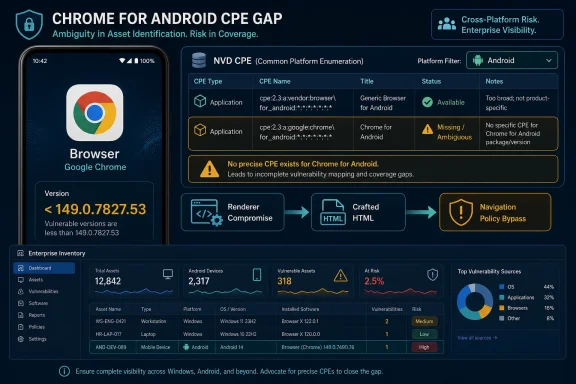
The short answer is yes: if the intent is to describe Chrome for Android precisely, the CPE story looks under-specified. The NVD configuration says “Google Chrome” and “Android,” but that is not quite the same thing as a clean CPE for the Android Chrome application. For vulnerability scanners, SBOM tooling, and enterprise mobile inventories, that distinction matters more than the low Chromium severity might suggest.
CVE-2026-11287 concerns insufficient validation or policy enforcement in Chrome’s Navigation component on Android before version 149.0.7827.53. The described attack requires a remote attacker who has already compromised the renderer process, and then uses a crafted HTML page to bypass navigation restrictions.
That prerequisite is doing a lot of work. A renderer compromise is not a casual drive-by condition; it implies the attacker already has a foothold inside one of Chrome’s most security-sensitive compartments. Chromium’s own severity rating is low, while CISA-ADP assigned a CVSS 3.1 score of 6.5, driven by high integrity impact and network reachability with user interaction.
The interesting part is not whether every Android user should panic. They should not. The interesting part is how the vulnerability is represented: Chrome before 149.0.7827.53, joined with Android as an operating-system condition.
That “AND” configuration is a workaround for a familiar CPE problem. Chrome for Android is both Chrome and an Android app, but vulnerability databases often have to choose between modeling the browser generically and modeling the platform specifically. When the affected code path exists only in the Android build, a generic
Enterprise vulnerability tools rely on CPEs because they need deterministic matching. If a Windows endpoint has Chrome 149.0.7827.52, it should not be flagged for an Android-only navigation flaw. If an Android device has Chrome 149.0.7827.52, it should. That sounds simple until the database has only a generic Chrome CPE and a separate Android CPE, rather than a package identity for Chrome’s Android application.
The risk is not merely false positives. It is also false confidence. If mobile device management tooling identifies apps by package name, store metadata, or Android inventory fields, but a vulnerability feed expresses the affected software as desktop-style Chrome plus Android, the matching logic becomes vendor-specific glue. Some tools will get it right. Some will overmatch. Some will miss it unless their maintainers manually map Chrome for Android to the generic Chrome CPE.
That is why the “Are we missing a CPE?” note is not bureaucratic trivia. It is the vulnerability ecosystem admitting that the schema may not describe the affected thing cleanly enough.
This CVE is specifically about Google Chrome on Android, not Chrome on Windows. That distinction should keep most WindowsForum readers from treating it as a direct desktop exposure. But Windows administrators increasingly manage Android devices, especially in mixed bring-your-own-device, frontline worker, and enterprise mobility environments.
A traditional Windows patching lens says: find the product, compare the version, deploy the update. A mobile browser lens says: confirm the app package, confirm the channel, confirm Play update status, confirm managed policy behavior, and confirm that device inventory is granular enough to separate Chrome from WebView and from Chromium-derived browsers.
That is where weak CPE precision becomes operational debt. A CVE record can be technically correct and still inconvenient for defenders.
Browser vendors often grade vulnerabilities in the context of exploit chains. A flaw that requires prior renderer compromise is rarely treated the same as a standalone remote code execution bug. If an attacker already owns the renderer, the navigation policy bypass may be a second-stage primitive rather than the initial breach.
CVSS, by contrast, can emphasize the security property being violated. In this case, the vector gives the issue high integrity impact, with network attack vector, low complexity, no privileges, and required user interaction. That makes sense if the bypass enables navigation behavior that the browser was supposed to prevent.
For administrators, the correct reading is somewhere in the middle. This is not a “drop everything” zero-day alert. It is also not meaningless. Browser exploit chains are built from precisely these kinds of primitives: small policy gaps that become useful once paired with a memory corruption bug, logic bug, or renderer foothold.
If your vulnerability tooling reports this CVE against Chrome on Windows, the finding deserves scrutiny. It may be the result of a generic Chrome CPE match that ignored the Android condition. Conversely, if your mobile inventory does not consume the Android half of the CPE configuration, it may fail to surface affected devices.
This is one of the quiet frustrations of modern browser security. Chromium is a shared engine, but Chrome is not one product in any operationally useful sense. Chrome on Windows, Chrome on Android, ChromeOS, WebView, Edge, Brave, and embedded Chromium all sit in overlapping but non-identical risk zones.
A CVE entry that says “Chrome” can mean different things depending on which component, platform, and distribution channel actually contains the vulnerable code. CVE-2026-11287 is a reminder that defenders should read the affected-platform language before trusting the headline product name.
The deeper problem is that CPE was not designed for today’s software distribution reality. A browser may be a desktop application, a mobile app, a system component, an embedded runtime, and a managed enterprise asset, all under the same brand. A mobile app may be better identified by package name than by vendor-product naming conventions.
Security databases are gradually being pushed toward richer identifiers: package URLs, SBOM component IDs, mobile package names, container image references, and ecosystem-specific coordinates. CPE remains widely used because it is entrenched, but it often needs help from context. CVE-2026-11287 is a small example of that larger transition.
The practical implication is simple: if you maintain vulnerability content, do not treat this as merely “Chrome before 149.0.7827.53.” Treat it as “Chrome for Android before 149.0.7827.53,” and make sure your matching logic preserves that boundary.
That dashboard is only as good as its identifiers. A bad CPE match can inflate risk counts, create noisy tickets, or send desktop teams chasing a mobile-only issue. A missed CPE mapping can leave Android fleets underreported while compliance reports look clean.
The lesson is not that every IT shop must manually curate every CVE. That is impossible. The lesson is that platform qualifiers deserve the same attention as CVSS scores. In this case, “on Android” is not a footnote. It is the product boundary.
For organizations with managed Android devices, the response is straightforward: confirm Chrome is at 149.0.7827.53 or later, ensure Google Play updates are flowing, and verify that vulnerability tooling is matching the Android Chrome app rather than generic desktop Chrome installations. For organizations without managed Android, this is mostly a feed-quality and false-positive issue.
The more interesting remediation work belongs to vulnerability managers and content teams. They should check whether their products ingest the NVD configuration as an AND relationship or flatten it into a generic Chrome finding. Flattening would be a mistake.
They should also watch for later NVD enrichment. The record was still evolving after publication, with NIST enrichment adding the CPE configuration after the CVE was first received from Chrome and after CISA-ADP added its CVSS and CWE data. It would not be surprising if the applicability statement or CPE mapping changed again.
That is why early CVE records require caution. A newly published CVE is often a sketch. The full operational picture arrives later, after vendor advisories, NVD enrichment, downstream distro trackers, and security tools normalize the data.
The short answer is yes: if the intent is to describe Chrome for Android precisely, the CPE story looks under-specified. The NVD configuration says “Google Chrome” and “Android,” but that is not quite the same thing as a clean CPE for the Android Chrome application. For vulnerability scanners, SBOM tooling, and enterprise mobile inventories, that distinction matters more than the low Chromium severity might suggest.
 The Bug Is Narrow, but the Metadata Problem Is Broad
CVE-2026-11287 concerns insufficient validation or policy enforcement in Chrome’s Navigation component on Android before version 149.0.7827.53. The described attack requires a remote attacker who has already compromised the renderer process, and then uses a crafted HTML page to bypass navigation restrictions.That prerequisite is doing a lot of work. A renderer compromise is not a casual drive-by condition; it implies the attacker already has a foothold inside one of Chrome’s most security-sensitive compartments. Chromium’s own severity rating is low, while CISA-ADP assigned a CVSS 3.1 score of 6.5, driven by high integrity impact and network reachability with user interaction.
The interesting part is not whether every Android user should panic. They should not. The interesting part is how the vulnerability is represented: Chrome before 149.0.7827.53, joined with Android as an operating-system condition.
That “AND” configuration is a workaround for a familiar CPE problem. Chrome for Android is both Chrome and an Android app, but vulnerability databases often have to choose between modeling the browser generically and modeling the platform specifically. When the affected code path exists only in the Android build, a generic
google:chrome CPE plus an Android OS CPE is serviceable — but not ideal.A Scanner Wants a Product, Not a Story
The current CPE configuration effectively says that vulnerable systems are those running Google Chrome before 149.0.7827.53 on Android. A human can understand that. A scanner may not.Enterprise vulnerability tools rely on CPEs because they need deterministic matching. If a Windows endpoint has Chrome 149.0.7827.52, it should not be flagged for an Android-only navigation flaw. If an Android device has Chrome 149.0.7827.52, it should. That sounds simple until the database has only a generic Chrome CPE and a separate Android CPE, rather than a package identity for Chrome’s Android application.
The risk is not merely false positives. It is also false confidence. If mobile device management tooling identifies apps by package name, store metadata, or Android inventory fields, but a vulnerability feed expresses the affected software as desktop-style Chrome plus Android, the matching logic becomes vendor-specific glue. Some tools will get it right. Some will overmatch. Some will miss it unless their maintainers manually map Chrome for Android to the generic Chrome CPE.
That is why the “Are we missing a CPE?” note is not bureaucratic trivia. It is the vulnerability ecosystem admitting that the schema may not describe the affected thing cleanly enough.
Chrome’s Version Number Looks Simple Until Android Enters the Room
The fixed version in the CVE description is 149.0.7827.53. For desktop Chrome, versioning is already complicated by staggered rollout, platform-specific builds, and patch-level differences between Windows, macOS, and Linux. For Android, the complexity grows because app delivery is mediated through Google Play, OEM update behavior, managed profiles, and sometimes Android System WebView dependencies.This CVE is specifically about Google Chrome on Android, not Chrome on Windows. That distinction should keep most WindowsForum readers from treating it as a direct desktop exposure. But Windows administrators increasingly manage Android devices, especially in mixed bring-your-own-device, frontline worker, and enterprise mobility environments.
A traditional Windows patching lens says: find the product, compare the version, deploy the update. A mobile browser lens says: confirm the app package, confirm the channel, confirm Play update status, confirm managed policy behavior, and confirm that device inventory is granular enough to separate Chrome from WebView and from Chromium-derived browsers.
That is where weak CPE precision becomes operational debt. A CVE record can be technically correct and still inconvenient for defenders.
The Severity Split Tells Its Own Story
Chromium labels the issue low severity, while the CISA-ADP CVSS vector lands at medium. That split is not necessarily a contradiction. It reflects two different ways of thinking about browser risk.Browser vendors often grade vulnerabilities in the context of exploit chains. A flaw that requires prior renderer compromise is rarely treated the same as a standalone remote code execution bug. If an attacker already owns the renderer, the navigation policy bypass may be a second-stage primitive rather than the initial breach.
CVSS, by contrast, can emphasize the security property being violated. In this case, the vector gives the issue high integrity impact, with network attack vector, low complexity, no privileges, and required user interaction. That makes sense if the bypass enables navigation behavior that the browser was supposed to prevent.
For administrators, the correct reading is somewhere in the middle. This is not a “drop everything” zero-day alert. It is also not meaningless. Browser exploit chains are built from precisely these kinds of primitives: small policy gaps that become useful once paired with a memory corruption bug, logic bug, or renderer foothold.
The Android Boundary Is the Whole Case
The description says the vulnerability affects Google Chrome on Android prior to 149.0.7827.53. That platform qualifier should drive every remediation and detection decision.If your vulnerability tooling reports this CVE against Chrome on Windows, the finding deserves scrutiny. It may be the result of a generic Chrome CPE match that ignored the Android condition. Conversely, if your mobile inventory does not consume the Android half of the CPE configuration, it may fail to surface affected devices.
This is one of the quiet frustrations of modern browser security. Chromium is a shared engine, but Chrome is not one product in any operationally useful sense. Chrome on Windows, Chrome on Android, ChromeOS, WebView, Edge, Brave, and embedded Chromium all sit in overlapping but non-identical risk zones.
A CVE entry that says “Chrome” can mean different things depending on which component, platform, and distribution channel actually contains the vulnerable code. CVE-2026-11287 is a reminder that defenders should read the affected-platform language before trusting the headline product name.
The Missing CPE Is Really a Missing Abstraction
The cleanest CPE would identify Chrome for Android as its own affected application, with a version range ending before 149.0.7827.53. If such a CPE is unavailable, NVD’s current approach — generic Chrome plus Android — is understandable. But understandable is not the same as ideal.The deeper problem is that CPE was not designed for today’s software distribution reality. A browser may be a desktop application, a mobile app, a system component, an embedded runtime, and a managed enterprise asset, all under the same brand. A mobile app may be better identified by package name than by vendor-product naming conventions.
Security databases are gradually being pushed toward richer identifiers: package URLs, SBOM component IDs, mobile package names, container image references, and ecosystem-specific coordinates. CPE remains widely used because it is entrenched, but it often needs help from context. CVE-2026-11287 is a small example of that larger transition.
The practical implication is simple: if you maintain vulnerability content, do not treat this as merely “Chrome before 149.0.7827.53.” Treat it as “Chrome for Android before 149.0.7827.53,” and make sure your matching logic preserves that boundary.
Windows Admins Still Have a Reason to Care
At first glance, this looks like a story for Android administrators, not Windows professionals. But WindowsForum readers live in the world where endpoint management rarely stops at Windows anymore. Microsoft Intune, Defender Vulnerability Management, third-party MDM suites, and asset platforms routinely blend Windows, macOS, iOS, Android, and browser inventories into one risk dashboard.That dashboard is only as good as its identifiers. A bad CPE match can inflate risk counts, create noisy tickets, or send desktop teams chasing a mobile-only issue. A missed CPE mapping can leave Android fleets underreported while compliance reports look clean.
The lesson is not that every IT shop must manually curate every CVE. That is impossible. The lesson is that platform qualifiers deserve the same attention as CVSS scores. In this case, “on Android” is not a footnote. It is the product boundary.
For organizations with managed Android devices, the response is straightforward: confirm Chrome is at 149.0.7827.53 or later, ensure Google Play updates are flowing, and verify that vulnerability tooling is matching the Android Chrome app rather than generic desktop Chrome installations. For organizations without managed Android, this is mostly a feed-quality and false-positive issue.
The Real Fix Is Boring, Which Is Why It Works
There is no exotic mitigation here. Update Chrome on Android. Restart the app if needed. Confirm the version. That is the ordinary browser-security ritual, and it remains the right answer.The more interesting remediation work belongs to vulnerability managers and content teams. They should check whether their products ingest the NVD configuration as an AND relationship or flatten it into a generic Chrome finding. Flattening would be a mistake.
They should also watch for later NVD enrichment. The record was still evolving after publication, with NIST enrichment adding the CPE configuration after the CVE was first received from Chrome and after CISA-ADP added its CVSS and CWE data. It would not be surprising if the applicability statement or CPE mapping changed again.
That is why early CVE records require caution. A newly published CVE is often a sketch. The full operational picture arrives later, after vendor advisories, NVD enrichment, downstream distro trackers, and security tools normalize the data.
The Chrome-for-Android Line Is the One to Preserve
For teams turning this CVE into policy, the important details are concrete and limited. The flaw is real, the platform scope is narrow, and the CPE expression may not be as precise as defenders would like.- CVE-2026-11287 affects Google Chrome on Android before version 149.0.7827.53.
- The attack described requires a compromised renderer process and a crafted HTML page.
- Chromium rates the vulnerability low severity, while CISA-ADP’s CVSS 3.1 assessment places it at medium severity.
- The current NVD configuration models the issue as Google Chrome before 149.0.7827.53 in combination with Android.
- A distinct Chrome-for-Android application CPE would make matching cleaner for scanners and mobile inventory tools.
- Windows desktop Chrome findings for this CVE should be checked carefully for overbroad CPE matching.
References
- Primary source: NVD / Chromium
Published: 2026-06-09T07:00:33-07:00
NVD - CVE-2026-11287
 nvd.nist.gov
- Security advisory: MSRC
Published: 2026-06-09T07:00:33-07:00
Original feed URL
Security Update Guide - Microsoft Security Response Center
 msrc.microsoft.com
- Related coverage: security.snyk.io
Improper Input Validation in chromium | CVE-2026-11287 | Snyk
Improper Input Validation in chromium | CVE-2026-11287security.snyk.io - Related coverage: vuldb.com
CVE-2026-11287 Google Chrome Navigation input validation (ID 502173 / Nessus ID 319283)
A flaw has been found in Google Chrome on Android. This vulnerability is handled as CVE-2026-11287. Upgrading the affected component is advised.vuldb.com - Related coverage: radar.offseq.com
CVE-2026-11018: Insufficient policy enforcement in Google Chrome - Live Threat Intelligence - Threat Radar | OffSeq.com
Detailed information about CVE-2026-11018: Insufficient policy enforcement in Google Chrome affecting Google Chrome. Get real-time updates, technical details, aradar.offseq.com - Related coverage: govcert.gov.hk
GovCERT.HK - Security Alert (A26-06-08): Multiple Vulnerabilities in Google Chrome
Security Alert (A26-06-08): Multiple Vulnerabilities in Google Chromewww.govcert.gov.hk
