

CVE-2026-11681 is a high-severity Google Chrome vulnerability disclosed on June 8, 2026, affecting Chrome on Linux before version 149.0.7827.103 and allowing a remote attacker to potentially trigger heap corruption through a crafted HTML page. The bug sits in Ozone, Chrome’s platform-abstraction layer for windowing and input, which makes it especially relevant to Linux desktop users and enterprise fleets that treat Chrome as just another auto-updating app. The oddity is that the public NVD configuration currently appears to describe versions up to, but excluding, 149.0.7827.102, while the CVE description says the fixed threshold is 149.0.7827.103. That one-digit discrepancy is the sort of metadata wrinkle that can turn a patched browser into a lingering compliance argument.
At the technical level, CVE-2026-11681 is familiar Chrome territory: a use-after-free memory safety flaw. That class of bug occurs when software continues to reference memory after it has been released, creating an opening for corruption, crashes, or, in more dangerous cases, attacker-controlled behavior. In Chrome’s case, the advisory language says a remote attacker could potentially exploit heap corruption by persuading a user to load a crafted HTML page.
The target component, Ozone, is not one of Chrome’s household names like V8, Blink, or Skia. But it is strategically important because it helps Chrome talk to platform-specific display, input, and windowing systems. On Linux, that means the bug lives close to the boundary where browser code meets the messy reality of desktop compositors, graphics stacks, and input plumbing.
The CVE is rated High by Chromium and has a CISA ADP CVSS 3.1 score of 8.8. That vector is the standard nightmare shape for a browser bug: network reachable, low attack complexity, no privileges required, user interaction required, and high impact across confidentiality, integrity, and availability. In plain English, the victim has to visit or render something malicious, but the attacker does not need an account on the system.
The version story is where this gets less clean. The CVE description says Chrome on Linux prior to 149.0.7827.103 is affected. NVD’s configuration history, however, reportedly added a CPE range for Google Chrome versions up to, but excluding, 149.0.7827.102, running on Linux. If that is not corrected or clarified, scanners may disagree with release notes, and administrators will be left deciding whether their dashboard or the vendor advisory gets the final word.
Linux desktops often sit in blind spots. Developer workstations, lab machines, kiosks, CI systems with GUI dependencies, and administrator laptops may not be managed with the same discipline as Windows endpoints. In many organizations, Chrome for Windows is governed through enterprise tooling, while Chrome on Linux is left to distro packages, user-level installs, or a mixture of repositories and manual updates.
That split matters because a browser vulnerability is not merely a browser vulnerability anymore. Chrome is an identity front end, an admin console viewer, a SaaS client, a password manager surface, and often the place where privileged users authenticate to cloud services. A crafted page does not need to compromise the whole machine to cause serious trouble if it can reach cookies, sessions, documents, or internal web applications.
Linux users sometimes assume they are less exposed because commodity malware campaigns tend to chase Windows first. Browser exploitation has always been less sentimental. If the target is a developer with cloud credentials, a Linux laptop can be more valuable than a random Windows desktop.
That is why the NVD CPE detail is worth scrutinizing. If a scanner interprets the vulnerable range as excluding only up to 149.0.7827.102, it may treat 149.0.7827.102 as fixed. But the CVE prose says versions prior to 149.0.7827.103 are affected, which would make 149.0.7827.102 vulnerable. In security operations, that kind of mismatch is not academic; it directly affects remediation queues.
The safest reading is to follow the stricter boundary: Chrome on Linux should be updated to 149.0.7827.103 or later where that version is available. If a Linux package channel exposes 149.0.7827.102 as the latest build, administrators should verify Google’s channel-specific release notes and their vendor’s packaging metadata before closing the issue. A vulnerability management system that says “green” while the CVE description says “prior to .103” is not enough evidence on its own.
This is also a reminder that CPE data is not the vulnerability. CPEs are a mapping layer, and mapping layers are often where precision goes to die. They are essential for automation, but they are not a substitute for reading the advisory language when a version boundary looks suspicious.
A modern browser is not a document viewer. It is a just-in-time compiler, a GPU client, a video pipeline, a password broker, a PDF reader, a USB and Bluetooth mediator, a file picker, a network stack, and a user interface framework glued together under severe performance pressure. The Ozone layer exists because Chrome must abstract platform differences without giving up speed or integration.
Memory safety flaws thrive in that environment. A component frees an object, another path still believes the object is alive, and an attacker tries to shape memory so that the stale reference becomes useful. The exploitability of any individual bug depends on details Google does not publish immediately, but the pattern is old enough that defenders should not dismiss “potential heap corruption” as soft language.
Google’s practice of restricting bug details until users have had time to update is sensible. It also creates the usual information gap: defenders know enough to patch, but not enough to model exploit chains confidently. For enterprise teams, that should push the response toward fast remediation rather than prolonged debate over whether the bug is likely to be weaponized.
Attackers do not need exotic social engineering to make that happen. Malvertising, compromised legitimate sites, phishing emails, poisoned search results, and links in collaboration tools are all established delivery paths. In targeted campaigns, a crafted internal-looking page sent to a developer or administrator can be enough.
The more meaningful mitigating factor is not user interaction but exploitation status. As of the public information available around disclosure, CVE-2026-11681 was not the headline actively exploited Chrome zero-day from the same update cycle; that attention belonged to a separate V8 issue. But Chrome security updates often bundle many memory bugs, and attackers reverse-engineer patches quickly.
That is the uncomfortable lesson of browser patching: even if a CVE is not known to be exploited on Monday, the patch itself becomes a research artifact by Tuesday. Waiting for confirmed exploitation is often equivalent to waiting for someone else to lose first.
Each layer introduces interpretation. A Chrome advisory may list platform builds in one format. A CVE record may describe affected versions in another. NVD may enrich the record later with a CPE range. A Linux vendor may package Chrome or Chromium with its own versioning cadence. A scanner plugin may use either the CPE, the installed package version, a registry-like artifact, or a browser executable check.
When all of those agree, automation looks magical. When they do not, the security team gets a ticket that cannot be closed cleanly. CVE-2026-11681 is a small but useful example because the apparent conflict is easy to state: the description says before 149.0.7827.103, while the NVD configuration shown in the user-provided record says up to, excluding 149.0.7827.102.
That could be a simple enrichment error. It could reflect channel-specific build numbering that is not obvious from the CVE prose. It could be corrected by the time many tools ingest the feed. But for administrators, the right response is not to guess; it is to validate against the installed Chrome version and the vendor’s release channel, then document the exception if a scanner cannot represent the truth.
That laissez-faire model breaks down when the browser is the attack surface. A developer workstation may have SSH keys, source repositories, cloud CLIs, Kubernetes contexts, test credentials, and access to internal dashboards. The browser is often the bridge between those assets and the public internet.
For CVE-2026-11681, Linux specificity should sharpen the response. Teams should inventory Chrome installations on Linux, verify whether they are Google Chrome or Chromium derivatives, check actual build numbers, and make sure update mechanisms are functioning. The answer should not be “our Windows patch tool says Chrome is fine.”
There is also a difference between Chrome and Chromium that matters operationally. The CVE names Google Chrome, but downstream Chromium packages may share affected code depending on how and when they were built. Enterprise teams should not assume that a non-Google package is immune merely because its branding differs. They should check vendor advisories for the browser package they actually ship.
A Chrome bug on Linux can intersect with Microsoft infrastructure in several ways. A Linux workstation may be used to administer Microsoft 365, Entra ID, Azure, Intune, GitHub, or Defender portals. A compromised browser session on that machine can become an identity and access problem before it becomes a traditional endpoint malware problem.
There is also the WSL-adjacent reality. Many Windows developers run Linux tooling locally, and some organizations blur the line between Windows endpoint management and Linux userland management. CVE-2026-11681 does not mean Chrome inside Windows is affected merely because WSL exists, but it does highlight the need to know where Linux browsers are actually installed and used.
The browser has become the common operating layer above operating systems. That means Windows administrators cannot safely ignore Linux browser CVEs if Linux machines sit anywhere near privileged workflows. The asset inventory, not the forum category, should decide relevance.
Chrome 149’s update cycle has been busy, with multiple vulnerabilities, multiple platform builds, and at least one separately reported exploited issue in V8. In that environment, it is easy for CVE pages, scanner plugins, vendor advisories, and news reports to blur separate bugs into a single “update Chrome now” message. That message is not wrong, but it can hide the fine print administrators need.
CVE-2026-11681 should not be confused with the actively exploited V8 issue from the same general update window. The Ozone bug is its own CVE, with its own Linux-specific description and its own version boundary. Bundling those together under “Chrome zero-day” may drive urgency, but it also muddies remediation evidence.
This is where mature patch operations earn their keep. The work is not simply to deploy “the latest Chrome.” It is to prove which machines received which build, on which platform, from which channel, and whether the vulnerability definition used by the scanner matches the vendor’s fixed-version claim.
The more nuanced question is exploit chaining. Browser memory corruption bugs often become more dangerous when paired with sandbox escapes, logic flaws, or credential theft techniques. The public CVE text for CVE-2026-11681 does not claim a sandbox escape; it says potential heap corruption. That distinction matters because Chrome’s sandbox is designed to contain renderer compromise.
But containment is not the same as harmlessness. A renderer-level exploit may still expose web-origin data, support phishing or session abuse, or become a foothold in a larger chain. And once researchers can inspect the patch, the distance between theoretical and practical narrows.
For ordinary users, the prescription is boring and correct: update Chrome and restart it. For administrators, the prescription is to treat the version discrepancy as a validation task, not a reason to delay. Patch first, reconcile metadata second.
If that mismatch persists in NVD, it is worth reporting through the appropriate feedback mechanism. Accurate CPE data matters because it feeds scanners, dashboards, procurement risk systems, and compliance evidence. Bad metadata scales faster than good judgment.
Still, administrators should not wait for NVD to settle before acting. NVD enrichment is downstream of the vendor disclosure, and it can lag or misstate edge cases. The vendor’s fixed-version language and the actual installed binary should carry more weight during active remediation.
The clean operational note is this: if Chrome on Linux is below 149.0.7827.103, treat it as vulnerable unless your vendor provides a specific, documented reason not to. If a tool says otherwise, capture the discrepancy and override the ticket workflow rather than letting a metadata artifact define risk.
A strong response does not require panic. It requires inventory, version verification, update enforcement, and a willingness to question scanner output when the underlying data conflicts. That is basic hygiene, but browser vulnerabilities punish organizations that treat basic hygiene as optional.
The version number matters because attackers and auditors both operate at that level of precision. “Chrome 149” is not enough. “Patched sometime last week” is not enough. For this CVE, the defensible target is Chrome for Linux at 149.0.7827.103 or later, unless authoritative channel-specific documentation proves a different fixed build.
The other lesson is that Linux endpoints deserve the same browser governance as Windows endpoints. If those machines touch sensitive systems, they are part of the enterprise attack surface. Their browsers should be inventoried, updated, and monitored with the same seriousness as any Windows desktop running Edge or Chrome.
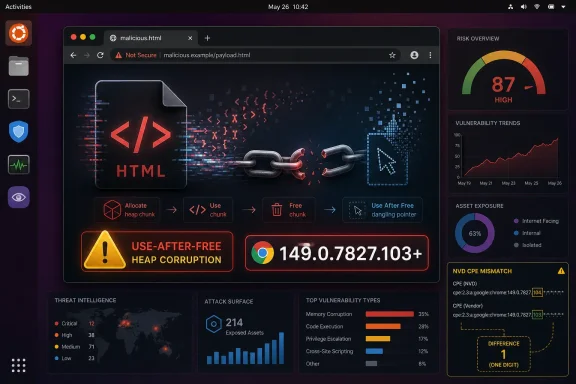 The Vulnerability Is Simple; the Versioning Is Not
At the technical level, CVE-2026-11681 is familiar Chrome territory: a use-after-free memory safety flaw. That class of bug occurs when software continues to reference memory after it has been released, creating an opening for corruption, crashes, or, in more dangerous cases, attacker-controlled behavior. In Chrome’s case, the advisory language says a remote attacker could potentially exploit heap corruption by persuading a user to load a crafted HTML page.The target component, Ozone, is not one of Chrome’s household names like V8, Blink, or Skia. But it is strategically important because it helps Chrome talk to platform-specific display, input, and windowing systems. On Linux, that means the bug lives close to the boundary where browser code meets the messy reality of desktop compositors, graphics stacks, and input plumbing.
The CVE is rated High by Chromium and has a CISA ADP CVSS 3.1 score of 8.8. That vector is the standard nightmare shape for a browser bug: network reachable, low attack complexity, no privileges required, user interaction required, and high impact across confidentiality, integrity, and availability. In plain English, the victim has to visit or render something malicious, but the attacker does not need an account on the system.
The version story is where this gets less clean. The CVE description says Chrome on Linux prior to 149.0.7827.103 is affected. NVD’s configuration history, however, reportedly added a CPE range for Google Chrome versions up to, but excluding, 149.0.7827.102, running on Linux. If that is not corrected or clarified, scanners may disagree with release notes, and administrators will be left deciding whether their dashboard or the vendor advisory gets the final word.
Ozone Makes This a Linux Story, Not Just a Chrome Story
Most Chrome vulnerabilities are cross-platform in practice because the browser shares so much code across Windows, macOS, Linux, Android, and ChromeOS. CVE-2026-11681 is different because the public description explicitly narrows the affected product to Google Chrome on Linux. That does not make the bug unimportant; it makes it more operationally awkward.Linux desktops often sit in blind spots. Developer workstations, lab machines, kiosks, CI systems with GUI dependencies, and administrator laptops may not be managed with the same discipline as Windows endpoints. In many organizations, Chrome for Windows is governed through enterprise tooling, while Chrome on Linux is left to distro packages, user-level installs, or a mixture of repositories and manual updates.
That split matters because a browser vulnerability is not merely a browser vulnerability anymore. Chrome is an identity front end, an admin console viewer, a SaaS client, a password manager surface, and often the place where privileged users authenticate to cloud services. A crafted page does not need to compromise the whole machine to cause serious trouble if it can reach cookies, sessions, documents, or internal web applications.
Linux users sometimes assume they are less exposed because commodity malware campaigns tend to chase Windows first. Browser exploitation has always been less sentimental. If the target is a developer with cloud credentials, a Linux laptop can be more valuable than a random Windows desktop.
The Patch Threshold Deserves More Attention Than the CVE Score
The most important practical question is not whether CVE-2026-11681 is “High” or “Critical.” It is whether Chrome on Linux is actually at or beyond the fixed version. The CVE text says the vulnerable range is before 149.0.7827.103, which implies that 149.0.7827.103 or later is the safe line.That is why the NVD CPE detail is worth scrutinizing. If a scanner interprets the vulnerable range as excluding only up to 149.0.7827.102, it may treat 149.0.7827.102 as fixed. But the CVE prose says versions prior to 149.0.7827.103 are affected, which would make 149.0.7827.102 vulnerable. In security operations, that kind of mismatch is not academic; it directly affects remediation queues.
The safest reading is to follow the stricter boundary: Chrome on Linux should be updated to 149.0.7827.103 or later where that version is available. If a Linux package channel exposes 149.0.7827.102 as the latest build, administrators should verify Google’s channel-specific release notes and their vendor’s packaging metadata before closing the issue. A vulnerability management system that says “green” while the CVE description says “prior to .103” is not enough evidence on its own.
This is also a reminder that CPE data is not the vulnerability. CPEs are a mapping layer, and mapping layers are often where precision goes to die. They are essential for automation, but they are not a substitute for reading the advisory language when a version boundary looks suspicious.
Use-After-Free Bugs Keep Surviving the Browser Security Machine
Chrome’s security architecture has improved dramatically over the years. Site isolation, sandboxing, exploit mitigations, memory partitioning, and a relentless update cadence have raised the cost of exploitation. Yet use-after-free bugs keep appearing because browsers are among the most complicated pieces of software most people run every day.A modern browser is not a document viewer. It is a just-in-time compiler, a GPU client, a video pipeline, a password broker, a PDF reader, a USB and Bluetooth mediator, a file picker, a network stack, and a user interface framework glued together under severe performance pressure. The Ozone layer exists because Chrome must abstract platform differences without giving up speed or integration.
Memory safety flaws thrive in that environment. A component frees an object, another path still believes the object is alive, and an attacker tries to shape memory so that the stale reference becomes useful. The exploitability of any individual bug depends on details Google does not publish immediately, but the pattern is old enough that defenders should not dismiss “potential heap corruption” as soft language.
Google’s practice of restricting bug details until users have had time to update is sensible. It also creates the usual information gap: defenders know enough to patch, but not enough to model exploit chains confidently. For enterprise teams, that should push the response toward fast remediation rather than prolonged debate over whether the bug is likely to be weaponized.
User Interaction Is Not Much Comfort in a Browser Bug
The CVSS vector for CVE-2026-11681 includes user interaction, and that can tempt some teams to downgrade urgency. That would be a mistake. For a browser vulnerability, “user interaction required” often means “the user viewed a malicious web page,” which is the browser’s entire job.Attackers do not need exotic social engineering to make that happen. Malvertising, compromised legitimate sites, phishing emails, poisoned search results, and links in collaboration tools are all established delivery paths. In targeted campaigns, a crafted internal-looking page sent to a developer or administrator can be enough.
The more meaningful mitigating factor is not user interaction but exploitation status. As of the public information available around disclosure, CVE-2026-11681 was not the headline actively exploited Chrome zero-day from the same update cycle; that attention belonged to a separate V8 issue. But Chrome security updates often bundle many memory bugs, and attackers reverse-engineer patches quickly.
That is the uncomfortable lesson of browser patching: even if a CVE is not known to be exploited on Monday, the patch itself becomes a research artifact by Tuesday. Waiting for confirmed exploitation is often equivalent to waiting for someone else to lose first.
The Scanner Problem Is Bigger Than This One CVE
The user’s question — whether a CPE is missing — points to a deeper problem in vulnerability management. The industry has built enormous workflows on top of standardized identifiers, but the identifiers are frequently incomplete, delayed, or ambiguous at exactly the moment defenders need clarity. CVE gives the bug a name; CPE tries to map it to products; CVSS tries to summarize severity; scanners try to translate all of that into action.Each layer introduces interpretation. A Chrome advisory may list platform builds in one format. A CVE record may describe affected versions in another. NVD may enrich the record later with a CPE range. A Linux vendor may package Chrome or Chromium with its own versioning cadence. A scanner plugin may use either the CPE, the installed package version, a registry-like artifact, or a browser executable check.
When all of those agree, automation looks magical. When they do not, the security team gets a ticket that cannot be closed cleanly. CVE-2026-11681 is a small but useful example because the apparent conflict is easy to state: the description says before 149.0.7827.103, while the NVD configuration shown in the user-provided record says up to, excluding 149.0.7827.102.
That could be a simple enrichment error. It could reflect channel-specific build numbering that is not obvious from the CVE prose. It could be corrected by the time many tools ingest the feed. But for administrators, the right response is not to guess; it is to validate against the installed Chrome version and the vendor’s release channel, then document the exception if a scanner cannot represent the truth.
Linux Fleets Need a Browser Patch Policy That Is Not an Afterthought
Windows administrators have spent years learning that Chrome, Edge, Firefox, and WebView components are first-class patch targets. Linux fleet management is less uniform. Some organizations use apt or yum repositories, some use Snap or Flatpak, some use configuration management, and some let developers manage their own workstations because “they know what they’re doing.”That laissez-faire model breaks down when the browser is the attack surface. A developer workstation may have SSH keys, source repositories, cloud CLIs, Kubernetes contexts, test credentials, and access to internal dashboards. The browser is often the bridge between those assets and the public internet.
For CVE-2026-11681, Linux specificity should sharpen the response. Teams should inventory Chrome installations on Linux, verify whether they are Google Chrome or Chromium derivatives, check actual build numbers, and make sure update mechanisms are functioning. The answer should not be “our Windows patch tool says Chrome is fine.”
There is also a difference between Chrome and Chromium that matters operationally. The CVE names Google Chrome, but downstream Chromium packages may share affected code depending on how and when they were built. Enterprise teams should not assume that a non-Google package is immune merely because its branding differs. They should check vendor advisories for the browser package they actually ship.
Microsoft Shops Should Still Care About a Linux Chrome Bug
WindowsForum readers may reasonably ask why a Linux-only Chrome CVE belongs in a Windows-centered publication. The answer is that modern Windows environments are rarely Windows-only. Microsoft shops increasingly manage mixed fleets, cloud developer environments, Linux build hosts, WSL workflows, Azure-hosted desktops, and browser-centric administration surfaces.A Chrome bug on Linux can intersect with Microsoft infrastructure in several ways. A Linux workstation may be used to administer Microsoft 365, Entra ID, Azure, Intune, GitHub, or Defender portals. A compromised browser session on that machine can become an identity and access problem before it becomes a traditional endpoint malware problem.
There is also the WSL-adjacent reality. Many Windows developers run Linux tooling locally, and some organizations blur the line between Windows endpoint management and Linux userland management. CVE-2026-11681 does not mean Chrome inside Windows is affected merely because WSL exists, but it does highlight the need to know where Linux browsers are actually installed and used.
The browser has become the common operating layer above operating systems. That means Windows administrators cannot safely ignore Linux browser CVEs if Linux machines sit anywhere near privileged workflows. The asset inventory, not the forum category, should decide relevance.
The Release Cadence Is a Feature Until It Becomes a Fog Machine
Chrome’s rapid update model is one of the browser’s strongest defenses. Security fixes can move from report to stable channel quickly, and most users never have to understand the details. The same machinery, however, creates version-number fog during high-volume patch weeks.Chrome 149’s update cycle has been busy, with multiple vulnerabilities, multiple platform builds, and at least one separately reported exploited issue in V8. In that environment, it is easy for CVE pages, scanner plugins, vendor advisories, and news reports to blur separate bugs into a single “update Chrome now” message. That message is not wrong, but it can hide the fine print administrators need.
CVE-2026-11681 should not be confused with the actively exploited V8 issue from the same general update window. The Ozone bug is its own CVE, with its own Linux-specific description and its own version boundary. Bundling those together under “Chrome zero-day” may drive urgency, but it also muddies remediation evidence.
This is where mature patch operations earn their keep. The work is not simply to deploy “the latest Chrome.” It is to prove which machines received which build, on which platform, from which channel, and whether the vulnerability definition used by the scanner matches the vendor’s fixed-version claim.
The Practical Risk Is Less Exotic Than the Component Name
Ozone sounds obscure, but the user-facing risk is ordinary: a malicious web page could trigger memory corruption in a vulnerable Linux Chrome build. That is enough to justify prompt patching without resorting to cinematic threat scenarios. The fact that the bug is high severity rather than critical does not make it a maintenance item.The more nuanced question is exploit chaining. Browser memory corruption bugs often become more dangerous when paired with sandbox escapes, logic flaws, or credential theft techniques. The public CVE text for CVE-2026-11681 does not claim a sandbox escape; it says potential heap corruption. That distinction matters because Chrome’s sandbox is designed to contain renderer compromise.
But containment is not the same as harmlessness. A renderer-level exploit may still expose web-origin data, support phishing or session abuse, or become a foothold in a larger chain. And once researchers can inspect the patch, the distance between theoretical and practical narrows.
For ordinary users, the prescription is boring and correct: update Chrome and restart it. For administrators, the prescription is to treat the version discrepancy as a validation task, not a reason to delay. Patch first, reconcile metadata second.
The CPE Gap Should Be Reported, but Not Waited On
The user-provided NVD text includes the familiar prompt asking whether a CPE is missing. In this case, the better question may be whether the CPE range is precise enough. A configuration that stops at “excluding 149.0.7827.102” appears inconsistent with a description that says “prior to 149.0.7827.103.”If that mismatch persists in NVD, it is worth reporting through the appropriate feedback mechanism. Accurate CPE data matters because it feeds scanners, dashboards, procurement risk systems, and compliance evidence. Bad metadata scales faster than good judgment.
Still, administrators should not wait for NVD to settle before acting. NVD enrichment is downstream of the vendor disclosure, and it can lag or misstate edge cases. The vendor’s fixed-version language and the actual installed binary should carry more weight during active remediation.
The clean operational note is this: if Chrome on Linux is below 149.0.7827.103, treat it as vulnerable unless your vendor provides a specific, documented reason not to. If a tool says otherwise, capture the discrepancy and override the ticket workflow rather than letting a metadata artifact define risk.
The Patch Window Is Where This Bug Will Be Won or Lost
CVE-2026-11681 is unlikely to be remembered as a landmark Chrome vulnerability. It is more likely to become one of the many high-severity memory bugs that disappear into the update stream. But that is exactly why it is useful: it exposes whether an organization’s browser patching process works when the story is messy, platform-specific, and not dominating headlines.A strong response does not require panic. It requires inventory, version verification, update enforcement, and a willingness to question scanner output when the underlying data conflicts. That is basic hygiene, but browser vulnerabilities punish organizations that treat basic hygiene as optional.
The version number matters because attackers and auditors both operate at that level of precision. “Chrome 149” is not enough. “Patched sometime last week” is not enough. For this CVE, the defensible target is Chrome for Linux at 149.0.7827.103 or later, unless authoritative channel-specific documentation proves a different fixed build.
The other lesson is that Linux endpoints deserve the same browser governance as Windows endpoints. If those machines touch sensitive systems, they are part of the enterprise attack surface. Their browsers should be inventoried, updated, and monitored with the same seriousness as any Windows desktop running Edge or Chrome.
The One-Digit Difference That Should Drive the Work
The immediate job is narrow, but it points to a broader discipline: do not let automated vulnerability metadata outrank verified product state. CVE-2026-11681 is a Linux Chrome bug with a high severity rating, a plausible remote web delivery path, and an apparent version-boundary inconsistency worth resolving.- Chrome on Linux below 149.0.7827.103 should be treated as exposed to CVE-2026-11681 unless a vendor advisory for that exact package says otherwise.
- The NVD CPE range shown in the user-provided record appears to conflict with the CVE description and should be reported or tracked for correction.
- Security teams should verify the actual browser binary version rather than relying solely on CPE-derived scanner output.
- Linux desktops, developer machines, and admin workstations should be included in browser patch compliance reporting.
- CVE-2026-11681 should not be conflated with the separate Chrome V8 issue from the same update cycle, even if both lead to the same practical advice to update.
- The safest remediation evidence is a documented installed version at or above the fixed threshold, followed by a browser restart to complete the update.
References
- Primary source: NVD / Chromium
Published: 2026-06-15T19:14:43-07:00
NVD - CVE-2026-11681
 nvd.nist.gov
- Security advisory: MSRC
Published: 2026-06-15T19:14:43-07:00
Original feed URL
Security Update Guide - Microsoft Security Response Center
 msrc.microsoft.com
- Related coverage: vulnerability.circl.lu
Vulnerability-Lookup
Vulnerability-Lookup - Fast vulnerability lookup correlation from different sources.vulnerability.circl.lu - Related coverage: radar.offseq.com
CVE-2026-11681: Use after free in Google Chrome - Live Threat Intelligence - Threat Radar | OffSeq.com
Detailed information about CVE-2026-11681: Use after free in Google Chrome affecting Google Chrome. Get real-time updates, technical details, and mitigation strradar.offseq.com
