

Google disclosed CVE-2026-14024 on June 30, 2026, as a medium-severity use-after-free flaw in Chrome’s Linux Ozone layer, fixed for Chrome 150 and described by NVD as affecting Google Chrome on Linux before version 150.0.7871.47. The bug is not a Windows vulnerability in the narrow platform sense, but it is exactly the sort of Chromium issue Windows administrators still need to track across mixed fleets, developer workstations, WSL-adjacent workflows, and browser standardization programs. The more interesting story is not that another Chrome memory bug exists; it is that the vulnerability databases, vendor release notes, and platform naming conventions still make basic exposure management harder than it should be.
The National Vulnerability Database entry, sourced from Chrome and later enriched by CISA’s ADP process, says a remote attacker could trigger heap corruption through a crafted HTML page after convincing a user to perform specific UI gestures. Google’s Chrome Releases blog announced Chrome 150’s stable-channel desktop promotion the same day, saying the release would roll out over the coming days and weeks and that it contained hundreds of security fixes. Put bluntly: this is a browser patch, not a panic button — but it is also a reminder that the browser has become the operating system surface area most enterprises patch least gracefully.
CVE-2026-14024 lands in the uneasy middle of modern browser security. Google labels it medium severity in Chromium’s own taxonomy, while CISA’s ADP enrichment assigns a CVSS 3.1 score of 8.8, high, with network attack vector, low attack complexity, no privileges required, user interaction required, and high confidentiality, integrity, and availability impact. NVD had not provided its own CVSS score at the time reflected in the entry, leaving defenders with the familiar split-screen view: vendor severity on one side, government-enriched scoring on the other.
That mismatch is not necessarily a contradiction. Chromium’s internal severity model accounts for exploitability in the architecture Google actually ships, including sandbox boundaries, process isolation, UI preconditions, and whether a flaw plausibly chains with others. CVSS, by design, is more abstract and often punishes memory corruption harshly when the theoretical impact includes compromise of sensitive data, code execution, or availability.
For IT teams, the practical reading is simple: do not let the word “medium” lull you into slow-walking the patch. A use-after-free in a browser component that can be reached from a crafted page is not the same as a local-only configuration bug. It may require user gestures, and CISA’s SSVC enrichment says exploitation was not known and the issue was not automatable, but those are scheduling inputs, not excuses.
The key phrase in the NVD description is “specific UI gestures.” That language usually means the exploit path is not a drive-by in the purest sense; the victim has to interact with the page in a particular way. But attackers have spent two decades proving that users can be led, nudged, tricked, or simply habituated into performing gestures that browsers treat as meaningful consent.
That makes Ozone boring in the way foundations are boring: nobody praises it when the building stands, but everyone cares when it cracks. A use-after-free in this zone of the codebase suggests a lifetime-management problem, where memory is freed while some code path can still reference it. In C and C++ software, that class of bug can produce crashes, data corruption, and, under the right conditions, exploitation.
The Linux qualifier matters. This CVE is described as affecting Chrome on Linux, and NVD’s configuration ties Chrome versions below the fixed threshold to Linux. Windows users running Chrome are not the primary affected population for this particular bug as described. Yet WindowsForum readers should still care, because the modern Windows environment is rarely Windows-only.
Developers may use Linux desktops, Linux VMs, containers with GUI tooling, or remote Linux workstations. Enterprises often manage Chrome across Windows, macOS, and Linux from the same console. Security teams rarely get to say, “that is a Linux browser bug, therefore it is someone else’s problem,” when identity cookies, admin portals, SaaS consoles, and source repositories are all one browser session away.
That does not automatically mean one source is wrong in a security-relevant way. Chrome build numbers can vary by platform, packaging channel, emergency respin, and rollout state. Vulnerability entries may use a cross-platform fixed-version threshold even when a platform-specific package is published under a neighboring build number. But ambiguity here has real consequences, because vulnerability scanners and compliance dashboards are literal-minded machines.
If a Linux asset reports Chrome 150.0.7871.46, a scanner that blindly interprets the NVD “less than 150.0.7871.47” range may flag it as vulnerable even if Google’s Linux stable release notes say 150.0.7871.46 is the Chrome 150 Linux build. Conversely, if administrators assume any Chrome 150 build is safe without checking vendor packaging, they may miss a lagging repo or derivative Chromium package.
This is where the CPE question in the submitted material matters. NVD’s change history shows a configuration using an AND relationship: Google Chrome versions up to but excluding 150.0.7871.47, combined with Linux kernel. That is an attempt to express “Chrome on Linux,” but it is an imperfect proxy for operating-system applicability. CPE modeling often struggles with software that is cross-platform but vulnerable only when built or executed against a specific OS integration layer.
The right operational answer is not to argue theology with the CPE feed. It is to verify the installed browser package against the vendor’s platform-specific release and then tune scanner exceptions carefully, documenting the reasoning. If Linux Chrome 150.0.7871.46 is the current Google-provided stable build for a given channel, a blanket “must be 150.0.7871.47 or higher” rule may need human review rather than automatic escalation.
NVD’s visible configuration for CVE-2026-14024 points to Google Chrome plus Linux kernel. That may be adequate for coarse triage, but it cannot answer the questions administrators actually need answered: Is the vulnerable Ozone code enabled in this build? Is this distro’s Chromium package backported? Does the version string reflect upstream Chrome, downstream Chromium, or vendor-patched source? Is the browser auto-updating, repo-updating, or frozen inside an image?
This is why defenders should treat CPE data as a map, not the terrain. The map gets you to the right neighborhood. It does not tell you whether the door is locked, whether the building was renovated, or whether the address number was painted over.
The issue is particularly sharp for Linux desktops, where the packaging ecosystem is both a strength and a source of vulnerability-management friction. Google Chrome from Google’s own repository is not the same operational object as Chromium from a distribution repository. Distro maintainers may backport fixes without adopting the exact upstream version number. Some vulnerability tools understand that; many do not.
So, are we missing a CPE here? Possibly, but the better question is whether a single CPE can represent the real exposure cleanly. If the vulnerable product is specifically Google Chrome on Linux, then the CPE model should not imply all Linux kernels are vulnerable, nor should it confuse Chrome’s platform package numbering. If Chromium derivatives inherit the flaw, they need their own vendor advisories and package mappings, not a casual assumption that every Chromium-branded thing is equally affected.
Modern exploitation frequently lives in the space between technical vulnerability and behavioral manipulation. A page can ask a user to drag, click, resize, grant focus, enter fullscreen, use a file picker, interact with a fake prompt, or perform a seemingly harmless gesture as part of a CAPTCHA-like flow. If the vulnerable code path sits near UI handling, windowing, input dispatch, or compositing, the requirement for interaction may be less of a barrier than a product manager would hope.
This is not to say CVE-2026-14024 is known to be exploited. CISA’s SSVC entry indicates no known exploitation at the time of enrichment. The Chromium issue link is restricted, which is normal until a majority of users have received the fix, and Google did not publish exploit mechanics in the release note.
But the combination of crafted HTML, heap corruption, and user gestures should be enough to put the fix into normal browser-patching urgency. The sensible enterprise posture is not emergency incident response; it is rapid validation that managed Linux browsers are receiving Chrome 150 and that exceptions are understood.
That number matters less as a scoreboard than as a signal. Chrome’s security release machinery is absorbing a huge volume of memory-safety, input-validation, GPU, rendering, extension, and platform-integration issues. Many of those bugs are found internally, fuzzed automatically, or reported through Google’s vulnerability reward program. The browser is not uniquely reckless; it is uniquely exposed and uniquely scrutinized.
For Windows admins, Chrome 150 is also a reminder that “Chromium-based” does not mean “patched at the same time.” Microsoft Edge, Brave, Vivaldi, Opera, and Electron-based applications consume Chromium on their own timelines and with their own versioning. A fix in upstream Chrome is the beginning of the patch story, not the end.
The publication timing is also familiar. Google says stable-channel updates roll out over days and weeks, which is reasonable for a global browser population but uncomfortable for risk teams that think in 24-hour patch SLAs. The workaround is not to wish Chrome’s deployment model away; it is to force update checks, monitor fleet versions, and distinguish “update available” from “update installed and browser restarted.”
The assets most likely to run Linux Chrome may also be among the most sensitive. Developers browse internal documentation, authenticate to Git hosting, access CI/CD dashboards, and handle secrets. Security engineers use browsers to inspect suspicious pages, admin consoles, and cloud control planes. A browser memory corruption issue on such a host does not become harmless because the employee’s primary laptop runs Windows 11.
There is also the identity angle. Browser compromise is not only about local machine takeover. Session cookies, OAuth tokens, password managers, SSO state, and enterprise browser profiles are high-value targets. Even a constrained exploit chain can become consequential if it reaches the right authenticated browser context.
That is why browser patch management should be organized around user risk and data access, not just operating-system family. A Linux desktop used by a developer with production access deserves at least as much attention as a Windows kiosk used for public browsing.
The uncomfortable truth is that a patch can be a blueprint. Once a commit lands, attackers can diff vulnerable and fixed code, infer the bug, and race lagging users. In a project as heavily watched as Chromium, the period between patch publication and fleet adoption is not theoretical downtime; it is the window in which exploit developers study the delta.
Restricted details do not mean defenders should ignore the bug. They mean defenders should focus on the available facts: affected platform, fixed channel, vulnerability class, interaction requirement, exploitation status, and deployment state. Waiting for a proof-of-concept before patching a browser memory corruption flaw is a backwards process.
This is especially true for use-after-free bugs. The public description may be sparse, but the class is well understood. When object lifetime goes wrong in a browser component that processes attacker-influenced input or UI state, the safe assumption is that the bug is worth removing quickly.
Neither number should be treated as scripture. A medium Chromium bug may be tightly constrained by sandboxing, gesture requirements, or exploit complexity. A high CVSS score may overstate likely exploitation in a fully patched, sandboxed, modern browser. But a medium browser memory bug can also chain with another flaw, and a high CVSS score can be the right reminder that “user interaction required” still means “phishable.”
The better triage frame is time-bound and practical. Is exploitation known? Apparently not, according to CISA’s SSVC entry. Is the bug remotely reachable through a crafted page? Yes, according to NVD’s description. Is a fix available in the stable channel? Yes, through Chrome 150. Is the vulnerable population likely to auto-update quickly? Some of it, but not all of it, especially in managed Linux environments.
That points to a priority somewhere between “drop everything” and “catch it next quarter.” For most organizations, it belongs in the next browser patch cycle with verification, not merely assumed auto-update.
Managed Windows Chrome fleets often report version compliance through Google Admin, Microsoft Intune, endpoint management platforms, or vulnerability scanners. Linux fleets are frequently less uniform. Some machines update from Google’s repository, some through distro packages, some through immutable images, and some not at all because a developer pinned a package during a debugging crisis six months ago.
The version ambiguity around 150.0.7871.46 and 150.0.7871.47 makes proof more important. Administrators should compare installed Linux Chrome builds against Google’s platform-specific stable release notes and their own vendor package metadata. If a scanner flags Linux Chrome 150.0.7871.46 solely because NVD says “less than 150.0.7871.47,” that finding deserves validation rather than blind acceptance.
The same goes for Chromium-based alternatives. Do not assume Edge, Brave, Vivaldi, or distro Chromium inherited the fix merely because Chrome stable moved. Check their release notes, package versions, and Chromium base versions. In regulated environments, document the evidence because auditors will often see the CVE before they see the nuance.
Chromium is a shared codebase, but risk is delivered through products. Google Chrome on Linux has one release cadence. Microsoft Edge has another. Linux distributions have another. Electron apps may lag behind all of them. An enterprise that says “we patched Chrome” has answered only one slice of the Chromium question.
This supply-chain view is uncomfortable because it expands the asset inventory problem. The browser is not just the icon on the desktop. It is embedded webviews, app runtimes, admin tools, kiosk shells, and thick clients that quietly ship a Chromium engine. CVE-2026-14024 itself is described for Google Chrome on Linux, but the operational lesson applies broadly: upstream fixes need downstream confirmation.
That does not mean every Chromium CVE should trigger a treasure hunt through every application. It means organizations need a standing process for high-volume browser advisories, including a way to identify which products consume Chromium, which vendors publish timely security notes, and which assets are allowed to lag.
CVE-2026-14024 will probably disappear into the long ledger of Chrome memory bugs once Chrome 150 finishes rolling through the ecosystem. But the friction around it — medium versus high, Linux-only but enterprise-relevant, fixed-version ambiguity, CPE modeling, restricted bug details, and downstream Chromium uncertainty — is the durable story. Browser security in 2026 is no longer about asking whether users clicked the update button; it is about proving that every place your organization runs the web has actually received the fix, restarted into it, and left no stale Chromium engine behind.
The National Vulnerability Database entry, sourced from Chrome and later enriched by CISA’s ADP process, says a remote attacker could trigger heap corruption through a crafted HTML page after convincing a user to perform specific UI gestures. Google’s Chrome Releases blog announced Chrome 150’s stable-channel desktop promotion the same day, saying the release would roll out over the coming days and weeks and that it contained hundreds of security fixes. Put bluntly: this is a browser patch, not a panic button — but it is also a reminder that the browser has become the operating system surface area most enterprises patch least gracefully.
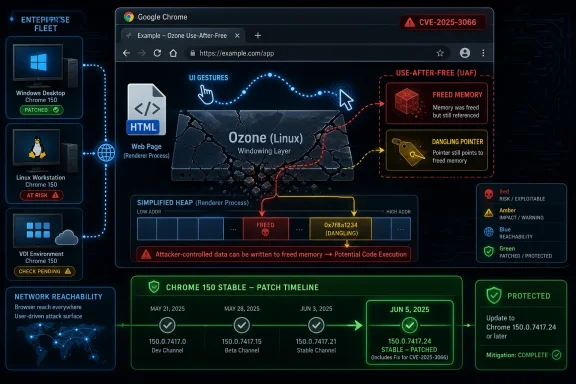 A Medium Chrome Bug Can Still Be a High Operational Problem
CVE-2026-14024 lands in the uneasy middle of modern browser security. Google labels it medium severity in Chromium’s own taxonomy, while CISA’s ADP enrichment assigns a CVSS 3.1 score of 8.8, high, with network attack vector, low attack complexity, no privileges required, user interaction required, and high confidentiality, integrity, and availability impact. NVD had not provided its own CVSS score at the time reflected in the entry, leaving defenders with the familiar split-screen view: vendor severity on one side, government-enriched scoring on the other.That mismatch is not necessarily a contradiction. Chromium’s internal severity model accounts for exploitability in the architecture Google actually ships, including sandbox boundaries, process isolation, UI preconditions, and whether a flaw plausibly chains with others. CVSS, by design, is more abstract and often punishes memory corruption harshly when the theoretical impact includes compromise of sensitive data, code execution, or availability.
For IT teams, the practical reading is simple: do not let the word “medium” lull you into slow-walking the patch. A use-after-free in a browser component that can be reached from a crafted page is not the same as a local-only configuration bug. It may require user gestures, and CISA’s SSVC enrichment says exploitation was not known and the issue was not automatable, but those are scheduling inputs, not excuses.
The key phrase in the NVD description is “specific UI gestures.” That language usually means the exploit path is not a drive-by in the purest sense; the victim has to interact with the page in a particular way. But attackers have spent two decades proving that users can be led, nudged, tricked, or simply habituated into performing gestures that browsers treat as meaningful consent.
Ozone Is the Layer Most Users Never See
The bug sits in Ozone, Chromium’s platform abstraction layer for windowing, input, and display integration. On Linux, Ozone is especially important because Chromium has to live across X11, Wayland, GPU acceleration stacks, window managers, compositors, and wildly different desktop environments. It is the plumbing that lets Chrome draw windows, process input, and talk to the operating system without hard-coding every platform path directly into browser logic.That makes Ozone boring in the way foundations are boring: nobody praises it when the building stands, but everyone cares when it cracks. A use-after-free in this zone of the codebase suggests a lifetime-management problem, where memory is freed while some code path can still reference it. In C and C++ software, that class of bug can produce crashes, data corruption, and, under the right conditions, exploitation.
The Linux qualifier matters. This CVE is described as affecting Chrome on Linux, and NVD’s configuration ties Chrome versions below the fixed threshold to Linux. Windows users running Chrome are not the primary affected population for this particular bug as described. Yet WindowsForum readers should still care, because the modern Windows environment is rarely Windows-only.
Developers may use Linux desktops, Linux VMs, containers with GUI tooling, or remote Linux workstations. Enterprises often manage Chrome across Windows, macOS, and Linux from the same console. Security teams rarely get to say, “that is a Linux browser bug, therefore it is someone else’s problem,” when identity cookies, admin portals, SaaS consoles, and source repositories are all one browser session away.
The Version Number Is Where the Story Gets Messy
The most confusing part of CVE-2026-14024 is the apparent version-number mismatch. NVD’s description says Chrome on Linux prior to 150.0.7871.47 is affected. Google’s June 30 stable-channel desktop post, however, lists Chrome 150.0.7871.46 for Linux and 150.0.7871.46/.47 for Windows and Mac.That does not automatically mean one source is wrong in a security-relevant way. Chrome build numbers can vary by platform, packaging channel, emergency respin, and rollout state. Vulnerability entries may use a cross-platform fixed-version threshold even when a platform-specific package is published under a neighboring build number. But ambiguity here has real consequences, because vulnerability scanners and compliance dashboards are literal-minded machines.
If a Linux asset reports Chrome 150.0.7871.46, a scanner that blindly interprets the NVD “less than 150.0.7871.47” range may flag it as vulnerable even if Google’s Linux stable release notes say 150.0.7871.46 is the Chrome 150 Linux build. Conversely, if administrators assume any Chrome 150 build is safe without checking vendor packaging, they may miss a lagging repo or derivative Chromium package.
This is where the CPE question in the submitted material matters. NVD’s change history shows a configuration using an AND relationship: Google Chrome versions up to but excluding 150.0.7871.47, combined with Linux kernel. That is an attempt to express “Chrome on Linux,” but it is an imperfect proxy for operating-system applicability. CPE modeling often struggles with software that is cross-platform but vulnerable only when built or executed against a specific OS integration layer.
The right operational answer is not to argue theology with the CPE feed. It is to verify the installed browser package against the vendor’s platform-specific release and then tune scanner exceptions carefully, documenting the reasoning. If Linux Chrome 150.0.7871.46 is the current Google-provided stable build for a given channel, a blanket “must be 150.0.7871.47 or higher” rule may need human review rather than automatic escalation.
The CPE Problem Is Bigger Than This CVE
CPEs were built to standardize product identification, but they often reveal how untidy real software has become. A browser is no longer just “Google Chrome.” It is Chrome stable, extended stable, beta, Chromium, distro-packaged Chromium, Snap-packaged Chromium, Flatpak Chromium, Chrome inside a managed VDI image, Chrome embedded in appliances, and Chromium inherited inside Electron apps that may or may not pull the same code path.NVD’s visible configuration for CVE-2026-14024 points to Google Chrome plus Linux kernel. That may be adequate for coarse triage, but it cannot answer the questions administrators actually need answered: Is the vulnerable Ozone code enabled in this build? Is this distro’s Chromium package backported? Does the version string reflect upstream Chrome, downstream Chromium, or vendor-patched source? Is the browser auto-updating, repo-updating, or frozen inside an image?
This is why defenders should treat CPE data as a map, not the terrain. The map gets you to the right neighborhood. It does not tell you whether the door is locked, whether the building was renovated, or whether the address number was painted over.
The issue is particularly sharp for Linux desktops, where the packaging ecosystem is both a strength and a source of vulnerability-management friction. Google Chrome from Google’s own repository is not the same operational object as Chromium from a distribution repository. Distro maintainers may backport fixes without adopting the exact upstream version number. Some vulnerability tools understand that; many do not.
So, are we missing a CPE here? Possibly, but the better question is whether a single CPE can represent the real exposure cleanly. If the vulnerable product is specifically Google Chrome on Linux, then the CPE model should not imply all Linux kernels are vulnerable, nor should it confuse Chrome’s platform package numbering. If Chromium derivatives inherit the flaw, they need their own vendor advisories and package mappings, not a casual assumption that every Chromium-branded thing is equally affected.
User Interaction Is Not a Comfort Blanket
The NVD description requires that an attacker convince a user to engage in specific UI gestures. Security teams often downgrade such issues mentally because they are not fully automatic. That is understandable, but it is also dangerous.Modern exploitation frequently lives in the space between technical vulnerability and behavioral manipulation. A page can ask a user to drag, click, resize, grant focus, enter fullscreen, use a file picker, interact with a fake prompt, or perform a seemingly harmless gesture as part of a CAPTCHA-like flow. If the vulnerable code path sits near UI handling, windowing, input dispatch, or compositing, the requirement for interaction may be less of a barrier than a product manager would hope.
This is not to say CVE-2026-14024 is known to be exploited. CISA’s SSVC entry indicates no known exploitation at the time of enrichment. The Chromium issue link is restricted, which is normal until a majority of users have received the fix, and Google did not publish exploit mechanics in the release note.
But the combination of crafted HTML, heap corruption, and user gestures should be enough to put the fix into normal browser-patching urgency. The sensible enterprise posture is not emergency incident response; it is rapid validation that managed Linux browsers are receiving Chrome 150 and that exceptions are understood.
Chrome 150 Was a Security Event Disguised as a Feature Release
Google’s June 30 post was framed as Chrome 150’s promotion to the stable desktop channel for Windows, Mac, and Linux. But the scale of the security section is what should catch an administrator’s eye. Google said the update included 433 security fixes, with access to bug details restricted until most users had received the patch.That number matters less as a scoreboard than as a signal. Chrome’s security release machinery is absorbing a huge volume of memory-safety, input-validation, GPU, rendering, extension, and platform-integration issues. Many of those bugs are found internally, fuzzed automatically, or reported through Google’s vulnerability reward program. The browser is not uniquely reckless; it is uniquely exposed and uniquely scrutinized.
For Windows admins, Chrome 150 is also a reminder that “Chromium-based” does not mean “patched at the same time.” Microsoft Edge, Brave, Vivaldi, Opera, and Electron-based applications consume Chromium on their own timelines and with their own versioning. A fix in upstream Chrome is the beginning of the patch story, not the end.
The publication timing is also familiar. Google says stable-channel updates roll out over days and weeks, which is reasonable for a global browser population but uncomfortable for risk teams that think in 24-hour patch SLAs. The workaround is not to wish Chrome’s deployment model away; it is to force update checks, monitor fleet versions, and distinguish “update available” from “update installed and browser restarted.”
Windows Shops Still Own the Linux Browser Problem
It is tempting for a Windows-first organization to tag CVE-2026-14024 as Linux-only and move on. That would be a mistake in many real environments. Linux browsers are common on engineering workstations, build servers with GUI access, security research boxes, cloud desktops, lab machines, and administrator jump hosts.The assets most likely to run Linux Chrome may also be among the most sensitive. Developers browse internal documentation, authenticate to Git hosting, access CI/CD dashboards, and handle secrets. Security engineers use browsers to inspect suspicious pages, admin consoles, and cloud control planes. A browser memory corruption issue on such a host does not become harmless because the employee’s primary laptop runs Windows 11.
There is also the identity angle. Browser compromise is not only about local machine takeover. Session cookies, OAuth tokens, password managers, SSO state, and enterprise browser profiles are high-value targets. Even a constrained exploit chain can become consequential if it reaches the right authenticated browser context.
That is why browser patch management should be organized around user risk and data access, not just operating-system family. A Linux desktop used by a developer with production access deserves at least as much attention as a Windows kiosk used for public browsing.
The Restricted Bug Link Is a Feature, Not a Cover-Up
NVD points to a Chromium issue entry for CVE-2026-14024, but Google’s release note warns that access to bug details and links may remain restricted until most users are updated. This routine practice frustrates researchers and administrators who want to understand exact exploitability. It is also one of the few responsible ways to publish browser fixes at internet scale.The uncomfortable truth is that a patch can be a blueprint. Once a commit lands, attackers can diff vulnerable and fixed code, infer the bug, and race lagging users. In a project as heavily watched as Chromium, the period between patch publication and fleet adoption is not theoretical downtime; it is the window in which exploit developers study the delta.
Restricted details do not mean defenders should ignore the bug. They mean defenders should focus on the available facts: affected platform, fixed channel, vulnerability class, interaction requirement, exploitation status, and deployment state. Waiting for a proof-of-concept before patching a browser memory corruption flaw is a backwards process.
This is especially true for use-after-free bugs. The public description may be sparse, but the class is well understood. When object lifetime goes wrong in a browser component that processes attacker-influenced input or UI state, the safe assumption is that the bug is worth removing quickly.
CVSS Says High, Chromium Says Medium, and Both Can Be Useful
The severity split around CVE-2026-14024 is a small case study in why vulnerability scoring is more useful as a conversation starter than an autopilot. Chromium’s medium rating reflects Google’s view from inside the browser architecture. CISA’s 8.8 CVSS score reflects a standardized model that sees a network-reachable, low-complexity bug with user interaction and potentially high impact.Neither number should be treated as scripture. A medium Chromium bug may be tightly constrained by sandboxing, gesture requirements, or exploit complexity. A high CVSS score may overstate likely exploitation in a fully patched, sandboxed, modern browser. But a medium browser memory bug can also chain with another flaw, and a high CVSS score can be the right reminder that “user interaction required” still means “phishable.”
The better triage frame is time-bound and practical. Is exploitation known? Apparently not, according to CISA’s SSVC entry. Is the bug remotely reachable through a crafted page? Yes, according to NVD’s description. Is a fix available in the stable channel? Yes, through Chrome 150. Is the vulnerable population likely to auto-update quickly? Some of it, but not all of it, especially in managed Linux environments.
That points to a priority somewhere between “drop everything” and “catch it next quarter.” For most organizations, it belongs in the next browser patch cycle with verification, not merely assumed auto-update.
The Patch Is Easy; The Proof Is Harder
For an individual user, the advice is uncomplicated: open Chrome’s About page, let it check for updates, and restart the browser. On Linux, package-manager updates may be the path instead, depending on how Chrome was installed. For administrators, the real work is proving that the update landed across the messy edge cases.Managed Windows Chrome fleets often report version compliance through Google Admin, Microsoft Intune, endpoint management platforms, or vulnerability scanners. Linux fleets are frequently less uniform. Some machines update from Google’s repository, some through distro packages, some through immutable images, and some not at all because a developer pinned a package during a debugging crisis six months ago.
The version ambiguity around 150.0.7871.46 and 150.0.7871.47 makes proof more important. Administrators should compare installed Linux Chrome builds against Google’s platform-specific stable release notes and their own vendor package metadata. If a scanner flags Linux Chrome 150.0.7871.46 solely because NVD says “less than 150.0.7871.47,” that finding deserves validation rather than blind acceptance.
The same goes for Chromium-based alternatives. Do not assume Edge, Brave, Vivaldi, or distro Chromium inherited the fix merely because Chrome stable moved. Check their release notes, package versions, and Chromium base versions. In regulated environments, document the evidence because auditors will often see the CVE before they see the nuance.
Browser Security Has Become a Supply-Chain Discipline
CVE-2026-14024 is not a grand, theatrical zero-day. It is more revealing than that. It shows how routine browser flaws now expose the weak seams between upstream projects, vendor builds, operating-system packages, vulnerability databases, scanners, and enterprise patch policy.Chromium is a shared codebase, but risk is delivered through products. Google Chrome on Linux has one release cadence. Microsoft Edge has another. Linux distributions have another. Electron apps may lag behind all of them. An enterprise that says “we patched Chrome” has answered only one slice of the Chromium question.
This supply-chain view is uncomfortable because it expands the asset inventory problem. The browser is not just the icon on the desktop. It is embedded webviews, app runtimes, admin tools, kiosk shells, and thick clients that quietly ship a Chromium engine. CVE-2026-14024 itself is described for Google Chrome on Linux, but the operational lesson applies broadly: upstream fixes need downstream confirmation.
That does not mean every Chromium CVE should trigger a treasure hunt through every application. It means organizations need a standing process for high-volume browser advisories, including a way to identify which products consume Chromium, which vendors publish timely security notes, and which assets are allowed to lag.
The Ozone Bug Leaves Administrators With a Narrow But Real To-Do List
CVE-2026-14024 should not be oversold as a confirmed exploitation campaign, but it should not be buried as a mere medium either. It is a Linux Chrome memory-safety issue, reachable through a crafted page and user gestures, fixed in the Chrome 150 stable-channel wave, and complicated by version and CPE representation.- Administrators should verify Linux Chrome installations against Google’s Chrome 150 stable release, not simply assume auto-update has completed.
- Security teams should review scanner findings carefully where tools require version 150.0.7871.47 even though Google’s Linux release note lists 150.0.7871.46.
- Mixed-platform organizations should include developer Linux desktops, lab systems, jump boxes, and VDI images in browser patch checks.
- Teams using Chromium-based browsers or Electron-heavy software should track downstream vendor updates instead of treating Google Chrome’s patch as universal coverage.
- Risk owners should treat the “specific UI gestures” requirement as a mitigating factor, not as a reason to defer patching indefinitely.
CVE-2026-14024 will probably disappear into the long ledger of Chrome memory bugs once Chrome 150 finishes rolling through the ecosystem. But the friction around it — medium versus high, Linux-only but enterprise-relevant, fixed-version ambiguity, CPE modeling, restricted bug details, and downstream Chromium uncertainty — is the durable story. Browser security in 2026 is no longer about asking whether users clicked the update button; it is about proving that every place your organization runs the web has actually received the fix, restarted into it, and left no stale Chromium engine behind.
References
- Primary source: NVD / Chromium
Published: 2026-07-03T07:00:04-07:00
NVD - CVE-2026-14024
 nvd.nist.gov
- Security advisory: MSRC
Published: 2026-07-03T07:00:04-07:00
Original feed URL
Security Update Guide - Microsoft Security Response Center
 msrc.microsoft.com
- Related coverage: cvefeed.io
CVE-2026-14024 - Chrome Use After Free
Use after free in Ozone in Google Chrome on Linux prior to 150.0.7871.47 allowed a remote attacker who convinced a user to engage in specific UI gestures to potentially exploit heap corruption via a crafted HTML page. (Chromium security severity: Medium)cvefeed.io - Related coverage: radar.offseq.com
CVE-2026-13827: Use after free in Google Chrome - Live Threat Intelligence - Threat Radar | OffSeq.com
Detailed information about CVE-2026-13827: Use after free in Google Chrome affecting Google Chrome. Get real-time updates, technical details, and mitigation strradar.offseq.com
