

CVE-2026-14082 is a low-severity Chromium Storage race condition fixed in Google Chrome 150.0.7871.47 for Windows and Mac and 150.0.7871.46 for Linux, disclosed June 30, 2026, that could let a remote attacker leak cross-origin data through a crafted HTML page. The headline looks modest; the implication is not. A browser bug that crosses origin boundaries, even with user interaction and no known exploitation, lands directly in the part of the web security model users are asked to trust without ever seeing. As documented by Google’s Chrome Releases blog and enriched by NVD and CISA-ADP, this is less a panic item than a reminder that browser patch management is now core endpoint hygiene.
Google classified CVE-2026-14082 as Chromium security severity “Low,” and that matters. It means this is not being presented as a drive-by remote code execution flaw, not a sandbox escape, and not a known exploited zero-day. CISA-ADP’s enrichment gives it a CVSS 3.1 score of 6.5, or “Medium,” because the confidentiality impact is high while integrity and availability are not affected.
That split is the story. Chromium’s severity label is about exploitability and impact in the browser’s own triage language; CVSS is a standardized scoring model that rewards certain outcomes, such as information disclosure, even when the path requires user interaction. A bug can be operationally less urgent than a critical memory corruption flaw and still be materially important to anyone who handles browser session data, enterprise web apps, identity portals, or regulated information.
The phrase “leak cross-origin data” should get administrators’ attention because the same-origin policy is one of the web’s foundational security boundaries. The browser is supposed to prevent one site from casually reading another site’s data. When a crafted page can exploit a race in Storage to pierce that boundary, the concern is not that the machine falls over; it is that the browser may reveal something it was specifically designed to keep isolated.
That scale changes how individual CVEs should be read. CVE-2026-14082 is one item in a very large patch train, not a standalone emergency advisory. It appears in Google’s release notes among the “Low” severity issues, reported by Google on May 14, 2026, with the underlying Chromium issue kept behind access controls until enough users receive the fix.
Google’s restriction of bug details is normal for Chrome. The company routinely withholds technical specifics when a vulnerability is newly fixed, partly to avoid handing attackers a recipe before the installed base has moved forward. For defenders, that creates an awkward gap: enough information to know the class of risk, not enough to model the exploit in detail.
That is why the practical answer is boring but correct. If Chrome is below 150.0.7871.47 on Windows or Mac, or below the corresponding 150.0.7871.46 Linux build, treat it as vulnerable and update. If an enterprise runs Chromium-based browsers that lag upstream, the same question should be asked of those vendors’ update channels as soon as possible.
The public description does not say whether the affected Storage behavior involves localStorage, sessionStorage, IndexedDB, Cache Storage, quota handling, partitioning, or another internal storage path. That is not unusual at this stage. “Storage” in Chromium is a broad component, and the bug tracker entry is permission-restricted, meaning outsiders should resist the temptation to over-specify the vulnerable primitive.
What we can say is that the attacker model is remote and web-delivered. The CVE description says a crafted HTML page could trigger the leak. CISA-ADP’s vector requires user interaction, which usually means the victim must visit or otherwise engage with attacker-controlled content rather than being compromised entirely passively.
That user-interaction requirement lowers the ceiling but does not remove the risk. Modern phishing, malvertising, compromised legitimate sites, and business-email lures all exist to get users onto attacker-controlled pages. A bug that needs a page view is still a browser bug, and browser bugs are unusually reachable.
Google’s Chromium severity rating is tied to the project’s internal view of browser security impact and exploitability. A low-rated issue might be difficult to exploit reliably, limited in scope, dependent on timing, or mitigated by other browser architecture. In the world of Chrome triage, low severity also places it below the parade of use-after-free, type confusion, sandbox escape, and critical memory safety issues that dominate security releases.
CVSS, by contrast, is more mechanical. CISA-ADP’s vector says the attack is network reachable, has low attack complexity, requires no privileges, requires user interaction, has unchanged scope, and can have high confidentiality impact. That combination produces a medium score even without code execution, integrity impact, or availability impact.
For WindowsForum readers, the right interpretation is: do not treat this like an active zero-day, but do not dismiss it because the Chromium label says low. The affected security boundary is meaningful. The fix is already available. The cost of patching Chrome is far lower than the cost of explaining why a browser known to leak cross-origin data was left unpatched.
The “Are we missing a CPE here?” prompt on NVD pages often looks like bureaucratic boilerplate, but it points to a real problem. Chrome is both a product and an upstream engine for a wider browser ecosystem. Microsoft Edge, Brave, Vivaldi, Opera, Electron applications, embedded Chromium runtimes, and Linux distribution Chromium packages all depend in varying ways on Chromium code, but their vulnerability records and patch timing do not always map neatly onto Google Chrome’s CPE.
That does not mean every Chromium-based product is automatically vulnerable in the same way at the same time. Vendors may carry different patch sets, ship different configurations, disable certain features, or pick up the fix under a different version number. But it does mean asset managers who only search for
This is where vulnerability management often becomes less about the CVE itself and more about inventory quality. If your environment knows where Chrome is installed but not where Chromium is embedded, you have a partial answer. The CPE line can tell scanners what to flag; it cannot tell administrators whether every browser engine on the network has moved beyond the flawed code path.
The better practice is to track Edge’s own stable channel release notes and Microsoft security update guidance while recognizing that Chromium security fixes often flow downstream. A Chromium Storage race fixed in Chrome is a signal to check Edge, not proof that Edge is currently exposed in the same form. That distinction matters in reporting, ticketing, and compliance evidence.
Enterprise admins also need to account for Chrome’s staggered rollout. Google says stable updates roll out over days or weeks, which is fine for consumer convenience but not always acceptable for managed fleets. Organizations with browser management tooling should verify the installed version rather than assume auto-update has completed.
On Windows, that means checking Chrome’s About page, enterprise reporting, software inventory, endpoint management dashboards, or registry/software inventory data depending on the toolchain. The important threshold is simple: Chrome before 150.0.7871.47 should be considered behind this fix on Windows and Mac. Linux environments should look for 150.0.7871.46 or the distribution’s patched equivalent.
That does not mean CVE-2026-14082 automatically leaks passwords or session cookies. The public record does not support that claim. But cross-origin data leakage is dangerous precisely because the details matter: what can be read, when it can be read, how reliably it can be read, and whether the attacker can target high-value origins.
Storage bugs also intersect with a larger trend in browser security. The browser has become the operating system for enterprise workflows, and origins have become something like process boundaries. When those boundaries are weakened, the blast radius is no longer just “a weird website bug.” It can become exposure inside SaaS applications, internal portals, identity providers, customer support tools, and administrative dashboards.
That is why confidentiality-only browser flaws should not be treated as second-class vulnerabilities. Attackers do not always need code execution if they can read the right data at the right time. For espionage, fraud, account takeover, or session riding, information disclosure can be enough.
But “not known exploited” is not the same as “not exploitable.” Browser bugs often become more dangerous after patch release because attackers can study diffs, infer the vulnerable path, and build proof-of-concept exploits against users who lag behind. Google’s restricted issue access slows that process but does not stop it forever.
The timing also matters. The CVE was published June 30 and modified July 1, 2026. As of July 3, the most important operational window is the rollout lag: machines that have not restarted Chrome, devices pinned to old versions, VDI images, kiosks, test benches, and unmanaged endpoints.
For consumers, opening Chrome’s About page and relaunching when prompted is usually enough. For businesses, the harder work is proving it happened everywhere.
That reality makes browser patching less glamorous than detection engineering but more reliable. A patched browser removes the vulnerable code path. A detection rule must guess what exploitation looks like, often without technical details, and race-condition exploitation may not leave clean network or endpoint indicators.
Enterprises should avoid overfitting their response to CVE-2026-14082 alone. The June 30 Chrome 150 update includes hundreds of security fixes, including critical and high-severity vulnerabilities elsewhere in the browser. Even if this particular Storage race is low severity in Chromium’s taxonomy, the release as a whole deserves routine priority.
The correct patch posture is therefore not “emergency all-hands” but “do not wait for the monthly desktop maintenance window.” Browsers are internet-facing applications with near-constant attacker attention. They should be patched on a cadence closer to endpoint security tools than to office productivity add-ins.
That is not a reason to distrust scanners; it is a reason not to outsource judgment to them. If Google says Chrome prior to 150.0.7871.47 is affected, that is the operational threshold for Chrome on Windows and Mac. If the scanner has not caught up, administrators can still query installed browser versions directly.
The CPE entry matters because it helps automate vulnerability detection at scale. But it is only one representation of the affected product. The more important truth is in the vendor release: Chrome 150 stable includes the fix, and prior versions fall below the fixed threshold.
Admins should also remember that browser processes can persist after an update is downloaded. Chrome commonly requires a relaunch to complete the update. A machine may have the update staged while users continue running the old vulnerable binary for days if they never close the browser.
Yet the affected concept is the same one that keeps web apps from devouring each other. The same-origin policy, storage partitioning, site isolation, and related browser controls are the quiet machinery that allow users to keep banking tabs, work dashboards, chat apps, cloud consoles, and random search results open in the same browser.
When that machinery fails, the browser stops being a neutral container and becomes a possible mixing chamber for data that should have stayed separate. The impact depends on the exact bug, and for CVE-2026-14082 the public details are sparse. Still, the class of failure is not trivial.
This is especially relevant for administrators who rely on browser-based admin consoles. Cloud IAM, Microsoft 365 admin centers, Azure portals, Google Workspace consoles, password vault web UIs, EDR dashboards, firewall management pages, and SaaS support tools all live inside the same browser architecture as ordinary web browsing. The security of those sessions depends heavily on origin boundaries holding.
For CVE-2026-14082, the terse disclosure is sufficient for patching but insufficient for nuanced detection. We know the affected product, fixed version, vulnerability class, likely user-interaction requirement, and confidentiality impact. We do not know the specific storage API, exploitation constraints, data types at risk, or reliability.
That uncertainty should shape the response. Do not write incident reports claiming observed compromise unless you have evidence. Do not claim the bug leaks cookies or passwords unless Google or another credible technical source confirms it. Do not dismiss it because it is “only low,” either.
Good security operations live in that middle ground. Patch based on vendor thresholds, monitor for relevant threat intelligence, and avoid inventing details that the public record does not support.
There is also a policy dimension. Some organizations delay browser updates because web apps are fragile. Others pin versions because extensions or line-of-business tools break. Chrome 150 is already causing discussion among users over extension behavior and other compatibility concerns, which means some admins may be tempted to slow deployment.
That temptation is understandable but risky. The same update that changes behavior also carries a large security bundle. If a business must delay Chrome 150 for compatibility reasons, it should do so deliberately, with compensating controls and a clear patch deadline, not by accident.
For most environments, the best answer is staged acceleration: test quickly, push broadly, verify completion, and keep an exception list short. Browser exceptions should expire, not become permanent.
For Windows users, Chrome’s built-in updater is usually fast, but it is not magic. If Chrome is open indefinitely, the new binary may not take effect until relaunch. If update services are disabled, blocked, misconfigured, or governed by enterprise policy, the browser can remain stale while appearing normal to the user.
Security teams should also align vulnerability tickets with real-world risk. CVE-2026-14082 alone is not the same priority as a known exploited critical bug, but the Chrome 150 update package is broad enough that delaying it creates exposure to many fixed flaws, not just this one. In patch meetings, that distinction is persuasive: this is not a one-CVE decision.
The threshold language should be explicit. On Windows and Mac, Chrome should be at 150.0.7871.47 or later. On Linux, Google’s stable release line identifies 150.0.7871.46 as the fixed Chrome 150 build, with distribution packages needing their own verification.
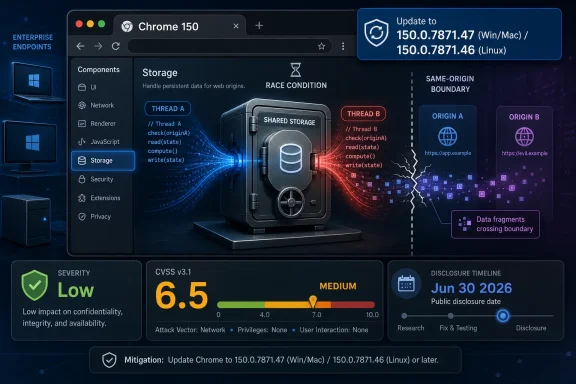 A “Low” Chrome Bug Still Lives in the Browser’s Most Sensitive Contract
Google classified CVE-2026-14082 as Chromium security severity “Low,” and that matters. It means this is not being presented as a drive-by remote code execution flaw, not a sandbox escape, and not a known exploited zero-day. CISA-ADP’s enrichment gives it a CVSS 3.1 score of 6.5, or “Medium,” because the confidentiality impact is high while integrity and availability are not affected.That split is the story. Chromium’s severity label is about exploitability and impact in the browser’s own triage language; CVSS is a standardized scoring model that rewards certain outcomes, such as information disclosure, even when the path requires user interaction. A bug can be operationally less urgent than a critical memory corruption flaw and still be materially important to anyone who handles browser session data, enterprise web apps, identity portals, or regulated information.
The phrase “leak cross-origin data” should get administrators’ attention because the same-origin policy is one of the web’s foundational security boundaries. The browser is supposed to prevent one site from casually reading another site’s data. When a crafted page can exploit a race in Storage to pierce that boundary, the concern is not that the machine falls over; it is that the browser may reveal something it was specifically designed to keep isolated.
Chrome 150 Arrived as a Security Bulk Shipment
Google’s June 30 Stable Channel Update promoted Chrome 150 to stable for Windows, Mac, and Linux. The update shipped as 150.0.7871.46 on Linux and 150.0.7871.46/.47 on Windows and Mac, with Google saying rollout would happen over the coming days and weeks. Buried inside that release was a huge security payload: 433 security fixes.That scale changes how individual CVEs should be read. CVE-2026-14082 is one item in a very large patch train, not a standalone emergency advisory. It appears in Google’s release notes among the “Low” severity issues, reported by Google on May 14, 2026, with the underlying Chromium issue kept behind access controls until enough users receive the fix.
Google’s restriction of bug details is normal for Chrome. The company routinely withholds technical specifics when a vulnerability is newly fixed, partly to avoid handing attackers a recipe before the installed base has moved forward. For defenders, that creates an awkward gap: enough information to know the class of risk, not enough to model the exploit in detail.
That is why the practical answer is boring but correct. If Chrome is below 150.0.7871.47 on Windows or Mac, or below the corresponding 150.0.7871.46 Linux build, treat it as vulnerable and update. If an enterprise runs Chromium-based browsers that lag upstream, the same question should be asked of those vendors’ update channels as soon as possible.
The Race Condition Is the Mechanism; Cross-Origin Leakage Is the Consequence
The weakness associated with the CVE is CWE-362, “Concurrent Execution using Shared Resource with Improper Synchronization,” better known as a race condition. In plain English, two pieces of code may access or modify shared state in an order the browser did not safely control. In browser storage, that can become security-relevant because state is not just a performance detail; it is part of how websites, sessions, permissions, and origins are separated.The public description does not say whether the affected Storage behavior involves localStorage, sessionStorage, IndexedDB, Cache Storage, quota handling, partitioning, or another internal storage path. That is not unusual at this stage. “Storage” in Chromium is a broad component, and the bug tracker entry is permission-restricted, meaning outsiders should resist the temptation to over-specify the vulnerable primitive.
What we can say is that the attacker model is remote and web-delivered. The CVE description says a crafted HTML page could trigger the leak. CISA-ADP’s vector requires user interaction, which usually means the victim must visit or otherwise engage with attacker-controlled content rather than being compromised entirely passively.
That user-interaction requirement lowers the ceiling but does not remove the risk. Modern phishing, malvertising, compromised legitimate sites, and business-email lures all exist to get users onto attacker-controlled pages. A bug that needs a page view is still a browser bug, and browser bugs are unusually reachable.
The Severity Labels Tell Two Different Truths
The most confusing part of CVE-2026-14082 is the gap between Google’s “Low” severity and CISA-ADP’s 6.5 “Medium” CVSS score. This is not necessarily a contradiction. It is two scoring systems emphasizing different questions.Google’s Chromium severity rating is tied to the project’s internal view of browser security impact and exploitability. A low-rated issue might be difficult to exploit reliably, limited in scope, dependent on timing, or mitigated by other browser architecture. In the world of Chrome triage, low severity also places it below the parade of use-after-free, type confusion, sandbox escape, and critical memory safety issues that dominate security releases.
CVSS, by contrast, is more mechanical. CISA-ADP’s vector says the attack is network reachable, has low attack complexity, requires no privileges, requires user interaction, has unchanged scope, and can have high confidentiality impact. That combination produces a medium score even without code execution, integrity impact, or availability impact.
For WindowsForum readers, the right interpretation is: do not treat this like an active zero-day, but do not dismiss it because the Chromium label says low. The affected security boundary is meaningful. The fix is already available. The cost of patching Chrome is far lower than the cost of explaining why a browser known to leak cross-origin data was left unpatched.
NVD’s CPE Confusion Is a Symptom of a Messy Vulnerability Supply Chain
The NVD entry is also notable for its metadata churn. The change history shows the CVE was received from Chrome on June 30, then modified by CISA-ADP on July 1 with CVSS, SSVC, and CWE information, and later touched by NIST initial analysis. The entry also shows an affected CPE configuration for Google Chrome versions up to, but excluding, 150.0.7871.47.The “Are we missing a CPE here?” prompt on NVD pages often looks like bureaucratic boilerplate, but it points to a real problem. Chrome is both a product and an upstream engine for a wider browser ecosystem. Microsoft Edge, Brave, Vivaldi, Opera, Electron applications, embedded Chromium runtimes, and Linux distribution Chromium packages all depend in varying ways on Chromium code, but their vulnerability records and patch timing do not always map neatly onto Google Chrome’s CPE.
That does not mean every Chromium-based product is automatically vulnerable in the same way at the same time. Vendors may carry different patch sets, ship different configurations, disable certain features, or pick up the fix under a different version number. But it does mean asset managers who only search for
google:chrome can miss adjacent exposure.This is where vulnerability management often becomes less about the CVE itself and more about inventory quality. If your environment knows where Chrome is installed but not where Chromium is embedded, you have a partial answer. The CPE line can tell scanners what to flag; it cannot tell administrators whether every browser engine on the network has moved beyond the flawed code path.
Windows Admins Should Watch Edge Without Assuming Chrome’s Version Number Applies
For Windows shops, the immediate reflex is to ask about Microsoft Edge. Edge is Chromium-based, but it has its own release pipeline, versioning, enterprise policies, and security advisories. Google Chrome 150.0.7871.47 is not an Edge version, and administrators should not pretend the numbers line up.The better practice is to track Edge’s own stable channel release notes and Microsoft security update guidance while recognizing that Chromium security fixes often flow downstream. A Chromium Storage race fixed in Chrome is a signal to check Edge, not proof that Edge is currently exposed in the same form. That distinction matters in reporting, ticketing, and compliance evidence.
Enterprise admins also need to account for Chrome’s staggered rollout. Google says stable updates roll out over days or weeks, which is fine for consumer convenience but not always acceptable for managed fleets. Organizations with browser management tooling should verify the installed version rather than assume auto-update has completed.
On Windows, that means checking Chrome’s About page, enterprise reporting, software inventory, endpoint management dashboards, or registry/software inventory data depending on the toolchain. The important threshold is simple: Chrome before 150.0.7871.47 should be considered behind this fix on Windows and Mac. Linux environments should look for 150.0.7871.46 or the distribution’s patched equivalent.
Browser Storage Has Become Identity Infrastructure by Accident
A decade ago, a browser storage bug might have sounded like a nuisance. Today it sits uncomfortably close to authentication, session continuity, app state, and privacy boundaries. Web applications store tokens, cache data, preserve state across reloads, and coordinate identity flows in ways users rarely understand.That does not mean CVE-2026-14082 automatically leaks passwords or session cookies. The public record does not support that claim. But cross-origin data leakage is dangerous precisely because the details matter: what can be read, when it can be read, how reliably it can be read, and whether the attacker can target high-value origins.
Storage bugs also intersect with a larger trend in browser security. The browser has become the operating system for enterprise workflows, and origins have become something like process boundaries. When those boundaries are weakened, the blast radius is no longer just “a weird website bug.” It can become exposure inside SaaS applications, internal portals, identity providers, customer support tools, and administrative dashboards.
That is why confidentiality-only browser flaws should not be treated as second-class vulnerabilities. Attackers do not always need code execution if they can read the right data at the right time. For espionage, fraud, account takeover, or session riding, information disclosure can be enough.
The Absence of Known Exploitation Is Reassuring, Not Exculpatory
CISA-ADP’s SSVC data lists exploitation as “none,” automatable as “no,” and technical impact as “partial.” That is useful. It suggests there is no public signal, at least in the enrichment record, that this flaw is being exploited in the wild. It also suggests the vulnerability may not be trivially weaponized at scale.But “not known exploited” is not the same as “not exploitable.” Browser bugs often become more dangerous after patch release because attackers can study diffs, infer the vulnerable path, and build proof-of-concept exploits against users who lag behind. Google’s restricted issue access slows that process but does not stop it forever.
The timing also matters. The CVE was published June 30 and modified July 1, 2026. As of July 3, the most important operational window is the rollout lag: machines that have not restarted Chrome, devices pinned to old versions, VDI images, kiosks, test benches, and unmanaged endpoints.
For consumers, opening Chrome’s About page and relaunching when prompted is usually enough. For businesses, the harder work is proving it happened everywhere.
Patch Management Is the Real Security Boundary Users Can Control
Users cannot meaningfully inspect Chromium’s Storage implementation. They cannot audit race conditions in browser internals. They cannot see whether a page is attempting to trigger a timing bug. The control they actually have is version currency.That reality makes browser patching less glamorous than detection engineering but more reliable. A patched browser removes the vulnerable code path. A detection rule must guess what exploitation looks like, often without technical details, and race-condition exploitation may not leave clean network or endpoint indicators.
Enterprises should avoid overfitting their response to CVE-2026-14082 alone. The June 30 Chrome 150 update includes hundreds of security fixes, including critical and high-severity vulnerabilities elsewhere in the browser. Even if this particular Storage race is low severity in Chromium’s taxonomy, the release as a whole deserves routine priority.
The correct patch posture is therefore not “emergency all-hands” but “do not wait for the monthly desktop maintenance window.” Browsers are internet-facing applications with near-constant attacker attention. They should be patched on a cadence closer to endpoint security tools than to office productivity add-ins.
Scanner Output Will Lag Behind the Browser Reality
One practical problem is that vulnerability scanners often depend on NVD enrichment, CPE mappings, vendor advisories, and plugin updates. During the first days after a Chrome release, these systems can disagree. NVD may not yet have a NIST CVSS score. CISA-ADP may have added one. Vendor plugins may key off different version thresholds.That is not a reason to distrust scanners; it is a reason not to outsource judgment to them. If Google says Chrome prior to 150.0.7871.47 is affected, that is the operational threshold for Chrome on Windows and Mac. If the scanner has not caught up, administrators can still query installed browser versions directly.
The CPE entry matters because it helps automate vulnerability detection at scale. But it is only one representation of the affected product. The more important truth is in the vendor release: Chrome 150 stable includes the fix, and prior versions fall below the fixed threshold.
Admins should also remember that browser processes can persist after an update is downloaded. Chrome commonly requires a relaunch to complete the update. A machine may have the update staged while users continue running the old vulnerable binary for days if they never close the browser.
The Web’s Origin Model Keeps Taking Body Blows
CVE-2026-14082 belongs to a class of bugs that are easy to underrate because they do not sound dramatic. There is no “remote code execution” phrase. There is no “actively exploited” warning. There is no named ransomware campaign or public exploit kit.Yet the affected concept is the same one that keeps web apps from devouring each other. The same-origin policy, storage partitioning, site isolation, and related browser controls are the quiet machinery that allow users to keep banking tabs, work dashboards, chat apps, cloud consoles, and random search results open in the same browser.
When that machinery fails, the browser stops being a neutral container and becomes a possible mixing chamber for data that should have stayed separate. The impact depends on the exact bug, and for CVE-2026-14082 the public details are sparse. Still, the class of failure is not trivial.
This is especially relevant for administrators who rely on browser-based admin consoles. Cloud IAM, Microsoft 365 admin centers, Azure portals, Google Workspace consoles, password vault web UIs, EDR dashboards, firewall management pages, and SaaS support tools all live inside the same browser architecture as ordinary web browsing. The security of those sessions depends heavily on origin boundaries holding.
Chrome’s Disclosure Style Gives Defenders Just Enough to Act
Google’s Chrome release notes are deliberately terse. They name the CVE, the component, the severity, the reporter, and sometimes the reward. They generally do not provide exploit narratives until the update has propagated. Security teams sometimes find this frustrating, but the alternative can be worse: publishing enough detail to accelerate attacks against unpatched users.For CVE-2026-14082, the terse disclosure is sufficient for patching but insufficient for nuanced detection. We know the affected product, fixed version, vulnerability class, likely user-interaction requirement, and confidentiality impact. We do not know the specific storage API, exploitation constraints, data types at risk, or reliability.
That uncertainty should shape the response. Do not write incident reports claiming observed compromise unless you have evidence. Do not claim the bug leaks cookies or passwords unless Google or another credible technical source confirms it. Do not dismiss it because it is “only low,” either.
Good security operations live in that middle ground. Patch based on vendor thresholds, monitor for relevant threat intelligence, and avoid inventing details that the public record does not support.
The Quiet Risk Is the Fleet You Forgot
The easiest Chrome installations to patch are the ones users stare at all day. The harder ones are on shared workstations, lab machines, digital signage players, build systems, jump boxes, kiosk terminals, training-room PCs, old VDI templates, and secondary user profiles. Those are the devices that turn a low-severity browser issue into a long-tail exposure.There is also a policy dimension. Some organizations delay browser updates because web apps are fragile. Others pin versions because extensions or line-of-business tools break. Chrome 150 is already causing discussion among users over extension behavior and other compatibility concerns, which means some admins may be tempted to slow deployment.
That temptation is understandable but risky. The same update that changes behavior also carries a large security bundle. If a business must delay Chrome 150 for compatibility reasons, it should do so deliberately, with compensating controls and a clear patch deadline, not by accident.
For most environments, the best answer is staged acceleration: test quickly, push broadly, verify completion, and keep an exception list short. Browser exceptions should expire, not become permanent.
The Chrome 150 Storage Fix Leaves a Simple Trail for Administrators
The operational checklist here is not exotic. Check Chrome versions, push the update, force relaunch where policy allows, and confirm that managed endpoints have crossed the fixed-version threshold. Then repeat the same reasoning for Chromium-derived products according to their vendors’ advisories.For Windows users, Chrome’s built-in updater is usually fast, but it is not magic. If Chrome is open indefinitely, the new binary may not take effect until relaunch. If update services are disabled, blocked, misconfigured, or governed by enterprise policy, the browser can remain stale while appearing normal to the user.
Security teams should also align vulnerability tickets with real-world risk. CVE-2026-14082 alone is not the same priority as a known exploited critical bug, but the Chrome 150 update package is broad enough that delaying it creates exposure to many fixed flaws, not just this one. In patch meetings, that distinction is persuasive: this is not a one-CVE decision.
The threshold language should be explicit. On Windows and Mac, Chrome should be at 150.0.7871.47 or later. On Linux, Google’s stable release line identifies 150.0.7871.46 as the fixed Chrome 150 build, with distribution packages needing their own verification.
The Storage Race Is Small; the Browser Governance Lesson Is Not
The concrete facts are straightforward, but the governance lesson is broader. CVE-2026-14082 shows why browser updates deserve the same operational respect as operating system patches. The browser is now where identity, data, and daily work meet the public internet.- Chrome users on Windows and Mac should verify they are running 150.0.7871.47 or later to receive the fix for CVE-2026-14082.
- Linux users should verify they are on Google’s fixed 150.0.7871.46 build or an equivalent patched distribution package.
- The vulnerability is a race condition in Chromium’s Storage component that could leak cross-origin data through a crafted HTML page.
- Google rates the issue Low, while CISA-ADP scores it Medium at CVSS 6.5 because confidentiality impact is high.
- There is no public indication in the enrichment record that the flaw is being exploited in the wild, but unpatched browsers remain unnecessarily exposed.
- Administrators should check Chromium-based browsers and embedded runtimes separately rather than assuming Chrome’s CPE fully describes their environment.
References
- Primary source: NVD / Chromium
Published: 2026-07-03T07:00:53-07:00
NVD - CVE-2026-14082
 nvd.nist.gov
- Security advisory: MSRC
Published: 2026-07-03T07:00:53-07:00
Original feed URL
Security Update Guide - Microsoft Security Response Center
 msrc.microsoft.com
