

Google Chrome fixed CVE-2026-14093 in the June 30, 2026 Chrome 150 stable desktop release for Windows, macOS, and Linux, closing a Cast use-after-free flaw that could let an attacker escape the browser sandbox after first compromising the renderer process. The oddity is not that Chrome had another memory-safety bug; that is the cost of operating the world’s most important browser engine at planetary scale. The oddity is the gap between Chromium’s own “Low” severity label and CISA’s enrichment data assigning a 9.6 Critical CVSS score. For administrators, that mismatch is the real story: the patch is straightforward, but the risk language around it is not.
As documented by the National Vulnerability Database and Google’s Chrome Releases blog, CVE-2026-14093 affects Google Chrome before 150.0.7871.47 and sits in the browser’s Cast component. Google’s June 30 stable-channel post says Chrome 150 moved to stable on Windows, Mac, and Linux, with Windows and macOS receiving 150.0.7871.46/.47 and Linux receiving 150.0.7871.46. The NVD entry, published the same day and modified on July 1, identifies the bug as a use-after-free condition that requires a compromised renderer and a crafted HTML page to potentially perform a sandbox escape.
That distinction matters. This is not a clean “visit a page and instantly lose the box” description. It is a second-stage browser escape primitive: dangerous when paired with a renderer compromise, less obviously catastrophic when viewed in isolation, and exactly the sort of vulnerability that makes severity scoring feel more like argument than arithmetic.
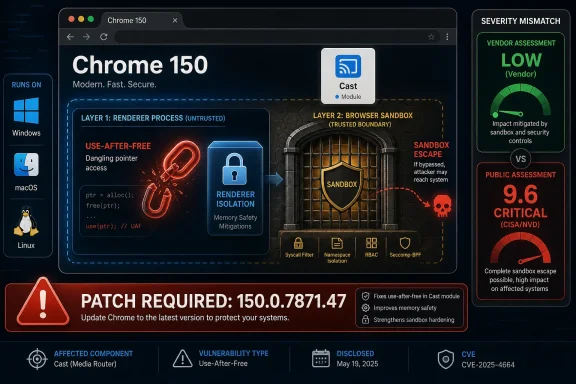
Chrome’s own language describes CVE-2026-14093 as a low-severity Chromium security issue, but the NVD page shows CISA-ADP assigning a CVSS 3.1 score of 9.6 Critical. That is a jarring spread, and it will produce predictable confusion in dashboards, ticket queues, and patch-priority meetings.
The reason is baked into the exploit chain. A sandbox escape is not usually the first step in a browser attack. Modern Chrome assumes the web is hostile and tries to trap renderer compromise inside a restricted process. If an attacker already has code execution in that renderer, a sandbox escape turns a contained browser incident into something much closer to host compromise.
Chrome’s label appears to weigh the precondition heavily: the attacker must first compromise the renderer. CISA’s CVSS vector, by contrast, models the postcondition aggressively: network attack vector, low attack complexity, no privileges required, user interaction required, changed scope, and high impacts to confidentiality, integrity, and availability. Both views can be internally coherent, but they answer different operational questions.
Google is asking, “How directly exploitable is this bug by itself?” CISA’s enrichment asks, “If this bug is used in the intended attack chain, how bad can it get?” Security teams need both answers, and they need to stop pretending one number can replace judgment.
That is why administrators should be careful about dismissing this as irrelevant to office desktops. The vulnerability is in Chrome prior to the fixed version, not merely in households that actively cast video. The practical remediation is still version-based: get Chrome to the patched channel, verify the endpoint actually landed there, and do not try to solve this with user guidance about avoiding casting.
Use-after-free bugs remain one of the browser world’s durable enemies because they turn memory lifetime mistakes into exploitation opportunities. A program frees an object, later touches memory as if that object still exists, and an attacker may be able to shape what now occupies that space. Browser vendors have spent years adding mitigations, allocator hardening, process isolation, and memory-safety workarounds, but C and C++ codebases still leave room for these errors.
In this case, the interesting phrase is “after compromising the renderer process.” Chrome’s renderer sandbox is designed to make renderer compromise less devastating. CVE-2026-14093 is therefore aimed at the barrier behind the barrier, the layer that says even a successful malicious web page should not automatically become a system-level intrusion.
For WindowsForum readers running Windows fleets, the safest operational reading is simple: Windows and macOS systems should be at Chrome 150.0.7871.47 where that build is offered. Linux administrators should check distribution packaging and Google’s Linux channel metadata rather than blindly applying a Windows-specific version expectation. Mixed-platform organizations should not reduce the advisory to a single string without confirming how each platform received the stable update.
The NVD change history adds another wrinkle. On July 1, NIST initially added a CPE configuration showing Chrome versions up to, but excluding, 150.0.7871.46, alongside Windows, Linux kernel, and macOS platform CPEs. The same NVD page’s description and affected-data language point to 150.0.7871.47 as the relevant pre-fix boundary. That is the kind of machine-readable inconsistency that can cause scanners to disagree.
This does not mean the patch is unknowable. It means CPE data is a map, not the territory. The vendor advisory and installed browser version should take precedence when a scanner’s model lags behind a changed CVE record.
When a CVE is modified after enrichment, the downstream systems do not all update at the same speed or interpret the update the same way. One scanner may flag every Chrome below 150.0.7871.47. Another may key off the temporary 150.0.7871.46 boundary. A third may wait for NVD scoring and treat the record as incomplete, while a fourth may ingest CISA’s 9.6 Critical score and light up the dashboard.
That is not merely annoying. It changes behavior. A Critical label can trigger emergency change windows, SLA clocks, customer notifications, or security exceptions. A Low label can be buried beneath ransomware-relevant server flaws. When the same CVE plausibly appears in both buckets, the organization’s process is being tested as much as its patch tooling.
The right response is not to ridicule either score. It is to tag the vulnerability as a browser sandbox-escape candidate with a renderer-compromise precondition, then patch on browser cadence rather than panic cadence. In most managed Chrome environments, that should still mean rapid deployment, because browser updates are designed to move quickly and because Chrome 150 carries many more security fixes than this one CVE.
Chrome 150’s security list includes numerous memory-safety and validation issues across components such as Extensions, GPU, ANGLE, Dawn, WebUSB, Chromoting, Skia, V8, and Chromecast. Some were rated Critical or High by Chromium. Some carried rewards. Some were found internally by Google. The cumulative message is that the stable update is a browser hardening event, not a narrow Cast patch.
For Windows users, the practical advice is unglamorous: let Chrome update, restart the browser, and verify the version. Chrome’s update engine can download fixes silently, but the running browser still needs a restart to complete the transition. In enterprise environments, that restart requirement remains the eternal weak link.
For admins, the more important task is measuring effective update completion. A machine that has downloaded Chrome 150 but has a weeks-old browser process still open is not in the same state as a machine running the fixed build. Browser patch reporting that does not distinguish installed version from running version is optimistic by design.
Browser exploitation is often chained. A malicious page may first exploit a renderer bug to gain code execution in a sandboxed process. That alone is bad, but Chrome’s architecture is designed to limit the blast radius. A sandbox escape is what can turn that contained foothold into broader access to the system, user data, tokens, files, or other processes.
That means second-stage bugs are valuable even when they are not initial-entry vulnerabilities. In mature exploit chains, the first bug opens the door, and the sandbox escape gets the attacker out of the lobby. Treating the second bug as low priority because it needs the first bug is like ignoring a privilege-escalation flaw because it assumes the attacker already has a low-privileged account.
CISA’s SSVC data on the NVD page lists exploitation as “none,” automatable as “no,” and technical impact as “total.” That combination is a useful sanity check. There is no public signal here, based on the NVD record, that CVE-2026-14093 is being exploited in the wild. But if it is used successfully as part of a chain, the impact model is severe.
Microsoft Edge ships through Microsoft’s own release process, not Google’s Chrome channel. Windows admins should therefore check Microsoft Edge security release notes and endpoint inventory rather than assume Edge is patched because Chrome is patched, or vice versa. The same logic applies to Brave, Vivaldi, Opera, and other Chromium derivatives: each vendor must integrate, test, and ship the relevant upstream changes.
Electron is harder. Many desktop apps bundle a Chromium runtime and update on the application vendor’s schedule. A patched system Chrome does not necessarily patch the Chromium embedded inside a chat client, productivity tool, device-management console, or developer utility. Whether CVE-2026-14093 is reachable in those contexts depends on the embedded version, enabled components, sandbox model, and exposed web content.
This is where asset inventory still earns its keep. Knowing “we run Chrome” is not enough. The more accurate question is where Chromium code exists in the environment, which instances render untrusted content, and which vendors have shipped fixed builds.
That does not mean every Chrome sandbox escape becomes a mass exploitation event. Most do not. Many require additional bugs, precise heap shaping, version-specific primitives, or exploit-development effort that only well-resourced attackers will spend. But defenders do not get to know in advance which chain will become commoditized.
The cost curve also favors patching. Updating Chrome is usually less disruptive than patching firmware, VPN appliances, hypervisors, or domain controllers. If an organization cannot move a mainstream browser update quickly, that is a governance problem masquerading as a technical one.
There is also a user-behavior angle. The NVD vector includes user interaction, which in browser terms often means convincing someone to load crafted content. That should not be reassuring. The entire web is a user-interaction machine, and phishing, malvertising, compromised sites, and poisoned search results all exist to deliver attacker-chosen content to real browsers.
If a risk committee sees “Chromium security severity: Low,” it may reasonably ask why the ticket is urgent. If it sees “CVSS 9.6 Critical,” it may demand an emergency response. Neither reaction is irrational, because each is anchored to a real data point. The failure is expecting a single label to carry the exploit preconditions, blast radius, chaining potential, patch availability, and fleet exposure.
A better internal classification would read something like this: Chrome Cast use-after-free, fixed in Chrome 150 stable, requires prior renderer compromise, may enable sandbox escape, no known exploitation in NVD/CISA data at publication time, patch through normal accelerated browser update process. That sentence is less dashboard-friendly than “Critical,” but it is more useful.
Security teams should also resist the temptation to treat “Low” as vendor minimization. Browser vendors score bugs within a specific architecture and threat model. A sandbox escape that requires an initial renderer compromise may be lower severity than a remotely reachable renderer RCE. But for defenders managing exploit chains, the sandbox escape can be the difference between a contained crash and a meaningful endpoint compromise.
Group Policy, Chrome Browser Cloud Management, enterprise software deployment tools, and endpoint management platforms can all help enforce update behavior. But enforcement is only as good as telemetry. Admins need to know which devices are below the fixed build, which browsers are waiting for restart, and which machines have not checked in.
The most common failure mode is the immortal browser session. Users keep dozens of tabs open, laptops sleep instead of rebooting, and Chrome’s relaunch prompt becomes part of the wallpaper. Attackers do not care that the update is staged on disk if the vulnerable process remains live.
This is especially relevant for high-risk user groups: help desks, finance teams, executives, developers, administrators, and anyone routinely handling untrusted links or documents. If a browser sandbox escape is ever paired with a renderer exploit, those are the users whose tokens and local access may matter most.
The change history shows the record arriving from Chrome on June 30, then receiving CISA-ADP additions on July 1, then NIST analysis adding CPE configuration and reference types, followed by another CISA-ADP modification. That is a normal life cycle for a fresh CVE, but normal does not mean stable.
For organizations that auto-generate tickets from NVD data, this raises a process question. What happens when the CVSS score arrives after the ticket? What happens when CPE bounds shift? What happens when a vendor advisory and NVD configuration disagree? If the answer is “we hope the scanner sorts it out,” the organization is outsourcing judgment to a parser.
The fix is not to abandon automation. It is to build review points for high-impact browser, VPN, identity, hypervisor, and kernel CVEs, especially when they involve privilege escalation or sandbox escape. Automation should collect the evidence; humans should interpret the contradictions.
Google has invested heavily in sandboxing, site isolation, fuzzing, exploit mitigations, MiraclePtr-style approaches, and memory-safety work. Those efforts matter. They have raised the cost of exploitation dramatically compared with the browser landscape of a decade ago.
But the vulnerability feed keeps showing the same bug classes. Use-after-free, type confusion, heap buffer overflow, out-of-bounds read and write, insufficient validation — these are not exotic failures. They are recurring symptoms of a platform that moves fast, supports enormous legacy and compatibility demands, and still relies on code where memory lifetime is a security boundary.
That does not make Chrome uniquely negligent. It makes Chrome uniquely visible. The same Chromium foundation powers a huge share of desktop browsing, mobile web views, embedded runtimes, and application shells. When Chromium fixes a bug, the rest of the ecosystem has to catch up.
As documented by the National Vulnerability Database and Google’s Chrome Releases blog, CVE-2026-14093 affects Google Chrome before 150.0.7871.47 and sits in the browser’s Cast component. Google’s June 30 stable-channel post says Chrome 150 moved to stable on Windows, Mac, and Linux, with Windows and macOS receiving 150.0.7871.46/.47 and Linux receiving 150.0.7871.46. The NVD entry, published the same day and modified on July 1, identifies the bug as a use-after-free condition that requires a compromised renderer and a crafted HTML page to potentially perform a sandbox escape.
That distinction matters. This is not a clean “visit a page and instantly lose the box” description. It is a second-stage browser escape primitive: dangerous when paired with a renderer compromise, less obviously catastrophic when viewed in isolation, and exactly the sort of vulnerability that makes severity scoring feel more like argument than arithmetic.
 The “Low” Chrome Bug That Reads Like a Critical One
Chrome’s own language describes CVE-2026-14093 as a low-severity Chromium security issue, but the NVD page shows CISA-ADP assigning a CVSS 3.1 score of 9.6 Critical. That is a jarring spread, and it will produce predictable confusion in dashboards, ticket queues, and patch-priority meetings.The reason is baked into the exploit chain. A sandbox escape is not usually the first step in a browser attack. Modern Chrome assumes the web is hostile and tries to trap renderer compromise inside a restricted process. If an attacker already has code execution in that renderer, a sandbox escape turns a contained browser incident into something much closer to host compromise.
Chrome’s label appears to weigh the precondition heavily: the attacker must first compromise the renderer. CISA’s CVSS vector, by contrast, models the postcondition aggressively: network attack vector, low attack complexity, no privileges required, user interaction required, changed scope, and high impacts to confidentiality, integrity, and availability. Both views can be internally coherent, but they answer different operational questions.
Google is asking, “How directly exploitable is this bug by itself?” CISA’s enrichment asks, “If this bug is used in the intended attack chain, how bad can it get?” Security teams need both answers, and they need to stop pretending one number can replace judgment.
Cast Is Not Just a Living-Room Feature Anymore
The word “Cast” makes the bug sound consumer-grade, like something confined to streaming a tab to a television. That undersells the reach of Chromium’s component architecture. Cast-related code can sit inside desktop Chrome builds even on machines that never touch a Chromecast, because browser features are bundled, integrated, and exposed through broad subsystems rather than shipped as neat little detachable modules.That is why administrators should be careful about dismissing this as irrelevant to office desktops. The vulnerability is in Chrome prior to the fixed version, not merely in households that actively cast video. The practical remediation is still version-based: get Chrome to the patched channel, verify the endpoint actually landed there, and do not try to solve this with user guidance about avoiding casting.
Use-after-free bugs remain one of the browser world’s durable enemies because they turn memory lifetime mistakes into exploitation opportunities. A program frees an object, later touches memory as if that object still exists, and an attacker may be able to shape what now occupies that space. Browser vendors have spent years adding mitigations, allocator hardening, process isolation, and memory-safety workarounds, but C and C++ codebases still leave room for these errors.
In this case, the interesting phrase is “after compromising the renderer process.” Chrome’s renderer sandbox is designed to make renderer compromise less devastating. CVE-2026-14093 is therefore aimed at the barrier behind the barrier, the layer that says even a successful malicious web page should not automatically become a system-level intrusion.
The Version Number Tells Admins What the Score Cannot
The NVD entry says Chrome prior to 150.0.7871.47 is affected, while Google’s stable-channel post lists Chrome 150.0.7871.46 for Linux and 150.0.7871.46/.47 for Windows and Mac. That discrepancy is not unusual in Chrome release mechanics, but it is exactly the sort of detail that makes vulnerability management brittle.For WindowsForum readers running Windows fleets, the safest operational reading is simple: Windows and macOS systems should be at Chrome 150.0.7871.47 where that build is offered. Linux administrators should check distribution packaging and Google’s Linux channel metadata rather than blindly applying a Windows-specific version expectation. Mixed-platform organizations should not reduce the advisory to a single string without confirming how each platform received the stable update.
The NVD change history adds another wrinkle. On July 1, NIST initially added a CPE configuration showing Chrome versions up to, but excluding, 150.0.7871.46, alongside Windows, Linux kernel, and macOS platform CPEs. The same NVD page’s description and affected-data language point to 150.0.7871.47 as the relevant pre-fix boundary. That is the kind of machine-readable inconsistency that can cause scanners to disagree.
This does not mean the patch is unknowable. It means CPE data is a map, not the territory. The vendor advisory and installed browser version should take precedence when a scanner’s model lags behind a changed CVE record.
CPE Drift Is Now a First-Class Security Problem
The user-facing line on the NVD page — “Are we missing a CPE here?” — is easy to ignore, but it captures a real problem. Vulnerability databases are no longer just reference libraries. They feed scanners, asset inventories, compliance dashboards, cyber-insurance questionnaires, procurement gates, and executive risk reports.When a CVE is modified after enrichment, the downstream systems do not all update at the same speed or interpret the update the same way. One scanner may flag every Chrome below 150.0.7871.47. Another may key off the temporary 150.0.7871.46 boundary. A third may wait for NVD scoring and treat the record as incomplete, while a fourth may ingest CISA’s 9.6 Critical score and light up the dashboard.
That is not merely annoying. It changes behavior. A Critical label can trigger emergency change windows, SLA clocks, customer notifications, or security exceptions. A Low label can be buried beneath ransomware-relevant server flaws. When the same CVE plausibly appears in both buckets, the organization’s process is being tested as much as its patch tooling.
The right response is not to ridicule either score. It is to tag the vulnerability as a browser sandbox-escape candidate with a renderer-compromise precondition, then patch on browser cadence rather than panic cadence. In most managed Chrome environments, that should still mean rapid deployment, because browser updates are designed to move quickly and because Chrome 150 carries many more security fixes than this one CVE.
Chrome 150 Was a Security Train, Not a Single-Bug Hotfix
Google’s Chrome Releases blog says this stable update includes hundreds of security fixes. CVE-2026-14093 is one named carriage in a long train, not the entire train. That matters because organizations often overfit their response to the one CVE that made it into a ticket subject line.Chrome 150’s security list includes numerous memory-safety and validation issues across components such as Extensions, GPU, ANGLE, Dawn, WebUSB, Chromoting, Skia, V8, and Chromecast. Some were rated Critical or High by Chromium. Some carried rewards. Some were found internally by Google. The cumulative message is that the stable update is a browser hardening event, not a narrow Cast patch.
For Windows users, the practical advice is unglamorous: let Chrome update, restart the browser, and verify the version. Chrome’s update engine can download fixes silently, but the running browser still needs a restart to complete the transition. In enterprise environments, that restart requirement remains the eternal weak link.
For admins, the more important task is measuring effective update completion. A machine that has downloaded Chrome 150 but has a weeks-old browser process still open is not in the same state as a machine running the fixed build. Browser patch reporting that does not distinguish installed version from running version is optimistic by design.
The Renderer Precondition Is a Warning, Not a Comfort Blanket
Some readers will look at the phrase “who had compromised the renderer process” and decide CVE-2026-14093 is only relevant after another bug has already won. That is technically true and strategically dangerous.Browser exploitation is often chained. A malicious page may first exploit a renderer bug to gain code execution in a sandboxed process. That alone is bad, but Chrome’s architecture is designed to limit the blast radius. A sandbox escape is what can turn that contained foothold into broader access to the system, user data, tokens, files, or other processes.
That means second-stage bugs are valuable even when they are not initial-entry vulnerabilities. In mature exploit chains, the first bug opens the door, and the sandbox escape gets the attacker out of the lobby. Treating the second bug as low priority because it needs the first bug is like ignoring a privilege-escalation flaw because it assumes the attacker already has a low-privileged account.
CISA’s SSVC data on the NVD page lists exploitation as “none,” automatable as “no,” and technical impact as “total.” That combination is a useful sanity check. There is no public signal here, based on the NVD record, that CVE-2026-14093 is being exploited in the wild. But if it is used successfully as part of a chain, the impact model is severe.
Edge, Electron, and the Chromium Shadow
A Chrome CVE is rarely only a Chrome story. Chromium is the engine family underneath Microsoft Edge, many embedded browsers, and a large portion of the Electron application universe. That does not mean CVE-2026-14093 automatically affects every Chromium-based product in the same way, but it does mean administrators should widen their audit lens.Microsoft Edge ships through Microsoft’s own release process, not Google’s Chrome channel. Windows admins should therefore check Microsoft Edge security release notes and endpoint inventory rather than assume Edge is patched because Chrome is patched, or vice versa. The same logic applies to Brave, Vivaldi, Opera, and other Chromium derivatives: each vendor must integrate, test, and ship the relevant upstream changes.
Electron is harder. Many desktop apps bundle a Chromium runtime and update on the application vendor’s schedule. A patched system Chrome does not necessarily patch the Chromium embedded inside a chat client, productivity tool, device-management console, or developer utility. Whether CVE-2026-14093 is reachable in those contexts depends on the embedded version, enabled components, sandbox model, and exposed web content.
This is where asset inventory still earns its keep. Knowing “we run Chrome” is not enough. The more accurate question is where Chromium code exists in the environment, which instances render untrusted content, and which vendors have shipped fixed builds.
Why Windows Shops Should Care Even Without a Known Exploit
Windows endpoints remain prime targets for browser-based intrusion because the browser is where user trust, identity, document workflows, SaaS access, and endpoint persistence all intersect. A sandbox escape in a browser engine is not just a browser bug; it is a potential bridge from web content to the desktop operating environment.That does not mean every Chrome sandbox escape becomes a mass exploitation event. Most do not. Many require additional bugs, precise heap shaping, version-specific primitives, or exploit-development effort that only well-resourced attackers will spend. But defenders do not get to know in advance which chain will become commoditized.
The cost curve also favors patching. Updating Chrome is usually less disruptive than patching firmware, VPN appliances, hypervisors, or domain controllers. If an organization cannot move a mainstream browser update quickly, that is a governance problem masquerading as a technical one.
There is also a user-behavior angle. The NVD vector includes user interaction, which in browser terms often means convincing someone to load crafted content. That should not be reassuring. The entire web is a user-interaction machine, and phishing, malvertising, compromised sites, and poisoned search results all exist to deliver attacker-chosen content to real browsers.
Severity Inflation Meets Real Risk
The security industry has a severity problem. Too many things are Critical, and too many genuinely dangerous chains are hidden behind component-level nuance. CVE-2026-14093 lands right in the middle of that dysfunction.If a risk committee sees “Chromium security severity: Low,” it may reasonably ask why the ticket is urgent. If it sees “CVSS 9.6 Critical,” it may demand an emergency response. Neither reaction is irrational, because each is anchored to a real data point. The failure is expecting a single label to carry the exploit preconditions, blast radius, chaining potential, patch availability, and fleet exposure.
A better internal classification would read something like this: Chrome Cast use-after-free, fixed in Chrome 150 stable, requires prior renderer compromise, may enable sandbox escape, no known exploitation in NVD/CISA data at publication time, patch through normal accelerated browser update process. That sentence is less dashboard-friendly than “Critical,” but it is more useful.
Security teams should also resist the temptation to treat “Low” as vendor minimization. Browser vendors score bugs within a specific architecture and threat model. A sandbox escape that requires an initial renderer compromise may be lower severity than a remotely reachable renderer RCE. But for defenders managing exploit chains, the sandbox escape can be the difference between a contained crash and a meaningful endpoint compromise.
The Patch Is Easy; The Verification Is the Work
On unmanaged home systems, the fix path is simple: open Chrome’s About page, let it update, and restart the browser. On managed Windows systems, the work is less about obtaining the patch and more about proving it landed everywhere that matters.Group Policy, Chrome Browser Cloud Management, enterprise software deployment tools, and endpoint management platforms can all help enforce update behavior. But enforcement is only as good as telemetry. Admins need to know which devices are below the fixed build, which browsers are waiting for restart, and which machines have not checked in.
The most common failure mode is the immortal browser session. Users keep dozens of tabs open, laptops sleep instead of rebooting, and Chrome’s relaunch prompt becomes part of the wallpaper. Attackers do not care that the update is staged on disk if the vulnerable process remains live.
This is especially relevant for high-risk user groups: help desks, finance teams, executives, developers, administrators, and anyone routinely handling untrusted links or documents. If a browser sandbox escape is ever paired with a renderer exploit, those are the users whose tokens and local access may matter most.
The NVD Record Is Also a Warning About Automation
The CVE record’s “Modified After Enrichment” banner should not be treated as bureaucratic noise. It is a reminder that vulnerability intelligence is a moving dataset. Automated enrichment is useful, but it is not final truth.The change history shows the record arriving from Chrome on June 30, then receiving CISA-ADP additions on July 1, then NIST analysis adding CPE configuration and reference types, followed by another CISA-ADP modification. That is a normal life cycle for a fresh CVE, but normal does not mean stable.
For organizations that auto-generate tickets from NVD data, this raises a process question. What happens when the CVSS score arrives after the ticket? What happens when CPE bounds shift? What happens when a vendor advisory and NVD configuration disagree? If the answer is “we hope the scanner sorts it out,” the organization is outsourcing judgment to a parser.
The fix is not to abandon automation. It is to build review points for high-impact browser, VPN, identity, hypervisor, and kernel CVEs, especially when they involve privilege escalation or sandbox escape. Automation should collect the evidence; humans should interpret the contradictions.
Chrome’s Memory-Safety Bill Keeps Coming Due
CVE-2026-14093 is also part of a longer-running story: the web platform remains heavily dependent on memory-unsafe languages, and the attack surface keeps expanding. Casting, GPU acceleration, media pipelines, USB, Bluetooth, graphics translation layers, web app installation, and browser extensions all stretch the boundary of what a “web browser” is.Google has invested heavily in sandboxing, site isolation, fuzzing, exploit mitigations, MiraclePtr-style approaches, and memory-safety work. Those efforts matter. They have raised the cost of exploitation dramatically compared with the browser landscape of a decade ago.
But the vulnerability feed keeps showing the same bug classes. Use-after-free, type confusion, heap buffer overflow, out-of-bounds read and write, insufficient validation — these are not exotic failures. They are recurring symptoms of a platform that moves fast, supports enormous legacy and compatibility demands, and still relies on code where memory lifetime is a security boundary.
That does not make Chrome uniquely negligent. It makes Chrome uniquely visible. The same Chromium foundation powers a huge share of desktop browsing, mobile web views, embedded runtimes, and application shells. When Chromium fixes a bug, the rest of the ecosystem has to catch up.
The Practical Read for WindowsForum Readers
CVE-2026-14093 is not a reason to panic, but it is a reason to make sure Chrome 150 actually crossed the finish line on your systems. The best response is disciplined, boring, and measurable.- Chrome users on Windows and macOS should verify that they are running the fixed 150.0.7871.47 build where available, not merely that Chrome downloaded an update in the background.
- Linux users should confirm their distribution or Google Chrome package version against the vendor’s channel metadata, because the Chrome release post lists Linux differently from the NVD affected-version language.
- Enterprise administrators should treat the bug as a sandbox-escape risk with a renderer-compromise precondition, not as either a standalone instant-compromise flaw or a harmless low-severity footnote.
- Scanner output should be checked against Google’s advisory and the live installed version, because the NVD record shows post-enrichment changes and potentially confusing CPE version boundaries.
- Chromium-based browsers and Electron applications should be reviewed separately, since Google Chrome’s update mechanism does not patch every Chromium runtime on a Windows endpoint.
- Restart compliance matters, because a staged browser update does not protect users who continue running an old vulnerable process.
References
- Primary source: NVD / Chromium
Published: 2026-07-03T07:00:21-07:00
NVD - CVE-2026-14093
 nvd.nist.gov
- Security advisory: MSRC
Published: 2026-07-03T07:00:21-07:00
Original feed URL
Security Update Guide - Microsoft Security Response Center
 msrc.microsoft.com
- Related coverage: cvefeed.io
CVE-2026-14093 - Chromium Use-After-Free Sandbox Escape
Use after free in Cast in Google Chrome prior to 150.0.7871.47 allowed a remote attacker who had compromised the renderer process to potentially perform a sandbox escape via a crafted HTML page. (Chromium security severity: Low)cvefeed.io
