

Google Chrome versions before 150.0.7871.46 are affected by CVE-2026-14414, a medium-severity Skia input-validation flaw. The confirmed security outcome is potential disclosure of sensitive information from process memory, but only after an attacker has already compromised Chrome’s renderer and persuaded the user to encounter crafted HTML content.Answer first
- Affected: Google Chrome versions below 150.0.7871.46
- Remediation: In Chrome, select ⋮ > Help > About Google Chrome, allow the update to complete, click Relaunch, and confirm the displayed version is 150.0.7871.46 or later
- Confirmed impact: An attacker who has already compromised Chrome’s renderer may use crafted HTML to obtain potentially sensitive information from process memory
- Known exploitation: None is recorded in the supplied CISA-ADP SSVC data
Google fixed the vulnerability at the 150.0.7871.46 version threshold. For Windows users and administrators, the response is therefore direct: update Chrome, relaunch it, and verify that the browser reports version 150.0.7871.46 or later.
The supplied public record does not describe CVE-2026-14414 as a complete browser or system compromise. It also does not record known exploitation. Those limits are important, but they do not change the remediation: installations below the fixed threshold should be updated.
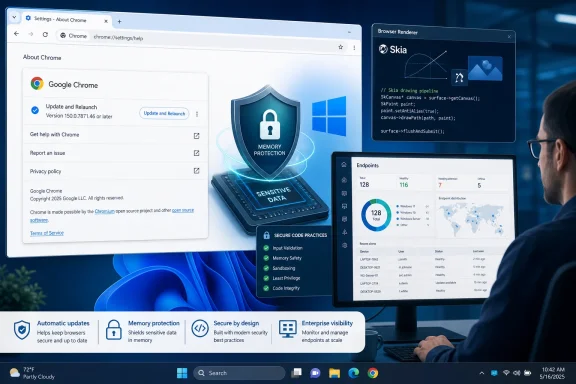 The Confirmed Risk Is Conditional Process-Memory Disclosure
Google’s description places a significant prerequisite directly in the vulnerability summary: the remote attacker must already have compromised Chrome’s renderer. The disclosure is therefore conditional rather than a documented one-step outcome of merely visiting a web page.After satisfying that prerequisite, an attacker may use crafted HTML to trigger insufficient input validation in Skia and obtain potentially sensitive information from process memory. The public description does not identify the specific information that may be exposed, how much information can be obtained, or how reliably the disclosure can be repeated.
That boundary should guide how the vulnerability is described:
- The confirmed outcome is potential process-memory information disclosure.
- Renderer compromise is a required precondition.
- User interaction is required.
- The public record does not document integrity or availability impact.
- The supplied SSVC assessment records no known exploitation.
- The available information does not establish a working multi-vulnerability exploit chain.
That distinction avoids both exaggeration and dismissal. CVE-2026-14414 should not be presented as an unauthenticated Chrome takeover, but an affected browser should not remain unpatched simply because the attack has prerequisites.
Medium Reflects the Attack Conditions, Not an Absence of Impact
The CISA-ADP CVSS 3.1 assessment gives CVE-2026-14414 a base score of 5.3, classified as Medium. Its vector is:CVSS:3.1/AV:N/AC:H/PR:N/UI:R/S:U/C:H/I:N/A:NThe vector describes a network-reachable condition with high attack complexity, no privileges required, and required user interaction. Its documented technical consequence is concentrated in confidentiality: confidentiality impact is rated High, while integrity and availability impacts are rated None.
These fields should be read together. The overall score is moderated by the demanding attack conditions, particularly the renderer-compromise prerequisite. At the same time, the assessment treats the possible disclosure as potentially significant within its limited confidentiality scope.
The visible 5.3 rating comes from the CISA-ADP contribution. It should not be described as an independent NVD score where the NVD record does not provide one.
For remediation, the affected-version boundary is more actionable than the numerical score:
| Deployment state | Chrome version | CVE-2026-14414 status | Required action |
|---|---|---|---|
| Below the fixed threshold | Earlier than 150.0.7871.46 | Affected | Update Chrome and relaunch it |
| At the fixed threshold | 150.0.7871.46 | Outside the affected range | Confirm the displayed version |
| Above the fixed threshold | Later than 150.0.7871.46 | Outside the affected range | Retain normal update monitoring |
Skia Is the Component, but the Public Technical Detail Is Limited
Skia is the graphics component named in the CVE record. The vulnerability is categorized as CWE-20, Improper Input Validation, indicating that some input was not sufficiently validated before being processed.Google’s public description supports a limited set of conclusions: crafted HTML reaches the affected Skia behavior, the attacker must already have compromised the renderer, and successful exploitation may expose potentially sensitive information from process memory.
The public record does not identify:
- The exact malformed input or graphics operation
- The internal object or data structure involved
- The quantity or location of memory that may be disclosed
- Whether an attacker can target particular process-memory contents
- Whether disclosure is repeatable or reliable
- Whether the behavior bypasses any named security mitigation
- Whether it can be combined with a specific second vulnerability
Reporting should therefore stay within the verified description. Claims about particular memory contents, proof-of-concept behavior, patch internals, exploit stability, sandbox escape, or remote code execution would go beyond the supplied record.
Limited public detail is not a reason to postpone remediation. The affected product and fixed-version threshold are already known, and those are the facts users need in order to close the exposure.
Individual Users Should Update Through Chrome’s About Page
The end-user remediation path is built into Chrome:- Open Google Chrome.
- Select the three-dot menu (⋮) in the upper-right corner.
- Select Help.
- Select About Google Chrome.
- Allow Chrome to check for and complete the available update.
- Click Relaunch when prompted.
- Return to ⋮ > Help > About Google Chrome.
- Confirm that the displayed version is 150.0.7871.46 or later.
The supplied vulnerability information does not justify panic, system reinstallation, or broad credential resets solely because an older Chrome version was present. An affected version indicates exposure to the vulnerability, not proof that exploitation or compromise occurred.
The appropriate response for an individual user is to install the fixed version, relaunch the browser, and confirm the result through the About Google Chrome page.
Windows Fleets Need a Verified Version, Not an Assumption
For a Windows fleet, successful remediation should produce evidence that covered endpoints report Chrome 150.0.7871.46 or later after the organization’s update-and-relaunch workflow.The checklist below is intentionally vendor- and tool-agnostic. Organizations can implement it with their existing endpoint-management, software-inventory, remote-support, configuration-management, or vulnerability-management platform.
Vendor- and tool-agnostic admin checklist
- Identify Windows endpoints on which Google Chrome is installed.
- Flag every reported Chrome version earlier than 150.0.7871.46.
- Deploy or permit installation of the fixed Chrome release.
- Instruct users to relaunch Chrome, or use the organization’s approved maintenance workflow to ensure the browser is closed and reopened.
- Collect a fresh Chrome version result after the relaunch step.
- Confirm that the reported version is 150.0.7871.46 or later.
- Recheck endpoints that were offline, unreachable, or missing from the first result set.
- Check shared PCs, kiosks, virtual desktops, lab systems, administrative workstations, and other Windows devices outside the primary workstation collection.
- Review deployment images and other provisioning sources so newly deployed endpoints do not begin with an affected Chrome package.
- Monitor the Google and NVD records for changes to the affected range, exploitation status, or technical assessment.
For organizations that use PowerShell-capable endpoint tooling, the following is one concrete inventory example for a standard system-level Chrome installation:
Code:
$chrome = "$env:ProgramFiles\Google\Chrome\Application\chrome.exe"

if (Test-Path $chrome) {
    (Get-Item $chrome).VersionInfo.ProductVersion
} else {
    "Chrome not found at the standard system-level path"
}
Code:
$paths = @(
    "$env:ProgramFiles\Google\Chrome\Application\chrome.exe",
    "${env:ProgramFiles(x86)}\Google\Chrome\Application\chrome.exe"
)

$paths |
    Where-Object { $_ -and (Test-Path $_) } |
    ForEach-Object {
        [PSCustomObject]@{
            Path    = $_
            Version = (Get-Item $_).VersionInfo.ProductVersion
        }
}The browser’s own About page remains the clearest end-user confirmation. At fleet scale, the objective is equivalent: obtain a fresh, endpoint-specific result showing Chrome 150.0.7871.46 or later after the remediation workflow.
Restart and Inventory Are the WindowsForum Differentiators
The important Windows operational question is not merely whether an update was offered. It is whether the organization completed a workflow that included updating, relaunching, and collecting a new version result.That makes the restart and inventory stages part of remediation rather than optional cleanup. The required evidence is straightforward:
- The endpoint was included in the Chrome inventory.
- A version below 150.0.7871.46 was identified or could not initially be ruled out.
- The fixed release was made available.
- Chrome was relaunched.
- A new check reported version 150.0.7871.46 or later.
Deployment sources also deserve attention. Updating current endpoints while leaving an older Chrome package in a provisioning image can recreate the affected state on newly deployed or restored systems. The fixed version should therefore be verified in both the live fleet and the sources used to build or recover Windows endpoints.
Administrators should avoid turning this into an unnecessarily complicated incident-response exercise. The supplied record does not establish active exploitation. The immediate goal is narrower: eliminate versions below the fixed threshold and retain evidence that the update-and-relaunch process succeeded.
A Chrome CVE Is Not Automatically an Edge Advisory
Windows administrators should not automatically apply Chrome’s affected-version range to Microsoft Edge or another Chromium-based browser.The supplied CVE record names Google as the vendor and Google Chrome as the affected product. Its version threshold is expressed as a Chrome build number. The record does not confirm that Edge or another Chromium-derived product is affected by CVE-2026-14414.
Shared Chromium ancestry alone is not enough to map one vendor’s version threshold onto another vendor’s browser. Products can use different component revisions, release branches, patches, configurations, and version-numbering schemes.
The defensible approach is vendor-specific:
- Use Google’s affected range and fixed version for Google Chrome.
- Use Microsoft’s own security and release information when evaluating Microsoft Edge.
- Use the applicable vendor’s advisory for every other Chromium-derived browser.
- Do not treat a Chrome build number as a universal Chromium security baseline.
Each installed browser needs its own inventory result, vendor advisory trail, and remediation threshold. For CVE-2026-14414, the confirmed target is Google Chrome below 150.0.7871.46.
Google, CISA-ADP, and NIST Describe Different Parts of the Record
The public vulnerability record combines information contributed by different organizations.Google’s CVE material supplies the core vulnerability description, identifies Chrome and Skia, states the renderer-compromise prerequisite, and provides the fixed-version boundary.
CISA-ADP contributes the CVSS 3.1 assessment and SSVC data. That contribution produces the 5.3 Medium score and records exploitation as none, automatable as no, and technical impact as partial.
NIST’s NVD material organizes the affected-product mapping and other record metadata. Where NVD has not published its own severity assessment, the CISA-ADP score should not be mislabeled as an independent NVD rating.
These layers answer different questions:
- Google: What is the flaw, what condition is required, and which Chrome version fixes it?
- CISA-ADP: How do the exploitability and impact factors score, and what does the available decision-support data record?
- NIST/NVD: How is the affected product and version range represented in the vulnerability database?
“Automatable: no” is consistent with the documented prerequisites and required user interaction. “Technical impact: partial” is consistent with the limited, confidentiality-focused consequence in the public description.
Record-development timeline
Because the supplied material does not provide independently verified publication dates suitable for this article, the timeline is presented as a sequence rather than with unsupported calendar timestamps:- Chrome CVE information was published: The core description identified Skia input validation, crafted HTML, the renderer-compromise prerequisite, potential process-memory disclosure, and the fixed Chrome threshold.
- CISA-ADP added its assessment: The record received a CVSS 3.1 score of 5.3 and SSVC values recording no known exploitation, no automation, and partial technical impact.
- NVD enriched the product mapping: The affected Chrome range was represented as versions earlier than 150.0.7871.46.
- The linked Chromium issue remained restricted: Its visible status was Permissions Required, limiting public access to the issue itself without establishing what specific materials were unavailable.
What the Record Does—and Does Not—Support
The strongest reporting on CVE-2026-14414 stays close to the confirmed facts.The record supports saying that Chrome versions before 150.0.7871.46 are affected. It supports saying that insufficient input validation in Skia can allow an attacker who has already compromised the renderer to obtain potentially sensitive information from process memory through crafted HTML. It supports the 5.3 CISA-ADP score and the supplied SSVC statement that no known exploitation was recorded.
The record does not establish:
- A stand-alone browser takeover
- Remote code execution
- A sandbox escape
- Persistence or privilege escalation
- A specific type of exposed data
- A reliable exploit chain
- A bypass of a named mitigation
- Active or historical exploitation
- Confirmed impact to Edge or other Chromium-based products
The remaining uncertainty does not weaken the remediation case. Defenders know the affected product, the vulnerable range, and the fixed threshold. That is enough to update Chrome now while reserving stronger conclusions for any future technical disclosure.
The Practical Windows Response Is Short
For individual users, open ⋮ > Help > About Google Chrome, allow the update to finish, click Relaunch, and verify version 150.0.7871.46 or later.For Windows administrators, inventory Chrome, identify every result below the threshold, deploy the fixed release, include a relaunch step, and collect a fresh post-remediation version result. Repeat the check for missed devices and review deployment sources that could reintroduce an older build.
Keep Chrome’s status separate from Edge and other Chromium-based browsers. Their exposure and fixed versions require vendor-specific confirmation.
CVE-2026-14414 is a conditional information-disclosure vulnerability, not a documented complete compromise. The supplied SSVC data records no known exploitation. Even so, the availability of a fixed Chrome version leaves little reason to accept continued exposure: update, relaunch, verify, and preserve the inventory evidence that shows the vulnerable builds are gone.
References
- Primary source: NVD / Chromium
Published: 2026-07-11T15:38:02-07:00
NVD - CVE-2026-14414
 nvd.nist.gov
- Security advisory: MSRC
Published: 2026-07-11T15:38:02-07:00
Original feed URL
Security Update Guide - Microsoft Security Response Center
 msrc.microsoft.com
- Related coverage: security-tracker.debian.org
- Related coverage: vulnerability.circl.lu
Vulnerability-Lookup
Vulnerability-Lookup - Fast vulnerability lookup correlation from different sources.vulnerability.circl.lu - Related coverage: notcve.org
