

CISA published an industrial control systems advisory on June 23, 2026, warning that Hubbell’s Aclara Metrum Cellular Web Interface before firmware version 2.1.0.105 exposes critical device functions without authentication, allowing unauthenticated network attackers to change operational settings and repeatedly restart affected devices. The vulnerability, tracked as CVE-2026-1840, is not a Windows bug, but it belongs squarely in the world WindowsForum readers actually administer: hybrid networks where endpoints, cloud consoles, remote access, OT devices, and utility infrastructure increasingly touch the same operational perimeter. The lesson is blunt: a web interface that controls field equipment is not “just a management page” when it can knock communications offline. In energy environments, availability is security.
The affected product is the Hubbell Aclara Metrum Cellular Web Interface, used in the energy sector and deployed in the United States. CISA describes the issue as a missing authentication control on critical system functions, which means an attacker with network access does not need credentials, user interaction, or prior privileges to reach the vulnerable behavior. That is why the advisory lands with a high severity rating: the exploit path is simple, the target is network reachable, and the impact is availability.
The CVSS 3.1 score is 7.5, with a vector that says almost everything an administrator needs to know: network attack vector, low complexity, no privileges required, no user interaction, and high availability impact. Under CVSS 4.0, CISA lists the issue at 8.7, also high. The scores are not the story by themselves, but they usefully confirm the shape of the threat: this is not about stealing files or popping a desktop shell; it is about making a device stop doing its job.
That distinction matters. In conventional enterprise security, confidentiality often dominates the mental model. In industrial and utility networks, a vulnerability that simply causes a device to become unreachable can be more damaging than one that leaks a database. A cellular communications device that can be repeatedly restarted or misconfigured is a tempting denial-of-service lever.
The most important phrase in the advisory is not “web interface.” It is “critical system functions.” Web interfaces are now the universal convenience layer of infrastructure. They are also the universal attack surface. When authentication is missing from functions that change operational parameters, the browser-friendly wrapper becomes a remote control for disruption.
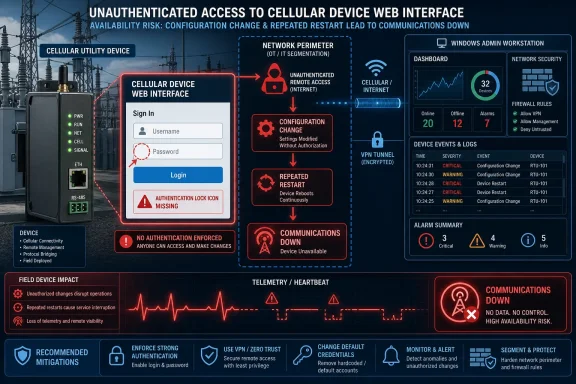
CISA’s summary says the affected interface allows unauthorized access to essential configuration settings. Attackers could alter operational parameters and trigger system restarts without restriction. Repeated use of those functions may lead to loss of communications to the device.
That last clause is where the risk becomes operational rather than theoretical. A single restart may be a nuisance. Repeated restarts, especially against field equipment that may not be physically easy to reach, can become a service interruption. If the device is part of a broader metering, telemetry, or utility communications chain, the downstream effect is not measured only in device uptime but in visibility, response time, and confidence in the network.
The advisory does not say that public exploitation has been observed. That is good news, but it is not a reason to relax. Vulnerabilities in exposed management interfaces often sit in the awkward zone between “no known exploitation” and “trivially discoverable once disclosed.” The difference is not always a sophisticated threat actor; sometimes it is a search engine, a scanner, and an administrator who assumed the device was only reachable internally.
If an affected interface is reachable only from a tightly controlled management segment, the bug is still serious but constrained. If it is reachable from the public Internet, the calculus changes immediately. The attacker does not need a stolen password, a phishing success, or a foothold inside the business network. The interface itself becomes the starting point.
The industrial world has spent years learning this lesson the hard way. Devices built for specialized operational environments often inherit enterprise-style convenience without enterprise-grade assumptions. A web UI is added for field configuration, remote support, or deployment efficiency. Over time, the device gets routed, NATed, VPN-linked, or cloud-adjacent. Eventually, the interface is no longer sitting in the quiet corner of a plant or substation network; it is part of a much larger exposure story.
That is why the advisory’s recommended practices focus on network architecture as much as patching. CISA urges organizations to minimize exposure for control system devices, isolate control system networks from business networks, place remote devices behind firewalls, and use secure remote access methods such as updated VPNs when remote access is required. None of that is glamorous. All of it is the difference between a firmware flaw and a field outage.
But firmware updates in OT and utility environments are not the same as patching a browser on a laptop. Administrators may need maintenance windows, vendor coordination, field access, rollback planning, and validation that the update does not break integrations. CISA explicitly reminds organizations to perform impact analysis and risk assessment before deploying defensive measures. That is not an excuse to delay indefinitely; it is a reminder that operational risk has two sides.
The danger is that firmware management becomes a once-audit-cycle activity. A device is installed, configured, accepted into production, and then treated as infrastructure furniture. The web interface remains, the network changes around it, and the original assumptions decay. By the time a CISA advisory arrives, the hardest part may not be applying the firmware; it may be discovering where the product is deployed and who owns the maintenance decision.
For Windows-heavy shops, this is familiar in a different costume. The same inventory problem that haunts endpoints, servers, printers, hypervisors, and remote management appliances applies to OT communications equipment. If the asset inventory does not know the firmware version, the risk register does not know the exposure. If the network map does not know how the interface is reachable, the firewall policy is probably telling a partial story.
Trusting the network perimeter is especially dangerous in environments that mix IT and OT access patterns. Engineers need remote support. Vendors need maintenance paths. Operators need dashboards. Security teams need monitoring. Business systems need reporting. Every one of those needs can be legitimate, and every one can widen the path to a device that was never designed to be broadly reachable.
This is where WindowsForum’s usual patch-and-harden instincts intersect with industrial security. The issue is not whether a vulnerable Aclara device runs Windows. The issue is whether Windows-administered infrastructure provides the jump hosts, VPNs, identity systems, DNS, routing, logging, and firewall rules that determine who can touch the device. In many organizations, IT is the custodian of the access paths even when OT owns the equipment.
That makes this vulnerability a shared-responsibility problem. OT teams understand the operational consequences of losing communications. IT teams often control the mechanisms that prevent unauthorized network reachability. Security teams interpret advisories and risk. If those groups read CVE-2026-1840 as “someone else’s appliance bug,” the organization has already missed the point.
In energy infrastructure, availability is not a secondary concern. Communications loss can degrade monitoring, delay response, interrupt telemetry, and complicate normal operations. Even when the affected device is not directly controlling generation or distribution, losing a communications link can blind operators at precisely the wrong moment.
Repeated restarts are particularly disruptive because they can create intermittent failure patterns. A device that is permanently down is obvious. A device that keeps disappearing and returning may trigger troubleshooting churn, false assumptions about carrier service, hardware defects, or environmental problems. Attackers do not always need to destroy a system to cause cost; sometimes they only need to make it unreliable.
That is why “no known public exploitation” should be read carefully. It means CISA has not received reports of exploitation specifically targeting this vulnerability at the time of publication. It does not mean exposed devices are safe, that exploitability is difficult, or that attackers will ignore the advisory. Public disclosure compresses the timeline between theoretical and practical risk.
The advice about VPNs is deliberately cautious. CISA notes that VPNs can have vulnerabilities and must be kept current. It also points out the part many organizations learn too late: a VPN is only as secure as the devices connected through it. A vulnerable web interface behind a VPN is better than one exposed to the Internet, but it is not automatically safe if credentials are shared, access is broad, endpoints are unmanaged, or segmentation is weak.
The better model is layered. Firmware should be updated. The device interface should not be Internet-accessible. Access should be limited to known management hosts or tightly controlled administrative networks. Remote access should be logged and authenticated. Configuration changes should be monitored. None of these layers is perfect, but together they turn a missing authentication flaw from an open door into a contained maintenance problem.
For smaller utilities or organizations with lean OT staff, that may sound like a heavy lift. It is. But the alternative is worse: relying on the hope that obscurity, private addressing, or institutional memory will protect devices that increasingly sit inside complex connected environments. Hope is not a compensating control.
Active Directory groups may determine who can reach jump boxes. Windows Server systems may host remote desktop gateways, monitoring tools, configuration repositories, or vendor support utilities. Defender, SIEM agents, and firewall logs may be the only places where suspicious access attempts become visible. A vulnerability in an OT web interface can therefore become a Windows-admin problem the moment an attacker uses Windows-managed infrastructure to reach it.
There is also a cultural lesson. Windows administrators have spent years internalizing patch cadences, forced reboots, credential hygiene, and least privilege. OT devices often live in a different rhythm, where stability and uptime make change slower and more deliberate. Neither culture is wrong, but vulnerabilities like CVE-2026-1840 expose the cost of treating those rhythms as separate universes.
The practical bridge is governance. If a Windows team manages identity, remote access, DNS, certificates, or network policy, it needs visibility into which OT systems depend on those services. If an OT team owns firmware and field equipment, it needs a way to signal urgency when a device-level advisory has network-level implications. The handoff cannot wait until an outage investigation.
The most charitable interpretation is legacy design meeting modern exposure. Devices may have been built for environments where physical or network access was considered a sufficient barrier. The less charitable interpretation is that management convenience still too often outranks secure defaults in embedded products. Either way, asset owners are left to manage the risk.
Vendor advisories and firmware updates are necessary, but customers should not treat them as the only quality signal. Procurement should ask how management interfaces authenticate sensitive actions, how firmware is signed and delivered, how updates are supported over the device lifecycle, and how security advisories are communicated. Those questions can feel bureaucratic until the day a web endpoint can reboot field equipment without a password.
There is an uncomfortable truth here: many organizations cannot patch their way out of design assumptions they never evaluated at purchase time. Security has to move earlier in the lifecycle. Otherwise, every advisory becomes an emergency inventory project.
The second response is exposure reduction. If a device does not need to be reachable from the Internet, it should not be. If it needs remote access, that path should be narrow, authenticated, monitored, and limited to the people and systems that actually require it. A firewall rule that permits broad administrative access from a corporate subnet is not segmentation; it is a convenience policy with a nicer name.
The third response is change planning. Firmware version 2.1.0.105 is the vendor’s remediation, and organizations should move toward it with appropriate impact analysis. That may require testing, scheduling, documentation, and coordination with operations teams. The goal is not reckless speed; it is deliberate urgency.
Finally, teams should review logs and monitoring data for signs of unusual access, repeated restarts, configuration changes, or communications instability. The advisory says no known public exploitation has been reported to CISA, but individual organizations still need to assess their own environments. Absence of a national report is not proof of local absence.
That specificity should not lead to complacency. In critical infrastructure, a narrow vulnerability in the wrong place can matter more than a broad vulnerability in a low-impact system. The blast radius is determined not just by product count but by function, placement, exposure, and recovery difficulty.
The advisory’s affected sector is energy, and the deployment area is the United States. That context raises the stakes without requiring exaggeration. There is no need to claim a grid-down scenario to take the issue seriously. A vulnerability that enables unauthorized operational changes and repeated restarts of communications equipment is already enough.
Security teams should resist both extremes: panic and dismissal. Panic produces rushed changes that may create operational problems. Dismissal leaves exposed interfaces in place because the vulnerability does not sound flashy enough. The right response is disciplined: inventory, isolate, patch, monitor.
CVE-2026-1840 will likely be resolved quietly in well-run environments: a firmware update, a firewall review, a few inventory corrections, and a better understanding of who can reach what. That is exactly how it should be. The future risk is that the next exposed management interface may sit deeper in the operational chain, with fewer logs, slower patch paths, and more dependencies nobody has mapped. For infrastructure operators and the Windows professionals who increasingly help secure them, the direction is clear: treat every web interface as part of the control plane until proven otherwise.
 A Small Web Interface Becomes a Large Operational Risk
The affected product is the Hubbell Aclara Metrum Cellular Web Interface, used in the energy sector and deployed in the United States. CISA describes the issue as a missing authentication control on critical system functions, which means an attacker with network access does not need credentials, user interaction, or prior privileges to reach the vulnerable behavior. That is why the advisory lands with a high severity rating: the exploit path is simple, the target is network reachable, and the impact is availability.The CVSS 3.1 score is 7.5, with a vector that says almost everything an administrator needs to know: network attack vector, low complexity, no privileges required, no user interaction, and high availability impact. Under CVSS 4.0, CISA lists the issue at 8.7, also high. The scores are not the story by themselves, but they usefully confirm the shape of the threat: this is not about stealing files or popping a desktop shell; it is about making a device stop doing its job.
That distinction matters. In conventional enterprise security, confidentiality often dominates the mental model. In industrial and utility networks, a vulnerability that simply causes a device to become unreachable can be more damaging than one that leaks a database. A cellular communications device that can be repeatedly restarted or misconfigured is a tempting denial-of-service lever.
The most important phrase in the advisory is not “web interface.” It is “critical system functions.” Web interfaces are now the universal convenience layer of infrastructure. They are also the universal attack surface. When authentication is missing from functions that change operational parameters, the browser-friendly wrapper becomes a remote control for disruption.
The Password Was Missing Where It Mattered Most
CVE-2026-1840 is mapped to CWE-306, “Missing Authentication for Critical Function.” That category is stark because it is not a subtle cryptographic failure, a race condition, or an obscure memory corruption edge case. It is the security equivalent of installing a lock on the front door while leaving the breaker panel exposed through a side window.CISA’s summary says the affected interface allows unauthorized access to essential configuration settings. Attackers could alter operational parameters and trigger system restarts without restriction. Repeated use of those functions may lead to loss of communications to the device.
That last clause is where the risk becomes operational rather than theoretical. A single restart may be a nuisance. Repeated restarts, especially against field equipment that may not be physically easy to reach, can become a service interruption. If the device is part of a broader metering, telemetry, or utility communications chain, the downstream effect is not measured only in device uptime but in visibility, response time, and confidence in the network.
The advisory does not say that public exploitation has been observed. That is good news, but it is not a reason to relax. Vulnerabilities in exposed management interfaces often sit in the awkward zone between “no known exploitation” and “trivially discoverable once disclosed.” The difference is not always a sophisticated threat actor; sometimes it is a search engine, a scanner, and an administrator who assumed the device was only reachable internally.
Internet Exposure Turns an Engineering Defect Into an Incident
Hubbell’s mitigation language is telling. Users are encouraged to update firmware to version 2.1.0.105 and to minimize network exposure, ensuring devices are not accessible from the Internet. That pairing is standard CISA advice, but in this case it reads less like boilerplate and more like the core of the incident model.If an affected interface is reachable only from a tightly controlled management segment, the bug is still serious but constrained. If it is reachable from the public Internet, the calculus changes immediately. The attacker does not need a stolen password, a phishing success, or a foothold inside the business network. The interface itself becomes the starting point.
The industrial world has spent years learning this lesson the hard way. Devices built for specialized operational environments often inherit enterprise-style convenience without enterprise-grade assumptions. A web UI is added for field configuration, remote support, or deployment efficiency. Over time, the device gets routed, NATed, VPN-linked, or cloud-adjacent. Eventually, the interface is no longer sitting in the quiet corner of a plant or substation network; it is part of a much larger exposure story.
That is why the advisory’s recommended practices focus on network architecture as much as patching. CISA urges organizations to minimize exposure for control system devices, isolate control system networks from business networks, place remote devices behind firewalls, and use secure remote access methods such as updated VPNs when remote access is required. None of that is glamorous. All of it is the difference between a firmware flaw and a field outage.
Firmware 2.1.0.105 Is the Fix, Not the Whole Strategy
The affected versions are listed as Hubbell Aclara Metrum Cellular Web Interface releases before 2.1.0.105. Hubbell’s remediation is to update to firmware version 2.1.0.105. For asset owners, that creates an immediate and concrete action item: identify exposed or deployed Metrum Cellular devices, verify firmware versions, and plan the update path.But firmware updates in OT and utility environments are not the same as patching a browser on a laptop. Administrators may need maintenance windows, vendor coordination, field access, rollback planning, and validation that the update does not break integrations. CISA explicitly reminds organizations to perform impact analysis and risk assessment before deploying defensive measures. That is not an excuse to delay indefinitely; it is a reminder that operational risk has two sides.
The danger is that firmware management becomes a once-audit-cycle activity. A device is installed, configured, accepted into production, and then treated as infrastructure furniture. The web interface remains, the network changes around it, and the original assumptions decay. By the time a CISA advisory arrives, the hardest part may not be applying the firmware; it may be discovering where the product is deployed and who owns the maintenance decision.
For Windows-heavy shops, this is familiar in a different costume. The same inventory problem that haunts endpoints, servers, printers, hypervisors, and remote management appliances applies to OT communications equipment. If the asset inventory does not know the firmware version, the risk register does not know the exposure. If the network map does not know how the interface is reachable, the firewall policy is probably telling a partial story.
The Advisory Is Really About Trust Boundaries
The phrase missing authentication can make the issue sound almost embarrassingly simple. In practice, it points to a deeper design failure: the device trusted the wrong boundary. It appears to have assumed that access to the interface was itself a sufficient gate for sensitive operations. That assumption no longer survives modern network reality.Trusting the network perimeter is especially dangerous in environments that mix IT and OT access patterns. Engineers need remote support. Vendors need maintenance paths. Operators need dashboards. Security teams need monitoring. Business systems need reporting. Every one of those needs can be legitimate, and every one can widen the path to a device that was never designed to be broadly reachable.
This is where WindowsForum’s usual patch-and-harden instincts intersect with industrial security. The issue is not whether a vulnerable Aclara device runs Windows. The issue is whether Windows-administered infrastructure provides the jump hosts, VPNs, identity systems, DNS, routing, logging, and firewall rules that determine who can touch the device. In many organizations, IT is the custodian of the access paths even when OT owns the equipment.
That makes this vulnerability a shared-responsibility problem. OT teams understand the operational consequences of losing communications. IT teams often control the mechanisms that prevent unauthorized network reachability. Security teams interpret advisories and risk. If those groups read CVE-2026-1840 as “someone else’s appliance bug,” the organization has already missed the point.
Availability Is the Quiet Priority Until It Fails
The CVSS vector lists no confidentiality impact and no integrity impact under version 3.1, but high availability impact. That profile can be deceptively easy to underrate in boardroom language. No data theft, no ransomware note, no leaked credentials — just a device that can be knocked offline or made unreachable.In energy infrastructure, availability is not a secondary concern. Communications loss can degrade monitoring, delay response, interrupt telemetry, and complicate normal operations. Even when the affected device is not directly controlling generation or distribution, losing a communications link can blind operators at precisely the wrong moment.
Repeated restarts are particularly disruptive because they can create intermittent failure patterns. A device that is permanently down is obvious. A device that keeps disappearing and returning may trigger troubleshooting churn, false assumptions about carrier service, hardware defects, or environmental problems. Attackers do not always need to destroy a system to cause cost; sometimes they only need to make it unreliable.
That is why “no known public exploitation” should be read carefully. It means CISA has not received reports of exploitation specifically targeting this vulnerability at the time of publication. It does not mean exposed devices are safe, that exploitability is difficult, or that attackers will ignore the advisory. Public disclosure compresses the timeline between theoretical and practical risk.
CISA’s Defensive Playbook Remains Boring Because It Works
CISA’s recommendations follow the familiar ICS security pattern: reduce exposure, segment networks, isolate control systems from business systems, use firewalls, and prefer more secure remote access methods when remote access is required. These recommendations appear in advisory after advisory because the failure mode also repeats. Management interfaces that should not be broadly reachable keep becoming reachable.The advice about VPNs is deliberately cautious. CISA notes that VPNs can have vulnerabilities and must be kept current. It also points out the part many organizations learn too late: a VPN is only as secure as the devices connected through it. A vulnerable web interface behind a VPN is better than one exposed to the Internet, but it is not automatically safe if credentials are shared, access is broad, endpoints are unmanaged, or segmentation is weak.
The better model is layered. Firmware should be updated. The device interface should not be Internet-accessible. Access should be limited to known management hosts or tightly controlled administrative networks. Remote access should be logged and authenticated. Configuration changes should be monitored. None of these layers is perfect, but together they turn a missing authentication flaw from an open door into a contained maintenance problem.
For smaller utilities or organizations with lean OT staff, that may sound like a heavy lift. It is. But the alternative is worse: relying on the hope that obscurity, private addressing, or institutional memory will protect devices that increasingly sit inside complex connected environments. Hope is not a compensating control.
The Windows Angle Is the Management Plane, Not the Device
Windows administrators may be tempted to file this under “industrial appliance issue” and move on. That would be a mistake. The modern Windows estate is often the management plane for everything around it, including devices that do not run Windows and never will.Active Directory groups may determine who can reach jump boxes. Windows Server systems may host remote desktop gateways, monitoring tools, configuration repositories, or vendor support utilities. Defender, SIEM agents, and firewall logs may be the only places where suspicious access attempts become visible. A vulnerability in an OT web interface can therefore become a Windows-admin problem the moment an attacker uses Windows-managed infrastructure to reach it.
There is also a cultural lesson. Windows administrators have spent years internalizing patch cadences, forced reboots, credential hygiene, and least privilege. OT devices often live in a different rhythm, where stability and uptime make change slower and more deliberate. Neither culture is wrong, but vulnerabilities like CVE-2026-1840 expose the cost of treating those rhythms as separate universes.
The practical bridge is governance. If a Windows team manages identity, remote access, DNS, certificates, or network policy, it needs visibility into which OT systems depend on those services. If an OT team owns firmware and field equipment, it needs a way to signal urgency when a device-level advisory has network-level implications. The handoff cannot wait until an outage investigation.
The Absence of Authentication Is a Design Smell Across the Industry
This advisory is also part of a broader pattern in industrial and embedded device security. Web management interfaces are convenient, but they often inherit assumptions from closed networks, bench configuration workflows, or trusted technician access. When those assumptions collide with remote administration and Internet-connected support paths, missing authentication becomes more than a coding defect.The most charitable interpretation is legacy design meeting modern exposure. Devices may have been built for environments where physical or network access was considered a sufficient barrier. The less charitable interpretation is that management convenience still too often outranks secure defaults in embedded products. Either way, asset owners are left to manage the risk.
Vendor advisories and firmware updates are necessary, but customers should not treat them as the only quality signal. Procurement should ask how management interfaces authenticate sensitive actions, how firmware is signed and delivered, how updates are supported over the device lifecycle, and how security advisories are communicated. Those questions can feel bureaucratic until the day a web endpoint can reboot field equipment without a password.
There is an uncomfortable truth here: many organizations cannot patch their way out of design assumptions they never evaluated at purchase time. Security has to move earlier in the lifecycle. Otherwise, every advisory becomes an emergency inventory project.
The Real Work Starts With Finding the Boxes
For affected organizations, the first response should be discovery. Identify Hubbell Aclara Metrum Cellular deployments, determine which devices expose the web interface, and confirm firmware versions. Pay particular attention to any management paths reachable from external networks, vendor access arrangements, cellular backhaul paths, or flat internal segments.The second response is exposure reduction. If a device does not need to be reachable from the Internet, it should not be. If it needs remote access, that path should be narrow, authenticated, monitored, and limited to the people and systems that actually require it. A firewall rule that permits broad administrative access from a corporate subnet is not segmentation; it is a convenience policy with a nicer name.
The third response is change planning. Firmware version 2.1.0.105 is the vendor’s remediation, and organizations should move toward it with appropriate impact analysis. That may require testing, scheduling, documentation, and coordination with operations teams. The goal is not reckless speed; it is deliberate urgency.
Finally, teams should review logs and monitoring data for signs of unusual access, repeated restarts, configuration changes, or communications instability. The advisory says no known public exploitation has been reported to CISA, but individual organizations still need to assess their own environments. Absence of a national report is not proof of local absence.
A High-Scoring Bug With a Narrow But Serious Blast Radius
One reason industrial advisories can be difficult to communicate is that the affected product set may be narrow while the consequences are serious for those who have it. CVE-2026-1840 is not a mass-market Windows vulnerability that affects millions of desktops. It is a specific flaw in a specific Hubbell Aclara interface before a specific firmware version.That specificity should not lead to complacency. In critical infrastructure, a narrow vulnerability in the wrong place can matter more than a broad vulnerability in a low-impact system. The blast radius is determined not just by product count but by function, placement, exposure, and recovery difficulty.
The advisory’s affected sector is energy, and the deployment area is the United States. That context raises the stakes without requiring exaggeration. There is no need to claim a grid-down scenario to take the issue seriously. A vulnerability that enables unauthorized operational changes and repeated restarts of communications equipment is already enough.
Security teams should resist both extremes: panic and dismissal. Panic produces rushed changes that may create operational problems. Dismissal leaves exposed interfaces in place because the vulnerability does not sound flashy enough. The right response is disciplined: inventory, isolate, patch, monitor.
The Aclara Advisory Reduces to a Few Hard Operational Truths
The practical meaning of CVE-2026-1840 is smaller than the fear and larger than the CVSS score. It is a reminder that infrastructure security often fails at the seam between device design and network reality.- Affected Hubbell Aclara Metrum Cellular Web Interface versions before 2.1.0.105 should be treated as vulnerable and prioritized for firmware review.
- The most serious risk is availability loss caused by unauthorized configuration changes or repeated device restarts.
- Devices exposing the management interface to the Internet carry the highest immediate risk and should be removed from public reach wherever possible.
- Segmentation, firewalling, and controlled remote access are not optional compensating controls for industrial web interfaces.
- Windows and enterprise IT teams may own the access paths, logs, and identity systems that determine whether this OT vulnerability is reachable.
- The lack of known public exploitation at publication time should not be treated as evidence that exposed devices can wait.
CVE-2026-1840 will likely be resolved quietly in well-run environments: a firmware update, a firewall review, a few inventory corrections, and a better understanding of who can reach what. That is exactly how it should be. The future risk is that the next exposed management interface may sit deeper in the operational chain, with fewer logs, slower patch paths, and more dependencies nobody has mapped. For infrastructure operators and the Windows professionals who increasingly help secure them, the direction is clear: treat every web interface as part of the control plane until proven otherwise.
References
- Primary source: CISA
Published: 2026-06-23T12:00:00+00:00

Hubbell Aclara Metrum Cellular Web Interface | CISA
www.cisa.gov
- Related coverage: hubbell.com
- Related coverage: vulners.com
Siemens SIMATIC - vulnerability database | Vulners.com
1. SUMMARY SIMATIC HMI Unified Comfort Panels before V21.0 are affected by a vulnerability that allows an unauthenticated attacker to access the web browser via the help link.This vulnerability allows an attacker to access the web browser through ...vulners.com
