

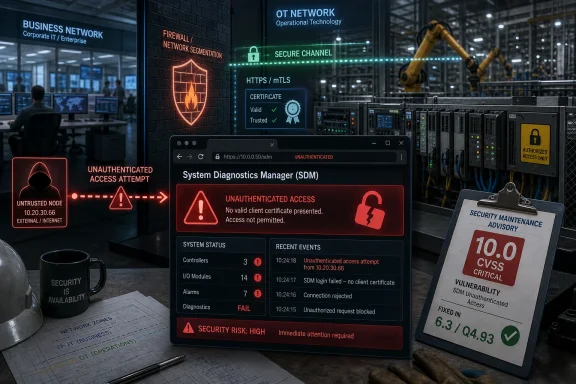
CISA republished ABB’s B&R advisory on May 26, 2026, warning that CVE-2025-3450 can let an unauthenticated network attacker abuse the System Diagnostics Manager in affected Automation Runtime versions before 6.3 and Q4.93 to delete data and trigger denial-of-service conditions. The uncomfortable part is not that another industrial controller stack has a critical CVSS score. It is that the vulnerable component is a diagnostic web interface, the kind of operational convenience that often survives long after commissioning because it is useful. In industrial environments, usefulness is frequently the enemy of least privilege.
ABB’s B&R Automation Runtime is not desktop software in the usual WindowsForum sense, but the advisory belongs squarely in the same conversation as Windows hardening, remote administration, and patch discipline. Automation Runtime is the middleware layer used to run applications on B&R target systems, and the System Diagnostics Manager, or SDM, is a web-accessible diagnostics page exposed through the Automation Runtime web server.
The vulnerability, tracked as CVE-2025-3450, sits in that SDM component. ABB describes it as an improper resource locking flaw that may allow an unauthenticated attacker with network access to delete data and cause denial-of-service conditions. In plainer language: a system meant to help operators observe and maintain controller state can, under affected versions, become a path to stopping the node.
The CVSS 3.1 score is 10.0, the highest possible rating. That score is driven by the familiar industrial nightmare combination: network attack vector, low complexity, no required privileges, no user interaction, high integrity impact, and high availability impact. Confidentiality is listed as unaffected, but in operational technology that is cold comfort. A system that stops doing its job can be more dangerous than a system that leaks a file.
The affected versions are Automation Runtime before 6.3 and before Q4.93. ABB says the issue is fixed in Automation Runtime 6.3 and Q4.93, and recommends that customers using SDM apply the update at the earliest convenience. That phrase has a different texture in a plant than it does on a laptop fleet: “earliest convenience” may mean the next maintenance window, the next line stoppage, or the next time a process can be safely interrupted.
That sentence describes the real perimeter. It is not just a firewall rule, and it is not just a version number. It is a chain of assumptions about who can touch the network, who can reach the controller, who can browse to a web interface, and whether the temporary maintenance exposure from last quarter was actually removed.
Industrial control systems have spent years absorbing IT-shaped conveniences: browser-based management, certificate configuration, remote access, web dashboards, API-style management surfaces, and centralized logging. These are not inherently bad developments. They make systems easier to support, easier to document, and easier to recover.
But every management plane becomes part of the attack surface. The SDM case is a reminder that diagnostics are not passive merely because they look like read-only support tooling. A web page that reports controller state still lives inside a web server, touches runtime resources, and may interact with files, locks, buffers, or processes whose behavior matters to the running system.
The phrase “improper resource locking” sounds dry, almost clerical. In a controller runtime, it hints at a more consequential failure mode: operations that should be serialized, protected, or bounded can be forced into unsafe sequences. If those operations include data deletion or state corruption, the path from malformed request to stopped node can become short enough to earn a critical score.
CISA’s republication is also explicitly a conversion of the vendor’s CSAF advisory. That matters because it gives defenders a standardized, machine-readable security advisory trail, but it does not magically add incident intelligence. According to the advisory text, B&R discovered the vulnerability through internal security analysis, it had not been publicly disclosed when the advisory was issued, and B&R had not received reports of exploitation at that time.
Those caveats should not lull anyone. “No known exploitation” is not the same as “not exploitable in your network,” and “requires network access” is not the barrier it once sounded like. Modern industrial compromise often begins elsewhere: a contractor laptop, a remote access appliance, a poorly segmented engineering workstation, a VPN account with weak controls, or malware that lands on the business side and starts looking for reachable services.
CISA’s recommended practices are the standard industrial-control refrain because they remain stubbornly relevant. Minimize exposure. Keep control systems off the internet. Put them behind firewalls. Separate production networks from business networks. Use secure remote access only where necessary, and keep that remote access stack patched. The repetition is not bureaucratic filler; it is the industry’s collective admission that segmentation is still the mitigation that saves organizations when software fails.
ABB’s own mitigation notes create a clear distinction between exposed and well-contained deployments. SDM is deactivated by default on Automation Runtime 6.0 and later. For older Automation Runtime versions below 6.0, ABB says SDM can be deactivated in the Automation Studio project. That is a meaningful mitigating factor, provided administrators have verified the state rather than assumed it.
The more dangerous environments are the ones where SDM was enabled for maintenance and then left reachable. That pattern is common across IT and OT. A troubleshooting interface is enabled during commissioning, a firewall exception is added to help a vendor, a diagnostic page becomes part of an operator’s informal workflow, and years later nobody wants to remove it because nobody is quite sure what depends on it.
This is where industrial security differs from ordinary patch commentary. The question is not simply whether a fixed build exists. The question is whether an asset owner can identify every affected runtime, determine whether SDM is active, map who can reach the web server, test an update safely, and document the residual exposure until the update is installed.
For Windows administrators who also support plant systems, this should feel familiar. The hard part of patching is rarely the installer. The hard part is inventory, dependency mapping, exception management, and finding the difference between “not exposed” and “we have never checked.”
ABB says an attacker could exploit the vulnerability by creating a specially crafted message and sending it to an affected system node. That still requires access to the system network, whether by direct connection, a wrongly configured or penetrated firewall, malicious software on a system node, or some other compromise of the network. This is not described as a drive-by internet worm in the advisory.
Even so, “internal only” is not a defense strategy. In many industrial environments, the internal network includes engineering workstations, HMIs, historians, jump boxes, remote support systems, and vendor-maintained machines that have different patch cadences and ownership boundaries. Once one of those systems is compromised, the difference between an internet-exposed service and a broadly reachable internal service begins to collapse.
The practical threat model is therefore lateral movement. An attacker does not have to care about B&R Automation Runtime on day one. They can land where defenses are weaker, discover web interfaces, identify controller infrastructure, and then use flaws like this to cause disruption at the moment that produces maximum operational pain.
That is why denial of service in industrial systems deserves more respect than it gets in enterprise vulnerability triage. In corporate IT, a DoS may mean degraded availability or emergency failover. In operational technology, it can mean a production line stoppage, a water process interruption, a safety shutdown, or a forced manual recovery procedure that consumes scarce specialist attention.
Industrial reality is less tidy. Controller runtime updates may require validation against application logic, hardware compatibility, safety requirements, vendor support agreements, and local change-control procedures. Even a small runtime change can be treated as a production event when the controller sits inside a process that cannot tolerate surprise behavior.
This is why ABB’s mitigation guidance matters nearly as much as the fixed version. If SDM is not required, deactivate it. If SDM is required only for maintenance, enable it or grant access only for the minimum time necessary. If the web server must remain available, restrict accessibility with external controls and host-based firewall rules.
ABB also recommends using HTTPS and notes that customers can configure mutual TLS in the Automation Studio project by validating the SSL communication partner. That is a stronger posture than simply encrypting traffic, because mTLS can make the client side prove its identity as well. The advisory also warns that mTLS configuration may affect other applications using the Automation Runtime web server, such as mapp View, which is exactly the kind of dependency that makes plant changes slower than security teams would prefer.
For administrators, the operational sequence should be obvious even if the execution is hard: inventory first, exposure reduction second, update planning third. If the runtime can be upgraded quickly, do it. If it cannot, SDM reachability becomes the immediate control surface.
Network segmentation is often discussed as an architecture diagram, but vulnerabilities like this expose whether the diagram is real. Can an ordinary office workstation reach the Automation Runtime web server? Can a contractor VPN session browse to SDM? Are engineering stations separated from corporate clients, or do they merely sit behind the same firewall with optimistic naming conventions?
The advisory’s mitigation language points toward several layers of control. Restrict SDM to trusted personnel. Limit web server access to trusted IP addresses. Use TLS and consider mutual TLS. Keep control networks isolated from business networks. Each measure is imperfect alone; together, they make exploitation harder and reduce the blast radius when credentials or endpoints fail elsewhere.
This is where WindowsForum readers should resist the instinct to treat OT advisories as somebody else’s problem. Windows systems are often the bridge into industrial environments. Engineering laptops, remote access gateways, domain-joined workstations, file shares, historian servers, and vendor tools frequently run on Windows. If those systems are mismanaged, they can become the path to a controller vulnerability that technically does not affect Windows at all.
The convergence cuts both ways. IT teams increasingly own or influence identity, endpoint detection, certificate services, remote access, and logging for industrial zones. OT teams own process safety, uptime, and vendor-specific runtime knowledge. A critical diagnostic-interface bug is exactly the kind of incident that punishes organizations where those teams meet only during audits.
But “disabled by default” is not the same as “disabled in production.” Defaults are overwritten by projects, integrators, maintenance practices, and emergency troubleshooting. A feature that is off on paper may be on in a copied Automation Studio project, a long-lived controller image, or a site-specific template that nobody has reviewed since commissioning.
This is especially relevant because the advisory spans Automation Runtime before 6.3 and before Q4.93, covering both newer 6.x and older Q4.x lines. Mixed fleets are common in industrial environments, where hardware life cycles can stretch for many years. A site may have new controllers with modern defaults and older nodes whose diagnostic settings reflect a very different security culture.
Administrators should therefore avoid debating the score in the abstract and instead ask for evidence. Which assets run affected versions? Which expose the Automation Runtime web server? Which have SDM enabled? Which IP ranges can reach it? Which remote access paths can reach those IP ranges? Which update path is supported for each controller?
The answer may show that the practical risk is low in a well-segmented plant with SDM disabled. It may also reveal a forgotten service quietly available to half the enterprise network. Both outcomes are useful because they replace assumption with inventory.
In the early life of a plant or machine, diagnostic tooling is a blessing. It shortens commissioning, gives engineers visibility, helps vendors troubleshoot, and reduces downtime. Over time, however, those same tools become embedded in informal procedures. They remain enabled because disabling them might inconvenience the next support call.
Security teams tend to talk about this as exposure, but operators experience it as operational memory. A maintenance engineer knows that SDM helped diagnose a controller issue two years ago. A vendor knows which page to ask for during a remote session. A line manager knows that waiting for formal change approval can cost production time. The risky configuration persists because it solves real problems.
That is why the best mitigation is not simply “turn it off” but a replacement workflow. If SDM is disabled by default and enabled only during maintenance, who approves that enablement? Who records it? Who confirms it was disabled afterward? If access is restricted by IP, which jump host is used? If mutual TLS is enabled, who manages the client certificates and renewal process?
Without that operational scaffolding, security guidance becomes aspirational. With it, a critical vulnerability becomes manageable: not harmless, but bounded by process and architecture.
Asset discovery, patch testing, certificate management, firewall scoping, remote access hygiene, and change windows are the same disciplines Windows administrators practice constantly. The difference is that OT assets often have higher uptime expectations, narrower vendor support paths, and more severe consequences when availability is lost.
A Windows admin might look at “web server access restricted to trusted IP addresses” and think in terms of host firewall rules, network ACLs, reverse proxies, or jump hosts. An OT engineer might think in terms of cell/area zones, engineering station access, and vendor maintenance workflows. The right answer usually needs both mental models.
The same is true for TLS. Enabling HTTPS is good, but certificate trust, lifecycle management, and client validation are where the implementation becomes durable. Mutual TLS can reduce unauthorized access, but only if certificate issuance and revocation are handled cleanly and if dependent applications are tested. Otherwise, a security improvement can turn into an outage vector.
This is the broader lesson: industrial cybersecurity is not a separate universe. It is enterprise security with longer equipment lifetimes, sharper availability stakes, and a much lower tolerance for casual reboot culture.
The advisory’s affected sectors are broad: chemical, communications, critical manufacturing, dams, energy, healthcare and public health, information technology, and water and wastewater. That breadth is not surprising for automation platforms. It is also why defenders should resist assuming that a vulnerability is irrelevant because it sounds specialized.
The organizations best positioned to handle this advisory will already know which B&R systems they operate, which runtime lines are in use, and how SDM is configured. The organizations most at risk will discover those facts under pressure. That distinction is less about budget than about whether OT assets are part of the same security visibility program as everything else.
There is also a governance point here. A CVSS 10 score can help justify urgency, but it can also flatten nuance. Security teams should not simply forward the advisory and demand emergency patching without context. Operations teams should not dismiss it because SDM is “supposed to be internal.” The useful conversation sits between those extremes: identify exposure, reduce reachability, schedule upgrades, and document the residual risk until the fix is deployed.
 A Critical Score Lands on a Maintenance Feature
ABB’s B&R Automation Runtime is not desktop software in the usual WindowsForum sense, but the advisory belongs squarely in the same conversation as Windows hardening, remote administration, and patch discipline. Automation Runtime is the middleware layer used to run applications on B&R target systems, and the System Diagnostics Manager, or SDM, is a web-accessible diagnostics page exposed through the Automation Runtime web server.The vulnerability, tracked as CVE-2025-3450, sits in that SDM component. ABB describes it as an improper resource locking flaw that may allow an unauthenticated attacker with network access to delete data and cause denial-of-service conditions. In plainer language: a system meant to help operators observe and maintain controller state can, under affected versions, become a path to stopping the node.
The CVSS 3.1 score is 10.0, the highest possible rating. That score is driven by the familiar industrial nightmare combination: network attack vector, low complexity, no required privileges, no user interaction, high integrity impact, and high availability impact. Confidentiality is listed as unaffected, but in operational technology that is cold comfort. A system that stops doing its job can be more dangerous than a system that leaks a file.
The affected versions are Automation Runtime before 6.3 and before Q4.93. ABB says the issue is fixed in Automation Runtime 6.3 and Q4.93, and recommends that customers using SDM apply the update at the earliest convenience. That phrase has a different texture in a plant than it does on a laptop fleet: “earliest convenience” may mean the next maintenance window, the next line stoppage, or the next time a process can be safely interrupted.
The Web Interface Is the Boundary That Keeps Moving
The most revealing detail in the advisory is not the CVSS vector. It is ABB’s mitigation language around SDM: the component is disabled by default in Automation Runtime 6 and is not intended to be enabled on active systems outside properly secured production networks or facilities lacking adequate physical and logical access controls.That sentence describes the real perimeter. It is not just a firewall rule, and it is not just a version number. It is a chain of assumptions about who can touch the network, who can reach the controller, who can browse to a web interface, and whether the temporary maintenance exposure from last quarter was actually removed.
Industrial control systems have spent years absorbing IT-shaped conveniences: browser-based management, certificate configuration, remote access, web dashboards, API-style management surfaces, and centralized logging. These are not inherently bad developments. They make systems easier to support, easier to document, and easier to recover.
But every management plane becomes part of the attack surface. The SDM case is a reminder that diagnostics are not passive merely because they look like read-only support tooling. A web page that reports controller state still lives inside a web server, touches runtime resources, and may interact with files, locks, buffers, or processes whose behavior matters to the running system.
The phrase “improper resource locking” sounds dry, almost clerical. In a controller runtime, it hints at a more consequential failure mode: operations that should be serialized, protected, or bounded can be forced into unsafe sequences. If those operations include data deletion or state corruption, the path from malformed request to stopped node can become short enough to earn a critical score.
CISA’s Republication Turns a Vendor Advisory Into an Operations Problem
The advisory’s chronology is important. ABB’s PSIRT advisory was originally issued on October 7, 2025, and CISA republished it on May 26, 2026, as ICSA-26-146-04. That does not necessarily mean the vulnerability is new to ABB customers, but it does mean the notice has been pulled into the broader U.S. industrial cybersecurity warning channel.CISA’s republication is also explicitly a conversion of the vendor’s CSAF advisory. That matters because it gives defenders a standardized, machine-readable security advisory trail, but it does not magically add incident intelligence. According to the advisory text, B&R discovered the vulnerability through internal security analysis, it had not been publicly disclosed when the advisory was issued, and B&R had not received reports of exploitation at that time.
Those caveats should not lull anyone. “No known exploitation” is not the same as “not exploitable in your network,” and “requires network access” is not the barrier it once sounded like. Modern industrial compromise often begins elsewhere: a contractor laptop, a remote access appliance, a poorly segmented engineering workstation, a VPN account with weak controls, or malware that lands on the business side and starts looking for reachable services.
CISA’s recommended practices are the standard industrial-control refrain because they remain stubbornly relevant. Minimize exposure. Keep control systems off the internet. Put them behind firewalls. Separate production networks from business networks. Use secure remote access only where necessary, and keep that remote access stack patched. The repetition is not bureaucratic filler; it is the industry’s collective admission that segmentation is still the mitigation that saves organizations when software fails.
CVSS 10 Does Not Mean Every Plant Is Equally Exposed
The temptation with a 10.0 score is to treat the vulnerability as universally catastrophic. That is the wrong read. The severity score describes the vulnerability under the scoring model; actual risk depends on where SDM is enabled, which Automation Runtime versions are deployed, who can reach the web server, and whether compensating controls are working.ABB’s own mitigation notes create a clear distinction between exposed and well-contained deployments. SDM is deactivated by default on Automation Runtime 6.0 and later. For older Automation Runtime versions below 6.0, ABB says SDM can be deactivated in the Automation Studio project. That is a meaningful mitigating factor, provided administrators have verified the state rather than assumed it.
The more dangerous environments are the ones where SDM was enabled for maintenance and then left reachable. That pattern is common across IT and OT. A troubleshooting interface is enabled during commissioning, a firewall exception is added to help a vendor, a diagnostic page becomes part of an operator’s informal workflow, and years later nobody wants to remove it because nobody is quite sure what depends on it.
This is where industrial security differs from ordinary patch commentary. The question is not simply whether a fixed build exists. The question is whether an asset owner can identify every affected runtime, determine whether SDM is active, map who can reach the web server, test an update safely, and document the residual exposure until the update is installed.
For Windows administrators who also support plant systems, this should feel familiar. The hard part of patching is rarely the installer. The hard part is inventory, dependency mapping, exception management, and finding the difference between “not exposed” and “we have never checked.”
The Attacker Does Not Need Credentials, but They Do Need a Path
The advisory describes a network-based unauthenticated attacker. That is the phrase that should get attention in every risk meeting. Authentication failures are often survivable when exposure is narrow; unauthenticated flaws become much more concerning when a service is reachable from broad internal networks.ABB says an attacker could exploit the vulnerability by creating a specially crafted message and sending it to an affected system node. That still requires access to the system network, whether by direct connection, a wrongly configured or penetrated firewall, malicious software on a system node, or some other compromise of the network. This is not described as a drive-by internet worm in the advisory.
Even so, “internal only” is not a defense strategy. In many industrial environments, the internal network includes engineering workstations, HMIs, historians, jump boxes, remote support systems, and vendor-maintained machines that have different patch cadences and ownership boundaries. Once one of those systems is compromised, the difference between an internet-exposed service and a broadly reachable internal service begins to collapse.
The practical threat model is therefore lateral movement. An attacker does not have to care about B&R Automation Runtime on day one. They can land where defenses are weaker, discover web interfaces, identify controller infrastructure, and then use flaws like this to cause disruption at the moment that produces maximum operational pain.
That is why denial of service in industrial systems deserves more respect than it gets in enterprise vulnerability triage. In corporate IT, a DoS may mean degraded availability or emergency failover. In operational technology, it can mean a production line stoppage, a water process interruption, a safety shutdown, or a forced manual recovery procedure that consumes scarce specialist attention.
The Fix Exists, but the Change Window Is the Real Constraint
ABB says the problem is corrected in Automation Runtime 6.3 and Q4.93. That is the cleanest line in the advisory and, for many defenders, the least complicated part technically. Upgrade the runtime, remove the vulnerable condition, and move on.Industrial reality is less tidy. Controller runtime updates may require validation against application logic, hardware compatibility, safety requirements, vendor support agreements, and local change-control procedures. Even a small runtime change can be treated as a production event when the controller sits inside a process that cannot tolerate surprise behavior.
This is why ABB’s mitigation guidance matters nearly as much as the fixed version. If SDM is not required, deactivate it. If SDM is required only for maintenance, enable it or grant access only for the minimum time necessary. If the web server must remain available, restrict accessibility with external controls and host-based firewall rules.
ABB also recommends using HTTPS and notes that customers can configure mutual TLS in the Automation Studio project by validating the SSL communication partner. That is a stronger posture than simply encrypting traffic, because mTLS can make the client side prove its identity as well. The advisory also warns that mTLS configuration may affect other applications using the Automation Runtime web server, such as mapp View, which is exactly the kind of dependency that makes plant changes slower than security teams would prefer.
For administrators, the operational sequence should be obvious even if the execution is hard: inventory first, exposure reduction second, update planning third. If the runtime can be upgraded quickly, do it. If it cannot, SDM reachability becomes the immediate control surface.
A Diagnostic Page Becomes a Test of Segmentation
The best defense against this class of flaw is not to pretend that industrial software will stop having vulnerabilities. It will not. The best defense is to ensure that a vulnerable diagnostic endpoint is reachable only by the small set of systems and people that genuinely need it.Network segmentation is often discussed as an architecture diagram, but vulnerabilities like this expose whether the diagram is real. Can an ordinary office workstation reach the Automation Runtime web server? Can a contractor VPN session browse to SDM? Are engineering stations separated from corporate clients, or do they merely sit behind the same firewall with optimistic naming conventions?
The advisory’s mitigation language points toward several layers of control. Restrict SDM to trusted personnel. Limit web server access to trusted IP addresses. Use TLS and consider mutual TLS. Keep control networks isolated from business networks. Each measure is imperfect alone; together, they make exploitation harder and reduce the blast radius when credentials or endpoints fail elsewhere.
This is where WindowsForum readers should resist the instinct to treat OT advisories as somebody else’s problem. Windows systems are often the bridge into industrial environments. Engineering laptops, remote access gateways, domain-joined workstations, file shares, historian servers, and vendor tools frequently run on Windows. If those systems are mismanaged, they can become the path to a controller vulnerability that technically does not affect Windows at all.
The convergence cuts both ways. IT teams increasingly own or influence identity, endpoint detection, certificate services, remote access, and logging for industrial zones. OT teams own process safety, uptime, and vendor-specific runtime knowledge. A critical diagnostic-interface bug is exactly the kind of incident that punishes organizations where those teams meet only during audits.
The “Disabled by Default” Detail Is Not a Get-Out-of-Patch Card
ABB deserves credit for the important design choice that SDM is disabled by default in Automation Runtime 6 and later. Secure defaults matter. They reduce accidental exposure and help new deployments avoid inheriting old habits.But “disabled by default” is not the same as “disabled in production.” Defaults are overwritten by projects, integrators, maintenance practices, and emergency troubleshooting. A feature that is off on paper may be on in a copied Automation Studio project, a long-lived controller image, or a site-specific template that nobody has reviewed since commissioning.
This is especially relevant because the advisory spans Automation Runtime before 6.3 and before Q4.93, covering both newer 6.x and older Q4.x lines. Mixed fleets are common in industrial environments, where hardware life cycles can stretch for many years. A site may have new controllers with modern defaults and older nodes whose diagnostic settings reflect a very different security culture.
Administrators should therefore avoid debating the score in the abstract and instead ask for evidence. Which assets run affected versions? Which expose the Automation Runtime web server? Which have SDM enabled? Which IP ranges can reach it? Which remote access paths can reach those IP ranges? Which update path is supported for each controller?
The answer may show that the practical risk is low in a well-segmented plant with SDM disabled. It may also reveal a forgotten service quietly available to half the enterprise network. Both outcomes are useful because they replace assumption with inventory.
The Advisory Is Also a Warning About Tooling Debt
The SDM vulnerability is not just a one-off bug. It is a symptom of tooling debt in industrial environments: management features added for legitimate reasons, wrapped in web interfaces, and then left to coexist with networks and threat models that have changed around them.In the early life of a plant or machine, diagnostic tooling is a blessing. It shortens commissioning, gives engineers visibility, helps vendors troubleshoot, and reduces downtime. Over time, however, those same tools become embedded in informal procedures. They remain enabled because disabling them might inconvenience the next support call.
Security teams tend to talk about this as exposure, but operators experience it as operational memory. A maintenance engineer knows that SDM helped diagnose a controller issue two years ago. A vendor knows which page to ask for during a remote session. A line manager knows that waiting for formal change approval can cost production time. The risky configuration persists because it solves real problems.
That is why the best mitigation is not simply “turn it off” but a replacement workflow. If SDM is disabled by default and enabled only during maintenance, who approves that enablement? Who records it? Who confirms it was disabled afterward? If access is restricted by IP, which jump host is used? If mutual TLS is enabled, who manages the client certificates and renewal process?
Without that operational scaffolding, security guidance becomes aspirational. With it, a critical vulnerability becomes manageable: not harmless, but bounded by process and architecture.
Windows Lessons Apply Even When the Controller Is Not Windows
There is an irony in covering this advisory for a Windows-focused audience: the vulnerable product is an automation runtime, not a Windows component. Yet the response playbook has Windows fingerprints all over it.Asset discovery, patch testing, certificate management, firewall scoping, remote access hygiene, and change windows are the same disciplines Windows administrators practice constantly. The difference is that OT assets often have higher uptime expectations, narrower vendor support paths, and more severe consequences when availability is lost.
A Windows admin might look at “web server access restricted to trusted IP addresses” and think in terms of host firewall rules, network ACLs, reverse proxies, or jump hosts. An OT engineer might think in terms of cell/area zones, engineering station access, and vendor maintenance workflows. The right answer usually needs both mental models.
The same is true for TLS. Enabling HTTPS is good, but certificate trust, lifecycle management, and client validation are where the implementation becomes durable. Mutual TLS can reduce unauthorized access, but only if certificate issuance and revocation are handled cleanly and if dependent applications are tested. Otherwise, a security improvement can turn into an outage vector.
This is the broader lesson: industrial cybersecurity is not a separate universe. It is enterprise security with longer equipment lifetimes, sharper availability stakes, and a much lower tolerance for casual reboot culture.
The Real Patch Is a Smaller Blast Radius
The most concrete next step is to update affected Automation Runtime installations to 6.3 or Q4.93 where applicable. That is the vendor fix, and it should be the desired end state. But the more durable improvement is to reduce the number of paths by which a diagnostic web interface can be reached in the first place.The advisory’s affected sectors are broad: chemical, communications, critical manufacturing, dams, energy, healthcare and public health, information technology, and water and wastewater. That breadth is not surprising for automation platforms. It is also why defenders should resist assuming that a vulnerability is irrelevant because it sounds specialized.
The organizations best positioned to handle this advisory will already know which B&R systems they operate, which runtime lines are in use, and how SDM is configured. The organizations most at risk will discover those facts under pressure. That distinction is less about budget than about whether OT assets are part of the same security visibility program as everything else.
There is also a governance point here. A CVSS 10 score can help justify urgency, but it can also flatten nuance. Security teams should not simply forward the advisory and demand emergency patching without context. Operations teams should not dismiss it because SDM is “supposed to be internal.” The useful conversation sits between those extremes: identify exposure, reduce reachability, schedule upgrades, and document the residual risk until the fix is deployed.
The Plant-Floor Lesson Hidden in CVE-2025-3450
This advisory is narrow enough to act on but broad enough to teach from. The vulnerable component has a name, the affected versions are identified, the fixed versions are available, and the mitigations are practical. That makes it a useful test of whether an organization can move from advisory to action without improvising the whole process.- Organizations running B&R Automation Runtime should verify whether any deployed systems are on versions before 6.3 or before Q4.93.
- Administrators should confirm whether SDM is enabled rather than relying on default-state assumptions.
- Sites that cannot patch immediately should restrict access to the Automation Runtime web server and disable SDM when it is not required.
- Maintenance workflows should grant SDM access only for the minimum time necessary and should include a step to remove that access afterward.
- Network teams should validate that business networks, contractor VPNs, and ordinary user subnets cannot reach controller diagnostic interfaces by accident.
- Security teams should treat this as an inventory and segmentation exercise, not only as a vulnerability ticket.
References
- Primary source: CISA
Published: 2026-05-26T12:00:00+00:00
- Related coverage: securityvulnerability.io
CVE-2025-3450 : Improper Resource Locking in B&R Industrial Automation Automation Runtime
Explore the improper resource locking vulnerability in B&R Industrial Automation’s products. Learn more about CVE-2025-3450.securityvulnerability.io - Related coverage: service.securitm.ru
CVE-2025-3450 - CVE уязвимости - SECURITM
Automation Runtime SDM requests may impact systemservice.securitm.ru
- Related coverage: vulnerability.circl.lu
Vulnerability-Lookup
Vulnerability-Lookup - Fast vulnerability lookup correlation from different sources.vulnerability.circl.lu - Related coverage: cert.pse-online.pl
Nowe podatności w produktach firmy B&R Industrial Automation. (P25-354) — CERT PSE
Nowe podatności w B&R Automation. cert.pse-online.pl
- Related coverage: dbugs.ptsecurity.com
CVE-2025-3450 — DoS in B&R Industrial Automation B&R Automation Runtime | dbugs
Details on CVE-2025-3450: DoS in B&R Industrial Automation B&R Automation Runtime. Includes CVSS score, affected versions, and references.dbugs.ptsecurity.com

- Related coverage: br-automation.com
