

The Vulnerability Is Small on Paper and Large in the Room
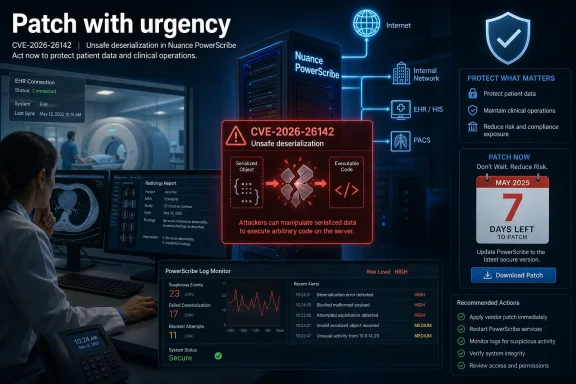
CVE-2026-26142 belongs to a familiar but stubbornly dangerous category: deserialization of untrusted data. In plain English, affected software may accept structured data from outside, rebuild it into live objects, and in doing so give an attacker a route to execute code. That class has produced some of the most painful enterprise incidents of the last decade because it often hides inside routine application plumbing.
The reason this matters in PowerScribe is not only technical severity. PowerScribe is radiology infrastructure, not a hobbyist web app. It supports dictation, reporting, workflow, and follow-up processes that many clinical teams experience as part of the daily operating system of imaging departments.
A remote code execution bug in that setting is different from a local privilege bug on a workstation. It potentially gives an attacker a first foothold or a lateral-movement platform inside an environment where uptime, privacy, and clinical continuity all matter at once. Even if exploitation details are not public, the impact statement is enough to move this into the “patch with urgency” pile.
Microsoft’s own framing also matters. The user-facing metric text around confidence is designed to distinguish rumor from confirmation: some vulnerabilities are merely alleged, some are inferred from research, and some are acknowledged by the affected vendor. CVE-2026-26142 lands in the latter world. The vulnerability is not a theoretical weakness being debated on a mailing list; it is an assigned CVE with vendor acknowledgement and a concrete impact description.
Vendor Confirmation Changes the Risk Conversation
Security teams sometimes treat incomplete advisories as permission to wait. That is understandable in a world where vulnerability databases are crowded with vague entries, duplicate records, and speculative scanner findings. But the absence of a public exploit recipe is not the same as the absence of exploitability.
The confidence metric is useful because it separates two ideas that often get blurred. One is whether defenders know every internal detail of the flaw. The other is whether defenders have enough confidence that the flaw exists and matters. For CVE-2026-26142, the second threshold has clearly been crossed.
That distinction should shape the response. If a vendor acknowledges a remote code execution vulnerability, identifies the affected product family, and describes the root issue as untrusted deserialization, defenders do not need to wait for a proof-of-concept to begin mitigation. In fact, waiting for one is often how organizations end up patching under emergency conditions instead of planned change control.
This is especially true in healthcare. Clinical systems are often harder to patch than commodity servers because upgrades may require vendor coordination, downtime windows, validation, and sign-off from departments that cannot simply stop using the system. The right response is not panic; it is immediate inventory, exposure review, vendor engagement, and a disciplined change plan.
Deserialization Bugs Reward Attackers Who Read Between the Lines
The advisory language for CVE-2026-26142 is short, but it says enough. “Deserialization of untrusted data” tells experienced defenders and attackers where to look: inputs that carry structured objects, application endpoints that rebuild state, messaging layers, service-to-service calls, legacy integrations, and code paths that assume data is trustworthy because it came from inside the application ecosystem.
That does not mean every PowerScribe deployment is equally exposed. Architecture matters. Segmentation matters. Authentication boundaries matter. Whether a vulnerable component is reachable from an untrusted network can be the difference between a theoretical risk and a live incident response. But the CVSS-style shape of the vulnerability — network access, no user interaction, no prior authorization implied by the description — is exactly the combination that makes security teams uneasy.
The hard part for defenders is that deserialization bugs rarely look like “bad input” in the ordinary sense. They are not always a suspicious string in a form field. They can involve encoded payloads, serialized objects, tokens, binary blobs, or application messages that look legitimate until the receiving component reconstructs them in a dangerous way.
That is why generic compensating controls only go so far. A web application firewall might help if the exploit traffic has recognizable patterns, but it should not be the plan of record. The durable fix is vendor remediation, configuration hardening, and a network posture that assumes critical clinical applications should not be broadly reachable by anything that can throw packets at them.
Healthcare Software Lives in the Worst Possible Patch Window
The most uncomfortable part of this disclosure is the setting. Radiology reporting is one of those systems that can be invisible to the public and indispensable to the hospital. When it works, reports move, clinicians read, follow-ups happen, and the workday continues. When it breaks, the damage is operational before it is abstract.
That makes patching both more urgent and more difficult. A security team can say “apply the update immediately,” but a radiology department may hear “risk disruption to tomorrow morning’s imaging schedule.” The result, too often, is a negotiation between two bad outcomes: accept exposure or risk downtime.
This is where mature IT operations earn their keep. The right move is not to force an untested patch into production at 4 p.m. because a CVE score is scary. It is to identify the actual product versions in use, determine whether internet or broad internal network exposure exists, test the vendor fix in a staging environment if possible, and compress the normal approval cycle because the vulnerability class justifies it.
There is also a human factor. Clinical application owners may not know what remote code execution means in operational terms. They should be told plainly: an attacker may be able to run software on a server that supports radiology reporting. That could lead to data theft, service disruption, ransomware staging, credential access, or pivoting into adjacent systems. None of those outcomes requires cinematic hacking; they require a vulnerable service and enough time.
The Microsoft-Nuance Connection Makes This a WindowsForum Story
PowerScribe is a Nuance product, and Nuance is part of Microsoft’s orbit after Microsoft’s acquisition of Nuance Communications. That is why a vulnerability in radiology reporting software appears in Microsoft’s security ecosystem rather than as an obscure vendor-only bulletin. For WindowsForum readers, that connection matters because it pulls a specialized healthcare product into the broader Microsoft patch-management conversation.
It also shows how the meaning of “Microsoft vulnerability” has changed. The modern Microsoft estate is not just Windows, Office, Exchange, and Azure. It includes vertical software, cloud services, identity platforms, AI systems, developer tools, Linux packages, and acquired product families with their own histories and deployment models. A security update guide entry can now matter deeply to a hospital even if it has nothing to do with a Windows kernel bug.
For sysadmins, that widens the inventory problem. If your vulnerability management program only maps CVEs to operating systems and mainstream Microsoft server roles, you may miss specialized applications that are now surfaced through Microsoft channels. Conversely, if clinical departments own their own application inventories, central security may not know where PowerScribe components live or how they are exposed.
The CVE should therefore trigger more than a patch ticket. It should trigger an asset-mapping question: who owns PowerScribe, where is it hosted, which components are reachable from which networks, what service accounts does it use, and how quickly can the organization deploy vendor fixes when radiology workflow is involved?
“No Public Exploit” Is Not a Strategy
At disclosure time, public reporting around CVE-2026-26142 appears limited. That is typical for newly published vendor advisories. It is also temporary. Once a CVE identifies a product, vulnerability class, and impact, researchers, criminals, and defensive vendors all start converging on the same target from different motives.
This creates a strange psychological trap. The quiet period immediately after disclosure can feel safe because there is not yet a flood of exploit chatter. In reality, it may be the best window defenders will get. Attackers do not need a polished exploit on GitHub to begin probing exposed systems, fingerprinting versions, and looking for reachable endpoints.
For healthcare organizations, the risk is amplified by ransomware economics. Attackers like systems that combine sensitive data, high operational pressure, and difficult downtime decisions. Radiology reporting infrastructure is not necessarily the first thing an attacker targets from the internet, but once inside a healthcare network, clinical systems can become leverage.
The practical stance is to assume scanning will follow disclosure. That does not mean assuming compromise. It means checking logs, reviewing ingress paths, narrowing access, and accelerating remediation before the exploit market matures. In vulnerability response, the difference between “not exploited” and “not yet exploited here” is often measured in days.
The Right Response Starts With Exposure, Not Just Version Numbers
Version checking is necessary, but it is not sufficient. The first question is whether the affected PowerScribe components exist in the environment. The second is whether they are reachable from untrusted networks. The third is whether compensating controls can reduce exposure while the patch process runs.
For many organizations, the immediate win will be segmentation. Clinical application servers should not be reachable from general workstation networks except where required. Administrative interfaces should not be exposed broadly. Vendor remote-access paths should be reviewed, logged, and constrained. If any PowerScribe-related service is reachable from the internet, that is a separate emergency.
Identity also matters. A remote code execution vulnerability can quickly become a credential problem if the affected service runs with excessive privileges or has access to databases, file shares, or integration accounts. Least privilege is not glamorous, but it limits blast radius when an application server becomes an attacker-controlled platform.
Logging deserves the same attention. If exploitation details are sparse, defenders should still look for abnormal service crashes, unusual child processes, unexpected outbound connections, suspicious authentication events from PowerScribe hosts, and changes to application directories. The point is not to invent indicators of compromise from thin air; it is to baseline the system and hunt for behavior that should not occur in a radiology reporting server.
This Is a Test of Vendor Dependency as Much as Patch Hygiene
CVE-2026-26142 also exposes a broader weakness in enterprise security: the dependence on opaque, specialized vendor platforms. Many hospitals cannot simply inspect, rebuild, or independently harden a clinical application. They need the vendor’s fix, the vendor’s guidance, and sometimes the vendor’s blessing to make changes safely.
That dependency is not inherently bad. Specialized software exists because clinical workflows are specialized. But it does mean contracts, support channels, and incident-response plans should assume security emergencies. If an organization has to spend the first day of a critical advisory figuring out who can open a vendor case, it has already lost time.
Procurement should care about this. Security response should be a purchasing criterion, not an afterthought. Vendors should be expected to provide clear affected-version matrices, fixed-version guidance, mitigation advice, logging recommendations, and customer communications that non-security clinical leaders can understand.
Microsoft’s role may help here by centralizing disclosure and giving the advisory more visibility. But visibility is not remediation. The burden still falls on each organization to translate the CVE into the messy local facts of its deployment.
The Signal Inside the Confidence Metric
The user-provided metric text is, in a way, the most important part of the story. It reminds us that vulnerability urgency is partly about confidence. A rumor with a scary impact may deserve monitoring; a vendor-confirmed RCE with network attack characteristics deserves action.
That does not mean defenders know everything. The root cause may be summarized rather than explained. The exploit path may be withheld. The affected-version table may require a customer portal or vendor support channel. But the signal is still strong enough to make the operational decision.
This is where security teams should resist both extremes. One extreme is alarmism: treating every critical CVE as evidence of active compromise. The other is complacency: refusing to move until exploit code is public. CVE-2026-26142 sits in the middle ground where sober urgency is the correct posture.
The confidence metric also hints at attacker knowledge. The more confirmed the details, the easier it becomes for capable attackers to focus research. A deserialization RCE in a named product is not a full exploit manual, but it is a map with enough landmarks to be useful.
The Radiology Server Is Now Part of the Attack Surface Map
The concrete actions are not mysterious, but they do require coordination across security, infrastructure, clinical applications, and vendor support. Treat this as a short-fuse infrastructure risk rather than a routine compliance item.
- Organizations running Nuance PowerScribe or PowerScribe One should immediately confirm affected versions and request vendor-specific remediation guidance.
- Administrators should determine whether any affected components are reachable from the internet, broad internal networks, vendor remote-access paths, or unmanaged devices.
- Security teams should prioritize patching or mitigation because the disclosed impact is unauthenticated remote code execution over a network.
- Network teams should restrict access to PowerScribe services to the smallest practical set of systems and users while remediation is underway.
- Incident responders should review logs from PowerScribe hosts for abnormal processes, crashes, outbound connections, and authentication patterns around and after June 9, 2026.
- Clinical leaders should be brought into the risk conversation early so that patch windows are treated as patient-safety-adjacent operational work, not back-office maintenance.
The larger takeaway is that specialized healthcare platforms can no longer sit outside the mainstream vulnerability program. If they carry patient workflow, identity, integrations, and privileged service accounts, they are enterprise attack surface.
CVE-2026-26142 will likely be remembered less for the elegance of its technical details than for the kind of environment it touches: clinical software that has to be available, trusted, and boring. Microsoft’s advisory gives defenders enough certainty to move now, even if it does not give attackers a finished playbook. The organizations that handle this well will be the ones that already know where their PowerScribe systems live, who owns them, how they are segmented, and how to patch them without improvising under pressure; everyone else should treat this disclosure as a warning that the next critical healthcare application bug may arrive with even less patience.