

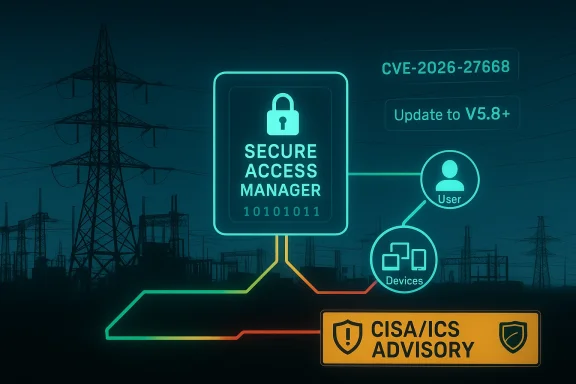
Siemens has issued a fresh industrial cybersecurity warning for RUGGEDCOM CROSSBOW Secure Access Manager Primary (SAM-P), and the headline is straightforward: an authenticated user with the User Administrator role may be able to climb into broader privileges than intended. The issue, tracked as CVE-2026-27668, affects all versions of SAM-P before V5.8, carries a CVSS v3.1 score of 8.8, and is now being republished by CISA as ICSA-26-111-02. Siemens says the fix is to update to V5.8 or later, while CISA is urging defenders to minimize network exposure and harden control-system access paths.
RUGGEDCOM CROSSBOW is not just another enterprise web application with a security bug. Siemens describes it as a secure access management solution designed to provide NERC CIP compliant access to Intelligent Electronic Devices, which places it squarely in the operational technology world where access control is part of the plant, substation, or utility trust model rather than a mere IT convenience. That context matters because a flaw in access governance here can affect how engineers, contractors, and administrators reach critical devices in the field.
The newly disclosed weakness is an incorrect privilege assignment issue, not a memory corruption or protocol parser bug. Siemens says “User Administrators are allowed to administer groups they belong to,” and that this can allow an authenticated User Administrator to escalate their own privileges and grant themselves access to any device group at any access level. In plain language, the product’s policy model appears to blur the line between belonging to a group and administering it, which is exactly the kind of subtle authorization mistake that can have outsized consequences in a centralized access platform.
This is not Siemens’ first CROSSBOW security conversation. CISA has previously posted advisories for RUGGEDCOM CROSSBOW, including a 2024 advisory that described a much broader set of issues such as missing authorization, SQL injection, missing authentication for critical functions, and path-related flaws. In other words, the product line has already spent time under the microscope, and that history makes the current privilege-escalation issue feel less like a random one-off and more like another reminder that privileged control-plane software is a high-value target.
The security significance is amplified by the deployment environment. Siemens and CISA both stress protected network architectures, defense-in-depth, and restricted remote access for control-system products. That guidance is routine in ICS advisories, but the reason it keeps appearing is simple: even when the bug itself requires authentication, any flaw that affects administrative trust boundaries can become a serious foothold once an attacker gains an account, abuses a credential, or pivots from a compromised management workstation.
The advisory’s language is also important because it reveals the type of attacker the flaw assumes. This is not an unauthenticated remote crash. It is an authenticated abuse case, which means the practical risk depends heavily on how accounts are issued, how tightly roles are segmented, and whether the environment treats SAM-P as a trusted internal service or as a broadly reachable management portal. In industrial environments, those details are often the difference between a theoretical problem and an operational incident.
Siemens assigned the vulnerability to CWE-266: Incorrect Privilege Assignment, and that classification is telling. Unlike a hard-coded credential or an obvious missing login check, an incorrect privilege assignment flaw usually means the product’s policy engine is making the wrong decision under a particular role combination or administrative path. Those defects are often harder to notice during ordinary QA because the software appears to be enforcing policy, just not the policy the operator thought they configured.
The more recent CVSS v4.0 score of 8.7 reinforces the same conclusion. Even where scoring frameworks evolve, the practical takeaway does not: if an attacker can take a legitimate low-privilege role and transform it into administrative reach, the system’s trust model has failed at a foundational level.
In the Siemens case, the flaw appears to be centered on group administration and membership logic. That may sound narrow, but industrial organizations often use groups as an abstraction for operational zones, device classes, or access tiers. If a User Administrator can promote themselves inside that model, they may be able to move from a scoped maintenance role to a much broader operational authority. That is the sort of policy drift that security teams hate because it can be both subtle and devastating.
The reason defenders should care is that role systems are often treated as low-risk housekeeping. People assume that if a user is already an administrator of one group, the impact of group-related permissions is limited. But in centralized access tools, group relationships are rarely local. They often encode real-world boundaries between plants, sites, vendors, and device classes. A bug in that logic can therefore collapse separation-of-duties assumptions that operations teams rely on every day.
A low-privilege foothold can come from many places: reused credentials, phishing, a compromised contractor laptop, exposed remote access, or an adjacent system that was never supposed to be a pivot point. Once inside, the attacker’s goal is often not to trigger a flashy exploit but to quietly rewrite the access map. That makes bugs like CVE-2026-27668 especially concerning because they reward stealth and patience rather than noisy exploitation.
In practical terms, a SAM-P compromise could let an attacker present themselves as a legitimate operator inside environments that otherwise enforce strict segmentation. That could have downstream effects on maintenance workflows, device access approvals, and emergency response procedures. It also complicates incident response, because a compromised privileged-access controller can muddy the audit trail that defenders use to reconstruct who accessed what and when.
This is why security teams in industrial settings often treat access-management appliances with the same seriousness they give to firewalls or identity providers. If the tool that mediates access is subverted, the rest of the environment may still look healthy while quietly becoming governable by the attacker. That asymmetry is what makes ICS management-plane bugs so dangerous.
For plant-floor and utility teams, the question becomes how a compromised access manager interacts with safety, uptime, and regulatory obligations. Even if the flaw does not directly manipulate devices, it may let an attacker influence the systems that permit maintenance, configuration, or emergency intervention. That can create a chain reaction in which a security bug becomes a process issue and then an availability issue.
Siemens’ advisory language also mirrors a familiar industrial-security pattern: patch if you can, segment if you cannot, and reduce exposure wherever possible. That advice is not specific to CROSSBOW, but the fact that it is repeated across advisories suggests the vendor sees the same deployment reality as the rest of the industry — many systems remain in service longer than their original security assumptions were built for.
The broader lesson is that industrial software is increasingly judged not only by whether it works, but by whether its trust model can survive hostile assumptions. A product can be functionally excellent and still be a liability if one administrative path can unexpectedly widen privileges. This advisory is a reminder that access-management software must be held to a higher standard than ordinary enterprise tools.
That kind of flaw is especially hard on industrial operators because their systems are often built around finely tuned administrative exceptions. Maintenance teams, outsourced vendors, and plant engineers may all need some level of scoped privilege, and the more the model tries to accommodate real-world workflows, the easier it is for an edge case to slip through. Convenience in access design is often the enemy of clean privilege boundaries.
Organizations should also treat the advisory as an opportunity to review whether group administration is overly permissive by design. If a User Administrator can administrate groups they belong to, that suggests the underlying privilege model may be too generous even after the patch, at least in terms of how roles are granted internally. Security teams should validate role assignments after remediation to ensure the intended separation of duties is actually present.
It will also be worth watching whether Siemens or CISA publish any additional detail on the logic error behind the privilege assignment issue. Sometimes the first advisory is intentionally terse, and later revisions clarify whether the flaw is confined to a specific workflow, role combination, or API path. That sort of follow-up often determines whether defenders can build targeted detection or must rely primarily on version control and access review.
Finally, teams should watch for signs that the issue is being used as a reminder to reassess industrial access architecture more broadly. Vendor advisories tend to land as single events, but operators should treat them as prompts to harden the whole class of remote-access and privileged-management tools. That means checking segmentation, checking logs, and checking whether any account can do more than its name suggests.
Source: CISA Siemens RUGGEDCOM CROSSBOW Secure Access Manager Primary | CISA
 Background
RUGGEDCOM CROSSBOW is not just another enterprise web application with a security bug. Siemens describes it as a secure access management solution designed to provide NERC CIP compliant access to Intelligent Electronic Devices, which places it squarely in the operational technology world where access control is part of the plant, substation, or utility trust model rather than a mere IT convenience. That context matters because a flaw in access governance here can affect how engineers, contractors, and administrators reach critical devices in the field.The newly disclosed weakness is an incorrect privilege assignment issue, not a memory corruption or protocol parser bug. Siemens says “User Administrators are allowed to administer groups they belong to,” and that this can allow an authenticated User Administrator to escalate their own privileges and grant themselves access to any device group at any access level. In plain language, the product’s policy model appears to blur the line between belonging to a group and administering it, which is exactly the kind of subtle authorization mistake that can have outsized consequences in a centralized access platform.
This is not Siemens’ first CROSSBOW security conversation. CISA has previously posted advisories for RUGGEDCOM CROSSBOW, including a 2024 advisory that described a much broader set of issues such as missing authorization, SQL injection, missing authentication for critical functions, and path-related flaws. In other words, the product line has already spent time under the microscope, and that history makes the current privilege-escalation issue feel less like a random one-off and more like another reminder that privileged control-plane software is a high-value target.
The security significance is amplified by the deployment environment. Siemens and CISA both stress protected network architectures, defense-in-depth, and restricted remote access for control-system products. That guidance is routine in ICS advisories, but the reason it keeps appearing is simple: even when the bug itself requires authentication, any flaw that affects administrative trust boundaries can become a serious foothold once an attacker gains an account, abuses a credential, or pivots from a compromised management workstation.
What Siemens Actually Disclosed
Siemens’ advisory is unusually direct about the core defect. The affected product is RUGGEDCOM CROSSBOW Secure Access Manager Primary (SAM-P), the impacted range is all versions before V5.8, and the remediation is equally simple: update to V5.8 or later. There is no workaround section that suggests a clever configuration bypass or a temporary compensating control specific to the flaw, which tells defenders that patching is the intended and primary answer.The vulnerability in one sentence
The underlying issue is that a User Administrator can administer groups they are already a member of, creating a permission loop that can be abused to grant broader access. That sounds almost trivial on paper, but those are the bugs that often have the largest blast radius because the attacker is not breaking the door down; they are convincing the system that they already own the key ring.The advisory’s language is also important because it reveals the type of attacker the flaw assumes. This is not an unauthenticated remote crash. It is an authenticated abuse case, which means the practical risk depends heavily on how accounts are issued, how tightly roles are segmented, and whether the environment treats SAM-P as a trusted internal service or as a broadly reachable management portal. In industrial environments, those details are often the difference between a theoretical problem and an operational incident.
Siemens assigned the vulnerability to CWE-266: Incorrect Privilege Assignment, and that classification is telling. Unlike a hard-coded credential or an obvious missing login check, an incorrect privilege assignment flaw usually means the product’s policy engine is making the wrong decision under a particular role combination or administrative path. Those defects are often harder to notice during ordinary QA because the software appears to be enforcing policy, just not the policy the operator thought they configured.
Why the CVSS score matters
A CVSS v3.1 score of 8.8 is high enough to demand immediate attention, especially in critical infrastructure. The vector string — AV:N/AC:L/PR:L/UI:N/S:U/C:H/I:H/A:H — tells a clear story: the attack is network-reachable, low-complexity, requires low privileges, needs no user interaction, and can have high impact across confidentiality, integrity, and availability. That combination is exactly why authorization bugs are so dangerous; they often start with “just” a low-privilege account and end with total control.The more recent CVSS v4.0 score of 8.7 reinforces the same conclusion. Even where scoring frameworks evolve, the practical takeaway does not: if an attacker can take a legitimate low-privilege role and transform it into administrative reach, the system’s trust model has failed at a foundational level.
Why This Is More Than a Simple Role Bug
Privilege-assignment flaws in access-management systems are qualitatively different from ordinary application bugs. In a business app, a role mistake might expose a report, alter a user profile, or reveal some internal data. In an industrial access broker, the same class of bug can affect who can reach devices that control production, substations, or remote infrastructure. The issue is not just “more access”; it is access to the mechanisms that gate access to everything else.Control-plane compromise is a force multiplier
When a management system is the target, the attacker does not need to own the process they ultimately want to affect. They need only to own the policy layer that decides who gets there. That is why access brokers, jump hosts, and secure remote-access platforms are so attractive: one successful abuse of the administrative plane can unlock dozens or hundreds of downstream systems.In the Siemens case, the flaw appears to be centered on group administration and membership logic. That may sound narrow, but industrial organizations often use groups as an abstraction for operational zones, device classes, or access tiers. If a User Administrator can promote themselves inside that model, they may be able to move from a scoped maintenance role to a much broader operational authority. That is the sort of policy drift that security teams hate because it can be both subtle and devastating.
The reason defenders should care is that role systems are often treated as low-risk housekeeping. People assume that if a user is already an administrator of one group, the impact of group-related permissions is limited. But in centralized access tools, group relationships are rarely local. They often encode real-world boundaries between plants, sites, vendors, and device classes. A bug in that logic can therefore collapse separation-of-duties assumptions that operations teams rely on every day.
The attacker model is more realistic than it looks
Because the vulnerability requires an authenticated User Administrator, some defenders may initially downgrade the risk. That would be a mistake. Industrial environments often have service accounts, shared admin processes, outsourced maintenance workflows, or third-party support arrangements that expand the set of people who can touch management consoles. Authentication is not the same thing as trust. Once an attacker lands inside that trust boundary, the path to escalation may be shorter than administrators expect.A low-privilege foothold can come from many places: reused credentials, phishing, a compromised contractor laptop, exposed remote access, or an adjacent system that was never supposed to be a pivot point. Once inside, the attacker’s goal is often not to trigger a flashy exploit but to quietly rewrite the access map. That makes bugs like CVE-2026-27668 especially concerning because they reward stealth and patience rather than noisy exploitation.
The Industrial Impact
CISA’s republication puts this issue in the same broad frame it uses for other control-system vulnerabilities: protect network access, segment control networks, and avoid unnecessary internet exposure. Those recommendations can read like boilerplate until a flaw like this appears in a product that sits at the center of operational access. Then they become the actual operational doctrine.Why critical manufacturing should pay attention
CISA classifies the affected sector as Critical Manufacturing, and Siemens lists the company headquarters in Germany with worldwide deployment. That matters because industrial security issues are often not confined to one region or one vertical; they propagate across multinational fleets, integrator-managed environments, and long-lived equipment deployments. When a central access manager is affected, the risk is not only local exploitation but also policy corruption across distributed sites.In practical terms, a SAM-P compromise could let an attacker present themselves as a legitimate operator inside environments that otherwise enforce strict segmentation. That could have downstream effects on maintenance workflows, device access approvals, and emergency response procedures. It also complicates incident response, because a compromised privileged-access controller can muddy the audit trail that defenders use to reconstruct who accessed what and when.
This is why security teams in industrial settings often treat access-management appliances with the same seriousness they give to firewalls or identity providers. If the tool that mediates access is subverted, the rest of the environment may still look healthy while quietly becoming governable by the attacker. That asymmetry is what makes ICS management-plane bugs so dangerous.
Enterprise vs. plant-floor consequences
For enterprise security teams, the main worry is unauthorized administrative expansion across management domains. A successful attacker could alter permissions, introduce persistence, or widen their view of device inventory and topology. For operators, the concern is more concrete: who can reach which device, under what maintenance window, and with what authority. Those are not abstract policy issues; they are operational control points.For plant-floor and utility teams, the question becomes how a compromised access manager interacts with safety, uptime, and regulatory obligations. Even if the flaw does not directly manipulate devices, it may let an attacker influence the systems that permit maintenance, configuration, or emergency intervention. That can create a chain reaction in which a security bug becomes a process issue and then an availability issue.
- Enterprise risk: broader administrative reach, policy tampering, identity confusion.
- Operational risk: unauthorized access to device groups and maintenance paths.
- Audit risk: compromised logs or misleading provenance around access decisions.
- Availability risk: access abuse can lead to downtime, misconfiguration, or delayed recovery.
- Regulatory risk: NERC CIP-oriented environments may face compliance and reporting pressure.
- Third-party risk: integrators and vendors may inherit the exposure through shared admin roles.
How This Fits Siemens’ Recent Security Pattern
Siemens products have been recurring fixtures in industrial advisory feeds, and CROSSBOW has appeared before in CISA’s advisory stream. That does not imply systemic failure, but it does show how much scrutiny industrial remote-access and management tooling now receives from both vendors and government responders. In 2024, CISA posted a CROSSBOW advisory that covered multiple serious issues in the product family, illustrating that the platform has been an active remediation target for some time.Repeated advisories are a signal, not just a warning
Repeated advisories usually mean one of two things: either the product is widely deployed and therefore heavily examined, or the attack surface is rich enough that independent findings keep surfacing. In practice, it is often both. That is especially true for management software, where the security bar is extremely high because the software is trusted to mediate access to sensitive equipment and privileged workflows.Siemens’ advisory language also mirrors a familiar industrial-security pattern: patch if you can, segment if you cannot, and reduce exposure wherever possible. That advice is not specific to CROSSBOW, but the fact that it is repeated across advisories suggests the vendor sees the same deployment reality as the rest of the industry — many systems remain in service longer than their original security assumptions were built for.
The broader lesson is that industrial software is increasingly judged not only by whether it works, but by whether its trust model can survive hostile assumptions. A product can be functionally excellent and still be a liability if one administrative path can unexpectedly widen privileges. This advisory is a reminder that access-management software must be held to a higher standard than ordinary enterprise tools.
Why CWE-266 keeps showing up
Incorrect Privilege Assignment is one of those CWE categories that sounds dry until it becomes a headline. It often reflects design or implementation assumptions rather than a single bad line of code. In role-driven systems, the mistake can be as simple as allowing an account to manage objects that overlap with the account’s own membership context, but the impact can be severe because policy engines are supposed to be the source of truth.That kind of flaw is especially hard on industrial operators because their systems are often built around finely tuned administrative exceptions. Maintenance teams, outsourced vendors, and plant engineers may all need some level of scoped privilege, and the more the model tries to accommodate real-world workflows, the easier it is for an edge case to slip through. Convenience in access design is often the enemy of clean privilege boundaries.
What Administrators Should Do Now
The immediate action is straightforward: identify whether any instances of RUGGEDCOM CROSSBOW Secure Access Manager Primary are deployed, determine whether they are running before V5.8, and plan an update to V5.8 or later. Because the advisory is centered on a privileged management plane, this should not sit in a routine patch queue if the product is actively used in production access workflows.A practical response sequence
A good response should start with asset validation, not with patching in the dark. Many industrial shops discover too late that they have multiple appliance generations, old images, or cloned management nodes hidden in vendor-support lanes. Once the affected scope is known, the remediation path becomes more predictable and less disruptive.- Confirm exposure. Inventory every SAM-P instance, version, and deployment role.
- Check privilege model use. Determine whether User Administrator roles are in active use and how group membership is structured.
- Schedule the upgrade. Move affected systems to V5.8 or later as quickly as operationally possible.
- Review access paths. Restrict management reachability to approved networks and jump hosts only.
- Audit privileged accounts. Look for unusual group changes, role changes, or access expansions.
- Validate post-patch behavior. Confirm that access controls behave as expected after the upgrade.
- Retain logs. Preserve relevant logs for incident review and future correlation.
Compensating controls still matter
Even when a patch is available, industrial environments rarely operate in a frictionless upgrade world. Change windows, validation requirements, vendor approvals, and safety reviews can slow deployment. In those situations, segmentation, access restriction, and VPN-based remote access can help reduce exposure while the fix is staged. They are not substitutes for patching, but they can buy time without pretending the problem is solved.Organizations should also treat the advisory as an opportunity to review whether group administration is overly permissive by design. If a User Administrator can administrate groups they belong to, that suggests the underlying privilege model may be too generous even after the patch, at least in terms of how roles are granted internally. Security teams should validate role assignments after remediation to ensure the intended separation of duties is actually present.
Strengths and Opportunities
The good news is that Siemens appears to have a clear fixed version and a straightforward remediation path, which is exactly what defenders want from a critical-infrastructure advisory. The issue is also understandable at a policy level, making it easier for administrators to assess exposure and for auditors to verify whether the affected role pattern exists in their deployment. The advisory is a useful prompt to reassess role architecture, network segmentation, and access governance around industrial remote-access tooling.- Clear remediation target: update to V5.8 or later.
- Low ambiguity: the advisory names the affected product and version boundary.
- High practical value: the flaw directly concerns access control, not obscure internals.
- Strong prioritization signal: CVSS 8.8 makes the issue hard to deprioritize.
- Good audit opportunity: role and group mappings can be reviewed during remediation.
- Defense-in-depth payoff: segmentation and restricted access reduce the chance of abuse.
- Operational visibility: logs and permission changes can be checked for suspicious patterns.
Risks and Concerns
The biggest concern is that this is an authenticated privilege-escalation flaw, which makes it easy for organizations to underestimate. An attacker who already has a foothold can use the bug to move from limited access to broad administrative control, and industrial environments often have more low-privilege accounts, vendor accounts, and maintenance pathways than operators realize. Patch delays, legacy access models, and weak segmentation can all make the risk worse.- Patch lag in industrial environments can leave systems exposed longer than expected.
- Shared or delegated admin roles may create exactly the conditions the bug needs.
- Overreliance on authentication can obscure the risk of privilege escalation.
- Poor segmentation can make a management compromise reach far beyond SAM-P.
- Third-party access may widen the attacker pool beyond internal staff.
- Weak logging can make abuse harder to detect and investigate.
- Legacy deployments may resist fast upgrades or lack tight change control.
What to Watch Next
The next development to watch is how quickly V5.8 lands in vendor-managed fleets, appliance images, and integrated deployments. As with most ICS advisories, the practical exposure window will be determined less by the date of disclosure than by the speed of downstream adoption. If the product sits behind change-control boards or in outsourced environments, remediation may take longer than security teams would like.It will also be worth watching whether Siemens or CISA publish any additional detail on the logic error behind the privilege assignment issue. Sometimes the first advisory is intentionally terse, and later revisions clarify whether the flaw is confined to a specific workflow, role combination, or API path. That sort of follow-up often determines whether defenders can build targeted detection or must rely primarily on version control and access review.
Finally, teams should watch for signs that the issue is being used as a reminder to reassess industrial access architecture more broadly. Vendor advisories tend to land as single events, but operators should treat them as prompts to harden the whole class of remote-access and privileged-management tools. That means checking segmentation, checking logs, and checking whether any account can do more than its name suggests.
- Confirm the version of every SAM-P deployment.
- Verify whether any instance remains below V5.8.
- Review User Administrator scope and group membership rules.
- Tighten network access to management interfaces.
- Audit recent role and group changes for anomalies.
- Validate that logs and alerts cover administrative privilege changes.
- Recheck third-party access pathways and jump-host controls.
Source: CISA Siemens RUGGEDCOM CROSSBOW Secure Access Manager Primary | CISA
