

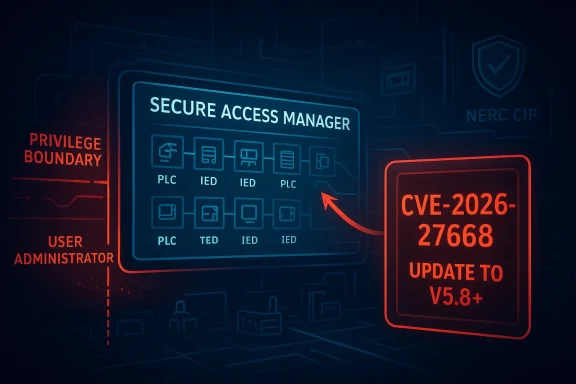
Siemens’ latest industrial-security advisory for RUGGEDCOM CROSSBOW Secure Access Manager Primary is a reminder that management-plane bugs can be just as consequential as flaws in the field devices they protect. The issue, tracked as CVE-2026-27668, carries a CVSS 3.1 score of 8.8 and affects all versions before V5.8, with Siemens urging customers to upgrade immediately s an incorrect privilege assignment problem: an authenticated User Administrator can administer groups they belong to and potentially escalate into control over any device group at any access level . For operators in crand other industrial environments, that makes this far more than a routine patch notice; it is a direct warning about trust boundaries, role design, and the fragility of admin logic in security software.
RUGGEDCOM CROSSBOW is Siemens’ secure access management solution for NERC CIP-compliant access to intelligent electronic devices, which makes it part of the control plane for industrial operations rather than a simple convenience feature . The advisory published by Siemens Produc26, and republished by CISA on April 21, 2026, describes a flaw that could let an authenticated administrator overreach their assigned scope and grant themselves access to device groups they should not control . That combination of privileged access and industrial reach isrability so significant.
This is not the kind of bug that depends on exotic memory corruption or a perfectly timed race. Instead, the logic error sits in the authorization model itself, which is often harder to spot and much harder to compensate for after deployment. When access control goes wrong in a system used to broker administrative access to industrial devices, the consequences can be broader than a single compromised account. They can include policy abuse, lateral movement, and the quiet reshaping of who can touch critical assets.
The advisory also underscores an important reality of industrial security: attackers do not always need to break in through the front door if the front door already contains an authorization mistake. A User Administrator with legitimate credentials is still an authenticated actor, and the flaw appears to let that role stretch beyond its intended bounds. In practice, that means the vulnerability sits at the intersection of identity, permissions, and device governance.
CISA’s republication adds the usual control-system defensive guidance: minimize network exposure, keep devices behind firewalls, segregate control-system networks from business networks, and use remote access methods carefully, with VPNs updated and monitored as part of a broader defense-in-depth posture . Those recommendations are standard, but in this case they are especially relevant plane product exposed too broadly can become an attractive stepping stone. The risk is not only that someone gets in; it is that they get in as the wrong kind of administrator.
Siemens says the outcome could be severe: an authenticated User Administrator may be able to grant themselves access to any device group at any access level . That matters because device groups are not decorative labels. In an industrial access-management system, a group can define hable, what administrative functions are exposed, and how much operational authority a user effectively has.
The advisory’s CWE-266: Incorrect Privilege Assignment classification captures the essence of the problem: the software assigns or interprets privileges in a way that violates the intended security policy . That can be more dangerous than a crash because it may create a path to persistent misuse that looks valid in logs. Security teams tend to prioribut misassigned privileges often leave the cleanest footprints for attackers.
The high base score is also a clue. With network attack vector, low attack complexity, low privileges required, and no user interaction, the issue is comparatively straightforward to exploit if the attacker already has the relevant role credentials . That makes this one of those cases where the real barrier is not technical ingenuity, but access to an affected account.
That profile is especially troubling for a secure-access gateway or management system. If an attacker can elevate within the administrative plane, they may not need to attack individual field devices at all. Instead, they can use the trusted management layer to reshape access policy and then operate downstream with seemingly legitimate authority.
The no user interaction component also matters. There is no need for a victim to click a link, approve a prompt, or open a booby-trapped file. That makes the issue more suitable for abuse in unattended or semi-unattended environments, where admin accounts are used by scripts, operators, or centralized management tools.
The high confidentiality, integrity, and availability impact combination is especially important in industrial settings because access-management compromise can become a multiplier. If policy is altered, the attacker’s reach can expand beyond one account or one device set. That is why authorization bugs are often more dangerous than they first appear: they can turn a narrow foothold into a broad administrative platform.
The advisory does not frame the fix as optional or as something that can safely wait for the next routine maintenance cycle. Siemens says it has released a new version and recommends updating to the latest version . In industrial environments, that wording should be taken seriously, especially when the product sits near privileged access to critical devices.
A sensible rollout plan would begin with inventory. Organizations need to confirm where SAM-P is deployed, which version is installed, and whether the product is exposed to broader administrative networks than intended. Once that is known, the upgrade to V5.8 or later should be prioritized based on operational criticality and exposure.
The advisory’s age matters too. Siemens published the advisory on April 14, 2026, and CISA republished it on April 21, 2026 . That one-week gap is normal for republished industrial advisories, but it also means defenders should already be treating the issue as current, not historical. In industrial security, “published last week” often means “act now.”
This is also why the advisory’s phrase about access to any device group at any access level is so worrisome . A group-based system is supposed to simplify policy enforcement. If the group model is broken, the simplification becomes a shortcut to privilege expansion.
In manufacturing environments, such an escalation could enable unauthorized maintenance actions, configuration access, or operational an attacker does not disrupt production immediately, the mere ability to broaden access can set the stage for later sabotage or stealthy manipulation.
Siemens ProductCERT’s advisory also notes that the issue was reported to CISA by Siemens ProductCERT . That indicates a conventional responsible-disclosure path, which is reassuring, but it also suggests the flaw was serious enough to warrant coordinated public notice. In industrial security, that level of coordination often marks a vulnerability that the vendor wants customers to patch before attackers can make .
The advisory’s CWE-266 classification is useful because it shows this is not a random implementation mistake. It fits a pattern seen across many products: a role is given the power to manage a scope that should have remained off-limits to that same role. That kind of design failure is often subtle during development and obvious only after a security review.
This is also why industrial customers should not treat one Siemens advisory as isolated. The right response is to review authorization logic across similar systems, especially where group ownership, group membership, and admin delegation intersect. Those are the seams where privilege boundaries tend to fray.
If an attacker can become a more powerful administrator inside SAM-P, they may be able to reach device groups that were meant to stay segregated. That can have implications for segmentation, maintenance approval, change control, and remote support. In large plants or multi-site environments, those capabilities can translate into broad access to industrial assets.
There is also a documentation problem. Many organizations believe they know what a role can do, but the live product behavior may diverge from the intended policy over time. When that happens, auditing the configuration may not be enough; the behavior itself must be tested. That distinction is crucial.
A secure access manager compromise may not immediately look like an incident. It may appear as a legitimate policy update, an approved group change, or a routine access adjustment. That is what makes it dangerous. The better the attacker fits the expected administrative workflow, the less likely the activity is to trigger suspicion.
The consumer analogy is imperfect, but useful: when management software governs access to important systems, the security of the admin console can matter more than the devices themselves. A flaw that lets one user administrator become effectively omnipotent is not a niche concern. It is a shortcut to broad control.
There is also the common reality of “temporary” exceptions that become permanent. A team grants extra access to get through a project, a service window, or a vendor support case, and the exception stays in place. If the software’s own authorization logic is flawed, those exceptions become even more hazardous.
The safest posture is to treat SAM-P as a security-sensitive control component, not as an ordinary admin utility. Even where deployment is limited, the consequences of overbroad access can still be severe. In operational technology, a small site does not mean a small risk.
There is also an opportunity here for industrial operators to audit related trust boundaries. A bug like this often reveals not just a single bad role assdesign pattern in how administrative privileges are modeled. That is the bigger lesson.
A second concern is underestimation. Authorization flaws are sometimes treated as less urgent than memory corruption or ransomware because they do not always generate dramatic symptoms. But quiet privilege escalation is exactly the sort of issue attackers prefer. It lets them blend into normal administrative activity.
It will also be worth watching whether similar authorization issues show up in adjacent Siemens access or device-management products. When one admin-plane vulnerability appears, it often signals broader pressure on role design, delegation logic, and boundary enforcement across a product family. Those are the seams that deserve scrutiny.
Source: CISA Siemens RUGGEDCOM CROSSBOW Secure Access Manager Primary | CISA
 Overview
RUGGEDCOM CROSSBOW is Siemens’ secure access management solution for NERC CIP-compliant access to intelligent electronic devices, which makes it part of the control plane for industrial operations rather than a simple convenience feature . The advisory published by Siemens Produc26, and republished by CISA on April 21, 2026, describes a flaw that could let an authenticated administrator overreach their assigned scope and grant themselves access to device groups they should not control . That combination of privileged access and industrial reach isrability so significant.This is not the kind of bug that depends on exotic memory corruption or a perfectly timed race. Instead, the logic error sits in the authorization model itself, which is often harder to spot and much harder to compensate for after deployment. When access control goes wrong in a system used to broker administrative access to industrial devices, the consequences can be broader than a single compromised account. They can include policy abuse, lateral movement, and the quiet reshaping of who can touch critical assets.
The advisory also underscores an important reality of industrial security: attackers do not always need to break in through the front door if the front door already contains an authorization mistake. A User Administrator with legitimate credentials is still an authenticated actor, and the flaw appears to let that role stretch beyond its intended bounds. In practice, that means the vulnerability sits at the intersection of identity, permissions, and device governance.
CISA’s republication adds the usual control-system defensive guidance: minimize network exposure, keep devices behind firewalls, segregate control-system networks from business networks, and use remote access methods carefully, with VPNs updated and monitored as part of a broader defense-in-depth posture . Those recommendations are standard, but in this case they are especially relevant plane product exposed too broadly can become an attractive stepping stone. The risk is not only that someone gets in; it is that they get in as the wrong kind of administrator.
What Siemens Says Happened
According to Siemens ProductCERT, the flaw exists because User Administrators are allowed to administer groups they belong to . That sounds narrow, but it is exactly the sort of sentence that sets off alarm bells in authorization r modify the groups it belongs to, then the boundary between membership and control starts to blur, and the system may allow privilege escalation through an apparently legitimate workflow.Siemens says the outcome could be severe: an authenticated User Administrator may be able to grant themselves access to any device group at any access level . That matters because device groups are not decorative labels. In an industrial access-management system, a group can define hable, what administrative functions are exposed, and how much operational authority a user effectively has.
Why this is not “just” a permissions bug
At first glance, one might dismiss the issue as a role-management mistake. That would be a mistake of its own. In a product designed to mediate access to industrial assets, permissions are the product, and authorization correctness is the security model itself.The advisory’s CWE-266: Incorrect Privilege Assignment classification captures the essence of the problem: the software assigns or interprets privileges in a way that violates the intended security policy . That can be more dangerous than a crash because it may create a path to persistent misuse that looks valid in logs. Security teams tend to prioribut misassigned privileges often leave the cleanest footprints for attackers.
The high base score is also a clue. With network attack vector, low attack complexity, low privileges required, and no user interaction, the issue is comparatively straightforward to exploit if the attacker already has the relevant role credentials . That makes this one of those cases where the real barrier is not technical ingenuity, but access to an affected account.
- The flaw affects authenticated users, not - The vulnerable role is a User Administrator, not a generic viewer.
- The impact can extend to any device group and any access level.
- The severity is driven by confidentiality, integrity, and availability impact together.
- The bug lives in policy logic, not in a temporary service failure.
Why the CVSS Score Matters
A CVSS 3.1 base score of 8.8 is not a casual rating; it places the issue firmly in the high-severity range . The vector tells the story: AV:N/AC:L/PR:L/UI:N/S:U/C:H/I:H/A:H. In plain English, the vulnerability is reachable over the network, is not hard to exploit, requires only low privilegefidentiality, integrity, and availability at a high level.That profile is especially troubling for a secure-access gateway or management system. If an attacker can elevate within the administrative plane, they may not need to attack individual field devices at all. Instead, they can use the trusted management layer to reshape access policy and then operate downstream with seemingly legitimate authority.
How to read the vector in operational terms
The low attack complexity means defenders should not assume the flaw is hard to trigger just because it affects an industrial product. The vulnerability is not a theoretical edge case that requires lab-only conditions. If an attacker has the right role, the path may be direct.The no user interaction component also matters. There is no need for a victim to click a link, approve a prompt, or open a booby-trapped file. That makes the issue more suitable for abuse in unattended or semi-unattended environments, where admin accounts are used by scripts, operators, or centralized management tools.
The high confidentiality, integrity, and availability impact combination is especially important in industrial settings because access-management compromise can become a multiplier. If policy is altered, the attacker’s reach can expand beyond one account or one device set. That is why authorization bugs are often more dangerous than they first appear: they can turn a narrow foothold into a broad administrative platform.
- Network reach expands the possible attack surface.
- Low privileges mean the attacker may already be inside the role structure.
- High impact across all three security pillars suggests a broad blast radius.
- No UI dependency reduces the chance that human vigilance will save the day.
- The score implies prompt remediation, not deferred maintenance.
The Update Siemens Recommends
Siemens’ remediation is clear: update to V5.8 or later . That is the most important operational fact in the advisory, because it turns the issue from a theoretical risk into a patch-management task. For organizations running SAM-P, the question is not whether the ftion is how quickly the upgrade can be validated and deployed without disrupting access workflows.The advisory does not frame the fix as optional or as something that can safely wait for the next routine maintenance cycle. Siemens says it has released a new version and recommends updating to the latest version . In industrial environments, that wording should be taken seriously, especially when the product sits near privileged access to critical devices.
Patch strategy in industrial environments
Industrial patching is always a balas expensive, change windows are narrow, and the systems involved may be tied to production schedules or compliance commitments. But that reality does not weaken the security case here; it strengthens it, because access-management flaws can be exploited without the noise of overt malware or device tampering.A sensible rollout plan would begin with inventory. Organizations need to confirm where SAM-P is deployed, which version is installed, and whether the product is exposed to broader administrative networks than intended. Once that is known, the upgrade to V5.8 or later should be prioritized based on operational criticality and exposure.
The advisory’s age matters too. Siemens published the advisory on April 14, 2026, and CISA republished it on April 21, 2026 . That one-week gap is normal for republished industrial advisories, but it also means defenders should already be treating the issue as current, not historical. In industrial security, “published last week” often means “act now.”
- Confirm whether where in the environment.
- Check whether installed versions are below V5.8.
- Prioritize systems that mediate administrator access.
- Validate the upgrade in a staging or maintenance window.
- Recheck role assignments after the update.
The Industrial Control System Angle
This advisory is especially important because it lands in a sector CISA identifies as Critical Manufacturing with worldwide deployment . That means the issue is not just a software defect in a niche admin tool; it is a vulnerability in the access layer that can sit upstream of industrial endpoints. When the control plane is vulnerable, the downstream devices inherit the risk whether or not they themselvesial control environments have long struggled with the tension between availability and security. Operators want systems that stay up, authenticate quickly, and avoid surprising changes. Attackers love that stability because it often leaves older permissions structures in place for years. This is why management-plane vulnerabilities matter so much: they exploit the very conservatism that keeps industrial operations reliable.Why access brokers are high-value targets
A secure access manager is not a peripheral component. It decides who can reach what, when, and under what conditions. Compromise that layer, and the attacker may no longer need to scan every device individually.This is also why the advisory’s phrase about access to any device group at any access level is so worrisome . A group-based system is supposed to simplify policy enforcement. If the group model is broken, the simplification becomes a shortcut to privilege expansion.
In manufacturing environments, such an escalation could enable unauthorized maintenance actions, configuration access, or operational an attacker does not disrupt production immediately, the mere ability to broaden access can set the stage for later sabotage or stealthy manipulation.
- Access brokers concentrate trust.
- Group-based policy mistakes scale quickly.
- Industrial systems often keep roles stable for long periods.
- Admin workflows may be shared by multiple teams.
- One misassigned privilege can affect many devices at once.
The Broader Siemens Security Pattern
This is not the first Siemens-related industrial advisory to emphasize access and privilege boundaries, and that matters. Vendors often harden one product area only to discover that adjacent components still assume too much trust. A recurring theme in industrial security is that the weakest point is often not the device itself, but the management layer that configures it.Siemens ProductCERT’s advisory also notes that the issue was reported to CISA by Siemens ProductCERT . That indicates a conventional responsible-disclosure path, which is reassuring, but it also suggests the flaw was serious enough to warrant coordinated public notice. In industrial security, that level of coordination often marks a vulnerability that the vendor wants customers to patch before attackers can make .
Why advisories like this keep repeating
Management and access-control systems tend to accumulate role exceptions over time. Administrators want flexibility, operators want convenience, and product designers try to avoid breaking existing deployments. The result is often a permissions model that grows by exception until the edge cases become security bugs.The advisory’s CWE-266 classification is useful because it shows this is not a random implementation mistake. It fits a pattern seen across many products: a role is given the power to manage a scope that should have remained off-limits to that same role. That kind of design failure is often subtle during development and obvious only after a security review.
This is also why industrial customers should not treat one Siemens advisory as isolated. The right response is to review authorization logic across similar systems, especially where group ownership, group membership, and admin delegation intersect. Those are the seams where privilege boundaries tend to fray.
- Group ownership and group membership should never imply automatic control.
- Delegated admin rights need explicit limits.
- Exceptions should be documented and reviewed regularly.
- Security architecture should assume roles will be abused if possible.
- Auditability matters as much as functional correctness.
Enterprise Exposure and Operational Risk
For enterprise operators, the important question is not whether an attacker can “break” the system in a dramatic way. It is whether the system can be coerced into authorizing something it should never authorize. In this case, the answer appears to be yes, and that makes the risk operational rather than merely technical.If an attacker can become a more powerful administrator inside SAM-P, they may be able to reach device groups that were meant to stay segregated. That can have implications for segmentation, maintenance approval, change control, and remote support. In large plants or multi-site environments, those capabilities can translate into broad access to industrial assets.
What makes enterprises particularly vulnerable
Enterprises often rely on shared administrative patterns. The same role definitions may be copied across plants, subsidiaries, or vendor-managed sites. That creates a multiplier effect: a single misconfigured authorization rule can be replicated at scale.There is also a documentation problem. Many organizations believe they know what a role can do, but the live product behavior may diverge from the intended policy over time. When that happens, auditing the configuration may not be enough; the behavior itself must be tested. That distinction is crucial.
A secure access manager compromise may not immediately look like an incident. It may appear as a legitimate policy update, an approved group change, or a routine access adjustment. That is what makes it dangerous. The better the attacker fits the expected administrative workflow, the less likely the activity is to trigger suspicion.
- Multi-site deployments can spread the same flaw everywhere.
- Shared admin patterns can hide weak role boundaries.
- Logged actions may look legitimate even when they are not.
- Security teams may miss the attack if they focus only on malware.
- Access policy abuse can precede much larger incidents.
Consumer and Smaller-Site Impact
Although this is firmly an industrial advisory, smaller operators should not ignore it. The fact that the affected product is tied to critical manufacturing does not mean the blast radius ends with Fortune 500 facilities. Smaller plants, integrators, utilities, and managed service providers may also run the same software stack or depend on it indirectly.The consumer analogy is imperfect, but useful: when management software governs access to important systems, the security of the admin console can matter more than the devices themselves. A flaw that lets one user administrator become effectively omnipotent is not a niche concern. It is a shortcut to broad control.
Why smaller teams may be at special risk
Smaller sites often have fewer dedicated security staff and less frequent access review. They may also depend more heavily on vendor guidance and default role assignments. That can make them slower to notice when a role model is overly permissive.There is also the common reality of “temporary” exceptions that become permanent. A team grants extra access to get through a project, a service window, or a vendor support case, and the exception stays in place. If the software’s own authorization logic is flawed, those exceptions become even more hazardous.
The safest posture is to treat SAM-P as a security-sensitive control component, not as an ordinary admin utility. Even where deployment is limited, the consequences of overbroad access can still be severe. In operational technology, a small site does not mean a small risk.
- Smaller sites may have weaker access-review processes.
- Vendor support workflows can normalize broad privileges.
- Temporary exceptions can become permanent.
- Misconfigured admin roles can linger unnoticed.
- Limited staffing increases the chance of delayed patching.
Strengths and Opportunities
The strongest aspect of this advisory is its clarity. Siemens has identified the vulnerable product, the affected version range, the exploit condition, and the remediation path in a way that leaves little room for ambiguity . That makes it much easier for defenders to act quickly. It also makes the advisory valuable as a model of how industrial vendors should communicate high-risk authorization flaws.There is also an opportunity here for industrial operators to audit related trust boundaries. A bug like this often reveals not just a single bad role assdesign pattern in how administrative privileges are modeled. That is the bigger lesson.
- Clear version boundary: all versions prior to V5.8 are affected.
- Straightforward fix: upgrade to V5.8 or later.
- High-confidence severity rating supports urgent remediation.
- The flaw is understandable to both security and operations teams.
- The advisory improves visibility for critical-manufacturing defenders.
- The issue encourages broader access-control audits.
- The notice supports better segmentation and role hygiene.
Risks and Concerns
The most obvious concern is exposure time. Even when a vendor publishes a fix quickly, industrial environments often patch slowly because uptime and validation requirements are high. That delay can leave systems vulnerable long after the advisory becomes public. In practice, the patch schedule can matter as much as the patch itself.A second concern is underestimation. Authorization flaws are sometimes treated as less urgent than memory corruption or ransomware because they do not always generate dramatic symptoms. But quiet privilege escalation is exactly the sort of issue attackers prefer. It lets them blend into normal administrative activity.
- Patch lag can outlast disclosure by weeks or months.
- Mixed fleets make version tracking difficult.
- Administrative abuse may look legitimate in logs.
- Role-model flaws can spread across templates and deployments.
- Compensating controls may not catch policy misuse.
- Review teams may focus on endpoints and ignore management layers.
- Industrial change windows can slow remediation.
Looking Ahead
The next thing to watch is how quickly Siemens customers move from awareness to remediation. Advisories that affect secure access managers often expose a gap between what organizations think their admin roles allow and what the product actually permits. That gap only closes when operators verify the installed version, review group ownership logic, and confirm that no local policy workarounds remain in place.It will also be worth watching whether similar authorization issues show up in adjacent Siemens access or device-management products. When one admin-plane vulnerability appears, it often signals broader pressure on role design, delegation logic, and boundary enforcement across a product family. Those are the seams that deserve scrutiny.
- Verify whether SAM-P instances are below V5.8.
- Prioritize internet-reachable or broadly reachable management paths.
- Review whether User Administrator roles are over-permissive elsewhere.
- Check for nested group or inherited privilege behaviors.
- Confirm the upgrade does not break legitimate access workflows.
- Reassess access segmentation after remediation.
Source: CISA Siemens RUGGEDCOM CROSSBOW Secure Access Manager Primary | CISA
