

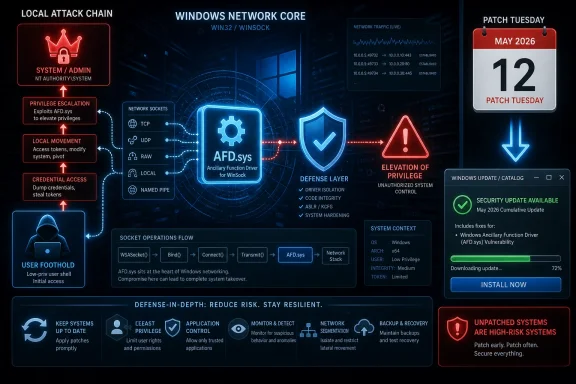
Microsoft disclosed CVE-2026-35416 on May 12, 2026, as a Windows Ancillary Function Driver for WinSock elevation-of-privilege vulnerability affecting supported Windows client and server releases, with remediation delivered through the regular Patch Tuesday security update channel. The short version is familiar, but not comforting: another local Windows kernel-adjacent bug has landed in a component that sits close to networking and is present almost everywhere. This is not the kind of flaw that lets an anonymous attacker stroll in from the internet by itself. It is the kind that turns a foothold into control.
CVE-2026-35416 arrives with the sparse phrasing that has become standard for many Microsoft Security Response Center entries: component, impact, affected platforms, score, exploitability guidance, and a patch. That minimalism is deliberate. Microsoft is trying to give defenders enough to prioritize without publishing a road map for exploit writers.
The affected component, the Windows Ancillary Function Driver for WinSock, is better known to many defenders as AFD.sys. It is a kernel-mode driver tied to Windows socket operations, and it has become a recurring name in Windows local privilege escalation advisories. When AFD.sys appears in a Patch Tuesday table, seasoned administrators do not read it as an exotic corner case.
That does not mean every AFD.sys CVE is equally dangerous. The important distinction is that this class of vulnerability generally requires local access or the ability to run code on the target machine. But in modern intrusions, “local” is often a temporary state, not a barrier. Phishing, browser exploitation, malicious documents, stolen credentials, exposed remote access tools, and compromised developer workstations all create the opening that a privilege-escalation bug can widen.
The practical reading is simple: CVE-2026-35416 is not likely to be the first move in an attack chain, but it can be the move that makes the rest of the chain much harder to stop.
Windows networking is a boundary-rich environment. User-mode processes make requests, kernel-mode code services them, handles and buffers cross privilege lines, and performance pressure discourages overly cautious design. Any bug in that space has the potential to become more than a crash. If the vulnerable path can be reached by a low-privileged process, a successful exploit may let that process obtain privileges it was never meant to have.
The recurring appearance of AFD.sys in Microsoft bulletins also says something about the maturity of Windows exploitation. Attackers do not need novelty for its own sake. They need reliable ways to climb from user context to administrator or SYSTEM context after they already have code execution. Local privilege escalation is the connective tissue between initial compromise and durable compromise.
For defenders, this is why “not remotely exploitable” should never be translated as “not urgent.” A remote code execution flaw may get the headlines, but an elevation-of-privilege flaw often decides whether the attacker can disable security tools, dump credentials, tamper with logs, install services, or move laterally with confidence.
That matters because vulnerability response is always partly a race over information. At one end of the spectrum, a vendor may acknowledge a vulnerability but release little public detail. At the other, researchers or attackers may already have proof-of-concept code, root-cause analysis, exploit notes, or active exploitation telemetry. The higher the confidence and the richer the technical detail, the less guesswork an attacker needs.
This is where administrators can misread the advisory. A confirmed vendor entry does not mean exploit details are public. It means the vendor is confident enough in the bug to assign a CVE and ship a fix. Those are different things, and the gap between them is the space in which patch timing matters.
Once a patch exists, reverse engineering begins. Attackers can compare vulnerable and fixed binaries, identify changed code paths, and build an exploit from the difference. That does not happen instantly for every bug, and some flaws remain too brittle or too environment-dependent to become commodity tools. But for a kernel component with a history of security attention, defenders should assume that patch diffing will start quickly.
A low-privileged foothold can be noisy and constrained. Security software may still be watching. Credential material may be inaccessible. Persistence may not survive a reboot. Administrative shares, sensitive registry hives, LSASS memory, service control, and driver loading may remain out of reach.
A working local privilege escalation changes that balance. It can turn a compromised user session into a platform for credential theft, defense evasion, and lateral movement. In ransomware operations, espionage campaigns, and hands-on-keyboard intrusions, that escalation step is not decorative. It is frequently the difference between a contained endpoint incident and a domain-wide problem.
CVE-2026-35416 should therefore be evaluated less as an isolated bug and more as a possible amplifier. If an attacker has no way to run code on a system, this vulnerability may not help them. If they do have code execution as a standard user, the risk profile changes sharply.
For enterprise IT, the calculus is more complicated but not fundamentally different. Security teams want rapid deployment; operations teams want assurance that file servers, domain controllers, VPN endpoints, line-of-business apps, and endpoint agents will survive the update. Both sides are right, which is why the organizations that handle Patch Tuesday best are the ones that have already built rings, rollback plans, and telemetry.
AFD.sys bugs deserve particular attention on systems where networking behavior is unusual or heavily instrumented. Endpoint detection agents, VPN clients, packet capture tools, firewalls, proxies, backup products, and legacy socket-heavy applications can all interact with networking internals in ways that make administrators cautious. That is not a reason to skip the update. It is a reason to test deliberately and deploy with eyes open.
The worst response is the middle path: delaying broadly without testing, then calling that caution. A real patch process moves. It starts with representative systems, watches for regressions, expands to larger rings, and closes the loop with compliance reporting.
The publication-time status can change, and for privilege-escalation flaws it often changes quietly. Attackers do not always need to burn a zero-day when a freshly patched one-day vulnerability will work against organizations that patch slowly. The less glamorous a bug looks, the longer it may remain useful against lagging fleets.
This is especially true for Windows client estates. A single unpatched developer workstation, jump box, help desk machine, or shared engineering system can be more valuable than a well-managed server. Those machines often have access paths, credentials, tokens, tools, and trust relationships that attackers can exploit after privilege escalation.
For servers, the risk depends heavily on exposure and role. A domain controller, remote desktop host, file server, build server, or management server deserves faster treatment than a low-value lab machine. But the baseline remains the same: supported Windows systems should receive the security update unless there is a documented compatibility blocker and a compensating control.
But the lack of public internals is not unusual for Microsoft’s monthly Windows advisories. The company’s security guide is built for operational response, not reverse-engineering education. In this model, the advisory says enough to justify action while withholding enough to slow weaponization.
That leaves defenders with process. Inventory affected systems. Confirm update applicability. Prioritize high-value assets. Deploy in rings. Monitor for installation failures. Watch for post-update regressions. Validate that security controls still start, network services still bind, and management tools still report.
This is the unglamorous truth of Windows security: the organizations that survive Patch Tuesday are rarely the ones with the cleverest hot takes about CVSS. They are the ones that can turn a vendor advisory into a measurable deployment within days, not weeks.
Context still matters. A kiosk with strict application control, no sensitive access, and fast reimaging is not the same as an administrator workstation. A test VM behind snapshots is not the same as a production remote access server. A vulnerability that requires local code execution is still more urgent on systems where attackers are most likely to land first.
The confidence metric adds another layer to that interpretation. It tells defenders how solid the underlying vulnerability information appears to be. A confirmed vendor issue with a shipped patch should not be dismissed merely because public exploit details are thin.
In fact, thin details can be the moment when defenders have the most advantage. Once exploit write-ups and proof-of-concept code circulate, the patching window becomes a scramble. Before that, it is still a managed maintenance problem.
Small businesses sit in the uncomfortable middle. They may not have WSUS, Intune, Defender for Endpoint, or formal vulnerability management, but they often have machines that hold payroll data, customer records, tax documents, VPN credentials, and administrator passwords. For them, “automatic updates eventually” is better than nothing, but it is not a strategy.
Larger enterprises should already be treating local privilege escalation bugs as part of endpoint hardening. Patch speed matters, but so do least privilege, application control, credential isolation, attack surface reduction rules, tamper protection, and monitoring for suspicious post-exploitation behavior. A patch closes one known path. Defense-in-depth reduces the value of the next one.
The key is not to let the word “local” shrink the response. Local vulnerabilities are exploited by attackers who have already solved the first problem. They are often the second problem defenders wish they had removed earlier.
Microsoft has spent years adding mitigations, hardening memory handling, tightening driver policies, and improving exploit resistance. Those investments matter. They raise the cost of exploitation and break old techniques. But they do not eliminate the economics of finding bugs in privileged Windows components.
The attacker’s incentive is obvious. A reliable local privilege escalation can be paired with many initial access methods. It can be reused across campaigns until patch adoption catches up. It can be hidden inside malware that otherwise looks like a conventional loader or post-exploitation tool.
That is why kernel-adjacent Patch Tuesday items deserve more than a quick glance. Even when they lack theatrical zero-day status, they often map closely to what attackers need after the first click, token theft, or foothold.
Source: MSRC Security Update Guide - Microsoft Security Response Center
 Microsoft’s Small Advisory Carries a Large Operational Message
CVE-2026-35416 arrives with the sparse phrasing that has become standard for many Microsoft Security Response Center entries: component, impact, affected platforms, score, exploitability guidance, and a patch. That minimalism is deliberate. Microsoft is trying to give defenders enough to prioritize without publishing a road map for exploit writers.The affected component, the Windows Ancillary Function Driver for WinSock, is better known to many defenders as AFD.sys. It is a kernel-mode driver tied to Windows socket operations, and it has become a recurring name in Windows local privilege escalation advisories. When AFD.sys appears in a Patch Tuesday table, seasoned administrators do not read it as an exotic corner case.
That does not mean every AFD.sys CVE is equally dangerous. The important distinction is that this class of vulnerability generally requires local access or the ability to run code on the target machine. But in modern intrusions, “local” is often a temporary state, not a barrier. Phishing, browser exploitation, malicious documents, stolen credentials, exposed remote access tools, and compromised developer workstations all create the opening that a privilege-escalation bug can widen.
The practical reading is simple: CVE-2026-35416 is not likely to be the first move in an attack chain, but it can be the move that makes the rest of the chain much harder to stop.
AFD.sys Keeps Reappearing Because It Sits Where Attackers Like to Pivot
AFD.sys is not a shiny consumer feature or a cloud-branded service with a marketing page. It is plumbing. That is exactly why attackers and vulnerability researchers keep circling back to it.Windows networking is a boundary-rich environment. User-mode processes make requests, kernel-mode code services them, handles and buffers cross privilege lines, and performance pressure discourages overly cautious design. Any bug in that space has the potential to become more than a crash. If the vulnerable path can be reached by a low-privileged process, a successful exploit may let that process obtain privileges it was never meant to have.
The recurring appearance of AFD.sys in Microsoft bulletins also says something about the maturity of Windows exploitation. Attackers do not need novelty for its own sake. They need reliable ways to climb from user context to administrator or SYSTEM context after they already have code execution. Local privilege escalation is the connective tissue between initial compromise and durable compromise.
For defenders, this is why “not remotely exploitable” should never be translated as “not urgent.” A remote code execution flaw may get the headlines, but an elevation-of-privilege flaw often decides whether the attacker can disable security tools, dump credentials, tamper with logs, install services, or move laterally with confidence.
The Confidence Metric Is Not Bureaucracy; It Is a Warning About Knowledge
The user-facing description attached to CVE-2026-35416 points to a metric that measures confidence in the vulnerability’s existence and in the credibility of known technical details. In plain English, it asks: do we know this thing is real, and how much do we know about how it works?That matters because vulnerability response is always partly a race over information. At one end of the spectrum, a vendor may acknowledge a vulnerability but release little public detail. At the other, researchers or attackers may already have proof-of-concept code, root-cause analysis, exploit notes, or active exploitation telemetry. The higher the confidence and the richer the technical detail, the less guesswork an attacker needs.
This is where administrators can misread the advisory. A confirmed vendor entry does not mean exploit details are public. It means the vendor is confident enough in the bug to assign a CVE and ship a fix. Those are different things, and the gap between them is the space in which patch timing matters.
Once a patch exists, reverse engineering begins. Attackers can compare vulnerable and fixed binaries, identify changed code paths, and build an exploit from the difference. That does not happen instantly for every bug, and some flaws remain too brittle or too environment-dependent to become commodity tools. But for a kernel component with a history of security attention, defenders should assume that patch diffing will start quickly.
Local Privilege Escalation Is the Attack Chain’s Force Multiplier
The phrase elevation of privilege has a way of sounding less dramatic than remote code execution. That is a mistake. In real environments, the attacker who already has a beachhead is often the attacker who matters most.A low-privileged foothold can be noisy and constrained. Security software may still be watching. Credential material may be inaccessible. Persistence may not survive a reboot. Administrative shares, sensitive registry hives, LSASS memory, service control, and driver loading may remain out of reach.
A working local privilege escalation changes that balance. It can turn a compromised user session into a platform for credential theft, defense evasion, and lateral movement. In ransomware operations, espionage campaigns, and hands-on-keyboard intrusions, that escalation step is not decorative. It is frequently the difference between a contained endpoint incident and a domain-wide problem.
CVE-2026-35416 should therefore be evaluated less as an isolated bug and more as a possible amplifier. If an attacker has no way to run code on a system, this vulnerability may not help them. If they do have code execution as a standard user, the risk profile changes sharply.
Patch Tuesday’s Real Burden Is Testing the Boring Parts
For home users, the advice is refreshingly dull: install the May 2026 Windows security updates and reboot. Windows Update exists for exactly this kind of bug. The risk of waiting usually outweighs the inconvenience of a restart.For enterprise IT, the calculus is more complicated but not fundamentally different. Security teams want rapid deployment; operations teams want assurance that file servers, domain controllers, VPN endpoints, line-of-business apps, and endpoint agents will survive the update. Both sides are right, which is why the organizations that handle Patch Tuesday best are the ones that have already built rings, rollback plans, and telemetry.
AFD.sys bugs deserve particular attention on systems where networking behavior is unusual or heavily instrumented. Endpoint detection agents, VPN clients, packet capture tools, firewalls, proxies, backup products, and legacy socket-heavy applications can all interact with networking internals in ways that make administrators cautious. That is not a reason to skip the update. It is a reason to test deliberately and deploy with eyes open.
The worst response is the middle path: delaying broadly without testing, then calling that caution. A real patch process moves. It starts with representative systems, watches for regressions, expands to larger rings, and closes the loop with compliance reporting.
The Absence of Public Exploitation Is Not a Comfort Blanket
If Microsoft does not mark a vulnerability as exploited in the wild, that is useful information. It is not a promise. It means Microsoft is not reporting known exploitation at publication time.The publication-time status can change, and for privilege-escalation flaws it often changes quietly. Attackers do not always need to burn a zero-day when a freshly patched one-day vulnerability will work against organizations that patch slowly. The less glamorous a bug looks, the longer it may remain useful against lagging fleets.
This is especially true for Windows client estates. A single unpatched developer workstation, jump box, help desk machine, or shared engineering system can be more valuable than a well-managed server. Those machines often have access paths, credentials, tokens, tools, and trust relationships that attackers can exploit after privilege escalation.
For servers, the risk depends heavily on exposure and role. A domain controller, remote desktop host, file server, build server, or management server deserves faster treatment than a low-value lab machine. But the baseline remains the same: supported Windows systems should receive the security update unless there is a documented compatibility blocker and a compensating control.
Microsoft’s Sparse Detail Leaves Defenders With Process, Not Drama
There is an understandable frustration when advisories omit root cause, exploit preconditions, and proof-level technical detail. Administrators want to know whether a bug is a use-after-free, an access-control failure, an integer overflow, or a race condition. Security engineers want indicators. Researchers want code paths.But the lack of public internals is not unusual for Microsoft’s monthly Windows advisories. The company’s security guide is built for operational response, not reverse-engineering education. In this model, the advisory says enough to justify action while withholding enough to slow weaponization.
That leaves defenders with process. Inventory affected systems. Confirm update applicability. Prioritize high-value assets. Deploy in rings. Monitor for installation failures. Watch for post-update regressions. Validate that security controls still start, network services still bind, and management tools still report.
This is the unglamorous truth of Windows security: the organizations that survive Patch Tuesday are rarely the ones with the cleverest hot takes about CVSS. They are the ones that can turn a vendor advisory into a measurable deployment within days, not weeks.
The Score Is a Starting Line, Not a Risk Model
CVSS is useful because it standardizes language. It is dangerous when treated as a substitute for judgment. A privilege-escalation vulnerability with a high severity score means the technical impact is serious under the stated conditions, but it does not automatically tell you which of your machines should be patched first.Context still matters. A kiosk with strict application control, no sensitive access, and fast reimaging is not the same as an administrator workstation. A test VM behind snapshots is not the same as a production remote access server. A vulnerability that requires local code execution is still more urgent on systems where attackers are most likely to land first.
The confidence metric adds another layer to that interpretation. It tells defenders how solid the underlying vulnerability information appears to be. A confirmed vendor issue with a shipped patch should not be dismissed merely because public exploit details are thin.
In fact, thin details can be the moment when defenders have the most advantage. Once exploit write-ups and proof-of-concept code circulate, the patching window becomes a scramble. Before that, it is still a managed maintenance problem.
Home PCs Get the Simple Version; Business Fleets Get the Hard One
For individual Windows users, CVE-2026-35416 is a reminder to let Windows Update do its job. Install the cumulative update, restart when prompted, and avoid running untrusted software. Most home users do not need to understand AFD.sys to make the correct decision.Small businesses sit in the uncomfortable middle. They may not have WSUS, Intune, Defender for Endpoint, or formal vulnerability management, but they often have machines that hold payroll data, customer records, tax documents, VPN credentials, and administrator passwords. For them, “automatic updates eventually” is better than nothing, but it is not a strategy.
Larger enterprises should already be treating local privilege escalation bugs as part of endpoint hardening. Patch speed matters, but so do least privilege, application control, credential isolation, attack surface reduction rules, tamper protection, and monitoring for suspicious post-exploitation behavior. A patch closes one known path. Defense-in-depth reduces the value of the next one.
The key is not to let the word “local” shrink the response. Local vulnerabilities are exploited by attackers who have already solved the first problem. They are often the second problem defenders wish they had removed earlier.
The Windows Kernel Remains the Prize Behind the First Compromise
AFD.sys is only one component, but CVE-2026-35416 fits a broader pattern. Modern Windows is heavily defended, yet the kernel remains a prize because kernel-level or SYSTEM-level execution gives attackers leverage over almost everything else on the machine.Microsoft has spent years adding mitigations, hardening memory handling, tightening driver policies, and improving exploit resistance. Those investments matter. They raise the cost of exploitation and break old techniques. But they do not eliminate the economics of finding bugs in privileged Windows components.
The attacker’s incentive is obvious. A reliable local privilege escalation can be paired with many initial access methods. It can be reused across campaigns until patch adoption catches up. It can be hidden inside malware that otherwise looks like a conventional loader or post-exploitation tool.
That is why kernel-adjacent Patch Tuesday items deserve more than a quick glance. Even when they lack theatrical zero-day status, they often map closely to what attackers need after the first click, token theft, or foothold.
The May AFD.sys Fix Belongs Near the Front of the Queue
CVE-2026-35416 is not a reason to panic, but it is a reason to move. The right response is disciplined urgency: patch supported systems, prioritize machines that would magnify an intrusion, and treat sparse technical detail as a temporary advantage rather than an excuse to wait.- CVE-2026-35416 is a Windows elevation-of-privilege vulnerability in the Ancillary Function Driver for WinSock, the AFD.sys component tied to Windows socket operations.
- The vulnerability is most relevant after an attacker already has local code execution or an authenticated foothold on a target machine.
- The May 12, 2026 security updates are the primary remediation path for supported Windows client and server systems.
- Systems with administrative use, remote access roles, developer tooling, security tooling, or sensitive credentials should be prioritized ahead of low-value endpoints.
- The lack of widely published exploit detail at disclosure should be treated as a patching window, not as proof that the bug is harmless.
- Organizations should validate update installation and watch for networking, VPN, endpoint security, and backup-agent regressions after deployment.
Source: MSRC Security Update Guide - Microsoft Security Response Center
