

Microsoft patched CVE-2026-41089, a critical Windows Netlogon remote code execution vulnerability affecting domain controllers, on May 12, 2026, and administrators are now being urged to prioritize domain controller patching after third-party warnings of active exploitation emerged in late May and early June. The bug is the kind of Windows Server flaw that compresses the usual patch-management debate into a much narrower question: how quickly can you protect the machines that define identity for the entire organization? Microsoft’s own advisory initially listed exploitation as less likely and not observed in the wild, but that is not the same thing as low risk. In Active Directory, a vulnerability does not need a catchy name or confirmed mass exploitation to be an emergency.
Netlogon has an unfortunately ordinary name for a service that sits near the heart of Windows enterprise trust. It helps maintain the secure channel between domain-joined machines and domain controllers, participating in the plumbing that lets Windows networks authenticate users, computers, and services without asking everyone to type passwords all day. When that layer breaks, the failure is not confined to a single application window or a single endpoint.
That is why a Netlogon remote code execution flaw lands differently from a bug in a peripheral Windows component. The target is not merely “a server.” In many environments, the target is the authority that decides who is allowed to become whom, where Kerberos tickets come from, and how machines establish trust across the estate.
CVE-2026-41089 is described as a stack-based buffer overflow in Windows Netlogon that could allow an unauthenticated attacker to execute code over the network against a Windows server acting as a domain controller. The CVSS 9.8 rating is not decorative. It reflects a combination security teams dread: network reachability, no required privileges, no required user interaction, and potentially complete compromise of confidentiality, integrity, and availability.
The operational lesson is familiar but still frequently ignored. Domain controllers are not just high-value assets; they are force multipliers. A successful compromise can become a launchpad for credential theft, Group Policy abuse, lateral movement, ransomware staging, and long-term persistence. Even a failed exploit that crashes a domain controller can become an authentication outage at exactly the wrong moment.
Exploitability ratings are a snapshot, not a prophecy. They describe Microsoft’s assessment at publication time, based on what is known about the bug, the platform, available mitigations, exploit reliability, and telemetry. Attackers get a vote after Patch Tuesday, and their vote often arrives after reverse engineering begins.
That dynamic is especially important for Windows Server vulnerabilities because the patch itself can become a roadmap. Once updates ship, skilled researchers and criminal groups can compare binaries, isolate changed functions, and infer the bug class. A vulnerability that looked awkward on disclosure day may look more tractable after two weeks of analysis, test harnesses, and failed attempts.
The reported warning from the Centre for Cybersecurity Belgium changes the practical risk calculus even if Microsoft has not yet moved its public flag to “Exploited: Yes.” In a perfect world, defenders would wait for neat alignment among vendor advisories, government alerts, threat intelligence feeds, and internal telemetry. In the world administrators actually inhabit, waiting for every dashboard to agree is how a “less likely” bug becomes a weekend incident.
A workstation fleet can often absorb staged failures. A domain controller fleet cannot be treated casually, but it also cannot be treated as untouchable. The right answer is not reckless patching; it is disciplined prioritization that puts domain controllers at the front of the queue while preserving rollback and recovery options.
In mature environments, that means identifying all writable domain controllers, read-only domain controllers, and any legacy Windows Server systems still participating in Active Directory. It means confirming backups before maintenance windows, checking replication health, and ensuring there are enough healthy DCs per site before cycling systems through updates. It also means resisting the temptation to patch “everything else first” because those systems are easier.
The uncomfortable truth is that easy patching is often low-value patching. If a vulnerability threatens Active Directory control, the most important systems are the ones administrators are most nervous about touching. CVE-2026-41089 is a reminder that operational caution and security urgency must be engineered to coexist, not allowed to cancel each other out.
Many organizations have improved internet-edge controls while leaving internal network access far too flat. Domain controllers may not be reachable from the public internet, but they are often reachable from broad internal address ranges, VPN pools, server subnets, management networks, and sometimes environments that should have been isolated years ago. If an attacker already has a foothold on one endpoint, a pre-authentication bug on a reachable DC is a terrifying escalation path.
This is where the conversation must move beyond “install the patch” and into “why could that host talk to Netlogon in the first place?” Domain controllers need to be reachable by domain-joined systems for legitimate reasons, but that does not imply unrestricted access from every VLAN, lab network, guest segment, contractor subnet, or stale VPN route. The practical control is not total isolation; it is intentional access.
Restricting RPC and Netlogon exposure is not always simple, because Windows domain operations involve dynamic ports, name resolution, Kerberos, LDAP, SMB, and other interdependent services. But complexity is not an excuse for leaving the crown jewels broadly reachable. Administrators should already know which systems need to communicate with domain controllers and from where. If they do not, this vulnerability is a brutal inventory exercise disguised as a patch event.
Vendors often require specific telemetry or validation before changing exploitation status. Government agencies may issue warnings based on incident response, partner reporting, or classified channels that are not fully disclosed. Security news sites may then summarize those warnings with varying degrees of precision. The result is an information environment where defenders must make decisions before the public record is perfectly synchronized.
For administrators, the correct response is not to argue over semantics. If a national cyber authority warns that a critical pre-authentication Netlogon RCE is being exploited, the defensive posture should change immediately. The burden of proof for emergency action is lower than the burden of proof for a vendor advisory status change.
That distinction matters because security teams sometimes become trapped by dashboards. If their vulnerability scanner says the patch is missing but the vendor page still says exploitation is less likely, they may downgrade the task behind browser zero-days, VPN bugs, or endpoint agent updates. In this case, the asset class should override the exploitability label. A domain controller vulnerability with this profile belongs near the top of the queue.
Zerologon taught defenders that flaws in authentication plumbing can bypass the comforting assumptions built around identity infrastructure. Once an attacker can subvert a domain controller, traditional endpoint boundaries become secondary. The directory is not merely another system to protect; it is the system that tells many other systems what protection means.
The lesson from that era was not only “patch faster.” It was also that Active Directory environments need tested recovery procedures, hardened administrative tiers, constrained delegation, privileged access workstations, strong monitoring, and realistic assumptions about compromise. A Netlogon RCE brings that same strategic lesson back into focus, even if the technical mechanics differ.
Organizations that responded to Zerologon by tightening DC exposure, auditing machine account behavior, and improving AD recovery are better positioned today. Organizations that treated it as a one-off panic and moved on are relearning the same lesson under a new CVE number.
That means checking update installation on each DC, not just relying on a deployment console’s aggregate success count. It means confirming replication health after patching, reviewing failed update logs, and making sure decommissioned or forgotten domain controllers are not still alive in a remote site, lab, or disaster recovery segment. Active Directory has a way of preserving the consequences of yesterday’s shortcuts.
Detection should also intensify around Netlogon and RPC traffic. Administrators should look for unusual sources contacting domain controllers, unexpected spikes in authentication-related traffic, abnormal RPC behavior, crashes or restarts of Netlogon-related services, and endpoint activity that suggests a host is probing DCs rather than using them normally. No single log line will neatly announce exploitation, but patterns matter.
The best monitoring posture combines network visibility with Windows event data and endpoint telemetry on the domain controllers themselves. That is sometimes politically difficult because DCs are treated as fragile and excluded from deeper inspection. CVE-2026-41089 is another argument against blind spots on the most important servers in the network.
This vulnerability gives administrators a concrete reason to revisit access control lists, firewall rules, VPN paths, and cloud connectivity into on-premises identity infrastructure. Hybrid environments complicate the picture because identity dependencies now stretch across on-prem AD, Microsoft Entra ID, synchronization servers, management agents, backup platforms, and privileged access tooling. A flat path into a DC from one forgotten management subnet can undo a lot of otherwise sensible security architecture.
The goal is not to break Windows authentication in pursuit of purity. The goal is to reduce unnecessary reachability. Workstations need to authenticate, servers need directory services, and administrators need management paths. But “needs access to Active Directory” should not automatically mean “can send arbitrary traffic to every domain controller from anywhere.”
This is also where organizations should examine their assumptions about internal trust. A pre-authentication network exploit is most dangerous after an attacker has landed somewhere else first. If a compromised laptop, vendor VPN account, or exposed server can directly reach DC services, the internal network is functioning as an exploit delivery system.
Active Directory recovery involves questions of authority, replication, credential validity, backup integrity, and trust. If attackers gain privileged control, they may create persistence that survives simple patching. They may alter Group Policy, add accounts, change ACLs, dump credentials, tamper with backups, or compromise systems used to manage recovery. In the worst cases, the directory cannot simply be “cleaned”; it must be restored to a known-good state with careful containment.
That is why offline or immutable backups matter. A backup that attackers can modify from the same administrative plane they compromised is not a reliable recovery anchor. A domain controller backup that has never been tested under realistic conditions is closer to a hope than a plan.
Security teams should use this moment to verify not only that backups exist, but that they can support authoritative restore scenarios, forest recovery planning, and staged rebuilds if necessary. This is not glamorous work. It is, however, the difference between a contained security event and a long, expensive identity crisis.
That does not mean Microsoft’s monthly release cadence is wrong. Predictability helps administrators plan, test, and deploy. But the predictable cadence must be matched by predictable urgency for certain categories of flaws. A critical RCE in authentication infrastructure cannot wait for the same leisurely cycle as a lower-risk client-side bug.
The phrase “patching domain controllers first” can sound obvious until one watches real organizations struggle with it. Change windows are fixed. Application owners resist downtime. Legacy systems have mysterious dependencies. Regional IT teams operate on different schedules. Outsourced providers move according to contract terms rather than threat tempo. Attackers do not care.
The best organizations pre-decide this class of response. They define emergency update procedures for domain controllers, maintain redundant capacity, rehearse rollback, and document who has authority to approve accelerated patching. When a CVE like this arrives, they are not inventing the process under pressure.
For CVE-2026-41089, the prioritization argument is unusually strong. The affected role is central. The attack vector is network-based. Authentication is not required. User interaction is not required. Third-party warnings suggest exploitation may already be underway. The cost of successful compromise is potentially domain-wide.
That does not mean every organization faces identical exposure. A tightly segmented environment with fully patched DCs, strong monitoring, and limited internal reachability has a different risk profile than a flat network with legacy Windows Server systems and stale VPN access. But the vulnerability’s shape gives defenders enough information to act now and refine later.
Administrators should also be cautious about public exploit claims and copycat write-ups. As attention rises, so does the volume of recycled, exaggerated, or AI-generated technical analysis. Treat credible vendor advisories, national cyber authority alerts, and observed internal telemetry as higher-value inputs than breathless posts promising “complete exploit details” without evidence.
The larger lesson is that Active Directory remains both the nervous system and the blast radius of the Windows enterprise. Microsoft can ship the patch, national agencies can issue warnings, and scanners can light up dashboards, but the outcome depends on whether organizations have built the muscle to update their most sensitive systems quickly and safely. CVE-2026-41089 will eventually fade into the long ledger of patched Windows flaws; the environments that survive it cleanly will be the ones that treat domain controller resilience not as a quarterly project, but as a standing condition of doing business.
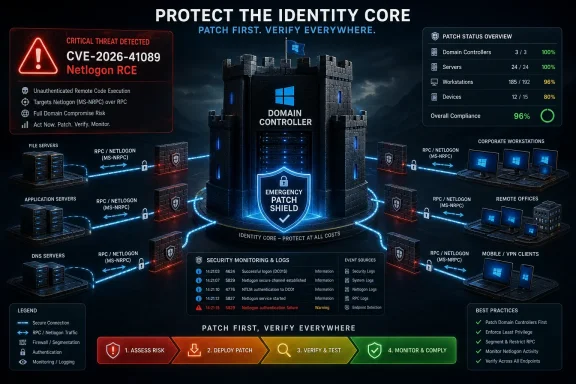 Netlogon Is Not Just Another Windows Service
Netlogon has an unfortunately ordinary name for a service that sits near the heart of Windows enterprise trust. It helps maintain the secure channel between domain-joined machines and domain controllers, participating in the plumbing that lets Windows networks authenticate users, computers, and services without asking everyone to type passwords all day. When that layer breaks, the failure is not confined to a single application window or a single endpoint.That is why a Netlogon remote code execution flaw lands differently from a bug in a peripheral Windows component. The target is not merely “a server.” In many environments, the target is the authority that decides who is allowed to become whom, where Kerberos tickets come from, and how machines establish trust across the estate.
CVE-2026-41089 is described as a stack-based buffer overflow in Windows Netlogon that could allow an unauthenticated attacker to execute code over the network against a Windows server acting as a domain controller. The CVSS 9.8 rating is not decorative. It reflects a combination security teams dread: network reachability, no required privileges, no required user interaction, and potentially complete compromise of confidentiality, integrity, and availability.
The operational lesson is familiar but still frequently ignored. Domain controllers are not just high-value assets; they are force multipliers. A successful compromise can become a launchpad for credential theft, Group Policy abuse, lateral movement, ransomware staging, and long-term persistence. Even a failed exploit that crashes a domain controller can become an authentication outage at exactly the wrong moment.
Microsoft’s “Less Likely” Label Was Never a Permission Slip
Microsoft’s May 12 Patch Tuesday release reportedly fixed the vulnerability while marking exploitation as not detected and exploitation less likely. That language matters, but it is often misunderstood outside security teams. “Less likely” is not “unexploitable,” and “not exploited” is not “safe to defer.”Exploitability ratings are a snapshot, not a prophecy. They describe Microsoft’s assessment at publication time, based on what is known about the bug, the platform, available mitigations, exploit reliability, and telemetry. Attackers get a vote after Patch Tuesday, and their vote often arrives after reverse engineering begins.
That dynamic is especially important for Windows Server vulnerabilities because the patch itself can become a roadmap. Once updates ship, skilled researchers and criminal groups can compare binaries, isolate changed functions, and infer the bug class. A vulnerability that looked awkward on disclosure day may look more tractable after two weeks of analysis, test harnesses, and failed attempts.
The reported warning from the Centre for Cybersecurity Belgium changes the practical risk calculus even if Microsoft has not yet moved its public flag to “Exploited: Yes.” In a perfect world, defenders would wait for neat alignment among vendor advisories, government alerts, threat intelligence feeds, and internal telemetry. In the world administrators actually inhabit, waiting for every dashboard to agree is how a “less likely” bug becomes a weekend incident.
The Domain Controller Is Where Patch Triage Gets Real
“Patch immediately” is easy to write and hard to execute. Domain controllers are among the most sensitive Windows systems to update because downtime, replication problems, authentication failures, and legacy dependencies can create visible business impact. That friction is exactly why attackers like this class of target.A workstation fleet can often absorb staged failures. A domain controller fleet cannot be treated casually, but it also cannot be treated as untouchable. The right answer is not reckless patching; it is disciplined prioritization that puts domain controllers at the front of the queue while preserving rollback and recovery options.
In mature environments, that means identifying all writable domain controllers, read-only domain controllers, and any legacy Windows Server systems still participating in Active Directory. It means confirming backups before maintenance windows, checking replication health, and ensuring there are enough healthy DCs per site before cycling systems through updates. It also means resisting the temptation to patch “everything else first” because those systems are easier.
The uncomfortable truth is that easy patching is often low-value patching. If a vulnerability threatens Active Directory control, the most important systems are the ones administrators are most nervous about touching. CVE-2026-41089 is a reminder that operational caution and security urgency must be engineered to coexist, not allowed to cancel each other out.
A Pre-Authentication Network Bug Changes the Perimeter Conversation
The most alarming part of the advisory is not simply that the flaw is remote code execution. It is that the described attack path does not require an attacker to authenticate or convince a user to click anything. That moves the vulnerability into the category of bugs where network exposure and internal segmentation become decisive.Many organizations have improved internet-edge controls while leaving internal network access far too flat. Domain controllers may not be reachable from the public internet, but they are often reachable from broad internal address ranges, VPN pools, server subnets, management networks, and sometimes environments that should have been isolated years ago. If an attacker already has a foothold on one endpoint, a pre-authentication bug on a reachable DC is a terrifying escalation path.
This is where the conversation must move beyond “install the patch” and into “why could that host talk to Netlogon in the first place?” Domain controllers need to be reachable by domain-joined systems for legitimate reasons, but that does not imply unrestricted access from every VLAN, lab network, guest segment, contractor subnet, or stale VPN route. The practical control is not total isolation; it is intentional access.
Restricting RPC and Netlogon exposure is not always simple, because Windows domain operations involve dynamic ports, name resolution, Kerberos, LDAP, SMB, and other interdependent services. But complexity is not an excuse for leaving the crown jewels broadly reachable. Administrators should already know which systems need to communicate with domain controllers and from where. If they do not, this vulnerability is a brutal inventory exercise disguised as a patch event.
Active Exploitation Reports Are a Warning, Not a Court Verdict
The current public picture contains an important ambiguity. Microsoft’s official status, according to the user-supplied source, has not confirmed exploitation in the wild. Third-party reporting, citing Belgium’s national cybersecurity authority, says exploitation is happening. Those two statements can coexist for a period of time without either being malicious or incompetent.Vendors often require specific telemetry or validation before changing exploitation status. Government agencies may issue warnings based on incident response, partner reporting, or classified channels that are not fully disclosed. Security news sites may then summarize those warnings with varying degrees of precision. The result is an information environment where defenders must make decisions before the public record is perfectly synchronized.
For administrators, the correct response is not to argue over semantics. If a national cyber authority warns that a critical pre-authentication Netlogon RCE is being exploited, the defensive posture should change immediately. The burden of proof for emergency action is lower than the burden of proof for a vendor advisory status change.
That distinction matters because security teams sometimes become trapped by dashboards. If their vulnerability scanner says the patch is missing but the vendor page still says exploitation is less likely, they may downgrade the task behind browser zero-days, VPN bugs, or endpoint agent updates. In this case, the asset class should override the exploitability label. A domain controller vulnerability with this profile belongs near the top of the queue.
Zerologon’s Shadow Still Hangs Over Active Directory
Any serious discussion of Netlogon security inevitably recalls Zerologon, the 2020 vulnerability that allowed attackers to abuse Netlogon cryptography and potentially take over domain controllers. CVE-2026-41089 is not the same vulnerability, and administrators should avoid treating every Netlogon issue as a replay of the last famous one. But the historical echo matters.Zerologon taught defenders that flaws in authentication plumbing can bypass the comforting assumptions built around identity infrastructure. Once an attacker can subvert a domain controller, traditional endpoint boundaries become secondary. The directory is not merely another system to protect; it is the system that tells many other systems what protection means.
The lesson from that era was not only “patch faster.” It was also that Active Directory environments need tested recovery procedures, hardened administrative tiers, constrained delegation, privileged access workstations, strong monitoring, and realistic assumptions about compromise. A Netlogon RCE brings that same strategic lesson back into focus, even if the technical mechanics differ.
Organizations that responded to Zerologon by tightening DC exposure, auditing machine account behavior, and improving AD recovery are better positioned today. Organizations that treated it as a one-off panic and moved on are relearning the same lesson under a new CVE number.
The First Move Is Patching, But the Second Move Is Proving
Once domain controllers are updated, the job is not over. Security teams need evidence that the patch landed everywhere it matters. In many environments, the difference between “we patched the domain controllers” and “every domain controller is patched” is where incidents live.That means checking update installation on each DC, not just relying on a deployment console’s aggregate success count. It means confirming replication health after patching, reviewing failed update logs, and making sure decommissioned or forgotten domain controllers are not still alive in a remote site, lab, or disaster recovery segment. Active Directory has a way of preserving the consequences of yesterday’s shortcuts.
Detection should also intensify around Netlogon and RPC traffic. Administrators should look for unusual sources contacting domain controllers, unexpected spikes in authentication-related traffic, abnormal RPC behavior, crashes or restarts of Netlogon-related services, and endpoint activity that suggests a host is probing DCs rather than using them normally. No single log line will neatly announce exploitation, but patterns matter.
The best monitoring posture combines network visibility with Windows event data and endpoint telemetry on the domain controllers themselves. That is sometimes politically difficult because DCs are treated as fragile and excluded from deeper inspection. CVE-2026-41089 is another argument against blind spots on the most important servers in the network.
Segmentation Is the Control Everyone Claims to Have
Most organizations believe they segment access to critical infrastructure until an incident proves otherwise. Domain controllers are the usual test case. If too many systems can reach too many DC services for too many reasons, segmentation exists more as a diagram than a defense.This vulnerability gives administrators a concrete reason to revisit access control lists, firewall rules, VPN paths, and cloud connectivity into on-premises identity infrastructure. Hybrid environments complicate the picture because identity dependencies now stretch across on-prem AD, Microsoft Entra ID, synchronization servers, management agents, backup platforms, and privileged access tooling. A flat path into a DC from one forgotten management subnet can undo a lot of otherwise sensible security architecture.
The goal is not to break Windows authentication in pursuit of purity. The goal is to reduce unnecessary reachability. Workstations need to authenticate, servers need directory services, and administrators need management paths. But “needs access to Active Directory” should not automatically mean “can send arbitrary traffic to every domain controller from anywhere.”
This is also where organizations should examine their assumptions about internal trust. A pre-authentication network exploit is most dangerous after an attacker has landed somewhere else first. If a compromised laptop, vendor VPN account, or exposed server can directly reach DC services, the internal network is functioning as an exploit delivery system.
Backups Are Not a Compliance Checkbox When the Directory Is at Stake
The user-supplied guidance rightly includes offline backups and AD recovery readiness. That line should not be read as generic hygiene. If domain controllers are compromised, recovery is not the same as restoring a file server or rebuilding a workstation image.Active Directory recovery involves questions of authority, replication, credential validity, backup integrity, and trust. If attackers gain privileged control, they may create persistence that survives simple patching. They may alter Group Policy, add accounts, change ACLs, dump credentials, tamper with backups, or compromise systems used to manage recovery. In the worst cases, the directory cannot simply be “cleaned”; it must be restored to a known-good state with careful containment.
That is why offline or immutable backups matter. A backup that attackers can modify from the same administrative plane they compromised is not a reliable recovery anchor. A domain controller backup that has never been tested under realistic conditions is closer to a hope than a plan.
Security teams should use this moment to verify not only that backups exist, but that they can support authoritative restore scenarios, forest recovery planning, and staged rebuilds if necessary. This is not glamorous work. It is, however, the difference between a contained security event and a long, expensive identity crisis.
The Patch Tuesday Model Meets the Adversary’s Calendar
CVE-2026-41089 also illustrates a broader weakness in enterprise patch culture. Patch Tuesday gives defenders a predictable rhythm, but it gives attackers one too. The calendar creates a public batch of clues, and the most valuable bugs in that batch receive attention first.That does not mean Microsoft’s monthly release cadence is wrong. Predictability helps administrators plan, test, and deploy. But the predictable cadence must be matched by predictable urgency for certain categories of flaws. A critical RCE in authentication infrastructure cannot wait for the same leisurely cycle as a lower-risk client-side bug.
The phrase “patching domain controllers first” can sound obvious until one watches real organizations struggle with it. Change windows are fixed. Application owners resist downtime. Legacy systems have mysterious dependencies. Regional IT teams operate on different schedules. Outsourced providers move according to contract terms rather than threat tempo. Attackers do not care.
The best organizations pre-decide this class of response. They define emergency update procedures for domain controllers, maintain redundant capacity, rehearse rollback, and document who has authority to approve accelerated patching. When a CVE like this arrives, they are not inventing the process under pressure.
The Administrator’s Burden Is Prioritization Under Uncertainty
No administrator patches in a vacuum. The same May 2026 update cycle included many other vulnerabilities, some of them critical. Security teams must decide what to fix first with incomplete information, imperfect asset data, and business pressure from every direction. That is the actual work of cyber defense: not knowing what matters, but acting on it before certainty arrives.For CVE-2026-41089, the prioritization argument is unusually strong. The affected role is central. The attack vector is network-based. Authentication is not required. User interaction is not required. Third-party warnings suggest exploitation may already be underway. The cost of successful compromise is potentially domain-wide.
That does not mean every organization faces identical exposure. A tightly segmented environment with fully patched DCs, strong monitoring, and limited internal reachability has a different risk profile than a flat network with legacy Windows Server systems and stale VPN access. But the vulnerability’s shape gives defenders enough information to act now and refine later.
Administrators should also be cautious about public exploit claims and copycat write-ups. As attention rises, so does the volume of recycled, exaggerated, or AI-generated technical analysis. Treat credible vendor advisories, national cyber authority alerts, and observed internal telemetry as higher-value inputs than breathless posts promising “complete exploit details” without evidence.
The Netlogon Checklist That Actually Changes Risk
The practical response to CVE-2026-41089 is not complicated, but it is unforgiving. The organizations that do well will be the ones that move domain controllers from “important but scheduled later” to “emergency infrastructure maintenance,” while tightening the paths attackers would use if a patch is missed.- Patch all domain controllers first, including remote-site, disaster recovery, read-only, and legacy systems that may not appear in the first deployment wave.
- Verify installation and reboot status on each domain controller instead of relying only on a central patch dashboard’s summary view.
- Restrict unnecessary network access to domain controller services, especially from VPN pools, user subnets, lab networks, vendor environments, and poorly governed server segments.
- Increase monitoring for unusual Netlogon, RPC, authentication, service crash, and domain controller communication patterns from unexpected hosts.
- Confirm that Active Directory backups are offline, immutable, recent, and tested well enough to support a real recovery rather than a paperwork exercise.
- Treat reports of active exploitation as operationally significant even if Microsoft’s public exploitation flag has not yet changed.
The larger lesson is that Active Directory remains both the nervous system and the blast radius of the Windows enterprise. Microsoft can ship the patch, national agencies can issue warnings, and scanners can light up dashboards, but the outcome depends on whether organizations have built the muscle to update their most sensitive systems quickly and safely. CVE-2026-41089 will eventually fade into the long ledger of patched Windows flaws; the environments that survive it cleanly will be the ones that treat domain controller resilience not as a quarterly project, but as a standing condition of doing business.
References
- Primary source: secnews.gr
Published: 2026-06-02T11:40:06.471304
Critical RCE Windows Netlogon flaw: Patch immediately
A critical vulnerability in Windows Netlogon coded CVE-2026-41089 (CVSS 9.8) puts the spotlight back on “patching Domain Controllers first”.www.secnews.gr - Related coverage: thecybersignal.com
Netlogon CVE-2026-41089 Exploited — CCB Warns DCs At Risk
Belgium's CCB warned May 29 that CVE-2026-41089, a critical pre-auth Windows Netlogon RCE patched May 12, is now exploited against domain controllers. www.thecybersignal.com
- Related coverage: threataft.com
Windows Netlogon RCE CVE-2026-41089 Actively Exploited | ThreatAft
Critical Windows Netlogon RCE CVE-2026-41089 (CVSS 9.8) actively exploited. Unauthenticated attackers gain SYSTEM on domain controllers. Patch immediately.threataft.com - Related coverage: datacomm.com
- Related coverage: gblock.app
Netlogon CVE-2026-41089: 0-Click Domain Controller RCE
CVE-2026-41089 is a 9.8 severity Windows Netlogon RCE that needs no auth and no user click. Belgium's CCB confirmed in the wild exploitation on June 1, 2026. Every supported Windows Server is vulnerable. www.gblock.app
- Related coverage: blog.gridinsoft.com
CVE-2026-41089 Netlogon RCE: Patch Domain Controllers
CVE-2026-41089 in Windows Netlogon is now reported as actively exploited. Patch domain controllers and check LSASS, Netlogon, and authentication logs. blog.gridinsoft.com
- Related coverage: rapid7.com
Rapid7 Vulnerability Database
Rapid7's VulnDB is curated repository of vetted computer software exploits and exploitable vulnerabilities.www.rapid7.com - Related coverage: cryptika.com
- Related coverage: it-connect.fr
Windows Server - CVE-2026-41089 : cette faille critique dans Netlogon est exploitée !
Le CCB a publié une alerte à propos de la CVE-2026-41089, une faille présente dans le service Netlogon de Windows Server : elle est exploitée par les pirates.www.it-connect.fr

