

Microsoft has listed CVE-2026-41108 as a Windows DNS Client elevation-of-privilege vulnerability in the MSRC Security Update Guide, identifying it on June 9, 2026 as a Windows flaw where the crucial early signal is not exploit code but Microsoft’s confidence that the bug exists. That makes this less a story about a spectacular new DNS apocalypse than about how modern vulnerability triage really works. The useful question for Windows admins is not “Is this scary?” but “How much do we know, who says so, and what should change before the next maintenance window?”
The phrase “Windows DNS Client Elevation of Privilege Vulnerability” sounds deceptively narrow. It is not the Windows DNS Server role, not a domain controller-only weakness, and not necessarily a remote code execution flaw. It points instead at the resolver machinery present on ordinary Windows endpoints and servers: the component that helps translate names into addresses before almost anything else on the network can work.
That distinction matters because DNS bugs carry cultural baggage in Windows security. Administrators remember the big ones: vulnerabilities that turned name resolution into a route toward remote compromise, service disruption, or domain-wide panic. CVE-2026-41108, as described by Microsoft’s label, lives in a different category: elevation of privilege, the class of vulnerability attackers often use after they already have some foothold.
That does not make it harmless. Privilege escalation is the difference between “a user-level compromise” and “the attacker owns the box.” In a ransomware intrusion, an infostealer infection, or a malicious insider scenario, local privilege escalation can be the step that disables security tools, dumps credentials, tampers with logs, or moves laterally with much less friction.
The interesting part of the advisory material supplied here is the metric definition: confidence in the existence of the vulnerability and in the credibility of the known technical details. In plain English, Microsoft is not merely saying “there is a bug.” It is giving defenders a way to judge whether the bug is speculative, partially corroborated, or confirmed by the vendor or author of the affected technology.
That is a subtle but important shift in how security teams should read advisories. Severity tells you the possible consequence. Exploitability tells you how likely exploitation may be. Report confidence tells you how solid the underlying story is.
That ubiquity is why a DNS Client vulnerability gets attention even when it is not a server-side remote worm. The attack surface is present across a broad Windows estate, including laptops, desktops, virtual machines, and servers that are not running the DNS Server role. The service is part of the operating system substrate, not an optional line-of-business application a company can neatly isolate.
For home users, the exposure model is usually simple: keep Windows Update moving, avoid running random code, and do not assume DNS-related jargon means your router is the main problem. For enterprises, the calculation is more layered. DNS Client behavior intersects with endpoint hardening, VPN profiles, split tunneling, internal namespaces, Active Directory, EDR telemetry, and the messy reality of machines that spend half their lives off the corporate LAN.
Elevation-of-privilege vulnerabilities in core Windows services also have a habit of becoming more relevant when chained. A phishing attachment, browser sandbox escape, exposed remote service, or stolen low-privilege credential may be only the first act. The second act is often a local bug that turns limited execution into administrative control.
That is why admins should resist the instinct to rank this kind of CVE solely beneath flashier remote code execution bugs. A remote unauthenticated RCE is the fire alarm. A reliable local privilege escalation is the unlocked stairwell that makes the fire spread.
That distinction changes urgency. If a vulnerability is only loosely described, security teams may still patch, but they patch while knowing the technical story is incomplete. If the vendor has acknowledged the vulnerability and issued a fix, the uncertainty moves. The debate is no longer “does this exist?” but “how quickly can attackers reverse-engineer the patch, reproduce the flaw, and operationalize it?”
This is especially relevant for Windows vulnerabilities because Microsoft’s monthly update cycle creates a predictable attacker research calendar. Once patches are available, diffing patched and unpatched binaries can reveal where the fix landed. For well-resourced attackers, the advisory is not the only source of truth; the patch itself becomes a map.
That is why “confidence” cuts both ways. High confidence helps defenders justify action. It also tells would-be attackers the target is real enough to study.
There is a tendency in executive reporting to compress every vulnerability into one number. That is comfortable, but it is also misleading. CVSS can describe impact and exploit conditions, but it does not always answer whether the details are mature, whether exploitation has been observed, or whether the public record contains enough information for copycat development. Report confidence fills part of that gap.
That logic belongs to an older security model. In 2026, initial access is cheap, common, and often boring. Credentials leak. Help desks get socially engineered. Users run payloads. Browser bugs happen. SaaS tokens are stolen. Contractors connect unmanaged devices. Once that first foothold exists, the attacker’s next problem is privilege.
A DNS Client elevation-of-privilege flaw is interesting precisely because DNS is foundational. The component may be running in contexts, service boundaries, and network conditions that vary across Windows builds and enterprise configurations. Without public technical detail, it would be irresponsible to invent a mechanism. But defenders do not need the exploit primitive to understand the operational risk: a low-privileged foothold plus a reliable local escalation can change the outcome of an incident.
This is the part of patching that often gets lost in vulnerability dashboards. Organizations do not get breached by CVSS scores; they get breached by sequences. A medium-looking step can become critical when it is the missing link between commodity malware and domain-impacting control.
It is also why endpoint coverage matters. If only servers are patched quickly while user workstations lag for weeks, the organization may be securing the wrong half of the chain. Attackers often start where users browse, read mail, join meetings, install tools, and authenticate into the rest of the environment.
That does not mean every DNS-labeled CVE is equally dangerous. The Windows DNS Server role, the DNS Client service, DNS over HTTPS behavior, name resolution policies, multicast fallback mechanisms, and domain controller integration all represent different pieces of the system. A vulnerability in one is not automatically a vulnerability in all.
But DNS bugs deserve care because the protocol sits at the start of so many trust decisions. Even when the bug is not about spoofing or cache poisoning, name resolution code processes data influenced by networks, resolvers, search suffixes, VPNs, captive portals, and application requests. The terrain is complicated, and complicated terrain is where parser and state-management bugs tend to survive.
For admins, the right posture is specific rather than theatrical. Do not assume CVE-2026-41108 is “the next SIGRed” just because DNS appears in the name. Do not dismiss it as a desktop-only nuisance just because “Client” appears in the name. Treat it as a Windows core-component privilege escalation until Microsoft’s details, exploitability assessment, and affected-product matrix narrow the risk further.
That posture is boring, but it is effective. Most patch programs fail not because teams misread the one spectacular emergency of the year, but because they underweight the cumulative value of fixing ordinary, chainable Windows flaws.
That leaves security teams working with structured signals. The name tells them the affected Windows component and impact category. The MSRC listing tells them Microsoft is treating the issue as real enough for the Security Update Guide. The confidence metric tells them how much weight to give the public technical record.
This is where disciplined vulnerability management beats adrenaline. The first response should be inventory: identify Windows versions in scope, confirm which cumulative updates apply, and determine whether any endpoints are outside normal update rings. The second response should be scheduling: move the fix through pilot, broad deployment, and exception handling without waiting for exploit chatter to make the decision emotionally easier.
The third response is detection and incident context. If an organization later learns that exploitation is practical or observed, it will want to know which machines remained unpatched during the exposure window. That means patch telemetry, device health, EDR visibility, and help-desk exception records matter as much as the advisory itself.
The fourth response is communication. Security teams should explain that this is not a DNS Server panic, not a reason to disable DNS Client casually, and not a vulnerability that should be ignored just because it is local privilege escalation. The goal is to keep the message accurate enough that infrastructure teams trust it.
A lack of public technical detail may mean the bug is hard to exploit. It may mean Microsoft is intentionally withholding detail. It may mean the finder reported privately and nobody outside the coordination loop knows much yet. It may also mean attackers are doing the same thing defenders are doing: waiting for the patch to reveal the interesting code path.
This is why report confidence matters. It helps separate “thin rumor” from “confirmed vulnerability with limited disclosure.” The former may justify monitoring and deferred remediation. The latter generally justifies patching, even if the public write-up is sparse.
For Windows administrators, the practical question is whether delaying the update produces a meaningful operational benefit. If the patch is part of the normal cumulative update flow and does not carry known breaking changes in the environment, delay buys little. If the environment has fragile VPN clients, legacy name-resolution dependencies, or specialized endpoint images, testing is reasonable — but testing should be measured in days, not in quarters.
There is also a strategic point here. Attackers do not need every organization to ignore a patch forever. They need enough laggards to create opportunity. Patch latency is not just an internal operations metric; it is part of the adversary’s business model.
Windows cumulative updates have improved the mechanics of remediation, but they have not eliminated organizational drift. A fleet can show 90 percent compliance and still leave the exact machines attackers prefer: systems used by privileged staff, systems exempted for “business continuity,” or systems that authenticate broadly while being maintained poorly.
Privilege-escalation bugs punish that drift. An unpatched workstation used by an admin can matter more than a patched rack of anonymous servers. A vulnerable jump box can matter more than a vulnerable kiosk, depending on who logs into it and what tokens are present. Asset criticality still matters even when the CVE is OS-wide.
This is where vulnerability teams should avoid treating the advisory as a standalone artifact. Map it onto identity exposure. Which unpatched systems have local admin users? Which are used by domain admins or cloud admins? Which run endpoint tools with high privileges? Which hold cached credentials, developer secrets, or remote management access?
That context turns a generic Windows CVE into a prioritized deployment plan. It also makes the inevitable exceptions more honest. If a machine cannot be patched promptly, the business owner should understand what privilege and identity exposure remain.
That may feel unsatisfying because patching is mundane. But for core OS vulnerabilities, mundane is often the correct answer. Windows Update exists to absorb precisely this kind of maintenance burden for users who should not have to understand resolver internals.
Power users should be more careful with third-party “debloat” scripts and service-disabling guides. The DNS Client service is not an ornamental feature. Breaking name resolution caching or Windows networking assumptions can create strange failures that are harder to diagnose than the vulnerability was to patch.
The same goes for registry hacks passed around without context. If Microsoft publishes a supported workaround, that is one thing. If a forum post claims that disabling a service “fixes” every DNS CVE, that is not security engineering; it is superstition with administrative rights.
That means the right monitoring window extends beyond Patch Tuesday. The first 24 hours answer whether patches install cleanly. The first week often reveals compatibility issues and early researcher findings. The first month reveals whether the bug becomes part of attacker tooling or fades into the mass of patched Windows flaws.
For CVE-2026-41108, the confidence metric should be revisited alongside any change in exploitability language. A confirmed vulnerability with no known exploitation is one priority. A confirmed vulnerability with functional exploit details circulating is another. A confirmed vulnerability added to active exploitation lists is no longer a normal maintenance item.
Security teams should also be wary of automated enrichment tools that overstate certainty. Some platforms generate confident prose from sparse CVE records. Others infer affected versions or exploit paths from component names. That can be useful for triage, but it can also pollute decision-making with invented specificity.
The safe editorial line is also the safe operational line: Microsoft has identified the component and impact class; public technical details appear limited; the vulnerability should be patched as part of Windows update hygiene; and priority should rise if exploitability or active-exploitation signals change.
The old mental model treated vulnerability disclosure as a document to read. The modern model treats it as the opening move in a race. Defenders receive enough information to patch; attackers receive enough information to investigate; both sides watch for the first credible technical details that change the economics.
That race is especially sharp for Windows because the platform is simultaneously standardized and wildly diverse. The same cumulative update may touch a gaming laptop, a hospital workstation, a factory controller, a cloud-hosted server, and a domain-joined executive device. Uniform patch packaging does not mean uniform operational risk.
The answer is not panic. It is mature sequencing. Test quickly. Deploy broadly. Track exceptions. Reassess when the advisory changes. Do not wait for a proof of concept to prove that a confirmed Windows privilege escalation deserves routine urgency.
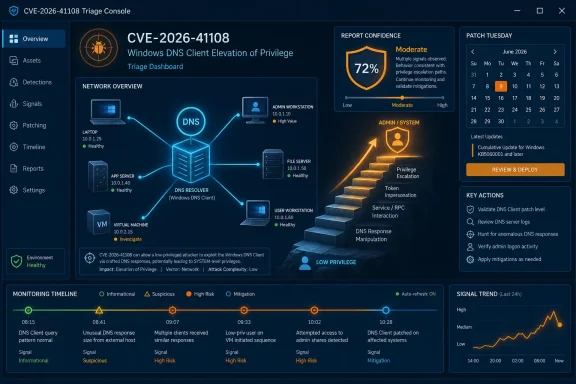 Microsoft’s Quiet DNS Bug Is Really a Trust Signal
The phrase “Windows DNS Client Elevation of Privilege Vulnerability” sounds deceptively narrow. It is not the Windows DNS Server role, not a domain controller-only weakness, and not necessarily a remote code execution flaw. It points instead at the resolver machinery present on ordinary Windows endpoints and servers: the component that helps translate names into addresses before almost anything else on the network can work.That distinction matters because DNS bugs carry cultural baggage in Windows security. Administrators remember the big ones: vulnerabilities that turned name resolution into a route toward remote compromise, service disruption, or domain-wide panic. CVE-2026-41108, as described by Microsoft’s label, lives in a different category: elevation of privilege, the class of vulnerability attackers often use after they already have some foothold.
That does not make it harmless. Privilege escalation is the difference between “a user-level compromise” and “the attacker owns the box.” In a ransomware intrusion, an infostealer infection, or a malicious insider scenario, local privilege escalation can be the step that disables security tools, dumps credentials, tampers with logs, or moves laterally with much less friction.
The interesting part of the advisory material supplied here is the metric definition: confidence in the existence of the vulnerability and in the credibility of the known technical details. In plain English, Microsoft is not merely saying “there is a bug.” It is giving defenders a way to judge whether the bug is speculative, partially corroborated, or confirmed by the vendor or author of the affected technology.
That is a subtle but important shift in how security teams should read advisories. Severity tells you the possible consequence. Exploitability tells you how likely exploitation may be. Report confidence tells you how solid the underlying story is.
The DNS Client Is Everywhere, Which Is Why “Client” Does Not Mean “Small”
The Windows DNS Client service is one of those components most users never think about because it works best when invisible. It caches DNS responses, supports name resolution behavior expected by Windows applications, and sits in the path of routine network activity. A browser launch, a software update check, an Active Directory lookup, a VPN connection, and an endpoint management agent may all depend on resolution happening correctly.That ubiquity is why a DNS Client vulnerability gets attention even when it is not a server-side remote worm. The attack surface is present across a broad Windows estate, including laptops, desktops, virtual machines, and servers that are not running the DNS Server role. The service is part of the operating system substrate, not an optional line-of-business application a company can neatly isolate.
For home users, the exposure model is usually simple: keep Windows Update moving, avoid running random code, and do not assume DNS-related jargon means your router is the main problem. For enterprises, the calculation is more layered. DNS Client behavior intersects with endpoint hardening, VPN profiles, split tunneling, internal namespaces, Active Directory, EDR telemetry, and the messy reality of machines that spend half their lives off the corporate LAN.
Elevation-of-privilege vulnerabilities in core Windows services also have a habit of becoming more relevant when chained. A phishing attachment, browser sandbox escape, exposed remote service, or stolen low-privilege credential may be only the first act. The second act is often a local bug that turns limited execution into administrative control.
That is why admins should resist the instinct to rank this kind of CVE solely beneath flashier remote code execution bugs. A remote unauthenticated RCE is the fire alarm. A reliable local privilege escalation is the unlocked stairwell that makes the fire spread.
Report Confidence Is the Metric Security Teams Pretend They Already Use
The definition supplied with CVE-2026-41108 describes a metric that measures confidence in the existence of the vulnerability and the credibility of known technical details. It acknowledges a basic truth of vulnerability management: not all CVEs are born equal. Some arrive with vendor confirmation, patches, affected versions, CVSS vectors, and clear exploitation notes. Others arrive as fragments: a name, a suspected impact, a rumor of a root cause, or research that points in the right direction without proving the whole case.That distinction changes urgency. If a vulnerability is only loosely described, security teams may still patch, but they patch while knowing the technical story is incomplete. If the vendor has acknowledged the vulnerability and issued a fix, the uncertainty moves. The debate is no longer “does this exist?” but “how quickly can attackers reverse-engineer the patch, reproduce the flaw, and operationalize it?”
This is especially relevant for Windows vulnerabilities because Microsoft’s monthly update cycle creates a predictable attacker research calendar. Once patches are available, diffing patched and unpatched binaries can reveal where the fix landed. For well-resourced attackers, the advisory is not the only source of truth; the patch itself becomes a map.
That is why “confidence” cuts both ways. High confidence helps defenders justify action. It also tells would-be attackers the target is real enough to study.
There is a tendency in executive reporting to compress every vulnerability into one number. That is comfortable, but it is also misleading. CVSS can describe impact and exploit conditions, but it does not always answer whether the details are mature, whether exploitation has been observed, or whether the public record contains enough information for copycat development. Report confidence fills part of that gap.
Elevation of Privilege Is the Middle of the Attack, Not the Beginning
Microsoft’s naming convention gives us the broad impact: elevation of privilege. That usually means an attacker must already have some level of access before the vulnerability becomes useful. In many organizations, that leads to a dangerous sigh of relief. If the attacker already needs access, the thinking goes, surely this can wait behind perimeter-facing bugs.That logic belongs to an older security model. In 2026, initial access is cheap, common, and often boring. Credentials leak. Help desks get socially engineered. Users run payloads. Browser bugs happen. SaaS tokens are stolen. Contractors connect unmanaged devices. Once that first foothold exists, the attacker’s next problem is privilege.
A DNS Client elevation-of-privilege flaw is interesting precisely because DNS is foundational. The component may be running in contexts, service boundaries, and network conditions that vary across Windows builds and enterprise configurations. Without public technical detail, it would be irresponsible to invent a mechanism. But defenders do not need the exploit primitive to understand the operational risk: a low-privileged foothold plus a reliable local escalation can change the outcome of an incident.
This is the part of patching that often gets lost in vulnerability dashboards. Organizations do not get breached by CVSS scores; they get breached by sequences. A medium-looking step can become critical when it is the missing link between commodity malware and domain-impacting control.
It is also why endpoint coverage matters. If only servers are patched quickly while user workstations lag for weeks, the organization may be securing the wrong half of the chain. Attackers often start where users browse, read mail, join meetings, install tools, and authenticate into the rest of the environment.
DNS Still Has a Special Place in the Windows Threat Model
DNS is both plumbing and policy. It determines where systems go, which services they find, how domain resources are located, and how security tools reach their cloud backends. In Windows networks, DNS is tightly woven into Active Directory assumptions, enterprise connectivity, and application behavior that may be decades old.That does not mean every DNS-labeled CVE is equally dangerous. The Windows DNS Server role, the DNS Client service, DNS over HTTPS behavior, name resolution policies, multicast fallback mechanisms, and domain controller integration all represent different pieces of the system. A vulnerability in one is not automatically a vulnerability in all.
But DNS bugs deserve care because the protocol sits at the start of so many trust decisions. Even when the bug is not about spoofing or cache poisoning, name resolution code processes data influenced by networks, resolvers, search suffixes, VPNs, captive portals, and application requests. The terrain is complicated, and complicated terrain is where parser and state-management bugs tend to survive.
For admins, the right posture is specific rather than theatrical. Do not assume CVE-2026-41108 is “the next SIGRed” just because DNS appears in the name. Do not dismiss it as a desktop-only nuisance just because “Client” appears in the name. Treat it as a Windows core-component privilege escalation until Microsoft’s details, exploitability assessment, and affected-product matrix narrow the risk further.
That posture is boring, but it is effective. Most patch programs fail not because teams misread the one spectacular emergency of the year, but because they underweight the cumulative value of fixing ordinary, chainable Windows flaws.
The Advisory Tells Less Than Admins Want, but Enough to Act
The supplied MSRC context does not provide public exploit code, a root-cause narrative, or a step-by-step attack path. That is normal for Microsoft advisories, particularly at initial publication. The company often balances usefulness for defenders against the risk of giving attackers a recipe.That leaves security teams working with structured signals. The name tells them the affected Windows component and impact category. The MSRC listing tells them Microsoft is treating the issue as real enough for the Security Update Guide. The confidence metric tells them how much weight to give the public technical record.
This is where disciplined vulnerability management beats adrenaline. The first response should be inventory: identify Windows versions in scope, confirm which cumulative updates apply, and determine whether any endpoints are outside normal update rings. The second response should be scheduling: move the fix through pilot, broad deployment, and exception handling without waiting for exploit chatter to make the decision emotionally easier.
The third response is detection and incident context. If an organization later learns that exploitation is practical or observed, it will want to know which machines remained unpatched during the exposure window. That means patch telemetry, device health, EDR visibility, and help-desk exception records matter as much as the advisory itself.
The fourth response is communication. Security teams should explain that this is not a DNS Server panic, not a reason to disable DNS Client casually, and not a vulnerability that should be ignored just because it is local privilege escalation. The goal is to keep the message accurate enough that infrastructure teams trust it.
Why “No Public Details” Is Not the Same as “No Risk”
The security industry has a bad habit of treating unknowns as zeroes. If there is no exploit demo, no proof-of-concept repository, and no viral social media thread, the vulnerability drops in priority. That behavior is understandable in overloaded teams, but it is not a risk model.A lack of public technical detail may mean the bug is hard to exploit. It may mean Microsoft is intentionally withholding detail. It may mean the finder reported privately and nobody outside the coordination loop knows much yet. It may also mean attackers are doing the same thing defenders are doing: waiting for the patch to reveal the interesting code path.
This is why report confidence matters. It helps separate “thin rumor” from “confirmed vulnerability with limited disclosure.” The former may justify monitoring and deferred remediation. The latter generally justifies patching, even if the public write-up is sparse.
For Windows administrators, the practical question is whether delaying the update produces a meaningful operational benefit. If the patch is part of the normal cumulative update flow and does not carry known breaking changes in the environment, delay buys little. If the environment has fragile VPN clients, legacy name-resolution dependencies, or specialized endpoint images, testing is reasonable — but testing should be measured in days, not in quarters.
There is also a strategic point here. Attackers do not need every organization to ignore a patch forever. They need enough laggards to create opportunity. Patch latency is not just an internal operations metric; it is part of the adversary’s business model.
The Enterprise Risk Is Patch Coverage, Not DNS Theory
The most likely failure mode around CVE-2026-41108 is not that administrators misunderstand DNS internals. It is that they successfully patch the easy machines and lose the long tail. That long tail includes roaming laptops, suspended VMs, lab systems, kiosk devices, developer workstations, rarely rebooted servers, and endpoints managed by a different team’s tool.Windows cumulative updates have improved the mechanics of remediation, but they have not eliminated organizational drift. A fleet can show 90 percent compliance and still leave the exact machines attackers prefer: systems used by privileged staff, systems exempted for “business continuity,” or systems that authenticate broadly while being maintained poorly.
Privilege-escalation bugs punish that drift. An unpatched workstation used by an admin can matter more than a patched rack of anonymous servers. A vulnerable jump box can matter more than a vulnerable kiosk, depending on who logs into it and what tokens are present. Asset criticality still matters even when the CVE is OS-wide.
This is where vulnerability teams should avoid treating the advisory as a standalone artifact. Map it onto identity exposure. Which unpatched systems have local admin users? Which are used by domain admins or cloud admins? Which run endpoint tools with high privileges? Which hold cached credentials, developer secrets, or remote management access?
That context turns a generic Windows CVE into a prioritized deployment plan. It also makes the inevitable exceptions more honest. If a machine cannot be patched promptly, the business owner should understand what privilege and identity exposure remain.
Home Users Should Patch, Not Re-Architect Their Network
For Windows enthusiasts and home users, the advice is simpler. Install the relevant Windows update when it is offered, reboot, and avoid the temptation to solve a local Windows flaw with router folklore. Changing DNS providers, flushing the DNS cache, or disabling random network features is unlikely to be the meaningful control unless Microsoft documents a specific workaround.That may feel unsatisfying because patching is mundane. But for core OS vulnerabilities, mundane is often the correct answer. Windows Update exists to absorb precisely this kind of maintenance burden for users who should not have to understand resolver internals.
Power users should be more careful with third-party “debloat” scripts and service-disabling guides. The DNS Client service is not an ornamental feature. Breaking name resolution caching or Windows networking assumptions can create strange failures that are harder to diagnose than the vulnerability was to patch.
The same goes for registry hacks passed around without context. If Microsoft publishes a supported workaround, that is one thing. If a forum post claims that disabling a service “fixes” every DNS CVE, that is not security engineering; it is superstition with administrative rights.
Defenders Need to Watch the Exploitability Story Change
The status of a CVE is not frozen on publication day. Microsoft may update exploitability assessments, affected product entries, FAQs, acknowledgements, or remediation notes. Third-party researchers may publish analysis after patch diffing. CISA may or may not add a vulnerability to its Known Exploited Vulnerabilities catalog later if exploitation is confirmed. Security vendors may begin detecting exploit attempts under different names.That means the right monitoring window extends beyond Patch Tuesday. The first 24 hours answer whether patches install cleanly. The first week often reveals compatibility issues and early researcher findings. The first month reveals whether the bug becomes part of attacker tooling or fades into the mass of patched Windows flaws.
For CVE-2026-41108, the confidence metric should be revisited alongside any change in exploitability language. A confirmed vulnerability with no known exploitation is one priority. A confirmed vulnerability with functional exploit details circulating is another. A confirmed vulnerability added to active exploitation lists is no longer a normal maintenance item.
Security teams should also be wary of automated enrichment tools that overstate certainty. Some platforms generate confident prose from sparse CVE records. Others infer affected versions or exploit paths from component names. That can be useful for triage, but it can also pollute decision-making with invented specificity.
The safe editorial line is also the safe operational line: Microsoft has identified the component and impact class; public technical details appear limited; the vulnerability should be patched as part of Windows update hygiene; and priority should rise if exploitability or active-exploitation signals change.
The Patch Tuesday Lesson Is Bigger Than One CVE
CVE-2026-41108 is a reminder that vulnerability management is now a continuous interpretation problem. Microsoft can publish structured data, but administrators still have to translate it into deployment order, outage risk, exception policy, and incident readiness. The work is less glamorous than exploit analysis and more consequential than most dashboards admit.The old mental model treated vulnerability disclosure as a document to read. The modern model treats it as the opening move in a race. Defenders receive enough information to patch; attackers receive enough information to investigate; both sides watch for the first credible technical details that change the economics.
That race is especially sharp for Windows because the platform is simultaneously standardized and wildly diverse. The same cumulative update may touch a gaming laptop, a hospital workstation, a factory controller, a cloud-hosted server, and a domain-joined executive device. Uniform patch packaging does not mean uniform operational risk.
The answer is not panic. It is mature sequencing. Test quickly. Deploy broadly. Track exceptions. Reassess when the advisory changes. Do not wait for a proof of concept to prove that a confirmed Windows privilege escalation deserves routine urgency.
The DNS Client Advisory Rewards Teams That Read the Fine Print
The concrete lesson from CVE-2026-41108 is that the quiet fields in a vulnerability record can matter as much as the headline. The confidence language supplied with the advisory is not filler. It is a guide to how seriously defenders should treat the existence of the bug and the amount of technical knowledge likely available to others.- CVE-2026-41108 is identified as a Windows DNS Client elevation-of-privilege vulnerability, which points to a local privilege-escalation risk in a core Windows networking component rather than a DNS Server-only issue.
- The most important supplied metric is confidence in the vulnerability report, because it helps distinguish confirmed vendor-backed risk from vague or speculative vulnerability chatter.
- Limited public technical detail should not be mistaken for low risk, especially after patches become available and attackers can study the changed code.
- Enterprise prioritization should focus on patch coverage across endpoints, privileged-user machines, jump hosts, and systems with broad identity exposure.
- Home users should rely on Windows Update and avoid unsupported service-disabling or registry workarounds unless Microsoft documents them.
- The risk picture can change after publication if Microsoft updates exploitability guidance, researchers publish analysis, or active exploitation is observed.
References
- Primary source: MSRC
Published: 2026-06-09T07:00:00-07:00
Security Update Guide - Microsoft Security Response Center
 msrc.microsoft.com
- Related coverage: rapid7.com
Rapid7 Vulnerability Database
Rapid7's VulnDB is curated repository of vetted computer software exploits and exploitable vulnerabilities.www.rapid7.com - Related coverage: absolute.com
- Related coverage: assets.kpmg.com
16 september 2022 microsoft september 2022 patch tuesday fixes 64 flaws.pdf.coredownload.inline
PDF documentassets.kpmg.com
- Official source: microsoft.com
MSRC - Microsoft Security Response Center
The Microsoft Security Response Center is part of the defender community and on the front line of security response evolution. For over twenty years, we have been engaged with security researchers working to protect customers and the broader ecosystem.www.microsoft.com
- Official source: msrc-ppe.microsoft.com
- Official source: learn.microsoft.com
Security Advisories and Bulletins | Microsoft Learn
learn.microsoft.com - Related coverage: datacomm.com
- Related coverage: sra.io
- Related coverage: osv.dev

OSV - Open Source Vulnerabilities
Comprehensive vulnerability database for your open source projects and dependencies.
osv.dev
