

CVE-2026-41526 is a KDE KCoreAddons command-injection vulnerability disclosed in late April 2026 that affects versions before 6.25, where KShell argument quoting can mishandle shell metacharacters and allow crafted user input to escape into terminal-executed commands. The bug is not a Windows vulnerability in the usual Patch Tuesday sense, but its appearance in Microsoft’s Security Update Guide matters because Microsoft now ships and tracks Linux components across Azure Linux and enterprise estates. The lesson is larger than one KDE helper function: modern desktops and developer workstations are stitched together from libraries, terminals, file managers, shells, containers, and cloud images, and trust boundaries often sit exactly where the user interface looks most harmless. This is the kind of flaw that reminds administrators that “local” does not mean “low priority” when the vulnerable path touches a shell.
KCoreAddons is one of those components most users never think about because it is supposed to disappear into the plumbing. It provides utility code used across KDE applications, which means a bug in a helper function can travel farther than a bug in a single app. In this case, the exposed surface is not a flashy remote service listening on the network, but a function intended to make command-line arguments safe before they are handed to a shell.
That distinction matters. Security advisories often sound abstract when they talk about “improper neutralization of escape, meta, or control sequences,” but the plain-English version is brutal: text that was supposed to remain text can become instructions. If an application accepts user-controlled input, quotes it, and then sends it into a terminal or shell command path, the application may have accidentally become an interpreter for the attacker.
KDE’s advisory points to KShell parsing and the interaction with
That is why the vulnerability lands in an awkward category for defenders. It is not the kind of remote, unauthenticated worm fuel that demands panic across every perimeter device. But it is also not a cosmetic bug. Any application using the vulnerable quoting behavior in a security-sensitive path becomes part of the blast radius, and KDE specifically called out Dolphin and Kate when used with embedded terminal functionality.
That convenience is also why the bug has teeth. A terminal embedded inside a trusted application still behaves like a terminal. If text reaches it in a way that the shell interprets as command syntax, the user’s session is the execution context. The exploit does not need kernel privileges to matter; it inherits the privileges and environment of the user who was tricked or maneuvered into triggering the path.
The phrase “user interaction required” can lull people into dismissing desktop vulnerabilities. That is a mistake. Attackers have spent decades turning user interaction into a reliable primitive: open this file, clone this repository, paste this string, click this project, preview this content, import this configuration. A bug that requires the victim to interact with crafted content is still a bug that can be operationalized if the target population routinely handles untrusted content.
For developers, the risk model is especially uncomfortable. Development workstations are full of secrets: SSH keys, package registry tokens, cloud credentials, signing material, local database dumps, and access to internal repositories. A command injection that runs as the user may not need escalation to cause damage. It only needs to run in the right terminal at the wrong time.
The user-provided MSRC language leans toward the first complication. It says a successful attack depends on conditions beyond the attacker’s control and may require preparation, environmental knowledge, or positioning. In other words, this is not a push-button exploit that works against every KDE user simply because KCoreAddons is installed.
But CVSS cannot tell administrators whether their developers use Kate’s embedded terminal against untrusted project trees, whether their Linux desktop image includes the affected framework, or whether automation wraps KDE helpers in a way no one has audited since the Plasma 5 era. Scoring systems compress context. Operations teams live in it.
The better reading is that CVE-2026-41526 is a targeted-exploitation concern rather than a mass-exploitation crisis. That should lower the temperature, not erase the ticket. If your environment has Linux desktops, KDE-based engineering workstations, Azure Linux images with KDE components, or packaged applications built on affected KCoreAddons versions, the fix is straightforward enough that arguing about the decimal point is wasted time.
That map no longer describes enterprise reality. Microsoft maintains Azure Linux, ships Linux workloads at scale, supports WSL for developers, distributes open-source components through cloud and container channels, and tracks third-party vulnerabilities that affect Microsoft-maintained products or images. If a KDE component is present in a Microsoft-supported Linux context, MSRC has a reason to list it.
For WindowsForum readers, this is precisely the point. The Windows estate is no longer only Windows. A typical Microsoft-centric organization may have Windows 11 laptops, WSL environments, Azure Kubernetes Service nodes, Azure Linux container hosts, GitHub Actions runners, Linux build agents, Intune-managed endpoints, and developers using graphical Linux desktops in VDI or local dual-boot setups. The vulnerability-management program has to follow the code, not the logo.
That does not mean every Windows administrator must suddenly become a KDE maintainer. It means Microsoft’s advisory feed increasingly reflects the hybrid estate Microsoft customers actually run. When MSRC lists a KDE flaw, it is telling security teams to look at the Linux packages they consume through Microsoft channels and adjacent tooling, not to search Windows Update for a KDE patch that was never going to be there.
The operational problem is not whether a fixed version exists. It is finding every place where the vulnerable library sits beneath a user-facing workflow. KCoreAddons can be installed because KDE Plasma is the main desktop, because a single KDE application was installed on another desktop, because a developer pulled in libraries for testing, or because a distribution metapackage included it without anyone treating it as a security-relevant dependency.
Linux vulnerability management still suffers from a visibility gap in many Windows-first shops. Windows endpoints are scanned, patched, inventoried, and reported with rigor. Linux desktops, WSL distributions, lab machines, engineering laptops, and throwaway build hosts are often treated as exceptions until they become incident artifacts. CVE-2026-41526 is a good excuse to close that gap.
The practical question is not “Do we use KDE?” but “Do any of our systems have KCoreAddons before 6.25, and do any of our workflows pass untrusted input into KDE applications or embedded terminals?” That second half is where asset inventory meets behavior. A vulnerable library sitting unused is a different risk than a vulnerable library wired into daily developer actions.
The trap is that quoting is not validation, and a shell is not a dumb transport. Shells are programming languages with decades of compatibility behavior, control characters, expansions, quoting rules, and terminal interactions. A value that looks safely wrapped at one layer can be reinterpreted at another, especially when the string is not being executed through a clean argument vector but sent into a terminal-like interface.
That is the important technical lesson from the
Security engineers have been preaching “avoid the shell” for years because the shell is the wrong abstraction for many application tasks. If a program needs to open a file, it should open a file. If it needs to spawn a process, it should pass arguments as arguments rather than concatenate a command line. If it must interact with a terminal, it should treat that boundary as hostile and surprising, not as a convenient string sink.
A vulnerability that depends on a crafted input path can be paired with social engineering, project poisoning, malicious documentation, or compromised collaboration channels. The attacker does not need to control the machine directly if they can control the content the user trusts. The history of terminal and clipboard attacks shows that “the user had to paste something” is often a viable delivery mechanism.
This is especially true in communities that normalize terminal literacy. The more comfortable users are with shells, the more likely they are to treat terminal-adjacent workflows as routine. A malicious string that looks like a path, a branch name, or a pasted instruction may not raise suspicion if the surrounding workflow feels familiar.
None of that makes CVE-2026-41526 a catastrophe. It does mean defenders should avoid the lazy phrase “requires user interaction” as if it were a mitigation. User interaction is a condition. It is not a control.
WSL is the obvious bridge, although WSL environments typically do not run full KDE desktops by default. More relevant are developer workstations that use graphical Linux apps, KDE desktops in virtual machines, Linux remote desktops, and corporate images used by engineering teams. In those places, the Windows identity system, corporate secrets, and cloud access may sit beside Linux user sessions that are less tightly governed.
Azure Linux is another reason the advisory belongs in Microsoft-facing vulnerability programs. If an organization consumes Microsoft-maintained Linux images or packages, it cannot assume that “non-Windows” means “out of scope.” Microsoft’s security feed becomes part of the triage process for open-source packages that land in cloud infrastructure.
The broader Windows lesson is about tooling sprawl. Windows administrators have spent the past decade absorbing Linux into their estates through containers, WSL, DevOps pipelines, and cloud-native infrastructure. The security model must absorb it too. A KDE library flaw may not affect every WindowsForum reader, but it is a clean example of why endpoint management and vulnerability management can no longer stop at the NT kernel boundary.
That downstream layer introduces timing differences. Rolling distributions may pick up KDE Frameworks updates quickly. Stable distributions may backport the patch without changing the visible version number, which means administrators must check package changelogs rather than assume the upstream version string tells the whole story. Enterprise images may lag until the next maintenance window unless the package is classified as security-relevant.
This is where security scanners can mislead. A scanner that keys only on upstream version numbers may flag a backported fixed package as vulnerable. A scanner that lacks package awareness may miss a pinned local build. For this CVE, remediation proof should be tied either to KCoreAddons 6.25 or later, or to a downstream package advisory confirming the relevant patch has been applied.
That may sound bureaucratic, but it is how open-source security actually works in enterprises. The patch is code. The fix is a package. The assurance is an inventory record that says where the package landed.
If an application’s design depends on quoting untrusted input and feeding the result into a terminal, the application should be revisited even after the library update. The same pattern may be vulnerable to other edge cases, future parsing bugs, or terminal behaviors outside the library’s control. The safer design is to minimize shell interpretation entirely.
Developers should also be honest about what counts as user input. File names are user input. Archive contents are user input. Git branch names are user input. Project metadata is user input. Clipboard contents are user input. Paths from mounted network shares are user input. If an attacker can influence the string, it belongs on the hostile side of the boundary.
The bug also highlights why GUI applications need security reviews around terminal integration. Embedded terminals are powerful, but they collapse the distance between visual affordances and command execution. A file manager that “types” into a terminal is doing something security-sensitive, even if the feature was built for convenience.
This is especially valuable in mixed Windows and Linux environments. Internal tools often grow around developer convenience: a right-click action that opens a terminal here, a helper that runs a command there, a small wrapper that passes a selected path into a shell. Those tools rarely receive the scrutiny given to internet-facing services, but they may run on machines with privileged access to source code and infrastructure.
A reasonable response does not require freezing KDE or banning embedded terminals. It requires reducing avoidable interpretation. Where possible, pass arguments through APIs that preserve argument boundaries. Where shells are unavoidable, constrain the inputs, document the assumptions, and test hostile characters. Where terminal input is simulated, assume terminal control sequences matter.
This is the kind of engineering hygiene that pays off beyond one CVE. The next bug may not be in KCoreAddons. It may be in an internal helper, an IDE extension, a file previewer, a Git integration, or a packaging script. The pattern is the asset.
The attacker’s goal is not always system-wide compromise. Sometimes it is credential theft, source-code tampering, persistence in a user profile, or lateral movement through the access the user already has. A shell command running as a developer can read environment variables, alter Git hooks, change shell startup files, exfiltrate SSH keys, or modify build artifacts. None of that requires administrator privileges.
This is why the phrase “with the privileges of the user” should not be read as a comfort. In modern environments, users are often the perimeter. Their tokens reach cloud consoles, package registries, CI pipelines, chat systems, and production logs. A compromised user session can be a stepping stone into systems that are better protected than the workstation itself.
CVE-2026-41526 is therefore a useful corrective to severity-score tunnel vision. The exploit path may be conditional. The affected component may be a desktop framework. The attack may require interaction. But if the target is a high-value user on a high-value workstation, the practical risk can rise quickly.
Quoting helpers are necessary, but they are last-resort tools, not architectural permission slips. The safest command line is the one that never becomes a command line string. The safest terminal integration is the one that does not rely on untrusted bytes being “typed” into a stateful interpreter. The safest file manager action is the one that passes a path as data, not as syntax.
That principle is easy to state and hard to retrofit. Desktop environments are full of features built over decades, and users expect graphical workflows to interoperate with terminals. KDE is hardly alone here. Every major platform has accumulated convenience layers that blur data and commands.
The right conclusion is not that KDE is uniquely careless. It is that mature software ecosystems carry old assumptions into new threat models. A helper function that seemed safe enough for one class of use can become dangerous when paired with embedded terminals, richer file workflows, and adversaries who understand control characters as well as command separators.
The first pass is inventory. Identify Linux systems with KDE Frameworks or KCoreAddons installed, including developer desktops, VDI images, lab machines, cloud images, and build hosts. Then separate systems with routine user interaction and untrusted content handling from systems where the package is present but effectively dormant.
The second pass is workflow review. If teams use Dolphin or Kate embedded terminals, prioritize those machines. If internal tools use KDE libraries or call KShell helpers with user-controlled input, review them. If developers are working with untrusted repositories, external archives, or customer-supplied files, assume crafted content is plausible.
The third pass is package validation. Version 6.25 or later is the clean upstream answer, but downstream backports may carry the fix under an older version string. Security teams should record the distribution advisory or package changelog rather than relying solely on superficial version comparisons.
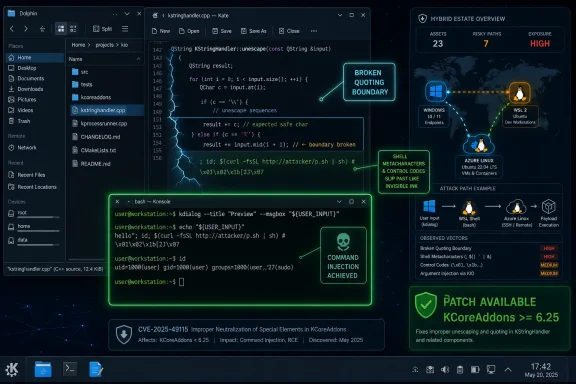 A Library Bug Becomes a Desktop Attack Surface
KCoreAddons is one of those components most users never think about because it is supposed to disappear into the plumbing. It provides utility code used across KDE applications, which means a bug in a helper function can travel farther than a bug in a single app. In this case, the exposed surface is not a flashy remote service listening on the network, but a function intended to make command-line arguments safe before they are handed to a shell.That distinction matters. Security advisories often sound abstract when they talk about “improper neutralization of escape, meta, or control sequences,” but the plain-English version is brutal: text that was supposed to remain text can become instructions. If an application accepts user-controlled input, quotes it, and then sends it into a terminal or shell command path, the application may have accidentally become an interpreter for the attacker.
KDE’s advisory points to KShell parsing and the interaction with
sendInput(), which sends a string to a terminal. The risk appears when control characters, including \x01, are used to interfere with the intended quoting boundary. Once the boundary is broken, shell metacharacters can stop being inert characters and start being syntax.That is why the vulnerability lands in an awkward category for defenders. It is not the kind of remote, unauthenticated worm fuel that demands panic across every perimeter device. But it is also not a cosmetic bug. Any application using the vulnerable quoting behavior in a security-sensitive path becomes part of the blast radius, and KDE specifically called out Dolphin and Kate when used with embedded terminal functionality.
The Embedded Terminal Is Convenience With a Memory
KDE’s affected examples are telling because they are not exotic. Dolphin, the file manager, and Kate, the editor, are exactly the kinds of applications power users and developers keep open all day. Their embedded terminals are productivity features, not security boundaries: they let a user move quickly from a graphical view of files or source code to a command prompt in the same working directory.That convenience is also why the bug has teeth. A terminal embedded inside a trusted application still behaves like a terminal. If text reaches it in a way that the shell interprets as command syntax, the user’s session is the execution context. The exploit does not need kernel privileges to matter; it inherits the privileges and environment of the user who was tricked or maneuvered into triggering the path.
The phrase “user interaction required” can lull people into dismissing desktop vulnerabilities. That is a mistake. Attackers have spent decades turning user interaction into a reliable primitive: open this file, clone this repository, paste this string, click this project, preview this content, import this configuration. A bug that requires the victim to interact with crafted content is still a bug that can be operationalized if the target population routinely handles untrusted content.
For developers, the risk model is especially uncomfortable. Development workstations are full of secrets: SSH keys, package registry tokens, cloud credentials, signing material, local database dumps, and access to internal repositories. A command injection that runs as the user may not need escalation to cause damage. It only needs to run in the right terminal at the wrong time.
The Severity Split Tells the Real Story
CVE-2026-41526 has been scored differently by different parties, and the disagreement is useful rather than confusing. MITRE’s CVSS vector treats the attack complexity as high, resulting in a medium score. NVD’s analysis, by contrast, lists a high score with lower attack complexity and higher availability impact. That divergence reflects a familiar tension: should the score represent the worst plausible impact once the vulnerable path is reached, or the practical difficulty of reaching that path reliably?The user-provided MSRC language leans toward the first complication. It says a successful attack depends on conditions beyond the attacker’s control and may require preparation, environmental knowledge, or positioning. In other words, this is not a push-button exploit that works against every KDE user simply because KCoreAddons is installed.
But CVSS cannot tell administrators whether their developers use Kate’s embedded terminal against untrusted project trees, whether their Linux desktop image includes the affected framework, or whether automation wraps KDE helpers in a way no one has audited since the Plasma 5 era. Scoring systems compress context. Operations teams live in it.
The better reading is that CVE-2026-41526 is a targeted-exploitation concern rather than a mass-exploitation crisis. That should lower the temperature, not erase the ticket. If your environment has Linux desktops, KDE-based engineering workstations, Azure Linux images with KDE components, or packaged applications built on affected KCoreAddons versions, the fix is straightforward enough that arguing about the decimal point is wasted time.
Microsoft’s Involvement Is a Supply-Chain Signal, Not a Branding Error
At first glance, it is odd to see a KDE vulnerability cited from Microsoft’s Security Update Guide. KDE is not a Microsoft desktop shell, and KCoreAddons is not a Windows DLL. But that reaction belongs to an older software map, one where Windows, Linux, desktop environments, cloud images, and developer tooling lived in separate administrative worlds.That map no longer describes enterprise reality. Microsoft maintains Azure Linux, ships Linux workloads at scale, supports WSL for developers, distributes open-source components through cloud and container channels, and tracks third-party vulnerabilities that affect Microsoft-maintained products or images. If a KDE component is present in a Microsoft-supported Linux context, MSRC has a reason to list it.
For WindowsForum readers, this is precisely the point. The Windows estate is no longer only Windows. A typical Microsoft-centric organization may have Windows 11 laptops, WSL environments, Azure Kubernetes Service nodes, Azure Linux container hosts, GitHub Actions runners, Linux build agents, Intune-managed endpoints, and developers using graphical Linux desktops in VDI or local dual-boot setups. The vulnerability-management program has to follow the code, not the logo.
That does not mean every Windows administrator must suddenly become a KDE maintainer. It means Microsoft’s advisory feed increasingly reflects the hybrid estate Microsoft customers actually run. When MSRC lists a KDE flaw, it is telling security teams to look at the Linux packages they consume through Microsoft channels and adjacent tooling, not to search Windows Update for a KDE patch that was never going to be there.
The Patch Is Simple; the Inventory Is Not
KDE’s remediation guidance is mercifully direct: update KCoreAddons to version 6.25 or later, or apply the upstream patch. In a clean rolling distribution, that may already have happened. In a managed enterprise image, a long-lived workstation fleet, or a pinned container base, it may not have.The operational problem is not whether a fixed version exists. It is finding every place where the vulnerable library sits beneath a user-facing workflow. KCoreAddons can be installed because KDE Plasma is the main desktop, because a single KDE application was installed on another desktop, because a developer pulled in libraries for testing, or because a distribution metapackage included it without anyone treating it as a security-relevant dependency.
Linux vulnerability management still suffers from a visibility gap in many Windows-first shops. Windows endpoints are scanned, patched, inventoried, and reported with rigor. Linux desktops, WSL distributions, lab machines, engineering laptops, and throwaway build hosts are often treated as exceptions until they become incident artifacts. CVE-2026-41526 is a good excuse to close that gap.
The practical question is not “Do we use KDE?” but “Do any of our systems have KCoreAddons before 6.25, and do any of our workflows pass untrusted input into KDE applications or embedded terminals?” That second half is where asset inventory meets behavior. A vulnerable library sitting unused is a different risk than a vulnerable library wired into daily developer actions.
Shell Quoting Keeps Failing Because It Is a Boundary Masquerading as a String
The recurring tragedy of command injection is that it often begins with a reasonable-sounding API. Developers need to pass arguments to commands. Users enter file names, URLs, branch names, search terms, project paths, archive names, and snippets of text. The application needs to preserve that input while preventing it from being interpreted as syntax. So the platform provides a quoting helper.The trap is that quoting is not validation, and a shell is not a dumb transport. Shells are programming languages with decades of compatibility behavior, control characters, expansions, quoting rules, and terminal interactions. A value that looks safely wrapped at one layer can be reinterpreted at another, especially when the string is not being executed through a clean argument vector but sent into a terminal-like interface.
That is the important technical lesson from the
sendInput() detail. Sending a string to a terminal is different from invoking a program with an argument array. The terminal path brings in state, control characters, line editing, shell parsing, and user context. If the application assumes it is merely “typing text,” it may miss the ways that text can steer the terminal.Security engineers have been preaching “avoid the shell” for years because the shell is the wrong abstraction for many application tasks. If a program needs to open a file, it should open a file. If it needs to spawn a process, it should pass arguments as arguments rather than concatenate a command line. If it must interact with a terminal, it should treat that boundary as hostile and surprising, not as a convenient string sink.
User Interaction Is Not a Safety Net
The advisory language says exploitation may require the victim to paste or open manipulated content in affected applications. That sounds comforting until you map it onto real behavior. Developers paste commands from issue trackers. Sysadmins paste one-liners from internal runbooks. Analysts open unfamiliar files. Contributors clone repositories from strangers. Users drag paths into terminals because graphical shells encourage that style of interaction.A vulnerability that depends on a crafted input path can be paired with social engineering, project poisoning, malicious documentation, or compromised collaboration channels. The attacker does not need to control the machine directly if they can control the content the user trusts. The history of terminal and clipboard attacks shows that “the user had to paste something” is often a viable delivery mechanism.
This is especially true in communities that normalize terminal literacy. The more comfortable users are with shells, the more likely they are to treat terminal-adjacent workflows as routine. A malicious string that looks like a path, a branch name, or a pasted instruction may not raise suspicion if the surrounding workflow feels familiar.
None of that makes CVE-2026-41526 a catastrophe. It does mean defenders should avoid the lazy phrase “requires user interaction” as if it were a mitigation. User interaction is a condition. It is not a control.
The Windows Angle Runs Through Developers and Cloud Images
For pure Windows desktop users who do not run KDE applications, this CVE is mostly background noise. It will not be fixed by a Windows cumulative update, and it does not turn File Explorer into a shell-injection vector. The relevance begins where Windows users become Linux users without leaving the Microsoft ecosystem.WSL is the obvious bridge, although WSL environments typically do not run full KDE desktops by default. More relevant are developer workstations that use graphical Linux apps, KDE desktops in virtual machines, Linux remote desktops, and corporate images used by engineering teams. In those places, the Windows identity system, corporate secrets, and cloud access may sit beside Linux user sessions that are less tightly governed.
Azure Linux is another reason the advisory belongs in Microsoft-facing vulnerability programs. If an organization consumes Microsoft-maintained Linux images or packages, it cannot assume that “non-Windows” means “out of scope.” Microsoft’s security feed becomes part of the triage process for open-source packages that land in cloud infrastructure.
The broader Windows lesson is about tooling sprawl. Windows administrators have spent the past decade absorbing Linux into their estates through containers, WSL, DevOps pipelines, and cloud-native infrastructure. The security model must absorb it too. A KDE library flaw may not affect every WindowsForum reader, but it is a clean example of why endpoint management and vulnerability management can no longer stop at the NT kernel boundary.
Packagers Will Decide How Fast This Becomes Boring
Upstream KDE has done the easy-to-understand part: identify the affected component, publish an advisory, and ship a fixed KCoreAddons release. The next step belongs to distributions and downstream vendors. Users do not usually install KCoreAddons from upstream tarballs; they install packages from Arch, Fedora, openSUSE, Debian, Ubuntu, KDE neon, enterprise repositories, or vendor-maintained images.That downstream layer introduces timing differences. Rolling distributions may pick up KDE Frameworks updates quickly. Stable distributions may backport the patch without changing the visible version number, which means administrators must check package changelogs rather than assume the upstream version string tells the whole story. Enterprise images may lag until the next maintenance window unless the package is classified as security-relevant.
This is where security scanners can mislead. A scanner that keys only on upstream version numbers may flag a backported fixed package as vulnerable. A scanner that lacks package awareness may miss a pinned local build. For this CVE, remediation proof should be tied either to KCoreAddons 6.25 or later, or to a downstream package advisory confirming the relevant patch has been applied.
That may sound bureaucratic, but it is how open-source security actually works in enterprises. The patch is code. The fix is a package. The assurance is an inventory record that says where the package landed.
Application Developers Inherited the Hard Part
The advisory says all applications relying on the vulnerable method in a security-critical path to handle user input are affected. That sentence should make KDE application developers pause. A fixed KCoreAddons reduces the immediate risk, but it does not absolve every caller of responsibility for how it treats user-controlled text.If an application’s design depends on quoting untrusted input and feeding the result into a terminal, the application should be revisited even after the library update. The same pattern may be vulnerable to other edge cases, future parsing bugs, or terminal behaviors outside the library’s control. The safer design is to minimize shell interpretation entirely.
Developers should also be honest about what counts as user input. File names are user input. Archive contents are user input. Git branch names are user input. Project metadata is user input. Clipboard contents are user input. Paths from mounted network shares are user input. If an attacker can influence the string, it belongs on the hostile side of the boundary.
The bug also highlights why GUI applications need security reviews around terminal integration. Embedded terminals are powerful, but they collapse the distance between visual affordances and command execution. A file manager that “types” into a terminal is doing something security-sensitive, even if the feature was built for convenience.
Security Teams Should Treat This as a Hunting Prompt
The immediate mitigation is to patch, but the better use of this CVE is as a hunting prompt. Look for places where desktop applications, scripts, helper tools, and internal launchers quote strings and pass them into shells. Look for automation that shells out when a direct library call would be safer. Look for terminal-feeding behavior that no one has threat-modeled because it lives in a user interface feature rather than a daemon.This is especially valuable in mixed Windows and Linux environments. Internal tools often grow around developer convenience: a right-click action that opens a terminal here, a helper that runs a command there, a small wrapper that passes a selected path into a shell. Those tools rarely receive the scrutiny given to internet-facing services, but they may run on machines with privileged access to source code and infrastructure.
A reasonable response does not require freezing KDE or banning embedded terminals. It requires reducing avoidable interpretation. Where possible, pass arguments through APIs that preserve argument boundaries. Where shells are unavoidable, constrain the inputs, document the assumptions, and test hostile characters. Where terminal input is simulated, assume terminal control sequences matter.
This is the kind of engineering hygiene that pays off beyond one CVE. The next bug may not be in KCoreAddons. It may be in an internal helper, an IDE extension, a file previewer, a Git integration, or a packaging script. The pattern is the asset.
The CVE Exposes the Soft Underbelly of “Local” Risk
Security teams love neat categories: remote code execution, elevation of privilege, local attack, user interaction, high complexity. Those categories help prioritize, but they can also hide consequence. A local command injection in a developer desktop session can be more damaging than a remote denial-of-service bug against a low-value service.The attacker’s goal is not always system-wide compromise. Sometimes it is credential theft, source-code tampering, persistence in a user profile, or lateral movement through the access the user already has. A shell command running as a developer can read environment variables, alter Git hooks, change shell startup files, exfiltrate SSH keys, or modify build artifacts. None of that requires administrator privileges.
This is why the phrase “with the privileges of the user” should not be read as a comfort. In modern environments, users are often the perimeter. Their tokens reach cloud consoles, package registries, CI pipelines, chat systems, and production logs. A compromised user session can be a stepping stone into systems that are better protected than the workstation itself.
CVE-2026-41526 is therefore a useful corrective to severity-score tunnel vision. The exploit path may be conditional. The affected component may be a desktop framework. The attack may require interaction. But if the target is a high-value user on a high-value workstation, the practical risk can rise quickly.
The Real Fix Is to Stop Treating Shells as String Buckets
The industry has learned and relearned the same lesson across SQL injection, command injection, LDAP injection, template injection, and cross-site scripting: interpreters are dangerous when data and code share the same channel. Shells are one of the oldest and sharpest examples. They are designed to interpret.Quoting helpers are necessary, but they are last-resort tools, not architectural permission slips. The safest command line is the one that never becomes a command line string. The safest terminal integration is the one that does not rely on untrusted bytes being “typed” into a stateful interpreter. The safest file manager action is the one that passes a path as data, not as syntax.
That principle is easy to state and hard to retrofit. Desktop environments are full of features built over decades, and users expect graphical workflows to interoperate with terminals. KDE is hardly alone here. Every major platform has accumulated convenience layers that blur data and commands.
The right conclusion is not that KDE is uniquely careless. It is that mature software ecosystems carry old assumptions into new threat models. A helper function that seemed safe enough for one class of use can become dangerous when paired with embedded terminals, richer file workflows, and adversaries who understand control characters as well as command separators.
The Practical Read for Admins Who Actually Have to Patch This
For administrators, the response should be proportional and concrete. Do not turn this into a generalized KDE scare story, but do not wait for exploit chatter before updating a package with a published fix. The affected range is clear enough, and the remediation target is KCoreAddons 6.25 or a downstream package carrying the patch.The first pass is inventory. Identify Linux systems with KDE Frameworks or KCoreAddons installed, including developer desktops, VDI images, lab machines, cloud images, and build hosts. Then separate systems with routine user interaction and untrusted content handling from systems where the package is present but effectively dormant.
The second pass is workflow review. If teams use Dolphin or Kate embedded terminals, prioritize those machines. If internal tools use KDE libraries or call KShell helpers with user-controlled input, review them. If developers are working with untrusted repositories, external archives, or customer-supplied files, assume crafted content is plausible.
The third pass is package validation. Version 6.25 or later is the clean upstream answer, but downstream backports may carry the fix under an older version string. Security teams should record the distribution advisory or package changelog rather than relying solely on superficial version comparisons.
The Concrete Lessons Hidden in a KDE Helper Function
The useful response to CVE-2026-41526 is not panic; it is disciplined cleanup. The vulnerability is narrow enough to patch quickly and broad enough to teach something about how modern endpoints actually fail.- Organizations running KDE Frameworks should update KCoreAddons to 6.25 or later, or confirm that their distribution has backported the relevant patch.
- Administrators should prioritize systems where KDE applications with embedded terminals handle untrusted files, paths, project metadata, or clipboard content.
- Windows-focused teams should still check Microsoft-managed Linux assets, Azure Linux images, developer workstations, and WSL-adjacent workflows where KDE components may be present.
- Developers should avoid designs that quote user input and send it into a shell or terminal when direct argument passing or non-shell APIs are available.
- Vulnerability scanners should be checked against distribution backports, because an older-looking package version may or may not include the fix.
- Security teams should treat this CVE as a prompt to audit internal tools that turn graphical selections, file names, or pasted text into shell commands.
References
- Primary source: MSRC
Published: 2026-06-03T01:43:10-07:00
Security Update Guide - Microsoft Security Response Center
 msrc.microsoft.com
- Related coverage: packages.fedoraproject.org
kf6-kcoreaddons-devel-6.25.0-1.el10_2 - Fedora Packages
View kf6-kcoreaddons-devel-6.25.0-1.el10_2 in Fedora EPEL 10.2. kf6-kcoreaddons-devel: Development files for kf6-kcoreaddonspackages.fedoraproject.org - Official source: microsoft.com
MSRC - Microsoft Security Response Center
The Microsoft Security Response Center is part of the defender community and on the front line of security response evolution. For over twenty years, we have been engaged with security researchers working to protect customers and the broader ecosystem.www.microsoft.com
- Related coverage: sra.io
- Related coverage: tbs.tech
