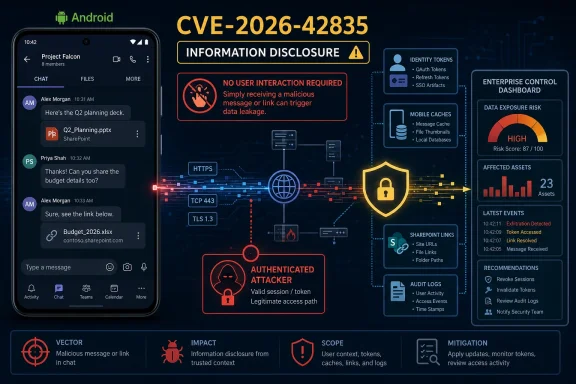
Microsoft disclosed CVE-2026-42835 on June 9, 2026, an Important-rated Microsoft Teams for Android information disclosure vulnerability that can let an authenticated attacker expose sensitive information over a network without requiring the victim to tap, approve, or otherwise interact with malicious content. The uncomfortable part is not merely that Teams had another bug. It is that the bug landed in the exact class of software enterprises increasingly treat as a secure front door to everything else. Collaboration apps are no longer chat clients; they are identity-adjacent, file-adjacent, meeting-adjacent work consoles sitting in millions of pockets.
For years, IT departments talked about Microsoft Teams as a productivity platform. That framing is now too small. Teams is where employees receive files, authenticate into meetings, coordinate incidents, discuss legal matters, share customer information, and sometimes make the sort of hurried decisions attackers love to influence.
On Windows desktops, that risk at least tends to live inside a mature management model. Enterprises have endpoint detection, patch reporting, configuration baselines, conditional access policies, and a decade of scar tissue from hardening Office and browsers. On Android, the same corporate workflows often move onto devices with more varied ownership, more fragmented patch states, and less consistent telemetry.
That is why CVE-2026-42835 matters beyond its individual exploit mechanics. Microsoft’s description points to improper neutralization of special elements in output used by a downstream component — broadly, an injection-style weakness — allowing an authorized attacker to disclose information over a network. The CVSS vector is especially attention-grabbing for defenders: network attack vector, low attack complexity, low privileges required, and no user interaction.
Those words should make enterprise security teams pause. “Authenticated attacker” does not mean “unlikely attacker” in Microsoft 365 environments where compromised accounts, guest access, over-permissive tenants, and stale credentials are routine operating conditions. If an attacker already has a foothold, a vulnerability in a mobile collaboration app can become a lateral-visibility tool rather than an initial compromise story.
A bug that requires a user to open a malicious file, click a link, or approve a prompt can be partially fought with awareness training and UX friction. Those defenses are imperfect, but they exist. A no-click path shifts the burden away from the user and back onto the application, the platform, and the organization’s ability to keep vulnerable clients out of production.
That distinction matters in Teams because the application is designed for ambient trust. Messages arrive from colleagues, contractors, help desks, project channels, external tenants, bots, meeting workflows, and automated systems. The value proposition is that work can flow without users interrogating every packet of context.
The paradox is that the more seamless collaboration becomes, the less practical user judgment becomes as a security control. Nobody wants a workforce that treats every Teams notification like a suspicious executable. But if the client can be induced into leaking information without a tap, the old “don’t click weird things” advice is beside the point.
This is where mobile collaboration risk diverges from classic email security. Email has been treated as hostile terrain for decades. Teams, Slack, Zoom chat, Google Chat, and mobile office suites are still culturally treated as internal space, even when they are bridged across tenants, vendors, devices, and identities. Attackers understand that cultural lag.
In a simple consumer story, an Android app update appears in Google Play and the user gets it automatically. In enterprise reality, the route may pass through managed Google Play, mobile device management policies, device compliance rules, app protection policies, regional rollout behavior, user behavior, battery settings, network constraints, and sometimes personal-device ambiguity. “Patch available” is the beginning of the administrative work, not the end.
That is especially true for bring-your-own-device programs. A company may control access to corporate data inside Teams through Intune app protection policies, but not fully control the OS, other installed apps, or the user’s update habits. On corporate-owned Android devices, the organization may have more leverage, but also more responsibility to prove the vulnerable version is gone.
The affected-product metadata circulating around the CVE indicates Microsoft Teams for Android builds before a fixed version line are in scope. That is exactly the sort of detail administrators need to operationalize, but the lesson is bigger than a single version string. Security teams need to know whether mobile collaboration apps are part of their vulnerability management program or merely assumed to be handled by app stores.
That assumption is increasingly untenable. Mobile apps have become enterprise clients, and enterprise clients need inventory, minimum-version enforcement, conditional access, and exception handling. If a Windows fleet had an Important-rated Office vulnerability with no user interaction required, few administrators would be satisfied with “the Store will probably update it.” Teams for Android deserves the same seriousness.
Information disclosure can be the connective tissue between one compromised account and a larger breach. In a collaboration platform, “sensitive information” may include message content, meeting context, file metadata, user details, tokens, internal naming conventions, project names, incident chatter, customer references, or hints about privileged workflows. Some of that may sound mundane until it is used to sharpen phishing, map an organization, or identify the next target.
Attackers do not need every secret at once. They need enough context to make the next move look normal. A private Teams thread can reveal who approves payments, which vendor is mid-negotiation, what system is down, which executive is traveling, or which administrator is handling a migration. The value is not always the data itself; it is the credibility the data grants.
This is why collaboration security has become a recurring theme across Microsoft 365. Teams is deeply embedded in identity, SharePoint, OneDrive, Exchange calendars, guest access, and increasingly AI-assisted search and summarization. A weakness in one client is not automatically a compromise of the entire tenant, but it can expose exactly the kind of operational context that makes tenant compromise easier.
The enterprise security industry sometimes overuses “sensitive data” until the phrase becomes meaningless. In Teams, it is concrete. It is the document someone dragged into a chat because email felt too formal. It is the outage bridge where engineers describe infrastructure in plain language. It is the HR conversation that was never meant to become discoverable by an attacker with a foothold.
The issue is that enterprise Android is uneven. Some organizations run tightly managed corporate-owned devices with strict compliance policies. Others allow personal phones to access Teams with app-level controls and a prayer. Between those poles sits a messy reality of contractors, frontline workers, shared devices, ruggedized hardware, meeting-room systems, and regional fleets with different update cadences.
Microsoft’s own mobile strategy reflects that diversity. Teams is not just a phone app for executives checking chat at an airport. It runs across Android phones, tablets, dedicated Teams devices, and workplace scenarios where mobile hardware has replaced traditional PCs. The collaboration perimeter is physical, portable, and frequently outside the building.
That reality complicates detection. A suspicious PowerShell command on a Windows endpoint is noisy in the right environment. A mobile app leaking information over the network may be harder to see, especially if traffic is encrypted, routed through sanctioned Microsoft endpoints, and generated by an approved application. Security teams may know a user signed into Teams, but not whether the client version carried a known disclosure flaw yesterday.
This is where mobile threat defense and mobile application management become more than procurement checkboxes. The practical question is whether an organization can answer, quickly, which Android devices are running Teams, which version they have, whether the app is managed, whether the device is compliant, and whether access can be blocked until the update lands. If the answer is no, the vulnerability is a governance problem before it is a technical one.
That is the uncomfortable truth behind many Microsoft 365 incidents. The attacker is not always kicking down the front door. Sometimes they are walking through it with credentials that pass MFA because the session was stolen, because the user approved fatigue prompts, because a legacy path remained open, or because a third-party account was trusted too broadly.
In that world, a low-privilege requirement is significant. A vulnerability that can be triggered by an authenticated but otherwise ordinary user fits the pattern of post-compromise escalation by information gathering. The attacker does not need to be a Teams administrator. They need a place to stand.
Organizations often invest heavily in preventing initial access while underinvesting in constraining what happens after access is obtained. Teams guest controls, cross-tenant access settings, app permissions, retention policies, sensitivity labels, and conditional access all shape the blast radius. CVE-2026-42835 is a reminder that the client itself also belongs in that threat model.
The best mental model is not “Can this bug hack my company by itself?” It is “If one account is already compromised, what additional visibility or leverage could this bug give the attacker?” That is how defenders should read most information-disclosure flaws in collaboration software.
Collaboration platforms are now going through a similar maturation. The attack surface is not just files, but messages, cards, previews, mentions, adaptive content, bots, meeting artifacts, tenant boundaries, mobile clients, and integrations. Every convenience feature is also a parser, renderer, permission decision, or data bridge.
Teams in particular has to process content from many sources while preserving a fluid user experience. It must display rich messages, handle links, open documents, notify users, synchronize state, respect policies, and integrate with identity. A downstream injection weakness is not surprising in such a complex system; what matters is how quickly it is fixed and how well customers can deploy that fix.
The old Office macro era taught a brutal lesson: productivity software is dangerous precisely because it is trusted and ubiquitous. Teams inherits that trust, but with a broader social graph and faster tempo. A malicious spreadsheet might wait in an inbox; a malicious collaboration event can arrive amid a live incident, meeting, or executive conversation.
That does not mean enterprises should retreat from collaboration platforms. It means they should stop treating them as neutral pipes. They are active, stateful, high-value clients that deserve the same scrutiny once reserved for browsers and office suites.
That shift changes what “patching Teams” means. It is not enough to patch one desktop client or assume Microsoft 365 service-side controls solve every client-side problem. The app on the phone is a first-class participant in the session, with its own rendering logic, local storage, notification behavior, and update path.
Conditional access can help, but only when policies are specific enough. Requiring compliant devices, approved client apps, app protection policies, and minimum app versions can reduce exposure. But those controls require maintenance. A policy written for last year’s mobile risk may not reflect today’s Teams feature set or this month’s vulnerability.
There is also a user-experience tradeoff. If mobile access becomes too brittle, employees route around it. They forward documents, use personal messaging apps, screenshot content, or delay work until they return to a PC. The goal is not to punish mobile productivity, but to make secure mobile access predictable and measurable.
That is the central challenge for IT pros. The business wants Teams everywhere. Security must make “everywhere” less vague.
Administrators should confirm that Teams for Android is updated across managed devices and that mobile application policies can enforce or at least report minimum versions. Security teams should review whether Android access to Teams is conditioned on device compliance or app protection controls. Help desks should be ready for users blocked by version enforcement, because a control that cannot be supported will be quietly weakened.
More mature environments should look at telemetry. Was there unusual Teams access from Android devices before patch adoption? Are guest accounts and low-privilege users able to interact with more Teams surfaces than intended? Are external collaboration policies still aligned with business reality, or did temporary exceptions become permanent?
The vulnerability should also prompt tabletop thinking. If a Teams mobile client leaked information, what logs would show it? Which team would investigate: endpoint, identity, messaging, SOC, mobile, or Microsoft 365 administration? Would legal and compliance know whether sensitive chats or files were potentially exposed?
These are not glamorous questions, but they are the difference between a patched CVE and a reduced risk. Microsoft can ship the fix. Enterprises have to prove the fix arrived where corporate data lives.
That scale cuts both ways. Microsoft has the engineering machinery to patch quickly and distribute updates globally. It also has an ecosystem so large that even an Important-rated mobile client bug becomes relevant to defenders across industries.
The company’s security posture has been under sustained scrutiny in recent years, particularly around cloud and identity incidents. The lesson for customers should not be that Microsoft products are uniquely unsafe. It should be that monocultures concentrate operational risk. When one platform becomes the default nervous system of work, its client bugs, policy defaults, and update delays become everyone’s problem.
Teams is a particularly concentrated case because it blends communication and content. An Exchange bug may expose mail. A SharePoint bug may expose files. A Teams bug can sit near both, with the added richness of real-time conversation and organizational context. That makes information disclosure in Teams more strategically useful than the dry CVE category suggests.
The strategic response is not vendor flight. It is vendor realism. Microsoft 365 customers need to treat Teams as a security-critical workload, not merely a licensed app in the productivity bundle.
The broader response is to ask whether mobile collaboration apps are visible enough to manage during the next disclosure. That is where many organizations will find the real gap.
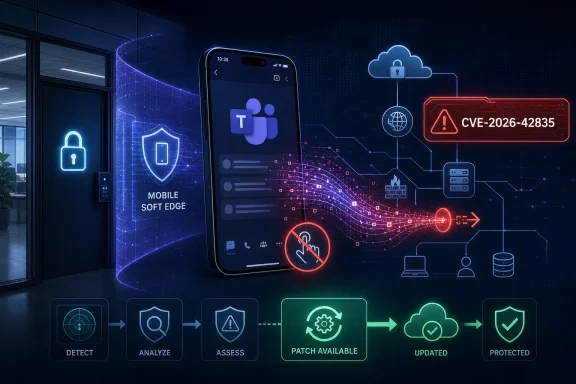 Teams Is Now Infrastructure, and Mobile Is the Soft Edge
For years, IT departments talked about Microsoft Teams as a productivity platform. That framing is now too small. Teams is where employees receive files, authenticate into meetings, coordinate incidents, discuss legal matters, share customer information, and sometimes make the sort of hurried decisions attackers love to influence.On Windows desktops, that risk at least tends to live inside a mature management model. Enterprises have endpoint detection, patch reporting, configuration baselines, conditional access policies, and a decade of scar tissue from hardening Office and browsers. On Android, the same corporate workflows often move onto devices with more varied ownership, more fragmented patch states, and less consistent telemetry.
That is why CVE-2026-42835 matters beyond its individual exploit mechanics. Microsoft’s description points to improper neutralization of special elements in output used by a downstream component — broadly, an injection-style weakness — allowing an authorized attacker to disclose information over a network. The CVSS vector is especially attention-grabbing for defenders: network attack vector, low attack complexity, low privileges required, and no user interaction.
Those words should make enterprise security teams pause. “Authenticated attacker” does not mean “unlikely attacker” in Microsoft 365 environments where compromised accounts, guest access, over-permissive tenants, and stale credentials are routine operating conditions. If an attacker already has a foothold, a vulnerability in a mobile collaboration app can become a lateral-visibility tool rather than an initial compromise story.
The No-Click Detail Changes the Risk Calculation
Security advisories often blur together because the language is intentionally sterile. “Information disclosure” sounds bloodless. “No user interaction” is not.A bug that requires a user to open a malicious file, click a link, or approve a prompt can be partially fought with awareness training and UX friction. Those defenses are imperfect, but they exist. A no-click path shifts the burden away from the user and back onto the application, the platform, and the organization’s ability to keep vulnerable clients out of production.
That distinction matters in Teams because the application is designed for ambient trust. Messages arrive from colleagues, contractors, help desks, project channels, external tenants, bots, meeting workflows, and automated systems. The value proposition is that work can flow without users interrogating every packet of context.
The paradox is that the more seamless collaboration becomes, the less practical user judgment becomes as a security control. Nobody wants a workforce that treats every Teams notification like a suspicious executable. But if the client can be induced into leaking information without a tap, the old “don’t click weird things” advice is beside the point.
This is where mobile collaboration risk diverges from classic email security. Email has been treated as hostile terrain for decades. Teams, Slack, Zoom chat, Google Chat, and mobile office suites are still culturally treated as internal space, even when they are bridged across tenants, vendors, devices, and identities. Attackers understand that cultural lag.
Microsoft Patched the Bug, but Patch Availability Is Not Patch Completion
The comforting sentence is that Microsoft has issued an update. The less comforting reality is that mobile app patching is a chain, not an event.In a simple consumer story, an Android app update appears in Google Play and the user gets it automatically. In enterprise reality, the route may pass through managed Google Play, mobile device management policies, device compliance rules, app protection policies, regional rollout behavior, user behavior, battery settings, network constraints, and sometimes personal-device ambiguity. “Patch available” is the beginning of the administrative work, not the end.
That is especially true for bring-your-own-device programs. A company may control access to corporate data inside Teams through Intune app protection policies, but not fully control the OS, other installed apps, or the user’s update habits. On corporate-owned Android devices, the organization may have more leverage, but also more responsibility to prove the vulnerable version is gone.
The affected-product metadata circulating around the CVE indicates Microsoft Teams for Android builds before a fixed version line are in scope. That is exactly the sort of detail administrators need to operationalize, but the lesson is bigger than a single version string. Security teams need to know whether mobile collaboration apps are part of their vulnerability management program or merely assumed to be handled by app stores.
That assumption is increasingly untenable. Mobile apps have become enterprise clients, and enterprise clients need inventory, minimum-version enforcement, conditional access, and exception handling. If a Windows fleet had an Important-rated Office vulnerability with no user interaction required, few administrators would be satisfied with “the Store will probably update it.” Teams for Android deserves the same seriousness.
Information Disclosure Is an Attack Multiplier
Not every vulnerability gives attackers code execution. That does not make it harmless.Information disclosure can be the connective tissue between one compromised account and a larger breach. In a collaboration platform, “sensitive information” may include message content, meeting context, file metadata, user details, tokens, internal naming conventions, project names, incident chatter, customer references, or hints about privileged workflows. Some of that may sound mundane until it is used to sharpen phishing, map an organization, or identify the next target.
Attackers do not need every secret at once. They need enough context to make the next move look normal. A private Teams thread can reveal who approves payments, which vendor is mid-negotiation, what system is down, which executive is traveling, or which administrator is handling a migration. The value is not always the data itself; it is the credibility the data grants.
This is why collaboration security has become a recurring theme across Microsoft 365. Teams is deeply embedded in identity, SharePoint, OneDrive, Exchange calendars, guest access, and increasingly AI-assisted search and summarization. A weakness in one client is not automatically a compromise of the entire tenant, but it can expose exactly the kind of operational context that makes tenant compromise easier.
The enterprise security industry sometimes overuses “sensitive data” until the phrase becomes meaningless. In Teams, it is concrete. It is the document someone dragged into a chat because email felt too formal. It is the outage bridge where engineers describe infrastructure in plain language. It is the HR conversation that was never meant to become discoverable by an attacker with a foothold.
Android Is Not the Weak Link; the Management Model Often Is
It would be lazy to turn this into an Android-bashing story. Android is a modern operating system with strong sandboxing, permission controls, hardware-backed security features, and a mature monthly security bulletin process. The issue is not that Android is inherently unfit for enterprise work.The issue is that enterprise Android is uneven. Some organizations run tightly managed corporate-owned devices with strict compliance policies. Others allow personal phones to access Teams with app-level controls and a prayer. Between those poles sits a messy reality of contractors, frontline workers, shared devices, ruggedized hardware, meeting-room systems, and regional fleets with different update cadences.
Microsoft’s own mobile strategy reflects that diversity. Teams is not just a phone app for executives checking chat at an airport. It runs across Android phones, tablets, dedicated Teams devices, and workplace scenarios where mobile hardware has replaced traditional PCs. The collaboration perimeter is physical, portable, and frequently outside the building.
That reality complicates detection. A suspicious PowerShell command on a Windows endpoint is noisy in the right environment. A mobile app leaking information over the network may be harder to see, especially if traffic is encrypted, routed through sanctioned Microsoft endpoints, and generated by an approved application. Security teams may know a user signed into Teams, but not whether the client version carried a known disclosure flaw yesterday.
This is where mobile threat defense and mobile application management become more than procurement checkboxes. The practical question is whether an organization can answer, quickly, which Android devices are running Teams, which version they have, whether the app is managed, whether the device is compliant, and whether access can be blocked until the update lands. If the answer is no, the vulnerability is a governance problem before it is a technical one.
The Attacker Only Needs One Real Account
Microsoft’s advisory language requiring an authorized attacker may sound limiting, but modern enterprise compromise often begins with some form of authorization. Stolen credentials, OAuth abuse, malicious insiders, compromised guest accounts, token theft, session hijacking, and weakly governed external collaboration all produce attackers who are, from the platform’s perspective, allowed to be there.That is the uncomfortable truth behind many Microsoft 365 incidents. The attacker is not always kicking down the front door. Sometimes they are walking through it with credentials that pass MFA because the session was stolen, because the user approved fatigue prompts, because a legacy path remained open, or because a third-party account was trusted too broadly.
In that world, a low-privilege requirement is significant. A vulnerability that can be triggered by an authenticated but otherwise ordinary user fits the pattern of post-compromise escalation by information gathering. The attacker does not need to be a Teams administrator. They need a place to stand.
Organizations often invest heavily in preventing initial access while underinvesting in constraining what happens after access is obtained. Teams guest controls, cross-tenant access settings, app permissions, retention policies, sensitivity labels, and conditional access all shape the blast radius. CVE-2026-42835 is a reminder that the client itself also belongs in that threat model.
The best mental model is not “Can this bug hack my company by itself?” It is “If one account is already compromised, what additional visibility or leverage could this bug give the attacker?” That is how defenders should read most information-disclosure flaws in collaboration software.
Collaboration Apps Have Become the New Office Macro Problem
There was a time when Microsoft Office documents were the obvious enterprise danger zone. Macros, templates, embedded objects, preview handlers, and scripting features turned productivity software into an attack surface. The defensive response took years: Protected View, macro restrictions, attachment scanning, application control, and a grudging cultural shift that documents could be dangerous.Collaboration platforms are now going through a similar maturation. The attack surface is not just files, but messages, cards, previews, mentions, adaptive content, bots, meeting artifacts, tenant boundaries, mobile clients, and integrations. Every convenience feature is also a parser, renderer, permission decision, or data bridge.
Teams in particular has to process content from many sources while preserving a fluid user experience. It must display rich messages, handle links, open documents, notify users, synchronize state, respect policies, and integrate with identity. A downstream injection weakness is not surprising in such a complex system; what matters is how quickly it is fixed and how well customers can deploy that fix.
The old Office macro era taught a brutal lesson: productivity software is dangerous precisely because it is trusted and ubiquitous. Teams inherits that trust, but with a broader social graph and faster tempo. A malicious spreadsheet might wait in an inbox; a malicious collaboration event can arrive amid a live incident, meeting, or executive conversation.
That does not mean enterprises should retreat from collaboration platforms. It means they should stop treating them as neutral pipes. They are active, stateful, high-value clients that deserve the same scrutiny once reserved for browsers and office suites.
The Security Boundary Is Moving from Device to Session
CVE-2026-42835 also lands at a moment when the old distinction between managed and unmanaged endpoints is losing clarity. A user may access Teams from a domain-joined Windows laptop, a personal Android phone, a shared frontline device, a browser session on a contractor machine, and a Teams room panel in the same week. The security boundary follows the session more than the device.That shift changes what “patching Teams” means. It is not enough to patch one desktop client or assume Microsoft 365 service-side controls solve every client-side problem. The app on the phone is a first-class participant in the session, with its own rendering logic, local storage, notification behavior, and update path.
Conditional access can help, but only when policies are specific enough. Requiring compliant devices, approved client apps, app protection policies, and minimum app versions can reduce exposure. But those controls require maintenance. A policy written for last year’s mobile risk may not reflect today’s Teams feature set or this month’s vulnerability.
There is also a user-experience tradeoff. If mobile access becomes too brittle, employees route around it. They forward documents, use personal messaging apps, screenshot content, or delay work until they return to a PC. The goal is not to punish mobile productivity, but to make secure mobile access predictable and measurable.
That is the central challenge for IT pros. The business wants Teams everywhere. Security must make “everywhere” less vague.
The Fix Is Operational, Not Dramatic
For most organizations, the right response to CVE-2026-42835 is not panic. It is disciplined hygiene.Administrators should confirm that Teams for Android is updated across managed devices and that mobile application policies can enforce or at least report minimum versions. Security teams should review whether Android access to Teams is conditioned on device compliance or app protection controls. Help desks should be ready for users blocked by version enforcement, because a control that cannot be supported will be quietly weakened.
More mature environments should look at telemetry. Was there unusual Teams access from Android devices before patch adoption? Are guest accounts and low-privilege users able to interact with more Teams surfaces than intended? Are external collaboration policies still aligned with business reality, or did temporary exceptions become permanent?
The vulnerability should also prompt tabletop thinking. If a Teams mobile client leaked information, what logs would show it? Which team would investigate: endpoint, identity, messaging, SOC, mobile, or Microsoft 365 administration? Would legal and compliance know whether sensitive chats or files were potentially exposed?
These are not glamorous questions, but they are the difference between a patched CVE and a reduced risk. Microsoft can ship the fix. Enterprises have to prove the fix arrived where corporate data lives.
Microsoft’s Scale Makes Every Client Bug a Fleet Problem
One reason Microsoft security stories feel relentless is that Microsoft sits at the center of enterprise computing. A vulnerability in a niche app may affect a narrow slice of users. A vulnerability in Teams touches organizations that standardized on Microsoft 365 for messaging, meetings, telephony, file sharing, identity workflows, and increasingly AI-assisted work.That scale cuts both ways. Microsoft has the engineering machinery to patch quickly and distribute updates globally. It also has an ecosystem so large that even an Important-rated mobile client bug becomes relevant to defenders across industries.
The company’s security posture has been under sustained scrutiny in recent years, particularly around cloud and identity incidents. The lesson for customers should not be that Microsoft products are uniquely unsafe. It should be that monocultures concentrate operational risk. When one platform becomes the default nervous system of work, its client bugs, policy defaults, and update delays become everyone’s problem.
Teams is a particularly concentrated case because it blends communication and content. An Exchange bug may expose mail. A SharePoint bug may expose files. A Teams bug can sit near both, with the added richness of real-time conversation and organizational context. That makes information disclosure in Teams more strategically useful than the dry CVE category suggests.
The strategic response is not vendor flight. It is vendor realism. Microsoft 365 customers need to treat Teams as a security-critical workload, not merely a licensed app in the productivity bundle.
The Real Lesson Is Hiding in the Version Inventory
The concrete response to this incident is refreshingly mundane, which is exactly why it is important. Update Teams for Android. Verify the update. Enforce minimum versions where possible. Revisit mobile access policies. Watch for suspicious behavior from authenticated users.The broader response is to ask whether mobile collaboration apps are visible enough to manage during the next disclosure. That is where many organizations will find the real gap.
A Mobile Teams Bug Draws the Map for the Next One
This vulnerability is not a five-alarm fire by itself, but it is a useful map of where enterprise exposure is moving.- Organizations should treat Microsoft Teams for Android as a managed enterprise client, not as a consumer app that happens to access work data.
- The no-user-interaction condition makes timely patch verification more important than user awareness messaging.
- The authenticated-attacker requirement still matters because compromised, guest, and low-privilege accounts are common ingredients in Microsoft 365 attacks.
- Information disclosure in Teams can be valuable because collaboration data contains operational context, not just isolated secrets.
- Mobile access policies should include inventory, minimum app versions, compliance requirements, and a support plan for users who fall out of policy.
- Security teams should use this incident to test whether they can investigate suspicious mobile Teams activity with the logs and tooling they already have.
References
- Primary source: Zimperium
Published: 2026-06-24T13:42:07.387645
Microsoft Teams Android Flaw Could Expose Sensitive Enterprise Data
A vulnerability in Microsoft Teams for Android may expose sensitive enterprise data without user interaction, highlighting mobile security risks. Organizations must act quickly. zimperium.com
- Related coverage: techradar.com
Microsoft says it's hard at work on a patch for this worrying Defender zero-day | TechRadar
RoguePlanet now has a CVE and a patch in the workswww.techradar.com - Related coverage: phonearena.com
Thousands of Android and iOS Apps are leaking your data - PhoneArena
Nearly 84,000 Android apps and 47,000 iOS apps were found using public rather than private servers, and 14% of those were dangerously misconfigured, exposing all kinds of sensitive information to the world. The disturbing part is that it's more than just basic advertising-related...www.phonearena.com - Related coverage: techtimes.com
11,877 Android, 6,608 iOS Apps Exposed to Potential Hackers, Says Zimperium Report
Thousands of Android and iOS app have exposed their user data. Mobile security firms say issues on cloud misconfigurationswww.techtimes.com - Related coverage: gadgets360.com
- Related coverage: scworld.com
Enterprise mobile apps riddled with sloppy data security | news | SC Media
Nearly 9 in 10 apps tested by Zimperium used encryption that did not adhere to best practices.www.scworld.com
- Official source: microsoft.com
Android apps with millions of downloads exposed to high-severity vulnerabilities | Microsoft Security Blog
Microsoft uncovered high-severity vulnerabilities in a mobile framework used by multiple large mobile service providers in pre-installed Android System apps that potentially exposed users to remote or local attacks.www.microsoft.com - Related coverage: cyberaccord.com
“Security Flaw in Microsoft Teams for Android Exposes Sensitive Information to Attackers” - Cyber Accord
```html Microsoft has revealed a notable security vulnerability in Microsoft Teams for Android that could permit an authenticated assailant to reveal confidential data over a network. The defect, identified as CVE-2026-42835, was officially announced on June 9, 2026, and has been rated Important... www.cyberaccord.com
- Related coverage: wired.com
Thousands of Android and iOS Apps Leak Data From the Cloud | WIRED
It's the digital equivalent of leaving your windows or doors open when you leave the house—and in some cases, leaving them open all the time.www.wired.com - Related coverage: betanews.com
Flawed phone apps could risk enterprise data - BetaNews
Analysis of over 17,000 enterprise-used mobile apps by Zimperium zLabs finds that 92 percent of all apps and 56 percent of the top 100 apps use flawedbetanews.com
- Related coverage: pcworld.com
Navy red team exposes Teams security flaws | PCWorld
"TeamsPhisher" can be used to slip messages and attachments past basic Teams security.www.pcworld.com - Related coverage: malwarebytes.com
Android “System Update” malware steals photos, videos, GPS location
A new Android malware can swipe images and video, rifle through online searches, and record phone calls and video. But is it stalkerware?www.malwarebytes.com - Related coverage: tomsguide.com
Microsoft's first Patch Tuesday of 2026 fixes over 100 bugs and one active zero-day flaw — don't wait to update your PC | Tom's Guide
Microsoft if back with its first round of Patch Tuesday updates for the new year which fix 114 security flaws in total.www.tomsguide.com - Related coverage: windowscentral.com
A "critical" Microsoft Copilot exploit exposes AI gullibility — turning the chatbot into a data snitch for 2FA codes and sensitive emails | Windows Central
Researchers uncovered a Copilot flaw that exposed 2FA codes and sensitive data.www.windowscentral.com - Related coverage: sherlockforensics.com
CVE-2026-42835: Improper neutralization of special Vulnerability - Sherlock Forensics
Improper neutralization of special vulnerability (CVE-2026-42835) scores CVSS 8.1 HIGH. Analysis of affected systems and remediation steps.www.sherlockforensics.com - Related coverage: windowsforum.com
CVE-2026-42835: High-Severity Microsoft Teams Android Info Disclosure Fix | Windows Forum
Microsoft disclosed CVE-2026-42835 on June 9, 2026, as a high-severity Microsoft Teams for Android information disclosure vulnerability that can let an...windowsforum.com - Related coverage: radar.offseq.com
CVE-2026-42835: CWE-74: Improper Neutralization of Special Elements in Output Used by a Downstream Component ('Injection') in Microsoft Microsoft Teams for Android - Live Threat Intelligence - Threat Radar | OffSeq.com
Detailed information about CVE-2026-42835: CWE-74: Improper Neutralization of Special Elements in Output Used by a Downstream Component ('Injection') in Microsoradar.offseq.com - Related coverage: ciberseguranca.pt
CVE-2026-42835: vulnerabilidade no Microsoft Teams para Android permite exposição de dados sensíveis - Ciberseguranca.PT
A Microsoft divulgou a 9 de junho de 2026 uma vulnerabilidade de segurança classificada como Importante no Microsoft Teams para Android. A falha, identificadawww.ciberseguranca.pt