

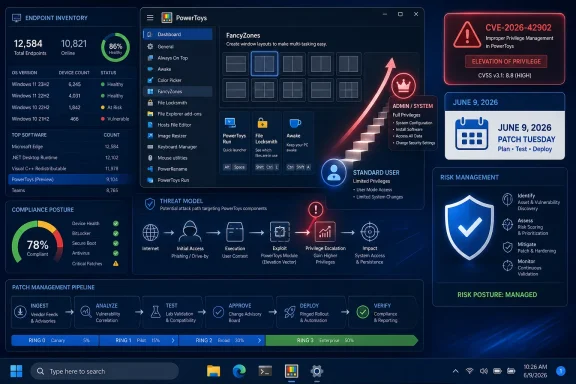
PowerToys Has Outgrown Its Toy Box
PowerToys has always lived in a strange part of the Windows ecosystem. It is Microsoft software, distributed through Microsoft-controlled channels, loved by enthusiasts, and used heavily by developers and administrators, but it is not part of the core Windows servicing model in the same way as the kernel, Edge, Defender, or Office. That liminal status is exactly why a PowerToys elevation-of-privilege CVE matters.
The modern PowerToys package is no longer a nostalgic bundle of small tricks for people who miss the Windows 95 era. It is a broad suite of utilities that can influence window management, input behavior, file operations, shell workflows, screen capture, launcher behavior, monitor controls, and system settings. Many of those functions sit close to trust boundaries that Windows has spent decades trying to formalize.
An elevation-of-privilege flaw is not usually the first step in a compromise. It is the second act, the move that turns a foothold into control. If an attacker already has local code execution as a standard user, a vulnerable privileged component can become the bridge to administrator or system-level capability.
That is why this class of bug deserves attention even when there is no public exploit, no wormable network vector, and no dramatic remote-code-execution headline. Privilege escalation is the quiet machinery of real-world intrusions. It is how attackers persist, disable defenses, steal credentials, and move from “annoying” to “owned.”
The Confidence Metric Is Doing More Work Than It Looks
The user-facing text around this CVE highlights a metric that is easy to skim past: confidence in the existence of the vulnerability and in the credibility of the technical details. That may sound academic, but it is one of the more practical signals in a modern vulnerability record. It tells defenders how much of the advisory rests on confirmed vendor knowledge rather than rumor, inference, or incomplete outside research.
In plain English, a vulnerability can exist in several states of public certainty. Sometimes only a symptom is known. Sometimes researchers have a plausible theory and a partial proof. Sometimes the vendor has reproduced the bug, assigned a CVE, and shipped or prepared a fix. The urgency changes as a flaw moves along that spectrum.
For CVE-2026-42902, the existence of a Microsoft Security Response Center entry is itself a meaningful threshold. Microsoft is not merely acknowledging a forum rumor or a GitHub issue with security overtones; it is classifying the problem through its formal vulnerability process. That does not mean every technical detail is public, and it certainly does not mean administrators should expect a step-by-step exploit explanation.
The asymmetry matters. Defenders often receive only the title, impact class, affected product, severity fields, exploitability assessments, and update guidance. Attackers may eventually learn more by diffing patched binaries, reading commits, or probing the same trust boundary. A sparse advisory is not a reason to ignore the issue; it is a reason to move before the analysis gap closes.
The Risk Is Local, but the Blast Radius Is Organizational
Elevation-of-privilege vulnerabilities are sometimes dismissed because they require local access. That is a comforting but incomplete reading. In modern enterprise compromise chains, local access is often the easy part. Phishing, stolen tokens, malicious browser extensions, poisoned developer packages, and exposed remote access tools can all give an attacker code execution without immediately giving them the privileges they need.
PowerToys is particularly interesting because of who installs it. The typical PowerToys user is not always the least privileged person in the organization. They may be a developer, a help-desk technician, a power user, an engineer, a build manager, or an administrator who wants faster navigation and better workflow controls. That population tends to sit near valuable data and elevated credentials.
A vulnerable utility on a lightly managed workstation is one problem. The same vulnerable utility on a developer laptop with repository access, signing material, test credentials, package publishing rights, or administrative tooling is a different problem. The software is the same; the operational context changes the risk.
This is where consumer-friendly Microsoft utilities collide with enterprise reality. PowerToys may feel optional, but in many organizations it has become part of the unofficial productivity layer. If IT does not know where it is installed, it cannot patch it with confidence. If endpoint controls treat it as harmless because it is from Microsoft, they may miss the significance of a vulnerability in a trusted binary.
Admin Mode Is the Center of Gravity
PowerToys has legitimate reasons to request elevated permissions. Some utilities need to interact with applications that are already running as administrator. Others touch protected settings or behaviors that ordinary user processes cannot modify. Microsoft’s own documentation has long made clear that elevation is sometimes necessary for the toolset to function as expected.
That design reality creates the security tension. A productivity suite that sometimes runs elevated must be engineered with the discipline of privileged software, even if its user interface feels lightweight. The moment a process crosses into administrator context, parsing bugs, file-path assumptions, update behaviors, interprocess communication, DLL loading, named pipes, service permissions, and configuration storage all become more consequential.
The exact root cause of CVE-2026-42902 is not public in the material most users will see at first glance. That is normal for Microsoft advisories, especially when the company is trying to reduce exploit handholding. But the impact label tells us enough to frame the concern: something about PowerToys could allow a user or process with fewer rights to gain more rights than intended.
The practical response should not be panic. It should be classification. If PowerToys is installed only for a few enthusiasts on personal machines, the update path is straightforward. If PowerToys is installed across engineering workstations, virtual desktop pools, privileged admin jump boxes, or shared lab systems, it deserves the same attention as any other endpoint component with elevation paths.
Open Source Does Not Magically Remove the Patch Problem
PowerToys being developed in the open is a strength. Public issue tracking, visible releases, community testing, and transparent engineering discussion can improve software quality. Open development also gives defenders a better chance to understand what changed after a security fix lands, assuming the fix is visible and not buried inside a private coordination window.
But open source does not erase the operational problem of patch adoption. A GitHub release is not a guarantee that every workstation receives the update. A Microsoft Store package is not a guarantee that every enterprise policy permits automatic delivery. A winget upgrade command is not a guarantee that the user has permission, bandwidth, or awareness to run it.
This is one of the recurring weaknesses in the Windows endpoint ecosystem. The operating system has a mature monthly servicing cadence, but the surrounding layer of first-party and third-party utilities often lives on separate rails. Some update through the Store. Some update through built-in updaters. Some are packaged by endpoint management teams. Some are installed manually and forgotten.
PowerToys sits across several of those worlds. That flexibility is convenient for users and messy for administrators. A CVE turns that messiness from a lifecycle annoyance into a security issue.
The June Patch Cadence Leaves No Room for Folk Inventory
June 9, 2026, is not just another date on a vulnerability page. It is Patch Tuesday, the day Microsoft’s security disclosures, cumulative updates, product advisories, and admin dashboards all converge. In that flood, a PowerToys CVE can easily look small next to Exchange, Windows kernel, browser, Office, or cloud-service flaws.
That is exactly how these issues linger. Security teams triage by severity, exposure, exploitation, asset criticality, and available mitigations. A local privilege escalation in a utility may fall below remote-code-execution bugs on internet-facing systems. That prioritization is rational. It is also where untracked software becomes a blind spot.
The first question is not “Is this the worst bug this month?” It is “Do we know where this product exists?” If the answer is no, the organization has already lost time. Inventory is the quiet prerequisite for every good patch decision.
For smaller shops and individual users, the answer is simpler: update PowerToys from the channel through which it was installed. For enterprises, the answer may involve endpoint management queries, software inventory reports, winget package detection, Store app controls, and validation on privileged workstations. None of that is glamorous, but it is the difference between a disclosed vulnerability and a remediated one.
Enthusiast Software Becomes Enterprise Software by Accident
PowerToys is a perfect example of how software enters business environments without a procurement ceremony. A developer installs it for FancyZones. A product manager installs it for quick launcher workflows. A support engineer installs it for text extraction or file utilities. A team lead shares a setup script. Eventually, what began as personal preference becomes part of how work gets done.
The problem is that governance often lags behind usefulness. Organizations tend to formalize software after it has already spread. By the time security asks whether PowerToys is approved, dozens or hundreds of endpoints may already have it, each installed through slightly different channels and versions.
Microsoft’s name complicates the conversation. Users often assume Microsoft-made utilities are automatically safe, sanctioned, and maintained through normal Windows Update. Administrators know better, but policy often reflects the same vague trust. “It’s from Microsoft” is not a patching strategy.
This does not mean PowerToys should be banned. In many environments, banning useful tools simply drives users toward worse alternatives. The better move is to approve it deliberately, package it consistently, track it accurately, and patch it promptly. A CVE like CVE-2026-42902 is a nudge toward that maturity.
The Exploitability Story Is Still Incomplete
At the time of writing, public reporting around CVE-2026-42902 is limited compared with headline-grabbing zero-days. That absence is useful but not decisive. Many privilege-escalation bugs become more interesting after patches are available, because attackers can compare versions and infer what was fixed.
Microsoft’s advisory framework typically distinguishes between active exploitation, public disclosure, exploitability expectations, and severity. Those fields help administrators decide whether to patch immediately, accelerate testing, or fold the fix into the next regular maintenance window. But defenders should be careful not to overread a lack of public exploit detail as a lack of attacker interest.
The PowerToys codebase is public, popular, and technically approachable. That can shorten the distance between advisory and researcher analysis. If the fix is visible in a commit or release diff, the security community may identify the vulnerable pattern quickly. Attackers read the same diffs.
This is the awkward trade-off of transparency. Open development helps trust and review, but it can also compress the exploit-development timeline after a vulnerability is acknowledged. The answer is not secrecy; it is faster remediation.
The Right Patch Policy Is Boring and Strict
For individual Windows users, the recommendation is refreshingly mundane: update PowerToys. Check the installed version, use the Microsoft Store, GitHub installer, winget, or whatever channel originally deployed it, and confirm that the machine is no longer running a vulnerable build once Microsoft’s fixed version is available. If PowerToys is configured to run as administrator, treat the update as more urgent.
For administrators, the work is broader. Start with discovery. Query endpoints for PowerToys installations, identify versions, determine install scope, and separate user-level installs from machine-wide installs. Pay special attention to devices used by administrators, developers, help desk staff, and anyone with privileged access to production systems.
Then standardize the deployment path. If an organization allows PowerToys, it should be delivered and updated through managed tooling rather than left to user initiative. If an organization does not allow it, that policy should be enforced with application control rather than assumed through silence.
Finally, log and monitor the aftermath. Elevation-of-privilege flaws are most valuable when chained with other activity. Suspicious local process launches, unexpected privilege changes, unusual child processes from trusted utilities, and attempts to tamper with endpoint defenses all matter more on systems that had vulnerable local software installed.
Power Users Need Guardrails, Not Lectures
There is a temptation after every utility vulnerability to scold users for installing extra tools. That misses the point. Power users install PowerToys because Windows still leaves productivity gaps that Microsoft itself acknowledges by maintaining the suite. The demand is legitimate.
The better security posture is not puritanical minimalism. It is managed abundance. Let users have capable tools, but make those tools visible, updateable, and constrained. A modern Windows estate cannot rely on a fantasy image of endpoints running only the base OS and a browser.
This is especially true for developers. Developer workstations are now high-value targets because they bridge source code, credentials, cloud environments, package registries, and internal documentation. They are also the machines most likely to accumulate helper utilities, preview tools, CLI extensions, local services, and experimental packages.
PowerToys belongs in that conversation. It should be assessed not as a toy, but as a privileged productivity platform. That does not make it unsafe by default. It makes it worthy of the same lifecycle discipline as any other widely used endpoint software.
The Small Utility CVE That Tells a Bigger Windows Story
CVE-2026-42902 is not just a line item for people who like FancyZones, PowerToys Run, or Command Palette. It is a reminder that Windows security is now distributed across a larger constellation of components than the old Patch Tuesday mental model can comfortably hold. The boundary between the operating system, Microsoft-maintained add-ons, Store-distributed apps, open-source utilities, and enterprise-managed packages keeps getting blurrier.
That blur benefits users. Windows gets better faster when Microsoft can ship useful tools outside the monolithic OS release cycle. PowerToys can experiment, iterate, and serve enthusiast needs in a way the Windows shell itself often cannot. The cost is that security operations must follow the software, not the branding.
If PowerToys is installed, it is part of the endpoint. If it can run elevated, it is part of the privilege model. If it has a CVE, it belongs in vulnerability management. That chain of reasoning is simple, but many organizations still break it at the first link.
The Practical Reading for WindowsForum Readers
CVE-2026-42902 is a narrow advisory with a broader message: the Windows tools we choose for convenience become part of our security architecture whether we admit it or not. Treat this as a prompt to clean up inventory, update PowerToys, and decide whether the utility is managed software or personal software in your environment.
- Microsoft has classified CVE-2026-42902 as an elevation-of-privilege vulnerability affecting PowerToys, which means the relevant risk is unauthorized gain of higher local privileges.
- The presence of a formal MSRC advisory gives defenders high confidence that the issue is real, even if public technical detail remains limited.
- Systems where PowerToys runs with administrator privileges deserve faster attention than casual personal installations.
- Enterprise administrators should inventory PowerToys installations instead of assuming Microsoft utilities are covered by normal Windows patching.
- The safest long-term posture is to deploy and update PowerToys through managed tooling or block it explicitly where it is not approved.
- Power users should update promptly and avoid treating “from Microsoft” as a substitute for version awareness.
The real story of CVE-2026-42902 is not that PowerToys has failed its users. It is that PowerToys has succeeded so thoroughly that it now lives in places where security discipline matters. Microsoft’s power-user suite will keep growing because Windows users keep needing the capabilities it provides; the next step is for home enthusiasts and enterprise IT alike to treat that growth with the seriousness reserved for software that can shape the desktop, touch protected settings, and sometimes run above the ordinary user line.